Diogo Lopes, Isabel Varajão, Nuno Sousa, Yusbel Castilla, Yanelys Llerena, Pedro Pereira, Pedro Magalhães (2026). Digital Avatars and Intelligent Recommendation: Design Approach and Study of Personalized User Experience in the Textile and Clothing Sector. In: Human Factors in Design, Engineering, and Computing. AHFE Open Access, vol. 238, pp. 888–900. https://doi.org/10.54941/ahfe1008320
Evaluating fit and drape in online apparel retail remains challenging, with limited human-factors data on consumer expectations for avatar-based virtual try-on. Within the TEXP@CT project, which develops a business-to-consumer (B2C) virtual try-on platform, design thinking was applied as a documented research procedure to examine how consumers perform with a try-on prototype, which avatar parameters they select as most relevant, and which design actions follow from their feedback. A task-based evaluation of a high-fidelity prototype was conducted with 31 consumers, each performing ten tasks. On average, participants achieved a 95.2% task completion rate with a mean time of 3:48 minutes and rated difficulty of use at 4.5 out of 5 (1 = very difficult, 5 = very easy). Users prioritized hips, chest/bust (74.2% each), waist (67.7%), and height (64.5%) for avatar parameters, and favored 360° rotation (87.1%) and walking (77.4%) movements. Qualitative feedback highlighted unnoticed controls (29.0%) and unclear icons, while confirming garment size as the primary driver for past returns (67.7%). Fifteen findings (six issues, nine opportunities) were translated into design knowledge and design actions, including credible fit cues, a common core of body parameters, direct body-shape adjustment on the avatar and explicit affordances for secondary controls, illustrating how user evidence can be traced to design decisions for a try-on tool.
Buying clothing online requires consumers to infer fit and fabric behavior from images alone. Fit uncertainty is linked to online product returns (Hong and Pavlou, 2014), whereas field experiments show that virtual fit information can reduce both returns and the practice of ordering multiple sizes (Gallino and Moreno, 2018). User studies on virtual try-on have investigated adoption (Kim and Forsythe, 2008), shopping experience (Liu et al., 2020), shopping behavior, fit expectations, and return intentions (Kim et al., 2026), while commercial services now allow shoppers to visualize garments on their
Digital Avatars and Intelligent Recommendation 889 own photographs (Google, 2025). Furthermore, avatar-based try-on has been examined for adoption and privacy (Ivanov, Mou and Tawira, 2023); however, little is reported on which avatar parameters consumers consider most important, or how such evidence is traced into interface design and implementation decisions for a single system.
This paper reports a study conducted within TEXP@CT, a project supporting the digitalization of the Portuguese textile and apparel industry, which is developing a virtual try-on system for companies’ e-commerce stores. Following the Stanford d.school design thinking process (d.school, 2010) and the ISO 9241-210 (2019) standard, the study addresses three research questions: RQ1: How do consumers perform across the prototype’s three interface interaction areas (combine look, customize avatar and see recommendations)? RQ2: Which avatar parameters (anthropometric, appearance, movement and poses) do consumers consider most important? RQ3: Which issues and design opportunities emerge from consumers’ qualitative feedback, and how can they be translated into design knowledge and design actions? This paper contributes evidence on task performance and avatar customization preferences, offering a traceable translation of qualitative data and feedback into design knowledge and design actions.
RELATED WORK
Kim and Forsythe (2008) applied a modified technology acceptance model to virtual try-on, identifying innovativeness and technology anxiety as moderators with no significant gender differences in adoption. Liu et al. (2020) compared AR- and VR-based try-on with a conventional e-commerce interface. Field experiments show that virtual fit information increases conversions and reduces returns (Gallino and Moreno, 2018), and user studies indicate it provides clearer fit expectations, though participants request reliability cues like confidence scores (Kim et al., 2026). Chen et al. (2025) enabled users to view different garment sizes on their own images. Regarding avatars, Park et al. (2024) found that self-discrepancy varies by avatar type. Furthermore, a survey revealed that women’s fit problems concentrate in the waist-hip area for bottoms and bust/shoulders for tops, while sleeve and leg length issues are frequent for both genders and predominant for men (Cools et al., 2014). This underscores the need to empirically examine, rather than assume, which body parameters consumers wish to control.
Applied here as a documented research procedure, design thinking is an iterative, user-centered problem-solving process that draws on principles such as user involvement and interdisciplinary collaboration and on tools such as visualization and experimentation, despite debates over its outcomes (Micheli et al., 2019). Following Höök and Löwgren (2012), our findings are distilled into intermediate-level design knowledge, abstracting beyond a single instance.
Related systems combine personalized avatars, motion capture and cloth simulation (Cannavò, Offre and Lamberti, 2025), pair avatars with image-based recommendation (Llerena et al., 2024, the project’s earlier prototype) or present garments in virtual reality (Sarakatsanos et al., 2024).
However, none report a traceable link from user evidence to design decisions for a consumer-facing system. This paper addresses that gap.
DESIGN PROCESS Process Overview
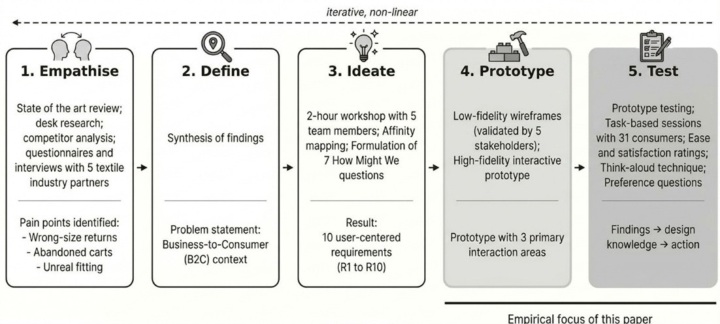
The five stages (d.school, 2010) were run as a non-linear, iterative set of design research activities (Figure 1). In this paper, platform denotes the overall system; prototype, the version evaluated; avatar, the consumer’s virtual representation on which garments are displayed; and consumers, potential end users of the B2C platform.
Figure 1: Design thinking process applied in TEXP@CT. The shaded stages are the focus of this paper.
Empathize, Define and Ideate The empathize stage combined a state-of-the-art review, desk research, competitive analysis and primary research with five partners from the textile and apparel industry, using questionnaires and semi-structured interviews with representatives from both markets B2B (fabric manufacturing) and B2C (garment retail). Three main pain points emerged: (1) products returned because of the wrong size; (2) uncertainty leading to items being left in the shopping cart; and (3) the inability to see how garments fit customers. In the define stage these findings were synthesized into a problem statement: “consumers need to visualize how selected garments fit and behave on a personalized avatar and receive relevant outfit recommendations from uploaded images, in order to make more informed purchase decisions and reduce the likelihood of returns”. In the ideate stage, a two-hour workshop with five project team members (a UX researcher, two developers, a technology coordinator and a product manager) generated ideas that were clustered through affinity mapping (Lucero, 2015). Seven “How might we?” questions, from user trust to technical feasibility, guided the session. The resulting themes were formalized as ten user-centered requirements (Table 1), which also defined the evaluation tasks.
Table 1: User-centered requirements (R) and the evaluation task (T).
Table available in the original PDF paper.
Evaluation Task
ID User-Centered Requirement (The User Shall be Able to …)
Navigate to the product details page
R1/ T1
browse and select garments from the store catalog R2/ T2 dress the avatar with selected garments Open the virtual fitting room and view the garment on the avatar
Add two garments from the catalog
R3/ T3
add selected garments to the virtual fitting room remove garments from the virtual fitting room Remove one garment from the R4/ T4 selected items
Customize silhouette and abdomen
R5/ T5
select a silhouette resembling their own body shape
Adjust hip measurements
R6/ T6
customize the avatar with manually entered body measurements R7/ T7 obtain estimated body measurements automatically from images
Use a (demo*) photo to estimate measurements
R8/ T8
customize the avatar’s facial appearance Set oval face shape and medium- length haircut select and apply movements and poses Select the crossed-legs pose R9/ T9
R10/ T10
obtain image-based recommendations for visually similar garments
Upload a (demo*) image and view recommendations Note: *The demo images used in the respective tasks are publicly available from the catalog of the online store under test.
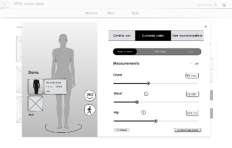
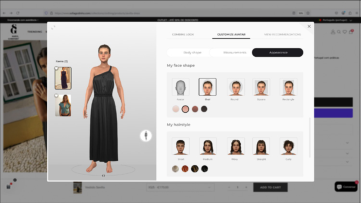
Prototype Low-fidelity wireframes (Figure 2) were reviewed informally and remotely by five stakeholders from the textile industry, focusing on information architecture, user flows and user-centered requirements, and then developed into an interactive high-fidelity prototype (Figure 3). The prototype comprises seven screens across three interaction areas: (1) Combine look, with catalog selection, preview on the avatar, movement and poses (360° rotation, walking, crossing the legs, legs apart and hands on hips); (2) Customize avatar, with similarity-based silhouette selection, manual and/ or automatic body-measurement input, and facial appearance options; and (3) See recommendations, which provides AI-based recommendations from the catalog using an uploaded image such as a look or outfit.
Figure 2: Interface screen samples of the low-fidelity wireframes (left to right): Combine look; Customize avatar; See recommendations (image-based).Figure 3: Interface screen sample of high-fidelity prototype evaluated in the study. Top left: Combine look; Top right: Avatar customize (anthropometrics); Bottom left: Avatar customize (appearance); bottom right: See recommendations (image-based).
EVALUATION METHOD Participants
Thirty-one consumers (16 women, 15 men) aged 18–54 years took part, most commonly aged 25–34 (14/31; 45.2%). Inclusion criteria were being an adult general consumer, with or without online shopping experience. Most shopped for clothing online at least occasionally (26/31; 83.9%), and returns or exchanges were rare (15/31; 48.4%) or occasional (12/31; 38.7%).
Procedure and Measures Sessions took place in person on a laptop, with a moderator and an observer, lasting approximately 25 minutes. Before the session, participants were informed of the study’s aims and procedure and signed an informed consent form. Using a think-aloud protocol, participants performed ten tasks (Table 1) while their time and completion rates were logged, defining completion as successfully reaching the target state. After each task, participants rated its difficulty from 1 (very difficult) to 5 (very easy), adapted from the Single Ease Question (Sauro and Dumas, 2009). Following ISO 9241-11 (2018), usability was operationalized in terms of effectiveness (task completion), efficiency (time on task) and satisfaction (post-test rating). Multiple-choice questions within tasks T6, T8 and T9 asked which anthropometric, facial-appearance and movement parameters participants considered relevant, with no limit on selections. A post-test questionnaire assessed overall satisfaction (1–5), agreement that “the recommender and virtual fitting room may influence my purchase decision” (1–5), reasons for past returns, and open-ended likes and dislikes. The photographs used in tasks T7 and T10 were sample images from the store’s public catalog.
Digital Avatars and Intelligent Recommendation 893 Analysis
Task performance and avatar parameter preferences were analyzed descriptively. Success rates are reported both per task and per participant, time on task reflects the mean of all attempts, and unrecorded difficulty ratings (zeros) were treated as missing values. The qualitative data, namely (i) what participants liked most and least, (ii) reasons for past returns, (iii) “other” answers and (iv) comments verbalized during the think-aloud protocol, were analyzed inductively using thematic analysis (Braun and Clarke, 2006), with themes derived from the written and think-aloud comments. Avatar parameters selected by most participants or with marked differences between women and men were also translated into opportunities. Each resulting finding was assigned to an interaction area, paired with design knowledge and a design action, and classified as an issue, or as an opportunity. Issues were further mapped to Nielsen’s (1994) heuristics and rated on his 0–4 severity scale.
RESULTS
Task Performance (RQ1) On average, participants successfully completed 9.5 of the ten tasks (95.2%; SD 0.8, range 7–10); 20 participants (64.5%) completed all ten tasks (Table 2). The lowest success rate (90.3%) was associated with tasks T6, T7 and T10. The ten tasks took 3:48 min in total; item selection (T3, 0:40 min) and silhouette customization (T5, 0:37 min) took the longest. Perceived difficulty was low (M = 4.47 of 5, where 5 = very easy), and T3 and T7 were rated the most difficult (4.10 each). Overall satisfaction was high (M = 4.58; 29/31, 93.5%, rated 4 or 5), and all participants (100%) agreed that the recommender and virtual fitting room may influence their future purchase decisions, a stated intention rather than observed behavior.
Table 2: Task success, time and difficulty by interaction area, task and gender.
Table available in the original PDF paper.
Area Task Success, n (%) Time, M (s) Difficulty, M (SD) W M All W M All W M All
Combine look
T1 Product details
16 (100)
15 (100)
31 (100)
17.2 25.5 21.2 4.69 (0.60)
4.60 (0.83)
4.65 (0.71)
T2 Virtual fitting room
16 (100)
14 (93.3)
30 (96.8)
11.0 19.3 15.0 4.69 (0.60)
4.40 (0.83)
4.55 (0.72)
T3 Item selection
16 (100)
13 (86.7)
29 (93.5)
38.0 41.6 39.8 4.06 (1.06)
4.14 (0.95)
4.10 (0.99)
T4 Delete item
16 (100)
15 (100)
31 (100)
4.9 7.1 5.9 4.81 (0.54)
4.87 (0.35)
4.84 (0.45)
Customize avatar
T5 Silhouette 15 (93.8)
14 (93.3)
29 (93.5)
39.2 35.3 37.3 4.07 (0.88)
4.27 (1.03)
4.17 (0.95)
T6 Measurements
15 (93.8)
13 (86.7)
28 (90.3)
32.6 21.0 27.0 4.60 (0.63)
4.53 (0.74)
4.57 (0.68)
T7 Auto measurements
14 (87.5)
14 (93.3)
28 (90.3)
27.7 27.8 27.8 4.33 (0.72)
3.86 (0.86)
4.10 (0.82) (Continued)
Table 2: Continued.
Table available in the original PDF paper.
Area Task Success, n (%) Time, M (s) Difficulty, M (SD) W M All W M All W M All
T8 Appearance
16 (100)
15 (100)
31 (100)
18.6 11.6 15.2 4.88 (0.34)
4.93 (0.26)
4.90 (0.30)
T9 Movement 15 (93.8)
15 (100)
30 (96.8)
15.0 18.5 16.7 4.53 (0.64)
4.07 (1.16)
4.30 (0.95)
See recom- mendations
T10 Recom mendations
13 (81.3)
15 (100)
28 (90.3)
23.6 21.5 22.6 4.43 (0.65)
4.40 (0.63)
4.41 (0.63)
All tasks, completed 9.5 (95.0)
9.5 (95.3)
9.5 (95.2)
22.8 22.9 22.8 4.52 (0.25)
4.41 (0.27)
4.47 (0.26)
– – – – – –
All tasks, not completed 0.5 (5.0)
0.5 (4.7)
0.5 (4.8)
Total time, ten tasks (s) – – – 227.7 229.1 228.4 – – – Note. W = women (n = 16); M = men (n = 15). Success: participants who completed the task, n (%). Time: mean of all attempts per task; total time: sum of the ten task means. Difficulty: 1 = very difficult, 5 = very easy.
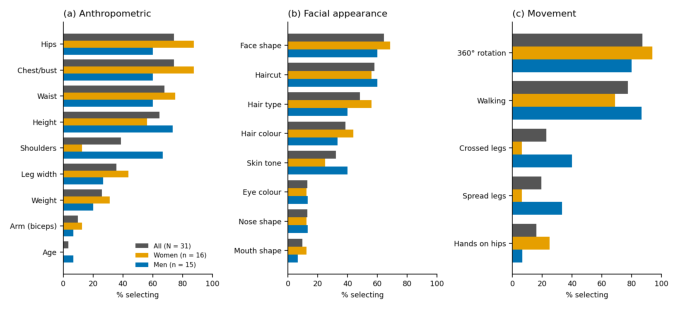
Avatar Customization Priorities (RQ2) From nine anthropometric options (Figure 4), the most selected were hips and chest/bust (23/31, 74.2% each), waist (21/31, 67.7%), and height (20/31, 64.5%), followed by shoulders (12/31, 38.7%) and leg width (11/31, 35.5%). Weight, arms, and age appealed to under a third. Gender splits emerged: women prioritized hips and chest/bust (14/16, 87.5% each) and waist (12/16, 75.0%), whereas men favored height (11/15, 73.3%) and shoulders (10/15, 66.7%). For appearance, face shape (20/31, 64.5%) and haircut (18/31, 58.1%) led. Among five movements, 360° rotation (27/31, 87.1%) and walking (24/31, 77.4%) dominated; static poses appealed to only 16.1–22.6%, though men preferred crossed (40.0% vs. 6.3%) and spread legs (33.3% vs. 6.3%), while women favored hands on hips (25.0% vs. 6.7%).
Qualitative Feedback (RQ3)
Table 3 categorizes feedback and preferences into fifteen findings (six issues, nine opportunities). The primary issue was hard-to-notice controls (H6; 9/31, 29.0%), which affected measurement and movement controls (three failures in T7; F7) and image uploads (three failures in T10; F14). Less frequent issues included insufficient garment details (2/31), with unmet fabric expectations driving returns (4/31) (F2), unclear icons (3/31; F3), uncertainty regarding item removal (1/31; F4), and disparate gender parameter sets (1/31; F10). Regarding opportunities, size (21/31, 67.7%) and fit (9/31, 29.0%) were primary return drivers (F1). Users desired direct on-avatar shape adjustments (9/31; F8), and one queried the representation of pregnancy, temporary body changes, or disability (F9). The most liked aspects were ease of use (9/31), avatar customization (6/31), garments on the avatar and overall design (5/31 each), and image-based recommendations (3/31) (F5, F11, F15). Finally, RQ2 preference data added three opportunities: prioritizing 360° rotation and
Digital Avatars and Intelligent Recommendation 895 walking over static poses (F6), adopting a core body parameter set (F12), and reducing facial options (F13).
Figure 4: Avatar parameters selected by all participants (N = 31), women (n = 16) and men (n = 15): (a) anthropometric, (b) facial appearance, (c) movement.Table 3: Qualitative feedback and preferences to design actions: usability issues and opportunities by interaction area (RQ3).
Table available in the original PDF paper.
ID Finding (Evidence) Design Knowledge Design Action Category Combine look
Opportunity
Fit uncertainty is the core purchase risk
F1 Size (21/31) and fit (9/31) main reasons for past returns
Shows fit, not just looks, with reliability clues and through standard or store measures Issue
Garment details are needed at try-on
Show size and fabric details in the fitting room
F2 Fabric not matching expectations as a return reason (4/31); insufficient information (H10, S3; 2/31)
Issue
Icons alone are not self-explanatory
Pair icons with text labels consistently
F3 Unclear icons; inconsistent use of icons and text labels (H4, S2; 3/31)
Issue
F4 Unclear how to remove items from the fitting room (H3, S2; 1/31)
Removal should be visible, not discovered
Add an explicit remove control to each item Opportunity
F5 Ease of use (9/31), garments on the avatar (5/31) and design (5/31) most liked
Ease of use is the main perceived strength
Keep a short, linear flow as features are added Opportunity
F6 360° rotation (27/31) and walking (24/31) valued far above others movements (5–7/31)
Seeing garments from all sides and in motion matters more than others posing
Make rotation and walking the main movements; keep others options as secondary (Continued)
Table 3: Continued.
Table available in the original PDF paper.
ID Finding (Evidence) Design Knowledge Design Action Category Customize avatar
Issue
Secondary controls need explicit affordances
Make measurement and movement controls more salient
F7 Measurement and movement controls hard to notice (H6, S3); 3 failures in T7
Opportunity
F8 Adjust body shape directly on the avatar (9/31)
Redundant input paths suit different users and tasks
Add direct on-avatar body-shape adjustment alongside measurement input Opportunity Expand the range of avatar body models
Avatars should represent diverse bodies
F9 Body diversity suggested, e.g., pregnancy, temporary body changes and disability (1/31) F10 The ranges of body
Issue
parameter measures are not equal between women and men (H4, S1; 1/31)
Women and men require different ranges of body parameter values.
Offer a common set of customization options, with input ranges defined separately for women and men.
F11 Avatar customization most
Opportunity
liked (6/31)
Personalization is a valued strength
Keep Avatar customization
F12 Hips, chest/bust (23/31
Opportunity
A small shared core covers most users, with different emphases
each), waist (21/31) and height (20/31) most preferred; shoulders mainly by men (10/15 vs 2/16)
Present the core parameters first and the others as optional or secondary options
F13 Face shape (20/31) and
Opportunity
Facial customization is secondary to body and hair
Prioritize face shape and hair; group facial details as optional
haircut (18/31) most preferred; eye color, nose and mouth shape by few (3–4/31) See recommendations
F14 Upload component hard to
Issue
notice (H6, S3); 3 failures in T10
Image-based features need an explicit affordance
Label the upload component and make it prominent
F15 Recommendations most
Opportunity
liked (3/31)
Image-based discovery is valued
Keep image-based recommendations Note. Themes coded from open answers (likes, dislikes, reasons for returns), “other” answers and think- aloud comments; n = participants mentioning each theme (N = 31; several per participant possible). F6, F12 and F13 derive from the multiple-choice preference questions in T6, T8 and T9 (Figure 4); n = participants selecting each option. Task data (Table 2) only corroborate. Heuristics (Nielsen, 1994): H3 user control and freedom; H4 consistency and standards; H6 recognition rather than recall; H10 help and documentation. Issue = problem observed in the prototype and participant’s feedback; Opportunity = unmet need or strength to build on. Severity (S) of issues, shown next to the heuristic, adapted from Nielsen (1994) and based on frequency, impact on task completion and persistence: 0 = not a usability problem; 1 = cosmetic, fix only if time allows; 2 = minor, low fixing priority; 3 = major, high fixing priority; 4 = catastrophic, must be fixed before release.
DISCUSSION AND CONCLUSION Fit as the Core Value
Size (67.7%) and fit (29.0%) drove past returns (F1), aligning with literature on fit uncertainty (Hong and Pavlou, 2014) and virtual fit interventions (Gallino and Moreno, 2018; Kim et al., 2026), though our data reflects stated reasons rather than tested return reductions. Unmet fabric expectations (12.9%) and requests for garment information (F2) show that material information is also needed at try-on, especially as viewer perception of virtual fabrics remains unclear (Qiu, Porterfield and Mathur, 2025). Consequently, the platform must convey fit using garment details and reliability cues, echoing recent demands for confidence scores (Kim et al., 2026).
A Shared Core of Body Parameters Hips and chest/bust (74.2% each), waist (67.7%), and height (64.5%) were the most selected parameters, supporting a common core over separate sets (F12). While prioritizing bust and waist-hips aligns with women’s fit issues (Cools et al., 2014), other choices diverged: men prioritized shoulders (66.7%) despite causing few fit problems (<20% in Cools et al.,) and neither gender prioritized sleeve/leg lengths. This confirms customization preferences must be tested empirically, not inferred from fit data. Descriptively, women prioritized torso girths (hips/chest 87.5% each, waist 75.0%), whereas men favored height (73.3%) and shoulders (66.7% vs. women’s 12.5%), hypothesizing a single default set. Requests for body diversity (F9) and direct on-avatar shape adjustments (F8) suggest offering direct manipulation alongside measurement input, fulfilling Nielsen’s (1994) flexibility and efficiency heuristic.
Appearance and Movement For facial customization, only face shape (64.5%; women 68.8%, men 60.0%) and haircut (58.1%; women 56.3%, men 60.0%) were chosen by a majority, overshadowing eye color, nose, and mouth shapes (9.7–12.9%) (F13). 360° rotation (87.1%; women 93.8%, men 80.0%) and walking (77.4%; women 68.8%, men 86.7%) were the most valued (F6), warranting prioritization, although selections may partly reflect the tasks in which the questions were asked (hips in T6, face shape and haircut in T8, poses in T9).
Issues and Opportunities High success, relatively short task times and low perceived difficulty suggest that the try-on concept was understood; the issues concerned mainly the discoverability of secondary features. The major issues (S3), hard-to-notice measurement and movement controls (F7) and image-upload component (F14), should be addressed first, followed by labeled icons (F3) and garment details in the fitting room (F2) (S2), and a visible remove control (F4) and a common parameter set (F10) (S1). The most valued strengths (F5, F11, F15) should be preserved as direct body-shape adjustment (F8) and more diverse
avatar bodies (F9) are added, while the preference data support prioritizing 360° rotation and walking (F6), a core set of body parameters (F12) and a reduced set of facial options (F13).
CONCLUSION
Design thinking was applied as a documented procedure to connect consumer evidence with design decisions for an avatar-based virtual try-on tool. Participants achieved a 95.2% task completion rate in 3:48 min, reporting low difficulty (4.5/5) and high global satisfaction (4.6) (RQ1). Hips, chest/ bust, waist and height formed a shared core of avatar parameters (64.5– 74.2%), and 360° rotation and walking were the most valued movements (RQ2). Qualitative feedback highlighted hard-to-notice controls and unclear icons rather than conceptual flaws, yielding fifteen findings (six issues, nine opportunities) that were translated into design knowledge and design actions (RQ3). To guide the platform’s functional implementation and update the prototype, developers should prioritize credible fit with garment details, a common parameter core, direct shape adjustments, explicit affordances for secondary features, and greater avatar diversity. Future testing will evaluate the developed platform’s impact on actual garment returns.
ACKNOWLEDGMENT
This work has been supported by the European Union under the NextGenerationEU, through a grant of the Portugal’s Recovery and Resilience Plan (RRP) Partnership Agreement, within the scope of the project TEXP@CT – Pacto de inovação para a Digitalização do Têxtil e do Vestuário (Project ref. nr. 61 - C644915249-00000025).
REFERENCES
Braun, V. and Clarke, V. (2006) ‘Using thematic analysis in psychology’, Qualitative Research in Psychology, 3(2). https://doi.org/10.1191/1478088706qp063oa Cannavò, A., Offre, G. and Lamberti, F. (2025) ‘A semi-automated pipeline for
the creation of virtual fitting room experiences featuring motion capture and cloth simulation’, IEEE Computer Graphics and Applications, 45(1). https://doi. org/10.1109/MCG.2024.3521716 Chen, S.X., Lim, A.C., Liu, Y., Sen, P. and Sra, M. (2025) ‘SiCo: an interactive sizecontrollable virtual try-on approach for informed decision-making’, in Proceedings of the 2025 ACM Designing Interactive Systems Conference (DIS ’25). https://doi. org/10.1145/3715336.3735693. Cools, J., De Raeve, A., Van Ransbeeck, P., Vasile, S., Vandersmissen, B. and
Vermeulen, M. (2014) ‘The use of 3D anthropometric data for morphotype analysis to improve fit and grading techniques – the results’, in Proceedings of the 5th International Conference on 3D Body Scanning Technologies, Lugano. https://doi.org/10.15221/14.046. d.school (2010) Bootcamp bootleg. Stanford, CA: Hasso Plattner Institute of Design at Stanford. Gallino, S. and Moreno, A. (2018) ‘The value of fit information in online retail:
evidence from a randomized field experiment’, Manufacturing & Service Operations Management, 20(4). https://doi.org/10.1287/msom.2017.0686.
Digital Avatars and Intelligent Recommendation 899 Google (2025) You can now virtually try on clothes and shoes with this new AI
shopping feature. Google Canada Blog, October 8. Available at: https://blog. google/intl/en-ca/products/explore-get-answers/you-can-now-virtually-try-on- clothes-with-this-new-ai-shopping-feature (Accessed: September 30, 2026). Hong, Y. and Pavlou, P.A. (2014) ‘Product fit uncertainty in online markets: nature, effects, and antecedents’, Information Systems Research, 25(2). https://doi. org/10.1287/isre.2014.0520. Höök, K. and Löwgren, J. (2012) ‘Strong concepts: intermediate-level knowledge in
interaction design research’, ACM Transactions on Computer-Human Interaction, 19(3), art. 23. https://doi.org/10.1145/2362364.2362371. ISO 9241-11 (2018) Ergonomics of human-system interaction – Part 11: Usability: definitions and concepts. Geneva: ISO. ISO 9241-210 (2019) Ergonomics of human-system interaction – Part 210: Human-
centred design for interactive systems. Geneva: ISO. Ivanov, A., Mou, Y. and Tawira, L. (2023) ‘Avatar personalisation vs. privacy in a virtual try-on app for apparel shopping’, International Journal of Fashion Design, Technology and Education, 16(1). https://doi.org/10.1080/17543266.2022.2125 589. Kim, J. and Forsythe, S. (2008) ‘Adoption of virtual try-on technology for online
apparel shopping’, Journal of Interactive Marketing, 22(2). https://doi. org/10.1002/dir.20113. Kim, S., Lee, S., Yang, J., Kim, H. and Oh, U. (2026) ‘Understanding user experience with virtual try-on and design implications for online fashion shopping’, in Proceedings of the 2026 CHI Conference on Human Factors in Computing Systems, art. 1129. https://doi.org/10.1145/3772318.3791811. Liu, Y., Liu, Y., Xu, S., Cheng, K., Masuko, S. and Tanaka, J. (2020) ‘Comparing VR-
and AR-based try-on systems using personalized avatars’, Electronics, 9(11), art. 1814. https://doi.org/10.3390/electronics9111814. Llerena, Y.F., Oliveira, J., Mendes, A.F., Ferreira, M.Â.C., Pozo Pérez, J.R. and Sousa, N. (2024) ‘Development of a virtual fitting room integrating computer vision, artificial intelligence and virtual reality technologies’, in Proceedings of the 2024 International Conference on Graphics and Interaction (ICGI). https://doi. org/10.1109/ICGI64003.2024.10923795. Lucero, A. (2015) ‘Using affinity diagrams to evaluate interactive prototypes’,
in Abascal, J., Barbosa, S., Fetter, M., Gross, T., Palanque, P. and Winckler, M. (eds) Human-Computer Interaction – INTERACT 2015. Cham: Springer (LNCS 9297). https://doi.org/10.1007/978-3-319-22668-2_19 Micheli, P., Wilner, S.J.S., Bhatti, S.H., Mura, M. and Beverland, M.B. (2019) ‘Doing design thinking: conceptual review, synthesis, and research agenda’, Journal of Product Innovation Management, 36(2). https://doi.org/10.1111/jpim.12466. Nielsen, J. (1994) ‘Heuristic evaluation’, in Nielsen, J. and Mack, R.L. (eds) Usability
inspection methods. New York: Wiley. Park, H., Petrova, A. and Peksoz, S. (2024) ‘The effect of body-scan virtual avatars on consumers’ self-perceptions and well-being’, ITAA Annual Conference Proceedings, 80(1). https://doi.org/10.31274/itaa.17072 Qiu, J., Porterfield, A. and Mathur, K. (2025) ‘Exploring visual perception of clothing
movement in 3D activewear motion simulation: a focus group study’, ITAA Annual Conference Proceedings, 81(1). https://doi.org/10.31274/itaa.18564
Sarakatsanos, O., Papazoglou-Chalikias, A., Boikou, M., Chatzilari, E., Jauk, M., Hafliger, U., Nikolopoulos, S. and Kompatsiaris, I. (2024) ‘VR Designer: enhancing fashion showcases through immersive virtual garment fitting’, Virtual Reality, 28(1), art. 70. https://doi.org/10.1007/s10055-024-00945-w Sauro, J. and Dumas, J.S. (2009) ‘Comparison of three one-question, post-task
usability questionnaires’, in Proceedings of the SIGCHI Conference on Human Factors in Computing Systems. https://doi.org/10.1145/1518701.1518946
SEARCH THE AHFE DIGITAL BOOKSTORE BY ISBN
Explore the complete digital volume
Human Factors in Design, Engineering, and Computing
Read this individual research paper free through the original publisher, or explore the full digital proceedings book.