Yi-Hung Hsu, Chien-Hsiung Chen (2026). The Impact of Scarcity-Based Dark Patterns on User Performance, Perceived Darkness, and Workload in Subscription Services. In: Human Factors in Design, Engineering, and Computing. AHFE Open Access, vol. 238, pp. 91–99. https://doi.org/10.54941/ahfe1008244
This study examines how different types of scarcity cues, a common form of dark pattern, affect user interaction with subscription platform interfaces. Three interface versions were designed based on a well-known subscription-based video streaming website, each presenting a different scarcity condition: time scarcity, resource scarcity, and no scarcity. The experimental task required participants to subscribe to the service. Thirty participants were recruited through purposive sampling and assigned to one of the three conditions in a between-subjects design. Task performance, perceived interface darkness, and cognitive load were assessed using task completion time, the System Darkness Scale (SDS), and the NASA Raw Task Load Index (NASA-RTLX), supplemented by observations and interviews. Task performance, SDS, and NASA-RTLX data were analyzed using one-way analysis of variance (ANOVA). The results indicate the following: (1) Both the time scarcity and resource scarcity conditions yielded better task performance than the no scarcity condition; however, participants reported disliking interacting with such dark interfaces under scarcity conditions. (2) The resource scarcity interface was perceived as the darkest; consistent with interview responses, these dark interface elements heightened users' uncertainty regarding both quantity and time. (3) The resource scarcity interface required greater effort to operate than the no scarcity interface. Future research may investigate factors such as users' purchase intention and subjective preferences toward scarcity-based interfaces. These findings may serve as a reference for researchers, designers, and practitioners in related fields.
In recent years, subscription-based services have become increasingly prevalent. Office software, graphic design software, AI services, games, video streaming, and social media platforms have all adopted subscription models to deliver their services and charge users. Dark patterns are defined as user interface design choices that lead users into making decisions they did not originally intend (Mathur et al., 2019), with the aim of luring, confusing, or steering users (van Nimwegen et al., 2022). As a user interface (UI) design strategy, dark patterns employ tactics such as hiding, disguising, delaying,
92 Hsu and Chen redirecting, repeating, and obstructing (Gray et al., 2024). Urgency is one such strategy, encompassing techniques such as countdown timers and limited- quantity offers. Countdown timers remind users that a deal is about to expire, whereas limited-quantity offers present deals of uncertain availability without a set deadline, thereby creating a sense of scarcity (Kozyreva et al., 2020). Conventional HCI principles suggest that under emergency conditions and high cognitive load, information density and the number of variables presented should be adjusted so that only the most essential information is retained (Kremer, 2018), thereby meeting users’ needs when interacting with the interface. Leveraging scarcity to steer users is a common strategy in online shopping and can be regarded as a dark pattern that manipulates users. Tuncer et al. (2024) found that the absence of scarcity cues provided users with better hedonic quality and overall user experience, whereas limited- time scarcity increased users’ frustration, and users tended to associate such dark elements with malicious intent on the part of the merchant. Scarcity is generally classified into two types: limited-time scarcity and limited-quantity scarcity (Aggarwal et al., 2011; Cialdini, 2013; Friedrich & Figl, 2018; Jang et al., 2015). Limited-time scarcity refers to offering products or services only within a restricted period, whereas limited-quantity scarcity refers to offers restricted to a limited number of units (Tuncer et al., 2024). Extending this line of inquiry from e-commerce websites to subscription-based services, it is worth examining how the scarcity elements of dark patterns affect users of subscription-based video streaming services.
Research Purpose This study aims to investigate how users interact with subscription interfaces under different scarcity conditions when subscribing to a subscription-based service. Specifically, it examines three dimensions: task performance, perceived darkness, and cognitive load. Observation is employed to further understand user–interface interaction, and interviews are conducted to explore users’ subjective perceptions of the different scarcity conditions. These considerations were integrated into the following research questions:
RQ1: How do different scarcity conditions (time scarcity, resource scarcity, and no scarcity) affect users’ task performance when subscribing to a streaming service? RQ2: How do different scarcity conditions affect users’ perceived darkness of the interface? RQ3: How do different scarcity conditions affect users’ cognitive load?
METHOD
Participants Participants were recruited through purposive sampling via social media. A total of 30 undergraduate students (age: M = 18.93, SD = 1.87) participated in the experiment, including 19 males and 11 females.
The Impact of Scarcity-Based Dark Patterns on User Performance 93 Experimental Apparatus
The experiment was conducted using a Xiaomi Redmi Note 14 Pro (5G) smartphone, equipped with 12 GB RAM and a MediaTek Dimensity 7300- Ultra CPU. The device featured a 6.67-inch AMOLED display with a 120 Hz refresh rate.
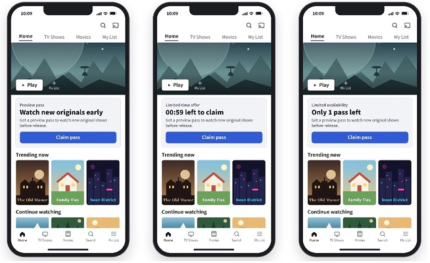
Prototype Design The experimental prototype was developed using HTML and CSS, modeled after well-known video streaming platforms. The prototype was designed around the scenario of subscribing to a streaming service and simulated the complete subscription process: after opening the landing page, participants entered their basic information and payment details, proceeded to select a subscription plan, and were then directed to the payment page, where completing the payment concluded the experimental procedure. All information entered by participants consisted of fictitious names and simulated payment accounts; no personal information was disclosed and no actual payment was made, thereby safeguarding participants’ rights. The prototype manipulated a single independent variable—the level of scarcity—which comprised three conditions: no scarcity, time scarcity, and resource scarcity. In the no scarcity condition, all pages resembled those of a typical video streaming platform. In the time scarcity condition, a countdown timer was displayed on every page; the 60-second countdown began as soon as the experiment started, and once it expired, the timer remained at 00:00. In the resource scarcity condition, a banner was displayed on the page indicating that only one subscription slot remained and that participants had to complete the process promptly or forfeit their eligibility. This informational banner was rendered at 75% opacity to create the impression that the offer was about to disappear. The three interface design conditions are illustrated in Fig. 1.
Figure 1: The three subscription services website samples for the experiment.
Procedure Prior to the experiment, participants were informed of their rights and signed an informed consent form. Participants then completed the experimental tasks as instructed, after which they filled out the SDS and NASA-RTLX
94 Hsu and Chen questionnaires, followed by a brief interview. The entire procedure took approximately 15–20 minutes, and each participant received USD 6 as compensation upon completion.
Measures Task completion time (in seconds) was measured from the moment participants opened the experimental website until they clicked the simulated payment button and the subscription confirmation message was displayed. All sessions were screen-recorded, and the recordings were coded by the first author. Responses to the interview questionnaire, the SDS, and the NASA- RTLX were collected via Google Forms.
The System Darkness Scale (SDS; van Nimwegen et al., 2022) is an instrument for assessing the perceived darkness of a system, and its structure and scoring procedure are modeled on the System Usability Scale (SUS; Brooke, 1996). The SDS consists of five items rated on a five-point scale, with responses scored from 0 (strongly disagree) to 4 (strongly agree). The item scores are summed and multiplied by 5 to yield a final score ranging from 0 to 100, with higher scores indicating greater perceived darkness (van Nimwegen et al., 2022).
The NASA Task Load Index (NASA-TLX) is a multidimensional instrument designed to assess subjective workload across six dimensions: Mental Demand, Physical Demand, Temporal Demand, Performance, Effort, and Frustration (Hart, 2006). However, the conventional NASA- TLX requires participants to complete pairwise comparisons to determine the relative weights of these dimensions, which may increase procedural complexity and participant burden. To address these limitations, numerous studies have adopted the simplified NASA Raw Task Load Index (NASA-RTLX), which eliminates the pairwise weighting procedure and calculates overall workload using the unweighted mean of the six subscale ratings. This approach streamlines the assessment procedure while reducing the time and effort required of participants (Giraud et al., 2018; Hart, 2006). A similar approach was also adopted by Zimmerer and Matthiesen (2021), further demonstrating the application of the unweighted NASA-RTLX method in empirical research. In the present study, each of the six subscales was rated on a 7-point Likert scale ranging from 1 (very low) to 7 (very high), with higher scores indicating greater perceived workload.
Analysis Method All behavioral data and questionnaire responses were analyzed using a one-way analysis of variance (ANOVA). The significance level was set at α = .05. When statistically significant differences were found, Tukey’s HSD post hoc test was conducted to examine pairwise differences among the groups.
RESULTS
The study results comprised participants’ task performance, SDS scale assessment results, NASA-RTLX assessment results, and findings from the interviews and observations, which are presented separately as follows.
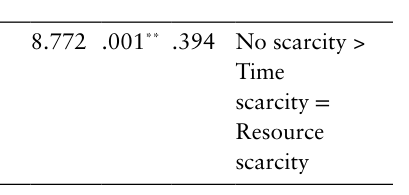
Analysis of Task Completion Time For task performance, the one-way ANOVA revealed a statistically significant difference (F(2, 27) = 8.772, p = .001, 2 p η = .394), as detailed in Table 1. Tukey’s HSD indicated that task completion time in the no scarcity condition (M = 53.20, SD = 17.46) was significantly longer than that in the time scarcity condition (M = 38.47, SD = 7.89, p = .028) and the resource scarcity condition (M = 31.04, SD = 8.23, p = .001). However, no significant difference was found between the time scarcity and resource scarcity conditions (p = .366).
Table 1: One-way ANOVA results for task completion time (seconds).
Table available in the original PDF paper.
Source No Scarcity
F p η2
p Tukey’s HSD
M (SD)
Time Scarcity M (SD)
Resource Scarcity M (SD)
Task 53.20 (17.46)
38.47 (7.89)
31.04 (8.23)
Equation reproduced from the original PDF.
* Significantly different at α = 0.05 level (*p < 0.05) ** Significantly different at α = 0.01 level (**p < 0.01) SDS Score Results
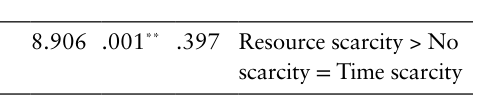
For the SDS, the one-way ANOVA revealed a statistically significant difference (F(2, 27) = 8.906, p = .001, 2 p η = .397). Tukey’s HSD indicated that the SDS score in the resource scarcity condition (M = 35.25, SD = 9.89) was significantly higher than that in the no scarcity condition (M = 16.75, SD = 13.59, p = .004) and the time scarcity condition (M = 15.25, SD = 11.63, p = .002). However, no significant difference was found between the no scarcity and time scarcity conditions (p = .957). The detailed data are presented in Table 2.
Table 2: One-way ANOVA results for SDS score.
Table available in the original PDF paper.
Source No scarcity
F p η2
p Tukey’s HSD
M (SD)
Time scarcity M (SD)
Resource scarcity M (SD)
SDS score
16.75 (13.59)
15.25 (11.63)
35.25 (9.89)
Equation reproduced from the original PDF.
* Significantly different at α = 0.05 level (*p < 0.05) ** Significantly different at α = 0.01 level (**p < 0.01)
For the NASA-RTLX, only the Effort dimension reached statistical significance, as detailed in Table 3. No significant difference was found in the Mental Demand dimension (F(2, 27) = 2.342, p = .115,
2 p η = .148), the Physical Demand dimension (F(2, 27) = 1.557, p = .229, 2 p η = .103), the Temporal Demand dimension (F(2, 27) = 1.256, p = .301,
Equation reproduced from the original PDF.
2 p η = .069). However, a statistically significant difference was found in the Effort dimension (F(2, 27) = 3.701, p = .038,
2 p η = .215). Tukey’s HSD revealed that the Effort score in the resource scarcity condition (M = 4.70, SD = 1.41) was significantly higher than that in the no scarcity condition (M = 2.40, SD = 2.27, p = .034), whereas the difference between the time scarcity condition (M = 3.10, SD = 2.02) and the resource scarcity condition was not significant (p = .174). Finally, no significant difference was found in the Frustration dimension (F(2, 27) = .535, p = .592, 2 p η = .038).
Table 3: One-way ANOVA results for NASA-RTLX.
Table available in the original PDF paper.
F p η2
p Tukey’s HSD
Source No scarcity M (SD)
Time scarcity M (SD)
Resource scarcity M (SD)
2.342 .115 .148
Mental Demand
3.20 (1.98)
3.40 (1.83)
4.80 (1.54)
1.557 .229 .103
Physical Demand
1.70 (1.33)
2.10 (1.91)
3.20 (2.48)
1.256 .301 .085
Temporal Demand
3.00 (2.10)
4.20 (2.14)
4.20 (1.54)
1.003 .380 .069
Performance 4.70 (1.49)
5.40 (1.17)
5.30 (0.82) 3.701 .038* .215 Resource
Effort 2.40 (2.27)
3.10 (2.02)
4.70 (1.41)
scarcity > No scarcity
.535 .592 .038
Frustration 2.20 (1.61)
2.70 (2.31)
3.10 (1.85) *Significantly different at α = 0.05 level (*p < 0.05) **Significantly different at α = 0.01 level (**p < 0.01)
DISCUSSION
The Discussion section is organized into three subsections: Analysis of Scarcity Level, Observation and Interview Results, and Research Limitations, which are discussed in detail below.
Analysis of Scarcity Level Regarding task performance, shorter task completion times indicate better performance. The results revealed that participants in the no scarcity condition required significantly more time to complete the subscription task than those in the time scarcity and resource scarcity conditions. Accordingly,
The Impact of Scarcity-Based Dark Patterns on User Performance 97 both scarcity conditions demonstrated significantly better task performance than the no scarcity condition. These findings may be explained by the psychological mechanisms underlying scarcity-based dark patterns. Previous research has identified the use of countdown timers to create a sense of urgency through time scarcity, as well as promotional messages emphasizing limited-time offers or restricted availability without explicitly specifying an expiration time. Such interface elements may lead users to perceive promotional opportunities as limited in duration or availability, thereby triggering scarcity bias and fear of missing out (FOMO) (Mathur et al., 2019). Consequently, users may feel compelled to complete the subscription process more quickly to avoid losing the perceived benefits. This mechanism may help explain why participants in both the time scarcity and resource scarcity conditions demonstrated better task performance than those in the no scarcity condition.
In terms of perceived dark pattern severity, the resource scarcity condition received the highest ratings. According to the interview findings, participants reported experiencing psychological pressure because they were uncertain whether the limited promotional offers would remain available throughout the subscription process or be claimed by other consumers. This uncertainty created a sense of urgency, prompting participants to complete the task as quickly as possible. With respect to subjective workload, the NASA Raw Task Load Index (NASA-RTLX) results indicated that participants in the resource scarcity condition reported higher perceived effort than those in the no scarcity condition. This finding suggests that participants had to expend greater effort to complete the subscription task under resource scarcity. Taken together, the findings from task performance, perceived dark pattern severity as assessed by the SDS scale, and the NASA-RTLX Effort dimension suggest that resource scarcity designs may accelerate task completion while simultaneously increasing perceived effort and psychological pressure. These results highlight a potential trade-off between improved task efficiency and increased user burden in scarcity-based interface designs.
Observation and Interview Results Observations and interviews were conducted with all 30 participants to gain further insights into their experiences during the experimental tasks. Participants in the no scarcity condition reported no particular concerns regarding the task procedures. In contrast, participants in both the time scarcity and resource scarcity conditions reported experiencing psychological pressure and a sense of urgency to complete the subscription task as quickly as possible. Furthermore, three of the ten participants (30%) in the time scarcity condition and four of the ten participants (40%) in the resource scarcity condition indicated that they had considered abandoning the subscription process due to the perceived pressure. These findings suggest that although scarcity-based dark patterns may improve task performance for some participants, they may also induce psychological pressure and increase users’ intentions to abandon the subscription process before completion. Therefore, the potential benefits of scarcity-based designs in enhancing task
98 Hsu and Chen efficiency should be carefully considered alongside their possible adverse effects on user experience and subscription intentions.
Research Limitations Participants were recruited using purposive sampling, and all were young university students. Therefore, the demographic homogeneity of the sample may limit the generalizability of the findings to other age groups and broader populations. Furthermore, the study involved a relatively small sample size (N = 30), with 10 participants in each group. This limited sample size may have reduced statistical power, increased sampling variability, and constrained the ability to detect statistically significant effects, particularly those of smaller magnitude.
CONCLUSION
The findings of this study indicate that users demonstrated better task performance under scarcity conditions than under the no scarcity condition, despite expressing negative perceptions of scarcity-based interface designs. Among the experimental conditions, resource scarcity was perceived as the most manipulative form of dark pattern design. Scarcity-related interface elements induced a sense of uncertainty regarding product availability, promotional offers, and other limited resources. Furthermore, participants in the resource scarcity condition reported higher perceived effort than those in the no scarcity condition, suggesting that scarcity-based designs may enhance task performance at the expense of increased cognitive and psychological demands. These findings provide valuable empirical insights into the potential trade-offs between task performance and user experience and may serve as a useful reference for interface designers, human–computer interaction researchers, and scholars investigating dark patterns in digital environments.
REFERENCES
Aggarwal, P., Jun, S. Y., Huh, J. H. (2011). Scarcity Messages: A Consumer Competition Perspective, Journal of Advertising Volume 40, No. 3. pp. 19–30. https://doi.org/10.2753/JOA0091-3367400302 Brooke, J. (1996) “SUS: A ‘quick and dirty’ usability scale”, in: Usability evaluation
in industry, Jordan, Patrick W., Thomas, Bruce, Weerdmeester, Bernard A., McClelland, Ian L. (Eds.). pp. 189–194. Cialdini, R. B. (2013). Influence: Science and practice (5th ed.). Boston, MA: Pearson Education. Friedrich, T., Figl, K. (2018) “Consumers’ perceptions of different scarcity cues on
e-commerce websites”, proceedings of the Thirty-Ninth International Conference on Information Systems, San Francisco, CA. Giraud, S., Thérouanne, P., Steiner, D. D. (2018). Web accessibility: Filtering redundant and irrelevant information improves website usability for blind users, International Journal of Human-Computer Studies Volume 111. pp. 23–35.
The Impact of Scarcity-Based Dark Patterns on User Performance 99 Gray, C. M., Santos, C. T., Bielova, N., Mildner, T. (2024) “An ontology of dark
patterns knowledge: Foundations, definitions, and a pathway for shared knowledge-building”, proceedings of the 2024 CHI Conference on Human Factors in Computing Systems, Honolulu, HI. pp. 1–22. Hart, S. G. (2006) “NASA-Task Load Index (NASA-TLX); 20 years later”, proceedings of the Human Factors and Ergonomics Society 50th Annual Meeting, San Francisco, CA. pp. 904–908. Jang, W. E., Ko, Y. J., Morris, J. D., Chang, Y. (2015). Scarcity message effects on
consumption behavior: Limited edition product considerations, Psychology & Marketing Volume 32, No. 10. pp. 989–1001. Kozyreva, A., Lewandowsky, S., Hertwig, R. (2020). Citizens versus the internet: Confronting digital challenges with cognitive tools, Psychological Science in the Public Interest Volume 21, No. 3. pp. 103–156. Kremer, K. (2018) “Critical human factors in UI design: How calm technology can
inform anticipatory interfaces for limited situational awareness”, proceedings of the 1st Conference on Information Systems for Crisis Response and Management (ISCRAM) Asia Pacific, Wellington, New Zealand. Mathur, A., Acar, G., Friedman, M. J., Lucherini, E., Mayer, J., Chetty, M., Narayanan, A. (2019). Dark patterns at scale: Findings from a crawl of 11K shopping websites, Proceedings of the ACM on Human-Computer Interaction Volume 3, No. CSCW. Article 81. Tuncer, R., Sergeeva, A., Bongard-Blanchy, K., Distler, V., Doublet, S., Koenig, V.
(2024). Running out of time(rs): Effects of scarcity cues on perceived task load, perceived benevolence and user experience on e-commerce sites, Behaviour & Information Technology Volume 43, No. 11. pp. 2281–2299. van Nimwegen, C., Bergman, K., Akdag, A. (2022) “Shedding light on assessing dark patterns: Introducing the System Darkness Scale (SDS)”, proceedings of the 35th International BCS Human-Computer Interaction Conference, Keele, UK. pp. 1–10. Zimmerer, C., Matthiesen, S. (2021). Study on the impact of cognitive load on
performance in engineering design, Proceedings of the Design Society Volume 1. pp. 2761–2770.
SEARCH THE AHFE DIGITAL BOOKSTORE BY ISBN
Explore the complete digital volume
Human Factors in Design, Engineering, and Computing
Read this individual research paper free through the original publisher, or explore the full digital proceedings book.