Eubin Tak, Min Kang (2026). Designing for Behaviour Change: A Systems Design Approach to Sustainability in Cosmetic Consumption. In: Human Factors in Design, Engineering, and Computing. AHFE Open Access, vol. 238, pp. 1004–1014. https://doi.org/10.54941/ahfe1008331
This research investigates overconsumption in the cosmetics industry, which contributes to environmental harm, particularly plastic packaging waste. The cosmetics industry generates substantial plastic packaging waste annually, much of which is difficult to recycle. This waste stems from a culture of overconsumption, in which consumers spend heavily on cosmetic products yet use only a fraction of what they buy. Secondary research revealed that psychological, informational, and social factors shape overconsumption and waste, including impulse purchasing, social standards, an influencer-driven market, and limited consumer literacy about cosmetic product specifications. Social media is a major accelerator, contributing to unrealistic beauty standards and never-ending “trends” that normalize overbuying. The study conducted interviews and analysed consumer discourse to identify key consumer behaviours. The study developed a framework comprising four stages of cosmetic consumption: Exploratory, uninformed and with limited product knowledge; Influenced, peak spending driven by trends and recommendations; Aware, recognizing overconsumption behavior and initiatives to reduce it; and Minimalist, maintaining routine with a replenishment-only mindset. Most spending patterns occurred during the Exploratory and Influenced stages. A key finding across the interviews and consumer discourse analysis was that seeing many of the products they had accumulated increased participants' awareness of their own consumption and led to an overall change in how they view future purchasing. This suggests that increasing the visibility of one’s own consumption patterns, rather than physically or intentionally restraining purchases, may serve as an effective catalyst for sustainable behavioral change. Based on these findings, the study proposes a systems design approach that makes consumers’ existing cosmetic collections and consumption patterns more visible, supporting greater self-awareness of overconsumption and more informed purchasing decisions. By helping consumers recognize their product inventory, including unused or unfinished items, the system aims to shorten the Exploratory and Influenced stages, reduce redundant purchases, and decrease product and packaging waste associated with cosmetic overconsumption.
The cosmetic industry produces an estimated 120 billion units of packaging each year, including plastic, glass, and metals that are inadequately recycled and end up in landfills (Wirtu, 2024). The issue of waste is not only a
Designing for Behaviour Change: A Systems Design Approach 1005 materials problem but also a behavioral one. Excessive waste stems from a culture of overconsumption, in which consumers spend heavily on cosmetic products but use only a fraction of what they buy. Every unused product generates unnecessary packaging and is eventually discarded. As discussed by Sankaranarayanan and Avila Velasquez, social media accelerates this pattern by circulating a constant stream of new product launches, hauls, and new “must-have” product lists that normalize overbuying. (Sankaranarayanan, 2017); (Velasquez, 2025). These habits are also forming at an earlier age: as children in the United States buy beauty products starting at an average age of twelve. The stage at which consumers first enter the world of cosmetics is critical to building lasting habits, and for many people it begins in adolescence (Clegg, 2026).
EXISTING APPROACHES For this study, existing approaches to reducing cosmetic waste are grouped into three broad categories. The first approach improves the materiality of the product and its end-of-life handling by creating a physically more sustainable product. The second approach provides buyers with more product information, such as ingredient transparency, product reviews, and sustainability labels. The third adds friction or resistance to buying, such as confirmation prompts. Each of these approaches targets the product itself or the exact moment of purchase.
Less attention has been directed toward helping consumers recognize their own buying patterns and overall accumulation of products. Observing one’s own behavior is a recognized part of behavior change: according to (Bandura, 1991), self-regulation involves monitoring one’s behavior, evaluating it against personal standards, and responding accordingly. This idea appears to have received limited attention in the reviewed literature in the cosmetics industry.
RESEARCH AIM This study argues that making accumulated cosmetic consumption more visible may increase self-awareness and support more intentional purchasing. This research study will address three research questions:
- Research Question 1: What are the psychological, social, and informational factors that drive the accumulation of cosmetic products? - Research Question 2: How does cosmetic consumption behavior change over the course of a consumer’s relationship with cosmetics? - Research Question 3: How does the visibility of accumulated products play into the shift toward more intentional, sustainable purchasing?
The paper makes three contributions: a four-stage framework of cosmetic consumption; qualitative evidence suggesting that recognizing one’s own product accumulation may prompt self-directed behavior change; and a systems design with design principles that apply this key insight across the consumer consumption journey.
LITERATURE REVIEW
Environmental Impact Sustainability requires a full life-cycle perspective: from initial material extraction to disposal at the end of its life, a sustainable product should minimize its environmental impact. (Corrêa, Oliveira, Abdalla, & Fernandes, 2022). Industry efforts have been made, but they focus on the materials of the packaging and product. L’Oreal, for example, has set a goal for 100% of its plastic packaging to come from recycled or bio-based sources by 2030 and to expand biodegradable ingredient formulations. This approach reduces the impact of each unit, but it does not address the number of units bought. A recyclable container that holds an unused product is still waste, because it is bought only to be thrown away eventually.
Psychological and Social Factors Studies of cosmetic consumer behavior agree that purchasing new products is closely tied to identity, as consumers use cosmetics to boost self-confidence, manage self-image, and conform to expectations set by family, peers, and social media (Sankaranarayanan, 2017; Avila Velasquez, 2025; Shi, 2023). The studies differ in emphasis. Some identify internal motives such as self- esteem as the main driver (Mironica et al., 2024; Avila Velasquez, 2025), while others emphasize external pressures from social media, influencer promotions, trend cycles, and discounts (Shi, 2023; Sankaranarayanan, 2017). Social media links the two drivers by turning internal insecurities into a steady stream of new product releases to “fix” those insecurities. What these studies share is a focus on individual purchase: both drivers explain why a consumer buys a product at a given moment. Less is known about how these purchases add up over time, or how consumers experience the accumulation that results.
Informational Factors and Product Uncertainty A second body of research points to limited consumer literacy about product specifications, which may include ingredients, skin type, shades, and undertones (Udayanga et al., 2024). Without this knowledge, consumers rely on brand familiarity, price, recommendations, or learning what works through trial and error. Influencers can fill this gap at times, but when content is not specific to the viewer, it may leave the buyer more uncertain; social media algorithms are targeted but not tailored enough to fit every individual. Overconsumption also has a negative relationship with the perceived value of information: when consumers value the information available to them, they are less inclined to buy (Udayanga et al., 2024). These studies agree that better information can reduce unnecessary purchasing. However, they focus on information about the product itself, while the information consumers have about themselves, such as what they already own and what they use, has received less attention.
Designing for Behaviour Change: A Systems Design Approach 1007 Existing Interventions
Existing interventions follow the three approaches outlined in the Introduction. Material and recycling approaches improve the product’s full life cycle. Informational approaches, such as eco-labels and sustainability metrics, aim to inform consumers’ choices, but research on pro-environmental behavior consistently finds a gap between what people know and what they do (Kollmuss & Agyeman, 2002). Restriction approaches, such as double confirmation before payment, distracting stimuli, or reduced social media use, add friction at the point of purchase (Grisham & Timpano, 2024). These interventions change the external conditions of purchasing rather than consumers’ own awareness of their behavior.
Self-Monitoring, Visibility, and Behavior Change Two related theories help explain why seeing one’s own behavior may influence future behavior. Objective self-awareness theory proposes that when attention is directed toward the self, individuals may compare their current state with their personal standards, and a perceived discrepancy can motivate them to reduce it (Duval & Wicklund, 1972). Bandura’s social cognitive theory of self-regulation describes a related but distinct process: self-regulation involves monitoring one’s behavior, evaluating it against personal standards, and responding accordingly (Bandura, 1991). In this view, self-monitoring is the first step, because people cannot change a behavior they do not observe. Harkin et al. (2016) provide broader empirical support for monitoring and visible feedback as mechanisms of self-regulation: their meta-analysis found that monitoring goal progress promotes goal attainment, particularly when progress is physically recorded or reported publicly. Together, these studies suggest that self-visibility may support change when feedback is personal, timely, and connected to action. However, they do not examine accumulated consumer products as a source of such feedback.
Research Gap The literature altogether explains why consumers buy cosmetics, and it suggests that awareness of one’s own behavior can support positive changes in habits. Existing cosmetic interventions act on materiality, product information, or the point-of-purchase. What remains unexamined is whether the visibility of consumers’ own accumulated products can prompt self- directed change in cosmetic consumption. This study further investigates that question through learning about consumers’ own accounts of how their purchasing habits have changed over time.
METHODOLOGY
This study used a qualitative design using three methods: secondary research, interviews, and an exploratory review of online consumer discourse. Qualitative methods were used as this research discusses the consumer’s individual experiences and requires an explanation of their purchasing habits over time, which can be difficult to capture through quantitative data alone.
The secondary research drew from academic literature reviews on cosmetic consumer behavior, industry and market reports, and analyses of the leading beauty companies and sustainability commitments. This phase of the research identified the psychological, informational, and social factors that were described in Section 2, which were used to develop the interview guide.
Interview A total of five participants who regularly purchase and use cosmetics were interviewed. The interviews covered four topics: purchasing habits and shopping channels, sources of product information, the size and usage of the participants’ cosmetic collection, and how the participants dispose of used or unused products. Participants are referred to as P1-P5 in this paper, and Table 1 summarizes each participant’s stage of consumption at the time of their interview and their most notable behaviors.
Table 1: Interview participants’ behavior.
Table available in the original PDF paper.
Behavior
Stage at the Interview P1 Minimalist Decluttered after getting “visual fatigue,” reuses unsuitable skincare on their body, buys cosmetics only to restock now.
P2 Aware Extensive trial-and-error process, buys into the popular products to see if they are any good, researches ingredients extensively.
P3 Minimalist Large product collection, buys only to restock now, shops in store to match shades properly.
P4 Minimalist Formerly would shop on TikTok Shop weekly, now they only purchase restock items every 3-12 months, relies heavily on Reddit.
P5 Aware Keeps expired products, has an ample collection of products; organizing their collections reduced the frequency of purchasing.
Analysis Interview notes were analyzed by clustering related observations, which were then compared across participants. Attention was given to turning points, the moments when participants described their buying habits changing, and to what they said prompted each change. The four-stage framework presented in Section 4 was developed retrospectively from participants’ accounts of how their behavior changed over time. None of the participants were in the Exploratory or Influenced stage at the time of their interview (Table 1); these earlier stages were reconstructed from how participants described their past purchasing.
FINDINGS Key Consumer Behaviors
The key behaviors listed below share one main insight: products are accumulated gradually, and the extent of that accumulation was out of view until something made it visible to the participants.
Low Product Utilization: The most consistent finding was a large gap between what the consumers own and what they use. 4 of the five participants self-reported that they regularly use half or fewer of the products in their collection, and some estimated using as little as 10% of their products. Participant four estimated that only 5% of her makeup collection is used and 30% of her skincare collection makes it into her daily routine. When it was asked where their unused products came from, all interviewees commonly attributed them to periods of buying without knowing what suited them.
“More is More” and Trial and Error: Limited consumer literacy has led participants to buy products blindly and assess the product against their skin. Participant two explained that they used to not know what their skin type was or what ingredients caused reactions, which has led to repeated trial-and-error purchases. Participant one had a similar experience of buying products blindly and believing that the more products they used, the better results they would get.
Restock-Only Mentality: Four out of the five participants have reported that after going through a period of trial-and-error purchasing, they have moved on to buying new products when they run out of what they currently use. Participant four went from buying a new product once or twice a week to replacing makeup/skincare every six to twelve months.
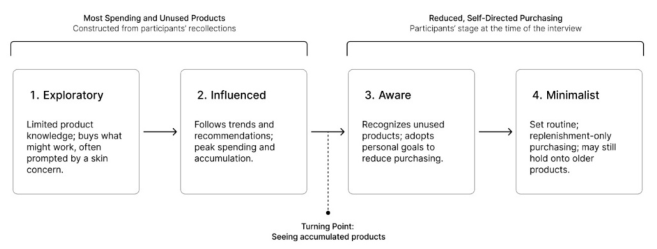
Four-Stage Consumption Framework Comparing participants’ accounts of how their consumption behavior changed over time revealed four recurring stages (Figure 1). Because all participants were in the Aware or Minimalist stage at the time of their interview, the Exploratory and Influenced stages are based on their retrospective descriptions.
Figure 1: Four stages of cosmetic consumption, developed retrospectively from participants’ accounts.
Figure 1 shows the four stages of cosmetic consumption. Participants recalled that they associated most of their spending and unused products
1010 Tak and Kang with the first two stages. A recurring pattern across participants was that seeing their accumulated products, and recognizing how much they had amassed, marked their move into the Aware stage.
Accumulation and Visibility The most evident trigger for moving from the Influenced to the Aware stage was seeing one’s own accumulated products. Four out of five participants agreed during their interviews that once they began to see their ample collection of unused products, they began to clean out and organize all their products, which led to them buying fewer products overall. Through interviews and literature reviews, we found these accounts are consistent with existing research linking self-monitoring to self-regulation.
DISCUSSION
Visibility and Self-Awareness The findings address Research Question 3: seeing one’s accumulated products was a recurring turning point between the Influenced and Aware stages. This is consistent with Bandura’s (1991) account of self-regulation, in which people monitor their behavior, evaluate it against personal standards, and respond accordingly. Decluttering may work as an unplanned act of self- monitoring, as it gathers products that were once scattered across drawers and bags into a single view. This confronts the consumer with a gap between what they own and what they use day to day. Objective self-awareness theory suggests that when attention is directed toward the self in this way, individuals may compare their current state with their personal standards and feel motivated to reduce the discrepancy (Duval & Wicklund, 1972). Participants’ descriptions of “visual fatigue” that led them to buy less are consistent with this account.
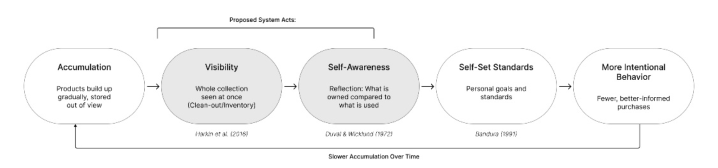
From Restriction to Self-Directed Behavior Change Strategies that participants adopted to reduce their consumption were described as being adopted only after reaching the Aware stage. This distinction is important: external friction asks consumers to accept an interruption they did not choose, whereas standards that consumers set for themselves are a form of self-regulation. These findings suggest that visibility may precede and enable self-directed restriction as the proposed pathway (Figure 2). Participants also described reaching the Aware stage following prolonged Exploratory and Influenced stages during which they made most of their purchases and accumulated unused products. For cosmetics, this suggests that visibility could be introduced earlier, before accumulation grows large enough to require a major clean-out.
Figure 2: Proposed pathway from accumulation to more intentional behavior, drawn from participants’ accounts and self-regulation research.
Implications for Sustainable Consumption Sustainability efforts in the cosmetic industry act downstream and focus on the materials and recycling of the physical product. The findings in this study suggest a more complementary approach to the cosmetic industry: reducing the number of products bought in the first place. As fewer redundant purchases may reduce demand for unnecessary products and the associated packaging waste. This approach means that the responsibility is shared amongst the consumers and the manufacturers. Brands and social media platforms profit from consistent new product launches and new trend cycles; therefore, a more meaningful approach to reducing waste will require a change in how the industry produces and markets new products.
DESIGN IMPLICATIONS FOR A PROPOSED SYSTEM Design Principles
The findings from this study and the literature review point to four design principles.
Provide Valuable Information: Make product information more accessible and tailored to the user based on their personal skin type, skin problems, and wants/needs.
Make Product Accumulation Visible: Show consumers their full product collection and how much of it they use, rather than waiting for them to see it themselves.
Bring Visibility to Decision-Making: Present what the consumer already owns in the moment when they consider buying something new, which can alter their decision.
Support Self-Regulation, Not Restriction: Inform the consumer’s personal judgment in various stages, with an emphasis on shortening the first two stages, Exploratory and Influenced.
Systems Design Framework The proposed systems design approach applies these four main design principles across the four stages of cosmetic consumption. Rather than focusing on a single product, it connects several touchpoints in-store, online, and at home around a shared record of the consumer’s collection.
1. Exploratory Stage: Introduce product specifications and learn about
ingredients to understand what suits the consumer’s wants and needs. 2. Influenced Stage: Continue learning and growing with the user and create a more tailored list of recommendations that can be applied to create a better routine. 3. Aware Stage: Tracking current product collections and new purchases
allows for unused products to become more visible to the user quickly. 4. Minimalist Stage: Quick point-of-purchase comparison and reviews are used to replenish finished products that users may want to update.
The aim for the Exploratory and Influenced stages is to shorten the period of high spending and initial product accumulation. In the Aware and Minimalist stages, the goal is to support a circular flow of purchase, where the new purchasing rate stays low and unused products are rehomed or properly recycled.
Key Features in the System
Product Inventory: Consumers can record the products they own, including the unused ones, and link up to cosmetic retailers or main shopping outlet accounts to get a single view of all their products.
Usage Tracking: The system sends reminder notifications to the user to keep track of what products are still being used or what did not work for them.
Learn More About Cosmetic Product Specifications: Users can get a better understanding of the types of ingredients to be wary of and understand what their main functions are made to target.
Point-of-Purchase Comparison: When considering a new product in-store or online, the consumer can use the system to compare the product to what they own and get information on whether it will fit into their routine.
LIMITATIONS AND FUTURE WORK This study has several limitations. The interview sample was small (n = 5), and participants were not selected to represent a specific range of ages, incomes, or cultural backgrounds. The four-stage framework was developed retrospectively from participants’ recollections, which may be incomplete or affected by recall bias, and it has yet to be validated with quantitative data. The exploratory review of online discourse was not systematic and likely over-represents consumers who are already in the Aware or Minimalist stages. Future work will test the proposed system with consumers at various stages and measure whether visibility produces lasting changes in purchasing behavior.
CONCLUSION
Cosmetic packaging waste is driven not only by how products are made but also by how many products are bought and never used. Existing approaches
Designing for Behaviour Change: A Systems Design Approach 1013 act on materials, product information, or the moment of purchase, leaving consumers’ view of their own accumulation largely unaddressed. Drawing on self-regulation theory, secondary research, interviews, and an exploratory review of online consumer discourse, this research study proposes a four- stage framework of cosmetic consumption and suggests that seeing one’s accumulated products is a recurring turning point toward self-directed change. These findings support the paper’s central argument: making accumulated cosmetic consumption more visible may increase self-awareness and support intentional purchasing behavior. The proposed design principles and systems design framework apply this insight across the consumption journey, and could potentially shorten the stages of high spending, reduce redundant purchases, and decrease the overall product and packaging waste that is associated with cosmetic overconsumption.
REFERENCES
Avila Velasquez, T. (2025). Decoding influence: Cosmetic industry strategies, media beauty standards, and their mental health impact on Generation Z consumers. Undergraduate Theses and Capstone Projects, 45. Bandura, A. (1991). Social cognitive theory of self-regulation. Organizational
Behavior and Human Decision Processes, 50(2), 248–287. https://doi. org/10.1016/0749-5978(91)90022-L Clegg, R. (2026, June 6). Cosmeticorexia: How girls are falling down a skincare rabbit hole. BBC News. https://www.bbc.com/news/articles/cx212x41evwo Corrêa, R. de S., Oliveira, U. R. de, Abdalla, M. M., & Fernandes, V. A. (2022).
Systematic literature review on sustainable products: Impact on organizations, research opportunities and future perspectives. Cleaner Waste Systems. Duval, S., & Wicklund, R. A. (1972). A theory of objective self-awareness. Academic Press. Gatt, I. J., & Refalo, P. (2022). Reusability and recyclability of plastic cosmetic
packaging: A life cycle assessment. Resources, Conservation & Recycling Advances. https://www.sciencedirect.com/science/article/pii/S2667378922000360 Grisham, J. R., & Timpano, K. R. (2024). Nudging society toward more adaptive approaches to material possessions: Harnessing implicit approaches to reduce overconsumption and excessive saving. Current Opinion in Psychology. Harkin, B., Webb, T. L., Chang, B. P. I., Prestwich, A., Conner, M., Kellar, I., Benn, Y.,
& Sheeran, P. (2016). Does monitoring goal progress promote goal attainment? A meta-analysis of the experimental evidence. Psychological Bulletin, 142(2), 198–229. https://doi.org/10.1037/bul0000025 Kollmuss, A., & Agyeman, J. (2002). Mind the gap: Why do people act environmentally and what are the barriers to pro-environmental behavior? Environmental Education Research, 8(3), 239–260. https://doi.org/10.1080/13504620220145401 Kumar, S., Kathuria, G., & Malhotra, D. (2025). Overconsumption: A systematic
literature review and future research agenda. International Journal of Consumer Studies. Mironica, A., Popescu, C. A., George, D., Tegzeșiu, A. M., & Gherman, C. D. (2024).
Social media influence on body image and cosmetic surgery considerations: A systematic review. Cureus. Patil, H., & Bakkappa, B. (2012). The influence of culture on cosmetics consumer behavior. IOSR Journal of Business and Management, 41–47.
approach. International Research Journal of Management Science & Technology, 160–172. Shi, R. (2023). The influence of marketing strategy on consumer behavior in the cosmetics industry. Highlights in Business, Economics and Management, 623–629. Udayanga, L., Subashini, N., Udugama, M., Silva, P., & Ranathunge, T. (2024).
Knowledge, perceptions, and consumption behaviour of cosmetics among undergraduates of Sri Lanka: A descriptive cross-sectional study. Frontiers in Public Health, 11, 1184398. https://doi.org/10.3389/fpubh.2023.1184398 U.S. Environmental Protection Agency. (2026, February 17). What makes a product greener? https://www.epa.gov/greenerproducts/what-makes-product-greener Wirtu, Y. D. (2024). A review of environmental and health effects of synthetic
cosmetics. Frontiers in Environmental Science.
SEARCH THE AHFE DIGITAL BOOKSTORE BY ISBN
Explore the complete digital volume
Human Factors in Design, Engineering, and Computing
Read this individual research paper free through the original publisher, or explore the full digital proceedings book.