Michaela Friedrich, Christian Schiller (2026). Designing Sustainable Business Models for Industrial Service Providers – Concepts and Challenges. In: Human Factors in Design, Engineering, and Computing. AHFE Open Access, vol. 238, pp. 2356–2366. https://doi.org/10.54941/ahfe1008461
Sustainability is becoming increasingly important for companies. However, there is a discrepancy between symbolic and genuine sustainability implementation. A key aspect of how genuine sustainability can be achieved in companies is the organizational embedding of sustainability – that is, the extent to which there are clear responsibilities for sustainability within the corporate structure. Our own empirical analysis demonstrates precisely this relationship: Clear responsibilities are associated with a higher level of green service maturity. This raises the question of how sustainability can be systematically embedded in companies. The literature on sustainable business models provides approaches to this end. Building on this, we further develop our own framework for designing business models and supplement the five building blocks of success it contains with sustainability dimensions.
In light of global challenges such as climate change, resource scarcity, and social inequality, pressure is mounting on companies to fundamentally transform their business models. In recent years, sustainability has evolved from a marginal issue into a central strategic focus for companies. While sustainability was long viewed primarily as a voluntary initiative within the framework of corporate social responsibility, it is now understood more as an integral part of corporate strategy and a key factor in enhancing competitiveness (Rezaee, 2017; Abdul-Azeez et al., 2024). Sustainable business models (SBMs) are therefore gaining importance, as they aim to combine economic success with environmental and social goals (Cantele and Truzzi, 2020). While traditional business models are primarily focused on economic value creation, sustainable business models expand the understanding of value to include social and environmental dimensions (Lee and Fu, 2024). The relevance of SBM development stems from several factors. First, regulatory requirements and stakeholder expectations regarding sustainability are leading to greater consideration of the topic in corporate strategy. Second, SBMs open up opportunities for innovation and competitive advantage, for example through improved resource utilization, increased resilience,
Designing Sustainable Business Models for Industrial Service Providers 2357 and access to new markets. Third, sustainability is increasingly viewed as a strategic necessity that promises long-term corporate performance and competitiveness (Yan, 2025; Latan, 2024).
This paper follows a combined empirical and conceptual approach. First, it analyzes whether a clear allocation of responsibilities for sustainability is associated with a higher level of green service maturity. Second, based on insights from the empirical findings and an integrative review of the SBM literature, it proposes a conceptual extension of an existing business model design framework that incorporates sustainability dimensions.
PURE SYMBOLISM OR ACTUAL CHANGE? EMPIRICAL FINDINGS ON SUSTAINABILITY PERFORMANCE Empirical studies show that environmental sustainability in companies – including industrial service firms – is now formally given high priority and is increasingly being integrated into strategic missions and external reporting. For example, the “Green Services” study by Fraunhofer IAO (Friedrich et al., 2025) shows that the service companies surveyed rank environmental sustainability as one of the most important current and future challenges. The study also shows that it is not only extrinsic factors – such as meeting customer or legal requirements – that play a role in the implementation of environmentally sustainable measures, but that companies are also strongly driven by the intrinsic motivation to do something for the environment, like improving environmental protection. At the same time, however, the literature highlights a discrepancy between reported sustainability performance and actual behavior. For example, a study by Sneideriene and Legenzova (2025) examines greenwashing in sustainability reports by analyzing the differences between sustainability reports and management reports. The results show that sustainability reports are often strategically embellished and exhibit systematic deviations from more objective management reports. Studies on ESG implementation also show that companies often pursue largely symbolic measures, while substantial changes fail to materialize. This so-called “implementation gap” is described as a structural problem (Ștefănescu and Suciu, 2026).
Against the backdrop of this discrepancy between symbolic and genuine sustainability implementation, the question arises as to which factors promote the truly effective implementation of environmental sustainability within a company. A key aspect in this context is the organizational embedding of sustainability – that is, the extent to which there are clear responsibilities for sustainability within the corporate structure. Unclear responsibilities can lead to a diffuse distribution of accountability, causing sustainability measures to remain rather non-binding and thus contributing to the implementation gap described above. Conversely, clearly assigned responsibilities could form the basis for a more systematic implementation of sustainability strategies.
Therefore, we would like to test the following hypothesis: Companies with clearly assigned responsibilities for environmental sustainability exhibit a higher level of green service maturity than companies with unclear responsibilities. To empirically test this assumption, we draw on our dataset
2358 Friedrich and Schiller from the “Green Services” study mentioned above (Friedrich et al., 2025). Two questions from the study are used to test the hypothesis. The first question is: “Who in your company is responsible for environmental sustainability issues?” with the following six possible answers (multiple responses were allowed): This is the responsibility of senior management. / This is the responsibility of all employees. / We have established a dedicated position or team for this purpose. / There are no clearly assigned responsibilities for this in our company. / An existing department (e.g., Sales, Marketing) handles this. / We have commissioned external partners (e.g., consultants) to handle this.
This question is designed to assess the clarity of organizational responsibilities for environmental sustainability and was converted into a dichotomous variable (clear vs. unclear responsibility). Since the response option “This is the responsibility of all employees” cannot be unambiguously categorized (although there is an assignment, if everyone is supposed to be responsible, the individual may not feel responsible), this response category was excluded. There is only one case in the dataset that selected this response category exclusively. The response category “In our company, there are no clearly assigned responsibilities for this” was defined as unclear responsibility. The remaining response categories were defined as clear responsibility. Cases that provided contradictory responses (e.g., selecting one of the clear responsibilities while also stating that there are no clearly assigned responsibilities) were excluded from the analysis. This affected 4 cases. Another 4 cases did not provide any information on this question, so out of 99 possible cases, 90 were included in the analysis (15 with unclear responsibility and 75 with clear responsibility).
The second question included in the analysis was: “Does your company already offer environmentally sustainable services?” This question is suitable for assessing the level of green service maturity. The response categories were: We already provide at least one specific environmentally sustainable service. / We are preparing to introduce environmentally sustainable services in our company. / We have analyzed the potential of environmentally sustainable services for our company. / We are currently researching environmentally sustainable services. / We have not yet addressed environmentally sustainable services, but plan to do so. / We have not yet looked into environmentally sustainable services and do not plan to do so. Multiple responses were not permitted here.
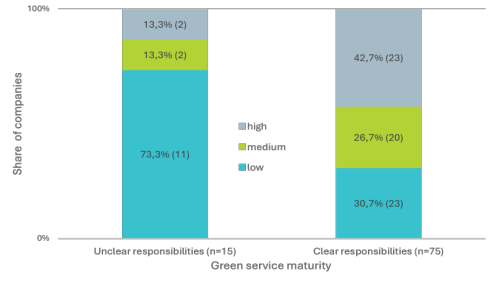
To test the hypothesis, a Mann-Whitney U test was first used, since the maturity level is measured on an ordinal scale and there are two independent groups. The results show a significant difference between companies with clear and unclear responsibilities (U = 271; Z = −3.24; p = .001). Companies with clearly defined responsibilities exhibit a significantly higher green service maturity level than companies with unclear responsibilities (median rank: 49.39 vs. 26.07). The effect size was r = .34, indicating a moderate effect. This supports the hypothesis that clearly assigned responsibilities are associated with a higher level of maturity in environmentally sustainable services. In addition, cross-tabulations and chi-square tests were calculated to provide a descriptive analysis of the relationship. For this purpose, the
Designing Sustainable Business Models for Industrial Service Providers 2359 green service maturity level was grouped into three categories (low, medium, high). This grouping reduced issues with low cell frequencies, which occurred in some cases in the original 6-level cross-tabulation, thereby improving the conditions for the chi-square analysis. The Pearson chi-square test shows a significant association between the clarity of responsibilities and the Green Service maturity level grouped into three categories, χ²(2) = 9.78, p = .008. With Cramér’s V = 0.33, this indicates a small to moderate association. Companies with unclear responsibilities are disproportionately represented in the low maturity group, while companies with clear responsibilities are more frequently found in the medium and high maturity groups.
Figure 1: Distribution of the green service maturity level (low, medium, high) by clarity of responsibilities for environmental sustainability.
Overall, both the Mann-Whitney U test and the supplementary cross- tabulation analysis confirm the hypothesis that companies with clearly assigned responsibilities for environmental sustainability exhibit a higher level of green service maturity than companies with unclear responsibilities.
SUSTAINABLE BUSINESS MODELS AS A RESPONSE TO THE IMPLEMENTATION GAP This brings into focus the question of how sustainability can be systematically integrated into value creation. This is where the concepts of SBMs come into play. SBMs go beyond isolated sustainability measures by integrating environmental and social objectives into the core structure of the business model, thereby addressing the structural causes of the implementation gap.
The literature presents various approaches to SBMs. Schaltegger et al. (2016) note that previous approaches have focused on an organization’s economic value creation, while sustainability researchers expand this understanding to include social and environmental value creation. While traditional business models primarily focus on customers and shareholders, the authors argue that sustainable business models must create value for a broad network of stakeholders as well as for the natural environment. Geissdoerfer et al. (2018) define SBMs in a very similar way. They further identify as a central
2360 Friedrich and Schiller challenge the fact that, although many ideas for SBMs are developed, these are either not implemented or fail in practical application. Causes for this include organizational inertia, a lack of resources, unclear responsibilities, and conflicts with existing business logic.
Bocken et al. (2014) develop a systematic typology of SBMs. They present eight so-called archetypes of sustainable business models and classify them into three forms of innovation: technological, social, and organizational innovations. In doing so, they illustrate which sustainability strategies companies can pursue. Sustainability does not arise primarily from individual environmental measures, but rather from the systematic redesign of the business model. The eight archetypes provide a framework for how companies can permanently integrate environmental and social value creation into their business logic.
Joyce and Paquin (2016) provide a design tool that systematically integrates sustainability aspects into the business model innovation process. This Triple- Layered Business Model Canvas supplements the classic Business Model Canvas (BMC) with an environmental and a social layer. Lüdeke-Freund et al. (2024) also provide a practical tool for companies – the Sustainable Business Model Design Framework (SBMD) – to systematically develop SBMs. They assume that successful SBMs are often based on recurring patterns. These patterns describe typical problems and proven solutions and can serve as reference points or templates for the development and design of new sustainable business models.
KEY ELEMENTS FOR A SUSTAINABLE BUSINESS MODEL The empirical findings cited above show that the success of sustainability initiatives is strongly influenced by the organizational framework within which they are implemented. Clear lines of responsibility are a key factor in this regard. Research on sustainable business models also makes it clear that successfully implementing sustainability requires the holistic integration of customer value, economic viability, and sustainability goals. Together, these empirical and conceptual insights suggest that sustainability must be embedded both organizationally and strategically within the business model. Building on the empirical findings regarding the importance of clear sustainability responsibilities and the insights from the SBM literature, the framework presented in this paper was conceptually extended to incorporate sustainability dimensions. A company must therefore always put the customer at the center, address their problems, and, ideally, solve them. To holistically consider and integrate these and other factors, a framework comprising five success building blocks for designing business models was developed as part of a research project funded by the German Federal Ministry of Research, Technology and Space (BMFTR). The existing framework serves as the foundation for integrating economic, social, and environmental sustainability considerations into business model design. As part of the work for this publication, these success building blocks are presented and supplemented with the aforementioned dimensions of sustainability.
Designing Sustainable Business Models for Industrial Service Providers 2361 The development of the five building blocks of a successful business model is essentially based on the following principles:
- The well-known Business Model Canvas (BMC) and Value Proposition Design (VPD) methods - The researchers’ empirical findings (heuristics) - Project workshops with companies The BMC and the VPD are among the best-known methods in the field of business model development and are used by countless companies as established tools. While the VPD focuses very strongly on customer value and tends to overlook the company itself, the BMC places great emphasis on the economic and operational viability of a business model, but in doing so quickly loses sight of the actual core aspects of a successful business model. Both methods were developed by Alexander Osterwalder and are closely intertwined. In principle, the VPD serves to elaborate in detail on the central element of the BMC – the value proposition – while addressing customer needs as effectively as possible (“Fit”). Only once the value proposition for the target customer groups has been comprehensively defined is the rest of the business model constructed.
Despite all the advantages of BMC and VPD, there are also some disadvantages to consider. While focusing on customer value should indeed be one of the key drivers of new business models, it is often overlooked that new business models can also offer other benefits to the company providing them and are therefore equally valid. Furthermore, the environment in which a company operates is only indirectly taken into account. In addition, the issue of (holistic) sustainability is not directly addressed in either method.
The five building blocks for a successful business model, which are presented below, are not intended to replace methods such as the BMC or the VPD, but rather to complement and enhance them. The goal in deriving these building blocks is also to provide companies with overarching guidelines for a business model that integrates economic, environmental and social dimensions of sustainability.
In summary, a business model can be understood as a conceptual framework that describes how organizations create, deliver, and monetize value. Osterwalder, Pigneur, and Tucci (2005) therefore also describe business models as a logical structure for generating and capturing value. Teece (2010) emphasizes that a business model illustrates how a company creates value for customers and generates economic returns from that value. However, in addition to the customer-focused value creation dimensions, the internal value creation dimensions (“organization orientation”) must not be neglected (Wirtz, 2020). Against this backdrop, drawing on the authors’ experience and workshops with companies, the following building blocks for a successful business model can be derived.
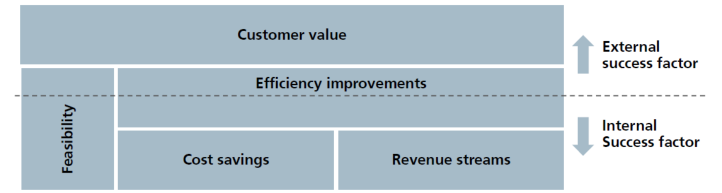
Customer Value: Customer value is at the core of the vast majority of business models. One of the key functions of a business model is to clarify what value a company offers its customers and why they should be willing to pay for it (Teece, 2010). Accordingly, the value proposition is also explicitly listed and further elaborated in the BMC (see above). Aspects such as competitive
2362 Friedrich and Schiller advantages, customer satisfaction, innovation, (increased) marketability, and pricing can thus be understood as concrete dimensions of customer value.
Feasibility: A business model must not only be theoretically describable and logically derivable, but also practically feasible. Thus, a company must have the organizational, financial, human resource, and technological prerequisites in place to actually introduce a value proposition to the market and offer it on a long-term basis. The aspect of customer acceptance also plays a decisive role here. Feasibility is the crucial bridge between the conceptual design and the operational implementation of a new business model.
Efficiency improvements: Another key to success for a new business model is increased efficiency. In addition to creating new opportunities for value creation, a new business model can also generate added value for the company or its customers through factors such as cost reduction, resource optimization, faster response times, increased scalability, or quality improvements. Increased efficiency is often a strategic lever for securing long-term competitiveness.
Cost Savings: Cost savings are closely linked to efficiency gains but have their own strategic significance. They directly improve the margin on a service and thus increase the company’s profitability. This creates room for new innovations, greater flexibility, and improved customer loyalty.
Revenue Streams: Business model innovations can also involve tapping into new revenue streams. This can improve a company’s financial sustainability, stability, and competitiveness. New revenue streams also make it possible to tap into growth potential among new customer groups.
Figure 2: The five building blocks of a successful business model.
In the following, the aforementioned building blocks will be systematically developed further to incorporate aspects of economic, social and environmental sustainability. This addresses the increasingly significant challenge of achieving an integrated approach to economic performance and social responsibility.
There are essentially two ways to integrate the topic of sustainability into the framework: first, through a standalone, additional success building block that brings together all sustainability dimensions. The advantage would be clear accountability, relatively straightforward communication, and easy integration with the required ESG reports. The second option for incorporating sustainability dimensions would be to integrate them into each of the five existing success building blocks. This, in turn, could
Designing Sustainable Business Models for Industrial Service Providers 2363 help overcome traditional silo thinking and foster a holistic perspective. Furthermore, it would result in a closer link between sustainability aspects and the operational factors of a business model, which would represent a significant competitive advantage. It is particularly for this latter reason that the authors of this publication have opted for the integrative approach. Furthermore, since there is a close connection between the five-success- building-blocks framework and the BMC, the three-level model approach proposed by Joyce and Paquin (2016) will be adopted, and – in addition to the economic level that already exists in practice – a social and an ecological level will be added to the framework. For each building block across these three levels, the following guiding question is developed: What (economic, social, environmental) value does this component create in the context of its role within the business model?
Just as the five building blocks of success should not be viewed in isolation from one another, the three dimensions of sustainability should also be viewed within a systemic context. The table below clearly illustrates this relationship between the building blocks of success and the dimensions of sustainability.
Table 1: The five building blocks of a successful business model, broken down into the three dimensions of sustainability.
Table available in the original PDF paper.
Building Block Economic Dimension Social Dimension
Environmental Dimension
Customer Value Sustainable and profitable value creation for customers
Fairness, honesty, trust Consideration of environmental factors at the customer’s site Social acceptance, necessary stakeholders Compliance with environmental regulations
Feasibility Financial viability, market potential, availability of resources Efficiency improvements Process optimization, scalability
Reduction of environmental costs, avoidance of penalties
Impact of targeted social investments on long-term (consequential) costs Revenue streams Diversified, Steady, and Consideration of Social Returns Environmental Certifications
Sustainable Sources of Revenue Taking the three levels of sustainability into account when developing each building block of success means that a new business model can create economic, social, and environmental value. In this way, companies become more resilient to external factors, better positioned for the future by anticipating regulatory developments and societal expectations, more attractive to customers, skilled workers, and investors, and potentially more innovative, as new and holistic perspectives are automatically integrated into
2364 Friedrich and Schiller the development of new solutions. Sustainability issues are systematically considered from the very beginning as one of the central design criteria. This enables companies to generate strategic competitive advantages and tap into new customer groups.
This study has several limitations. First, the empirical analysis is based on a cross-industry survey of companies and therefore does not allow for causal conclusions. Second, it should be noted that the sample size of 90 companies is rather limited and that the responses are self-reported by the companies. Third, although the proposed conceptual framework was derived from empirical data, the literature, workshops, and our own project experience, it has not yet been empirically validated. Such validation should therefore be conducted in future research.
CONCLUSION
This publication demonstrates that sustainability is becoming increasingly important for companies. At the same time, however, there is an “implementation gap” between aspiration and reality, which can be attributed, at least in part, to unclear responsibilities. A corporate survey conducted by the authors shows that clear responsibilities are associated with a higher level of green service maturity. Furthermore, many companies lack strategic guidelines that integrate the three dimensions of sustainability (economic, social, and environmental) with operational success factors for a new business model. To address this challenge, the authors introduce a framework with five essential building blocks for a successful business model that integrates the aforementioned dimensions of sustainability. This framework provides companies with a practical and structured starting point for systematically developing new and sustainable business models. Furthermore, this approach allows for the clear delineation of areas of responsibility and the assignment of predefined roles.
It remains unclear at this point how a company can actually assign roles. Is a dedicated team or organizational unit required for this purpose? Is a staff function sufficient, or should an existing team take on this additional task? How important are factors such as company size or the company’s role in the value chain? These and other questions provide starting points for further research.
ACKNOWLEDGMENT
The authors gratefully acknowledge the contributions of the agileASSEMBLY project and the Competence Center “Smart Services”. The business model framework comprising five key success factors, which provided the conceptual basis for this research, was developed within the first project mentioned. The sustainability survey and empirical investigations presented in this paper were conducted within the second project mentioned. The agileASSEMBLY research and development project is funded by the German Federal Ministry of Research, Technology and Space (BMFTR) within the “Innovations for Tomorrow’s Production, Services and Work” program (funding number
Designing Sustainable Business Models for Industrial Service Providers 2365 02J21C124) and implemented by the Project Management Agency Karlsruhe (PTKA). The Competence Center “Smart Services” was funded by the German federal state of Baden-Württemberg. The authors are responsible for the content of this publication.
REFERENCES
Abdul-Azeez, O. Y., Nwabekee, U. S., Agu, E. E., Ijomah, T. I. (2024). Strategic approaches to sustainability in multinational corporations: A comprehensive review. International Journal of Frontline Research in Science and Technology, 3(2), 38–54. https://doi.org/10.56355/ijfrst.2024.3.2.0046 Bocken, N. M. P., Short, S. W., Rana, P., Evans, S. (2014). A literature and practice
review to develop sustainable business model archetypes. Journal of Cleaner Production, 65, 42–56. https://doi.org/10.1016/j.jclepro.2013.11.039 Cantele, S., Truzzi, S. (2020). Sustainable business models: Literature review of main contributions and themes. International Journal of Business and Management, 15(5), 11–28. https://doi.org/10.5539/ijbm.v15n5p11 Friedrich, M., Schiller, C., Said, C., Stern, E., Glauninger, I., Guhl, J., Fulde, T.
(2025). Green Services – Welchen Stellenwert hat ökologische Nachhaltigkeit im Unternehmen?, Fraunhofer IAO. https://doi.org/10.24406/publica-4571 Geissdoerfer, M., Vladimirova, D., Evans, S. (2018). Sustainable business model innovation: A review. Journal of Cleaner Production, 198, 401–416. https://doi. org/10.1016/j.jclepro.2018.06.240 Joyce, A., Paquin, R. L. (2016). The triple layered business model canvas: A tool to
design more sustainable business models. Journal of Cleaner Production, 135, 1474–1486. https://doi.org/10.1016/j.jclepro.2016.06.067 Latan, D. (2024). Innovations in sustainable business models: Redefining success beyond profitability. Journal of International Business Research, 23(4), 1–4. https://www.abacademies.org/articles/innovations-in-sustainable-business- models-redefining-success-beyond-profitability-17093.html Lee, C.-W., Fu, M.-W. (2024). Conceptualizing sustainable business models
aligning with corporate responsibility. Sustainability, 16(12), 5015. https://doi. org/10.3390/su16125015 Lüdeke-Freund, F., Massa, L., Breuer, H. (2024). Sustainable business model design.
Journal of Business Models, 12(1), 115–132. https://doi.org/10.54337/jbm. v12i1.8409 Osterwalder, A., Pigneur, Y., Tucci, C.L. (2005). Clarifying business models: Origins, present, and future of the concept. Communications of the Association for Information Systems, Volume 15, 1–40. https://doi.org/10.17705/1CAIS.01601 Rezaee, Z. (2017). Corporate sustainability: Theoretical and integrated strategic
imperative and pragmatic approach. Journal of Business Inquiry, 16(1, Special Issue), 60–87. https://journals.uvu.edu/index.php/jbi Schaltegger, S., Hansen, E. G., Lüdeke-Freund, F. (2016). Business models for sustainability: Origins, present research, and future avenues. Organization & Environment, 29(1), 3–10. https://doi.org/10.1177/1086026615599806 Sneideriene, A., Legenzova, R. (2025). Uncovering greenwashing: Investigating
impression management gap in corporate reporting. Sustainability, 17(8342). https://doi.org/10.3390/su17188342 Ștefănescu, C. A., Suciu, A. L. (2026). Symbolic versus substantive ESG practices: A systematic review and integrative framework. Corporate Social Responsibility and Environmental Management. https://doi.org/10.1002/csr.70722
2366 Friedrich and Schiller Teece, D. J. (2010). Business models, business strategy and innovation. Long Range
Planning 43, 172–194. https://doi.org/10.1016/j.lrp.2009.07.003 Wirtz, B. W. (2020). Business model management – Design process instruments.
Second Edition. Wiesbaden: Springer. Yan, S. (2025). Sustainability and competitive advantage: The impacts of ESG practices on business performance. International Journal of Business and Management, 20(6), 261–273. https://doi.org/10.5539/ijbm.v20n6p261
SEARCH THE AHFE DIGITAL BOOKSTORE BY ISBN
Explore the complete digital volume
Human Factors in Design, Engineering, and Computing
Read this individual research paper free through the original publisher, or explore the full digital proceedings book.