Tian Wang, Yuning Jiang, Jingyi Mu, Yuanhong Ma (2026). Evidence-Informed Modular Design for Restorative Campus Open Spaces: A Case Study at Harbin Institute of Technology. In: Human Factors in Design, Engineering, and Computing. AHFE Open Access, vol. 238, pp. 1037–1044. https://doi.org/10.54941/ahfe1008334
1 School of Architecture and Design, Key Laboratory of Cold Region Urban and Rural Human Settlement Environment Science and Technology, Ministry of Industry and Information Technology, Harbin Institute of Technology, Harbin, China ↗
2 Shenzhen University, Benyuan Design Research Center, Shenzhen, Guangdong, China ↗
University students need accessible places for short recovery during intensive study periods, yet campus open spaces often provide limited support for switching among rest, communication, reading, and light dining. This study examines how user evidence can inform a modular open-space prototype at Harbin Institute of Technology. The research combined a site survey of four campus spaces, behavioral observation in two study-intensive settings, a questionnaire with 95 valid responses from 101 collected, and 12 semi-structured interviews. Among the questionnaire respondents, 77.9% reported high end-of-term pressure. A 67-response evaluation subset rated existing rest spaces positively overall, but functional suitability had the lowest mean and greatest dispersion. Across the full questionnaire, short rest was the most frequently selected function (76.1%), followed by communication (55.2%), reading (47.8%), and light dining (47.8%); semi-open or semi-enclosed space was selected by 62.1%. In the 28-response on-site questionnaire, environmental preferences favored wood, low-saturation colors, and warm tones; greenery was supported qualitatively by observation and interviews. These findings were synthesized into three design requirements: functional diversity, spatial adaptability, and restorative environmental quality. The resulting modular proposal provides different activity settings and degrees of enclosure. As an unbuilt conceptual prototype, it demonstrates a traceable evidence-to-design pathway rather than verified post-occupancy effectiveness.
Psychological pressure among university students is shaped by academic workload, social relationships, and uncertainty about future careers. Although counseling and formal support services remain essential, everyday campus settings also influence whether students can pause, regulate attention, and recover between demanding activities. Stress Recovery Theory suggests that environmental qualities can affect affective and physiological recovery,
while studies of campus green space have associated access to nature and usable outdoor settings with mental health, learning engagement, and well- being (World Health Organization, 2022; Auerbach et al., 2018; Ulrich et al., 1991; Sun et al., 2023; Liu et al., 2022). These findings make campus open space relevant not only as circulation infrastructure but also as part of a distributed system of everyday support.
The design problem is not solved by adding more seats alone. Students alternate among short rest, informal conversation, reading, eating, waiting, and movement. These activities require different degrees of visibility, privacy, social proximity, weather protection, and physical support. A single standardized seating arrangement may therefore suit one activity while discouraging another. Inclusive design, understood here as the provision of meaningful spatial choice, calls for environments that allow users to approach or withdraw from interaction and to select more open or more sheltered settings (Persson et al., 2015).
Evidence-informed design offers a way to connect reported needs with spatial decisions. However, preference percentages should not be treated as direct proof of environmental performance. A preference for wood, for example, identifies a desired sensory character but does not establish an optimal coverage ratio or a causal reduction in stress. Research on wood components, environmental color, and nature integration shows that effects depend on configuration, lighting, exposure, and context (Guo et al., 2023; Li et al., 2023; Weijs et al., 2023; Michels et al., 2022). The present study therefore distinguishes three levels of claim: survey evidence describes preferences; design translation proposes spatial responses; and effectiveness would require evaluation after implementation.
This paper revisits a course-design project for campus public space and reorganizes its calculated survey results, field records, and design material into a concise design study. It first identifies the gap between generally positive evaluations of existing spaces and their lower functional suitability, then links this gap to functional, spatial, and environmental preferences. The study asks: How can traceable user evidence guide the selection and arrangement of modular elements for restorative campus open space without presenting an unbuilt proposal as a validated intervention?
MATERIALS AND METHODS
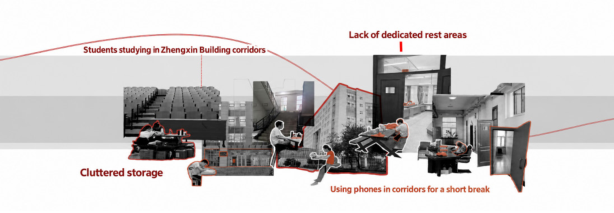
Study Context The study was developed for the main campus of Harbin Institute of Technology in Harbin, China. Four candidate common spaces were screened for pedestrian intensity, activity support, proximity to learning facilities, accessibility, and representativeness. Two study-intensive settings were then selected for closer observation and interviews. Preliminary documentation showed that resting and informal study often spill into circulation and building-edge spaces, while dedicated settings for short recovery and flexible activity change are limited.
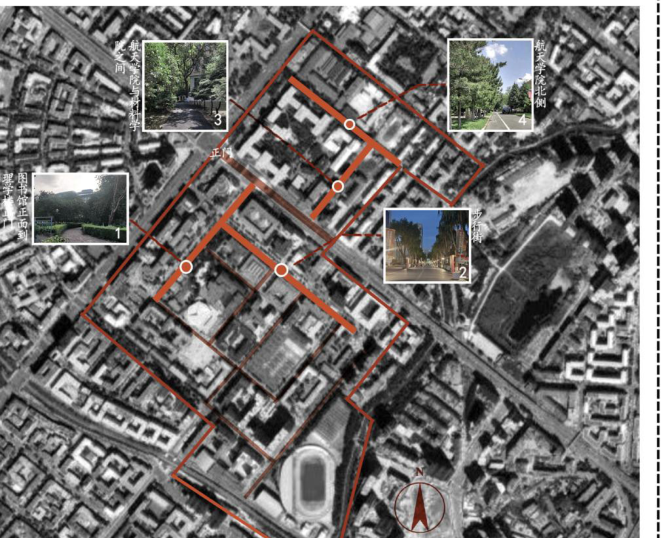
The four candidate nodes lie along frequently used routes and represent distinct relationships among teaching buildings, residence areas, landscape
Evidence-Informed Modular Design for Restorative Campus Open Spaces 1039 edges, and pedestrian movement (Fig. 2). Their comparison established the spatial context for interpreting the observation, questionnaire, and interview evidence.
Figure 1: Existing campus-space conditions, including improvised resting, limited activity choice, and a shortage of dedicated recovery settings.Figure 2: Campus study context and four candidate open-space nodes along major student routes.
Evidence Sources and Analysis The study combined quantitative and qualitative sources. The questionnaire yielded 95 valid responses (67 online and 28 on-site) after completeness and logical-consistency screening of 101 collected questionnaires. Descriptive statistics were calculated for pressure, recovery behavior, functional needs, spatial openness, and environmental preferences. The three comparable items used to evaluate existing campus rest spaces had 67 complete online
responses and satisfactory internal consistency (Cronbach’s alpha = 0.881). Material and color preferences were reported from the 28-response on-site questionnaire. Behavioral observations recorded activity type, location, and dwell patterns, while interviews were summarized through open coding and thematic analysis.
Table 1: Research methods and evidence sources.
Table available in the original PDF paper.
Method Sample Data Collected Analytical Purpose Site screening Site survey 4 public spaces Spatial characteristics and campus context
Objective behavior evidence
Behavioral observation
2 study-intensive settings
Activity type, location, dwell time, spatial distribution
Questionnaire 95 valid; 101
Quantitative assessment
collected
Pressure, recovery behavior, space evaluation and preferences
Qualitative interpretation
Semi- structured interviews
12 participants Spatial experience, unmet needs and design expectations
Evidence-to-Design Translation Results were retained with their original denominators. Measures combining the online and on-site questionnaires use N = 95; the existing-space evaluation uses the 67-response online subset; and material and color preferences use the 28-response on-site subset. Evidence was synthesized into three design- relevant categories: functional needs, spatial adaptability, and environmental preferences. These categories were mapped to module types, enclosure gradients, and a low-stimulus environmental strategy. The proposal is evaluated for consistency between evidence and design representation, not for post-occupancy effectiveness.
RESULTS
Pressure and Everyday Recovery Context Pressure was rated on a five-point scale from –2 to 2, with lower scores indicating greater pressure. Across the 95 valid questionnaires, the mean was –1.011 (SD = 1.135), and 74 respondents (77.9%) selected –2 or –1. Walking (61.1%), mind-wandering or doing nothing (58.9%), and communication (49.5%) were the most common recovery behaviors. These results establish a context of substantial end-of-term pressure and show that recovery often relies on short, low-cost activities embedded in daily campus routes; they do not demonstrate that environmental conditions caused the reported pressure.
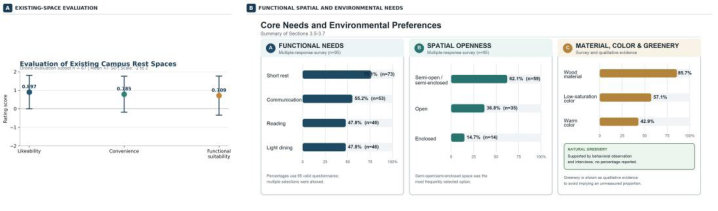
Evaluation of Existing Campus Rest Spaces The 67-response evaluation subset rated existing spaces positively overall (Fig. 3A). Likeability received the highest mean (M = 0.897, SD = 0.905), followed by convenience (M = 0.785, SD = 0.968). Functional suitability had the lowest mean (M = 0.709) and the largest dispersion (SD = 1.052).
Evidence-Informed Modular Design for Restorative Campus Open Spaces 1041 Thus, the central problem is not simply the absence of usable places: existing spaces are accessible and generally liked, but their ability to support different activities is less consistent across students. This functional gap provides the transition from site evaluation to the needs analysis.
Functional Spatial and Environmental Preferences Across the 95 valid questionnaires, short rest was selected by 73 respondents (76.1%), communication by 53 (55.2%), and reading and light dining by 46 each (47.8%). Semi-open or semi-enclosed space was the most frequently selected spatial condition (59 respondents; 62.1%), while open and enclosed space were also selected by 36.8% and 14.7%, respectively. Because multiple responses were allowed, these values describe acceptable choices rather than mutually exclusive groups. Within the 28-response on-site questionnaire, wood was selected by 85.7%, low-saturation colors by 57.1%, and warm tones by 42.9%; greenery was supported by observation and interview evidence without a reported percentage (Fig. 3B).
The combined pattern supports diversity rather than one universal setting. Functional evidence calls for short-rest, social, reading, and light-dining options. Spatial evidence supports a gradient from open interaction to partial shelter and temporary withdrawal. Environmental preferences indicate a restrained, natural character, but they are treated as directional preferences rather than proof that any material or color will reduce stress.
Figure 3: Evaluation and preference evidence: (A) mean ratings and standard deviations for existing campus rest spaces (online subset, n = 67; scale −2 to 2); and (B) functional needs and spatial openness (combined N = 95), material and color preferences (on-site subset, n = 28), and qualitative greenery evidence.
MODULAR DESIGN TRANSLATION Needs Interpretation and Modular Response
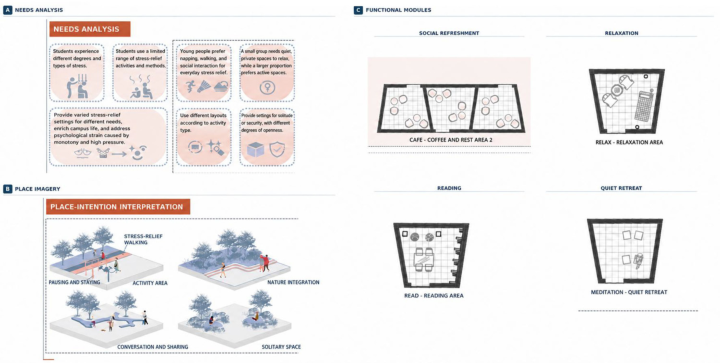
The design analysis translates the evidence into three connected readings (Fig. 4). Panel A interprets differences in pressure, recovery activity, and desired privacy as requirements for functional diversity and adjustable enclosure. Panel B organizes the intended experience into four complementary conditions: short rest, light activity, informal conversation, and temporary retreat. Panel C converts these conditions into four functional modules for social refreshment, relaxation, reading, and quiet retreat. Together, the panels show how the proposal moves from user needs to spatial character and then
to recognizable design elements without presenting the unbuilt scheme as a tested intervention.
Figure 4: Design analysis and modular response: (A) needs analysis, (B) place imagery for short rest, activity, informal conversation, and temporary retreat, and (C) functional modules for social refreshment, relaxation, reading, and quiet retreat.
Spatial Arrangement and Environmental Character The modular strategy organizes the four settings as a family rather than a single building. Socially active modules should face principal arrival routes, while reading and quiet-retreat modules can be positioned deeper within the site or buffered by planting. Relaxation settings mediate between these conditions. The composition creates a sequence from open circulation to semi-defined occupation and more sheltered retreat. This arrangement interprets the preference for intermediate enclosure as spatial choice, not as a universal requirement for walls.
Planting and curved landscape edges provide visual continuity and soft separation. The spatial strategy retains a continuous perimeter route so that users can pass through the site without entering a module. Material and color preferences are represented conceptually through natural textures and a restrained palette. Technical requirements such as accessibility, drainage, winter maintenance, fire safety, and exact circulation widths were not measured in the preference survey and would need separate verification before implementation.
DISCUSSION
The results form a continuous argument. Students reported substantial pressure and relied on brief, accessible recovery activities. Existing spaces were generally liked and convenient, yet functional suitability was the weakest and most variable evaluation. The subsequent needs analysis identifies what that functional gap contains: short rest, communication, reading, light dining, and different degrees of openness. A modular approach responds by providing recognizable alternatives within one open-space system rather than assigning all users to a single restorative setting.
Evidence-Informed Modular Design for Restorative Campus Open Spaces 1043 The preference for semi-open or semi-enclosed settings is particularly important. Campus spaces are often treated as either fully public circulation zones or clearly bounded rooms. The survey results point toward intermediate conditions in which users remain connected to campus life while gaining some control over gaze, noise, and proximity. In the prototype, this condition is produced through module orientation, planting, and spacing rather than complete enclosure. Such measures may support perceived refuge while preserving visibility and access.
Environmental preferences should be interpreted conservatively. Wood, warm tones, and low saturation can inform atmosphere, but their restorative value depends on material placement, lighting, maintenance, thermal conditions, and exposure duration (Guo et al., 2023; Li et al., 2023; Weijs et al., 2023; Michels et al., 2022). In Harbin, outdoor design must additionally address a long cold season, snow management, wind, and seasonal changes in vegetation. The present prototype offers a summer-oriented spatial concept; year-round performance would require climatic simulation and field testing.
Several limitations constrain the study. It was conducted at one university with a non-probability sample, and some measures applied only to questionnaire subsets; denominators must therefore be read by analysis. The material and color findings are preference evidence rather than performance tests. Detailed raw observation schedules, interview coding records, and respondent-level data were not available for independent reanalysis. Finally, the design was not built, so no claim can be made about use rates, stress reduction, or post-occupancy satisfaction. Future work should test a small reversible installation and predefine occupancy, dwell time, activity fit, perceived restoration, and environmental comfort measures.
CONCLUSION
This study demonstrates a cautious pathway from documented user evidence to a modular campus open-space concept. The argument begins with a measurable gap: existing spaces are generally liked and convenient, but their functional suitability is lower and more variable. The combined 95-response needs analysis then identifies short rest, communication, reading, light dining, and semi-open or semi-enclosed settings as principal design concerns, supplemented by material and color preferences from the 28-response on-site subset and qualitative evidence for greenery.
These findings were translated into functional diversity, spatial adaptability, and restorative environmental quality, then represented through a coordinated family of modular units. The value of the prototype lies in making this reasoning visible. It should not be interpreted as proof of effectiveness; implementation and post-occupancy evaluation are required before claims about psychological recovery or broader transferability can be supported.
REFERENCES
Auerbach RP, Mortier P, Bruffaerts R, et al. WHO World Mental Health Surveys International College Student Project: Prevalence and distribution of mental disorders. Journal of Abnormal Psychology. 2018;127(7):623–638. doi: 10.1037/ abn0000362.
Guo W, Wen H, Liu X. Research on the psychologically restorative effects of campus common spaces from the perspective of health. Frontiers in Public Health. 2023;11:1131180. doi: 10.3389/fpubh.2023.1131180. Li J, Chen S, Xu H, Kang J. Effects of implanted wood components on environmental
restorative quality of indoor informal learning spaces in college. Building and Environment. 2023;245:110890. doi: 10.1016/j.buildenv.2023.110890. Liu W, Sun N, Guo J, Zheng Z. Campus green spaces, academic achievement and mental health of college students. International Journal of Environmental Research and Public Health. 2022;19(14):8618. doi: 10.3390/ijerph19148618. Michels N, Debra G, Mattheeuws L, Hooyberg A. Indoor nature integration for stress
recovery and healthy eating: A picture experiment with plants versus green color. Environmental Research. 2022;212:113643. doi: 10.1016/j.envres.2022.113643. Peng L, Jin S, Deng Y, Gong Y. Students’ perceptions of active learning classrooms from an informal learning perspective. Sustainability. 2022;14(14):8578. doi: 10.3390/su14148578. Persson H, Ahman H, Yngling AA, Gulliksen J. Universal design, inclusive design,
accessible design, design for all: Different concepts-one goal? Universal Access in the Information Society. 2015;14:505–526. doi: 10.1007/s10209-014-0358-z. Sun N, Liu W, Zheng Z. Campus outdoor environment, learning engagement, and the mental health of college students during the COVID-19 pandemic. Frontiers in Public Health. 2023;11:1143635. doi: 10.3389/fpubh.2023.1143635. Ulrich RS, Simons RF, Losito BD, Fiorito E, Miles MA, Zelson M. Stress recovery
during exposure to natural and urban environments. Journal of Environmental Psychology. 1991;11(3):201–230. doi: 10.1016/S0272-4944(05)80184-7. Weijs ML, Jonauskaite D, Reutimann R, Mohr C, Lenggenhager B. Effects of environmental colours in virtual reality: Physiological arousal affected by lightness and hue. Royal Society Open Science. 2023;10(10):230432. doi: 10.1098/ rsos.230432. World Health Organization. World Mental Health Report: Transforming Mental
Health for All. Geneva: WHO; 2022. Wu X, Kou Z, Oldfield P, Heath T, Borsi K. Informal learning spaces in higher education: student preferences and activities. Buildings. 2021;11(6):252. doi: 10.3390/buildings11060252.
SEARCH THE AHFE DIGITAL BOOKSTORE BY ISBN
Explore the complete digital volume
Human Factors in Design, Engineering, and Computing
Read this individual research paper free through the original publisher, or explore the full digital proceedings book.