Sebastian Huber, Christian Zagel, Freimut Bodendorf (2019). Interactive System Design forCollaborative Case Management. In: Advances in The Human Side of Service Engineering. AHFE Open Access, vol. 8. https://doi.org/10.54941/ahfe100264
The success of knowledge work represents one of the most important aspects for businesses to date. Managers across all industries are searching for new ways to increase the productivity in this domain. Since traditional approaches, such as Business Process Management cannot provide the suitable context to support knowledge intensive workflows, the recent trend of Adaptive Case Management has set out to address this issue by providing a framework that enables an agile and dynamic environment for work execution. As this is a very young discipline, suitable software solutions are still rare. Therefore, the paper at hand consolidates the general principles behind this new approach and subsequently focuses on the aspect of user interface design covering innovative technologies and new methodologies of the Human Computer Interaction domain. In addition, this work also discusses possible solution approaches and presents a reference implementation based on the findings proposed. The presented solution aims at increasing employee productivity and creativity by providing a motivating way of collaboration.
It is not a recent discovery that the role of knowledge-intensive work in a business environment has been growing rapidly over the last few years (Shepherd, 2010). Industrialized countries in particular, have experienced an increasing demand for workers in Research & Development departments and alike, and this trend is projected to continue in the future (Schmidt, 2009). As a consequence, increased productivity in these areas is becoming a major concern for companies that strive to realize long-term competitive advantages.
During the last decade, Business Process Management (BPM) has established itself as the traditional approach to increase business productivity (McCauley, 2010). By providing tools that enable companies to define and map their processes onto an IT environment, BPM primarily aims at structuring key workflows by automating highly repetitive, low-level, and administrative tasks. The result of this development becomes evident in today’s sophisticated platforms, supporting major company processes, like e.g., enterprise resource planning (ERP), customer relationship management (CRM), and supply chain management (SCM).
While this approach has been successful in structured environments, traditional BPM faces a profound conflict in the context of knowledge-intensive work. On the one hand, BPM aims at formally defining static workflows in order to realize repeatability and automation. On the other hand, the very nature of knowledge work demands a flexible, unstructured framework that is driven by creativity, unknown events and empowers actors to adapt to unpredictable circumstances (Swenson, 2010b). This fundamental contradiction makes it difficult, if not impossible, to apply the traditional approach of increasing productivity in a knowledge environment.
The recent development of Adaptive Case Management (ACM) has set out to address these issues, by providing an infrastructure for knowledge-based work that focuses on the required flexibility, tools and dynamics associated with this obstacle. The basic principle behind ACM is to leave the general structure of a given workflow open to adaptation and changes, by combining the build-time and run-time phases of BPM into a single process.
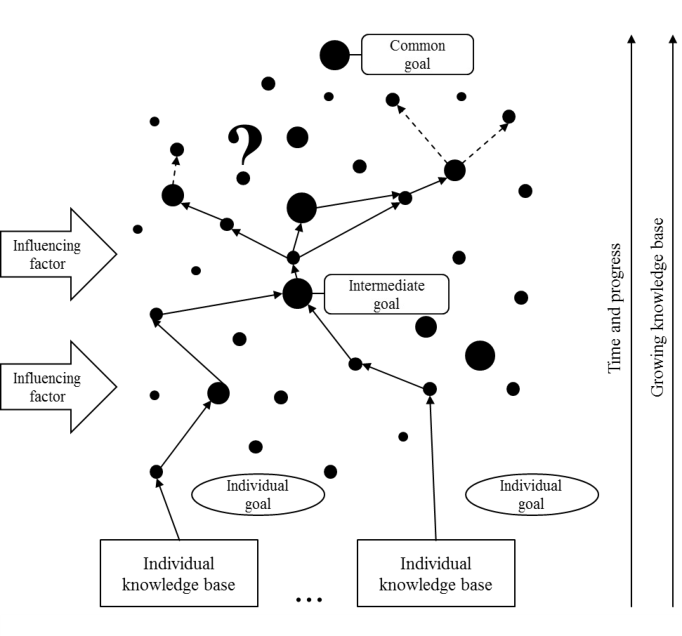
Schematically, Figure 1 illustrates this comprehensive view of ACM: In a case a common goal is predefined and the involved humans contribute their individual knowledge bases. The interdisciplinary collaboration and co-work is characterized by a growing knowledge base over the execution time. At the same time corrective actions and adjustments of the process are possible for the parties involved in order to respond to external factors or unforeseen disturbances. One major characteristic of a case is that the way to achieve the desired output is not predictable.
Figure 1. Overview of Adaptive Case Management
In order to meet this solution approach, which is also widely recognized in business practice for knowledge- intensive business processes, a paradigm shift can be observed in BPM (cf. Figure 2). So far, the traditional process and project management approaches are top-down oriented. This means, that initially the organizational and process structure of an organization is defined and deployed. Then the process instances or projects follow a strictly documented plan and their execution is usually monitored continuously. In contrast, cases focus on the interdisciplinary cooperation which implies that the approach is bottom-up and the work is done across the formal organizational structure as well as cross-functional. If available, cases can follow existing templates and best practices, which can be used from successful archived cases. The actual case execution is simultaneously dynamic and emergent. This means, that the classical planning and execution phases merge.
By empowering actors to shape their environment according to the respective circumstances, the overall process turns out to dynamically evolve during the actual execution, rather than being strictly defined in advance. As a consequence, knowledge workers are presented with a system that enables them to react to unpredictable challenges, while making adjustments based on their own expertise and preferences (Kraft, 2010).
With this claim in mind, ACM promises to fill in the gap left open by traditional BPM. However, while the general concepts and goals seem to be clear, there is still little consensus on how to unfold and implement the approach in a real-life business environment. In order for ACM to live up to its expectations, further research is required especially regarding the question on how to design such an application to optimally integrate and support the knowledge worker. With current technological developments, the application of innovative interaction approaches may additionally support collaborative work and consequently facilitate an increase in productivity and effectiveness.
METHODOLOGY
Figure 2. Paradigm-shift in Business Process Management The research methodology follows a three-step approach: (1) based on a literature review, the general ideas and common principles of ACM are consolidated and depicted. (2) Then, the success factors of HCI input devices are derived applying a case study approach. (3) Finally, an IT-based solution approach is presented as well as evaluated using a prototype (Collaborative Case Management).
Figure available in the original PDF paper.
RELATED WORK
Central Principles of Adaptive Case Management The actual term “Adaptive Case Management” was developed during an expert meeting in 2009, which resulted in the first and most prominent publication on ACM: “Mastering the Unpredictable” (Swenson, 2010a). In this collective volume, the authors describe a variety of individual ideas on how to realize and implement the new paradigm, which shows that the specifics for the implementation are still highly disputed. For example, Pucher (2010) suggests a very comprehensive, domain-independent approach, whereas Matthias (2010) supports a “slim” and specialized system that is tailored to the respective environment. Similarly, Hollingsworth, (2010) derives the ACM concept from a healthcare background, while Kraft (2010) relies on customer management, and de Henk et al. (2010) focus on their individual understanding of innovation management.
Nonetheless, all authors largely agree on main characteristics and define “cases” as the central entity that encapsulates the knowledge-intensive process in ACM. Huber et al. (2013, 2014) consolidate and describe the fundamental principles. The following enumeration focuses on the collaboration challenges implied:
1) Goal orientation: A case is defined by a specific goal, which needs to be attained during the process execution and within a predefined (but adjustable) timeframe (Kraft, 2010). As the goal describes what needs to be accomplished, and therefore guides the general stream of work, it replaces the traditional model that would outline how the process must be executed (Ukelson, 2010). This provides knowledge workers with the necessary freedom and flexibility to constantly plan, prioritize, and reevaluate the structure of activities towards that goal. However, determining the case progress proves to be difficult, as the state of the case as a whole is determined by the combined state of all sub-goals, tasks, documents, other related business entities or even other related cases (Pucher, 2010). As ACM demands a flexible and adjustable environment, this claim needs to be carefully balanced with existing restrictions that are necessary for successful process execution. Managers and participants therefore need to be provided with the respective tools to define and enforce constraints, as well as to spot instances that are at risk of breaking them.
2) Emergence: ACM needs to provide the necessary means to support emergent processes and roll out solutions that empower knowledge workers to deal with the dynamic nature of the workflows they are engaged in (Shepherd, 2010). As the process is not dictated ahead of time, participants can control the order of steps, add new participants or change the type of information needed, effectively merging the traditional planning- and execution phases into a single step (Pucher, 2010). In order to support this degree of adaptability, processes are defined as and described by a set of dynamic tasks, rather than rigid flow charts (Shepherd, 2010). By allowing knowledge workers to shape and adjust their individual surroundings as they see fit, the presentation of a case or multiple cases can be optimized for each type of user and be designed around the way they will interact with it (Khoyi & Swenson, 2010).
3) Data centricity: Messages, documents, spreadsheets, etc., play an integral part in the context of knowledge work and is both produced and consumed during the actual execution of the process (Ukelson, 2010). Since ACM is characterized by a high degree of variability and lacks a predefined workflow, it is in fact the data that drives and shapes the case and its environment. The case is therefore aligned with the respective data and collects activities that are necessary for its goal-oriented transformation (Swenson, 2010b). Because content is the driver of knowledge intensive processes, ACM requires a comprehensive facility for creating, capturing, indexing, storing, finding, sharing, editing, versioning, and retaining a wide variety of data types (Pucher, 2010). All case documentation, including emails, meeting notes, correspondence, etc., must be organized and accessible to participants working on the same case. In addition, a typical knowledge-work scenario may transcend multiple departments or organizations and needs to draw information from many different sources. Content and case artifacts may reside on separate application systems, or even physical storage facilities (McCauley, 2010). Part of ACM's complexity is therefore represented by the workers' need for access to a variety of external and internal resources. So far, the challenge of bringing all these sources together in the context of managing a process has been too difficult or too expensive for many organizations to address (McCauley, 2010).
4) Collaboration: Knowledge-intensive work mainly consists of human interactions and therefore requires a high degree of collaboration (Ukelson, 2010). As multiple people take part in the process they need to be provided with tools to communicate, cooperate, and coordinate information and activities (McCauley, 2010). This also implies a high degree of transparency to allow all participants to put their actions into a greater context. ACM therefore needs to support social interactions and negotiations with a suitable set of tools that are integrated into the case environment. Collaboration must be easy, widespread, and productive (McCauley, 2010). To support this claim, current IT landscapes already provide a wide variety of tools such as wikis, blogs, chats, and decision support tools. However, no system can claim to incorporate all possible channels of communication. In order to avoid participants being overwhelmed or confused, information and data must be organized and presented in a useful way and assist their efficient and effective collaboration. A collaborative ACM implementation must know who needs what and when, and must not supply irrelevant information. Even complex collaboration data should therefore be structured and presented to caseworkers simply, intuitively, and in a context-sensitive manner (McCauley, 2010).
5) Transparency: One of the most important aspects of ACM is the concept of knowledge preservation and continuous improvement through templates. Even though case instances are not precisely repeatable, they often contain recurring elements and patterns that can be identified and made available for future usage and adaptation (Khoyi & Swenson, 2010). Knowledge workers may capture, share, and improve ideas and best practices through a community library and create new cases assembled from existing templates (Kraft, 2010). This case-spanning concept can have a big effect on productivity, as it provides guidance (not constraints) for future process iterations and makes knowledge transparent and available. Case templates provide the opportunity for knowledge preservation and continuous improvement. As similar problems often have similar Human Side of Service Engineering (2019) solutions, workers can execute new case instances based on existing solutions or store current instances for future usage (McCauley, 2010).
Success Factors of Human Computer Interaction The Human Computer Interaction (HCI) research discipline is not limited to studying the physical components of a system. Psychological elements, especially the experiential elements of interacting with computers increasingly gain practitioner’s and researcher’s attention (Zagel et al. 2014). The primary goal is to create positive experiences by selecting appropriate innovative technologies as a means for interaction. Studies prove that an increase in the perceived user experience may lead to an additional ascription of the functional value (Hassenzahl et al. 2009).
On the other hand, these psychological aspects also reflect on the respective mental models, which represent implicit knowledge like schemes, paradigms, perspectives and attitudes towards the perception and definition of the environment (Johnson-Laird 1983). A mental model can therefore be described as the cerebral representation of a system’s functionality. Kilimoski and Mohammed (1994) state, that members of a team likely internalize multiple individual mental models. By approximating these models, it is possible to create a so-called “shared mental model”, that is able to enhance a team’s productivity and efficiency (Cannon-Bowers et al. 1993). The more intuitive the use of a system, the easier it is for the user to construct the respective mental model. While research was able to prove the effectiveness of shared mental models in collaborative work before, “much empirical and conceptual work remains to be done” (Payne, 2008). A key aspect is the impact of the HCI technology applied.
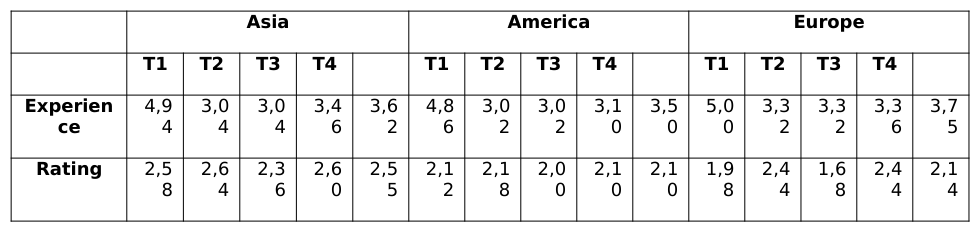
Within the scope of a HCI study the user-specific success factors in regards to traditional and innovative interaction possibilities are evaluated. A total of 150 subjects of different nationalities (50 Asian, 50 European, 50 American) are asked about their usage. Besides traditional technologies like mouse and keyboard interaction, also more recent methods like touch and multi-touch as well as contactless technologies like gesture and speech control are included in the survey. Focus lies on evaluating the perceived intuitiveness and fun during use. The respective technologies are rated on a Likert-type scale labeled at the end points (1 = “very good”; 5 = “very bad”). Previous experience with the technology is rated on a scale from 1 (no previous experience) to 5 (daily usage).
Table 1: Average rating of the interaction technologies Asia America Europe
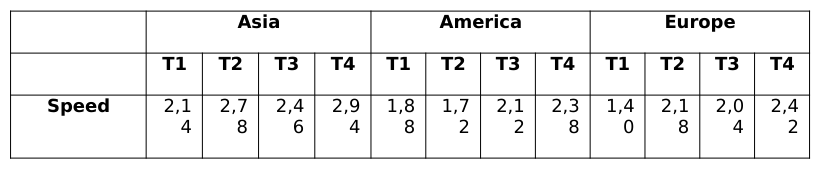
The results accredit the European subjects a higher experience with the respective technologies than the Asian or American subjects. At the same time, the technologies are rated more critical (cf. Table 1) 1. Most of the subjects rate the technologies on a clearly rational level, assigning usability and reliability as the highest importance. Nevertheless, joy of use and intuitiveness seem to significantly influence the choice of an interaction type. Multi- touch interaction is rated better in comparison to traditional control methods (mouse and keyboard) in both criteria. Even though traditional technologies are used for completing daily tasks, more innovative methods are preferred if available. Both factors, intuitiveness and joy of use, significantly influence the perceived usefulness of a system. This psychological relationship can also be transferred to collaborative systems.
Table 2: Comparison of the interaction technologies Asia America Europe
Current realizations of ACM systems are based on the following assumption: while multiple team members participate in working on a collaborative software platform, interaction with the system still happens through individual devices (e.g., the employee’s personal computer). The concept proposed tries to increase the manifestation of the shared mental model by increasing intuitiveness and a better collaboration through a multi-user interaction tool. Multi-touch tabletop displays have been identified as a medium that supports the collaborative aspect of work (Dohse et al. 2008).
Within the concrete use case of ACM and based on the research presented, an increase of productivity is expected, by using a multi-touch tabletops as a common interaction medium, thus strengthening the shared mental model. The following chapter provides an overview about how an IT-based solution (so-called Collaborative Case Management) has to be designed to reflect the requirements for multi-user interaction technologies.
SYSTEM DESIGN FOR COLLABORATIVE CASE MANAGEMENT Architecture
In order to evaluate the effectives of new input devices on collaboration, an initial prototype has been designed and implemented. Even though additional building blocks are part of this release, the subsequent presentation will focus on approaches that are backed by positive user feedback and evaluation data. The tentative design of the prototype is based on Jablonski’s (2004) systematic approach, which separates the complexity of the architectural concept into platform and application layers, which are linked by technologies and standards.
The platform’s architecture is represented by a web-architecture according to Jablonski (2004), and can therefore be divided into four separate layers, namely back-end, application server, web portal and client. The basis of the system is represented by the Linux Ubuntu operating system and a database instance of Oracle’s MySQL service. This first layer provides the basic runtime environment and required data storage facilities. The application server is based on the GlassFish community server, which offers a framework for the development of JavaEE based applications and connects the prototype with the underlying infrastructure. In order to operate the actual application, clients merely require a traditional web browser. To further enhance the usability, the user interface relies on JavaScript and AJAX technologies, which provide a “desktop-like” look-and-feel for the final application.
The application architecture is organized according to functional criteria. Therefore, the prototype distinguishes the layers data management, business logic and presentation (Jablonski, 2004). This structure comprises the actual navigation tree of the entire system and provides a comprehensive overview of the available items and their respective position within the system.
Design The following components are available across all case instances to provide the basic functionality of a collaboration platform:
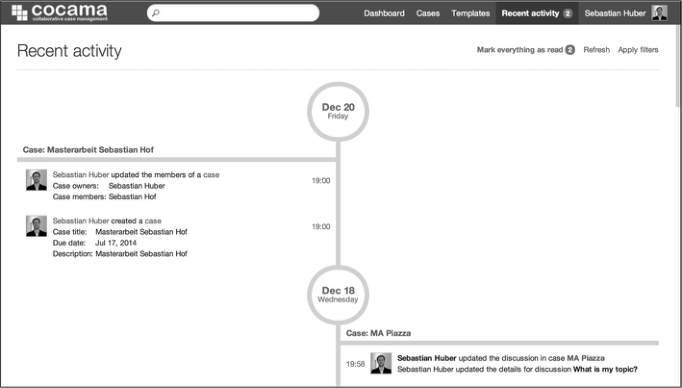
1) Activities: This section collects all activities on the platform and visualizes them in different views. They can be searched, filtered, and commented. Moreover, discussions within the activity streams are possible as well (cf. Figure 3).
Figure 3. Case-spanning Activity Stream
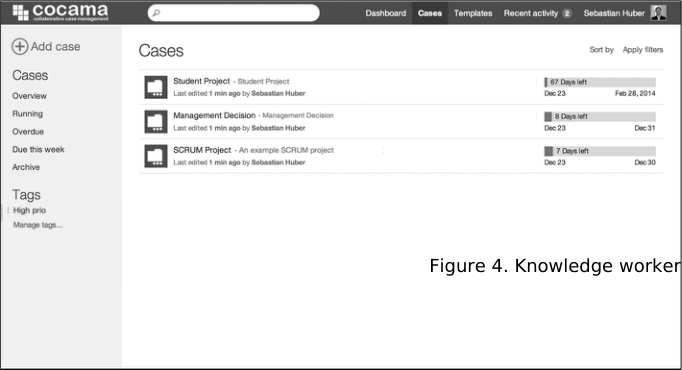
2) Dashboard: The dashboard gives an overview for the knowledge-worker of all relevant business objects he is involved in. By using state-of-the art visualization techniques this information helps to improve the detection of cause-effect relationships and action needs (cf. Figure 4).
3) Cases: The core of the platform is the case management system. This section shows all relevant cases, the user can work, edit, and proceed in different views (cf. Figure 5). The actual collaboration in those cases is depicted later in this section.
Figure 4. Knowledge worker's dashboard
Figure available in the original PDF paper.
Figure 5. Case overview
4) Templates: This component manages the different patterns for cases. Templates contain best practices for the task execution and collaboration. They can be instantiated as new cases that need to be solved. The collaborative work in individual cases may also serve as a basis for the development of a common knowledge base by archiving those cases. The repository also provides the possibility to manage business services, orchestrated processes and technical services in a SOA-like approach. In addition, the templates can be exchanged with other participants and communities.
5) Organizations: This section extends the administration on a personal level (e.g., own profile, notification settings, tags, and embedded external applications) by adding functions to configure the visibility settings for templates and available functionalities (case extensions) for user groups. That way the system is multi-client capable and suitable for the deployment in a cloud computing environment.
The following functions are available within each case:
1) Case Dashboard: The dashboard is designed to implement the core principles of goal orientation and transparency. This component provides all the necessary features to define and control case goals, according to the management-by-objectives approach. Different views (e.g., Earned Value Charts and Motion Charts) provide adequate information retrieval and processing techniques (e.g., visualization of the entire history of a case).
2) Case Members: This component implements the integrated roles concept and manages the assignment of user rights. The prototype offers pure reading access for e.g., external partners as well as the possibility of an active membership of a case to collaboratively work on tasks. The case owner role enables users to make fundamental changes in the case structure.
3) Case Extensions: This functionality provides the possibility to enrich the collaborative work in cases with comprehensive case extensions that can be added or removed during runtime. The default setting of extension is limited to the fundamental components, required for task execution (e.g., task list, decision support system, and document libraries).
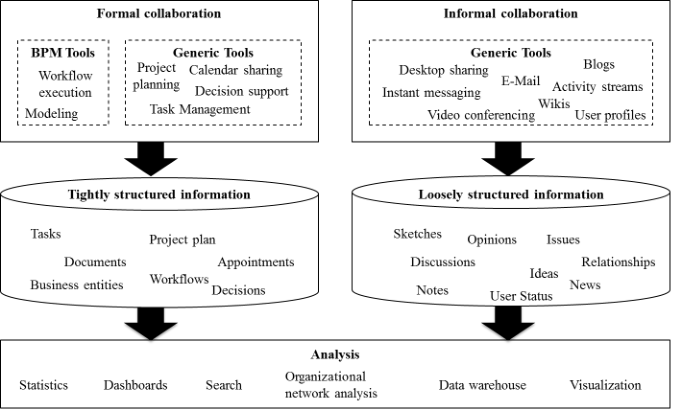
The key idea of case extensions is to provide a modular suit of collaboration functionalities that can be flexibly added during case execution. That way, the collaboration platform focuses on the fundamental components that are required for small projects. As a case grows over time new functions may be necessary and can be attached easily. Figure 6 gives an overview of the different case extensions by combining formal and informal collaboration for structured and weakly structured contents.
Figure 6. Overview of case extensions
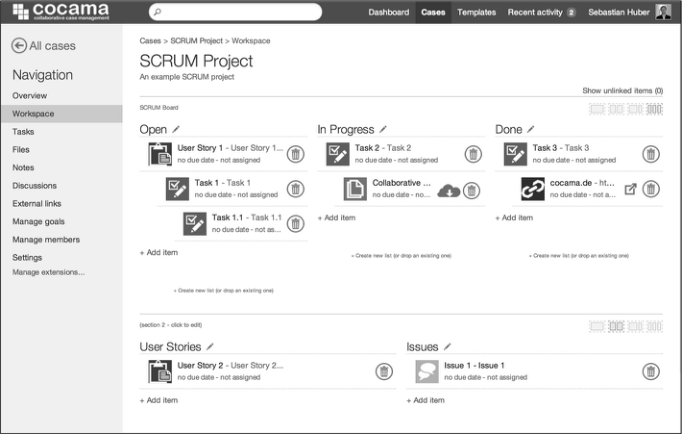
Another important aspect is the collaboration on different business objects, like tasks, documents, and decisions. In typical software solutions these objects are treated in separate navigation views and functions respectively. The option to create relationships between those business objects is not provided. An innovative approach in that regard, which directly supports collaboration, is the case workspace. With an intuitive “drag and drop” behavior it is possible to create different lists and freely arrange all objects that are used in the case. That way hierarchical relationship between tasks (milestones, subtasks) or the assignment of documents to discussions, etc. could be realized. That functionality has been developed with multi-touch tabletops in mind. It increases the manifestation of the shared mental model, because the workspace view is common for all case contributors. In Figure 7 an example of a task board that is used in agile software development (SCRUM) is depicted. Another example could be a typical scheduling decision. Therefore, two lists are required: one list for the different decision outcomes (e.g., appointment date 1 and 2) and one for the participants. Now the case members could assign themselves via drag-and-drop to the different alternatives. The workspace serves as a flexible integrator for the business objects used in the different case extensions and is an innovative view to collaborate on them and to create semantic relationships between those objects.
Figure 7. Case workspace
Evaluation To test the implemented prototype, the collaborative nature of work has been simulated as part of a student case study (n=63). This scenario is based on real-world projects of a fashion manufacturer, which has to coordinate a large number of suppliers in order to design and manufacture a new fashion product. With new suppliers being integrated and existing suppliers being replaced, this process is knowledge-intensive, difficult to plan ex-ante and collaborative. As the supplier is responsible for coordinating the entire project, the case study comprises two major roles:
1) Managing role (case owners): This role is responsible for the entire management of the different group tasks and has to consolidate them as a final result.
2) Operational role (case members): In cases of other groups this role has to provide a specific task and is controlled by the case-spanning role.
During the case study every group (12 groups in total) fulfilled both roles and worked on five different tasks. For each tasks they had two weeks to coordinate and deliver the results. Table 3 summarizes the data that has been collected from the prototype during the case study execution.
Activity Amount
Table 3. Quantitative evaluation data Invited users 63 Created user groups 12
Table available in the original PDF paper.
Collected events (clicks, etc.) 4.505.607 Discussions started 96 Cases created 74
Tasks created 883 Messages sent 911 Activity Stream Events 2.608
Documents uploaded 119
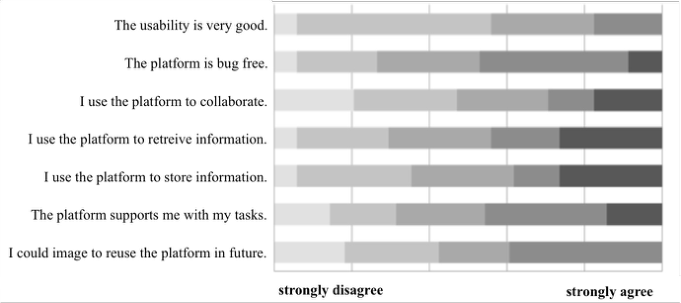
With more than 2.600 activity stream events, the prototype is intensively used for collaboration. One major challenge is to consolidate those events to prevent an information overflow for the user. For instance if a document has been changed several times in the last few minutes those events can be grouped together into one single activity without losing too much relevant information. Aside the technical data collection, the case study participants were also asked to rate the actual implementation based on the statements depicted in Figure 8.
Figure 8. Qualitative evaluation data
The first results are promising, as the proposed solutions to handle collaborative tasks with the Collaborative Case Management approach seems to enable the user to fulfill the complex collaborative case study scenario.
CONCLUSIONS
This contribution outlined and discussed how the recent trend of ACM has set out to revolutionize the way knowledge work can be supported with IT. First, the general concepts and principles behind the new paradigm were introduced, and put into the broader context of BPM as a whole. Subsequently, the success factors of Human Computer Interaction were investigated, in order to illustrate the fundamental differences of an ACM implementation compared to other traditional IT systems for collaboration tasks.
By following the fundamental principles of ACM, this approach promises to master the emergent and unpredictable nature of knowledge work, which is often highly collaborative. As the new approach breaks with the traditional separation of planning and execution (and in fact merges both phases into one), workers are provided with a framework that supports the required flexibility and enables an agile and dynamic environment for teamwork.
Especially the case workspace is designed for team collaboration by utilizing new ways of interaction (e.g., multi- touch tabletop displays). By rearranging the different case elements, the contributors share their mental model. However, as the implementation did not encompass all suggestions of the new approach, additional research challenges have to be resolved in the future.
Further work has to be done in optimizing the collaborative user interface of the system. One major limitation is the screen orientation of the workspace that hinders free interaction of several users at once. An orientation-independent interface will be constructed that allows interacting with the system from all sides of a multi-touch enabled tabletop. Additional evaluations of the new interaction concept in a real life scenario will include the methodology’s impact on joy-of use and productivity in collaborative process management tasks.
Additionally, the concept was only tested in a case study scenario with students. As they do not represent typical knowledge workers in the IT industry, more applications in further business scenarios and in different application domains could be used to enrich the solution approach as well as to improve the prototype.
Nonetheless, ACM has emerged as a compelling paradigm to manage the unpredictable. As the development of the technology is still at a very early stage, further research efforts are required to mature the concept. Understanding the specific design challenges however, will pave the way for ACM to realize its full potential.
REFERENCES
Cannon-Bowers, J. A., Salas, E., Converse, S. A. (1993), “Shared mental models in expert team decision-making” in: Individual and Group Decision Making, Castellan , N. J. (Ed.), Hillsdale, Lawrence Erlbaum, pp. 221-246 de Henk, M., Prasad, S., van Donge, T. (2010), “Innovation Management“ in: Mastering the Unpredictable. How Adaptive Case
Management Will Revolutionize The Way That Knowledge Workers Get Things Done, Swenson, K. D. (Ed.), Tampa, Meghan-Kiffer Press, pp. 211–256 Dohse, K. C., Dohse, T., Still, J. D., Parkhurst, D. J. (2008), “Enhancing Multi-user Interaction with Multi-touch Tabletop Displays using Hand Tracking” in: Proceedings of the First International Conference on Advances in Computer-Human Interaction, pp. 297-302 Hassenzahl, M., Eckholdt, K., Thielsch, M. T. (2009), “User Experience and Experience Design – Konzepte und
Herausforderungen“ in: Usability Professionals, pp. 233-237 Hollingsworth, D. (2010), “Healthcare“ in: Mastering the Unpredictable. How Adaptive Case Management Will Revolutionize The Way That Knowledge Workers Get Things Done, Swenson, K. D. (Ed.), Tampa, Meghan-Kiffer Press, 2010, pp. 163– 180 Huber, S., Hauptmann, A., Lederer, M., Kurz, M. (2013), “Managing Complexity in Adaptive Case Management“ in: S-BPM
ONE Running Solutions: 5th International Conference S-BPM ONE 2013 Proceedings, Fischer H., Schneeberger, H. (Eds.), Berlin: Springer, pp. 209–226 Huber, S., Lederer, M., Bodendorf, F. (2014), “IT-enabled Collaborative Case Management - Principles and Tools” in: Proceedings of the 2014 International Conference on Collaboration Technologies and Systems, Smari, W. W., Fox, G. C., Nygård, M. (Eds.), Minneapolis, Minnesota, USA, IEEE by The Printing House, Inc., Stoughton Jablonski, S. (2004), “Guide to Web Application and Platform Architectures“, Berlin: Springer Johnson-Laird, P. N. (1983), “Mental Models”, Harvard University Press, Cambridge, Mass. Khoyi, D., Swenson, K. D. (2010), “Templates, not Programs“ in: Mastering the Unpredictable. How Adaptive Case
Management Will Revolutionize The Way That Knowledge Workers Get Things Done, Swenson, K. D. (Ed.), Tampa, Meghan-Kiffer Press, 2010, pp. 145-162 Kilimoski, R., Mohammed, S. (1994), “Team Mental Model: Construct or Metaphor?” in: Journal of Management, 20, pp. 403- 437 Kraft, F. M. (2010), “Improving Knowledge Work“ in: Mastering the Unpredictable. How Adaptive Case Management Will
Revolutionize The Way That Knowledge Workers Get Things Done, Swenson, K. D. (Ed.), Tampa, Meghan-Kiffer Press, pp. 181–209 Matthias, J. T. (2010), “Technology for Case Management“ in: Mastering the Unpredictable. How Adaptive Case Management Will Revolutionize The Way That Knowledge Workers Get Things Done, Swenson, K. D. (Ed.), Tampa, Meghan-Kiffer Press, 2010, pp. 63–88 McCauley, D. (2010), “Achieving Agility” in: Mastering the Unpredictable. How Adaptive Case Management Will Revolutionize
The Way That Knowledge Workers Get Things Done, Swenson, K. D. (Ed.), Tampa, Meghan-Kiffer Press, pp. 257-275 Payne, S. J. (2008), “Mental Models in Human-Computer Interaction” in: The Human-Computer Interaction Handbook.
Fundamentals, Evolving Technologies and Emerging Applications, Sears A., Jacko J. A. (Eds.), New York, CRC Press, pp. 63-76 Pucher, M. J. (2010), “The Elements of Adaptive Case Management“ in: Mastering the Unpredictable. How Adaptive Case Management Will Revolutionize The Way That Knowledge Workers Get Things Done, Swenson, K. D. (Ed.), Tampa, Meghan-Kiffer Press, pp. 89–134 Schmidt, K. (2009), „Gestaltungsfeld Arbeit und Innovation. Perspektiven und Best Practices aus dem Bereich Personal und
Innovation“, Freiburg: Haufe Shepherd, T. (2010), “Moving from Anticipation to Adaptation“ in: Mastering the Unpredictable. How Adaptive Case Management Will Revolutionize The Way That Knowledge Workers Get Things Done, Swenson, K. D. (Ed.), Tampa, Meghan-Kiffer Press, pp. 41-62 Swenson, K. D. (2010a), “Mastering the Unpredictable. How Adaptive Case Management Will Revolutionize The Way That
Knowledge Workers Get Things Done”, Tampa, Meghan-Kiffer Press Swenson, K. D. (2010b), “Historical Perspective“ in: Mastering the Unpredictable. How Adaptive Case Management Will Revolutionize The Way That Knowledge Workers Get Things Done, Swenson, K. D. (Ed.), Tampa, Meghan-Kiffer Press, 2010, pp. 293-302 Ukelson, J. P. (2010), “What to do when modeling doesn't work“ in: Mastering the Unpredictable. How Adaptive Case
Management Will Revolutionize The Way That Knowledge Workers Get Things Done, Swenson, K. D. (Ed.), Tampa, Meghan-Kiffer Press, pp. 29-39 Zagel, C., Glomann, L., Süßmuth, J. (2014), „Assessing the influence of gender towards the adoption of technology-enabled selfservice systems in retail environments“, Gender-UseIT 2014, Berlin.
LISTED IN THE AHFE DIGITAL BOOKSTORE CATALOGUE
Explore the complete digital volume
Advances in The Human Side of Service Engineering
Read this individual research paper free through the original publisher, or explore the full digital proceedings book.
ISBN 978-1-4951-2091-6
Explore this ISBN in the AHFE Bookstore ↗Listed in the July 2026 bookstore catalogue; search by ISBN to confirm current availability · Digital book purchase optional