Christian Zagel, Freimut Bodendorf (2019). Success Factors and Approaches of Service Fascination – A Research Framework. In: Advances in The Human Side of Service Engineering. AHFE Open Access, vol. 8. https://doi.org/10.54941/ahfe100293
To gain competitive advantage many retailers, especially the ones of the fast moving consumer goods industry, aim at providing their consumers with unforgettable experiences across various channels. A lot of research has been performed in order to identify appropriate experiential criteria for achieving the highest possible consumer satisfaction. Nevertheless, researchers still lack knowledge regarding the impact of the individual experiential dimensions, the influence of technology as well as possibilities to measure the effects of system design features on perceived consumer experiences. A generalized concept is presented which aims at applying research findings on consumer experience for the strategic development of exciting self-service systems. Supported by an experiential design survey, a service fascination research model is presented to assess strengths and weaknesses of concrete self-service technology artifacts and the dependencies between their utilitarian and hedonic aspects as well as the user’s technology readiness and trust. The approach and corresponding hypotheses are evaluated using the examples of an interactive fitting room as well as a social media mirror specifically designed to create positive emotions amongst young consumers.
MOTIVATION Achieving and retaining leadership in today’s consumer goods industry requires the consistent renewal of not only products and services but also their presentation. Heading towards a service oriented economy, companies strive to be successful mainly by providing extensive services in a wide field of applications. After decades of price fights and cost reductions, practitioners now try to differentiate their companies from others by means of a much stronger focus on their consumers (Shaw and Ivens, 2005). This human-centered approach, putting the consumer in the center of all efforts, is intensively supported by a wide field of researchers (Douglas and Craig, 2000; Farinet and Ploncher, 2002; Parasuraman, 2000) and finally leads to a new, practice-oriented research stream called “Customer Experience” (Meyer and Schwager, 2007; Schmitt, 1999; Schmitt and Mangold, 2004; Verhoef et al., 2009). The concept sees every direct or indirect contact with the consumer as a potential starting point for economic competition (Berry et al., 2002; Pine and Gilmore, 1999). Verhoef et al. (2009) describe customer experience as a construct that “is holistic in nature and involves the customer’s cognitive, affective, emotional, social and physical responses to the retailer.” In contrast to traditional Customer Relationship Management (CRM) approaches the focus comprises emotional and irrational aspects of human behavior (Holbrook and Hirschman, 1982). Referring to
Gentile et al. (2007), “such experience plays a fundamental role in determining the customers’ preferences, which then influence their purchase decision.”
Although literature depicts the general importance of customer experience as such, there is still a lack of knowledge about the impact of its distinct drivers, means of measurement as well as information about the influence of self- service technologies (Verhoef et al., 2009). While many researchers concentrated on E-Commerce applications in the past, more recent works, e.g., the ones conducted by Pantano and Corvello (2010) or Willow (2010), focus on improving the consumer touch points at the physical point of sale. Further research is done by Zagel and Bodendorf (2012), who identify the potential to create new, emotional and exciting self-service solutions for young and technology ready user groups by applying advanced technologies in retail environments.
Building on widely accepted models of customer experience as well as technology acceptance research, this paper describes a two-step approach to (1) to rate the manifestation of the experiential dimensions for concrete self-service artifacts and (2) to assess the correlations of elements influencing the overall experience of self-service use (cf. Zagel et al., 2014). The concept therefore enables researchers and practitioners to strategically build, to measure, and to improve consumer-oriented and technology-based self-service systems with the goal of service fascination1.
As practical examples for self-service technologies in retail environments, two artifacts, an interactive fitting room as well as a social media mirror, are presented. They are compared and used to validate the theoretical model. Conclusions are drawn on how the services can be improved to better serve the consumer’s functional and hedonic needs, leading to fascinating services.
THEORETICAL OVERVIEW The Technology Acceptance Model
For identifying potential issues in the design and acceptance of technology-based systems, researchers have begun to build on theories of innovation diffusion (Rogers, 1962). The focus of most studies lies on identifying the influence of users’ perceptions towards the adoption of new IT solutions. The Technology Acceptance Model (TAM) by Davis (1989) resp. Davis, Bagozzi and Warshaw (1989) is one of the most applied adoption and intention models to explain the usage of technology and the acceptance of information systems (see Figure 1). It is based on Ajzen and Fishbein’s (1980) Theory of Reasoned Action (TRA). TRA explains a person’s behavioral intention by dependencies on the person’s attitude as well as subjective norms. Refining TRA, Perceived Ease of Use (PEOU) and Perceived Usability (PU) are considered the primary determinants of system usage. In this context Davis (1989) defines PU as “the degree to which a person believes that using a particular system would enhance his or her job performance”, whereas PEOU is described as “the degree to which a person believes that using a particular system would be free of effort.”
Perceived Usefulness Attitude towards
Behavioral Intention to
External Variables
Actual System Use
Using Use Perceived Ease of Use
Figure 1. Technology Acceptance Model by Davis (1989) and Davis et al. (1989) Both, PU as well as PEOU, are influenced by certain system design features, called external variables. Comparably to the TRA, the user’s perceptions originating through interaction with a technology determine the user’s attitude towards using the system. This attitude then determines the Behavioral Intention to Use (BI) and in turn also the Actual System Use.
Figure available in the original PDF paper.
1 “Service Fascination can be described as an extraordinary positive emotional state arising through conscious and subconscious effects of self-service technology use.” (Zagel et al., 2014) Human Side of Service Engineering (2019)
Throughout the last decades the traditional TAM has undergone several modifications and extensions. In 2000, Venkatesh and Davis (2000) proposed the so called TAM2 that integrates social influence processes (e.g., subjective norm, voluntariness, and image) as well as cognitive instrumental processes (e.g., job relevance, output quality, and result demonstrability). It was possible to explain the influence of peers on the adoption of new services. As attitude has been found to only partially mediate PU and BI it has not been adopted in TAM2 and most of the other extensions. With TAM3, Venkatesh and Bala (2008) developed a refined model in order “to understand how various interventions can influence the known determinants of IT adoption and use.” It includes eleven determinants of PU and PEOU as well as Voluntariness and (previous) Experience as moderating factors. But the model is also used in various other fields of acceptance research. Lee et al. (2003), Pantano and Di Pietro (2012), as well as Legris et al. (2003) provide detailed overviews on TAM literature. Most extensions of the traditional TAM deal with the explanation of how external variables influence the willingness to use systems. Legris et al. (2003) state that “there is no clear pattern with respect to the choice of the external variables considered.” Nonetheless, they can be used to better understand “what influences PU and PEOU.” While in early publications authors concentrate on the investigation of subjective norms (Venkatesh and Davis 1996, Venkatesh and Davis, 2000), education (Agarwal and Prasad 1997), or prior experiences with the system (Taylor and Todd, 1995), more recent studies focus on hedonic factors (Chiu et al., 2009; Du et al., 2010; Hsu and Lu, 2004; Sonderlund and Julander, 2009; Tseng and Lo, 2011) and security in interactive and especially online systems (Chen et al., 2004; Gupta and Xu, 2010; Tsanakinjal et al., 2010).
A Concept to Assess the Experiential Effects of Technology Use The traditional TAM and widely accepted models of customer experience research serve as a basis for creating a measurement construct to assess the experiential aspects of self-service technology design as well as a causal model used to analyze the effects of experiential self-service system design characteristics towards service fascination. In this context, self-service systems are defined as “technological interfaces that enable consumers to produce a service independent of direct service employee involvement.” (Meuter et al. 2000) Following Pine and Gilmore’s (1999) understanding of experiences, the goal of the proposed concept is to create, to measure, and to improve self-service systems for active user participation and interaction. Comparable to the model described by Kano et al. (1984), the proposed concept integrates basic dimensions (perceived usefulness and perceived ease of use), rejection dimensions (trust) and experiential dimensions (experiential design), supported by technology readiness as a mediator (cf. Zagel et al. 2014). The underlying idea is that an easy to use system that provides value for the user and does not involve any risk can be made exciting by strategically integrating experiential design elements (affective, cognitive, behavioral, sensorial, and social dimensions).
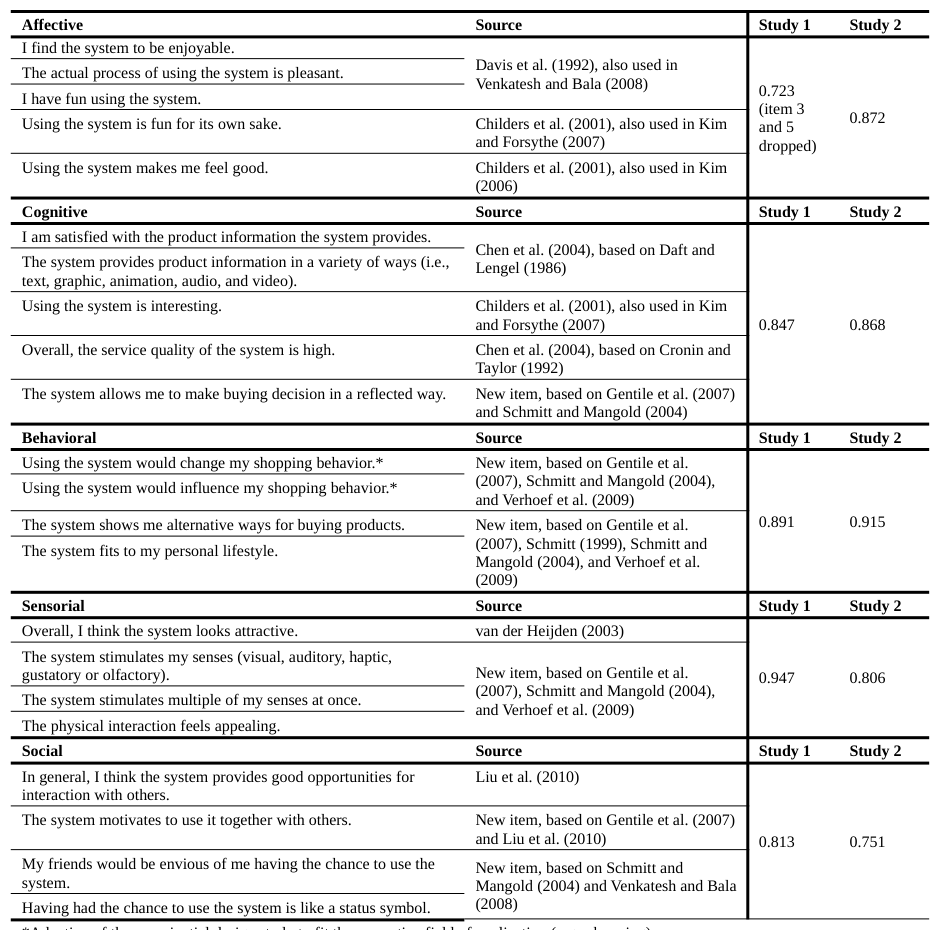
The first part of the research concept consists of a survey used to identify the experiential characteristics of concrete technological self-service artifacts. It can be used to reveal strengths and weaknesses of the design. As part of the general marketing efforts the overall goal is to create self-service systems for retail use that consciously and subconsciously fascinate the user. These positive experiences manifest through positive emotions and in the active willingness to share and recommend products or services (Mattila, 2005). Customer experience literature proposes various criteria supposed to positively influence the perception of products and services. Applying an explorative factor analysis, Novak et al. (2000) first introduce a valid scale for the construct of customer experience in the Internet context. Their work is based on Csikszentmihalyi’s Flow concept, a psychological approach that describes a person’s emotional state of being completely merged in a task (Csikszentmihalyi, 1975, 1990). However, a large number of experience concepts (Gentile et al., 2007; Knutson et al., 2006; Mascarenhas et al., 2006; Novak et al., 2000; Schmitt and Mangold, 2004; Verhoef et al., 2009) underpins that there is not one single widely accepted theory. Nevertheless, the excitement criteria proposed by Schmitt and Mangold (2004) serve as a basis for subsequent research and therefore can be regarded a prevailing opinion (Gentile et al., 2007; Mascarenhas et al., 2006; Verhoef et al., 2009). Accordingly, holistic experiences build on a stimulation of sensory, social, behavioral, cognitive as well as affective modules. Based on this assumption, the survey is constructed of items to measure these experiential dimensions. These items (see Table 1) are either adopted from previous research or newly created on basis of research in the respective areas.
Table 1. Experiential Design Survey (including Cronbach's α for both studies) Affective Source Study 1 Study 2 I find the system to be enjoyable.
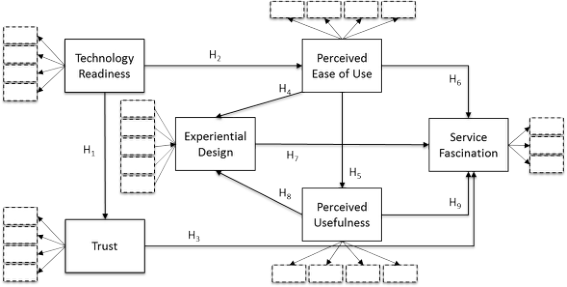
*Adaption of the experiential design study to fit the respective field of application (e.g., shopping) Schmitt and Mangold (2004) state that these experiential dimensions form one holistic construct. This results in the fact that users discern the effects of these stimuli as one complex and integrated feeling, often not being able to consciously separate the elements (Gentile et al., 2007). Consequently, they form a common, formative “experiential design” construct within the second part of the research concept presented: the service fascination research model (see Figure 2). The goal is to assess interdependencies with other (reflective) constructs influencing the overall satisfaction and service fascination (Zagel et al., 2014).
Figure 2. Service Fascination Research Model (based on Zagel et al., 2014)
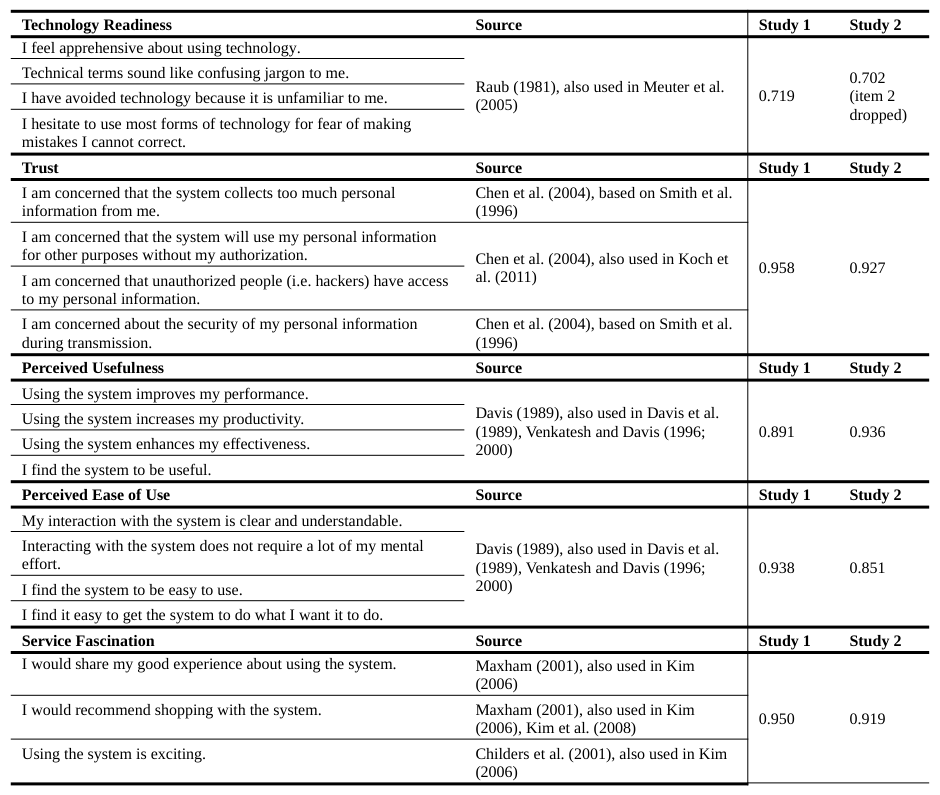
Table 2 shows the grouping of the items, their origins in literature, as well as the Cronbach values for both studies. While the basic elements (perceived usefulness and perceived ease of use) as well as their relationships (H 5) are adopted from the traditional TAM (Davis, 1989), further extensions are done to integrate the aspects relevant for self-services addressed in previous research.
Table 2. Service Fascination Questionnaire (including Cronbach's α for both studies) Technology Readiness Source Study 1 Study 2 I feel apprehensive about using technology.
Next to the element stated before, the aspect of technology readiness is included as a mediating variable, being especially important when assessing innovative technologies. Research has shown that people with higher technology anxiety are more likely to avoid using self-service technologies (Parasuraman, 2000). Next to that, technology readiness is also found to influence the perceived ease of use when interacting with computers (H 2) (Hackbarth et al., 2003). Finally, if a person is used to and enjoys working with technology he/she is likely to judge potential security issues of a system (H1). These connections between technology readiness and trust are discussed in recent studies (Liljander et al., 2006). Amongst others, Gefen et al. (2003) as well as Koch et al. (2011) see trust playing a crucial role in technology and service adoption, either supporting or preventing (if usage of a system is too risky) the creation of positive experiences (H3). As perceived usefulness and perceived ease of use are of experiential nature, providing functional/utilitarian value to the user, they directly influence the experiential design of a system (H4, H8). Furthermore, acting as basic elements and being regarded an absolute necessity for the acceptance of technologies, they directly influence the overall service fascination (H6, H9). Consumers strive for positive emotions. Schmitt and Mangold (2004) as well as Gentile et al. (2007) showed that a substantial part of the value perceived when interacting with a system is formed by experiences and hedonic elements that may even predominate pure functional aspects (H7). These correlations lead to the following hypotheses:
H1: Technology Readiness affects Trust towards self-service systems.
H2: Technology Readiness affects the Perceived Ease of Use towards self-service systems.
H3: Trust affects Service Fascination.
H4: Perceived Ease of Use affects the perception of the Experiential Design of self-service systems.
H5: Perceived Ease of Use affects the Perceived Usefulness of self-service systems.
H6: Perceived Ease of Use affects Service Fascination.
H7: The Experiential Design of self-services affects Service Fascination.
H8: Perceived Usefulness affects the perception of the Experiential Design of self-service systems.
H9: Perceived Usefulness affects Service Fascination.
RESEARCH METHODOLOGY AND SELF-SERVICE ARTIFACTS Study 1 - Interactive Fitting Room
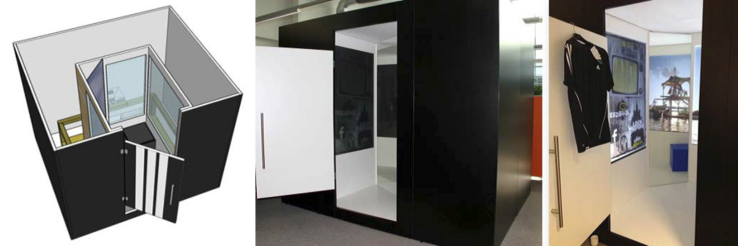
The prototype of an interactive fitting room presented by Zagel and Süßmuth (2013) serves as the first self-service system to validate the proposed model. The system applies innovative technologies in order to generate an exciting retail service for young consumers. Analyses and observations conducted between 2010 and 2013 amongst various companies of the textile industry show that the use of technology is in most cases limited to the optimization of back-end systems (e.g., stocktaking based on Radio Frequency Identification (RFID) Technology) or the presentation of multimedia content via digital signage systems. Especially the areas of intense consumer contact like shopping windows or fitting rooms have hardly been improved during the last decades. In retail shops fitting rooms typically feature identical layouts and designs and currently do not provide a pleasing stay (Dennis-Jones, 2007) even though the goal should be to raise consumer’s attention by addressing physical, cognitive, and emotional stimuli (Mayer, 2000). Latest studies prove the economic importance of this consumer touch point as well: A pleasant fitting of clothes in a dressing room leads to 71 % of buying probability (Envisionretail, 2006).
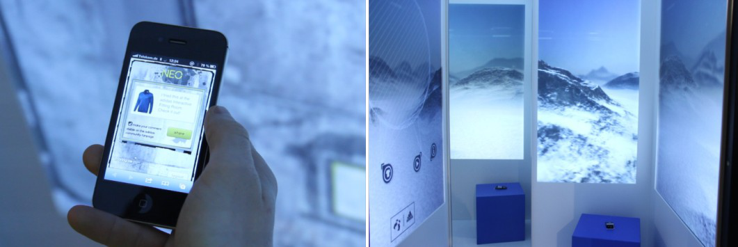
The developed system uses IT-support like RFID, touch interfaces and projection screens to create an immersive, virtual space in a fitting room environment. Focusing on the consumer group of 14 to 19 year olds, the goal is to create an exciting shopping experience by stimulating multiple senses. In addition to detailed product information the system offers recommendation services and access to social networks. When accessing the fitting room, the consumer feels like stepping into another world which reflects the respective context of the product at hand. By automatically detecting the article via RFID, the system triggers for example an animated mountain environment, when entering with an outdoor jacket (see Figure 4). All user interfaces and controls are integrated into the specific virtual world, augmented by additional product information. For the realization of the physical prototype, a dimensionally correct piece of furniture is constructed. Three large projection screens integrated into the walls compose the core of the system. Comparable to a CAVE (Cave Automatic Virtual Environment) they maximize the level of immersion by augmenting reality with virtual content. Cruz-Neira et al. (1993) describe the CAVE as a projection-based virtual reality system in form of a cube, using the walls as display areas. All additional hardware components as well as the projectors are mounted inside of an interior wall. Figure 3 shows the physical prototype.
Next to displaying general product data like available sizes, colors and detailed material information, it is possible to also show cross- and upselling information. A link to the online world, especially the company’s Web store as well as social networking services (SNS) is realized by integrating product reviews and ratings from the website into the fitting room’s product experiences and by allowing the consumer to actively share and comment products from within the device. By scanning a QR-code with his personal smartphone, the user is linked to a mobile optimized website (see Figure 4).
Figure 4. Social Media Connection and Immersive Environment
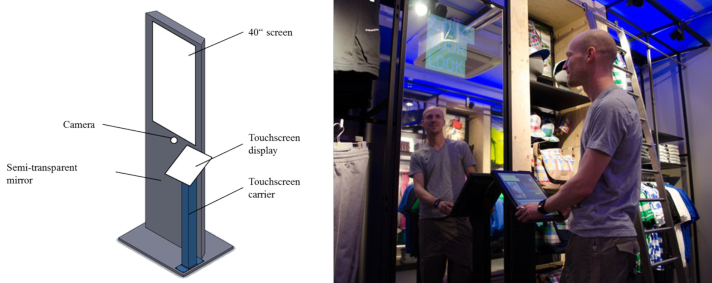
Study 2 – Social Media Mirror As a second self-service system the so called “Social Media Mirror” is presented. Since 2012, eleven devices are installed in ten fashion stores throughout Germany. As an interactive consumer touch point the device allows users to connect with their friends and other consumers while shopping in the retail store. It provides its users with a fun way to take pictures, record short videos and share their look in combination with a personal comment on favorite social networking platforms. Next to posting the content on private profiles it is also possible to upload the posts to the company’s brand sites. Furthermore, sales assistants can use the system to post content in order to promote articles and to engage consumers through social platforms.
The system is realized through a terminal, consisting of a large format screen and a camera mounted behind a one- way mirror as well as a pillar carrying a 15 inch touchscreen display (see Figure 5). The term "Social Media Mirror" is derived from its large, reflective front surface covering the camera as well as the large format screen. This semi- transparent mirror glass is used to make the display and the camera invisible and only reveal the digital content as soon as the display shows other than black colors. When turned on, it is therefore not possible to recognize the technical devices behind the glass and the user gets the impression of standing in front of a standard mirror with interactive elements. The goal is to integrate the technology in an unobtrusive way and to surprise the consumer through messages appearing.
Figure 5. Social Mirror (Left: Hardware Setup; Right: Productive Use) DATA COLLECTION
Procedure The described self-service systems serve as appropriate artifacts to validate the proposed model and to identify differences in their individual experiential manifestation. Both systems are evaluated applying the questionnaires introduced above with additional demographic questions about gender and age. The questionnaires are pre-tested on a small number of consumers and a factor analysis is conducted to ensure that the measures are distinct from each other. After the self-service systems are used by the participants, they are asked to provide answers on Likert-type items labeled at the endpoints (“strongly disagree” and “strongly agree”). The constructs “trust” and “technology readiness” are represented by reverse coded items in the questionnaires and translated for further analysis.
While study 1 (interactive fitting room) is evaluated within a laboratory experiment in August 2013 amongst 67 participants (28 female, 39 male, average age 23.6 / std. 4.73), study 2 (social media mirror) is performed in a productive shop environment in December 2013 amongst 68 subjects (55 female, 13 male, average age 20.4 / std. 4.25). Participation in the study is voluntary and without any compensation. The evaluation group for study 1 consists of subjects recruited at the university and on a shopping street, the subjects for study 2 are randomly asked for participation in the store. For the evaluation of both artifacts the subjects are asked to complete the surveys after autonomously interacting with the self-service systems.
Data Analysis The reliabilities of the constructs used to validate the design artifacts and the theoretical model are calculated using SPSS 20 and presented together with the item groups in Tables 1 and 2. Despite the technology readiness criterion (study 2) and the affective dimension (study 1), all reliabilities exceed Nunnaly’s (1978) recommended levels. In order to also reach a Cronbach’s α value exceeding the threshold of 0.7, the items without strong contribution are dropped.
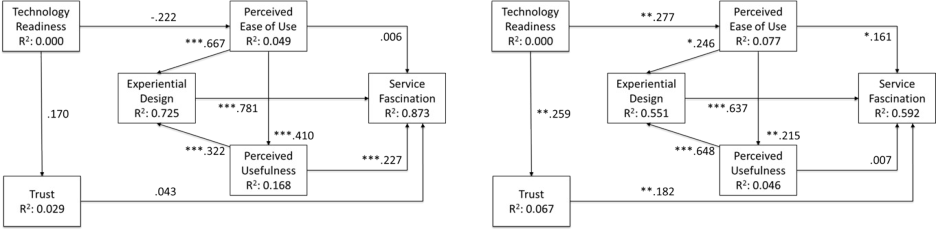
The structural model presented in this paper is modeled in SmartPLS 2.0 using the partial least squares method (67 / 68 cases, each with 5000 samples) to test the proposed relationships and to analyze model validity. On a measurement model level, the reflective constructs are validated based on the criteria of indicator reliability, convergence (composite reliability and average variance extracted (AVE)), discriminant validity (Fornell-Larcker criterion and cross loadings), and communality applying Stone Geisser’s Q2. The formative measurement model “experiential design” is validated using the indicator weights of the items and the variance inflation factor (VIF). As for both studies some of the indicator weights do not significantly influence the latent construct, also the loadings are examined, showing high significance. The structural model is validated by testing the hypotheses in form of the respective directional paths and by the variance explained (R2). Figure 6 shows the results of the analyses for both evaluated systems.
Figure 6. Test Results - Path Coefficients, left = study 1, right = study 2, t-values (*<0.1; **<0.05;
***<0.001)
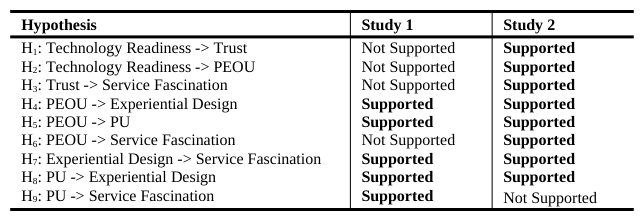
Table 3 summarizes the hypotheses and the analysis results for both studies. While results differ in several of the hypothesized relationships, the patterns for H4, H5, H7, and H8 match for both studies. PEOU and PU are found to significantly influence the experiential design. The traditional TAM’s robustness is confirmed by the significant relationship of PEOU towards PU. Finally, the experiential design of a self-service system claims a significant relationship towards the overall perceived service fascination. With R2 values of 0.725 / 0.873 (study 1) and 0.551 / 0.592 (study 2), the model is able to well explain the two main variables “experiential design” and “service fascination” (Chin, 1998).
Table 3. Hypotheses and Results Hypothesis Study 1 Study 2 H1: Technology Readiness -> Trust H2: Technology Readiness -> PEOU H3: Trust -> Service Fascination H4: PEOU -> Experiential Design H5: PEOU -> PU H6: PEOU -> Service Fascination H7: Experiential Design -> Service Fascination H8: PU -> Experiential Design H9: PU -> Service Fascination
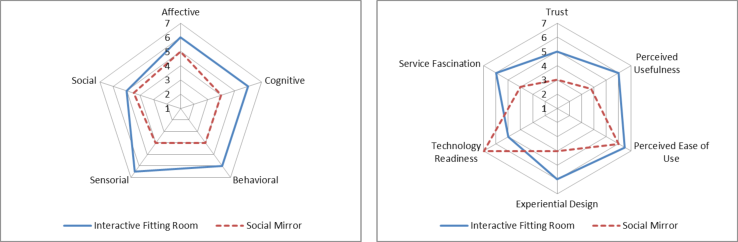
Even though the experiential dimensions are integrated into the common component “experiential design” within the service fascination research model, they can be analyzed separately using the first questionnaire section. The detailed analysis for both self-service artifacts is depicted in Figure 7.
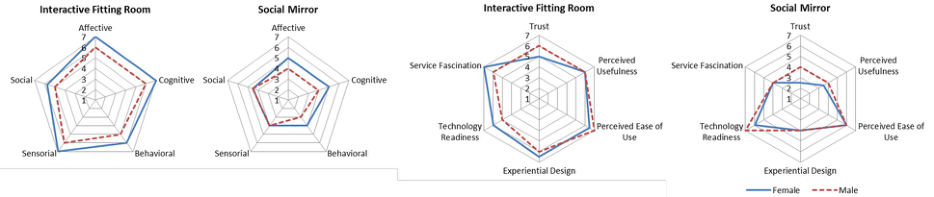
Figure 7. Evaluation Results: Interactive Fitting Room vs. Social Mirror (Medians) The results clearly show more positive ratings for the interactive fitting room in comparison to the social media mirror across both parts of the survey. All experiential dimensions (the utilitarian and the hedonic factors) are perceived with a higher intensity. The self-service system of study 1 is furthermore accredited more usefulness and a better ease of use, in sum leading to a higher overall service fascination. Nevertheless, the subjects of study 2 considered themselves as being more technology ready than the subjects of study 1. Most noticeable are the differences regarding the sensorial dimension as well as the perceived usefulness of the devices. For deeper analysis
the results are broken down into genders (see Figure 8).
Figure 8. Gender Breakdown: Interactive Fitting Room vs. Social Mirror (Medians) Discussion and Future Research
There are many aspects influencing a customer’s satisfaction with a technology-based self-service system. This study analyzes various effects: service fascination shaped through experiential design, trust, technology readiness, and ease of use as well as the system’s usefulness. The data show that the experiential design is strongly related to service fascination and consequently the willingness to use and actively promote a service. It is therefore possible to confirm Gentile et al.’s (2007) statements. While it is possible to reinforce the traditional TAM’s robustness in explaining technology adoption through PU and PEOU, both elements are also found to be part of the experiential continuum. In both studies it was possible to confirm their importance as basic elements of electronic self-services, constituting an absolute necessity for system use. The most interesting finding is, that while within both test groups women show less trust in technology, they experience the experiential design dimensions with a higher or at least the same intensity compared to men. This implies high potential for future research. If confirmed in additional use cases, a major chance for improvement lies in the creation of gender-specific self-service experiences, focusing on the experiential elements with highest impact. The position of trust as a rejection dimension for self-service use is only confirmed in study 2, which represents the system with the lower overall service fascination rating. Further research has to be done in this area. Especially trust’s relationship to the perceived experience has to be further examined to answer the question: do consumers show a high willingness to take risks for the sake of exciting moments? While both groups of study participants are age-wise comparable, they strongly differ in technology readiness. Additional investigation has to be done to learn, if a higher technology readiness generally leads to an inferior evaluation of the experiential elements.
Limitations of the work presented can provide starting points for continued research in the area of consumer experience management as well as for a better understanding of the adoption and use of technology-based systems. Both studies only focus on self-service systems and are conducted with rather small sample sizes (N=67/68) within the specific focus group of the digital natives. Further investigation needs to be done to prove the validity of the concept and model with higher sample sizes and their applicability to other target audiences. Additional and repeated utilizations across further self-service artifacts will provide knowledge about promising technology combinations and a change in perception over time. Further chances for research lie in evaluating the influence of a system’s innovativeness towards how it is perceived, as well as the changes in perception if an innovation becomes commodity.
CONCLUSION AND OUTLOOK Creating superior experiences is gaining tremendous attention by marketers and retailers. However, authors still demand for research that provides a deeper understanding of the experiential dimensions and their effects, as well as consumer experience in general. This paper presents an approach for assessing consumer experience in technology- based self-service systems in a structured way. A research model is introduced that integrates the constructs trust, technology readiness and experiential design generated through systematic implementation of experiential dimensions. The model is able to confirm findings of existing literature: the specific assessment of the excitement criteria can lead to positive experiences. From a practical standpoint the findings of this research support the future development of attractive services. Retailers and marketing experts are striving for self-service systems that are not only easy to use and provide utilitarian value to their consumers, but specifically include hedonic elements, leading to great experiences. Creating positive emotions, excitement and fascination will per se lead to positive word-of- Human Side of Service Engineering (2019) mouth and to a higher overall value perception. The implementation of these findings in practical use cases and the combination with future research in long term investigations will show, if the economic accrual is able to pay off the additional investments in technology.
REFERENCES
Agarwal, R., Prasad, J. (1997), “The role of innovation characteristics and perceived voluntariness in the acceptance of information technologies”, Decision Sciences Volume 28, No. 3, pp. 557-582. Ajzen, I., Fishbein, M. (1980), “Understanding attitudes and predicting social behavior”, Eaglewood Cliffs, NJ: Prentice-Hall. Berry, L. L., Carbone, L. P., Haeckel, S. H. (2002), “Managing the Total Customer Experience”, Sloan Management Review.
Volume 43, 85-89. Csikszentmihalyi, M. (1975), “Beyond Boredom and Anxiety: The Experience of Play in Work and Game”, San Francisco. Csikszentmihalyi, M. (1990), “Flow: The Psychology of Optimal Experience”, Harper and Row, New York. Chen, L., Gillenson, M. L., Sherrell, D. L. (2004), “Consumer Acceptance of Virtual Stores: A Theoretical Model and Critical Success Factors for Virtual Stores”, ACM SIGMIS Volume 35, No. 2, pp. 8-31. Childers, T. L., Carr, C. L., Peck, J., Carson, S. (2001), “Hedonic and utilitarian motivations for online retail shopping
behavior”, Journal of Retailing Volume 77, No. 4, pp. 511-535. Chin, W. (1998), “The Partial Least Squares Approach to Structural Equation Modeling.” In: Marcoulides, G. (Eds.), Modern Business Research Methods. New Jersey, pp. 295-336. Chiu, C. M., Chang, C. C., Cheng, H. L., Fang, Y. H. (2009), “Determinants of customer repurchase intention in online
shopping”, Online Information Review Volume 33, No. 4, pp. 761-784. Cronin, J. J., Taylor, S. A. (1992), “Measuring Service Quality: A Reexamination and Extension”, Journal of Marketing Volume 56, No. 3, pp. 55-68. Cruz-Neira, C., Sandin, D., DeFanti, T. (1993), “Surround-screen projection-based virtual reality: The design and
implementation of the cave”, ACM SIGGRAPH, pp. 135-142. Daft, R. L., Lengel, R. H. (1986), “Organizational Information Requirements, Media Richness, and Structural Design” Management Science Volume 32, No. 5, pp. 554-571. Davis, F. D. (1989), “Perceived usefulness, perceived ease of use and user acceptance of information technology”, MIS
Quarterly Volume 13, No. 3, pp. 319-340. Davis, F. D., Bagozzi, R. P., Warshaw, P. R. (1989), “User acceptance of computer technology: a comparison of two theoretical models”, Management Science Volume 35, No. 8, pp. 982-1003. Davis, F. D., Bagozzi, R. P., Warshaw, P. R. (1992), “Extrinsic and Intrinsic Motivation to Use Computers in the Workplace”,
Journal of Applied Social Psychology Volume 22, No. 14, pp. 1111-1132. Dennis-Jones, C. (2007), “Dressed to Impress?”, Retail Week. pp. 22-23. Douglas, S. P., Craig, C. S. (2000), “Global Marketing Strategy”, Mac Graw Hill, New York. Du, H., Whinston, A. B., Lu, T., Liu, J. (2010), “An empirical study of consumer adoption on mobile data services (MDS) in China”, Second International Conference on MultiMedia and Information Technology, pp. 298-301. EnvisionRetail (2006), “In Store Behaviour: What Stops Shoppers Buying”, WSGN, p. 2. Farinet, A., Ploncher, E. (2002), “Customer Relationship Management”. ETAS, Milan. Gentile, C., Spiller, N., Noci, G. (2007): “How to Sustain the Customer Experience: An Overview of Experience Components that
Co-create Value With the Customer”, European Management Journal Volume 25, No. 5, pp. 395-410. Gu, J.-C., Fan, L., Suh, Y. H., Lee, S.-C. (2010), “Comparing Utilitarian and Hedonic Usefulness to User Intention in Multipurpose Information Systems“, Cyberpsychology, Behavior, and Social Networking Volume 13, No. 3, pp. 287-297. Gupta, S., Xu, H. (2010), “Examining the relative influence risk and control on intention to adopt risky technologies”, Journal of
Technology Management & Innovation Volume 5, No. 4, pp. 22-37. Hackbarth, G., Grover, V., Yi, M. Y. (2003), “Computer playfulness and anxiety: positive and negative mediators of the system experience effect on perceived ease of use”, Information and Management Volume 40, pp. 221-232. Holbrook, M. B., Hirschman, E. C. (1982), “The experiential aspects of consumtion: Consumer fantasy, feelings and fun”,
Journal of Consumer Research Volume 9, No. 2, pp. 132-140. Hsu, C.-L., Lu H.-P. (2004), “Why do people play on-line games? An extended TAM with social influences and flow experience”, Information & Management Volume 41, pp. 853-868. Kim, J. (2006), “Sensory Enabling Technology Acceptance Model (SE-TAM): The Usage of Sensory Enabling Technologies for
Online Apparel Shopping”, PhD thesis, Auburn University, Auburn and Alabama, USA. Kim, J., Forsythe, S. (2007), “Hedonic usage of product virtualization technologies in online apparel shopping”, International Journal of Retail & Distribution Management Volume 35, No. 6, pp. 502-514. Kim, D. J., Ferrin, D. L., Rao, H. R. (2008), “A trust-based consumer decision making model in electronic commerce: The role of
trust, perceived risk, and their antecedents”, Decision Support Systems Volume 44, No. 2, pp. 544-564. Knutson, B. J., Beck, J. A., Seung Hyun, K., Jaemin, C. (2006), “Identifying the Dimensions of the Experience Constrct”, Journal of Hospitality and Leisure Marketing Volume 15, No. 3, pp. 31-47. Koch, S., Toker, A., Brulez, P. (2011), “Extending the Technology Acceptance Model with perceived community characteristics”,
Informationresearch Volume 16, No. 2, paper 478. Lee, Y., Kozar, K. A., Larsen, K. R. T. (2003), “The Technology Acceptance Model: Past, Present, and Future”, Human Side of Service Engineering (2019)
Communications of the Association for Information Systems Volume 12, Article 50, pp. 752-780. Legris , P., Ingham, J., Collerette, P. (2003), “Why do people use information technology? A critical review of the technology acceptance model”, Information & Management Volume 40, pp. 191-204. Liljander, V., Gillberg, F., Gummerus, J., van Riel, A. (2006), “Technology readiness and the evaluation and adoption of self-
service technologies”, Journal of Retailing and Consumer Services Volume 13, pp. 177-191. Liu, I.-F., Chen, M. C., Sun, Y. S., Wible, D., Kuo, C.-H. (2010), “Extending the TAM to explore the factors that affect Intention to Use an Online Learning Community”, Computers & Education Volume 54, No. 2, pp. 600-610. Mascarenhas, O. A., Kesavan, R., Bernacchi, M. (2006), “Lasting Customer Loyalty: A Total Customer Experience Approach”,
Journal of Consumer Marketing Volume 23, No. 7, pp. 397-405. Mattila, A. (2005), “Relationship Between Seamless Use Experience, Customer Satisfaction and Recommendation”, Problems and Perspectives in Management, pp. 96-108. Maxham, J. G. (2001), “Service recovery’s influence on consumer satisfaction, positive word-of-mouth, and purchase
intentions”, Journal of Business Research Volume 54, No. 1, pp. 11-24. Mayer, H. O. (2000), “Einführung in die Wahrnehmungs-, Lern-, und Werbe-Psychologie“, Oldenbourg, p. 178. Meyer, C., Schwager, A. (2007), “Das Kundenerlebnis verbessern”, Harvard Business Manager Volume 29, No. 4, pp. 58-73. Meutner, M. L., Ostrom, A. L., Bitner, M. J., Roundtree, R. (2000), “Self-Service Technologies: Understanding Customer Satisfaction with Technology-Based Service Encounters”, Journal of Marketing Volume 64, No. 3, pp. 50-64. Meutner, M. L., Bitner, M. J., Ostrom, A. L., Brown, S. W. (2005), “Choosing Among Alternative Service Delivery Modes: An
Investigation of Customer Trial of Self-Service Technologies”, Journal of Marketing Volume 69, No. 2, pp. 61-63. Novak, T. P., Hoffman, D. L., Young, Y. F. (2000), “Measuring the Customer Experience in Online Environments: A Structural Modeling Approach”, Marketing Science Volume 19, No. 1, pp. 22-42. Nunnally, J. C. (1978), “Psychometric Theory”, 2nd. Ed., New York, McGraw-Hill, pp. 245-246. Pantano, E., Di Pietro, L. (2012), “Understanding Consumer’s Acceptance of Technology-Based Innovations in Retailing”,
Journal of Technology Management & Innovation Volume 7, No. 4, pp. 1-19. Pantano, E., Corvello, V. (2010): “Digital contents managed for improving consumers’ experience”, International Journal of Digital Content Technology and its Application, Volume 4, No. 7, pp. 8-10. Parasuraman, A. (2000), “Technology Readiness Index (Tri): A Multiple-Item Scale to Measure Readiness to Embrace New
Technologies”. Journal of Service Research Volume 2 No. 4, pp. 207-320. Pine, J. B., Gilmore, G. H. (1999), “The Experience Economy”, Boston. Raub, A. C. (1981), “Correlates of Computer Anxiety in College”, PhD thesis, University of Pennsylvania, Philadelphia, USA. Rogers, E. M. (1962), “Diffusion of Innovations” The Free Press of Genoce, New York. Schmitt, B. H. (1999), “Experiential Marketing – How to get customers to sense, feel, think, act, relate to your company and brands”, The Free Press, New York. Schmitt, B. H., Mangold, M. (2004), “Kundenerlebnis als Wettbewerbsvorteil. Mit Customer Experience Management Marken
und Märkte Gewinn bringend gestalten“, Wiesbaden. Shaw, C., Ivens, J. (2005), “Building Great Consumer Experiences”, MacMillan, New York. Smith, H. J., Milberg, S. J., Burke, S. J. (1996), “Information Privacy: Measuring Individuals’ Concerns about Organizational Practices”, MIS Quarterly Volume 20, No. 2, pp. 167-196. Sonderlund, M., Julander, C. R. (2009), “Physical attractiveness of the service worker in the moment of truth and its effects on
customer satisfaction”, Journal of Retailing and Consumer Services Volume 16, No. 3, pp. 216-226. Tanakinjal, G. H., Deans, K. R., Gray, B. J. (2010), “Third Screen Communication and the Adoption of Mobile Marketing: A Malaysia Perspective”, International Journal of Marketing Studies Volume 2, No. 1, pp. 36-47. Taylor, S., Todd, P. (1995), “Assessing IT usage: The role of prior experience”, MIS Quarterly, pp. 561-570. Tseng, F. M., Lo, H. Y. (2011), “Antecedents of consumers’ intentions to upgrade their mobile phones”, Telecommunications
Policy Volume 35, pp. 74-86. Van der Heijden, H. (2008), “Factors influencing the usage of websites: the case of a generic portal in The Netherlands”, Information & Management Volume 40, No. 6, pp. 541-549. Venkatesh, V., Bala, H. (2008), “Technology Acceptance Model 3 and Research Agenda on Interventions”, Decision Sciences
Volume 39, No. 2, pp. 273-315. Venkatesh, V., Davis, F. D. (1996), “A model of the antecedents of perceived ease of use: development and test”, Decision Sciences Volume 27, No. 3, pp. 451-481. Venkatesh, V., Davis, F. D. (2000), “A Theoretical Extension of the Technology Acceptance Model: Four Longitudial Field
Studies”, Management Science Volume 46, No. 2, pp. 186-204. Verhoef, P. C., Lemon, K. N., Parasuraman, A., Roggeveen, A., Tsiros, M., Schlesinger, L. A. (2009): “Customer Experience Creation: Determinants, Dynamics and Management Strategies”, Journal of Retailing Volume 85, No. 1, p. 31-41. Willow, C. (2010), “Third-generation display technology: nominally transparent material”, Journal of Management &
Innovation Volume 5, No.4, pp. 108-120. Zagel, C., Bodendorf, F. (2012), “User Centered Design of Innovative E-Service Solutions. A Scientific Approach to User Fascination”, SRII Global Conference (SRII), 2012 Annual, IEEE, San Jose, California, pp. 697-704. Zagel, C., Glomann, L., Suessmuth, J. (2014), “Assessing the influence of gender towards the adoption of technology-enabled
self-service systems in retail environments”, Paper presented at the Gender-UseIT 2014 Conference, Berlin, 3-4 April. Zagel, C., Süßmuth, J. (2013), “CeBIT Innovation Award 2013”, CeBIT, Hannover.
LISTED IN THE AHFE DIGITAL BOOKSTORE CATALOGUE
Explore the complete digital volume
Advances in The Human Side of Service Engineering
Read this individual research paper free through the original publisher, or explore the full digital proceedings book.
ISBN 978-1-4951-2091-6
Explore this ISBN in the AHFE Bookstore ↗Listed in the July 2026 bookstore catalogue; search by ISBN to confirm current availability · Digital book purchase optional