Gemma J. M. Reada, Paul M. Salmonb, Michael G. Lennéc, Daniel P. Jenkinsd (2021). Extracting Design Information from the Outputs of Systems Analysis: A Case Study in Public Transport Ticketing. In: Advances in Human Aspects of Transportation: Part II. AHFE Open Access, vol. 16. https://doi.org/10.54941/ahfe100691
1 Human Factors Group, Accident Research Centre, Monash Injury Research Institute, Monash University, Victoria, Australia ↗
2 University of the Sunshine Coast Accident Research, University of the Sunshine Coast, Maroochydore, Queensland, Australia ↗
3 Human Factors Group, Accident Research Centre, Monash Injury Research Institute, Monash University, Victoria, Australia d DCA Design International, Warwick, UK ↗
Analysis and design activities underpinned by the systems thinking are required for the design of modern complex sociotechnical systems. Cognitive work analysis is a commonly used analysis framework for understanding complex systems. Although the framework was developed with a view to then using analysis outputs to inform system design, questions about its direct application to design remain. This paper will describe an approach that was developed to support the translation of cognitive work analysis outputs into design-relevant information. The approach was applied to a case study analysis of a public transport ticketing system, with the insights documented during the analysis being used to prepare design materials for a participatory design workshop. The process of identifying design-relevant information from the analysis outputs and applying this to the preparation of design materials was found to be structured and efficient, providing the potential for traceability between analysis and design without constraining the creativity required for design innovation.
The application of systems-based approaches to analysis and design is becoming more important in the modern age of increasingly technologically complex, distributed, high-risk domains . Cognitive work analysis (CWA) is an analysis framework underpinned by systems thinking and open systems principles. While CWA has been used in many design applications , like all human factors analysis methods, the outputs of CWA provide information to support the design process rather than creating the design concept itself.
This paper will describe an approach to the translation of design-relevant information arising from the application of CWA to design. A case study focusing on the public transport ticketing domain will be used to demonstrate an aspect of this approach, the identification of insights and their application in the preparation of materials for participatory design workshops.
Cognitive Work Analysis
CWA is a framework of methods that supports the analysis of complex socio-technical systems with the aim of improving system design (Vicente, 1999). It is unique in its formative, constraint-based approach, in that it can be used to model the possibilities for behaviour, rather than describing actual behaviour (i.e. how work is done), or prescribing normative behaviour (i.e. how work should be done). The framework encompasses five phases of analysis that commence by modelling the environmental constraints within the domain (though work domain analysis), and then considers the tasks (through control task analysis), strategies (through strategies analysis), allocation of functions amongst human or technical actors (through social organisation and cooperation analysis) and the competencies required by actors operating within the domain (through worker competencies analysis) .
CWA has been used to analyze many varied complex systems including nuclear power generation , military command and control , air traffic control , road transport and rail transport . It is an established analysis framework, with evidence showing that its application can improve system design . Yet despite the framework’s increasing use, questions remain over its use as a design tool, and the details of how it is used in design applications . Design guidance for CWA tends to focus on the development of displays and interfaces and there is a need to support the use of CWA outputs in design processes for all system elements, such as the design of teams, procedures, and training systems.
In response to the need for further support and guidance for using CWA in integrated systems design, the CWA design tool (CWA-DT) was developed. The tool aims to provide guidance for a design team wishing to use the outputs of CWA for design purposes. Acknowledging the close relationship between analysis and design, and the iterative nature of the process, the tool provides guidance for both analysis and design.
The CWA Design Tool The CWA-DT provides guidance for various stages of a design process from planning the analysis process through to implementation. It consists of guidance as well as structured documentation to assist users to plan for and execute their design activities. Due to space constraints, this paper focuses the analysis phase and the design planning phase and omits discussion about the subsequent design activities.
Analysis stage The CWA-DT provides some guidance to assist the analysis process. However, it does not intend to replace authoritative texts on CWA and refers readers to such guidance available for completing the analysis phases. The analysis phase is driven by an Analysis Brief developed prior to the analysis commencing. The main contribution of the CWA-DT in the analysis stage is the guidance and templates for recording insights derived by the analysts regarding the system under investigation. Insights in this context include both non-obvious inferences from the evidence provided in the analysis , as well as more obvious findings about the system that the analyst considers important for the design process.
The template for documentation of insights prompts the analyst to provide a description of the insight identified and how it was identified (i.e. which phase of CWA was being undertaken and the thought process surrounding the insight development). This enables an explicit linking between the analysis, the insight, and any proposed design subsequently stemming from the insight. When documented, insights are categorized into Assumptions, Leverage points, Metaphors, Scenario features or Design solutions. A description of each is provided in Table 1.
Table 1: Types of insight documented in the CWA-DT Insight type Description
Design planning stage In addition to developing documentation to guide the design process, the design planning stage involves the development of materials for participatory design workshops. This enables the communication of insights usually only available to the analysts to those not directly involved and immersed in the analysis. This is important for participatory design processes where it is impracticable for stakeholders and users to be involved in the details of the analysis, but it is those details that make CWA such a unique and valuable analysis framework. The insights are not simply communicated to the participants, but are incorporated into participatory design activities involving, for example, scenarios, metaphorical design, and brainstorming.
ANALYSING THE PUBLIC TRANSPORT TICKETING SYSTEM The public transport ticketing domain
Public transport systems are funded by public revenue (i.e. taxes) as well as contributions by the end user. The user contribution is collected through the sale of tickets, with various means employed to enforce the requirement to hold a valid ticket for travel. Internationally, the trend in ticketing systems has been a move towards durable smartcards that store value rather than disposable paper tickets in line with a general trend toward a cashless society.
An Australian state government has recently implemented a smartcard-based ticketing system. The smartcard system is used on multiple modes of public transport (e.g. train, bus, etc) with fares based on two geographically- based zones of travel. The durable plastic card is required to be purchased, and value (monetary amount) or a travel pass (a product that enables travel for a set period of time) to be purchased and loaded prior to travel. Purchasing and loading facilities are provided at many, but not all, locations at which passengers may begin their journey. Since it was introduced, the ticketing system has been subject to large-scale criticism from its users and the media regarding aspects such as the speed of processing, usability and convenience of ticket purchasing. As an example of a failure system design, it was considered that this example would provide an interesting case study.
Planning the analysis process The analysis process was planned through the analysis brief developed at the beginning of the project. The fictional analysis brief noted that the current system was subject to criticism and described the need for the project as:
An election is held and a new government, not involved in any past decisions about the system, is elected to power. The new Minister for Transport has tasked this project team with reviewing the ticketing system and designing the next generation system for implementation in 5-10 years’ time. The team is to identify and learn from the issues with the current system and design a new system that meets the goals of government and users.
The analysis brief also described the deliverable of the project as a proposed design solution for a ticketing system appropriate for a metropolitan public transport system in 5-10 years’ time. Other points from the analysis brief included that data should be collected regarding both regular and irregular users, and that the project is constrained to the design of a ticketing system, rather than alternative means of gaining funds for public transport operations.
Data sources
A work domain analysis was developed for the ticketing system drawing upon publicly available documentation and interviews with two subject-matter experts. The latter four phases of the CWA analysis were informed by interviews with six users of the ticketing system (three regular and three irregular users), using semi-structured interviews based on the critical decision method, as well as reference to publicly available documentation.
Work domain analysis The work domain analysis phase of CWA describes the functional structure of the work domain . The abstraction hierarchy (AH) is used in this phase of analysis. It describes the constraints of the work domain within which behaviour is possible. The AH encompasses five levels of abstraction, with means-ends links between nodes at adjacent levels. The representation identifies the physical resources available in the system, the processes afforded by those resources, the functions supported by the processes, the values and priorities that are measured and monitored within the system, and the overall purpose/s of the goal-directed work domain .
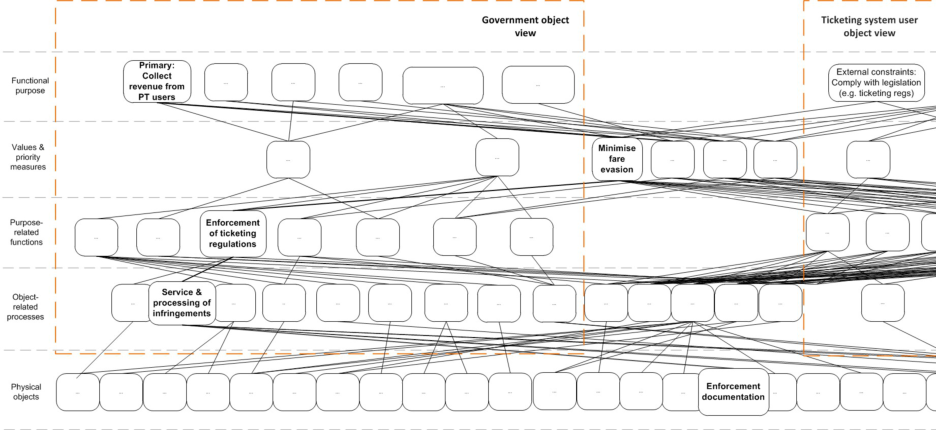
During the development of the ticketing system AH, it became clear that there were discrepancies in how the work domain is viewed by the government stakeholders of the system and the users of the system. For example, while the primary purpose of the system from the government point of view was defined as to collect revenue from public transport users, for the users the primary purpose was reach destination. This suggests that while government may view the ticketing system as a sub-system of the wider public transport system, users experience ticketing in an integrated manner within the overall service being delivered. This discrepancy between different system stakeholders is dealt with in the work domain analysis of CWA by analyzing the object worlds, or perspectives, of different stakeholders . This was achieved within the AH by delineating the parts of the work domain that belonged to only one stakeholder’s object world with the remainder of the work domain being shared.
One of the insights derived during the development of the AH arose originally from reviewing the transcript of an interview with one of the subject matter experts. The interviewee had stated that ‘(I) think they should have trusted the user a lot more than they did. People want to do the right thing and if people don’t want to do the right thing they’ll go out of their way to not do it.’ This statement resonated as a number of the users interviewed stressed that they wanted to comply with the rules around ticketing and make sure that they had a valid ticket for their journey. However, ensuring compliance with regulations is a key part of the government object view within the AH.
Figure 1. Extract of the AH showing stakeholder object worlds, focused on nodes associated with compliance and enforcement
Figure 1 provides a simplified extract of the AH; showing only those nodes relating to enforcement and compliance. It can be seen that the value of Minimize fare evasion was shared amongst both government and public transport users. Users also had a purpose to comply with legislation (e.g. ticketing regulations). Although users valued the need to avoid fare evasion, reviewing the nodes that are highlighted in bold, it can be seen that enforcement has a key role in the system. Reading from the bottom level up it can be seen that Enforcement documentation is a physical object that supports the process of the Service and processing of infringements. This process supports the function of Enforcement of ticketing regulations, which is related to Minimizing fare evasion, which in turn supports the government’s primary purpose to Collect revenue from public transport users. This supported the initial insight that the system is designed on the assumption that users do not want to pay for transport and are not trusted to voluntarily comply with regulations. This assumption was documented in the insights template.
Control task analysis The control task analysis phase of CWA identifies the activities and tasks that need to be carried out within the work domain. The tools used in this phase include the contextual activity template (CAT) which analyses activities in work domain terms, as well as the decision ladder which analyses activities in decision making terms .
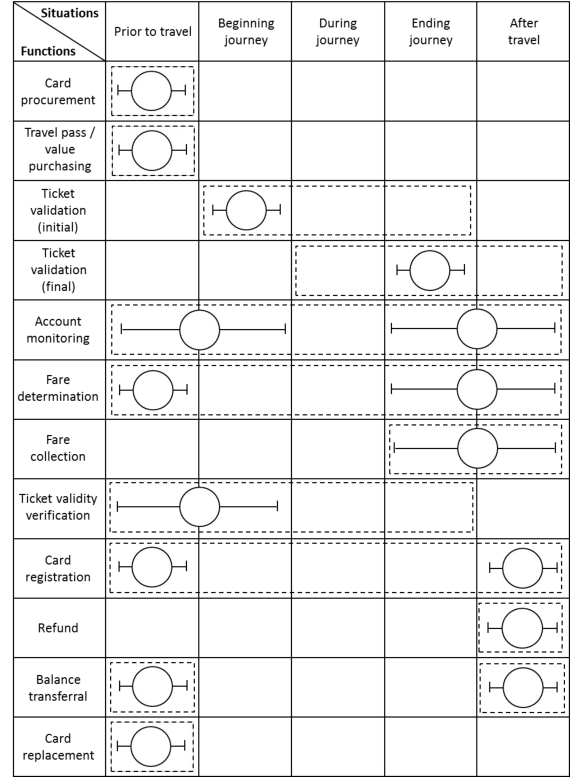
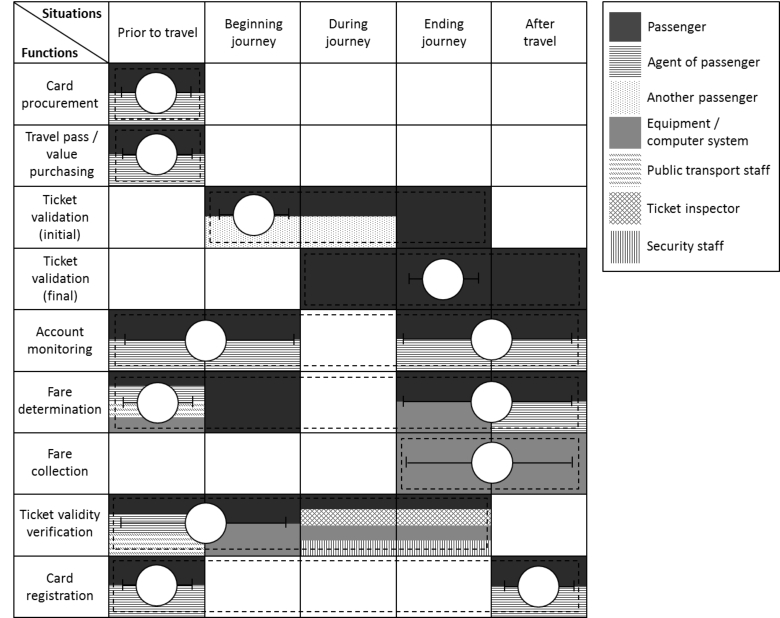
Contextual activity template The CAT developed for the ticketing system case study is shown in Figure 2. The template is a matrix with the situations encountered within the work domain represented by the columns and the functions occurring within the work domain shown in the rows. The circles with the attached bars in the matrix represent situations in which the functions typically occur. The dotted line boxes in the matrix indicate situations in which the functions could occur, although they may not typically occur there . Figure 2 identifies five situations that focus on the timeline of a public transport journey. The first situation is prior to travel, the next is when travel is beginning, the period during the journey is then analyzed, followed by the conclusion of the journey and then the period following travel. The functions represented in the first column of Figure 2 were transposed from the functions in the user object world of the AH. This was done because the focus of the analysis was on the user tasks and functions rather than those functions associated with customer service and administration.
The CAT shows that most functions occur either before or after the journey, with no functions typically occurring during the journey. This finding was documented as potential leverage point. This is because passengers generally have more time available during their journey for tasks such as validating their ticket, determining the cost of their fare, verifying the validity of their ticket, monitoring their account, registering their card, etc. Some of these activities could potentially be undertaken by passengers with portable electronic devices and internet access. However, there are no smartphone applications available to support this activity nor is wi-fi available on the public transport vehicles. Vitally, there is no equipment available on public transport vehicles to support users to undertake any of these functions.
A second insight that arose during the development of the CAT was that initial validation of the ticket cannot be undertaken prior to commencing the journey. However, airlines provide for online check-in prior to travel. This insight was documented as a potential metaphor for exploration in the design process.
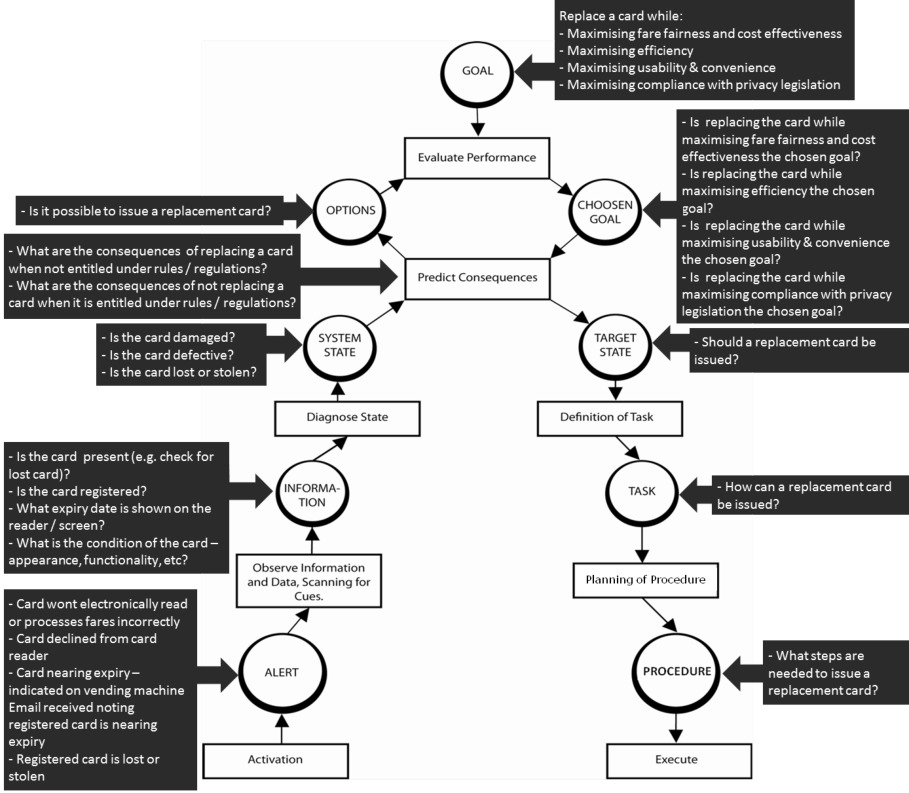
Decision ladders A decision ladder developed for the ticketing system case study is provided in Figure 3. Decision ladders outline the information processing activities (rectangular boxes) and resultant knowledge states (circles) that if followed from the bottom left to the bottom right represent the process of novice decision making . As expertise develops, shortcuts can occur where for example, an alert is directly associated with a system state or the diagnosis of a system state leads to the selection and execution of a task without any intervening information processing steps.
For the case study, decision ladders were developed for the purpose-related functions in the AH . However, this was done only for those purpose-related functions identified within the ticketing system user object world.
Figure 2. Contextual activity template
Figure 3 provides the decision ladder for the function of card replacement. The decision ladder shows the different ways that the system can alert the end user that a card requires replacement, the information then required by the end user to determine the system state (e.g. whether the card is defective, expired or lost / stolen), the options available to the end user, the possible goals the end user might have, etc. To assist in developing this decision ladder, publicly available user guidance and forms for card replacement were reviewed.
During the process of mapping this information on to the decision ladder it became clear that the guidance provided to the user was provided from an administrative perspective rather than a user perspective. For example, the same form is required to be filled out for replacement of damaged, defective, expired, and lost or stolen cards. However, the form has many caveats and exceptions depending on the reason for which the replacement is required, and depending upon whether the card was registered or unregistered. For example, the form asks for the unique identification number printed on the card. However, if the card is lost or stolen many users would likely not have kept a separate record of this information. During the process of trying to understand these documents for the purpose of populating the decision ladder, an insight was documented that the user guidance and forms are based around administrative processes rather than the problem being faced by the user. This insight was then framed as a design solution which was to amend the supporting materials to ensure they are user-focused. The documentation around this insight also noted that while this was potentially a low priority in terms of system change, it reflects the system administration (rather than user) perspective that has been taken in the design of the system.
Figure 3. Decision ladder for the function Replace card
Strategies analysis The strategies analysis phase identifies the range of strategies that can be employed to perform the activities and tasks in the system . A common tool used for strategies analysis is the information flow chart. These flow charts identify the steps than can be used to move from a start state to an end state. Flow charts were developed for the key purpose-related functions identified in the user object view of the AH, however these are not presented in this paper due to space restrictions. Further, the flow charts tended to provide a very fine level of detail regarding task execution which was potentially more useful for a detailed design process following the selection of a system design concept.
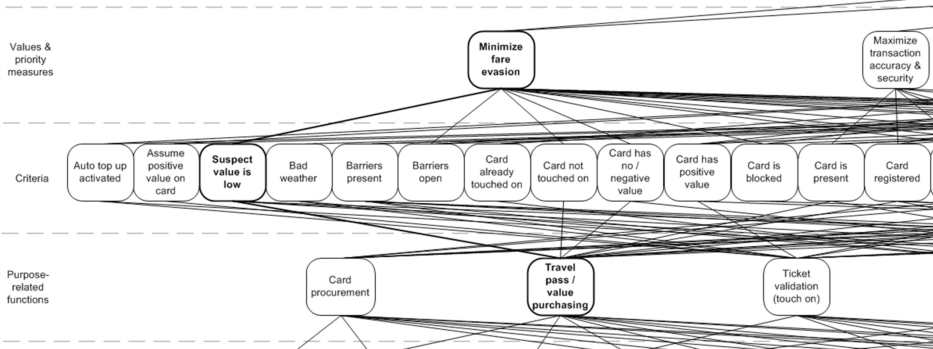
In addition to information flow charts, a strategies analysis diagram was developed for the ticketing system. This tool supports a more formative approach to identifying strategies. The SAD builds on the AH developed in the work domain analysis phase and involves the additional of two levels to the diagram: verbs and criteria. The verbs are used to specify how the physical objects can be used and the criteria specify the circumstances under which different strategies might be chosen. The SAD was completed for only parts of the AH that were relevant to the user domain. An extract of the SAD is provided in Figure 4. The extract focuses on the criteria identified for determining which strategy to use. For example, the purpose-related function of Travel pass / value purchasing may be undertaken when the user Suspects value is low to support the value of Minimize fare evasion. A total of 41 criteria were identified from the interviews with users and from document analysis. In documenting the criteria it became clear that they provided richness to the analysis that was not uncovered through the other phases of analysis. The criteria represented a number of circumstantial features that were thought to provide important features for scenarios. For example, bad weather, a card having no or negative value, the presence or absence of ticket barriers, could all provide relevant scenario features.
Figure 4. Extract of SAD showing some of the criteria identified within the analysis Social organization and cooperation analysis
The social organization and cooperation analysis (SOCA) phase analyses how tasks and activities are distributed across agents within the system . SOCA can be performed using any of the CWA tools already applied by overlaying the agents (human and technical) that could be involved in different aspects of the system’s functioning. For the case study, SOCA was performed using the CAT. An extract of the SOCA-CAT is shown in Figure 5.
Figure 5. SOCA-CAT
Seven actors were identified within the SOCA phase: passengers, agents of passengers (e.g. parents or carers who perform functions for passengers but do not travel with them), other passengers travelling on public transport, equipment or the computer system (i.e. automation), public transport staff such as customer service personnel or drivers, ticket inspectors and security staff. The SOCA highlights that although the system is promoted as being more technologically advanced than previous paper ticket systems, most functions are still required to be performed by humans. Fare collection is the only automated function. Considering that the users interviewed stressed that their overall goal was to reach their destination, rather than to use a ticketing system, automating more functions around ticketing may be a beneficial design solution. An insight in the form of a design solution was recorded suggesting that functions such as ticket validation could be automated, for example, passengers could walk through a scanner which automatically detects the smartcard and registers it as beginning or completing a journey.
Worker competencies analysis The final phase of CWA, worker competencies analysis, identifies the cognitive skills and processes required to perform tasks within the system . The skill, rule and knowledge (SRK) taxonomy is generally applied in this phase. The taxonomy relates to levels of performance : skill-based behaviour (SBB; sensory-motor performance which occurs without conscious control), rule-based behaviour (RBB; the application of stored rules in familiar situations and occurs on a more conscious level) and knowledge-based behaviour (KBB; explicit and conscious reasoning required for unfamiliar situations). The SRK inventory proposed by Kilgore and colleagues builds upon the decision ladder. The inventory was developed to support interface design activities, and has subsequently been utilized, and extended, by other authors .
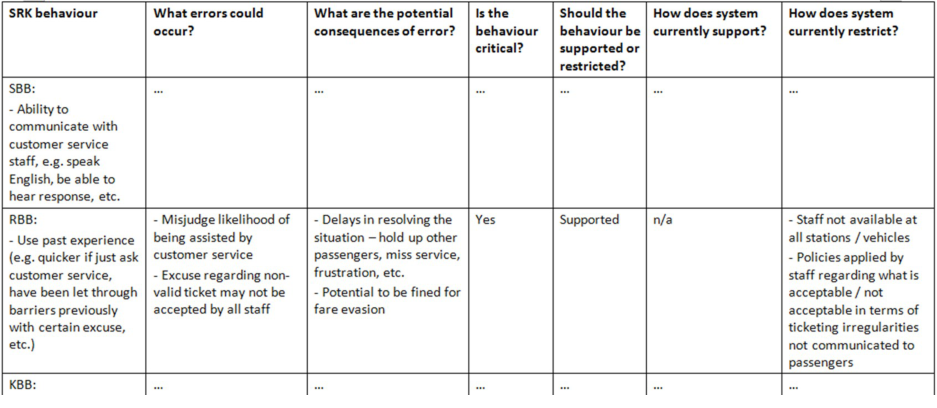
In this case study, the aim is to support integrated systems design, rather than the design of interfaces or information systems alone. In this case, the analysts determined that the SRK inventory was best completed in relation to the strategies identified within the strategies analysis phase. Strategies were drawn from the SAD by reviewing the relationships between the verbs and physical objects and transposing the strategies into a table identifying the SBB, RBB, and KBB required to execute each strategy. The inventory was also extended to identify the errors that could occur at each level of performance, the consequences of these errors and a judgment, based on the consequences, about the criticality of that behaviour. Where the behaviour is critical, consideration is given to whether the behaviour should be supported or restricted. An evaluation is then conducted regarding how the system currently supports and restricts this behaviour. This evaluation assists to uncover design problems and insights for re-design.
Figure 6 shows an extract of the SRK inventory developed for the case study in relation to the strategy Query customer service desk / booth. The focus is on the RBB which identified that when users experience problems associated with ticketing irregularities (for example, they believed they validated their card but subsequently it is not accepted by the equipment) they may apply use rules based on past experience to guide their interaction with customer service representatives to resolve the issue. Errors could be associated with misjudging the likelihood of being assisted, or the level of assistance provided, or with the likelihood that an excuse is accepted by different customer service staff members (e.g. expect consistency when it may not be present). The table identifies that this should be supported, but upon reviewing the outputs of the previous analysis phases no evidence was found that this is currently supported. It was found that the behaviour was restricted in two ways: with staff not always being available to query, and with the policies or guidance applied by staff in relation to dealing with ticketing inconsistencies not provided to users. The user guidance is written on the basis that the system operates as designed and does not, for example, provide examples of what a user should do if equipment is defective and will not accept an attempt to validate their smartcard at the beginning of a journey. Based on this insight, an assumption was documented that giving users too much information will enable them to abuse the regulations.
Figure 6. Extract of the SRK taxonomy table for the strategy Query customer service desk / booth USING THE INSIGHTS IN DESIGN
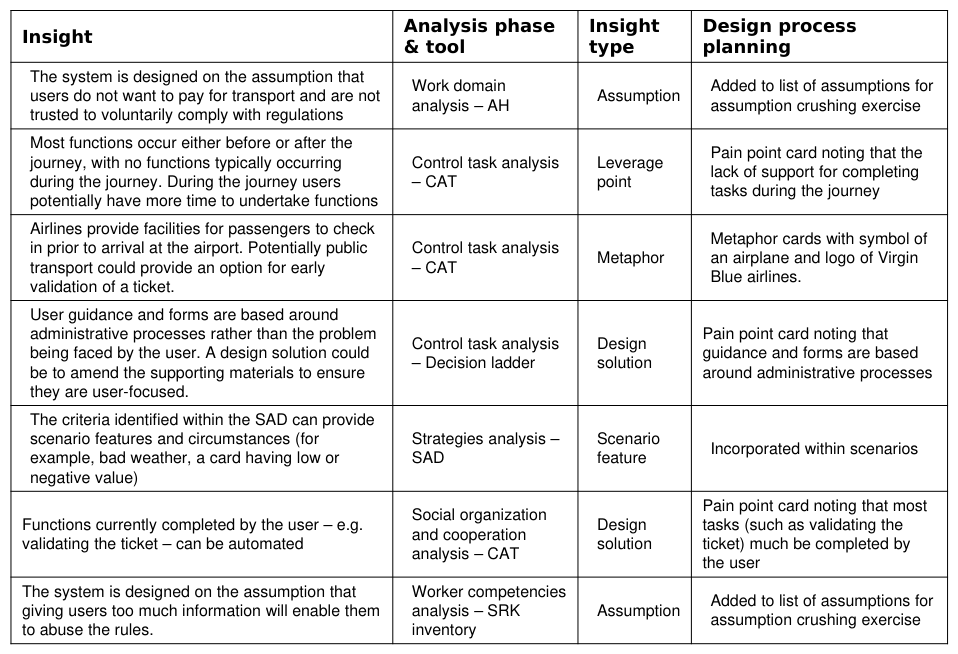
The above discussion has described the background to seven insights derived from analyzing the system using CWA. These examples provide some understanding into the different types of insights documented and how they arose. It is worth noting that while some insights resulted from the final content of the analysis (such as reviewing the CAT and noticing that no functions are typically performed during the journey), other insights stemmed from the process of using data to develop the outputs (such as the insight that the user guidance documents were difficult to use to develop the decision ladder due to being based around the system rather than user needs). In total, 34 insights were documented while the analysis was completed; 26 were identified by the primary analyst and the remainder by a CWA expert who reviewed the analysis outputs.
Documented insights need to be transferred to inform the design process. The CWA-DT is predicated on participatory design processes and as such the insights were used to inform the development of activities within participatory design workshop. Table 2 summarizes the example insights and how they were used to develop materials for a design workshop. The activities included: Assumption crushing: The process of presenting assumptions associated with the system, then challenging these assumptions and creating opposite statements . This enables the design process to transcend the traditional design solutions and promote innovation. The crushed assumptions can be used to brainstorm design ideas, e.g. through recording them on individual cards which are sorted and combined by workshop participants to create new ideas and design solutions. The materials developed were a list of assumptions uncovered during the analysis, and blank cards for recording the crushed assumptions.
Metaphor cards: This activity involved the presentation of cards to prompt metaphorical thinking, drawing from the potential metaphors identified in the analysis. Some metaphor cards presented symbols (such as the symbol of an airplane) while others presented brand logos of well-known companies (such as Virgin Blue airlines) to inspire thinking about the potential for application of initiatives from other domains as well as from various brand perspectives.
Pain point cards: Pain points are aspects of the system that cause frustration for users or stand in the way of users achieving their goals. For the design ideation phase, the leverage points and design solutions were re-phrased into pain points. This was done to avoid leading participants to certain solutions or constraining their thinking to certain types of solutions. The original insights are not lost, but are introduced later in the evaluation stage of the design process.
Scenarios: Scenarios are narratives of use situations relevant to the design process. Scenarios enable information discovered in the analysis to be communicated efficiently and effectively to design participants . They can promote understanding of user goals, experiences and challenges to prompt design solution ideas and to evaluate proposed designs by considering how the scenario might be different if that design was implemented. The analysis can provide many inputs to scenarios, including user goals, the presence of conflicting goals, different types of situations and circumstances, different strategies that can be employed and the different competencies of users.
Table 2: Summary of selected insights documented from the case study analysis Insight Analysis phase & tool
CONCLUSIONS
The purpose of this paper was to demonstrate how design-relevant information from CWA can be applied to the preparation of materials for participatory design workshops. The aim of the CWA-DT is to promote the application of CWA findings in design, particularly in participatory design processes. The analysis terminology and representations can be difficult to communicate and share with users and system stakeholders which can affect their ability to meaningfully collaborate in the process. The challenge is to translate the analysis findings without compromising their utility and their validity through over-simplification.
The process of identifying insights while conducting the analysis was very efficient, taking little additional resources to complete in addition to the analysis process itself. The template provides structure for this process which promotes ease of use and efficiency. The documentation of analysis insights and how they were exposed can provide traceability between the analysis and the design activities, without constraining the creativity required for design innovation. It should however be noted that CWA-DT is not limited to the design activities described in this paper and that appropriate activities should be selected based on the needs and resources of the project.
Further development work on the CWA-DT will focus on the development of a set of questions or criteria that can be applied following completion of the analysis to trigger further insights that may have been missed during the analysis process itself. Further, additional insight categories may be added over time as the tool is applied to different domains. Additional design activities will also be added such as those that focus on positive or beneficial aspects of the system that could be enhanced. This would ensure that the tool builds on the positive aspects of current functioning and opportunities discovered through formative analysis.
ACKNOWLEDGEMENTS
Gemma Read’s contribution to this article was funded through an Australian Postgraduate Award (Industry) provided by an Australian Research Council Linkage Grant (ARC, LP100200387) to Monash University in partnership with the University of Sunshine Coast and the University of Southampton, and the following partner organizations: the Victorian Rail Track Corporation, Transport Safety Victoria, Public Transport Victoria, Transport Accident Commission, Roads Corporation (VicRoads) and V/Line Passenger Pty Ltd. Dr Paul Salmon’s contribution to this article was funded through an Australian National Health and Medical Research Council post doctoral training fellowship.
REFERENCES
Ahlstrom, U. (2005). Work domain analysis for air traffic controller weather displays. Journal of Safety Research, 36, 159-169. Burns, C. M., Skraaning, G., Jamieson, G. A., Lau, N., Kwok, J., Welch, R., et al. (2008). Evaluation of Ecological Interface Design for Nuclear Process Control: Situation Awareness Effects. Human Factors, 50, 663–679. Carroll, J. M. (2002). Scenario-Based Design. In W. Karwowski (Ed.), International Encyclopedia of Ergonomics and Human
Factors (Second ed.). Boca Raton, FL: CRC Press. Clatworthy, S. (2011). Service innovation through touch-points: Development of an innovation toolkit for the first stages of new service development. International Journal of Design, 5, 15-28. Cornelissen, M., Salmon, P. M., Jenkins, D. P., & Lenné, M. G. (2013). A structured approach to the strategies analysis phase of
cognitive work analysis. Theoretical Issues in Ergonomics Science, 14, 546-564. Cornelissen, M., Salmon, P. M., McClure, R., & Stanton, N. A. (2013). Using cognitive work analysis and the strategies analysis diagram to understand variability in road user behaviour at intersections. Ergonomics, 56, 764-780. Dekker, S. (2011). Drift into failure: From hunting broken components to understanding complex systems. Surrey: Ashgate. Imber, A. (2012). Five ways to boost creativity. Melbourne. Jenkins, D. P., Salmon, P. M., Stanton, N. A., & Walker, G. H. (2010a). A new approach for designing cognitive artefacts to
support disaster management. Ergonomics, 53, 617-635. Jenkins, D. P., Stanton, N. A., Salmon, P. M., Walker, G. H., & Rafferty, L. (2010b). Using the decision-ladder to add a formative element to naturalistic decision-making research. International Journal of Human-Computer Interaction 26, 132- 146. Jenkins, D. P., Stanton, N. A., Walker, G. H., Salmon, P. M., & Young, M. S. (2008). Applying cognitive work analysis to the
design of rapidly reconfigurable interfaces in complex networks. Theoretical Issues in Ergonomics Science, 9, 273-295. Kilgore, R., St-Cyr, O., & Jamieson, G. A. (2008). From Work Domains to Worker Competencies: A Five-Phase CWA. In A. M.
Bisantz & C. M. Burns (Eds.), Applications of Cognitive Work Analysis (pp. 15-48): CRC Press. Klein, G. (2011). A naturalistic study of insight. Journal of Cognitive Engineering and Decision Making, 5, 335–351. Liedtka, J., & Ogilvie, T. (2010). Designing for Growth: A Design Thinking Tool Kit for Managers. New York: Columbia Business School Publishing. Lintern, G. (2005). Integration of cognitive requirements into system design. Paper presented at the Proceedings of the Human
Factors and Ergonomics Society 49th Annual Meeting, Orlando. McIlroy, R. C., & Stanton, N. A. (2011). Getting past first base: Going all the way with Cognitive Work Analysis. Applied Ergonomics, 42, 358-370. Meadows, D. H. (1999). Leverage points: Places to intervene in a system. Hartland, VT: The Sustainability Institute. Morgan, G. (1980). Paradigms, metaphors and puzzle solving in organization theory. Administrative Science Quarterly, 25, 605-
622. Naikar, N. (2013). Work Domain Analysis: Concepts, Guidelines and Cases. Boca Raton, FL: Taylor and Francis Group. Naikar, N., Moylan, A., & Pearce, B. (2006). Analysing activity in complex systems with cognitive work analysis: concepts, guidelines and case study for control task analysis. Theoretical Issues in Ergonomics Science, 7, 371-394. Naikar, N., Pearce, B., Drumm, D., & Sanderson, P. M. (2003). Designing teams for first-of-a-kind, complex systems using the
initial phases of cognitive work analysis: Case study. Human Factors, 45, 202-217. Rasmussen, J. (1983). Skills, rules and knowledge - signals, signs and symbols, and other distinctions in human performance models. IEEE Transactions on Systems, Man and Cybernetics, 13, 257 - 266. Stanton, N. A., McIlroy, R. C., Harvey, C., Blainey, S., Hickford, A., Preston, J. M., et al. (2013). Following the cognitive work
analysis train of thought: exploring the constraints of modal shift to rail transport. Ergonomics, 56, 522-540. Vicente, K. J. (1999). Cognitive Work Analysis: Toward Safe, Productive, and Healthy Computer-Based Work. Mahwah, NJ: Lawrence Erlbaum Associates.
LISTED IN THE AHFE DIGITAL BOOKSTORE CATALOGUE
Explore the complete digital volume
Advances in Human Aspects of Transportation: Part II
Read this individual research paper free through the original publisher, or explore the full digital proceedings book.
ISBN 978-1-4951-2098-5
Explore this ISBN in the AHFE Bookstore ↗Listed in the July 2026 bookstore catalogue; search by ISBN to confirm current availability · Digital book purchase optional