Nirit Gavish, Hagit Krisher (2019). The Effect of Knowledge of Results during Computerized System Training. In: Advances in Cognitive Engineering and Neuroergonomics. AHFE Open Access, vol. 7. https://doi.org/10.54941/ahfe100224
The proliferation of commercial computerized systems to improve cognitive functions has helped many people, yet several key issues remain open. The current research focuses on the effect of feedback given to trainees in a computerized training system for visual attention. The visual attention skill was trained specifically to control temporal integration: a process in which a series of stimuli with a short break between them is combined together into one stimulus. Two training groups were compared: one with complete feedback during the training (Feedback group) and one without (No Feedback group), with 15 trainees in each group. The results demonstrated that the Feedback group’s performance was significantly poorer compared to the No Feedback group as assessed by the number of errors in new sets (measured during training). The deterioration observed in performance during training is not a common phenomenon. We explain these results by the theory of overconfidence. Based on the research results, we assert that giving feedback during cognitive computerized training can lead to undesirable consequences also in training, and should be re-considered.
Neurological findings on the plasticity of the human brain and its ability to acquire and improve cognitive skills (much more than once thought possible) (Buonomano & Merzenich, 1998) have produced what Owen et al. (2010) called the “multimillion-pound industry” (pp. 775) of computerized systems aimed at training the brain and improving cognitive functions. The explosive growth of this industry is also being fueled by the rising number of elderly people and their desire to maintain their cognitive abilities (Stern et al., 2011), as well as the advancements in studying learning deficits and attention disorders such as ADHD (Kieling et al., 2008; Steinhausen, 2009).
Many commercial computerized systems on the market today can be used for self-training whereas others require an expert trainer to supervise and guide the trainee or dedicated facilities. A few examples of such systems are “BrainMaster – Neurofeedback Systems” for neurofeedback training (http://www.brainmaster.com, Martin & Johnson, 2006); “Cogmed JM” for children and adults with attention deficits, learning disorders, brain injury or stroke (http://www.cogmed.com); “BrainAge” for training with math- and literature-related activities (http://www.brainage.com); “Drive Sharp” for cognitive training for driving skills (http://www.positscience.com);
“Your Baby Can Read” for language training for infants (http://www.yourbabycanread.com); and “HAPPYneuron” for exercising memory, attention, language, visual-spatial and executive function skills (http://www.happy- neuron.com, Croisile, 2006) (see detailed review in Rabipour & Raz, 2012).
Nevertheless, despite the diversity of commercial and academic computerized mental training systems, many core issues on how to best design and use these systems in order to promote learning and learning transfer are unresolved. For example, the level of task difficulty, stimulus and task variability, complexity of the training context, generalizability versus specificity of learning, etc. (Green & Bavelier, 2008; Rabipour & Raz, 2012; Slagter et al., 2011) are still unclear. One of these open questions is whether having feedback during training is beneficial to trainees.
In general, feedback is information that the learner receives, in response to performance, about performance outcomes (Adams, 1968, 1971; James, 1890; Salmoni et al., 1984; Schmidt, 1982; Schmidt et al., 1989). The importance of feedback for learning has been known to researchers and instructors from the early days of psychology. For example, Trowbridge and Cason (1932) published a series of experiments showing that participants’ performance of simple motor movements was directly related to the rate and quality of the feedback that they received. Reviews on the evolvement of research in this area over the years can be found in Adams (1987), Magill (2006), and Schmidt et al. (1989).
Feedback has two main different roles in learning. Feedback provides information that the learner can use in order to correct errors and carry on completing the task. Hence, as mentioned by Salmoni et al. (1984), it provides “a strong guidance function on future performance” (pp. 358). In addition, feedback has the effect of increasing motivation and making the task more interesting and, as a result, learners work harder (Arps, 1920; Crawley, 1926; Elwell & Orindley, 1938). However, these two roles, which may have a positive effect on acquisition, can also weaken long- term and transfer performance. The learner might be less motivated if the feedback is withdrawn. More importantly, the learner may become dependent on the feedback, which prevents him from processing other sources of information (intrinsic processes) and hence blocks the development of more established and solid abilities, a process named “the guidance hypothesis” (Salmoni et al., 1984; Schmidt et al., 1989).
The current research focuses on the effect of feedback given in a computerized training system that trains visual attention for visual temporal integration. Visual temporal integration is of vital importance to visual perception, because it affords the ability to not only perceive what was seen, but also when it was seen. Integration is a process that plays a role on very basic levels of perceptual processing (e.g., layers of visual cortex taking input from the optic nerve), as well as on more advanced ones. A typical example of more complex integration is watching television at the standard frame rate of 24 frames per second. These sequential still images are interpreted by the brain as fluid motion (Akyürek & Meijerink, 2012). This phenomenon known as visible persistence, and it enables objects to remain visible a short time after the object itself has disappeared from view (Efron,1970a,1970b; Enns, Brehaut, & Shore,1999; Wisser & Enns, 2001).
During visual perception and recognition, human eyes move and successively fixate at the most informative parts of the image, which therefore are processed with the highest resolution. At the same time, the mechanism of visual attention uses information extracted from the retinal periphery for the selection of the next eye position and the control of eye movement. Thus, the eyes actively perform problem-oriented selection and processing of information from the visible world under the control of visual attention (Rybak, Gusakova, Golovan, Podladchikova, & Shevtsova,1998).
A computerized training system to train visual attention of temporal integration used in the current study (based on US patent 4162493; Ross & Sala-Spini, 1979). Lamm (US patent US 2005/0024588 A1; Lamm, 2005) described this system and its ability to produce changes in visual attention of visual temporal integration . The system is based on a visual display capable of generating various stimuli in different locations and presenting these stimuli with predefined time intervals between them. Lamm (2005) demonstrated that participants were able to improve their visual attention (measured by identifying correctly the letter/word/sentence) because of dedicated training with the system. The training protocol described is based on gradually exposing participants to varying time intervals between stimuli. In each training trial, the time intervals lie between the participant’s failure and his or her last success. Our assumption is that in this system trainees can use intrinsic feedback. Since some stimuli are common words and sentences, sometimes the trainee is able to guess correctly whether he or she identified the word or sentence. Hence, he or she learns to connect between identifying a stimulus correctly and the associated visual attention process.
The current research examined the effect of giving complete feedback during the abovementioned computerized training system, which trains visual attention of temporal integration. Thirty undergraduate students were randomly assigned to two training groups: an experimental group that got complete feedback during training (successfully identifying the stimuli and the correct stimuli in case of a failure), and a control group that did not get any kind of feedback. The trainees were invited individually to three consecutive training sessions of about 45 minutes long each.
The research hypothesis was that, based on the guidance hypothesis, Complete feedback will result in better performance during training compared to training with no feedback (better results during the training program in terms of progress, errors, etc.).
METHOD
Design Participants were randomly assigned to two between-participants groups: the Feedback group, which got complete feedback during training, and the No Feedback group, which did not get any feedback.
Participants Thirty undergraduate students (9 males, 21 females) from Ort Braude College, Israel, participated. Participants were randomly divided into two equal groups. Participants’ average age was 24.9, with a range of 18 to 29. All participants had normal or corrected to normal visual acuity. Seventy percent of the participants (67% in Feedback group and the 73% in the No Feedback group) spoke Hebrew as their mother tongue. Twenty percent of the participants (27% in the Feedback group and 13% in the No Feedback group) stated that they have some learning disability. Almost all of the participants that admitted having some learning disability (except of one) had been briefly exposed to the training system in the past, from several months to several years before the experiment took place. The reason for the prior exposure is because ORT Braude College uses this system to assess students’ level of visual attention disorder.
Twenty-four participants (12 in each group) were paid NIS 120 (about USD 20) for participating and the remaining six participants were given course credit points in lieu of money.
Participants Thirty undergraduate students (9 males, 21 females) from Ort Braude College, Israel, participated. Participants were randomly divided into two equal groups. Participants’ average age was 24.9, with a range of 18 to 29. All participants had normal or corrected to normal visual acuity. Seventy percent of the participants (67% in Feedback group and the 73% in the No Feedback group) spoke Hebrew as their mother tongue. Twenty percent of the participants (27% in the Feedback group and 13% in the No Feedback group) stated that they have some learning disability. Almost all of the participants that admitted having some learning disability (except of one) had been briefly exposed to the training system in the past, from several months to several years before the experiment took place. The reason for the prior exposure is because ORT Braude College uses this system to assess students’ level of visual attention disorder.
Experimental Task The experimental task in the training system required participants to smoothly track lighted columns using only their eyes, in step with the light as it moved from one column to the next, to identify the correct stimulus presented each time and to read it aloud.
Materials and Setup The training system included a special visual display (see Figure 1) capable of displaying the stimuli in a running mode and computer software. The special display includes an array of lights that are arranged in consecutive columns. The display presents moving text, a visual illusion similar to the “running letters” displayed in commercial neon signs. The display is in the shape of a 136 cm long and 11 cm high bar consisting of sixteen parallel columns separated by an empty space. Using the software, the experimenter chooses which letter, text or icon is displayed and the time gaps between two consecutive columns in the display. Each time only one column is alight, and the consecutive column is alight after the determined time gap. The letter, word or sentence can be perceived only when integrating the displays on the set of columns. The longer the time gap, the harder it is for the participant to view an image, because a longer time gap requires an increased period of temporal integration. The time gaps were marked in indices of 300 and above, increasing linearly. Transforming the time gap index to a time gap between consecutive display columns can be done using the equation:
Time gap between consecutive display (milliseconds) = 19.17 + 0.22*(Time gap index) For example, the index of 300 corresponds to a time gap of 85 milliseconds between consecutive display columns (within the range of human visible persistence; see Lamm, 2005). The index of 600 corresponds to a time gap of 151 milliseconds; the index of 900 corresponds to a time gap of 218 milliseconds; and the index of 1200 corresponds to a time gap of 284 milliseconds.
Figure 1. The special display used in the experiment
Figure available in the original PDF paper.
The experiment was conducted in a semi-dark room, the best condition for seeing the display. The experimenter sat next to the trainee and used a score sheet, invisible to the trainee, to describe the training progression and track the trainee’s successes and failures.
Procedure General Procedure
The experiment took place in the Assisted Technology Room at Ort Braude College, Israel. Trainees were assigned times for their sessions—three sessions, about 45 minutes each; one trainee per session. A trainee’s consecutive sessions were no less than one day and no more than one week apart.
In the first session, the trainee received an explanation about the experiment, a consent form to sign and completed a personal details questionnaire. Thereafter, the trainee was shown the training system, exposed to 16 different stimuli with a time gap of 300 and asked to identify them (a pre-test phase). Following this, the trainee took a test with the system in order to determine his or her initial temporal integration skill level. The test had nine steps, six stimuli in each one (Steps 1, 4 and 7 with a time gap of 300; Steps 2, 5 and 8 with a time gap of 600; Steps 3, 6 and 9 with a time gap of 900). At the end of the test, the system determined the trainee’s initial start level, based on Lamm’s (2005) algorithm, and the experimenter determined the training starting point by rounding this level down to the closet hundred. Thereafter, the trainee went through the 12 training steps with the system.
In the second session, the trainee completed 20 training steps with the system.
In the third session, the trainee completed 16 training steps with the system. Trainees were then thanked for their participation.
During the test and training with the system, participants in the Feedback group were told whether they had read the stimulus correctly and were given the correct stimulus in a case of a failure. No information was given to participants in the No Feedback group.
Training Procedure Each step in the training included 40 stimuli: 11 letters/numbers, 13 words, 9 short sentences of two words, and 7 long sentences of three words, in this order. Success during a step was defined as the trainee identifying correctly
90% or more stimuli, i.e., if he or she made four or fewer errors. If successful, the time gap was increased by 100 and the previous set of stimuli but with the new time gap was again presented to the trainee. If the trainee once more identified 90% or more stimuli, he or she was presented with a new set of stimuli using the same time gap, and so on. For example, the trainee started with a time gap of 600, succeeded, moved to a time gap of 700 and was exposed to the same set of stimuli (“a”), succeeded, was exposed to a new set of stimuli (“b”) with a time gap of 700, succeeded, and moved to a time gap of 800 but with the previous set of stimuli (“b”).
In case of a failure, the time gap was decreased by 50 if this was the first failure in a sequence, and the trainee was presented with the previous set of stimuli. After the second or more failure in a sequence (e.g., the trainee failed twice or more), the time gap was decreased by 25 and, as with the first failure, the trainee was presented with the previous set of stimuli. After a success, a new set of stimuli was presented with the previous time gap, and only after the trainee succeeded with the new set of stimuli was the time gap increased by 100. In other words, the trainee could progress to a longer time gap only after successfully identifying a new set of stimuli during the current time gap.
The progression procedure was identical for all 48 training steps, irrespective of the session to which they belonged.
Performance Measures Several performance measures were defined in the research:
Test: Score in the test with the training system before the training started, rounded down to the closet hundred.
Longest time gap: The longest time gap in which the trainee succeeded with a new (not seen before) set of items.
Errors in old sets: The mean number of errors in a set of stimuli previously presented.
Errors in new sets: The mean number of errors in a set of stimuli presented for the first time.
RESULTS
T-tests for unpaired samples (equal variances assumed, two-tailed) were performed for the preliminary performance measures of the Feedback and No Feedback groups.
The mean test score in the training system before the training was not significantly different between the groups. The mean test score for the Feedback group was 733.3 (SD = 163.3), and for the No Feedback group 740.0 (SD = 150.2) (t(28) = 0.12, p = .91). It seems that the two groups started with very similar levels of visual temporal integration skills.
To examine the performance with the system at the end of the training and the d2 post-training performance measures, MANCOVA was conducted, with Feedback as the between-participants independent variable; mother tongue (Hebrew or other), learning disability (yes or no), and Test (score in the test with the training system before the training started time) as the covariates; and longest time gap, number of errors in old sets, and the number of errors in new sets as the dependent variables.
The effect of Feedback was significant (Wilks' Lambda test on the combined variable: F(8,18) = 2.966, p = .03, Partial Eta Squared = 0.57). These covariates had also significant effects: mother tongue (Wilks' Lambda test on the combined variable: F(8,18) = 2.53, p = .049, Partial Eta Squared = 0.53), learning disability (Wilks' Lambda test on the combined variable: F(8,18) = 2.714, p = .04, Partial Eta Squared = 0.55), and Test (Wilks' Lambda test on the combined variable: F(8,18) = 34.61, p < .001, Partial Eta Squared = 0.94).
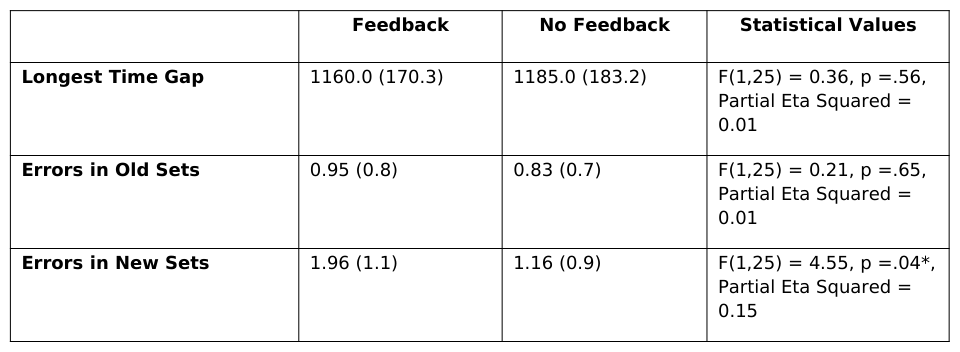
The univariate analysis of the independent variable Feedback demonstrated significant effects for the mean number of errors in new sets, which was, surprisingly, higher for the Feedback group (M = 1.96, SD = 1.1) compared with the No Feedback group (M = 1.16, SD = 0.9, F(1,25) = 4.55, p = .04, Partial Eta Squared = 0.15), Longest time gap and the number of errors in old sets were not significantly different between the two groups. The post-training results are presented in Table 1.
Table 1: Post-training results: Performance measures with the training system: Means and standard deviations (in parentheses) for each performance measure
* – Effect is significant at the 0.05 level
In addition, for the covariate Test, the univariate analysis demonstrated significant effect for the longest time gap – higher for participants with higher test score (Pearson Correlation: r = 0.89, p < 0.001; F(1,25) = 70.25, p < .001, Partial Eta Squared = 0.74). No other significant effects were found.
DISCUSSION AND CONCLUSIONS The “multimillion-pound industry” (Owen et al., 2010, pp. 775) of commercial computerized systems for training the brain and improving cognitive functions has presented many key issues about their design and associated training protocols that are still unresolved. One issue is the use of feedback during training. While feedback can provide essential information and increase learners’ motivation (Arps, 1920; Crawley, 1926; Elwell & Orindley, 1938), the guidance hypothesis theorizes that it may prevent the learner from using his or her intrinsic processes sources and hence block the development of important abilities (Salmoni et al., 1984; Schmidt et al., 1989).
The current research focuses on the effect of feedback given in a computerized training system which train visual attention of visual temporal integration. In the process of visual temporal integration, a series of stimuli with a short break between them is combined together into one stimulus (Di Lollo, 1980; Di Lollo et al., 1988; Di Lollo & Hogben, 1987; Long & Beaton, 1982; Hogben & Di Lollo, 1974). Lamm (2005) described the use of a computerized system to train visual attention of visual temporal integration, and this system was used in the current study. Two training groups were compared, one that got complete feedback during the training and one that did not.
The results demonstrated that the Feedback group did significantly worse in comparison to the No Feedback group on the measure of the mean number of errors in new sets, which is part of the training process. This is probably the most sensitive measure. Since trainees who had four errors as well as trainees who had none move to the next stage, the measure of the longest time gap is less sensitive than the measures of number of errors. In addition, the measure of mean number of errors in old sets is less sensitive than the measure of mean number of errors in new sets since the first could be also a function of pure memory, not only of learning. It is interesting to note that the Feedback group did not do any better on the measure of errors in old sets even though trainees in this group were told what the stimuli were before being asked to identify them again, and hence it was reasonable to assume that they would outperform the No Feedback group on this measure.
Giving feedback resulted in a drop in performance in the training system itself. This deterioration observed in performance during training is not a common phenomenon. Our hypothesis that complete feedback will result in better performance during training was not confirmed and we even observed a reverse effect. A possible explanation for the poor performance in this task with complete feedback that addresses both the training and the transfer is overconfidence. The measure of commission errors in the d2 test was higher for the Feedback group. This measure can be an indicator of overconfidence: Trainees were overconfident in their ability to identify the target symbols, and, as a result, marked many items that were not the target symbols. The phenomenon of overconfidence has been demonstrated in past research (Arkes et al., 1987; Juslin, 1994; Lichtenstein et al., 1982). Complete feedback during training might made trainees to feel that the task is easier than it really is and make them misjudge their temporal integration skills as higher than their true level. During training, this might cause trainees to respond too quickly and, as a result, make mistakes. The measure of response time was not recorded in the current study, and we recommend that it be recorded and analyzed in future research in order to provide additional support for the above hypothesis.
It is possible that the specific way of giving feedback, which was complete feedback, augmented the effect causing the poor results for the group trained in this condition. Schmidt and Bjork (1992) reported the superiority of summarized feedback after several trials versus feedback after each trial in improving transfer of learning and long- term retention both in motor and verbal tasks (e.g., Schmidt et al., 1989). A subject for future research is whether partial feedback in this task can improve performance both in training and transfer of learning.
One more limitation of the current study is that the training included only three sessions and 48 sets of stimuli. Given that trainees continued to improve even at the end of the training, it is possible that the findings would have been different if more training sessions had been given. Future research should expand the training given to trainees in this task and compare the results in this case.
Based on the current research results, giving feedback during cognitive computerized training can lead to undesirable consequences also in training. These results are probably linked to overconfidence and, as a result, non- optimal self-management of training. Hence, the recommendations are that it is better to think of other ways than feedback for providing feedback. It is recommended that this finding be examined in other cognitive tasks and that the robustness of this study evaluated using our suggestions for future research. Generalization of this phenomenon and its boundaries will result in many real-life applications for computerized system training.
ACKNOWLEDGMENTS
This research was supported in part by the Council for Higher Education, Israel.
REFERENCES
Adams, J.A. (1968). Response feedback and learning. Psychological Bulletin, 70, 486-504. Adams, J.A. (1971). A closed-loop theory of motor learning. Journal of Motor Behavior, 3, 111-149. Adams, J.A. (1987) Historical review and appraisal of research learning retention and transfer of human motor skills.
Psychological Bulletin, 101, 41-74. Akyürek, E.G., & Meijerink, S.K. (2012). The deployment of visual attention during temporal integration: An electrophysiological investigation. Psychophysiology, 49, 885-898. Arkes, H.R., Christensen, C., Lai, C., & Blumer, C. (1987). Two methods of reducing overconfidence. Organizational Behavior
and Human Decision Processes, 39, 133-144. Arps, G.F. (1920). Work with KR versus work without KR. Psychological Monographs, 28(No. 125). Buonomano, D.V., & Merzenich, M.M. (1998). Cortical plasticity: from synapses to maps. Annual Review of Neuroscience, 21, 149-186. Catalano, J.F., & Kleiner, B. M. (1984). Distance transfer in coincident timing as a function of variability of practice. Perceptual
and Motor Skills, 58, 851-856. Crawley, S.L. (1926). An experimental investigation of recovery from work. Archives of Psychology, 13, 26.
Croisile, B. (2006). Memory stimulation: Which scientific benefits? Which exercises? Revue de Gériatrie, 31, 421-433. Di Lollo, V. (1980). Temporal integration in visual memory. Journal of Experimental Psychology: General, 109, 75-97. Di Lollo, V., Clark, C.D., & Hogben, J.H. (1988). Separating visible persistence from retinal afterimages. Perception & Psychophysics, 44, 363-368. Di Lollo, V., & Hogben, J.H. (1987). Suppression of visible persistence as a function of spatial separation between inducing
stimuli. Perception & Psychophysics, 41, 345-354. Efron, R. (1970). The minimum duration of a perception. Neuropsychologia, 8, 57-63. Efron, R. (1970). The relationship between the duration of a stimulus and the duration of a perception. Neuropsychologia, 8, 37-
55. Elwell, J.L., & Orindley, G.S. (1938). The effect of knowledge of results on learning and performance. British Journal of Psychology, 29, 39-53. Enns, J.T., Brehaut, J.C., & Shore, D.I. (1999). The duration of a brief event in the mind's eye. The Journal of general
psychology, 126, 355-372. Green, C.S., & Bavelier, D. (2008). Exercising your brain: a review of human brain plasticity and training-induced learning.
Psychology and Aging, 23, 692-701. Hogben, J.H., & Di Lollo, V. (1974). Perceptual integration and perceptual segregation of brief visual stimuli. Vision Research, 14, 1059-1069. James, W. (1890). The principles of psychology (Vol. 1). New York: Holt. Juslin, P. (1994). The overconfidence phenomenon as a consequence of informal experimenter-guided selection of almanac
items. Organizational Behavior and Human Decision Processes, 57, 226-246. Kieling, C., Goncalves, R.R.F., Tannock, R., & Castellanos, F.X. (2008). Neurobiology of attention deficit hyperactivity disorder. Child and Adolescent Psychiatric Clinics of North America, 17, 285-307. Lichtenstein, S., Fischhoff, B., & Phillips, L.D. (1982). Calibration of probabilities: The state of the art to 1980. In D. Kahneman,
P. Slovic, & A. Tversky (Eds.), Judgment under Uncertainty: Heuristics and Biases. Cambridge: Cambridge University Press. Lamm, O. (2005). Method for detection and improving visual attention deficit in humans and system for implementation of this method. United States Patent Application Publication, US2005/0024588 A1. Long, G.M., & Beaton, R.J. (1982). The case for peripheral persistence: Effects of target and background luminance on a partial-
report task. Journal of Experimental Psychology: Human Perception and Performance, 8, 383-391. Magill, R.A. (2006). Motor Learning and Control: Concepts and Applications. New York: McGraw-Hill. Martin, G., & Johnson, C.L. (2006). The boys totem town neurofeedback project: A pilot study of EEG biofeedback with incarcerated juvenile felons. Journal of Neurotherapy, 9, 71-86. medical-dictionary.thefreedictionary.com/biofeedback Owen, A.M., Hampshire, A., Grahn, J.A., Robert Stenton, R., Dajani, S., Alistair S. Burns, A.S., Howard. R.J., & Ballard, C.G.
(2010). Putting brain training to the test. Nature, 465, 775-779. Rabipour, S., & Raz, A. (2012). Training the brain: Fact and fad in cognitive and behavioral remediation. Brain and Cognition, 79, 159-179. Rybak, I.A., Gusakova, V.I., Golovan, A.V., Podladchikova, L.N., & Shevtsova, N.A. (1998). A model of attention-guided visual
perception and recognition. Vision research, 38, 2387-2400. Ross, J., & Sala-Spini, A.F. (2005). Graphic display systems. United States Patent Application Publication, 4162493. Salmoni, A.R, Schmidt, R.A., & Walter, C.B. (1984). Knowledge of results and motor learning: A review and critical appraisal.
Psychological Bulletin, 5, 355-386. Schmidt, R.A. (1982). Motor Control and Learning: A Behavioral Emphasis. Champaign, IL: Human Kinetics Press. Schmidt, R.A., Young, D.E., Swinnen, S., & Shapiro, D.C. (1989). Summary of knowledge of results for skill acquisition: Support for the guidance hypothesis. Journal of Experimental Psychology: Learning, Memory and Cognition, 15, 352-359. Shea, J.B., & Morgan, R.J. (1979). Contextual interference effects on the acquisition, retention, and transfer of a motor skill.
Journal of Experimental Psychology: Human Learning and Memory, 5, 179-187. Skinner, R.F. (1938). The Behavior of Organisms. New York: Appleton. Slagter, H.A., Davidson, R J., & Lutz, A. (2011). Mental training as a tool in the neuroscientific study of brain and cognitive plasticity. Frontiers in Human Neuroscience, 5, 17. Steinhausen, H.C. (2009). The heterogeneity of causes and courses of attention deficit/hyperactivity disorder. Acta Psychiatrica
Scandinavica, 120, 392-399. Stern, Y., Blumen, H.M., Rich, L.W., Richards, A., Herzberg, G., & Gopher, D. (2011). Space Fortress game training and executive control in older adults: A pilot intervention. Aging, Neuropsychology, and Cognition, 18, 653-677. Trowbridge, M.H., & Cason, H. (1932). An experimental study of Thorndike’s theory of learning. The Journal of General
Psychology, 7, 245-260. Wisset, T.A.W., & Enns, J.T. (2001). The role of attention in temporal integration. Perception, 30, 135-145.
LISTED IN THE AHFE DIGITAL BOOKSTORE CATALOGUE
Explore the complete digital volume
Advances in Cognitive Engineering and Neuroergonomics
Read this individual research paper free through the original publisher, or explore the full digital proceedings book.
ISBN 978-1-4951-2101-2
Explore this ISBN in the AHFE Bookstore ↗Listed in the July 2026 bookstore catalogue; search by ISBN to confirm current availability · Digital book purchase optional