Shunsuke Owa, Wonseok Yang (2024). On the use of Verb for Micro Interactions in UI. In: Interdisciplinary Practice in Industrial Design. AHFE Open Access, vol. 144, pp. 198–204. https://doi.org/10.54941/ahfe1005132
With the shift to an online-centric living environment, users are increasingly utilizing digital devices to search for information and decide. Users are often at a painful point when accessing content and functions because of unclear interactions with the system or delayed reactions, preventing them from using the system as they wish. Therefore, to improve the usability of services, methods must be devised for rapid recognition of the UI. The use of dynamic elements in the UI can quickly convey feedback and status changes to users to decide intuitively. Based on the current survey, many Micro Interactions often use animation to physically differentiate UI from other UI and information, such as zooming in and out, contrast, movement, and color change. However, current Micro Interactions lack clear rules and are considered dependent on the skills of designers when creating them. In this research, we considered that user perception could be influenced by utilizing the dynamic characteristics of Micro Interactions, focusing on verb that express the movement of objects and human actions based on the images that language has to offer. This experiment yielded the following analysis of the images of the movement of objects and people. The results were classified into two broad categories: those in which the subjects had a common perception of the dynamic image recalled from the verb and those in which the subjects did not have a common perception of the verb, and variations existed in the motion recalled. Each was characterized by differences in whether the verb itself contained the meaning of a vector or context.
The rapid development of information technology has significantly changed the environment of daily activities, such as shopping, working, and learn- ing, shifting to an online-centric environment where information retrieval and decision-making via digital devices are commonplace. Although this increases productivity and efficiency, the sheer volume of information and options creates difficulties in recognizing and deciding between tasks. There- fore, information and situations must be recognized quickly. As a method, interaction with the user can be devised by communicating the success or failure of an operation or a specific state through visual, auditory, or tactile feedback. Most interactions are visual with Micro Interactions, utilizing con- trast with color intensity and motion graphics (Motomatsu, 2023). Micro
On the Use of Verb for Micro Interactions in UI 199
Interaction is the smallest unit of interaction that performs only one task based on a single scenario (Dan, Musha & Musha, 2014). In this research we focus on those that utilize motion graphics and other forms of movement. Dynamic elements are likely to attract attention (Dick, Ullman & Sagi, 1987) and generate preferences for things to which attention is directed (Kihara et al., 2011). Therefore, dynamic Micro Interactions are believed to lead to positive experiences by making users aware of their attention and enjoyment. However, current user-entertaining dynamic Micro Interactions do not have clear rules; therefore, they depend on the skills of the designer when creat- ing them. Therefore, users may feel dissatisfied or uncomfortable when they experience unexpected movements that may lead to a low usability of the service.
In this research, we focused on the possibility of designing the images of verb based on the movements of objects and people to create rules for dynamic Micro Interactions (Katayama, Ishikawa, & Kohzen, 2004). Expressing the dynamic characteristics of Micro Interactions based on the impressions people have from the verb can positively affect information cog- nition through the formation of empathy among many users and enable experience-oriented design with objectivity (Miyoshi, 2022).
Impact of Dynamic Elements on Cognition and Interaction Movement is a phenomenon in which something moves and the person watching it perceives the movement. Therefore, the expression of movement is understood not by the meaning of the movement itself but by the mech- anism by which the person who notices the movement infers the meaning of the movement based on his/her own experience and the context of the scene (Harada, 2013). In addition, the meaning of a movement changes significantly depending on the context in which it is used. As the angle of direction of movement changes, the increase in speed after the change and the frequency of the change in the direction of movement significantly con- tribute to the biotic impression (Kouroki, Matuda, & Kusumi, 2018), adding effective dynamic elements that can increase the persuasiveness of its content (Harada, 2013). For example, dynamic elements are used in the interactions that accompany these feedback operations such as changes upon tapping, linear (stepless) movements with swiping, and cycling animated icons during loading (Harada, 2019).
Use of Language in Design Language in design is considered important for properly communicating the intent and philosophy of ideas or concepts (Kogechamaru, 2023). In addition, designing with language can change the focus of questions and help develop ideas from a wide range of perspectives (Anzai, 2020). Specifically, a way of thinking exists that rephrases nouns into verb that is effective in keeping the viewpoints of the facilitator asking the questions and the members partici- pating in the dialogue from being confined to the target “artifact (object)” itself (Anzai, 2021). In a previous research, the use of verb in product design
200 Owa and Yang
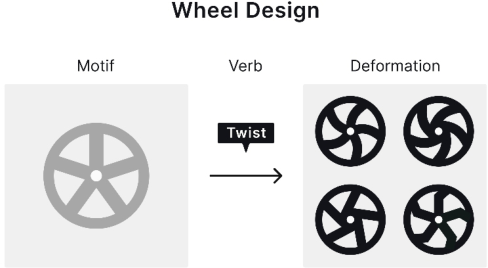
to obtain new form ideas increased the degree of change and the attractive- ness of a motif (Katayama, Ishikawa, & Kohzen, 2004). In this research, we applied these findings to clarify the effects on users regarding using verb to create movement in Micro Interactions in UI.
Figure 1: Examples of verb conjugations in product design.
RESEARCH METHODS First, we investigated the presence of dynamic Micro Interactions on cur- rent Electronic Commerce Website and OTT services. Next, we narrowed the 1071 verbs to those expressing the movement of objects and human actions and requested the participants to sketch the images of the movement of objects and human actions from the extracted verb.
Survey of Current Micro Interactions on Electronic Commerce Website and OTT Service To clarify the usability of the dynamic Micro Interactions created from verb, we targeted a flowing sequence of actions in our experiments (Kurosu, 2023). Therefore, we investigated the existence of dynamic Micro Interactions on Electronic Commerce Website and OTT services where a series of flows exist, from product selection to payment and from video selection to viewing.
Extraction of Verb to Be Utilized for Micro Interactions In creating dynamic Micro Interactions on Electronic Commerce Website and OTT services, we excluded “noun + do” forms (Noguchi, 2010), and we extracted verb expressing the movement of objects and human actions from 1071 verbs. In addition, during the course of the sketch survey, verb that were considered difficult to express the image of movement were repeatedly omitted through pilot tests.
Sketch Survey of the Movements of Objects and People Recalled From Verb To improve the usability of dynamic Micro Interactions, a sketch survey was conducted with 30 subjects each with the aim of clarifying the images of
On the Use of Verb for Micro Interactions in UI 201
object and human motions recalled from narrowed verb. In order not to bias the subjects’ imagination in the sketching survey of the movement of objects, a simple rectangle was included on the survey form as a thin dotted line as an aid, utilizing the concept of emptiness (Hara, 2018). When asking people to sketch their actions, a simple pictogram with no action was included as a thin dotted line to aid the sketching novice. The participants were then requested to sketch the movements of objects and people by adding arrows and lines to the presented verb.
RESULTS
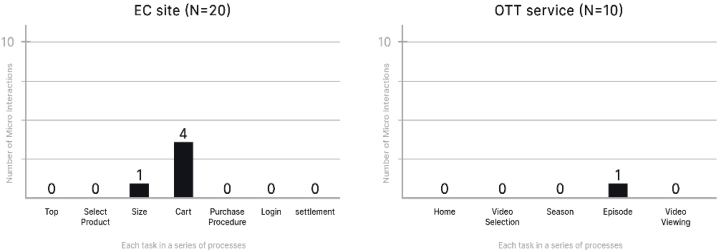
Micro Interaction Findings in Electronic Commerce Website and OTT Service Among the Electronic Commerce Website, dynamic Micro Interactions were observed for Rakuten Ichiba, Qoo10, STYLEVOICE, and FASHION WALKER in the process from product selection to payment, and for MAGA- SEEK in size selection and other processes. However, dynamic elements have not been used at other websites and tasks. In addition, the only OTT ser- vice that utilized dynamic Micro Interaction, the subject of this research, in the process from video selection to video viewing was Disney+ when select- ing episodes, that was rarely utilized. Currently, most Micro Interactions do not add any movement and regularity does not exist in movements. There- fore, users may feel lost or inoperable. Therefore, the use of dynamic Micro Interactions on Electronic Commerce Website and OTT service can lead to improved usability.
Figure 2: With or without micro interactions.
Survey Results and Discussion of Verb Utilized in Micro Interaction The number of verbs was narrowed to 61, excluding verb that describe actions that produce sounds with the mouth, such as “apologize,” “say,” and “speak,” as well as verb that describe states, such as “old,” “different,” and “mad.” However, because even omitted verb have potential conjugation when creating Micro Interactions, the verb narrowed down in this research were treated as examples only, and more verbs are required when creating Micro Interactions for practical use. We believe that using this research as a
202 Owa and Yang
reference for creating Micro Interactions when developing services will lead to more usable services.
Table 1. List of narrowed verbs: Japanese.
Table available in the original PDF paper.
Table 2. List of narrowed verbs: English.
Table available in the original PDF paper.
Be offered Fall Revolve Suck Breathe out Put in Float Return Face Stop Deliver Be filled Move Transfer Shine Put Turn Fall Shed Swell Get on Enter Be folded Be hit Lean Disappear Come Roll Separate Carry Run Open Jump Add Be broken Spare Leave Approach Go away Close Go out Fly Go through Flutter Sink Prop Move on Retreat Slip Shake Droop Twist Bounce Disengage Knock over Fold Sway Scatter Shrink Arrive Go
Results and Discussion of a Survey of Movement Imagery Recalled From Verb The sketch survey results were quantified by summarizing the same move- ment images with subject verb. However, those filled in with red numbers were summarized as others (Table 3). For verb that were vectors of the mean- ing of the verb itself, had no fixed context, or had two or more meanings of the verb, no noun or other word occurred before the verb; this might cause variations in the movement image among the participants. The trends in the survey results also revealed that the mental models of the participants had a spatiotemporal sense in which the past was on the left and lower side and the future was on the right and upper side (Nagumo, 2009). In addi- tion, many object movements had similar images of movement with different verb, whereas few human movements had similar images of movement. This might be due to the fact that human movements required the use of arms and legs for expression, and therefore, the images recalled were more varied than those of object movements.
On the Use of Verb for Micro Interactions in UI 203
Table 3. Some results of the sketch survey: red numbers are others.
This research aims to clarify the impact of language on user cognition by utilizing the dynamic characteristics of Micro Interactions, focusing on verb that express the movement of objects and human actions from the images contained in the language. We extracted verb that expressed the movement of objects and human actions and requested the participants to sketch images of the movement of objects and human actions from the verb. Our experiments and surveys revealed that when creating Micro Interactions from verb, the best situation was if the verb themselves contained meanings, with a fixed vector and context. However, even with verb whose motion images tend to differ from person to person, Micro Interactions can be created without compromising the congruence of motion images by understanding the men- tal models of users through a sketch survey using procedures such as those used in this research. To achieve an even more usable and intuitive opera- tion, validation experiments should be conducted to investigate the usability of dynamic Micro Interactions created from verb.
REFERENCES
Anzai, Y., (2020), Question Design, Gakugei Shuppansha, pp. 101–102. Anzai, Y., Oda, H., (2021), Research Driven Innovation: Exploring Ideas from Questions, Shoei-sha, p. 263. Dan, S., Musha, H., Musha, R., (2014), Micro interaction UI/UX Design Godsend
Details. O’Reilly Japan, p. 217. Dick, M., Ullman, S., Sagi, D., (1987), Parallel and serial processes in motion detection, Science, 237, pp. 400–402. Hara, K., (2018), Kenya Hara’s idea of the possibility of images created from ‘empti-
ness’, available at: https://insights.amana.jp/article/24452/ (accessed 2 January 2024). Harada, H., (2019), Textbook of UI Design, Shoei Publishing Co, p. 207. Harada, T., (2013), Moving Diagram Improvement Drill, Works Corporation, p. 187. Hillstrom, A. P., Yantis, S. (1994). Visual motion and attentional capture. Perception
& Psychophysics, 55, pp. 399–411. Katayama, K., Ishikawa, Y., Kohzen, I., (2004), Research on design conception method (form conception method).
204 Owa and Yang
Kihara, K., Yagi, Y., Takeda, Y., & Kawahara, J. (2011), Distractor devaluation e ect in the attentional blink: Direct evidence for distractor inhibition. Journal of Experimental Psychology: Human Perception and Performance, 37, 168179. Kogechamaru, (2023), The Language of Design, Yorosha, pp. 8–13. Kouroki, M., Matuda, K., Kusumi, T., (2018), Effects of kinetic factors of object
motion on emotional perception of the object, Journal of the Sensory Engineering Society of Japan, Volume 17, No. 1, pp. 1–10. Kurosu, M., (2013), Fundamentals of Human Center Design, Modern Science Society, p. 281. Matsuda, K., Kusumi, T., Kobayashi, T., Ichikawa, M., Kouroki, M., Kurokawa, M.,
(2013), Effects of velocity variation and randomness of object motion on active gazing and preference formation, Research in Cognitive Psychology, Volume 10, No. 2. Miyoshi, K., (2022), Design of the movement itself, BNN, pp. 66–67. Motomatsu, H., (2023), UI/UX Designer Training Course, Shuwa system, pp. 100–102. Nagumo, H., (2009), Visual Design. WORKS CORPORATION. pp. 96–97. Nakayama, K., & Silverman, G. H., (1986), Serial and parallel processing of visual feature conjunctions, Nature, 320, pp. 264–265. Noguchi, K., (2010), A Discussion on the Sentence Structure of [noun + (to) + do],
The Linguistic Society of Japan, 114th. Raymond, J. E., Fenske, M. J., & Tavassoli, N. T. (2003), Selective attention determines emotional responses to novel visual stimuli. Psychological Science, 14, p. 537. Raymond, J. E., Fenske, M. J., & Westoby, N. (2005), Emotional devaluation
of distracting patterns and faces: A consequence of attentional inhibition dur- ing visual search? Journal of Experimental Psychology: Human Perception and Performance, 31, pp. 1404–1415.
LISTED IN THE AHFE DIGITAL BOOKSTORE CATALOGUE
Explore the complete digital volume
Interdisciplinary Practice in Industrial Design
Read this individual research paper free through the original publisher, or explore the full digital proceedings book.
ISBN 978-1-964867-20-5
Explore this ISBN in the AHFE Bookstore ↗Listed in the July 2026 bookstore catalogue; search by ISBN to confirm current availability · Digital book purchase optional