Jun Otsuka, Wonseok Yang (2024). Consideration of the Problem of Digital Divide in the Development of ICT. In: Interdisciplinary Practice in Industrial Design. AHFE Open Access, vol. 144, pp. 205–214. https://doi.org/10.54941/ahfe1005133
The rapid changes in the living environment caused by technological development have created a divergence between the ability of humans to use technology and the technology being used, creating a Digital Divide. In particular, everyone needs equal access to public services such as healthcare and public administration. Liu (2018) states that the Digital Divide cannot be completely eliminated in the information and communication sector due to the rapid transition of technology, and that it is important to take measures that are sustainable. Since further digitization is expected in public services in the future, it is necessary to take sustainable measures against the Digital Divide. This research will survey the literature on the Digital Divide among the elderly. First, we selected articles, reports, and websites, including those related to public services, based on the following criteria: "the article must describe the factors or measures that cause the Digital Divide," "the content must be related to the elderly," and "the article must have been published between 1995 and 2023. Next, the factors causing the Digital Divide were categorized, and the essential factors of the Digital Divide and the overall situation were overviewed. Finally, in order to clarify whether there is a relationship between devices and the Digital Divide, we further narrowed down the literature on devices and classified them again. The results indicate that in order to address the Digital Divide in a sustainable manner, it is important to address factors that occur regardless of the device, such as low digital self-efficacy and lack of mental models when handling digital information, rather than to apply countermeasures to all the factors. In particular, factors related to mental and internal aspects, which are often difficult to see, have not been clarified in detail, and are expected to provide clues for sustainable countermeasures.
The rapid development of ICT (Information and Communication Technol- ogy) has expanded the environment in which everyone can work and study without being restricted by location or time. However, lifelines are signifi- cantly affected for those who are not accustomed to this environment. The recent outbreak of a new type of coronavirus infection has led to the active adoption of ICT as a means of infection prevention and further digitaliza- tion of our lives, and as DX progresses, social infrastructure services such as education, labor, payments, and administrative procedures are rapidly moving online. This rapid change has created a gap between the ability of
individuals to use technology and the technology being used, causing a Digi- tal Divide. Public services such as healthcare and public administration need to be equally accessible to all. As an increasing number of public services are expected to be digitized, several countries and regions are taking mea- sures to address this issue according to their own circumstances. The Digital Divide is a complex and abstract phenomenon that is difficult to understand. The factors that cause this include income, education, and race, but the most significant factor is age (Sebastian et al., 2022). The elderly people are partic- ularly vulnerable to the Digital Divide owing to large individual differences in cognitive and physical aspects, and this problem is expected to grow in the future, particularly as the population of the elderly is increasing in devel- oped countries. Although some previous research have examined the Digital Divide in general, few have focused on it from the perspective of a specific per- son or examined the Digital Divide in its entirety (Najeh, 2021; Sophie et al., 2022). Therefore, a bird’s eye view of the Digital Divide from the perspective of a specific segment can provide new insights. Bridging the Digital Divide is also related to the Sustainable Development Goals. Current measures are mostly ad hoc or post hoc, such as in-store counseling services. Taking mea- sures to ensure that no one is left behind and that no one is disadvantaged by the Digital Divide is important. As Liu (2018) stated, this research considers it appropriate to implement sustainable measures in the near future; there- fore, it investigated and compared materials, including public services, related to the Digital Divide to clarify the current situation. From the results, we aim to identify the factors causing the Digital Divide that need to be addressed sustainably.
INFORMATION SOCEITY PROBLEMS The adaptation of information technology to society has led to changes such as “an overwhelming increase in the volume of information,” “rapid change,” “coexistence of values,” “a society with a flexible structure,” and “a systemic society”(Kishida, 1970). These changes have been accompanied by lifestyle changes, such as the spread of telecommuting, and economic changes, such as an increase in Internet shopping. However, these changes have not only resulted in positive aspects but also problems due to pitfalls, such as the pri- oritization of comfort and technology. The problems caused by these changes can be divided into three major categories: social problems, such as leakage of personal information, technostress, and information floods (Kobayashi, 1994; Nakanome, 1972); psychological problems, such as Internet fraud among the elderly, degeneration of functions and senses, and lack of human warmth and contact; and educational and learning problems, such as decline in emotional intelligence, lack of observation and discipline, and instant information. These aspects change with the spread of SNS, introducing design design in the design of devices, and other changes in information technology that permeate the society.
Consideration of the Problem of Digital Divide in the Development of ICT 207
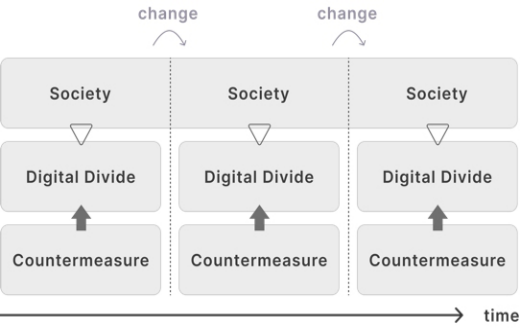
SUSTAINABILITY OF THE DIGITAL DIVIDE Liu suggested that the digital divide will change over time as “society,” includ- ing the environment, economy. Specifically, it continues to change in stages from a gap in the ability to access ICTs to a gap in the ability to use ICTs, and thereafter a gap in the ability to use ICTs to provide benefits (Sophie et al., 2022; Najeh, 2021). The measures have changed in each era. In addition, var- ious temporary approaches to changing the Digital Divide, such as responses in physical stores and smartphone training sessions, are not based on the assumption of continuous use. Fukushima (2006) defined sustainability as the continuation to balance change over time. To maintain sustainability in the Digital Divide, performing these processes over time and continuing to balance them is necessary (Figure 1).
Figure 1: Relationship between social transition and measures to address the digital divide.
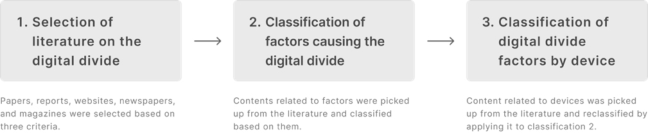
RESEARCH METHOD AND RESULT This study is an exhaustive qualitative study of the literature on the Digital Divide. The literature was selected, and then the factors that cause the Digital Divide were grouped by similar connotations and classified in detail based on the descriptions in the literature. Furthermore, from the selected literature, we extracted literature related to devices and the Digital Divide, and based on the aforementioned classification, we re-categorized the factors for each device. The main flow is shown in Figure 2.
Figure 2: Research flow.
208 Otsuka and Yang
Selection of Documents We selected literature from articles, reports, journals, newspapers, and web- sites based on the following criteria: “The article must describe factors or measures that cause the Digital Divide,” “The content must be related to the elderly,” and “The material must have been published between 1995 and 2023.” The definition of “elderly people” was taken from that of “elderly people” in the individual papers; focused on materials published after 1995, considering that the use of the Internet became widespread in the private sector after the launch of Windows 95. The survey period was September–December 2023; seven documents were gathered from 1997 to 2009, 23 from 2010 to 2019, and 30 from 2020 to 2023, for a total of 60 documents.
Classification of Factors Causing the Digital Divide To identify the factors that cause the Digital Divide, we extracted their descriptions of from the literature and categorized them as follows: “capa- bility,” “external,” “usefulness,” and “intrinsic.”
The “ability factors” are those related to the ability to use the device and that of the body to function. We categorized 29 references that had contexts such as “cannot operate the screen owing to trembling” or “attempted to use the device but did not know how to use it “as references related to” ability factors”.
“External factors” include those related to the lack of universal design and financial problems. A total of 37 references were placed in this category in the context of “the design does not consider the use by the elderly” and “the sudden occurrence of errors seems to be a waste of time.”
The “intrinsic factors” were those related to motivation issues and anxi- ety about oneself. A total of 21 references with contexts such as “I am not interested” and “I do not want to depend on others even if I have a problem” were placed in this category.
The “usefulness factor” is a factor related to the context of lack of need. A total of three references with the context of “I do not find it very useful in my life” or “I do not find the Internet helpful in my life” were classified as “usefulness factor” references.
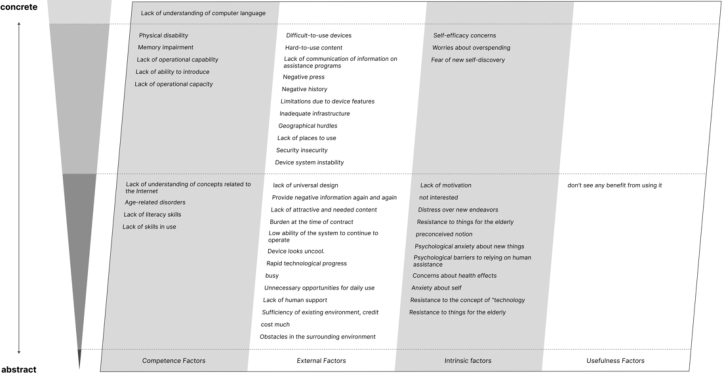
These four categories were further subdivided and summarized in Figure 3.
Consideration of the Problem of Digital Divide in the Development of ICT 209
Figure 3: Pyramid diagram of factors causing the digital divide The “competence factors”and “external factors”were more than the other factors, and they were discussed in various sources. The “usefulness factor” was less frequently mentioned, and although it was mainly stated as “not feeling the need for it,” no reason was provided to delve deeper into the back- ground of why it was not needed, except for the factor “not feeling the benefit of using it.” The number of documents on intrinsic factors was relatively small, and few were discussed in detail.
Classification of Factors Contributing to the Digital Divide by Device To clarify whether there is a relationship between the characteristics of devices and the content of the Digital Divide they cause, We reclassified the content descriptions regarding the three devices of “computer,” “smart- phone,” and “tablet” into the factors that cause the Digital Divide. A total of 9 documents were identified for computers, 16 for smartphones, and 5 for tablets. Literatures on other devices were extremely scarce and were there- fore excluded. The device-specific factors were categorized as summarized in Table 2.
Table 2. Relationship between device-specific factors and the four factors causing the digital divide.
computer Lack of understanding of computer language
Worries about overspending
smartphone Unclear contract system fees Information overload when purchasing devices Lack of human support Sufficiency of existing environment, credit tablet Limitations due to device features
210 Otsuka and Yang
The factors specific to computers among those mentioned are as follows.
Table 3. Specific factors of the digital divide in computers.
Table available in the original PDF paper.
Factor Explanation Lack of understanding of computer language Factors such as lack of knowledge of computer language seen at the edge, such as not being able to understand comments on errors. Lack of opportunities for use
Factors such as the lack of opportunities to use ICT on a daily basis, including the absence of a partner for mutual communication such as sending e-mails.
The factors specific to smartphone among those mentioned are as follows.
Table 4. Specific factors of the digital divide in smartphones.
Table available in the original PDF paper.
Factor Explanation Contract system fees Unclear Factors such as the uncertainty of the contract details, which makes it difficult to understand the usage fees for smartphones. This has caused people to be hesitant to use smartphones, fearing high bills. When purchasing a device Information overload
The problem of not knowing which device is appropriate for the buyer due to the large number of device types. Lack of human support The factor of having no one to support them. Specifically, there is no one to ask for advice on how to use the program, or the program is turned a blind eye or is uncooperative. Furthermore, there is the factor of “lack of communication of information on assistance programs. Sufficiency of existing environment, credit
Factors such as concerns about addictive use.
Factors arising from satisfaction with and trust in the status quo, such as being satisfied with existing analog services, feeling no need for cell phones because they use PCs and tablets, and not daring to adapt to new technologies because they trust existing services. Worries about overuse Worries about overspending
The factors specific to Tablet among those mentioned are as follows.
Table 5. Specific factors of the digital divide in tablets.
Table available in the original PDF paper.
Factor Explanation Depends on device features Limitations
Factors such as inability to print directly from a particular device, inability to back up, and other limitations of what the device itself can do.
Consideration of the Problem of Digital Divide in the Development of ICT 211
Next, we examined the following device-specific factors based on the characteristics of each device.
Table 6. Peculiar factors and considerations of the digital divide in computers.
Table available in the original PDF paper.
Factor Consideration Lack of understanding of computer language
Compared to other devices, computers are more sophisticated and less portable, making them less likely to be used and difficult for older adults to understand
Table 7. Peculiar factors and considerations of the digital divide in computers.
Table available in the original PDF paper.
Factor Consideration
Smartphone use requires signing a contract with a telecommunications company, and these processes are burdensome for the elderly.
Contracting system Unclear fees Information overload when purchasing devices Lack of human support The fact that it is a personal device leads to the need for it regardless of whether the user can use it or not, plus the promotion of DX in public services, which inevitably leads to an increased demand and lack of support. Worries about overspending
Potentially addictive due to portability and the ability to use it anytime, anywhere Existing environment Sufficiency, credit
Satisfied with existing devices and not interested in using new devices because they are latecomers compared to computers and other media
Table 8. Specific factors and considerations of the digital divide in smartphones.
Table available in the original PDF paper.
Factor Consideration Limitations due to device characteristics
Even though the use possesses entertainment elements such as watching videos, drawing pictures, etc., it is difficult to connect to the next experience such as printing.
CONCLUSION
Taking various measures to address the “competent factors” and “external factors” that cause the Digital Divide indicates that these factors have been recognized for a long time and are already considered a social problem. In addition, these factors are easily recognized visually and are easily exposed as social problems. Therefore, we assume that they are easy to countermeasure and that We can find a significant amount of literature on them.
212 Otsuka and Yang
In contrast, “intrinsic factors”have not been investigated in detail and may not be considered as social problems. Because “intrinsic factors” are strongly linked to psychological aspects, they are difficult to recognize visually and are unlikely to surface as social problems. Therefore, We assume that they are difficult to countermeasure, or that the countermeasures themselves have not been taken, and finding literature on them is difficult.
The “usefulness factor”is a fundamental problem different from other fac- tors, and can be divided into cases where the Digital Divide itself is resolved when the elderly feel the need for it, and those where it turns into other factors.
As discussed, “capability factors” and “external factors” are those that are easy to recognize and therefore easy to address, whereas “intrinsic factors” are those that are difficult to recognize and therefore difficult to address. In addition, the “usefulness factor” takes an exceptional position.
To maintain sustainability of the Digital Divide, implementing continuous countermeasures against problems that change over time is important. There- fore, “intrinsic factors,” which are difficult to counteract, must be the most important focus for a sustainable solution to the Digital Divide problem.
By reorganizing the characteristics of each device and the factors that cause the Digital Divide, it became clear that each device had unique factors. How- ever, it also became clear that some of these factors have now been eliminated through device improvements. By continuing to take measures against the common factors of “ability factor,” “usefulness factor,” and “intrinsic fac- tor,” which may occur even if devices change in the future, we can build a foundation for sustainable countermeasures that can respond to new devices and technologies.
As ICT continues to develop, new information gaps may emerge. Future studies on the Digital Divide from other generations, users, and organizations may reveal new aspects. The history of the Digital Divide is still young (only approximately 30 years old), and researching it from various perspectives to create a sustainable society is important.
REFERENCES
Alibaba News Editor (2021/10/22), Elderly Can Easily Shop Online, Alibaba’s Digital Divide Solution Now Available. ALIBABA NEWS JAPANESE: https://jp.aliba banews.com/taobao_senior/. Barbara Barbosa Neves, Jenny Waycott and Sue Malta. (2018), “Old and afraid
of new communication technologies? Reconcepualising and contesting the ‘age- based digital divide”’, Journal of Sociology, Vol. 54, No. 2, pp. 1–11. Birgit Jæger. (2004), “Trapped in the Digital Divide?: Old People in the information Society”. Technology Studies, Vol. 17, No. 2, pp. 5–22. Digital Rural City State Initiative DIGIDEN, Sumida-ku Senior Citizens Club for
Minchare! Measures against the Digital Divide for the Elderly, Digital Rural City State Initiative DIGIDEN: https://www.cas.go.jp/jp/seisaku/digitaldenen/koshien/ kekka/2022_winter/0008.html. Eleftheria Vaportzis, Maria Giatsi Clausen and Alan J Gow. (2017), “Older Adults Perceptions of Technology and Barriers to Interacting with Tablet Computers: A Focus Group Study”, Front Psychol, Vol. 8, pp. 1–12.
Consideration of the Problem of Digital Divide in the Development of ICT 213
Fujii Shiko. (2023), “Transition of Digital Divide in the DX Era: From Infrastructure Divide to Literacy Divide”. Administration, Vol. 29, No. 2, pp. 136–145. Fukushima T. (2006), “Requirements for Sustainability (Sustainability),” Journal of
Environmental Science, Vol. 19, No. 5, pp. 415–424. Ger Tielen. (1998), “Integrating Senior Citizens into the Information Society”.
Ageing International, No. 24, pp. 143–153. Junya Suzuki (2010/4/23), “Why can’t I read the Asahi Shimbun?”--When elderly people use iPad. ITmedia PC USER_: https://www.itmedia.co.jp/pcuser/articles/ 1004/23/news028.html. Jyoti Choudrie, Gheorghita Ghinea and Vivian Nwamaka Songonuga. (2013) “Silver
Surfers, E-government and the Digital Divide: An Exploratory Study of Lon- don Local Authority Websites and Older Citizens”, Interacting with Computers, Vol. 25, No. 6, pp. 417–442. Katayama Yuki (2020/12/18), Creating a Digital Society that Makes Life Easier for the Senior Generation (China)-The Digital Divide Spread by the ‘Suc- cess’ of ‘Health Codes’, Nissay Basic Research Institute: https://www.nli- research.co.jp/report/detail/id=66410?pno=2&site=nli. Kate Conger and Erin Griffith (March 27, 2020) As Life Moves Online, an Older
Generation Faces Digital Divide. The New York Times Website: https://www.nyti mes.com/2020/03/27/technology/virus-older-generation-digital-divide.html. Kishida Junnosuke. (1970), How to live and think in the information society, Japan Productivity Center. Kobayashi Y., et al. (1994), “Pitfalls of Information Society”, Journal of the Japan
Ergonomics Society 30 Supplement, Vol. Supplement, No. 30, pp. 44–45. Kondo Noriko. (2013), “Information Disparity in the Great East Japan Earthquake: How to Provide Disaster-Related Information from the Perspective of the Elderly and People with Disabilities Let’s Be Elderly People Who Can Use the Internet During Disasters!”. Fire Science and Information Quarterly, No. 113, pp. 20–24. L Damodaran, C W Olphert and J Sandhu. (2014), “Falling off the Bandwagon?
Exploring the challenges to sustained digital engagement by older people”. Gerontology, vol. 60, no. 2, pp. 163–173. Liu Succession. (2018), “Research on Measures to Close the Information Gap”, Review of Correspondence, No. 5, pp. 85–102. Michelle Pieri. (2010), “Davide Diamontinir. Young people”, elderly and ICT.
Procedia Social and Behavioral Sciences, Vol. 2, No. 2, pp. 2422–2426. Najeh Aissaoui. The digital divide: A literature review and some directions for future research in light of COVID-19. Global Knowledge, Memory and Communication. 2021, vol. 71, no. 8/9, pp. 686–708. Nakanome N.-A. (1972), “On the ability in the information society”, Journal of
Educational Research, Vol. 39, No. 4, pp. 35–41. Nomura Research Institute (2022), Attitudes, behaviors and issues related to digitization among seniors: Where Japan’s digital divide stands today, where “aging” and “digitalization” coexist, Nomura Research Institute. SoftBank News Editor (2022/4/6), Smartphone Classes in Cars? Smartphone Nan-
demo Support-go” to bridge the local digital divide, SOFTBANK NEWS: https: //www.softbank.jp/sbnews/entry/20220406_01. Sophie Lythreatis, Sanjay Kunar Singh, Abdul-Nasser El-Kassar. “The digital divide: A review and future research agenda”. Technologital Forecasting & Social Change. 2022, vol. 175, pp. 1–11. Takasho M. (2016), “A Study on Solving Issues of Aging Society by Utilizing ICT:
Development of Educational Programs Using Smartphones and Creation of Local Mechanisms.” Transactions of the Society for Standardization Research, Vol. 14, No. 1, pp. 97–111.
214 Otsuka and Yang
Yamaoka H. (2023), “Financial DX and the Response to the Elderly”, Personal Finance, pp. 41–50. Yasuoka Mika, Tanaka Aki, Taguchi Kota and Iwasaki Naoko (2018.7.6), Digital divide among the elderly “not to be left behind” toward the real- ization of a digital society. HUWEI: https://www.huawei.com/jp/ publication- s/huawave/30/hw30_feature_story. Yokoyama Yuji (2022/11/9), The reality of the digital divide problem as seen from
docomo Shops - Part 2 -[Field Report], Digital Administration: https://www.digi tal-gyosei.com/post/2022-11-18-reportage-docomoshop2/. Yokoyama Yuji (2022/11/9), The reality of the digital divide problem as seen from docomo stores - Part 1 -[Field report], Digital Administration: https://www.digita l-gyosei.com/post/2022-11-18-reportage-docomoshop/. Yukiki Y., Jianhe Chen and Kurashima N. (2022), “Prospects for “human-oriented
technology” to promote IT utilization by the elderly in a super-smart society”, Digital Practice, Vol. 63, No. 5, pp. 70–89. Zhao, B. (12/1/2020), “Announcing Measures to Address the Digital Divide for the Elderly, Guaranteeing ‘Health Code’ Support and Alternatives”. JETRO, https: //www.jetro.go.jp/biznews/2020/12/9424302a5ff9a410.html.
LISTED IN THE AHFE DIGITAL BOOKSTORE CATALOGUE
Explore the complete digital volume
Interdisciplinary Practice in Industrial Design
Read this individual research paper free through the original publisher, or explore the full digital proceedings book.
ISBN 978-1-964867-20-5
Explore this ISBN in the AHFE Bookstore ↗Listed in the July 2026 bookstore catalogue; search by ISBN to confirm current availability · Digital book purchase optional