Raja Parasuraman, Pamela Greenwood, Melissa Scheldrup, Brian Falcone, Brian Kidwell, Ryan McKendrick (2019). Neuroergonomics of Skill Acquisition: Genetic and Non-Invasive Brain Stimulation Studies. In: Advances in Cognitive Engineering and Neuroergonomics. AHFE Open Access, vol. 7. https://doi.org/10.54941/ahfe100216
The present experiments examined the effects of two neuroergonomic methods—molecular genetics and transcranial Direct Current Stimulation (tDCS)—on skill acquisition in complex multitasking environments. The results of the first experiment showed that a variant of a common dopamine gene, COMT, interacted with training in supervisory control of unmanned vehicles. Individuals with the Met allele of the COMT gene showed greater trained-related gains in performance than those with the Val allele, consistent with the role of COMT in regulating dopamine availability and executive function. In the second experiment, stimulation of dorsal and ventral frontoparietal attention networks with tDCS accelerated acquisition of multitasking skill on the Space Fortress game. These findings indicate that novel neuroergonomic methods can supplement more traditional training methods for the development of expertise in complex tasks.
Research on skill acquisition, maintenance, and transfer has contributed to the development of diverse training techniques in human factors and ergonomics (Stammers and Patrick 1975). Different training methods have been identified, including ones that allow individuals to reach higher levels of performance and at an earlier stage than through practice alone (Fitts and Posner, 1967; Gopher, Weil, and Siegel, 1989; Wickens et al., 2012). Although many of these training methods are effective, the development of expertise in most complex tasks—such as in intelligence analysis, medical diagnosis, or military aviation—typically requires extensive practice (Ericsson et al., 1993). Consequently, in an economic era of manpower shortages and limited resources for training (e.g., Williams et al., 2009), there is a need to develop and evaluate newer methods than can accelerate skill acquisition.
In this paper we describe the effects of two novel approaches to complex skill development based on neuroergonomics, the study of brain and behavior at work (Parasuraman, 2003, 2011; Posner, 2012)—genetics and non-invasive brain stimulation. The first neuroergonomic approach capitalizes on an emerging body of evidence showing that variants of neurotransmitter genes can be linked to individual differences in different cognitive functions, including attention, memory, and decision making (Greenwood and Parasuraman, 2003; Parasuraman, 2009; Parasuraman and Jiang, 2012). However, it is well understood that inter-individual variation in human performance reflects both genetic and environmental factors. Among the latter are practice and training. Accordingly, gene x training interactions in human performance, if found reliably, can guide the identification of training methods that are best suited to individuals differing in specific genotypes (Parasuraman, 2009).
The second neuroergonomic approach exploits recent research on the effects of non-invasive brain stimulation, in particular transcranial Direct Current Stimulation (tDCS). A large and growing body of research has shown that tDCS can enhance the efficiency of the same basic cognitive functions found to be sensitive to genetic influence, namely attention, memory, and decision making (Jacobson, Koslowsky, and Lavidor, 2011; Coffman, Clark and Parasuraman, 2014). There is a need to extend this research to skill acquisition in more complex tasks representative of work environments.
We describe two studies that examined skill development in two different multitasking situations that typically require many hours to master. The first study examined the effects of the COMT gene on skill development in a task representing supervisory control of multiple unmanned vehicles (McKendrick et al., 2014). The second study examined the effects of tDCS on acquiring skill in Space Fortress, a complex perceptual-motor task that has been linked to proficiency in flying high-performance military aircraft (Gopher, Well, and Bareket, 1994).
SUPERVISORY CONTROL OF UNMANNED VEHICLES: INTERACTION BETWEEN A DOPAMINE GENE AND TRAINING Unmanned vehicles (UVs) are increasingly being deployed to enhance mission capabilities and reduce human exposure to hazards in many civilian and military work domains. Currently two or more personnel are assigned to control a single UV. However, new systems are being developed where a single operator has to supervise multiple UVs, or a team of M operators is required to oversee N UVs, where N>>M, while also being engaged in other tasks such as communications and visual search (Cummings, Clare, and Hart, 2010; Chen and Barnes, 2012). Effective supervisory control in such multitasking environments is therefore likely to be critically dependent on high levels of executive function and working memory (Ahmed et al., 2014; McKendrick et al., 2014).
The prefrontal cortex (PFC) is an important brain structure controlling executive function. Neural activation of the PFC is strongly modulated by the neurotransmitter dopamine (Miller and Cohen, 2001). Several genes influence dopaminergic pathways in the brain, but a major gene variant influencing the PFC is the Val158/108Met variant (single-nucleotide polymorphism, SNP) in the Catechol-O-Methyltransferase (COMT) gene (Goldberg and Weinberger, 2004). This SNP involves the substitution of the amino acid valine (Val) for methionine (Met), which leads to differences in the post-synaptic availability of dopamine, and potentially to variation in dopamine-related PFC cognitive functions. Given that human DNA is double-stranded, different individuals may possess two Met variants (alleles) (Met/Met genotype), two Val alleles (Val/Val), or one of each (Met/Val).
The Met allele of the COMT gene is associated with lower enzymatic activity and hence with greater PFC dopamine availability than the Val allele (Goldberg and Weinberger, 2004). Individuals with one or more Met alleles should therefore be superior to those with the Val allele in executive function and in supervising multiple UVs. A recent meta-analysis confirmed that Met allele carriers showed greater efficiency of prefrontal cortex activation during executive function tasks (Mie, Kirsch, and Meyer-Lindenberg, 2010). In addition, given the role of COMT in cortical plasticity and new learning (Witte et al., 2002), the Met advantage should be particularly evident only after some degree of training and practice. Accordingly, we hypothesized that individuals with the Met/Met COMT genotype would exhibit greater training-related increases in multitasking performance than Met/Val or Val/Val individuals.
A sample of 99 students (48 men, 51 women) aged 18-38 years (mean = 20.6, standard deviation = 3.1) participated and gave written informed consent. Participants provided cheek saliva samples for extraction of DNA. After genotyping using established procedures, the 99 participants were divided into three groups: Met/Met (N=16), Met/Val (N=56), and Val/Val (N=27).
Participants performed a simulated air defense task in which they had to use up to six 6 UVs to protect a no-fly “Red Zone” from attacking aircraft (see Figure 1). Neutral and enemy assets approached this red zone from different directions. Neutral units could also, sometimes, without cue, reveal themselves as enemy units. Participants had four main sub-tasks in this complex multitask: (1) attack all possible enemy targets; (2) minimize enemy intrusions into the Red Zone; (3) avoid friendly fire against own or neutral units; and (4) attend to a communications window which presented messages regarding incoming aircraft. Participants performed the task at each of two levels of task load, 50 enemy aircraft (low load) and 62 enemy aircraft (high load). Following training on the multi-UV task, participants were given two practice blocks to familiarize them with the task. They then performed the task under low and high task load conditions, in a counterbalanced manner. Each task load condition was performed for four blocks of trials each lasting seven minutes. Performance measures were the percentage of enemy targets successfully attacked, the percentage of red zone incursions, and attack efficiency, computed as the percentage of enemy units destroyed by a participant per missile fired).
Figure 1. Screen shot of the multi-UV air defense task. The six UV assets are shown in green, enemy aircraft (to be targeted) in red, and unknown entities in blue. The no-fly Red Zone is also shown in the lower middle half of the screen.
Figure available in the original PDF paper.
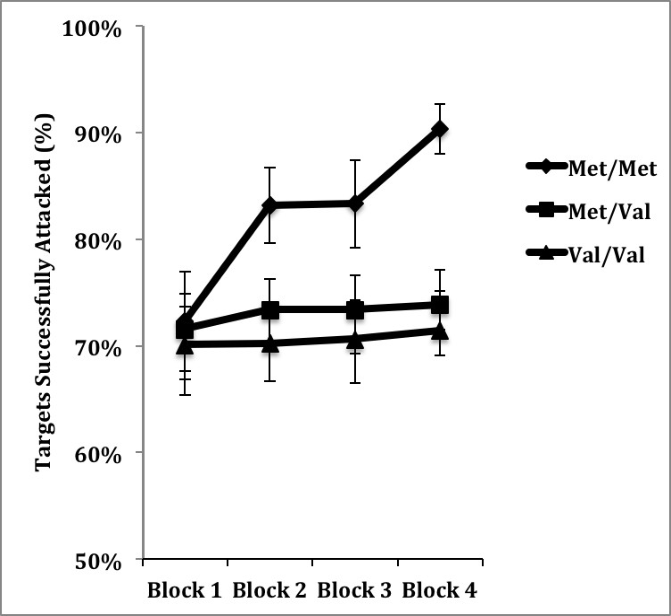
Figure 2 shows the percentage of targets successfully attacked as a function of COMT genotype and training. A significant gene x training interaction was found. The Met/Met group had a significantly higher percentage of enemy targets successfully destroyed than the Val/Val and the Met/Val groups, who did not differ from each other. The superior performance of the Met/Met group developed over blocks, with an 18% increase in targets destroyed over the four blocks of training. In contrast, the Met/Val and Val/Val groups did not exhibit appreciable skill acquisition over the four blocks. These trends were mirrored in the percentage of red zone incursions, which decreased over blocks for the Met/Met and Met/Val groups, but did not change significantly for the Val/Val group, as again supported by a significant gene x training interaction.
To assess whether the gene x training interaction effects in offensive and defensive performance were due to a response bias, that is a tendency to be biased (or not) towards firing missiles at enemy targets, the attack efficiency measure was analyzed similarly to the other performance measures. A gene x training interaction effect was again found, such that the Met/Met showed an increase in efficiency over blocks, whereas the other two groups did not show a systematic change.
Figure 2. Mean percentage of enemy targets successfully attacked for the Met/Met, Met/Val, and
Val/Val groups as a function of training blocks.
These results are consistent with the view that the Val158Met variant of the COMT gene interacts with training to influence individual differences in supervisory control of UVs. Although there were no differences in performance between genotypes at the beginning of training, there was a strengthened effect of genotype over the course of skill acquisition. Individuals with two copies of the Met allele, which is known to encode a low activity version of the COMT enzyme, resulting in higher levels of extracellular dopamine in PFC (Goldberg and Weinberger, 2004), showed a greater increase in targets successfully engaged and a greater reduction in enemy red zone incursions over blocks. The observed benefit of the Met allele was not due merely to indiscriminant shooting at enemy aircraft (a kind of response bias effect). If so, the Attack Efficiency measure (percent of targets destroyed per missile fired) should have been significantly lower in the Met/Met group than in the Met/Val and Val/Val groups, but in fact was higher than in the other two groups.
Individual operator abilities have previously been linked to effective supervision of multiple UVs (Chen and Barnes, 2012; McKendrick et al., 2014). The present results add to that work by showing that executive function, which has been strongly linked to the COMT gene in neuroimaging studies (Mier et al., 2010), is not only associated with individual differences in multi-UV supervision, but also to the acquisition of supervisory control skill.
ACCELERATING COMPLEX TASK SKILL ACQUISITION WITH TDCS A second neuroergonomic technique that has the potential to boost skill acquisition in complex tasks is tDCS, a form of non-invasive brain stimulation. tDCS involves the application of a weak DC current (typically 1 to 2 mA) to electrodes attached to the individual’s scalp (Bikson, Datta, and Elwassif, 2009). A positive (anodal) polarity is generally used to stimulate neuronal function and enhance behavioral performance. Conversely, a negative (cathodal) polarity is used to inhibit neuronal activity and performance. The technique is safe for research use in healthy subjects for up to 30 minutes of stimulation. The precise mechanism by which tDCS influences brain function is not precisely known, but is thought to involve alteration of the electrical environment of cortical neurons, specifically small changes in the resting membrane potential of neurons, so that they fire more readily to input from other neurons (Biksom et al., 2009).
A number of studies have shown that application of anodal tDCS to scalp sites overlying different brain areas can enhance basic cognitive functions, including attention, working memory, and decision making (for reviews see Jacobson et al., 2011; Coffman et al., 2014). Moreover, there is emerging evidence that tDCS can accelerate skill development in tasks representative of complex work environments, including surveillance and security operations (Falcone et al., 2012) and intelligence analysis (McKinley et al., 2013).
In the present study we examined the effects of tDCS on performance of the Space Fortress (SF) multitask. The task involves directing an own spaceship against the Space Fortress, which is located in the center of the screen, while dealing with friendly and enemy mines and monitoring the ship’s resources. A joystick is used to navigate the ship while firing missiles at the Space Fortress, which becomes vulnerable to destruction after it is hit by 10 missiles. Performance measures include total score, which is the sum of four sub-scores, each detailing a different component of the task; ship control, ship velocity, speed of responding to mines, and points. Developing skill in this complex task typically takes many hours to days (Mane, Adams, and Donchin, 1989). Our interest was to examine whether 30 minutes of tDCS could speed up acquisition of this task. Previous neuroimaging research was used to guide the choice of brain areas to stimulate. In particular, given that one aspect of Space Fortress requires highly focused attention (ship control and ship velocity), we hypothesized that stimulation of the dorsal frontoparietal attention network, which has been associated with focused attention (Corbetta, Patel, and Schulman, 2008), would accelerate acquisition of these sub-tasks. In contrast, stimulation of the ventral attention network should facilitate skill development for SF sub-tasks that require the redirection or shifting of attention from flying the ship (speed and points).
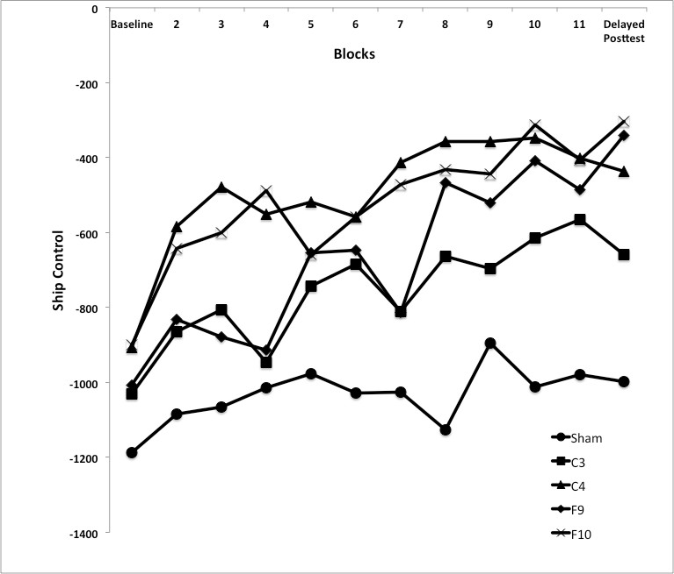
Figure 3. Mean ship control scores as a function of training blocks and stimulation condition. The first and last blocks were baseline and delayed posttest, respectively.
A total of 100 undergraduate students were recruited to participate in this study. Participants were randomly assigned to receive either sham (0.2 mA) or one of four 2mA anodal stimulation conditions; (a) right ventral frontal, (b) right parietal, (c) left ventral frontal, and (d) left parietal (F10, C4, F9 and C3, respectively in the 10-20 EEG nomenclature). Participants were trained for 12 blocks, of which the first was a baseline and the last a delayed posttest.
All groups showed an increase in the control sub-score over training and there were also differences in the effects of stimulation condition (see Figure 3). Both the C4 and the F10 groups performed significantly better than the sham stimulation group. Similarly, all groups changed on the velocity sub-score over games of training and there was an overall group difference and a group x game interaction. The C4 stimulation group performed better than the F9 and the C3 groups and better than the sham group. All groups improved on the speed sub-score over games of training and there was an overall group difference. Post-hoc comparisons revealed that the F9 stimulation group differed significantly from the sham group. Finally, all groups improved on the points sub-score over games of training, but there were no other significant effects for this measure.
These results support the hypothesis that stimulation of dorsal and ventral frontoparietal attention networks with tDCS would accelerate SF skill acquisition, as quickly as in the first hour of training. This finding is important given that skill development on the SF task typically requires many hours of practice (Mane et al., 1989). The model of Corbetta et al. (2008) on attentional orienting postulates that the dorsal network is engaged during focused attention, whereas attentional reorienting requires the ventral network. We therefore expected that subtasks that require focused attention (control and velocity) would benefit from tDCS to the dorsal attention network while subtasks that require redirection of attention (speed and points) would benefit from tDCS to the right hemisphere ventral network. The results partially supported these hypotheses. We predicted that learning to control the ship (control and velocity sub-scores) would require focused attention and therefore would benefit from stimulating either the dorsal attention network or both dorsal and ventral networks. However, ship control benefited from both right parietal (C4) and right ventral frontal (F10) stimulation, consistent with a benefit of ventral attention network stimulation. Our findings implicating the ventral network are broadly consistent with previous work showing that SF training reduced activation of ventral frontal regions (Lee, et al., 2012; Prakash et al, 2012). Those studies assessed activation patterns at the end of training. We modulated activation at the beginning of training. To the extent that SF training requires frequent reorienting of visuospatial attention, the ventral attention network may be important early in training – producing our results – but become less important as the task is learned (Prakash et al., 2012).
DISCUSSION AND CONCLUSIONS Two novel approaches to complex skill development based on neuroergonomics (Parasuraman, 2003, 2011)— genetics and non-invasive brain stimulation—were investigated in this paper. In the first experiment, we found that a variant of a common dopamine gene, COMT, interacted with training in supervisory control of unmanned vehicles. Specifically, individuals with the Met allele of the COMT gene showed greater training-related gains in performance than those with the Val allele, consistent with the role of COMT in regulating dopamine availability and executive function (Mier et al., 2010). Insofar as increased dopamine signaling has been found to heighten regional activation specifically in the dorsal attention network (Tomasi et al., 2011), our evidence reveals the importance of that network in supervisory control. The findings further suggest that training methods matched to the cognitive abilities of an individual may provide a robust method for enhancing the performance of humans working with automated and robotic systems and could be used either in place of or to supplement personnel selection (Szalma, 2009). Future research should examine gene x training interaction effects for other training methods such as adaptive training (Wickens et al., 2012) or variable-priority training (Gopher et al., 1989).
In the second experiment, we found that stimulation of ventral frontoparietal attention networks (Corbetta et al., 2008) accelerated acquisition of multitasking skill on the Space Fortress game. The development of expertise in this task typically requires extended practice over many hours, but significant gains in performance were seen after only 1 hour of training with tDCS. In future work we plan to investigate whether such gains can be consolidated and increased with additional tDCS stimulation, e.g., on a daily basis. Another topic for future research is retention— whether there is significant forgetting after cessation of stimulation—and transfer—whether training with tDCS leads to performance enhancement in related but different multitasks.
The present set of studies examined the efficacy of genetic and tDCS based methods for skill acceleration independently of each other. An interesting question is whether there would be additive or synergistic effects of the two types of performance modulation. Only a few studies have investigated the effects of tDCS on individuals with different genotypes (Plewnia et al., 2013). In addition, genetics could be examined with other forms of brain stimulation, and with other training methods, such a cognitive or videogame training (Clark and Parasuraman, 2014).
REFERENCES
Ahmed, N., de Visser, E., Shaw, T., Mohamed-Ameen, A., Campbell, M. A., and Parasuraman, R. (2014). Predicting humanautomation performance in networked systems using statistical models: The role of working memory capacity. Ergonomics, http://dx.doi.org/10.1080/00140139.2013.855823. Bikson M, Radman T, and Datta A. (2006).Rational modulation of neuronal processing with applied electric fields. Proceedings
of the IEEE Engineering in Medicine and Biology Society 1: 1616–1619. Chen, J. Y. C., and Barnes, M. J. (2012). Supervisory control of mul- tiple robots: Effects of imperfect automation and individual differences. Human Factors, 54, 157–174. Clark, V., and Parasuraman, R. (2014). Enhancing brain and mind in health and in disease. NeuroImage, 85, 889-894.
dx.doi.org/10.1016/j.neuroimage.2013.08.071 Coffman, B. A., Clark, V. P., and Parasuraman, R. (2014). Battery powered thought: Enhancement of attention, learning, and memory in healthy adults using transcranial Direct Current Stimulation. NeuroImage, 85, 895-908. dx.doi.org/10.1016/j.neuroimage.2013.07.083. Corbetta, M., Patel, G., and Shulman, G. L. (2008). The reorienting system of the human brain: From environment to theory of
mind. Neuron, 58(3), 306–24. doi:10.1016/j.neuron.2008.04.017 Cummings, M. L., Clare, A., and Hart, C. (2010). The role of human–automation consensus in multiple unmanned vehicle scheduling. Human Factors, 52, 17–27. Ericsson, K., Krampe, R. T., and Tesch-Romer, C. (1993). The role of deliberate practice in the acquisition of expert
performance. Psychological Review, 100, 363–406. Falcone, B., Coffman, B. A., Clark, V. P., and Parasuraman, R. (2012). Transcranial direct current stimulation enhances perceptual sensitivity and 24-hour retention in a complex threat detection task. PLoS One, 7(4), e34993. doi:
10.1371/journal.pone.0034993. Fitts, P. M., and Posner, M. I. (1967). “Human performance.” Oxford, UK: Brooks/Cole. Goldberg, T. E., and Weinberger, D. R. (2004). Genes and the pars- ing of cognitive processes. Trends in Cognitive Science, 8, 325–335. Gopher, D., Weil, M., and Siegel, D. (1989). Practice under changing priorities: An approach to the training of complex skills.
Acta Psychologica, 71(1-3), 147–177. doi:10.1016/0001-6918(89)90007-3 Gopher, D., Well, M., and Bareket, T. (1994). Transfer of skill from a computer game trainer to flight. Human Factors, 36, 387–
405. Greenwood, P., and Parasuraman, R. (2003). Normal genetic variation, cognition, and aging. Behavioral and Cognitive Neuroscience Reviews, 2, 278-306. Jacobson, L., Koslowsky, M., and Lavidor, M. (2011). tDCS polarity effects in motor and cognitive domains: a meta-analytical
review. Experimental Brain Research, 1–10. doi:10.1007/s00221-011-2891-9 Lee, H., Voss, M.W., Prakash, R. S., Boot, W. R., Vo, L. T. K., Basak, C., et al. (2012). Videogame training strategy-induced change in brain function during a complex visuomotor task. Behavioural Brain Research, 232(2), 348–57. doi:10.1016/j.bbr.2012.03.043 Mane, A. M., Adams, J. A., and Donchin, E. (1989). Adaptive and part-whole training in the acquisition of a complex perceptual-
moto skill. Acta Psychologica, 71, 179–196. McKendrick, R., Shaw, T., de Visser, E., Saqer, H., Kidwell, B., and Parasuraman, R. (2014). Team performance in networked supervisory control of unmanned air vehicles: Effects of automation, working memory and communication content. Human Factors, doi: 10.1177/0018720813496269. Mckinley, R. A., McIntire, L., Bridges, N., Goodyear, C., and Weisend, M. P. (2013). Acceleration of image analyst training
with Transcranial Direct Current Stimulation . Behavioral Neuroscience, 127, 936-946. Mier, D., Kirsch, P., and Meyer-Lindenberg, A. (2010). Neural substrates of pleiotropic action of genetic variation in COMT: A meta-analysis. Molecular Psychiatry, 15, 918–927. Miller, E. K., and Cohen, J. D. (2001). An integrative theory of pre- frontal cortex function. Annual Review of Neuroscience, 24,
167–202. Parasuraman, R. (2003). Neuroergonomics: Research and practice. Theoretical Issues in Ergonomics Science, 4, 5-20. Parasuraman, R. (2009). Assaying individual differences in cognition with molecular genetics: theory and application.
Theoretical Issues in Ergonomics Science, 10, 399-416. Parasuraman, R. (2011). Neuroergonomics: Brain, cognition, and performance at work. Current Directions in Psychological Science, 20, 181-186. Parasuraman, R., and Jiang, Y. (2012). Individual differences in cognition, affect, and performance: Behavioral, neuroimaging,
and molecular genetic approaches. NeuroImage, 59, 70-82. Plewnia, C., Zwissler, B., Längst, I., Maurer, B., Giel, K,, and Krüger, R. (2013) Effects of transcranial direct current stimulation (tDCS) on executive functions: Influence of COMT Val/Met polymorphism. Cortex, 47, 1801-1807. Posner, M. I. (2012). Expanding horizons in ergonomics research. NeuroImage, 59, 149-153. Prakash, R. S., De Leon, A., Mourany, L., Lee, H., Voss, M. W., Boot, W. R……Kramer, A. (2012). Examining neural correlates
of skill acquisition in a complex videogame training program. Frontiers in Human Neuroscience, 115. doi:10.3389/fnhum.2012.00115. Stammers, R. B., and Patrick, J. (1975). “Psychology of training.” London: Methuen. Szalma, J. (2009). Individual differences in human–technology interaction: Incorporating variation in human characteristics into human factors and ergonomics research and design. Theoretical Issues in Ergonomics Science, 10, 381–397. Tomasi, D., Volkow, N. D., Wang, G. J., Wang, R., Telang, F., Caparelli, E. C., . . . Fowler, J. S. (2011). Methylphenidate
enhances brain activation and deactivation responses to visual attention and working memory tasks in healthy controls. Neuroimage, 54(4), 3101-3110. doi: 10.1016/j.neuroimage.2010.10.060. Wickens, C. D., Hutchins, S., Carolan, T., and Cumming, J. (2012). Effectiveness of part-task training and increasing-difficulty training strategies: A meta-analysis approach. Human Factors, 55, 461–470. doi:10.1177/0018720812451994. Williams, T. E., Satiani, B., Thomas, A., and Ellison, C. (2009). The impending shortage and the estimated cost of training the
future surgical workforce. Annals of Surgery, 250, 590-597. Witte, A. V., Kürten, J., Jansen, S., Schirmacher, A., Brand, E., et al. (2012). Interaction of BDNF and COMT polymorphisms on paired-associative stimulation-induced cortical plasticity. Journal of Neuroscience, 32, 4553-4561.
LISTED IN THE AHFE DIGITAL BOOKSTORE CATALOGUE
Explore the complete digital volume
Advances in Cognitive Engineering and Neuroergonomics
Read this individual research paper free through the original publisher, or explore the full digital proceedings book.
ISBN 978-1-4951-2101-2
Explore this ISBN in the AHFE Bookstore ↗Listed in the July 2026 bookstore catalogue; search by ISBN to confirm current availability · Digital book purchase optional