Naoki Yamao, Y. Okada (2020). An Analysis of Drug Administration Taskson Safety Management in Medical Centers. In: Advances in Social and Organizational Factors. AHFE Open Access, vol. 9. https://doi.org/10.54941/ahfe100323
The safety management in various hospitals recently has begun in order to reduce the incidents and prevent human errors. Among incidents that occurred in hospital, many are related to drug administration error. Drug administration error is a type of human error that occurs somewhere in the process spanning from medicine prescription by the doctor through administration by the nurse. We examined whether there is any problem with the incident report on the drug administration error in the hospital. Then, we found that it is difficult for safety manager with little experience, to find the problems in drug administration task. Also we found that they didn’t know how they would discuss countermeasures. Therefore we studied to help safety manager find and take measure in work including dangerous factors at drug administration tasks by evaluating the risk of the work. The method is evaluating the risk of the work in the drug administration tasks by using Factors List, Risk Score and Influence of the Factors. By using this method, it helps safety managers in the hospitals understand problems of the work in the drug administration tasks and activate the recurrence prevention activities of medical accident.
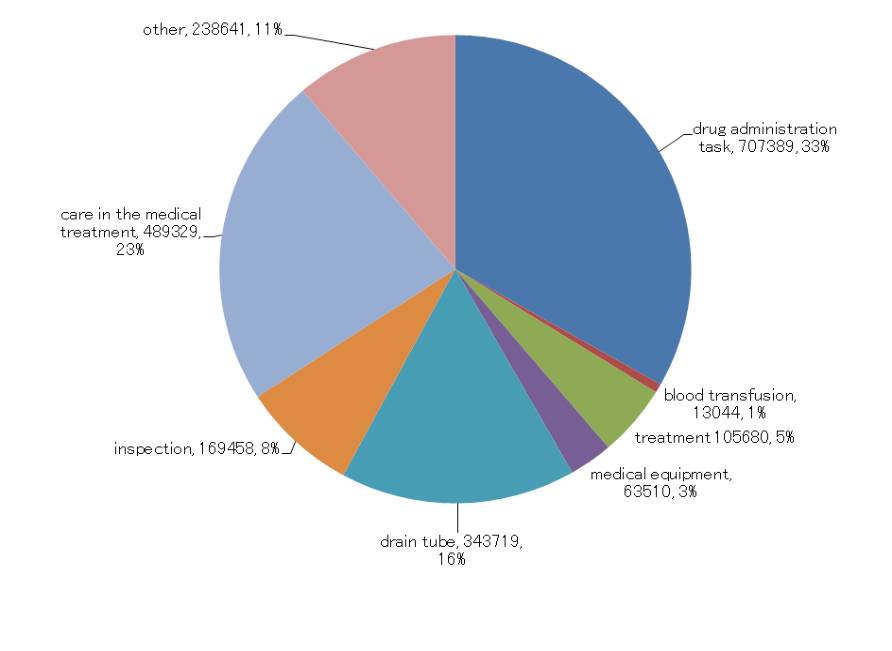
In medical institutions such as hospitals, there has been great interest in safety activities for medical services related to the patient's life. Therefore, safety activity is important in hospitals in order to continue to protect safety. One of major safety activity in hospital is recurrence prevention activities of medical accidents. This is activities in which medical safety manager investigate the accident and discover the dangerous factors and take measures. Because there are many personnel, money, time, and equipment in large-scale hospitals, safety manager can easily takes measures. But because there are not much personnel, money, time, and equipment in small-scale hospitals, safety manager cannot easily takes measures. For this reason safety manager have to take measures against the most dangerous factor included in the work. The most dangerous factor is decided by safety manager. If safety manager don’t have much knowledge and experience of accidents, it is difficult that safety manager takes measure against accident. Figure 1 is ratio of the number of accidents in about 400 hospitals.
Figure 1: Ratio of the number of accidents in about 400 hospitals. (January 2010-June 2013) It is found that drug administration tasks have the largest percentage from Figure 1. From the above, we studied to help that safety manager find and take measure in work including the largest dangerous factors at drug administration tasks. In this paper, we wrote about methods of evaluating risk of work and how to use them. We call risk of work as Human Error Possibility.
THE METHOD OF EVALUATING RISK OF WORK IN DRUG ADMINISTRATION TASKS Factors List
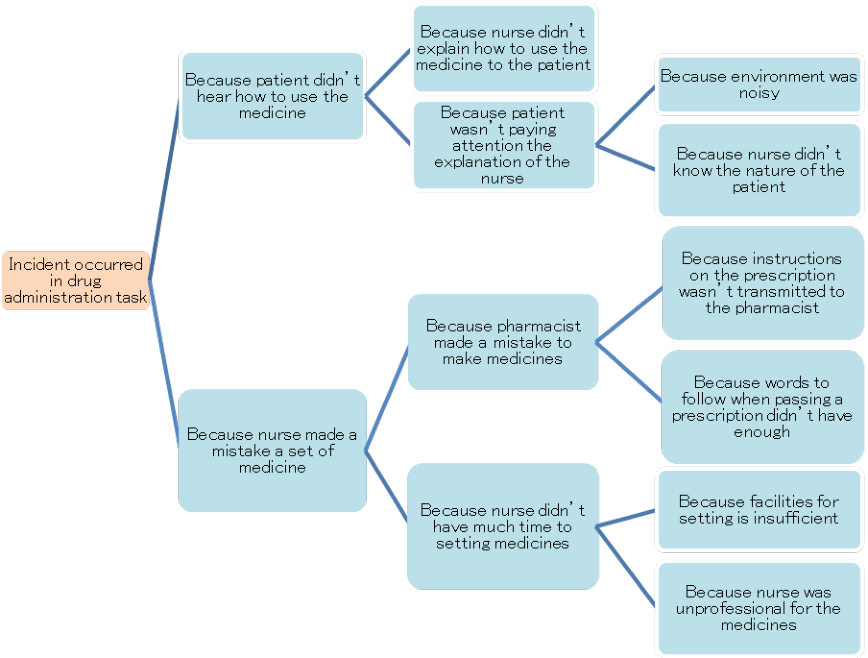
First, we investigated what kind of dangerous factors is in drug administration tasks when an accident occurs. In that case, safety manager can soon conceive factors that directly affect the accident. Certainly when an accident occurs in medical field, it is important for safety manager to find factors that directly affect the accident. But it is important to find not only the clear factor but also a lot of factors that lurk in the back side of the clear factor from a past accident. Decreasing these latent factors leads to the prevention of a severe accident. In a word, it means that taking measures based on analyzing incidents will consequentially prevent a severe accident. This idea is based on the Heinrich’s hierarchy "There are accident of 29 medium degrees and 300 slight cases in the back side of one severe accident ". When an accident occurs, the possibility that a lot of incidents have been lurking till then is high. Then we examined a lot of factors that lurk in the back side of the clear factor from a past accident. First we analyzed 30 incident cases with 30 persons concerned with 10 hospitals (safety managers, nurses, pharmacist, etc…) by using Root Cause Analysis. Root Cause Analysis is method that can extract a lot of potential factors by prompting that analyst to consider many times why accident happened. Also analyst can understand structure of cause and effect of the accident. Figure 2 is an example of the result of the Root Cause Analysis. By using this method, we were able to extract 666 factors lurking in the accident of drug administration task.
Figure 2: An example of Root Cause Analysis
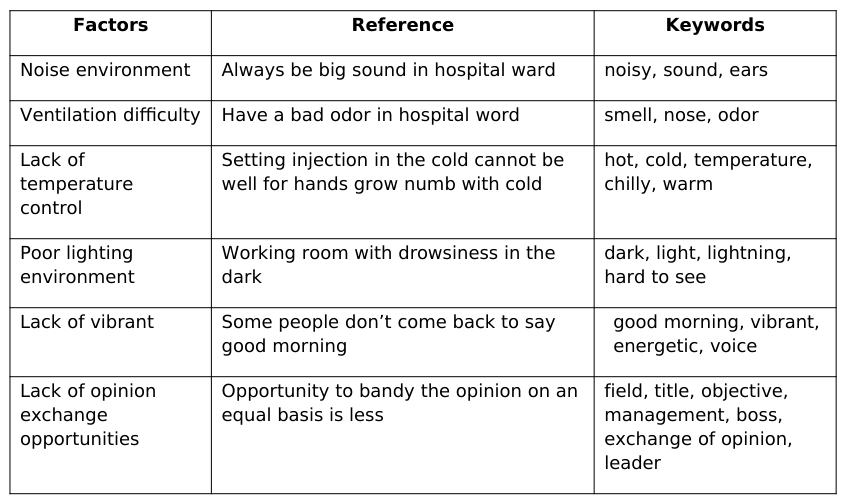
Next we counted the number of 666 factors included in the 236 incident reports in 10 hospitals. And we narrowed down 666 factors to 64 factors. We define 64 factors as “Factors List”. Table 1 is the Factors List created. We have set the references and keywords to each factor.
Table 1: Factors list (excerpts)
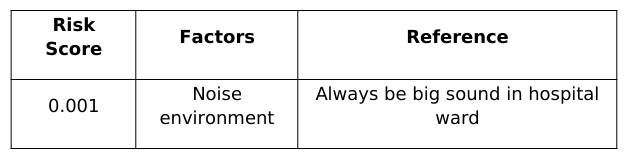
Risk Score Next, we examined the degree of danger for each factor included in Factors List in drug administration tasks. We define this as “Risk Score”. Therefore we set the Risk Score of each factor by referring to the data of NUREG/CR- 1278. NUREG/CR-1278 is the data indicating the probability of human error in the work and used in nuclear power industry. In addition, we also used HEART (Human Error Assessment and Reduction Technique) with the aim of complementing the NUREG/CR-1278. Table 2 is a one case. In this way, we established Risk Score of 64 factors.
Table 2: Risk Score (see NUREG/CR-1278) Risk Score Factors Reference
Influence of the Factors Next, we examined the degree of influence of each factor in Factors List that affects the accident. We define this as “Influence of the Factors”. Influence of the Factors is the degree to which the factors are affecting incident. Therefore, in the present study, we calculated the degree of influence of each factor by using the following formula.
Influence of the Factors = the number of factors obtained from incident reports / the number of incident reports The calculation was based on the keywords included in Factors List.
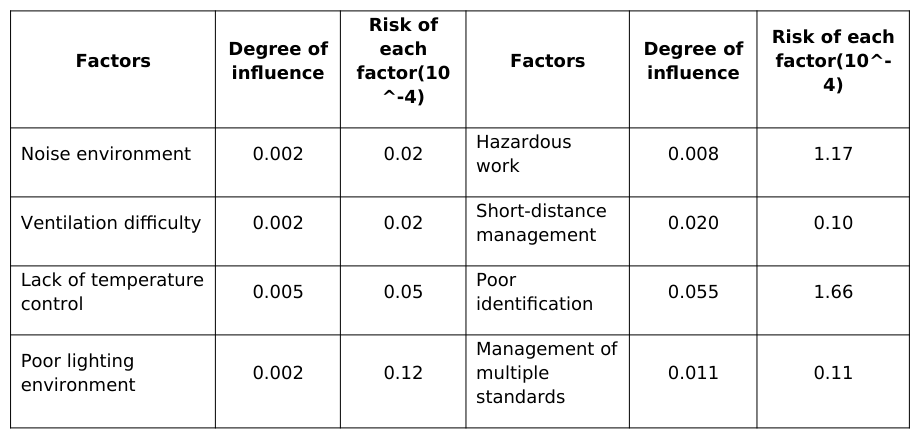
Calculation of the risk of each factor It is possible to calculate a risk of factor by using “Factors List”, ”Risk Score” and “Influence of Factors” as defined previously. We show the formula below.
Risk of each factor = presence or absence of each factor (0, 1) × Risk Score of each factor ×Influence of each Factor By this formula, risk of each factor can be calculated.
Table 3: Risk of each factor Risk of
Calculation of Human Error Possibility (risk of work) By calculating risk of each factor, it is possible to calculate a risk of work. A risk of work consists of many risks of factors. And a risk of work shows Human Error Possibility. Since each factor included in Factors List is independent, the following formula is obtained.
Human Error Possibility = 1-Π (1- risk of factors) =1-Π (1- presence or absence of each factor × Risk Score of each factor ×Influence of each Factor)
In this way, we can calculate Human Error Possibility.
Evaluation Safety manager can tell that the higher the Human Error Possibility, the higher the priority, which means they should take measure for that work.
VERIFICATION Actually, we verified this method in the A hospital. Figure 3 is the flow of drug administration tasks in the A hospital.
Doctor Nurse Pharmacist Patient Receive a examination Examination
Instruction on the prescription Receive an instruction on the prescription
Pass a prescription to the pharmacy
Prepare medicines
Carry the medicine to ward
Fill in medicines with a date and set medicines
Set medicine of the next day
Double check
Administer medicines
Figure 3: The flow of drug administration tasks in the A hospital.
Figure available in the original PDF paper.
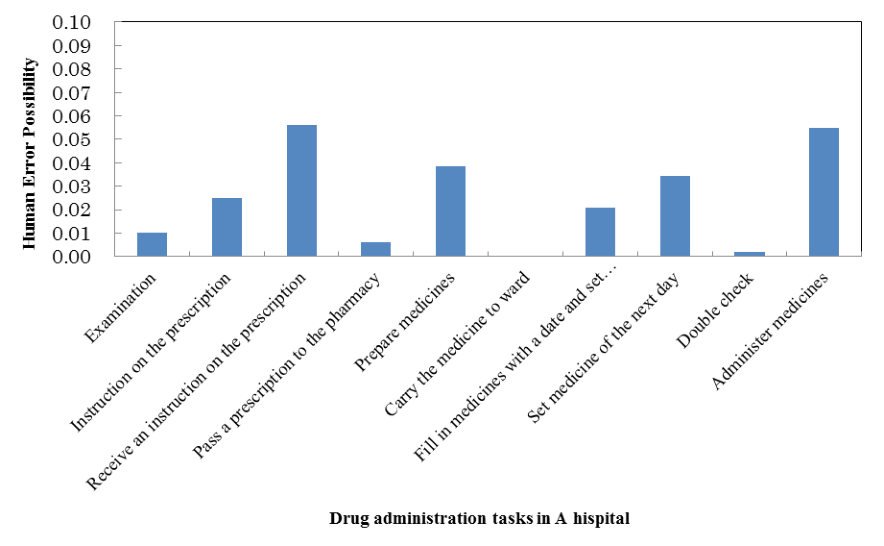
The safety manager in the A hospital pick all the factors that are true for Factors List in drug administration tasks of their own hospital. Factors whose degree of risk is higher become factors against which they should take measures. Figure 4 show Human Error Possibility in the A hospital. And figure 4 show that the risk of “Receive an instruction on the prescription” is the highest.
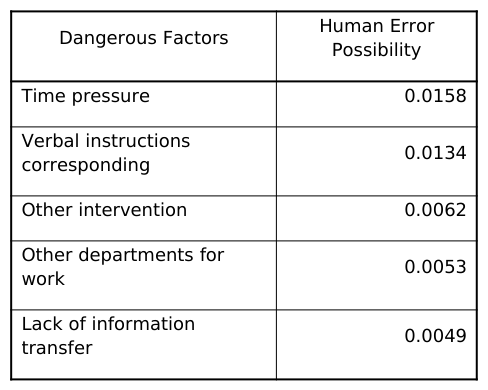
Figure4: Human Error Possibility of each work in drug administration tasksTable 4: Dangerous factors included in “Receive an instruction on the prescription” Dangerous Factors Human Error
By looking at the table 4, we can evaluate that factor of “Time pressure” included in “Receive an instruction on the prescription” should be addressed in the A hospital. Furthermore, by comparing Human Error Possibility of the one hospital with Human Error Possibility of the other hospitals and finding the work that has the highest Human Error Possibility, it also will be possible to help safety managers in the hospitals to improve the work. As a result of using our method, safety managers said that finding a weakness in the drug administration tasks became easier by the presence of the indicator of the risk of work, and that it was very convenient when taking measures. Further, safety managers said that they could take better measures by being able to find problems that they didn’t care when taking measures.
CONCLUSIONS
One of major safety activity in hospital is recurrence prevention activities of medical accidents. This is activities in which medical safety manager investigate the accident and discover the dangerous factors and take measures. What is important in this activity is to discover the dangerous factors. Safety manager have to discover the dangerous factors and understand the problems exactly, or recurrence prevention activities does not work. Also by understanding which work has problems, safety manager can use the past measures and studies. But in fact, for the inexperienced safety managers, it is difficult to discover the dangerous factors and understand the problems exactly. From the above, we studied to help safety manager find and take measure in work including dangerous factors at drug administration tasks by evaluating the risk of the work. The method is to evaluate the risk of the work in the drug administration tasks by using Factors List, Risk Score and Influence of the Factors. By using this method, safety managers in the hospitals can easily understand problems of the work in the drug administration tasks and activate the recurrence prevention activities of medical accident.
REFERENCES
Furukawa, A., Okada Y.: A Proposal of Collection and Analysis System of Near Miss Incident in Nursing Duties. HCI (9) pp497-502 2009 Furukawa, A., Okada, Y., Sagawa, N. and Fujitsuka R.: A Proposal of a Training Program of Risk Managers Applying Incident
Reports in Medical Organizations. Proceedings of Asia Pacific Symposium on Safety 2009 pp352-355 Sagawa, N. , Fujitsuka, R. , Furukawa, A. ,Okada, Y. :A Study on Usability of a Reference List in Nursing Duties, Proceedings of the 38th Annual Meeting of Kanto-Branch, Japan Ergonomics Society, 2008, pp47-48 Swain, A. D., Guttman, H. E. (1983). Handbook of human reliability analysis with emphasis on nuclear power plant
applications.. NUREG/CR-1278 (Washington D.C.). Yukimachi, T. , Nagata, M. : Reference List on Basis of GAP-W Concept and a Case Study, Human Factors in Japan, Vol.9, No.1, 2004.7, pp46-62 Yukimachi, T. , Nagata, M. : Study of Performance Shaping Factors in Industrial Plant Operation and GAP-W Concept, Human
Factors in Japan, Vol.9, No.1 2004.7, pp7-14
LISTED IN THE AHFE DIGITAL BOOKSTORE CATALOGUE
Explore the complete digital volume
Advances in Social and Organizational Factors
Read this individual research paper free through the original publisher, or explore the full digital proceedings book.
ISBN 978-1-4951-2102-9
Explore this ISBN in the AHFE Bookstore ↗Listed in the July 2026 bookstore catalogue; search by ISBN to confirm current availability · Digital book purchase optional