Malgorzata Jasiulewicz-Kaczmarek (2020). How Quality Management supports Sustainable Development?. In: Advances in Social and Organizational Factors. AHFE Open Access, vol. 9. https://doi.org/10.54941/ahfe100337
In the following paper an attempt to present the role of quality management in enterprises following sustainable development strategy was taken. Methods striving for quality(defined in their broadest meaning) are the basic catalyzer for changes which enable identification of new opportunities and definition of alternative actions to be taken. They focus on the best practices and means leading to improvement in the areas jeopardizing economic, environmental and social infrastructure.
Analysis of changing management paradigms from workshop through mass production, customer orientation and mass customization to the current mass collaboration idea leads to the conclusion that the main cause for them is striving for increased competitiveness of enterprises in dynamic conditions reflecting critical changes in the market. And even though today because of increasing non-linearity (and complexity), and discontinuity as well as pace of changes, forecasting is almost impossible, we still can try to forecast directions of changes, which is simply identification of mega-trends that are likely to appear in the future.
The term “mega-trends” was coined and popularized by John Naisbitt in 1982. He defined (Naisbitt, 1997) mega-trends as broad processes embracing the world, having socio-economic or structural character and influencing a unit and shaping its future. Broader definition was introduced by (Frost and Sullivan, 2011) as they defined mega- trends as “global, solid and macroeconomic development forces which influence business, economy, society, culture and private life and by that defining our future world and its growing pace of changes”.
Research on mega-trends refers to thinking about future with application of so-called “oriented forecasting”. The perspective enables building scenarios and provides managers with guidelines which can be used in decision-making processes concerning future development and investments. Analysis of mega-trends from time perspective leads to understanding external challenges which are unavoidable for a given region or market and have global consequences and results. The external challenges are to influence functioning of enterprises and decision-making. The model similar to the well-known model of product’s life-cycle by (Rozen et al, 2012) can be used for their analysis, with application of its characteristic stages including: [Equation or mathematical symbol available in the original paper PDF] stage 1 - Definition, which is convergence of trends connected, leading to creation of mega-trend
• stage 2 – Growth, which is fast manifestation of mega-trend and spreading its influence on business, industry and lifestyle. [Equation or mathematical symbol available in the original paper PDF] stage 3 – Domination, the stage refers to the results of mega-trend and its influence on all the areas of social and economic life. [Equation or mathematical symbol available in the original paper PDF] stage 4 – Decrease, which is a period in which mega-trend is so common it is treated as a normal thing. The scope of the hereby paper results in necessity to characterize two mega-trends: sustainable development and pro-quality actions. Analysis of the literature leads to the conclusion that “sustainable development” mega-trend is in its growth stage, so it will shape trends and enforce changes in methods of conducting research and building competitive edge of companies. The second mega-trend mentioned is now in its decrease stage, so it is taken as something “normal” from company’s point of view. Its role is then supportive (Figure 1).
Figure 1 Life cycle of a mega trend „Quality” and “Sustainable development” (Jasiulewicz-Kaczmarek, 2013a) The question arises: how actions focused on quality support striving for sustainable development?
SUSTAINABLE DEVELOPMENT Sustainable development is a very wide idea and it has numerous interpretations (Clifton, 2009). The term “sustainable development” was used for the first time in the Brundtland report developed by World Commission on Environment and Development, also called Brundtland Commission, in 1987. There, it was defined as a process aiming for development aspirations of contemporary generation meeting, and in the same enabling meeting these aspirations by the future generations as well. Thus sustainable development is about reaching a balance between economic, social, and environmental goals, as well as people’s participation in the planning process in order to gain their input and support (Sneddon et al, 2006) (Figure 2).
Figure 2. Three constituent parts of sustainable development (Vaidogas and Juocevičius, 2008)
Figure available in the original PDF paper.
For many years the term “sustainable” was mostly connected to ecological issues and problems analyzed were usually damages to natural environment caused by civilization. Today, companies striving for sustainable development are the result of more utilitarian and anthropocentric rationales such as protection of environment and surviving.
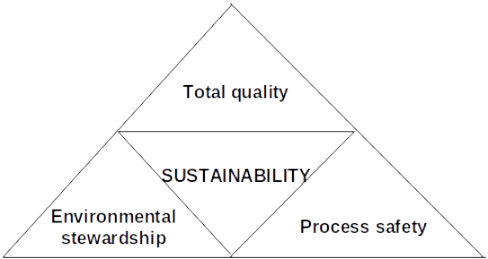
The concept of sustainability is becoming more operational at the company level, whereas earlier, the concept was primarily discussed at national and international level. For a company sustainable development means adoption of such business strategy and such actions that contribute to satisfying present needs of company and interested parties, as well as simultaneous protection, maintenance and strengthening of human and environmental potential which will be needed in the future (Sidorczuk-Pietraszko, 2007). A broad interpretation of sustainability at the company level has many factors, including: [Equation or mathematical symbol available in the original paper PDF] impact on the environment. [Equation or mathematical symbol available in the original paper PDF] health and safety of employees, visitors and the surrounding community. [Equation or mathematical symbol available in the original paper PDF] corporate citizenship. [Equation or mathematical symbol available in the original paper PDF] quality and efficiency of products and processes - not only to increase profitability but also to reduce consumption of raw materials and energy. [Equation or mathematical symbol available in the original paper PDF] design of new machines, equipment and systems. [Equation or mathematical symbol available in the original paper PDF] research into the use of different types of fuel and energy, materials handling, heating and cooling processes, the storage and pumping of liquids and gases, and environmental controls. [Equation or mathematical symbol available in the original paper PDF] research into the use of different types of raw and transformed materials. [Equation or mathematical symbol available in the original paper PDF] specification, selection, installation, management and maintenance of factory production and machinery. Since sustainable development is becoming an increasingly popular concept, there is a growing need to ensure the possibility of its implementation. To operationalize the economy-environment-social triad, the manager should integrate the following initiatives as one (Figure 3):
• total quality of product and process, [Equation or mathematical symbol available in the original paper PDF] environmental protection, [Equation or mathematical symbol available in the original paper PDF] total process safety.
Figure 3. Components of Sustainable operations (Ferrer, 2008) The way to help companies improve their economical, environmental and social performance is by:
• minimizing production of waste – less waste generated and increased waste re-usage or recycle (Golinska and Kawa, 2011; Dostatni et al, 2013), [Equation or mathematical symbol available in the original paper PDF] using resources such as materials, water and energy efficiency, [Equation or mathematical symbol available in the original paper PDF] avoiding or at least improving management of metalworking fluids, lubricating oils and hydraulics oils (Szafrański, 2011), [Equation or mathematical symbol available in the original paper PDF] improving environmental, health and safety performance (Lind and Nenonen, 2008;Górny, 2011; Sadłowska-Wrzesińska, 2013), [Equation or mathematical symbol available in the original paper PDF] adopting lean manufacturing and other sustainable engineering techniques (Jayal et al 2010; Jasiulewicz- Kaczmarek, 2013b) [Equation or mathematical symbol available in the original paper PDF] improving working conditions (Hamrol et al, 2011; Mazur, 2013), [Equation or mathematical symbol available in the original paper PDF] using best practice in the process of producing and maintaining movement (Rui et al. 2009; Jasiulewicz- Kaczmarek and Drożyner, 2011; Narayan, 2012) [Equation or mathematical symbol available in the original paper PDF] training all employees about sustainable practices (Misztal and Butlewski, 2012).
Corporate sustainability in the dynamic complexity of the twenty-first century economy means that businesses need to, through developing and sustaining relationships with key stakeholders, establish a corporate culture “consistent with the concept of sustainable development”. To achieve this, (Welford, 1995) identifies the “six shifts”: from objects to relationships; from parts to the whole; from domination to partnership; from structures to processes; from individualism to integration; and from growth to sustainability. Hence, sustainable development can be defined as capability of an enterprise to adjust to changes in business environment to catch currently best performance methods and to achieve and maintain predefined level of competitiveness. It is not revolutionary approach, however it proves capability to use and improve competences, activities and values, which states for building future, without discrimination of previous achievements but with their help as a strong basis for future success
QUALITY MANAGEMENT Evolution in approach to actions towads quality
Quality is a relative term as it depends on culture, ethics, civilization, it refers to time, place and is multi- dimensional. Many ways of defining and interpreting quality term in utilitarian sense refers to the level of noticing and range of problems it contains in a company. According to L. Wasilewski (1998) „if for any reasons we have to define the term quality, we have to adjust it to the level of system development in a company”. As their quality system is developing, companies change main dimensions of quality definition and measures they use. Such evolutionary character of the tem quality can be found in scientific works of (Dale et al, 2000; Hellsten and Klefsjö, 2000; Lagrosen and Lagrosen, 2005). D. A. Lubin and D. C. Esty (2010), defined actions undertaken in companies to achieve quality as one of mega- trends in management. Development of management ideas can be presented in the form a life cycle as in the scheme (Figure. 1). In the first stage of this mega trend development, quality was mostly connected with products and the focus was on inspection of some critical characteristics of final products referred to predefined requirements – specifications. Along with economic development and production scale growth inspection costs have been growing and did not give the results expected by the owners. It was noted that by inspection it is impossible to provide an appropriate level of quality. The scope of activities charged to the quality started to extend the processes of production. This stage of development and the perception of quality in the company in the literature is called quality control. In actions for quality employees were included in the production, drew attention to the skills of workers supervised by them formally established requirements and standards for their implementation. Feedback was created between the result of control and production line. Based on the results of checks production process was modified so as to obtain products that meet the specifications. As in the run-up, the producers did not have much difficulty in disposing of the products, and therefore did not have to take into account customer feedback. Therefore, during this period primarily refined receiver subsystems and supply the current and final product inspection, not paying attention to the information coming from the market. The next step is the development of quality assurance. It was characterized by a gradual moving away from a narrow perception of quality, treated as compliance with the requirements and technical standards for the quality, expected by the users of the products. During this period there was a significant change of views on the concept of quality and its place in the management of the company. The essence was to build a quality system, which purpose was aimed at preventing non-conformity, and managers started to be involved in system functioning. Although management involvement was limited, the first declarations for the management of enterprises in the form of so called quality policies, systems and internal evaluation of compliance between declarative and actual commitments, covering all areas of the company appeared. The fourth stage, therefore, can be described as quality management, where quality has become a strategic issue and its scope extended to the quality of the organization and the quality of the relationship with the environment of an organization (customers, suppliers, competitors, the public in general). Managers began to look for new methods and tools to support collaboration between departments, taking into account information from the market and improve manufacturing processes (Mazur and Gołaś, 2010).
The discussion on the future and the role of quality management in the enterprise is ongoing for almost ten years. In the literature we can find two views. The first of these relates to the concept of Total Quality Management (TQM). This paradigm states that the responsibility for quality lies not in one department or one person (the representative of the management), but the whole organization needs to take responsibility for quality and take it as a common value.
The second trend is related to the evolution of the semantic, which speaks of "excellence" and not a "quality". The idea of quality has become insufficient for the development of enterprises, many companies benefits from the awards and excellence models and uses them as guidelines. Hence, the term “quality” becomes insufficient for companies’ development, and many of them focuses on awards and excellence models taking them as directives or guidelines. Both trends despite of differences have some common elements. They both introduce the next term important for identification of the role of quality management in a company. The term mentioned is “transactivity” (Foster and Jonker, 2007). It originates from the basic connection of organization and its broader sociological context and consequently is the key relation between the idea of quality management and more and more important aspect of social corporate responsibility. It is also an attempt to draw attention of managers to necessity to react to needs and expectations of more and more various groups of stakeholders, providing in the same time value for shareholders.
Customers and stakeholders in organization In ISO 9000:2006 standard customers are defined as „an organization or a person who receives a product”. Hence, there are internal and external customers. Though the standard gives some further explanation for the definition its range is quite narrow. A broader definition was suggested by J. Juran (1988) who defined customer as “anyone who is affected by the product or by the process used to produce the product”).
While according to Ishikawa (1985) customer is simply the process that follows („the next process is your customer”).
The above definitions indicate a diverse range of conceptual, from a narrow set out in ISO 9000:2006 to a wide proposed by Juran, where the customer can also be a local community, the environment, and even future generations . This broad definition of "client" is close to the notion of "stakeholder". The term is often used in the sense of those who have a "stake" in the organization. The most famous, but the most general definition of stakeholders was presented by E. Freeman in 1984. According to Freeman (1984): "a stakeholder is any person or group that "can affect or is affected by the achievement of the organization 's objectives". This definition has been the subject of discussion and deliberations in literature (Clarkson, 1994; Donaldson and Preston, 1995; Freeman, 2002; McVea and Freeman, 2005). In the final model of excellence Malcolm Baldrige National Quality Award (MBNQA ) 2011- 12 (NIST, 2012) the term "stakeholders" refers to all groups that are or may be affected by the activities of the organization and its success. The key stakeholders in the organization are, among others: customers, employees, partners, associates, shareholders, donors, providers, payers, regulators, policy makers, trade unions, local community . The EFQM Excellence Model 2010 (2010), defines stakeholders as: "a person , group, or organization that has direct or indirect ownership or interest in the organization because it can affect or be affected by the organization or its influence." This approach is close to the definition of Freeman. In addition, in the EFQM model , a division of the interior and external stakeholders was made. Examples of external stakeholders are the owners (shareholders), customers, suppliers, partners, government agencies and representatives of the community or society, while examples of internal stakeholders are people or groups of people. Taking into account the above considerations, stakeholders can be defined as a person, group of persons or organizations that contribute and put requirements, and thus affect the organization, expecting the results - satisfaction that will satisfy their requirements are, therefore, under the influence of the organization (see Figure. 4)
Figure 4. Relations between organization and stakeholders
Figure available in the original PDF paper.
According to the International Organization for Standardization, the organizations depend on their customers and therefore, should understand them current and future need, they will meet these requirements, while taking care to exceed customer expectations. On the other hand, emphasizes that "the success of an organization is based on meeting current and future needs and expectations of current and potential customers and end users, and the consideration of other stakeholders" (ISO 9004:2009). Now, expectations of stakeholders do not refer only to the direct transaction between the parties, but also to participation in the debate on social and environmental problems, and proactive thinking about the effects of business in society.
This growing concern for the public is a part of the change in thinking about quality. In this new way of thinking about money should go back to the definition of the client by Crosby and to the old TQM definitions contained in ISO 8402:1992 as a starting point to define the next dimension of quality. This new dimension of quality must support businesses through the challenges of the next mega trend of "sustainable development". Binding part of the old with the new and the new with the old is the concept of stakeholders and the organizations responsibility for its impact on society.
Integration of requirements and expectations of stakeholders Over a half-century ago, quality pioneers Edwards Deming and Joseph Juran encouraged organizations to ask better questions about corporate challenges and enabled companies to redesign systems for improvement. They started with a systems approach and then grounded quality in practical analytical tools to foster product, service, and organizational improvements. Today’s sustainable development frameworks encourage businesses to ask better questions about impacts to stakeholders, society, and the environment, and they seek to develop the tools and measures needed to demonstrate improvements.
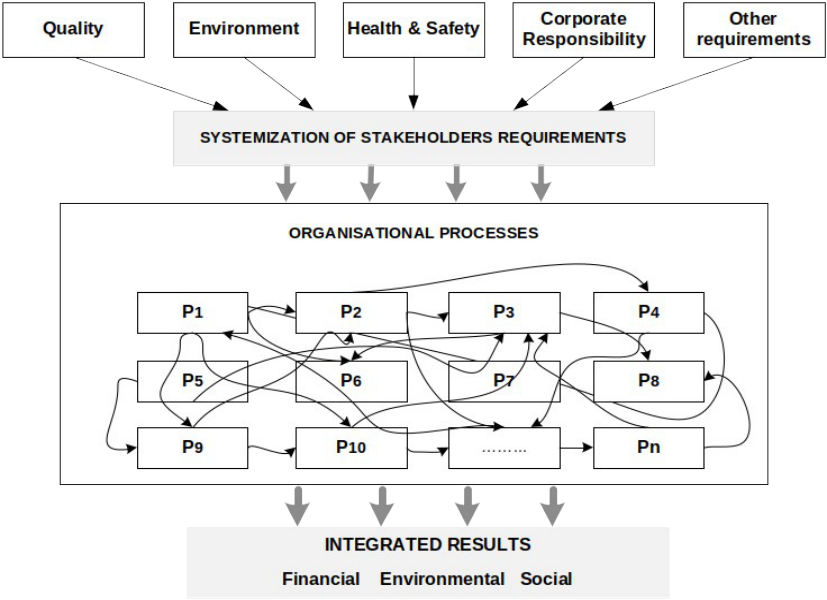
In recognition of these challenges, a number of management systems (MS) have emerged to help managers systematically address an organization's key stakeholder requirements (Misztal, 2009). After the introduction, in 1987, the ISO 9000 series of standards for quality assurance, other standards were developed for environmental management (ISO 14001), health and safety (OHSAS 18001) and corporate social responsibility (ISO 26000). It's just a few examples. It is obvious that the new standards will continue to appear, and those that have already been issued, are and will be subject to periodic updates. Organizations are therefore face difficult decision of which or which of the standards to enter and how to enter to meet the needs and expectations of stakeholders and effectively implement the integrated management of the organization. Integrated management "means understanding and effective targeting every aspect of the organization so that the requirements (needs and expectations) all parties were satisfactorily met within the available financial resources, organizational and technical" (Poskrobko, 2007).
In practice, the concept of integrated pro-quality management is often referred to the integration of formal management systems and building integrated management system. Miller (2003) defines an integrated management system as "one, clearly defined, documented and consistent system that enables efficient and simultaneous management of multiple aspects , by establishing and implementing a uniform policy and the resulting targets for these aspects". British Standards Institution (BSI, 2000 ), in the guide on the integration of management systems , sets out an integrated management system as "a combination of processes, procedures and practices utilized in the organization to implement its policies, which may be more effective in achieving the objectives of the policy approach than by separate systems". Integration in this document is understood as the ability to connect systems used in the company and specified in separate norms and standards .
Thus, if the policy of the organization is focused on meeting the requirements of its stakeholders it is the only way for organizations to design and implement an integrated management system. The purpose of this system will be maintaining competitiveness and ensuring sustainable development through optimal management requirements of stakeholders and equitable balance their needs and expectations (Figure 5).
Figure 5. Systemization and integration of stakeholders requirements
Analyzing the requirements and guidelines contained in the formal management standards and content stored in the proposals of new releases such as ISO 9001 and ISO 14001 (eg, a new edition of ISO 9001 is planned in 2015) can formulate general principles that should be taken into account when building an integrated system management aiming at meeting the challenges arising from the context in which the organization operates (market impacts, economic, social and environmental). These include: [Equation or mathematical symbol available in the original paper PDF] orientation to stakeholders; [Equation or mathematical symbol available in the original paper PDF] systemic approach; [Equation or mathematical symbol available in the original paper PDF] process approach; [Equation or mathematical symbol available in the original paper PDF] focus on the risks and opportunities; [Equation or mathematical symbol available in the original paper PDF] targeted improvement.
CONCLUSIONS
Analysis of both mega-trends, sustainable development and quality (Jasiulewicz-Kaczmarek, 2013), leads to the conclusion that they much in common: [Equation or mathematical symbol available in the original paper PDF] both have gone through a historical and conceptual progression from passive reactivity to proactive, strategic integration; [Equation or mathematical symbol available in the original paper PDF] both impact satisfaction, well-being and safety of customers, employees and other stakeholders [Equation or mathematical symbol available in the original paper PDF] both are based on a core set of values, such as “create zero waste,” “make external costs visible,” and “drive out fear” between management and employees. Like quality, sustainable development also has a strong focus on people - not just in terms of customer satisfaction, but related to the quality of working life and employee satisfaction; [Equation or mathematical symbol available in the original paper PDF] both impact, and are impacted by, every function in the organization. Just as a customer’s perception of quality is affected by everything including product design and development, manufacturing, logistics, interactions with marketing, sales, customer service and more, so too is sustainability impacted by every function within the organization. [Equation or mathematical symbol available in the original paper PDF] both are based on continuous improvement towards a performance ideal: a company will never reach perfection in either quality or sustainability, and it is also never “done,” but rather always striving to improve towards the goal of perfection; [Equation or mathematical symbol available in the original paper PDF] both, if done well, help drive significant financial and strategic benefits to the organization in the form of scrap and rework reduction, cost reductions, increased profitability, improved reputation and customer loyalty. Done poorly or insufficiently, however, both can lead to waste, increased costs, lost customers, degraded company reputation, and other adverse business impacts [Equation or mathematical symbol available in the original paper PDF] in both, senior management holds complete responsibility. The majority of quality problems are the fault of poor management rather than poor workmanship. Likewise, corporate sustainability success is directly related to CEO commitment. Value creation is driven through executive buy-in and execution throughout the organization. Similar to chief quality officers, the chief sustainability officer must lead an effort to institutionalize this new thinking and processes into the company. I think that there are three main ways in which experience in quality managemnt and knowledge in the area can support enterprises in realization of the challenges emerging from sustainable development realization. They are the following: [Equation or mathematical symbol available in the original paper PDF] knowledge and experience in applkying methods such as. [Equation or mathematical symbol available in the original paper PDF] experience in managing key process and [Equation or mathematical symbol available in the original paper PDF] knowledge and experience in imlementation of organizational and cultural changes. However support seems not to be enough. It is necessary to define activities in the area of quality management which need to be taken not to exist for managers only as „somtehing obvious and normal“ (fourth stage of a lifecycle), but also as the source of inspiration in creating value for stakeholders and and support in solving potential and existing problems. What can sustainable development teach quality? In which direction quality management systems should develop? Taking the fact that quality standards according to ISO 9000 and branch specific standards are extremely popular within companies into consideration, necessity to update and improve them is obvious. Increasing standards and making them more detailed should refer to: including „risk based thinking“ to activities and processes of a companyand better alignment with business management processes which means taking context of corporate operations into consideration.
REFERENCES
BSI (2000), Management System Integration – A Guide, Clarkson, M. (1994), “A risk based model of stakeholder theory”, Proceedings of the Second Toronto Conference on Stakeholder Theory. Toronto: Centre for Corporate Social Performance & Ethics, University of Toronto Clifton, D. (2009), “Security and a Sustainable World”, Journal of Sustainable Development 2(3), pp. 3-17. Dale, B.G., Zairi, M., Van der Wiele, A., Williams, A.R.T. (2000), “Quality is dead in Europe – Long Live Excellence, true or false?” Measuring Business Excellence 4(3), pp. 4-10 Donaldson, T., Preston, L. E. (1995), “The Stakeholder Theory of the Corporation: Concepts, Evidence, and Implications”, Academy of Management Review, 20(1), pp. 65-91 Dostatni, E., Diakun, J., Hamrol A., Mazur, W. (2013) "Applicationof agent technology for recycling-oriented product
assessment", Industrial Management & Data Systems, 113(6), pp.817 – 839 EFQM (2010), “User Guide Understanding an organisation’s stakeholders”, EFQM Publications, pp. 2 Ferrer, G. (2008), “Sustainability, What Does it Mean for the Operations Manager?”, Journal of Operations and Supply Chain Management 1(2), pp 1 - 16, International Conference of the Production and Operations Management Society Foster, D., Jonker, J. (2007), “Towards a third generation of quality management Searching for a theoretical re-
conceptualisation of contemporary organisations based on the notions of stakeholders and transactivity”, International Journal of Quality & Reliability Management 24(7), pp. 683-703 Freeman, R.E. (1984), “Strategic management: A stakeholder approach”, Boston, MA: Pitman Freeman, R.E. (2002), “Toward a New Vision for Management Research: A Commentary on Organizational Researcher Values, Ethical Responsibility, and the Committed-to-Participant Research Perspective”, Journal of Management Inquiry, 11(2), pp. 186-189 Frost & Sullivan. (2011), “Mega Trends That Will Shape the Future of the World”, May 2011 Golinska, P., Kawa A. (2011), “Remanufacturing in automotive industry: Challenges and limitations” Journal of Industrial
Engineering and Management 4(3), pp.453-466. Górny, A. (2011), The Elements of Work Environment in the Improvement Process of Quality Management System Structure, [in:] Advances in Human Factors, Ergonomics, and Safety in Manufacturing and Service Industries, W. Karwowski, G. Salvendy (eds.), pp. 599 – 606, CRC Press, Taylor & Francis Group, Boca Raton
Hamrol, A., Kowalik, D., Kujawińska, A. (2011), “Impact of chosen work condition factors on quality of manual assembly process”, Human Factors and Ergonomics in Manufacturing & Service Industries Special Issue: Agility and Ergonomics Aspects in Network Organizations 21(2), pp. 156–163 Hellsten, U., Klefsjö, B. (2000), “TQM as a Management System Consisting of Values, Techniques and Tools”, The TQM
Magazine 12(4), pp. 238-244. Ishikawa, K. (1985), “What is total quality control? The Japanese way”, Englewood Cliffs, NJ: Prentice Hall, pp.107 ISO 9004:2009 Managing for the sustained success of an organization - A quality management approach Jasiulewicz-Kaczmarek, M. (2013a), “Q4S – Quality for Sustainability”, 8th Research/Expert Conference with International Participations ”QUALITY 2013“, Neum, B&H, June 06 – 08, pp. 117 - 122 Jasiulewicz-Kaczmarek, M. (2013b), “Role and contribution of maintenance in sustainable manufacturing”, , 2013 in. 7th IFAC
Conference on Manufacturing Modelling, Management, and Control Series Title: Manufacturing Modelling, Management, and Control, Vol. 7 | Part 1, N. Bakhtadze, K. Chernyshov, A. Dolgui, V. Lototsky, (eds.), , Publisher: International Federation of Automatic Control, pp. 1146-1151 Jasiulewicz-Kaczmarek M., Drożyner P. (2011), Maintenance Management Initiatives towards Achieving Sustainable Development, in: Information Technologies in Environmental Engineering Environmental Science and Engineering, Golinska P. et al. (eds.): Springer - Verlag Berlin Heidelber, pp. 707-721, Jayal, A.D., Badurdeen, F., Dillon, O.W. Jr., Jawahir, I.S. (2010), “Sustainable manufacturing: Modeling and optimization challenges at the product, process and system levels”, CIRP Journal of Manufacturing Science and Technology (2), pp. 144–152. Juran, J. (1988), “Quality Control Handbook”, 4th ed., McGraw-Hill, New York, NY, pp. 23 Lagrosen, Y., Lagrosen, S. (2005), “The effects of quality management – a survey of Swedish quality professionals”,
International Journal of Operations & Production Management 25(9/10), pp. 940-952. Lind, S., Nenonen, S. (2008), “Occupational risks in industrial maintenance”, Journal of Quality in Maintenance Engineering 14(2), pp.194- 204 Lubin, D.A., Esty, D.C.(2010), “The Sustainability Imperative”, Harvard Business Rreview Naisbitt, J. (1997), „Megatrends. Megatrendy. Dziesięć nowych kierunków zmieniających nasze życie” Poznań 1997 Misztal, A. (2009), „Przegląd standardów uzupełniających systemy zarządzania jakością w wybranych branżach przemysłu”,
Problemy Jakości 08/2009, pp. 30-33 Mazur, A., Gołaś, H.(2010), „Zasady, metody i techniki wykorzystywane w zarządzaniu jakością”, Wydawnictwo Politechniki Poznańskiej Mazur, A. (2013), “Application of Fuzzy Index to Qualitative and Quantitative Evaluation of the Quality Level of Working
Conditions” Communications in Computer and Information Science 374, pp 514-518 McVea, J.F., Freeman, R.E. (2005), “A Names-and-Faces Approach to Stakeholder Management. How Focusing on Stakeholders as Individuals Can Bring Ethics and Entrepreneurial Strategy Together”, Journal of Management Inquiry 14(1), pp. 57-69 Miller, P. (2003), „Zintegrowane systemy zarządzania”, Studia i Prace Kolegium Zarządzania i Finansów, Zeszyt Naukowy no.
34, SGH, Warszawa, pp. 111-128 Misztal A., Butlewski M. (2012), “Life improvement at work”, Publisher: Politechnika Poznanska, Narayan, V., (2012), “Business performance and maintenance. How are safety, quality, reliability, productivity and maintenance related?”, Journal of Quality in Maintenance Engineering 18(2), pp.183-195 National Institute of Standards and Technology (NIST) http://www.nist.gov/baldrige/publications/upload/2011_2012_Business_Nonprofit_Criteria.pdf pp. 68 (october 2012) Park-Dahlgaard, S.M. (1999), “The evolution patterns of quality management: some reflections on the quality movement”, Total
Quality Management 10(4/5), pp. 473-480 Poskrobko, B. (2007), Zarządzanie środowiskiem, PWE, Warszawa Rozen, A., Fredette, J., Marom, R., Collins, S. (2012), “Megatrends, a wave of change impacting the future”, Market Analysis Rui, L. et al. (2009), “The preliminary study on the human-factor evaluation system for maintainability design”, Presiding of the International Conference on Intelligent Human-Machine Systems and Cybernetics 2, pp. 107-112 Sadłowska-Wrzesińska, J. (2014), „Bezpieczeństwo behawioralne (BBS), społeczna odpowiedzialność biznesu (CSR) i dialog
społeczny – współczesne wyzwania bezpieczeństwa pracy”, in: Innowacje w zarządzaniu i inżynierii produkcji. Tom II, Knosala R. (ed.), Oficyna Wydawnicza Polskiego Towarzystwa Zarządzania Produkcją, pp. 606-616 Sneddon, C., Howarth, R. B., Norgaard, R. B. (2006), “Sustainable development in a post-Brundtland world”, Ecological Economics 57(2), pp. 253-268. Sidorczuk-Pietraszko, E. (2007), “The concept of sustainable development at organizational level”, in: Towards the Theory of
Sustainable Development, Polish Academy of Science. Studies on Sustainable Development. pp. 365 Szafrański, B., (2011), „Rola środków smarnych w utrzymaniu ruchu”, Inżynieria & Utrzymanie ruchu zakładów przemysłowych 7/8 Vaidogas, E. R., Juocevičius, V. (2008), “Sustainable development and major industrial accidents: the beneficial role of risk-
oriented structural engineering”, Technological and Economic Development of Economy Baltic Journal on Sustainability 14(4), pp. 612–627 Wasilewski, L.(1998), „Podstawy zarządzania jakością”, Wydawnictwo Wyższej Szkoły Przedsiębiorczości i Zarządzania im. L.
Koźmińskiego, Warszawa Welford, R, (1995), “Environmental strategy and sustainable development: The corporate challenge for the twenty - first century”, London: Routledge, p.117
LISTED IN THE AHFE DIGITAL BOOKSTORE CATALOGUE
Explore the complete digital volume
Advances in Social and Organizational Factors
Read this individual research paper free through the original publisher, or explore the full digital proceedings book.
ISBN 978-1-4951-2102-9
Explore this ISBN in the AHFE Bookstore ↗Listed in the July 2026 bookstore catalogue; search by ISBN to confirm current availability · Digital book purchase optional