Beata Mrugalska (2020). Need of Safety Integration in Robust Design. In: Advances in Social and Organizational Factors. AHFE Open Access, vol. 9. https://doi.org/10.54941/ahfe100340
Nowadays systems include more and more components and their variables. The effects of their changes tend to accumulate and may lead to unacceptable risks. Thus, the objective is to reduce the sensitivity of the design to uncertain or randomly varying factors. In order to achieve it robust design methods can be applied. They have already found many industrial implications mainly because of their simplicity and practicality. In this paper an attempt was made to show how to place safety issues in such design. For this aim a theoretical model was elaborated and its practical implication was shown.
In the last decades, an introduction of a huge number of innovations in technology and management has been ob- served. This rapid development has contributed to new opportunities for man-machine-interaction. Modern ma- chines are equipped with compound controlled units what enable advanced production processes. Furthermore, they are also designed to be used in more and more severe working conditions (Singh and Kazzaz, 2003). However, a human being is still necessary to perform the whole system. His role is invaluable as human decisions are required to proper co-operation between human and advanced intelligent devices. For example, they are needed to support production processes by machine monitoring (Oborski, 2004). Furthermore, in spite of all these technological advances human life is often endangered to many hazards in workplace.
Accidents occur as a result of a process involving a combination of technical, personal, behavioural, environmental and work process factors. Areas of particular concern are exposures to biological agents, chemicals, extreme temper- atures, noise, radiation and vibration. In order to assure appropriate working conditions and minimize the risk of oc- cupational accidents and injuries many legislative regulations, standards and guidelines have been elaborated. They concern not only workers performance but mainly production processes and products (Murthy et al., 2008; Rausand and Utne, 2009; Mrugalska and Kawecka-Endler, 2011; Mrugalska and Arezes, 2013). Following them, all possible hazards related to the product during its life phases should be identified and eliminated, and remaining risk associ- ated with those hazards alleviated (Directive 2006/42/WE). For instance, it can be assured by implementing Preven- tion through Design (Gambatese et al., 2009; Gambatese et al., 2013). Nevertheless, the analysis of manufacturing practices shows that it is almost a custom to technically design the product at first and then add safety aspects to its original version (Hsiao, 1998; Fadier and De la Garza, 2006; Butlewski, 2012). For manufacturers it is a challenge to elaborate a product which meets clients’ requirements in the scope of functionality, quality and reliability, but also safety (Cordero and Sanz, 2009; Górny and Mrugalska, 2013; Mrugalska, 2014). Social and Organizational Factors (2020)
Currently, a lot of efforts is put in determining design variables to satisfy individual product performance, its vari- able requirements which are often in conflict (Murphy, et al., 2005). In the literature various product robust design methods and approaches can be found (Phadke, 1989; Isermann, 2005; Ding, 2008; Mrugalska and Kawecka-Endler, 2012; Mrugalska, 2013a). Their aim is to reduce sensitivity to variations and that especially in early design stages of products.
In this paper a particular attention is paid to showing the role of safety issues in robust design. Therefore, a model which combines these two approaches is elaborated and widely discussed. In order to develop it design methodology principles suggested by Bonsiepe (1984) and Tavares and Silva (2012) are used. Its practical application is shown on the basis of a machinery.
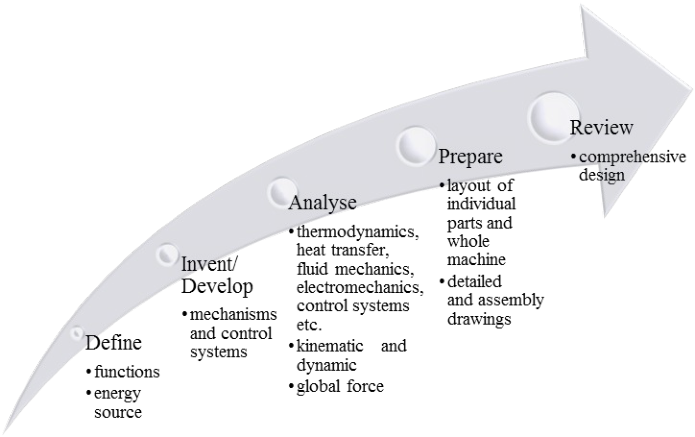
FRAMEWORK FOR DESIGN AND MODELING The definition of design has a very broad scope as it can be discussed in the terms of various societal contexts such as career-design, community-design and product design. Following engineering design, design is “the human power to conceive, plan, and realize products that serve human beings in the accomplishment of any individual or collec- tive purpose” (Pahl and Beitz, 1988). It refers to the aspects of preparation of drawings and/or its specifications for the final product and the issues concerning the execution of product project (European Federation of Engineering, 2006). Thus, design is a thoughtful process based on the laws and insights of science, which enables finding solutions to the problems which have “a common a goal, some constraints and some criteria, which lead the defini- tion of successful solutions” (Filippi and Cristofolini, 2010). The actions, which have to be undertaken, can be pre- sented as shown in Figure 1.
Figure 1. Steps of machinery design process (Adopted from (Collins, 2010)).
Traditionally, design process is viewed as a sequence of actions which follow step by step. But nowadays more and more often it is seen in practice that design process can be parallel or in reverse sequential (Madsen et al., 2004). Even some designers emphasize that their ideas derive from all possible sources. Therefore, their activities cannot result only from the previous stage and they have to loop through a few times during the whole design process (Bax- ter, 1995).
A review of the recent literature shows that several types of models describing the engineering design process can be found. It is common to differentiate three classification schemes (Wynn and Clarkson, 2005): [Equation or mathematical symbol available in the original paper PDF] stage vs activity-based models, [Equation or mathematical symbol available in the original paper PDF] problem vs solution-oriented literature, [Equation or mathematical symbol available in the original paper PDF] abstract vs analytical vs procedural approaches. Social and Organizational Factors (2020)
In the first scheme, also known as morphological and problem-solving approach, a linear, stage-based chronological structure of the project is perceived as the morphological dimension of the design process, whereas the problem- solving dimension results from cyclical, rework characteristic of the designer’s daily tasks. Problem vs solution-ori- ented literature scheme is based on the results of the research study conducted by Lawson (1980) that designers pre- fer to 'try and see' solution-oriented approach, while the scientifically trained firstly unravel the problem and then they synthesize solutions. Thus, it is necessary to adopt both these strategies at one point or another following the nature of the design problem. It leads to such a curious phenomenon that stage-based models implement a problem- oriented strategy and, activity-based models can be either problem- or solution-oriented in nature. In the last scheme it is affirmed that abstract models have typically activity-based nature and can adopt either a problem- or solution- oriented strategy. On the other hand, procedural models are problem-oriented in nature and encompass a stage-based component (Filippi and Cristofolini, 2010). Analytical models of designing are completely different ones as they are based on mathematical equations which represent the physical characteristics of the product. The models can be also classified as (Birmingham el al., 1997; Cross, 2000; Dym and Little, 2003; Filippi and Cristofolini, 2010): [Equation or mathematical symbol available in the original paper PDF] descriptive models, [Equation or mathematical symbol available in the original paper PDF] prescriptive models, [Equation or mathematical symbol available in the original paper PDF] integrative models. Descriptive models, as they are rather not so detailed, only display the sequence of the activities occurring in the de- sign process, whereas prescriptive ones show algorithmic procedures for design methodologies. In the integrative models the attention is concentrated on the iterative understanding of the problem and development of the solution. Furthermore, some other authors differentiate sequential design models, cyclical models, and hybrid ones. It is also possible to categorize models as process-based, task-based, and parameter-based models (Filippi and Cristofolini, 2010).
ROBUST DESIGN APPROACH Robust design is a set of engineering methods for managing uncertainties. It relies on such a designing of the system that it becomes robust or insensitive to variations without eliminating or reducing its sources in the system (Singh, 2006). One commonly known mean to achieve greater robustness is through parameter design.
In robust design literature, design parameters are divided into categories (Taguchi, 1986; Phadke, 1989; Mrugalska, 2008): [Equation or mathematical symbol available in the original paper PDF] control factors, [Equation or mathematical symbol available in the original paper PDF] noise factors, [Equation or mathematical symbol available in the original paper PDF] input factors, [Equation or mathematical symbol available in the original paper PDF] output factors (responses). Control factors, also known as design variables, are those system parameters that a designer can adjust, and thus they can be controlled and manipulated. Noise factors are parameters that influence the performance of a product or process but are relatively uncontrollable (Hidahl, 2001). They are mainly perceived as too difficult and/or costly to control as they encompass working conditions, manufacturing variability and degradation of the system (Frey and Li, 2004). Therefore, they can be divided into the following subcategories: [Equation or mathematical symbol available in the original paper PDF] manufacturing disturbances, [Equation or mathematical symbol available in the original paper PDF] operational disturbances. As far as manufacturing disturbances are concerned they are object and resource disturbances. For ex- ample, object disturbances involve changeability of environment in the technological process, labour division and machines breakdowns whereas resource disturbances concern energetic disturbances, material defects or shortage of raw materials and errors in produc- tion planning and control. The operational disturbances are the result of exposure to envi- ronmental changes such as humidity, pressure, pollution and temperature (Mrugalska and Kawecka-Endler, 2012) and derive from natural causes or activities of a human as describe conditions under which the product must be operated, and dictate the performance of the product characteristics (Sutherland et al., 1988; Mrugalska, 2013b). They also depend on electrical and mechanical disturbances (i.e. inaccu- racy of control system, transient voltage, unbalanced voltage, voltage fluctuations, poor mounting, mechanical over load and pulsating load (Mrugalska and Kawecka-Endler, 2012; EN 60079–0; Singh and Kazzaz, 2003; Mrugalska, 2013a). Therefore, it is necessary for designers to identify where the
Social and Organizational Factors (2020) uncertainties are present in a system model (Figure 2) be able to employ an appropriate uncertainty management method.
Operational disturbances
Product/Process Input factors Output factors
Manufacturing disturbances
Figure 2. Factors influencing product and its process.
Figure available in the original PDF paper.
In design parameters methods, for a given system architecture, the designer’s task is to choose controllable parame- ters in such a manner that the target or optimal response with minimal variation in output is assured (Singh, 2006). For this aim, the coordination of two tasks is needed: estimation of sensitivity to noise factors and finding such de- sign variables that reduce sensitivity (Frey and Li, 2004). Presently, different robust design methods have been pro- posed for a large number of systems. However, the choice of the appropriate design method is still controversial. Some robust design techniques yield good results but at relatively high cost. Therefore, in practice they are only used for the most critical components. Other robust design methods seem to be easier to apply and demand less amount of resources but it may happen that the rsults are not satisfactory(Frey and Li, 2004). Thus, some researches underline advantages of parameter design, however, others claim that it alone does not always lead to satisfactorily high quality (Choi, 2005). Practitioners highly recommend to use Taguchi Methods on the basis of their effective- ness in industrial implications, however, it requires the knowledge about experimental design methodology and it does not eliminate the source of variation by introducing “signal to noise” ratio (Quirante, 2011; Venkataraman and Pinto, 2011). Thus, others and scholars prefer alternative techniques based on statistical theory. Now, it is a Systems Engineer who is responsible for choosing the strategy on the basis of pros and cons of every available technique (Frey and Li, 2004).
DEVELOPING DESIGN PROCESS BY ROBUST AND SAFETY ASPECTS A few decades ago, safety was an issue virtually ignored in the world. Design field was dominated by engineers, who paid main concern on functionality of products. But now the situation has changed and more companies are em- ploying human factors experts, while others are hiring consultants (Swain, 2007). An integration of a human factor in the design at various stages of design has become not only an engineering issue. Designers have started working with focus groups and/or end users, even before having working on prototypes. It is widely recognizable that under- standing of the abilities and limitations of the human may contribute to preventing human error in operations or maintenance (Energy Institute, 2011). Furthermore, more and more often companies refuse to accept customers’ claims saying “it was a user error, not a design problem”. Such situations result from the fact that clients are more approachable and are getting used to have the right thing for the first time. On the other hand, it is said that compa- nies are interested in industrial design, which encompasses both product development and optimization of produc- tion process, and have understood how costly is redesign of products due to use errors (Swain, 2007). However, it is still noticed that the process of safety integration is not always efficient. It is assumed that to be efficient in the ap- plications a regular risk analysis and control procedure must be conducted in practice and they should be integrated into the design process. Such an integration allows to optimize the results achieved in particular design phases.
In order to elaborate a model, which encompasses both safety and robust aspects, it is necessary to develop the pro- cedures that facilitate performing the task and analysis of working environment (Tavares and Silva, 2012). Accord- ing to Bonsiepe (1984) the following sequence of activities can be established: Social and Organizational Factors (2020)
• problem definition, [Equation or mathematical symbol available in the original paper PDF] tasks analysis and operators’ opinions, [Equation or mathematical symbol available in the original paper PDF] project requirements list, [Equation or mathematical symbol available in the original paper PDF] ergonomics and anthropometrics studies, [Equation or mathematical symbol available in the original paper PDF] brainstorming and sketches, [Equation or mathematical symbol available in the original paper PDF] functional mock-ups, [Equation or mathematical symbol available in the original paper PDF] preliminary tests, [Equation or mathematical symbol available in the original paper PDF] revisions, [Equation or mathematical symbol available in the original paper PDF] implementation of new products. However, it is worth to emphasise that in practice such a design process does not follow a linear path but it is a com- pound sequence of stages or phases (Wilpert, 2007).
The proposed approach in the paper is based on thirteen steps as it is depicted in Figure 3. As it was mentioned in the previous chapter, the robustness can be achieved via the parameter design. For this aim, mathematical modelling and methods of parameter estimation, in which parameters and acceptable tolerance of manufacturing product pa- rameters are calculated, can be used. For example, such a method as Bounded-Error Approach can be applied (Walter and Pronzato, 1997; Mrugalska and Kawecka-Endler, 2012). It is based on the assumption that the values of disturbances are in a certain limited interval. The information about these limits can derive from legal acts, standards or regulation. Moreover, the potential hazards analyzed in this approach are directly related to machinery as they re- sult from noise factors. They also indirectly influence safety and health of the machinery users what enables to inte- grate safety and robust approach.
Social and Organizational Factors (2020)
Figure 3. Safety and robust integration in design process.
Figure available in the original PDF paper.
CONCLUSIONS
Design process is a series of steps that lead to the development of a new product or system. However, it is a chal- lenge to find a good niche and create a successful product as more and more competitors are on the market and cus- tomers’ requirements become strict and demanding. Thus, a development of a solid foundation for a new product must be done beginning from the early product design stage. In this paper a particular attention was paid to incorpo- rating safety issues in design stage. For this aim a model, which includes activities required in machinery design, was elaborated. It was extended by the knowledge derived from robust design methodology.
REFERENCES
Baxter M. (1995), “Product Design: Practical Methods for the Systematic Development of New Products”, CRC Press LLC, Boca Raton. Birmingham, R. Cleland, G. Driver, R. Maffin, D. (1997), “Understanding engineering design: context, theory and practice”.
Prentice Hall, London. Bonsiepe, G.(1984), “Metodologia Experimental”, Desenho Industrial – Brasília, CNPq/Coordenaçăo Editorial. Butlewski, M. (2012), “The issue of product safety in contemporary design”. In: S. Salamon (ed.) Safety of the system, technical, organizational and human work safety determinants. Publishing House of Czestochowa University of Technology, Czesto- chowa. Choi, H.-J. (2005), “A Robust Design Method for Model and Propagated Uncertainty”, A Dissertation Presented to the Aca-
demic Faculty - School of Mechanical Engineering, Georgia Institute of Technology. Collins J.A. Busby H.R. Staab G.H. (2010), “Mechanical Design of Machine Elements and Machines: A Failure Prevention Perspective”, John Wiley & Sons, Inc., Hoboken, New Jersey. Cordero, C.A. Sanz J.L.M. (2009), “Measurement of machinery safety level: European framework for product control. Particu-
lar case: Spanish framework for market surveillance”, Safety Science, 47, pp. 1285-1296. Cross, N. (2000), “Engineering design methods: Strategies for product design”, John Wiley & Sons, Inc., Hoboken, New Jersey. Ding, S. (2008), “Model-based Fault Diagnosis Techniques: Design Schemes, Algorithms, and Tools”, Springer-Verlag, Berlin/ Heidelberg. Directive 2006/42/WE of the European Parliament and of the Council of 17 May 2006 on Machinery, and Amending Directive
95/16/EC (recast). Official Journal of the European Union. L157/24. Retrieved November 10, 2013, http://eur- lex.europa.eu /LexUriServ/ LexUriServ.do?ur- i=OJ:L:2006:157:0024: 0086:EN:PDF. Dym, C.L. Little, P. (2003), “Engineering design: a project-based introduction”, John Wiley & Sons, Inc., Hoboken, New Jersey. EN 60079–0 (2004), “Electrical Apparatus for Explosive Gas Atmospheres. Part 0: General Requirements”. Energy Institute (2011), “Human factors in design”, note no. 5, Energy Institute Website: http://www.energyinst.org.uk. European Federation of Engineering Consultancy Associations/Architects’ Council of Europe (2006), “Designing for safety in
construction: Taking account of the ‘general principles of prevention”. Fadier, E. De la Garza, C. (2006), “Safety design: towards a new philosophy”, Safety Science, 44, pp. 55–73. Filippi, S. Cristofolini I. (2010), “The Design Guidelines Collaborative Framework: A Design for Multi-X Method”, Springer- Verlag, London. Frey, D.D. Li, X. (2004), “Evaluating Robust Design Methods Using a Model of Interactions in Complex Systems”, Engineering
Systems Symposium, 29-31 March, Massachusetts Institute of Technology Website: http://esd.mit.edu/symposium/pdfs/pa- pers/frey.pdf. Gambatese, J.A Hallowell, M. Renshaw, F.M. Quinn, M.M. Heckel, P. (2013), “Prevention through design. Research. The power of collaboration”. Professional Safety, January, pp. 48-54. Gambatese, J. Gibb, A. Bust, P. Behm, M. (2009), “Industry’s perspective of design for safety regulations”, CIB W099 Confer-
ence Working Together: Planning, Designing and Building a Healthy and Safety Construction Industry, Melbourne, Aus- tralia, October 21-23, 2009. Górny, A. Mrugalska, B. (2013), “Application of SMART criteria in planning improvements to the operating conditions of machinery”, HCI International 2013 - Posters' Extended Abstracts, HCI International 2013, Las Vegas, NV, USA, July 21-26, 2013, Proceedings. Part II, 494-498, Springer-Verlag, Berlin.
Social and Organizational Factors (2020)
Hidahl, J.W. (2001), “Robust Design”. In: J.B. ReVelle (ed.), Manufacturing Handbook of Best Practices: An Innovation, Productivity, and Quality Focus, CRC Press LLC, Boca Raton. Hsiao, S.W. (1998), “Fuzzy logic based decision model for product design”, International Journal of Industrial Ergonomics, 21,
pp. 103-116. Isermann, R. (2005), “Fault-Diagnosis Systems: An Introduction from Fault Detection to Fault Tolerance”, Springer-Verlag, Berlin/Heidelberg. Lawson, B. (1980), “How designers think”, The Architectural Press, London. Madsen, D.A Folkestad, J. Schetz, K.A Shumaker, T. M. Stark, C. Turpin, J. L. (2004), “Engineering Drawing and Design”, 3rd
edition, Delmar, Thomson Learning, New York. Mrugalska, B. (2014), “Integrating safety in design process: a case study”, Proceedings of SHO’13 International Symposium on Occupational Safety and Hygiene, 13-14 February, 2014, Guimarães, Portugal. Mrugalska, B. (2013a), “Design and Quality Control of Products Robust to Model Uncertainty and Disturbances”. In: K. Winth
(ed.), Robust Manufacturing Control, Lecture Notes in Production Engineering (pp. 495-505). Berlin/Heidelberg: Springer- Verlag. Mrugalska, B. (2013b), “Environmental Disturbances in Robust Machinery Design”, In: Arezes, P. et al. (eds.) Occupational Safety and Hygiene, pp. 229–236. Taylor and Francis Group, London. Mrugalska B. (2008), “Methodology of machines design robust to disturbances in manufacturing and operation processes”. Un- published doctoral dissertation, Poznan University of Technology, Poznan (in Polish). Mrugalska, B. Arezes, P. (2013), “Safety Requirements for Machinery in Practice”, In: Arezes, P. et al. (eds.) Occupational
Safety and Hygiene, pp. 97–102. Taylor and Francis Group, London. Mrugalska, B. Kawecka-Endler, A. (2012), “Practical Application of Product Design Method Robust to Disturbances”, Human Factors and Ergonomics in Manufacturing & Service Industries. 22, pp. 121–129. Mrugalska, B. Kawecka-Endler, A. (2011), “Machinery design for construction safety in practice”. In: C. Stephanidis (ed.), Uni-
versal Access in HCI, Part III, HCII 2011, LNCS 6767 (pp. 388–397). Berlin/Heidelberg: Springer-Verlag. Murthy, D.N.P. Østeräs, T. Rausand, M. (2008), “Product Reliability: Specification and Performance”, Springer-Verlag, London. Murphy, T.E. Tsui, K-L. Allen, J.K. (2005), “A Review of Robust Design Methods for Multiple Responses”, Research in Engi-
neering Design, Volume 16, Issue 3, pp. 118-132. Oborski, P. (2004), “Man-Machine Interactions in Advanced Manufacturing Systems”, The International Journal of Advanced Manufacturing Technology, Volume 23, Issue 3-4, pp. 227-232. Pahl, G. Beitz, W. (1988), “Engineering Design—A Systematic Approach”, The Design Council. Phadke, S.M. (1989), “Quality Engineering Using Robust Design”, Prentice Hall, Englewood Cliffs, New York. Quirante, T. Sebastian, P. Ledoux, Y. (2011), “Development of a trade-off function for robust optimization problems in design
engineering”. Proceedings of the IMProVe 2011, International conference on Innovative Methods in Product Design, June 15-17, 2011, Venice, Italy. Rausand, M. Utne, I.B. (2009), “Product safety – Principles and practices in a life cycle perspective”, Safety Science, 47, pp.
939-947. Singh, G.K. Kazzaz, A.S. (2003), “Induction Machine Drive Condition Monitoring and Diagnostic Research - A Survey”, Electric Power Systems Research. 64(2), 145–158. Singh, J. (2006), “Comparative Analysis of Robust Design Methods”, A Dissertation Presented to the Academic Faculty – Massa-
chusetts Institute of Technology. Sutherland, J.W. Ferreira, P.M. DeVor, R.E. Kapoor, S.G. (1988), “An Integrated Approach to Machine Tool System Analysis”, Design and Control. Proceedings of 3rd Int. Conf. on Comp.-Aid. Prod. Engr. pp. 429-445. Swain E. (2007), “Catching the Human Factors Fever”, Medical Device & Diagnostic Industry, Vol. 10. Taguchi, G. (1986), ”Introduction to quality engineering: designing quality into products and processes”, Kraus International
Publications, White Plains, New York. Tavares, A.S. Silva, F.N. (2012), “Ergonomics and design: its principles applied in the industry”, Work: A Journal of Prevention, Assessment, and Rehabilitation, 41, pp. 5981-5986. Venkataraman, R.R. Jeffrey, K. Pinto, J.K. (2011), “Cost and Value Management in Projects”, John Wiley & Sons, Inc., Hobo-
ken, New Jersey. Walter, E. Pronzato, L. (1997), “Identification of Parametric Models from Experimental Data”. Springer Verlag, Berlin. Wilpert, B. (2007), “Psychology and design processes”, Safety Science, 45, pp. 293–303. Wynn, D.C. P J Clarkson, P.J. (2005), “Models of designing”. In: Clarkson P.J. Eckert, C.M. (eds.) Design Process Improvement: A review of current practice. pp. 34-59. Springer Verlag, Berlin.
Social and Organizational Factors (2020)
LISTED IN THE AHFE DIGITAL BOOKSTORE CATALOGUE
Explore the complete digital volume
Advances in Social and Organizational Factors
Read this individual research paper free through the original publisher, or explore the full digital proceedings book.
ISBN 978-1-4951-2102-9
Explore this ISBN in the AHFE Bookstore ↗Listed in the July 2026 bookstore catalogue; search by ISBN to confirm current availability · Digital book purchase optional