Porakoch Sirisuwan, Takashi Yoshikawa, Hiroyuki Hamada (2020). Relationship among Movement Trajectory of Body Parts, Center of Gravity Movement and Standing Postures while Chucking of an Expert and Non-Expert. In: Advances in Social and Organizational Factors. AHFE Open Access, vol. 9. https://doi.org/10.54941/ahfe100344
The participants are an expert is 85 years has been working 70 years in lathe and the non-expert is 16 years that only 1 year of experience. The standing posture aligned with the chuck had the rotation pattern movement. It had a most distance movement of wrists, shoulders, elbows and hands. The standing on the right of the chuck was not a rotation pattern but trend line movement was a straight line. The standing posture of right side of the chuck always used his waist as like the base of movement. The standing postures did not influence the balance movement between left and right side of body. The standing postures affect the body movement on XZ plane. The expert always bent his elbow both left and right side and stretched it out of the body not only the standing aligned with the chuck but also the standing on the right of the chuck. The difference of hand holding position does not affect the standing posture on the right side of the chuck. The expert always sidle away from the machine around 45 degrees. The differences of hand holding position affect the distance and pattern movement.
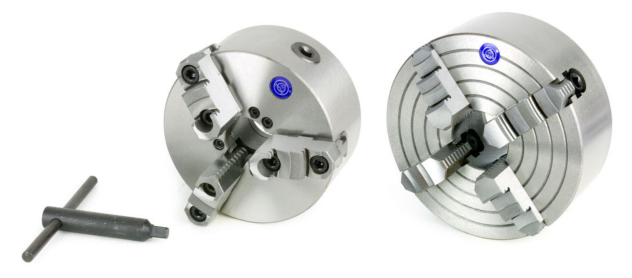
Lathe processing Turning is a cutting operation that the part is rotated as the tool and hold around a horizontal axis while being formed to size and shape by cutting tool on a machine which called a lathe. Lathe is one of the machine tools most well used that is a machine tool used principally for shaping pieces of metal, wood, or other materials. The shapes of part on the lathe processing usually are cylindrical, radial, or irregularly shaped. Principal capabilities of the lathe are forming straight, tapered, profile cut, groove, or irregularly outlined cylinders, facing or radial turning cylindrical sections, cutting screw threads, and boring or enlarging internal diameters ( Kalpakjian, 2006). Generally, workpieces are clamped and are held to the headstock spindle of the lathe with chuck. The independent chuck includes four jaws which are adjusted individually on the chuck face by means of adjusting screws. The jaws of the independent chuck may be reversed so that the steps face in the opposite direction; thus, workpieces can be gripped either externally or internally. The independent chuck can he used to hold square, round, Social and Organizational Factors (2020) octagonal, or irregular shaped workpieces in either a concentric or eccentric position due to the independent operation of each jaw. Because of its versatility and capacity for fine adjustment, the independent chuck is commonly used for mounting workpieces that require extreme accuracy. The universal scroll chuck usually has three jaws which move in unison as an adjusting pinion is rotated. The advantage of the universal scroll chuck is its ease of operation in centering the work for concentric turning. This chuck is not as accurate as the independent chuck but, when in good condition, it will centre the work automatically within 0.003 of an inch of complete accuracy. In addition, the universal scroll chuck can be used to hold and automatically center round or hexagonal workpieces. However, this chuck unable used effectively to hold square, octagonal, or irregular shapes (Army Institute, 1988). The worker always uses the chuck key as the t-shaped wrench when the worker wants to loosen or tighten the work-piece gripping in the chuck jaw.
Figure 1. Characteristic to chuck key, universal scroll chuck and independent chuck Skills were of vast importance to the industrial work. All part of the production efficiently depended on the professional’s skills. Without their expertise in the making of goods merchandise, most of the industrial factory would not have survived. Because of advanced technology, the professional and the precision machine have been necessary to operate in many areas of industrial complex to become an important asset in developing simultaneous.
The last experiment of study the difference among an expert and a non-expert in the behavior for chucking in the lathe found that the characteristic of standing posture and the hand holding position on chuck key of expert worker did not influenced on movement pattern of body along Y value. However, only the standing posture influenced the movement pattern of XZ plane. Before chucking, the expert exerted the forearm force to push the body backward after that he move the body forward and he start twisting. Moreover, the distance movements of shoulder right, waist left and waist right are quite similar. However, the distance movement of shoulder left is smaller. In addition, Expert worker always bent the body down forward while he was chucking whereas the non-expert always kept upright standing along the movement of chucking. His body did not move forward. Expert worker have a quite steady balance movement between left and right side of body until he twisted the body for chucking. The body leaning did not rather appearance. While he was chucking he did not blend his knee and have not up and down movement. The expert has a few position movements in Y axis. The distance movement of expert both the X and Z axis have a less distance movement along each axis than non expert.
Conversely, the non-expert could not keep the balance movement. He often leaned the left side of body. It is determinant of inclining the body to the left while he was beginning chucking. The non-expert kept standing upright along movement of chucking. The position of waist and shoulder of each side was quite concentric. It showed that the non-expert did not move the shoulder forward. Beside he rotated both shoulder right and waist right to backward for exert force to twist chuck key. At the same time, both shoulder left and waist left move to left side as a rotation pattern. The difference in acceleration of vertical movement between expert and non-expert is a much more significant. The vertical motion of the expert that quite smooth and constantly. The certain intervals the acceleration is approximately constant and not over other intervals. The acceleration data of non-expert is interesting. The maximum acceleration is about 2.5 G (gravitation). The acceleration increasing occurred in the end of time. As expected, the Y values of expert hover around zero point while the Y values of non-expert shows the up or down acceleration of the chucking behavior.
METHOD AND INSTRUMENTS Aim
This study focused the relationship among the pattern direction of body movement such as the torso, waist, shoulder, hand, elbow and forearm with the center of gravity movement and the stand postures that there are difference between an expert and the non-expert.
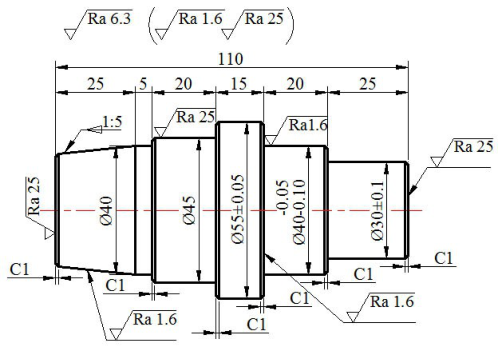
Participants and tool The experiment participants were 2 Japanese-men experienced for the lathe processing. The expert worker (85 years) has worked in the company for 70 years and the non-expert (16 years) has worked 1 year of experience for the lathe operation. This experiment investigates by used universal scroll chuck. Both of them operates on the lathe machine without the controlling speeds, feed and tooling instructions. In Figure 2 is the workpiece drawing on lathe operation used tool steel (S45C) as the work pieces material.
Figure 2. Working drawing
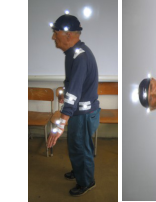
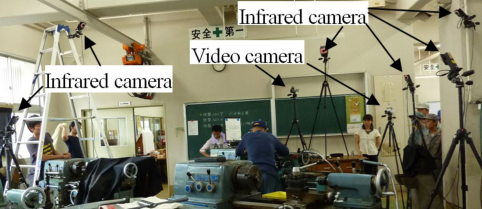
An expert and the non-expert workers were conducted with 16 reflective markers only on the top of their body. All reflective markers position data which the synchronization was taken by a motion analysis system (sampling rate: 100Hz). As equipments for chucking movement analysis in lathe processing are three-dimensional motion capture system (Mac3D Motion analysis) consisted of 6 infrared cameras and 2 video cameras captured the position of each subject (Figure 3).
Figure 3. Positioning of the reflective markers on an expert and non-expert worker.Figure 3. Position of reflex markers on the top body of participants, location of infrared and video cameras.
RESULTS & DISCUSSION
(a) (b) (c)
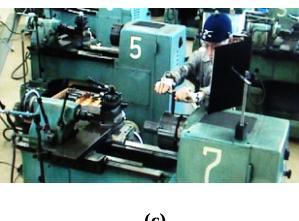
Figure 4. The standing posture of the expert and the non-expert worker
(a) (b)
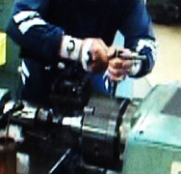
Figure 5. The characteristic of hand holding position.
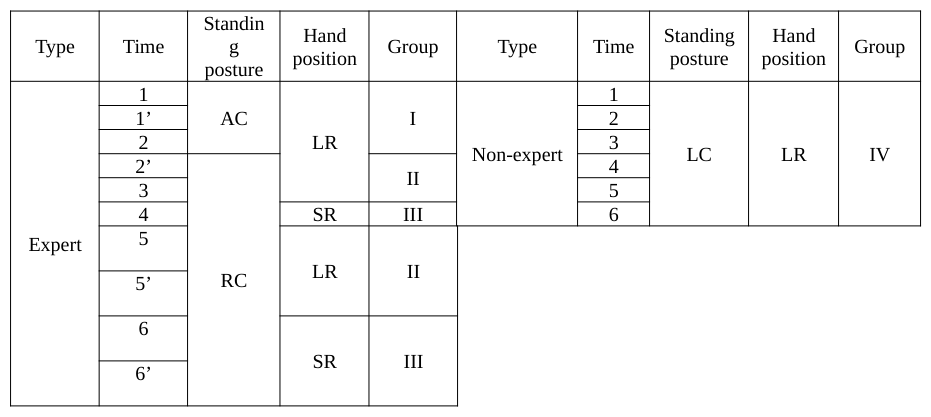
The observation thoroughly work of time found that the expert worker have using the chuck key for lock the work piece into the chuck jaw in 10 times. The 6 times are the first probably quite tight of jaws with workpiece (1, 2, 3, 4, 5, 6) and the 4 times are the repetition tighten chucking (1’, 2’, 5’, 6’). The non-expert worker has 6 times for the tight only. The standing character of expert worker can divided in 2 groups and the non-expert is only 1 group (Figure 4). The first standing of expert on Figure 5(a), the body of expert such as waists, shoulders and trunk aligned with the chuck (AC). The second standing posture on Figure 5(b), He stood at the right side of the chuck and quite near the tailstock (RC). Besides, Figure 5(c) showed the non-expert worker had the left standing of the chuck (LC).The hands holding position on the key chuck in Figure 5 consisted of 2 characteristics. Firstly, both the left hand and the right hand held on the handle of chuck key (LR). Secondary, only the right hand was holding on the handle and the left hand held on the shank of chuck key (SR). The hand characteristic of the expert worker was both the former and the latter hand position. However, the hand holding position of non-expert was the former only. These data were categorized the behavior of the expert and non-expert in 4 groups such as type I, II, III and IV. The details are as below in table 1
Table 1: The subdivision group of the expert and non-expert worker were separated by the characteristic of hand position and standing posture.
For understanding clearly, Figure 6 showed the X, Y and Z axis construction for help the conception of movement on each plane for example XY plane, YZ plane and XZ plane. The legend used for understanding the purpose and the content of the chart.
Y
-Z X
Figure 6. Tooling for comprehension analysis
Figure available in the original PDF paper.
Z
Y
Y
Z
X
X
Figure 7. Group I of Expert worker, Stand alignment with the chuck (AC), both left and right hand hold on the handle of chuck key (LR)
Figure available in the original PDF paper.
The consideration on YZ plane should be image at behind of worker. On Figure 7, It shown the movement data of an expert worker in group I that included the movement of bilateral on shoulder, elbow, hand and waist. The group I, the standing posture of expert worker was alignment with the chuck (AC) by turning the face of expert to the chuck beside his hands both left and right side held on the handle of chuck key (LR). On above mention in last my research that the line graph of shoulders and waists had a fairly stable movement along the Z axis that easy detection on YZ plane. The line graph on Figure 7 can also explained the movement of torso and forearms. In case of elbows and hands, the expert worker always bent his elbow both left and right side and stretched it out of the body. He can control the line balance of forearm for parallel movement of hand and elbow position along the XZ plane. The position reflex marker of YZ and XY plane found both hand and elbow position pretty similar on the Y axis. On XZ plane, the line graphs movement of elbow left and right had a similar pattern of waists and shoulders that the line graphs of them as a curve. But the truth of their direction movement have difference. When he began twisting the chuck both the waist and the shoulder turned to the left side but the elbows were swing to the right side. His hands had a least movement distance. It can observe by comparison of movement distance on each line graphs. The curves line graphs movement of waists, shoulder and elbow on plane of XZ can confirm that during the expert was chucking he used the center of body as the line of backbone for center of rotational movement.
Z
Y
Y
Z
X
X
Figure 8. Group II of Expert worker, Stand on the right side of the chuck (RC), both left and right hand hold on the handle of chuck key (LR)
Figure available in the original PDF paper.
In Figure 8, all though this figure has difference the standing posture with the previous figure but the expert still keep steady straight between the position of hands and elbows. The positions of them are as alike the Y position along the X axis. In this case, the expert stood on the right side of the chuck (RC) and sidle away from the machine around 45 degrees. The jaws tighten up by this procedure often used his waists for center of twisting. The expert worker still bent his elbow both left and right side and stretched it out of his body. When he get start, he will fix the waist and jerk the elbow for pulling the shoulder to the left side together. Therefore, when the elbow moved both shoulder and hand will follow up. On XZ plane, the parts of right side were used less than the left side.
Z
Y
Y
Z
X
X
Figure 9. Group III of Expert worker, Stand on the right side of the chuck (RC), left hand hold on the shank but right hand hold on the handle of chuck key(SR)
Figure available in the original PDF paper.
Even if, most characteristic important of group II and group III such as the keeping steady straight between the position of hands and elbows, the standing posture, the bending his elbow both left and right side and stretched it out of his body, the sticking of his waist for as the center of twisting while chucking were similar. Nevertheless, the movement characteristic of his waists, shoulders and hands had difference. In case of group III, the bodies movement of left side were hardly moved when compared with the movement of right body and compared with the left side movement of group II. The trend line graphs both YZ plane, XZ plane and XY plane shown that the maximum distance movement of group III was belonged to the hand and the elbow of right side. At the moment of an expert chucking, he had a few movement of his waists, shoulders and forearm of left side. The jaws tighten on group III, the expert used only the forearm of right side by the right handle of chuck pulled.
Z
Y
Y
Z
X
X
Figure 10. Group IV of Non-expert worker, Stand on the left side of the chuck (LC), both left and right hand hold on the handle of chuck key (LR)
Figure available in the original PDF paper.
This graphs indicated the uncommon movement of the non-expert worker. Firstly, the position line on XY plane of his left hand and elbow were aligned by inclining towards with his shoulder meanwhile the right elbow was bent lower than his right hand. During chucking, his arms both left and right side had not a changed appearance. Secondary, the line graphs of body movement on XZ plane shown that the non-expert always had rotated the body movement together with swung the body to the left side by used the left hand as a center of rotation. Therefore, the distance movement of left side will be less than the right side. Lastly, the YZ plane indicated the non-expert inclined the body left down all the time.
CONCLUSION
This results mention can summarize the relationship among the movement trajectory of body, the center of gravity movement and the standing posture of an expert and non-expert meanwhile chuck jaws was tighten for lock the workpiece on lathe processing as below;
1. The pattern movement of the standing posture which alignment with the chuck on group I had the rotation pattern movement. The line of backbone is also a center of body between left and right side has been the center of this rotation.
2. The characteristic movement of an expert both group II and III which stand on the right of the chuck are not a rotation pattern but their trend line movement are a straight line.
3. The standing posture of right side of the chuck (group II and III) always use his waist as like the base of movement.
4. The standing postures do not influence the balance movement between left and right side of body. Both waists and shoulder still keep parallel steady among wrist line, shoulder line and XZ plane. On the contrary, the standing postures affect the body movement on XZ plane
5. Not only the standing posture which alignment with the chuck on group I but also group II and III which stand on the right of the chuck, the expert always bent his elbow both left and right side and stretched it out of the body.
6. The difference of hand holding position does not affect the standing posture on the right side of the chuck. The expert always sidle away from the machine around 45 degrees. However, the differences of hand holding position affect the distance and pattern movement.
7. There are a most distance movement of wrists, shoulders, elbows and hands on the standing posture which align with the chuck on group I.
REFFERENCE Army Institute for Professional Development (1988). Lathe Operation, Edition 8.pp. 30-33 Douglas C. Montgomery (1997), “Introduction to statistical quality control”, 3rd edition Canada: John Wiley & Sons, Inc.
pp. 2-8 Ito R., Yoshikawa T. and Sirisuwan P (2013)., "About using the elbows of an expert in the chucking process of a lathe," Shikoku branch of Japan society for design engineering, pp.33-34. Kalpakjian and S. R. Schmid (2006), “Manufacturing engineering and Technology”, Prentice-Hall Koshino T., Yoshikawa T. and Ito R (2011), “Visualization of skills of the takumi using a usual lathe - Difference of
consciousness for products” Mechanical Engineering Congress, September, J231023. Yoshikawa T., Ito R. and Tsujinaka T. (2012), “ Stance of chucking by the Takumi on Lathe Workin”, The Japan Society of Mechanical Engineering, pp.2012-517. Yoshikawa T., Tsujinaka T. and Ochi M. (2011), “Report of experimental Knowledge for working with an usual lathe by Takumi
living in saijo city” Reprinted from the memories of Niihama National College of Technology, Vol.47, pp.61-66.
LISTED IN THE AHFE DIGITAL BOOKSTORE CATALOGUE
Explore the complete digital volume
Advances in Social and Organizational Factors
Read this individual research paper free through the original publisher, or explore the full digital proceedings book.
ISBN 978-1-4951-2102-9
Explore this ISBN in the AHFE Bookstore ↗Listed in the July 2026 bookstore catalogue; search by ISBN to confirm current availability · Digital book purchase optional