Wang Zelong, Porakoch Sirisuwan, Chieko Narita (2022). Technique Analysis of Processing System for Traditional Japanese Paper Fan. In: Advances in Ergonomics In Design, Usability & Special Populations: Part III. AHFE Open Access, vol. 20. https://doi.org/10.54941/ahfe1001308
Kyo-Uchiwa is a traditional Japanese paper fan. The each main production process of Kyo-Uchiwa was described and summarized in this paper. The ‘Momi’ process was focused, which is the most important step for Kyo-Uchiwa production. The participant’s muscle activity of ‘Momi’ making process was measured and compared by electromyography (EMG) between using different bamboos with 3 days and 4 hours soaking time during the whole ‘Momi’ process. The classic electromyography fatigue indexes of EMG, MNF and MDF, were used to investigate master’s fatigue state. As a result, the bamboo of Kyo-Uchiwa frame at 3 days condition was considered as suitable production material before ‘Momi’ process.
Japanese traditional industries have been passed down to posterity for a long time and they always have kept their own skills inside their family. It has a problem of Japanese experts and traditional industries which been decreased by increasing imports, such as the cheap foreign-made articles from foreign countries and the intervention of high technology.
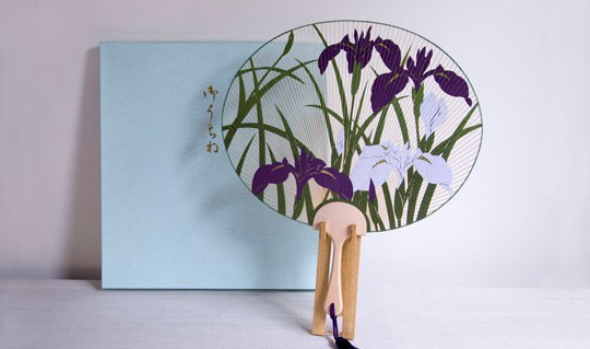
Kyoto has been the capital city of Japan for one thousand years. ‘Kyo-Uchiwa’ is one of traditional handwork has roots in Kyoto (a Japanese paper fan) as shown in Figure 1. ‘Kyo-Uchiwa’ is a hand-held fan to relieve hot weather in summer. ‘Kyo-Uchiwa’ is implemented to induce airflow for the purpose to cool or refresh oneself. The movement of a hand-held fan provides cooling by increasing the airflow over the skin which in turn increasing the evaporation rate of sweat on the skin. This evaporation has a cooling effect due to the latent heat of evaporation of water. Fans are convenient to carry around, especially fold fans. The Japanese fans are made of paper on a bamboo frame. It is usually with a design painted on them. The non-bending fan is ‘Kyo-Uchiwa’. In addition to folding fans, the non-bending fans are popular and used in a common place. ‘Kyo-Uchiwa’ is often used by a person to create a breeze to keep cool in hot weather and often given as gifts at these times. Originally, a big leaf and an animal hair were used as ‘Kyo-Uchiwa’. Over times they changed, and it have made from bamboo and paper today. “Kyo-Uchiwa” is very valuable. Because In Kyoto, the wholesale dealer performing a design of the fan by handwork from processing of domestic bamboo is only one and the craftsman is only one too. This is the main problem for the continuation the ‘Kyo- Uchiwa’.
In this study, all production processes of ‘Kyo-Uchiwa’ manufacture were investigated and the time of every process was calculated and compared. Among them, one of most important production proceses of ‘Kyo-uchiwa’, called “Momi”, was analyzed in detail by EMG system, which is a process to separate the bamboo fibre to make the frame of ‘Kyo-Uchiwa’. ‘Momi’ is very hard work to craftsman, because it requires his maximum effort. ‘Momi’ motion takes the master a long time and gives damage to his body. Therefore, it is difficult to bring up successors. Before the “Momi” process, the bamboo is immersed in water so that it becomes softer and makes it easier to bend. Traditionally, the immersing time for the bamboo is 3 days, which has been thought to give the most suitable hardness. In addition, the participant’s muscle activity of ‘Momi’ making process with 3 days and 4 hours was measured by electromyography (EMG) among ‘Kyo-Uchiwa’ manufacture. The MNF and MDF index of EMG signals were calculated and compared in order to measure the level of fatigue state.
The purpose of this study is through EMG analysis to clarify the bamboo between 3 days and 4 hours soaking time influenced on ‘Momi’ production process in order to provide a suggestion to help beginners or non-experts to select and prepare the making material of ‘Kyo-Uchiwa’.
Figure 1. Kyo-Uchiwa
KYO-UCHIWA PRODUCTION PROCESS Kyo-Uchiwa production flow
‘Kyo-Uchiwa’ is supported by many bamboo stalks between the papers and has ‘Sashie’ structure that is the head
(main body) and the handle are made separately. There are three main stages in ‘Kyo-Uchiwa’ manufacture. Firstly, the materials were strict selected and the shape was rigid controlled. Secondly, the fiber of the bamboo was separated to make the frame of ‘Kyo-Uchiwa’, which was called ‘Momi’ process. Lastly, the frame of ‘Kyo- Uchiwa’ was covered with paper and gotten painted. Details of important processes are described below. Three stages were divided into twelve steps in detail as shown in Figure 2.
Figure 2. The Production flow chart of ‘Kyo-Uchiwa’
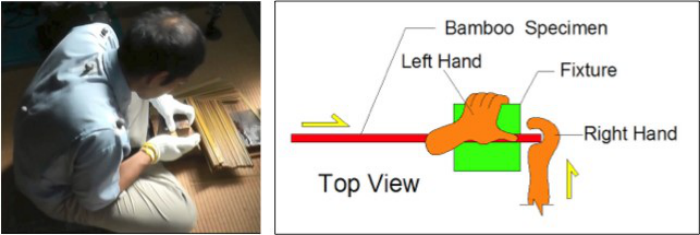
Critical process of Kyo-Uchiwa ‘Momi’ process is the one of the most important steps during the whole production process, its stability and accuracy decides overall appearance of the shape of ‘Kyo-Uchiwa’ frame, which is a process to separate the bamboo fibre to make the frame of ‘Kyo-Uchiwa’ as shown in Figure 3.1. ‘Momi’ process also is the most difficult step for a ‘Kyo-Uchiwa’ master, because it taken significant time and energy to bend the top of the frame with very small moment as shown in Figure 3.2. The ‘Momi’ process also is the most complicated step for successor training and prone to injury. The bamboo is required to immerse in water so that it becomes softer and easier to bend.
1.The Photo of ‘Momi’ process 2. The schematic of ‘Momi’ process
Figure 3. The “Momi” process of Kyo-Uchiwa manufacture
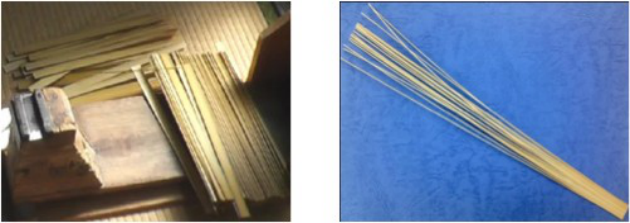
Traditionally, 3 days has been thought as the immersion time for the bamboo before ‘Momi’ process with the most suitable hardness and never been questioned. And some of ‘Kyo-Uchiwa’ workshop used the bamboo with 4 hours immersion time to make the ‘Momi’ process in order to speed up procedures. The shape change before and after the ‘Momi’ process was illustrated in Figure 4.1 and Figure 4.2.
1.Before ‘Momi’ process 2.After ‘Momi’ process
Figure 4. Bamboo characteristic before and after ‘Momi’ process
EXPERIMENT Participant
A Japanese fan master was employed as the participant, 172cm height and 70kg weight, who has 10 years experience in ‘Kyo-Uchiwa’. The participant can keep the consistent performer during the whole process of Kyo- Uchiwa production.
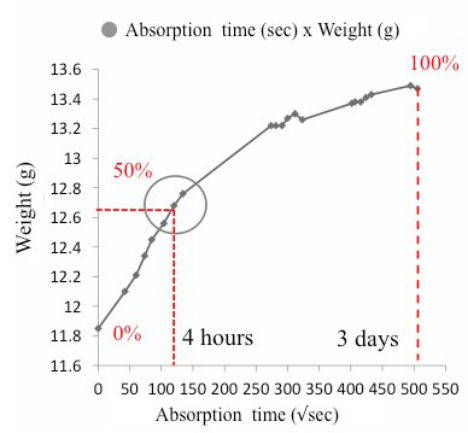
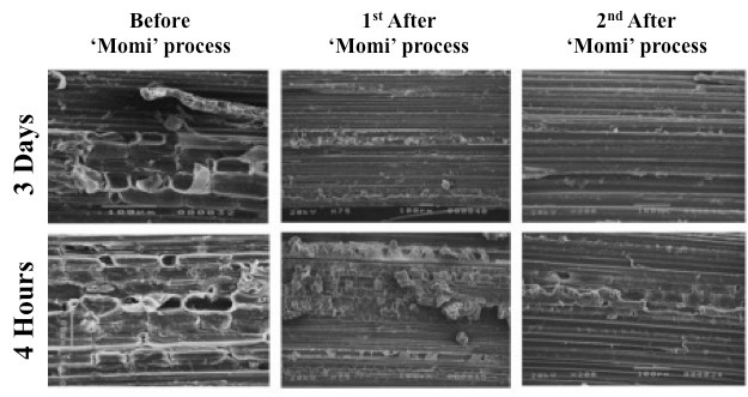
Material Two types of flat bamboos with different soak time, 2cm width, 28cm length, and 0.2cm thickness, were selected as comparison objects for proceeding the experiment, which were immersed in water 3 days and 4 hours respectively. Normally, the moisture content of the frame of ‘Kyo-Uchiwa’ was reached 100% and 50% after 3 days and 4 hours soaking in water according to actual data as shown in Figure 5. Based on traditional experience, the flat bamboo with 3 days immersion was considered of as a best proceeding state for ‘Momi’ process. And it just was a critical state that the bamboo can be bended with 4 hours soaking. The actual containing moisture of two types subjects were observed and investigated by Digital Microscopy as shown in Figure 6.
Figure 5. Moisture content ratio of bamboo with 3-day and 4-hour soaking time in the waterFigure 6. SEM observation images of bamboo with 3 days and 4 hours soaking time in the water
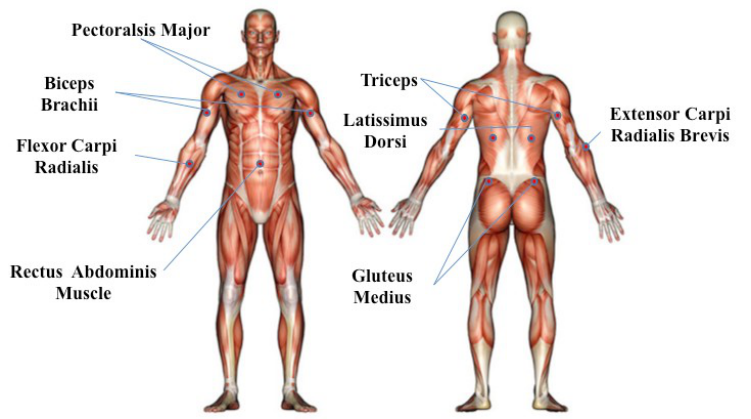
Electromyographic measurement The participant’s muscle activity of ‘Momi’ making process with 3 days and 4 hours was measured by electromyography (EMG) among ‘Kyo-Uchiwa’ manufacture. The machine telemeter system WEB- 1000(Nihon Kohden Co.) and the telemeter codeless electrode (Nihon Kohden Co.) were consisted of EMG measurement system, and the sampling frequency rate was 1,000 Hz. The surface electrodes of thirteen muscles were recorded, they were the bilateral side of Pectorails major, Biceps brachii, Triceps brachii, Latissimus dorsi, Gluteus medius and only right side of Rectus abdominis, Extensor carpi radialis brevis and Flexor carpi radialis as shown in Figure 7.
Figure 7. The schematic diagram of measured muscle
EMG signal analysis The most commonly, the Mean frequency (MNF) and median frequency (MDF) are the most useful and popular frequency-domain features and frequently used for the assessment of muscle fatigue in surface EMG signals. Because the MNF and MDF of surface electromyography (sEMG) descent with muscle fibre conduction velocity (MFCV) has good correlation data during the Process of local muscle fatigue.
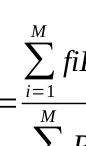
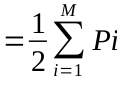
MNF is an average frequency which is calculated as the sum of product of the EMG power spectrum and the frequency divided by the total sum of the power spectrum. The mean frequency of a spectrum is calculated as Equation.1. Where Pi is Pi is the i-th line of the power spectrum; fi is the frequency variable; M is the highest harmonic considered; Equation.1:
Equation reproduced from the original PDF.
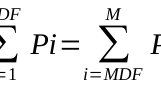
MDF is a frequency at which the EMG power spectrum is divided into two regions with equal amplitude (a half of the total power, or dividing the total power area into two equal parts). It is obtained as following Equation.2. Where Pi is Pi is the i-th line of the power spectrum; fi is the frequency variable; M is the highest harmonic considered; Equation.2:
MDF M
Equation reproduced from the original PDF.
Equation available in the original PDF paper.
Equation reproduced from the original PDF.Equation reproduced from the original PDF.
In this research, 3 days and 4 hours of all muscles’ electromyography were compared each other. The muscles with great different signals were focused and further analyzed. The electromyography signals of these muscles were transformed from time domain to frequency domain after Fourier transform. The MNF and MDF were calculated via above equation.
RESULT AND DISCUSSION
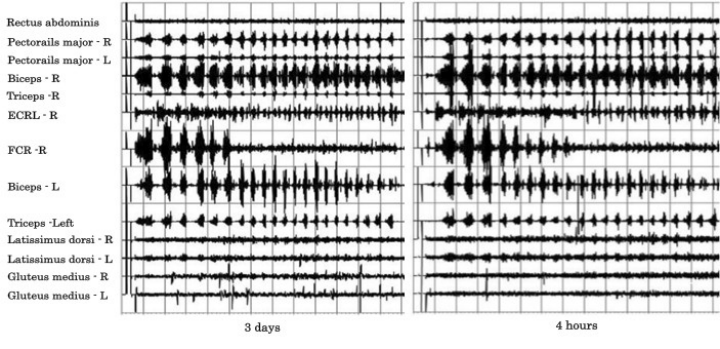
The Figure 8 was summarized and illustrated the all EMG signals of muscle activities at 3 days condition and 4 hours condition. It was shown that the upper limb’s muscles, the trunk muscles and the hip muscles coordinated were coordinated together during ‘Momi’ motion at both 3 days condition and 4 hours condition. Furthermore, it was easy to discovered significant differences between the two conditions in left and right bilateral biceps brachii, right extensor carpi radialis brevis, right flexor carpi radialis. The Muscles activity remainder was identical.
Figure 8. The EMG of ‘Momi’ process
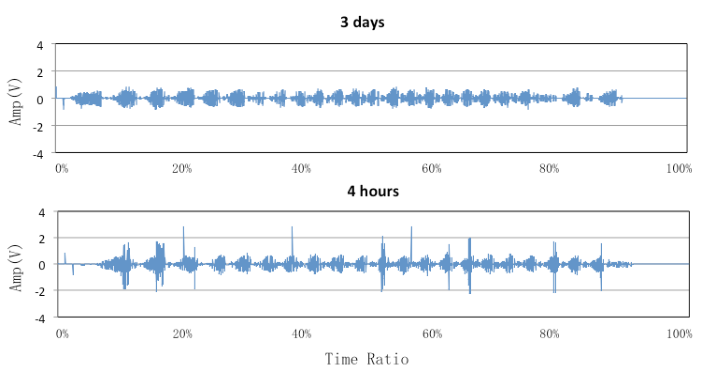
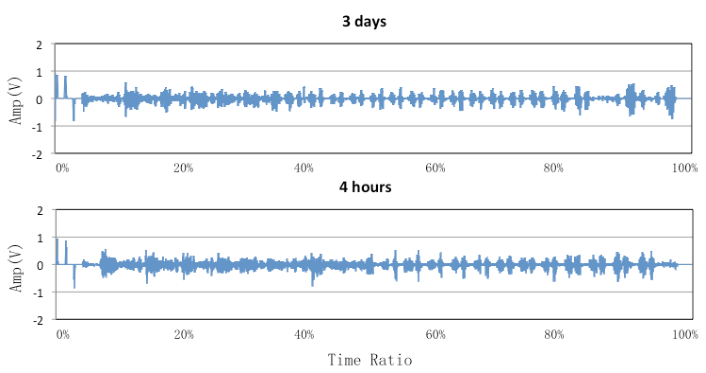
In case of Right Biceps Brachii muscles (RBB) were showed similar muscle activity patterns at 3 days condition and 4 hours condition as shown in Figure 9. However, the muscle activity at 3 days condition was showed more stable wave patterns than 4 hours. The waveform area of 4 hours condition was tiniest increased continuously and appeared high wave crest. It was considered that Right Brachii muscls have to take more strength and explosive strength during each bending.
Figure 9. The EMG of Right Biceps Brachii muscles (RBB) at 3 days and 4 hours conditions
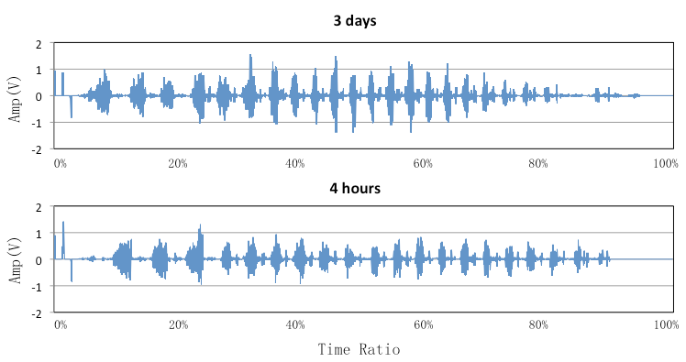
Left Biceps Brachii muscle (LBB) was explained in Figure 10. The EMG of 3 days condition was showed the shorter range and higher wave crest. Contrastively, The waveform area of 4 hours was appeared little longer than 3 days and fluctuated with longer time. It was thought that the bamboo was bended effectively under the 3 days condition, because the left hand pressured on the bamboo with shorter time.
Figure 10. The EMG of Left Biceps Brachii muscle (LBB) at 3 days and 4 hours conditions
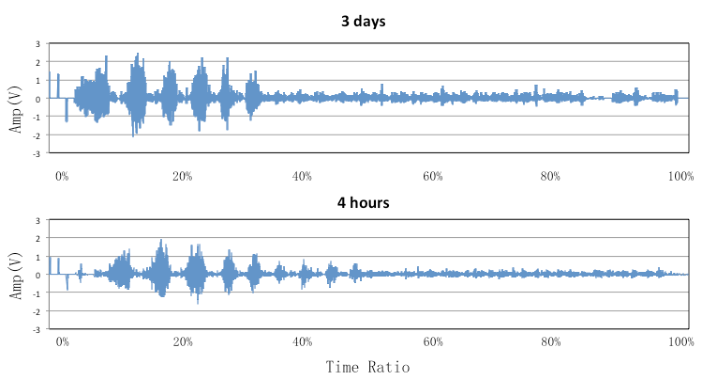
Right Extensor Carpi Radialis Brevis muscle (RECRB) was illustrated in Figure 11. Compared with the 4 hours condition, the muscle activity at 3days condition was presented the shorter period of waves about 2.5 seconds. On the other hand, at 4 hours condition, the period of waves near 4 seconds, EMG signal showed continuous muscle activity in the first half part and double physic patterns in the second half part. It was described that master was unable to quickly bent bamboo so that RECRB muscle had to continue power at the beginning, and performed the motion two times with less force at latter half.
Figure 11. The EMG of Right Extensor Carpi Radialis Brevis (RECRB) at 3 days and 4 hours conditions
Right Flexor Carpi Radialis muscle (RFCR) behaved that the wave of muscle activity at 3 days condition was generated more wave strokes than 4 hours as shown in Figure 12.
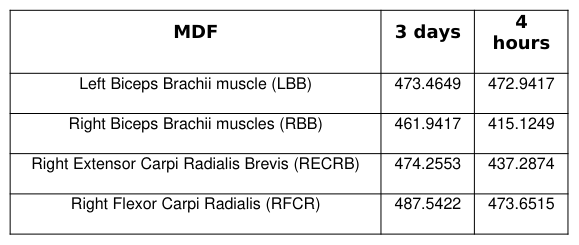
Figure 12. The EMG of Right Flexor Carpi Radialis (RFCR) at 3 days and 4 hours conditions The 3 days and 4 hours of all muscles’ electromyography Mean frequency (MNF) and Median frequency (MDF) of 4 muscles’ EMG data at 3 days condition and 4 hours condition were illustrated at Table 1 and Table 2. According to these two tables, both MNF and MDF at 3 days condition were presented larger values than 4 hours in Left Biceps Brachii muscle (LBB), Right Biceps Brachii muscles (RBB), Right Extensor Carpi Radialis Brevis (RECRB), Right Flexor Carpi Radialis (RFCR). It said that master’s muscles at 4 hours condition were presented fatigue state and especially prone to fatigue compared to 3 days condition.Table 1: The summary of Mean frequency (MNF) at 3 days and 4 hours conditions MNF 3 days 4 hoursTable 2: The summary of median frequency (MDF) at 3 days and 4 hours conditions MDF 3 days 4 hours
CONCLUSIONS
In a word, the EMG analysis was showed that the bamboo with 3 days soaking time can be proceed more effectively during the ‘Momi’ process. And the small values of MNF and MDF at 3 days condition was presented that master can keep working state and physical strength than 4 hours. The bamboo of Kyo-Uchiwa frame at 3 days condition was more suitable as production material before ‘Momi’ process. Three days immersion was the very important step during the Kyo-Uchiwa production process as it can affect the shape of final product, which was recommended to abecedarians.
REFERENCES
Cael, C. (2010), “Functional Anatomy: Musculoskeletal anatomy, Kinesiology and Palpation for Manual therapist”, Wolters Kluwer. Kendal, FP. Provance, PG. McCreary, EK. (1993), “Muscles: Testing and function with Posture and Pain”, 4th edition;
Lippincott Williams&Wilkins. Ministry of Economy. (2013), Trade and Industry website: http://www.meti.go.jp. Myers, TW. (2009), “Anatomy trains: Myofascial Meridians for Manual and Movement Therapist”, 2nd edition; Churchill Livingstone Elsevier. Neumann, DA. 2010, “Kinesiology of the Musculoskeletal system: Foundations for Rehabilitation”. 2nd edition; Elsevier Science
Health Science Division. Stephen, R, Alty. Apostolos, G. (2011), “Mean frequency estimation of surface EMG signals using filterbank methods”, 19 th European Signal Processing Conference; Barcelona, Spain, August 29- September 2.
LISTED IN THE AHFE DIGITAL BOOKSTORE CATALOGUE
Explore the complete digital volume
Advances in Ergonomics In Design, Usability & Special Populations: Part III
Read this individual research paper free through the original publisher, or explore the full digital proceedings book.
ISBN 978-1-4951-2108-1
Explore this ISBN in the AHFE Bookstore ↗Listed in the July 2026 bookstore catalogue; search by ISBN to confirm current availability · Digital book purchase optional