Yujiro Kawata, Akari Kamimura, Shino Izutsu, Kai Yamada (2020). Relative age effect in physical and psychological development in young Japanese children and associated problems for kindergarten teachers. In: Advances in Social and Organizational Factors. AHFE Open Access, vol. 9. https://doi.org/10.54941/ahfe100352
In school classroom, a child born soon after the selection period’s cut-off date (early born children) may benefit by up to a full year in physical and psychological development compared with a child born just before the cut-off date (late born children). This phenomenon is called the “relative age effect” (RAE). RAE is defined as the consequence of age differences between individuals within the same cohort, either in school or on sports teams (Musch & Grondin, 2001). This study examines the effect size of RAE in physical and psychological development and discusses educational problems faced by kindergarten teachers due to this RAE. Data were collected from 100 five-year-old Japanese children (60 male, 40 female) and their kindergarten teachers. Significant main effects of birth month category on physical development and on psychological development were found (early born children were more developed than late born children). The effect size of RAE in physical development was greater than that in psychological development. We concluded that the RAE existed in physical and psychological development among young children. Further, RAE appeared greatly on physical than on psychological development. Thus, we propose that kindergarten teachers could benefit from an awareness of the RAE.
In most public educational systems, the cut-off date for entrance into kindergarten or first grade is specified; in the Japanese educational system, the school year starts on April 1st and ends on March 31st. Although a primary purpose of this procedure is to avoid large age differences, a child born soon after the selection period’s cut-off date (early born children) may benefit by up to a full year in physical and psychological development compared with a child born just before the cut-off date (late born children). This phenomenon is called the “relative age effect” (RAE). RAE is defined as the consequence of age differences between individuals within the same cohort, either in school or on sports teams (Musch & Grondin, 2001) (Figure 1).
Cut-off date Same age group Advantageous Disadvantageous
Apl. – Jun. Jul. – Sep. Oct. – Dec. Jan. – Mar.
Figure 1. Advantage and disadvantage in the same age group (Japanese school year).
Figure available in the original PDF paper.
In the sports domain, about 30 years ago, Grondin, Deshaies, and Nault (1984) and Barnsley, Thompson, and Barnsley (1985) discussed a possible relationship between relative age and participation in sport, which is similar to the relationship between relative age and scholastic achievement. They argued that children born early in the competition year have a competitive advantage over their younger peers. Grondin et al. (1984) found that the birthdate distribution of ice hockey players in competitive youth hockey leagues and in the main professional ice hockey league in North America, the National Hockey League (NHL) is highly skewed. That is, the number of players born in the first months of the year is greater than that of players born in the last months of the year. Following these reports, a similar phenomenon has been found in other sports, such as baseball, cricket, tennis, swimming, volleyball, handball, and soccer (for a review, see Musch and Grondin, 2001). Nakata and Sakamoto (2011) also found a similar phenomenon in some sports in Japan. Thus, a late born child may have disadvantage in competitive sports.
In the educational domain, the RAE also exists. A relative age difference of almost one year is related to significant differences in children’s cognitive development (Bisanz, Morrison, & Dunn, 1995; Morrison, Smith, & Dow- Ehrensberger, 1995). Late born children have more academic problems than do their early born classmates (Bell & Daniel, 1990; Dickinson & Larson, 1963; Gilly, 1965; Grondin, Proulx, & Zhou, 1993; Hauck & Finch, 1993). Late born children are more likely to be classified as learning disabled (Diamond, 1983; Maddux, 1980), and their academic achievement is significantly lower than that of older classmates’ (Davis, 1980). Thus, late born children may have an educational disadvantage, even at a young age. Although, as Musch and Grondin (2001) pointed out, despite the obvious similarity, there seems to be an important difference between the RAE in sports and education: sports participation is voluntary, while attending school is compulsory.
In spite of the growing body of research on the RAE, recent studies of the RAE do not address possible disadvantageous in education. Appropriate support is necessary for children to achieve the maximum benefit from schooling. A lack of knowledge of the RAE in education is serious problem. In Japan, Kawata et al. (2013) founded the existence of RAE on physical development and kindergarten teachers’ evaluation of 4–5 year-old Japanese children. Specifically, early born children were more physically developed (height and weight in physical size, running and throwing in motor ability) and received higher ratings from teachers in these skills. Consideration should also be given to psychological variables, such as competence and motivation.
Children differ not only in their physical maturity but also in psychological maturity when the RAE is present. However, the RAE in psychological development among young children has not been well examined. Therefore, this study examined the effect size of RAE in physical and psychological development and examined educational problems faced by kindergarten teachers due to RAE.
METHODS
Participants Data were collected from 100 five-year-old Japanese children (60 male, 40 female) and their kindergarten teachers from public and private kindergartens in Tokyo, Japan.
Measurements We collected demographic data (gender, age, and grade), and measures of physical and psychological development.
For physical development, we assessed physical size, actual motor ability, and motor ability as evaluated by kindergarten teachers with the following measurements.
(1) In recognition of circadian variations, we measured physical size (body height and body weight) in the morning after the children had urinated.
(2) Actual motor ability was measured by a 20 m sprint, the standing broad jump, ability to throw a tennis ball, and dexterity of the right and left toes. These were assessed by a skilled measurer using various instruments. For the 20 m sprint, we set up a 25 m straight course with goal lines at 20 m, the actual distance timed, and at 25 m, the line to which the children ran. The experimenter stood at the 25 m goal line and recorded the children’s time from the start cue (“set and go”) to the 20 m line. For the standing broad jump, we placed a 3 m tape measure on the floor and drew a start line. We instructed the children to jump as far as they could from the start line, pushing off with both feet. To measure throwing ability, we used a tennis ball. We instructed the children to throw the ball as far as possible using their dominant hand. For dexterity of the toes, children were asked to carry marbles as many as they can within 20 seconds using their toes.
(3) Motor ability evaluated by teachers for running, jumping, and throwing was measured the kindergarten teachers’ answer to the following questions: “How well does this child run,” “How well does this child jump,” and “How well does this child throw?” The questions were on a five-point Likert scale from 1 (very poorly) to 5 (very well).
For psychological development, we assessed perceived physical competence, attitude toward physical activity, and zest for living.
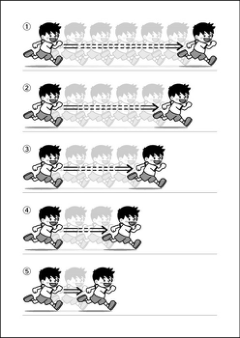
(1) To measure perceived physical competence, we used the Pictorial Perceived Physical Competence Scale (Kawata et al., 2013, Figure 2). This scale assesses the children’s perspectives of their competence in running, jumping, and throwing, with scores ranging from 1 (low competence) to 5 (high competence). Children are asked to choose one child of five children who do abovementioned physical activities after the following instructions: “How fast can you run,” “How far can you jump,” “How far can you throw?” Each picture was presented one at a time. Children are asked to point a child with their finger.
Figure 2. The Pictorial Perceived Physical Competence Scale (Kawata et al., 2013).
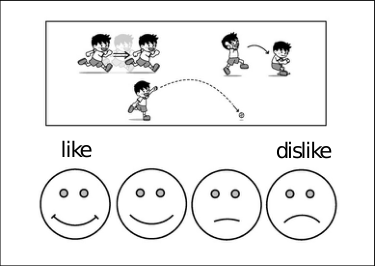
(2) To measure attitude toward physical activity, we used the Pictorial Attitude for Physical Activity Scale. This scale assesses enjoyment and liking of physical activity. To measure enjoyment and the liking, we drew a picture of children and playing a sad and smiling child’s face (Table 3). Children are asked to provide their level of agreement or disagreement with two questions on a four point Likert scale, ranging from 1 (not enjoyable or dislike) to 4 (enjoyable or like) after the following questions: “Do you enjoy physical activities,” “Do you like physical activities?” Each picture was presented one at a time. Children are asked to point a face with their finger.
like dislike enjoyable not enjoyable
Figure 3. The Pictorial Attitude for Physical Activity Scale. (3) We used the concept of zest of living (health, human relationships, environment, language, and expression), which is part of the kindergarten educational procedures of Japanese Ministry of Education, Culture, Sports, Science and Technology. We created questionnaire items corresponding to these five aspects. The kindergarten teachers are asked to provide their level of agreement or disagreement with five questions on a five point Likert scale, ranging from 1(completely disagree) to 5 (completely agree). The questions, accompanied by the abovementioned aspects, were as follows: The “Do you think that the child has healthy life rhythm (health),” “Do you think that the child has good relationship with others (human relationships),” “Do you think that the child has feelings of curiosity about the surrounding environment (environment),” “Do you think that the child has ability to express in words what he/she experiences (language),” “Do you think that the child has ability to express in sounds or action what he/she feels (environment)?”
Ethical Consideration This study was approved by the Research Ethics Committee at the School of Health and Sports Science, Juntendo University. Prior to the study, we obtained permission from the principals of a kindergartens and the board of education. Informed consent was obtained from the parents of the participants. Each participant was made aware of his or her right to decline cooperation at any time, even after consenting to participate, without repercussion.
Statistical analysis Children were divided into the following four groups according to calendar quarters based on their birth month: Group A (April 2nd through June), Group B (July through September), Group C (October through December), and Group D (January through April 1), which was aligned with the Japanese school year that runs from April 1 to March 31. Children born on April 1 were in the Group D because such children are one grade below according to the Japanese school education law. Group A and B are early bone children, while Group C and D are late bone children. A one-way analysis of variance (ANOVA) was conducted to assess the differences in all variables among the four groups. We calculated the η2 as an effect size of the each analysis. The effect size is regarded as a statistical measure of the strength of a phenomenon. Thus, we used the effect size to compare the strength of the RAE in this study. The criteria of the effect size of η2 in one-way ANOVA are regarded as follows: small effect (η2 = 0.01), medium effect (η2 = 0.06), and large effect (η2 = 0.14). Statistical significance was set at p < .05.
RESULTS AND DISCUSSION
We examined the existence of the RAE in physical and psychological development through one-way ANOVAs (Table 1). In physical development, there was a significant main effect of birth month category on physical size. Specifically, Group A children were taller and heavier than were Groups C and D children. This result is concordant with the previous study by Kawata et al. (2013). In measured motor ability, the main effect was also significant: Specifically, Group A was better than was Group D in the standing broad jump. In motor ability evaluated by teachers, there were also significant main effects. Specifically, Group A rated higher than were Groups C and D in running and jumping. These results indicated that the RAE exists for physical development (physical size, actual measured motor ability, and motor ability evaluated by teachers).
The analysis of psychological development resulted in no significant main effects of birth month category on perceived physical competence. Kawata et al. (2013) reported that 4 to 5-year-old children gave themselves extremely high scores regardless of their actual measured motor ability. Thus, there were no significant differences between birth month categories. Similarly, there was no significant main effect on attitude toward physical activity. Thus, in this study, most children had a high assessment of their physical competence and they liked and enjoyed physical activities regardless of their relative age. In zest for living, as evaluated by teachers, there were results showed significant main effects. Specifically, Group B had higher language evaluation than did Group D. This is the first evidence of the RAE in the development of language among young children. These results indicated that although the RAE exists in the development of zest for living (language), the RAE does not exist on perceived physical competence or attitude toward physical activity.
Table 1. Comparison of variables by birth month category.
Table available in the original PDF paper.
Birth Month
Total
Effect size F -value Multiple comparison A. Apr.- Jun. B. Jul.-Sep. C. Oct.-Dec. D. Jan.-Mar.
(η 2)
Equation reproduced from the original PDF.
M SD M SD M SD M SD M SD
Physical development Physical Size Body height 113.5 5.1 111.5 4.7 108.9 4.5 105.8 4.4 110.0 5.3 8.3 *** A > C, D B > D 0.25 Body weight 19.8 3.2 18.6 1.6 17.9 2.4 16.6 1.7 18.3 2.6 5.2 ** A > C, D 0.17 Motor Ability (measured value) 20m sprint 5.2 0.6 5.3 0.6 5.5 1.0 5.5 0.6 5.4 0.8 0.7 0.03 Standing broad jump 109.3 20.7 99.1 18.4 96.8 22.1 86.8 35.0 98.6 24.4 2.4 * A > D 0.09 Tennis ball throwing 7.3 2.7 7.0 2.4 6.0 2.8 5.3 1.9 6.4 2.6 2.1 0.08 Dexterity of the toes (right) 10.1 4.5 8.1 4.5 8.9 4.1 7.2 2.8 8.7 4.2 1.4 0.05 Dexterity of the toes (left) 9.3 4.1 7.7 4.2 8.9 3.9 6.2 5.0 8.3 4.3 1.8 0.07 Motor Ability (teacher's evaluation) Evaluation for running 4.2 1.0 4.1 1.0 3.5 1.1 3.4 1.1 3.8 1.1 3.0 * A > C, D 0.11 Evaluation for jumping 4.1 0.8 3.7 1.0 3.2 0.9 3.5 0.8 3.6 1.0 4.2 * A > C, D 0.15 Evaluation for throwing 3.6 1.1 3.4 1.1 3.1 1.1 2.8 0.7 3.2 1.1 2.2 0.08
* p < .05, ** p < .01, *** p < .001 The effect size on the physical development indexes was greater than was that on the psychological development indexes. The effect size on physical size was greatest. Therefore, it appears that the RAE is likely to be present in physical development among young children. Within the physical development category, the effect size on motor ability evaluated teachers was greater than was that on actual measured motor ability. This may imply unequal treatment and expectations in education. For example, if teachers consistently evaluate late born children lower, these children might lose their feelings of competence and motivation. On the other hand, if teachers give early born children higher evaluations, a “Pygmalion effect”—the phenomenon whereby the teacher’s expectancy of a student’s ability triggers a series of verbal and nonverbal interactions that leads to higher student achievement—may be present in the classroom. Therefore, early born children are profiting from an initial relative age advantage and are likely to be perceived as the most talented in their age group because RAE is not understood, as Musch and Grondin (2001) seggested. Thus, kindergarten teachers’ understanding of RAE may lead to appropriate support for all children’s healthy development.
CONCLUSIONS
We concluded that the RAE existed in physical and psychological development of young children. Further, the effect size of the RAE was relatively larger in physical than in psychological development. We propose that kindergarten teachers could benefit from an awareness of the RAE.
REFERENCES
Barnsley, R. H., Thompson, A. H., & Barnsley, P. E. (1985). Hockey success and birthdate: The relative age effect.
Canadian Association for Health, Physical Education, and Recreation, 51, 23-28. Bell, J. F., & Daniel, S. (1990). Are summer-born children disadvantaged? The birthdate effect in education. Oxford Review of Education, 16, 67-80. Bisanz, J., Morrison, F. J., & Dunn, M. (1995). Effects of age and schooling on the acquisition of elementary
quantitative skills. Developmental Psychology, 31(2), 221. Davis, B. G. (1980). Does age of entrance affect school achievement? Elementary School Journal, 80(3), 133-143. Diamond, G. H. (1983). The birthdate effect—a maturational effect? Journal of Learning Disabilities, 16(3), 161-
164. Dickinson, D. J., & Larson, J. D. (1963). Effects of chronological age in months on school achievement. The Journal of Educational Research, 56, 492-493. Gilly, M. (1965). Mois de naissance et réussite scolaire. Enfance, 18(4), 491-503. Grondin, S., Deshaies, P., & Nault, L. (1984). Trimestres de naissance et participation au hockey et au volleyball. La
Revue Québecoise de l’Activité Physique, 2(3), 97-103. Grondin, S., Proulx, J., & Zhou, R.-M. (1993). Date de naissance et rendement scolaire. Apprentissage et Socialisation, 16, 169-174. Hauck, A. L., & Finch, A. (1993). The effect of relative age on achievement in middle school. Psychology in the
Schools, 30(1), 74-79. Kawata, Y., Iijima, M., Izutsu, S., Kamimura, A., Yamada, K., & Hirosawa, M. (2013). Development of the Perceived Physical Competence Scale for Young Children: A study on to 4–5year-old Japanese boys and girls. Abstract of the ISSP 13th World Congress of Sports Psychology, 246. Kawata, Y., Kamimura, A., Izutsu, S., Yamada, K., Iijima, M., & Hirosawa, M. (2013). Does the relative age effect
exist in physical size, motor ability, awareness of physical activity, and kindergarten teachers’ evaluation of young Japanese children? Abstract of the ISSP 13th World Congress of Sports Psychology, 247. Maddux, C. D. (1980). First-grade entry age in a sample of children labeled learning disabled. Learning Disability Quarterly, 3(2), 79-83. Morrison, F. J., Smith, L., & Dow-Ehrensberger, M. (1995). Education and cognitive development: A natural
experiment. Developmental Psychology, 31(5), 789. Musch, J., & Grondin, S. (2001). Unequal competition as an impediment to personal development: A review of the relative age effect in sport. Developmental Review, 21(2), 147-167. Nakata, H., & Sakamoto, K. (2011). Relative age effect in Japanese male athletes. Perceptual and Motor Skills,
113(2), 570-574.
LISTED IN THE AHFE DIGITAL BOOKSTORE CATALOGUE
Explore the complete digital volume
Advances in Social and Organizational Factors
Read this individual research paper free through the original publisher, or explore the full digital proceedings book.
ISBN 978-1-4951-2102-9
Explore this ISBN in the AHFE Bookstore ↗Listed in the July 2026 bookstore catalogue; search by ISBN to confirm current availability · Digital book purchase optional