Yusuke Takahashi, Hiroshi Yajima, Takuya Dan, Takashi Murata (2020). Research on Motivation Management for Project Members. In: Advances in Social and Organizational Factors. AHFE Open Access, vol. 9. https://doi.org/10.54941/ahfe100369
In recent years, the success rate of enterprise IT projects has been said to be about 30% to 40%. IT projects tend to change dynamically during the project period, and project managers (PMs) must maintain a high level of motivation among the project members during that period. However PMs currently identify the motivation levels of project members in a vague manner relying on experience and intuition. Therefore, it is difficult for PMs to obtain a clear picture of the motivation levels of the members. It is thus important to create or identify a mechanism by which project managers can understand the motivation levels of members, and in this paper we propose such a mechanism. In the proposed method, the motivation of project members is first classified into two categories. Next, we measure the motivation in a manner suited to the characteristics of each classification category. Then, we propose a method for visualizing the motivation of members. Finally, we verify the effectiveness of the proposed method through an experiment where the proposed method is applied to actual enterprise projects.
The success rate of projects in the information technology (IT) industry in recent years is said to be between 30% and 40% (Yaguchi 2008). One reason for this low project success rate is the low motivation of project members. Motivation means both having the incentive to move toward a particular goal or in a certain direction of development and maintaining this incentive until the goal is achieved. Maintaining strong motivation can lead to high work performance.
Recent projects in the IT industry have been characterized by dynamic changes. Each project member must respond to these dynamic changes while performing their duties. Therefore, members should provide support with respect to the changes as part of the team, combine their knowledge, be proactive in learning new techniques and solving problems quickly, and communicate closely with other members within the project(Likert,R.1967 ,Locke&Latham https://openaccess.cms-conferences.org/#/publications/book/978-1-4951-2102-9
Edited by T. Ahram, W. Karwowski and T. Marek 1984).
For all project members to follow the above standard of conduct, they must maintain strong motivation for their work. However, thus far, project managers (PMs) of IT projects have relied on their intuition to obtain understanding of the motivation of each member, and therefore have failed to maintain a high level of motivation among project members.
In this study, we propose a method that allows PMs to maintain the motivation of project members in dynamically changing projects. The characteristics of this study include the separation of the concept of motivation into two separate categories (referred to as static motivation and dynamic motivation) and some proposed methods for managing these categories separately. Because the characteristics of the two types of motivation differ, assessment methods are specific to each type, and PMs are provided with support in terms of motivation management by visualizing the assessment results. The usefulness of the proposed method is verified through application to an actual project.
PROBLEMS WITH IT PROJECT MANAGEMENT
As mentioned, the success rate of IT projects in recent years tends to be low (30% to 40%). One reason for this low success rate is that project members cannot respond to dynamic changes in the project, and in some cases the final product does not meet client quality standards. Under these circumstances, project members must proactively adapt to changes in the project. The project success rate can be improved by combining the knowledge of all members and establishing cooperation between the project members. To ensure the active participation of project members, it is necessary to maintain their motivations at a high level. Therefore, PMs must determine the motivation in light of the project’s characteristics. However, thus far PMs have been assessing motivation in an ill-defined manner, which has led to problems typified by the following cases.
Case 1: The PM determines each member’s motivation on the basis of regular reports from each member to the PM during the course of the project. However, it is difficult for members to communicate all of their opinions in regular reports. Therefore, PMs cannot determine motivation levels accurately due to information loss. Project members may also be anxious about expressing their true opinions in regular reports. In such circumstances, it is necessary to reconsider the mechanism by which PMs inquire about the opinions of the project members.
Case 2: PMs assess the motivation of project members in an ill-defined manner, making it difficult to identify the reasons for the decrease in motivation among project members. At the same time, it is difficult to provide feedback to members who need help improving their motivation level.
Case 3: Because PMs assess the motivation of members in an ill-defined manner, they do not take appropriate measures. Therefore, it is difficult to know, for example, what the motivation of a member was several weeks in the past or why the motivation has suddenly declined.
The method proposed in this study solves the problems outlined in the above three cases.
Edited by T. Ahram, W. Karwowski and T. Marek
PROPOSED METHOD Basic Concepts
In this study, we consider the handling of motivation on the basis of the specifics of the IT project and the problems that arise within the project. IT projects are prone to undergo considerable changes. Therefore, various problems can arise if PMs assess motivation in a an ill-defined manner. To maintain a high level of motivation, the characteristics of the motivation of project members have to be clearly modeled. In this study, we focus on the following two ideas.
1) Each member works on the project in a certain environment and under certain conditions, which must be considered when determining motivation(Maslow 1954).
2) Projects tend to change dynamically, and members have to respond to those changes. Different members associate the adaptation process either with difficulties or with a sense of accomplishment, and their motivation changes accordingly.
In this study, motivation is categorized into two types in consideration of the above two points. Subsequently, the characteristics of these two types of motivation are elucidated by using knowledge obtained from the field of cognitive psychology. From the results of this process, we propose a method that can elucidate the measures that should be taken with respect to motivation. The proposed two types of motivation are static motivation, relating to point 1) above, and dynamic motivation, relating to point 2) above. The motivation of project members is modeled according to these two types of motivation.
Herzberg’s Two-Factor Theory The motivation with regard to projects has been assessed in an ill-defined manner in the past. This study adopts the concept that there are two aspects to motivation. Thus, it is necessary to clarify to what these two types of motivation correspond. Without performing these steps, it is difficult to determine the motivation qualities of project members. Therefore, in this study, we adopt Herzberg’s two-factor theory (Latham 2009), which is highly regarded in the field of cognitive psychology, as a theory of motivation in relation to work.
The two-factor theory (proposed by American clinical psychologist Frederick Herzberg) relates to the following factors of satisfaction and dissatisfaction at work.
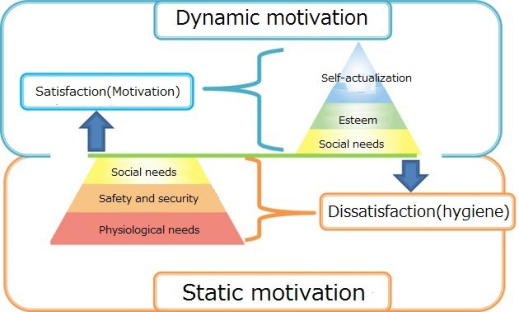
1) Motivation: Satisfaction at work depends on factors such as achievement and recognition. Motivating factors satisfy needs belonging to the “Self-actualization,” “Esteem,” and “Social needs” layers in Maslow’s hierarchy of needs (Latham 2009).
2) Hygiene factors: Dissatisfaction at work depends on factors such as company policies, company management, and salary. Hygiene factors satisfy needs belonging to the “Physiological needs,” “Safety and security needs,” and “Social needs” layers in Maslow’s hierarchy of needs(Maslow 1943, McGregor 1960).
The model proposed in this study is a combination of static and dynamic motivation and expressed in a form suitable for Herzberg’s two-factor theory (see Figure 1).
Definition and Characteristics of Static Motivation https://openaccess.cms-conferences.org/#/publications/book/978-1-4951-2102-9
Edited by T. Ahram, W. Karwowski and T. Marek
1) Definition: Motivation used to determine the basic needs of each project member, based on the living environment and conditions. Translated into Maslow’s hierarchy of needs, this corresponds to elements of the “Physiological needs,” “Safety and security needs,” and “Social needs” layers.
2) Characteristics: It is difficult to induce changes within a short period of time. Static motivation is a fundamental
Figure 1. Model of motivation with regard to projects type of motivation and an important part of members’ lives. 3) Examples: Includes major life events of the project members, such as marriage or changes in salary. These events do not occur often for individual people. Therefore, changes in motivation induced by such events are unlikely to occur within a short period of time. 4) Measures: Changes in static motivation are unlikely to occur within a short period of time. Therefore, it is sufficient to perform a project-oriented assessment only once. The assessment is considered to be in the form of a personal statement about the living environment and private information about individual members. In this study, assessment is performed by survey.
Definition and Characteristics of Dynamic Motivation
1) Definition: Each member has a sense of impediment or accomplishment with regard to the project, and this type of motivation is seen in the process of focusing on work. Translated into Maslow’s hierarchy of needs, it corresponds to elements of the “Self-actualization,” “Esteem,” and “Social needs” layers.
2) Characteristics: This type of motivation can change within a short period of time. Dynamic motivation affects work performance, and therefore it is an important factor of the quality of work (Furukawa 2011).
3) Example: Members have to adapt to continual changes in a project. This includes cases where the number of tasks that have to be completed before the deadline increases due to sudden changes in the specifications provided by the client, cases where mistakes are made due to a shortened deadline, and the converse cases, where members feel a sense of accomplishment because they produced the final results despite the shortened deadline. The events within a project change on a daily basis. Therefore, changes in this type of motivation are considered to occur within a short period of time (Ohta 2012).
4) Measures: Because dynamic motivation can change within a short period of time, it is necessary to assess the motivation with regard to the project on a daily basis. Since this motivation affects the way members perform their https://openaccess.cms-conferences.org/#/publications/book/978-1-4951-2102-9
Edited by T. Ahram, W. Karwowski and T. Marek duties, it is necessary to observe the members’ behavior.
Two-layer Motivation Assessment Static motivation is a measure of the living environment and conditions of the members and tends to change little within a short period of time. Therefore, it is assessed before the member joins the project. In contrast, dynamic motivation focuses on the members’ work. Therefore, this type of motivation must be assessed from the beginning to the end of a project. In addition, since it can change within a short period of time, it must be assessed every day for the duration of the project.
MOTIVATION ASSESSMENT METHOD Assessment of Static Motivation
Static motivation is assessed by survey, whereby a questionnaire developed on the basis of Maslow’s hierarchy of needs was proposed. Specifically, three questions were prepared for each of the three layers “Physiological needs,” “Safety and security needs,” and “Social needs,” as follows.
“Physiological needs” layer
1) Is your usual mood (state of mind) calm? 2) Do you have any physical problems (body condition)? 3) Is your living environment stable?
“Safety and security needs” layer
4) Are you satisfied with the general wage standards in the company? 5) Overall, are you capable of performing your work well? 6) When you are not working, are you able to relax?
“Social needs” layer 7) Do you feel that you are a good match for the company climate? 8) Do you have many close colleagues and superiors? 9) Do you feel like you are contributing to the company?
The assessment is based on the above questions.
Assessment of Dynamic Motivation We conducted on-site interviews with PMs, and we focused on the following three points related to the assessment of members’ motivation.
1) Weekly reports: Regularly issued reports are reviewed by PMs to assess the motivation of members. These reports contain thoughts and notes about the working conditions of each member.
Edited by T. Ahram, W. Karwowski and T. Marek
2) PC operation: Because the focus here is IT projects, the emphasis falls on work performed on PCs. Depending on the usage of PCs, qualitative and quantitative one-sided assessment of the motivation for work can be performed regularly.
3) Communication frequency: A factor essential to project success is close communication between members as well as between the PM and each member. To determine the motivation with respect to duties, we analyzed communication time and the content of the conversation.
To assess dynamic motivation, we set up tools and mechanisms pertaining to each item in the above three points.
METHODS
Assessment Method In assessing motivation during the project evaluated in this study, we obtained data relating to static and dynamic motivation. The motivation assessment method is outlined below.
1) In the first step, the static motivation of each member was assessed by survey before commencing the project.
2) In the second step, which began with the commencement of the project, we collected PC operation data and communication data on a daily basis.
3) One week after the project commenced, each member completed a report.
4) The PM evaluated the dynamic motivation by using the PC operation data, communication data, and reports. At the same time, the total motivation was visualized by combining this evaluation with the static motivation data collected in the first step.
5) The PM inspected the visualized motivation for each member and provided feedback at the beginning of the following week.
6) Steps 3) to 5) were repeated each week until the end of the project as a way to manage member motivation.
Edited by T. Ahram, W. Karwowski and T. Marek
Second step
After commencing the project
Planning
assessment data once a week
Feedback Control Implementa tion
End of the project
Figure 2. Assessment method.
Figure available in the original PDF paper.
Presentation of Motivation Data The PM assesses the motivation of each member on the basis of the static and dynamic motivation data mentioned above. Furthermore, depending on the outcome of the assessment, the PM takes measures for each member. This is based on a mechanism in which the two types of motivation assessed in this study are summarized as a motivation map, which is presented to the PM.
Dynamic motivation
Static motivation
Figure 3. Motivation map
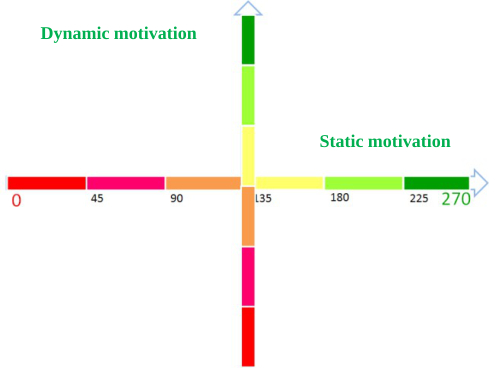
In the motivation map, the static and dynamic motivations are plotted along the horizontal and vertical axes, respectively. Each axis is color-coded with red, pink, orange, yellow, light green, and green sections representing different levels of motivation. Data collected in the assessment of static and dynamic motivation are plotted on this map, and the location of the data in the plot represents the level of motivation. After commencing the project, the https://openaccess.cms-conferences.org/#/publications/book/978-1-4951-2102-9
Edited by T. Ahram, W. Karwowski and T. Marek motivation of each member is plotted on the basis of collected data, and the map is inspected by the PM. As the project .progresses, the motivation of each member is plotted on the same motivation map each week, allowing the PM to determine the status of and trends in the motivation of each member.
EXPERIMENT Goal of Experiment
We assessed the motivation of each member of a project at an actual company to determine whether motivation can be assessed on the basis of the concepts of static and dynamic motivation postulated in this study. Furthermore, we examined whether the motivation map (a map plotting data about static and dynamic motivation) is effectively utilized by the PM in the course of the project.
Overview of Experiment We conducted an experiment that targeted the members of a project at an IT company whose name has been withheld. The project concerned the verification of a system requested by a client.
1) There were four members participating in this project. 2) All four participants were members of a partner company of the target IT company. 3) The project duration was one month, and the dynamic motivation was measured every day during that time. 4) The project members submitted weekly reports to the PM. 5) To determine the way PCs were used by the project members, the ManicTime time management software was installed on all PCs before the project commenced. 6) Arrangements were made for the project members to complete the communication sheets. 7) The project members were unaware that the purpose of this research was to evaluate their motivation. 8) The PM plotted the members’ motivations on the motivation map once a week. 9) The PM examined the motivation of each member, as shown in the motivation map, and provided feedback to the members the following week.
Edited by T. Ahram, W. Karwowski and T. Marek
Figure 4. Assessment results for static motivation
Figure available in the original PDF paper.
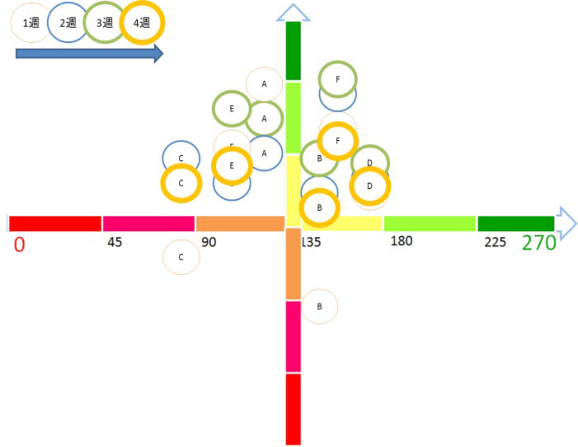
Experimental Results The experiment’s results (see Figure 4) show the changes in motivation for three workers during the four weeks. Although the total number of people working on the project was higher, there were a number of substitutions during the project period; only three workers were part of the project for the entire four weeks.
Figure 5. Assessment results presented as a motivation map.
DISCUSSION
In this study, the motivation with regard to a project was divided into static and dynamic parts, which were assessed by appropriate means.
In Figure 5, the static motivations of members A, B, and C did not change significantly between the assessments conducted immediately before the project commenced and after the project finished. The project period in the experiment was one month. Therefore, it can be considered that static motivation is unlikely to change within one month. In contrast, Figure 5 shows that dynamic motivation changed each week for each member. It is considered that dynamic motivation is affected by events occurring in a dynamically changing project, which in turn influences the work. Specific events in the project targeted in this experiment included sudden substitutions of project members and mistakes made by members. These results suggest that the categorization of project-related motivation as proposed in this study is useful.
Analysis of Measures
Edited by T. Ahram, W. Karwowski and T. Marek
Case 1: In this study, project-related motivation was divided into static and dynamic parts, which were assessed by appropriate methods. As a result, it was found that although static motivation does not change within short periods of time, dynamic motivation does. This demonstrates that the division of motivation into two parts is both possible and appropriate. Plotting the static and dynamic motivation in a motivation map provides assistance to PMs in assessing the characteristics of each type of motivation.
Case 2: In this experiment, static motivation was found to be unlikely to change within one month (see Figure 4). This shows that the static motivation can be assessed through a survey before the project commences. In contrast, dynamic motivation depends on dynamic changes characteristic of the project, and so it changes accordingly (see Figure 5). However, throughout this project, certain assessments could not be adequately conducted during the evaluation of member activities. This is because there are presently no adequate techniques to assessing these items. However, data pertaining to points such as communication and PC operation management displayed dynamic changes on a daily basis. For that reason, these data can be regarded as useful indicators for the assessment of dynamic motivation.
Case 3: In this study, the motivation of each member was displayed to the PM in the form of a motivation map, whose usefulness was evaluated in interviews during the project. By using a motivation map to visualize the past motivation level as understood by the PM, it was possible to determine the motivation state of each member for the preceding week. At the same time, the PM was able to reassess how they approached each member. The motivation map allowed the PM to know the motivation state of members at all times and to review their motivation history.
Phenomena Observed during the Experiment The trends in changes in dynamic motivation depended on static motivation score (see Figure 5). Members with a static motivation score of 0.5 or above (right side of the figure) displayed a gradual increase in dynamic motivation after the first week. However, in the fourth week, their motivation tended to decline, which was likely due to the sense of relative calm in the last week of the project. In contrast, for members with a static motivation score of 0.5 or lower, the dynamic motivation did not show any particular trend. In other words, it can be said that the dynamic motivation of members who do not have a baseline level of static motivation is unstable.
CONCLUSIONS
In this study, we addressed the problem that over the course of projects, PMs assess members’ motivation in an ill- defined manner. In this regard, we postulated that the motivation with regard to a project can be divided into two parts, and these parts have different characteristics. Thus, we assessed motivation as static and dynamic motivations and proposed assessment methods that rely on the characteristics of these aspects. As a result, we experimentally found that static motivation does not change within a short period of time, but dynamic motivation does, which supports the hypothesis proposed in this study.
In future work, we plan to conduct factor analysis on the surveys used to determine static motivation, as well as to develop a technique for determining dynamic motivation with even higher accuracy. We think the number of project member in experiment was not enough. We need much more number of project member in experiment. In the experiment mentioned before, we started the experiment with twelve members. But, during the project, 6 member were exchanged. So, we think that we should execute experiment more than twenty members. And, also we plan to https://openaccess.cms-conferences.org/#/publications/book/978-1-4951-2102-9
Edited by T. Ahram, W. Karwowski and T. Marek the method that PMs can maintain the level of motivation of members high during the project period to success the IT project
ACKNOWLEDGEMENTS
In the course of this study, we obtained information about IT project management from numerous companies and PMs through on-site observations and interview. And many IT managers gave us chance to discuss about motivation in IT project. Furthermore, a number of professional psychologists evaluated this study from a psychological perspective. We express our deepest gratitude to everyone for their assistance.
REFERENCES
Furukawa, H. (2011), “Sangyou / soshiki shinrigaku [Industrial and Organizational Psychology]”. Asakura Shoten, 6th Ed. [in Japanese]. Latham, G. (2009), “Waaku mochibeeshon [Work Motivation]”. NTT Publishing [in Japanese]. Likert.R (1967) “The human organization: Its management and value”, McGraw-Hill Locke,E.A.,& Latham,G.P.(1984), “Goal setting: A motivational technique that works! Englwood Cliff, N: Prentice
Hall Maslow,A.H. (1954). “Motivation and personality” New York : Harper Maslow,A.H.(1943).”A theory of human motivation”, Psychological Review McGregor,D.M.(1960) “The human side of the enterprise”, New York: McGraw-Hill Ohta, H. (2012), “Shounin to mochibeeshon –Jisshousareta sono kouka– [Acknowledgement and motivation: Their proven effectiveness]”. Dobunkan Shuppan, 1st Ed. [in Japanese]. Yaguchi, R., Yoshida, Y. (2008), “2008 dai 2 kai purojekuto jittai chousa 800 sha seikouritsu wa 31.1% [Second
Survey on Project Implementation at 800 Companies (2008 Edition): 31.1% Success Rate]”, in: Nikkei Computer, pp. 36–53 [in Japanese].
LISTED IN THE AHFE DIGITAL BOOKSTORE CATALOGUE
Explore the complete digital volume
Advances in Social and Organizational Factors
Read this individual research paper free through the original publisher, or explore the full digital proceedings book.
ISBN 978-1-4951-2102-9
Explore this ISBN in the AHFE Bookstore ↗Listed in the July 2026 bookstore catalogue; search by ISBN to confirm current availability · Digital book purchase optional