Andree Woodcock (2020). Heads in the Sand: The Failure to Engage With Our Ageing Society. In: Advances in Social and Organizational Factors. AHFE Open Access, vol. 9. https://doi.org/10.54941/ahfe100370
The increasing number of older people requires serious attention from policy makers and service providers if a crisis in care is to be avoided. This paper presents a biographical study of 9 months in the life of an elderly couple, looking at the problems experienced by them and their family when dealing with different stages of health and social care provision. The study covered periods of general health, hospitalization, reablement and separation. Studying the events arising in each period has provided insights into the requirements of the frail elderly and the adequacy of current provision.
An international crisis is looming as populations across the world are ageing. The changes in demographics will affect everyone. An increased number of older people means that services will change and that more people will be required to assist the elderly, many of whom will have a different range of illnesses and more complex expectations in terms of their quality of care than previous generations. Governments are responding to this through a variety of policy measures: e.g. in terms of changing employment and pension laws, and adaptations to health and social care provision to enable independent living. Designers and technology providers are developing assistive living products and new business models to tap into a potentially highly lucrative market. However the reality is that many older people do not or cannot access such products and services, and that service delivery of care in the home or in care- homes is rated as not fit for purpose.
The Select Committee on Public Service and Demographic Change (2013) opened with the following statement “The UK population is ageing rapidly, but we have concluded that the Government and our society are woefully underprepared. Longer lives can be a great benefit, but there has been a collective failure to address the implications and without urgent action this great boon could turn into a series of miserable crises. “(p7). Ipsos MORI showed that people are unprepared or unwilling to plan for old age because of “assumptions (based on little knowledge), a fear of the unknown, denial, and negative connotations of being a ‘pensioner’ mean that we put off our financial planning until we are forced to” . Additionally they do not contemplate or provide for future disability or mental illness, even to the extent of adapting houses to be suitable for older life. Many people assume that the State or their family will look after them.
A rapidly ageing society means older people living longer, often with one or more chronic long-term health conditions. For example, it is predicted that there will be 51% more people aged 65 and over, and 101% more people aged 85 in England in 2030 when compared to 2010. For people aged 65 and over in England and Wales, 2010 to 2030 will witness the following increases: people with diabetes up by over 45%; people with arthritis, coronary heart disease, stroke, each up by over 50%; people with dementia (moderate or severe cognitive impairment) up by over 80% to 1.96 million; people with moderate or severe need for social care up by 90%. Over 50% more people will have three or more long-term conditions in England by 2018 compared to 2008. Changes in societal structure mean that extended or even nearly located families may not exist, even if family members were willing to look after ageing relatives. Additional marriage break ups, and remarriages in later life may mean that older couples no longer have shared histories or the required levels of social investment in each other to stay together in times of crisis.
Although most people want to live independently in their own homes for as long as possible, when help is needed, reports such as that published by the Equality and Human Rights Commission (2011) express concern as to the quality of care provided citing lack of training, rapid staff turnover and the inability of staff to deal with people’s needs as causes of concern.
A basic requirement of living independently should be that it in itself does not become a chore, that services and products are accessible, comprehensible and ‘joined up’. Woodcock et al (2013) cited research which showed that the elderly who experienced difficulties in everyday life just ‘carried on’ without looking for other support, and that designers of assisted living aids and products did not understand the context of use for their products, did not support higher level needs or the needs of the whole person.
This research specifically addresses these points by providing insights into the life of an elderly couple of average education, who wished to continue to live independently in their own home, for as long as possible. They represent the oldest old of the population (i.e. over 85 years of old (currently just over 2% of the population)). The study demonstrates why and how the oldest old become the heaviest users of health and social care services and shows that one of the reasons may be inefficiencies and lack of transparency of health services.
In this age group just under 40% of men and less than 10% of women live together, either as a married or cohabiting couple (Dunhall, 2008). The predicted expansion of this population requires more research on issues such as the effects of living with chronic disease of on (usually the female) partner’s health, well-being and sense of identity (e.g. Hagedoorn et al, 2001), models of successful ageing (e.g. Baltes and Baltes, 1990) and the factors which influence it (e.g. acceptance of lower expectations about appearance, upkeep of the home, and the relationships with care workers, Aronson, 2002).
Aims The aims of this study were to:
1. provide insights into the life of the frail elderly, living independently in their own home,.
2. document problems experienced in terms of everyday activities, their coping strategies and negotiations with the health and social care providers.
3. understand the way in which relationships with family, carers and service providers evolves over time.
METHOD
A biographical, case study approach has been adopted. Although the first stage of the study was presented as a participant observation study (Woodcock, 2014), this approach of data collection and analysis has been abandoned and the biographical nature of the work acknowledged in this paper as the study has been conducted with close family members of the author. Yin (1984) defined a case study as an intensive study of a person or situation, which can provide in depth information about situations or problems that are impractical to study in other ways. The case study began opportunistically, and was, from the outset conducted informally as a series of naturalistic observations with the researcher as both observer and participant. The move to a biographical study was felt necessary firstly, owing to the increased difficulty in recording and reflecting events objectively; secondly, because of the need to acknowledge the positionality of the researcher more fully; and thirdly because of the way in which the case study evolved after the reablement phase (see below).
The biographical method has ‘proven to be an excellent way of making theoretical sense of social phenomena ….. Biography is conceived as a ‘social creation/construction’, which ‘constitutes both social reality and the subjects’ worlds of knowledge and experience, and which is constantly affirmed and transformed within the dialectical relationship between life history knowledge and experiences and patterns presented by society’ (Fischer-Rosenthal and Rosenthal 1997: 138).’ (Apitzsch and Siouti, 2007). It has been used in areas such as sociology, educational science, psychology, medical and health sciences, theology, social work, and gender studies.
Denzin noted that this field may encompass: life, self, experience, epiphany, case, autobiography, ethnography, auto-ethnography, biography, ethnography story, discourse, narrative, narrator, fiction, history, personal history, oral history, case history, case study, writing presence, difference, life history, life story, and personal experience story. (1989, p. 27). Within this classification the current research may be termed as a personal experience story. It starts with personal experiences and uses sociological and psychological theory as interpretational and explanatory tools.
It follows in the tradition of the Chicago School of Sociology (eg, Zorbaugh, 1929; Shaw, 1930; Cornwell and Sutherland, 1937), concerning the experiences of the frail elderly (and their relatives) who currently have little social power and who are somewhat marginalized from society. The approach adopted enables a depth and richness of information and insight that other methodologies cannot provide. It is hoped that enough information is provided to make the research interesting, meaningful and accessible. It could not have been undertaken in any other way. To have the necessary level of impact it is important that the narrative makes ‘imaginative contact’ with readers (Goodson and Sikes, 2001), as through this, change may be possible. ‘Shared humanity is a good basis for social enquiry’ (Sikes, 2006).
The motivations behind the following account and its articulation as a conference paper have to be acknowledged in accordance with the traditions of biographical research. The cathartic nature of writing has to be acknowledged, along with it a personal need to understand and explain what has been happening – i.e. the act of setting down events, looking for patterns and explanations is important. In so doing I want to hold up for inspection, what is mostly hidden, but what is increasingly commonplace, ordinary and not recorded. If such events are not captured, they cannot be used as vehicles of change. Indeed, as evidenced in the introduction, most of us are still in denial about growing old and the plight of the elderly. Whilst acknowledging my positionality (e.g. Guba and Lincoln, 1981; Chiseri-Strater, 1996; Roberts, 2002), it should be recognised that the value of the research may be limited by the amount of self disclosure made.
Motivations for using the case study approach are that it is hoped that others may learn vicariously from the case study through the narrative (Stake, 2005). This has affected the levels of disclosure. Events, medical conditions, and feelings are disclosed to a level where it is hoped that insights have been provided into the problems faced by the frail elderly and their families, which may be addressed by ergonomists specialising in the health care arena and which were not known by the researcher at the outset. Certain conclusions and events have had to be emphasized at the expense of others. The rationale for inclusion of certain items has been made because of the magnitude of its importance to the lives of Joshua and Ivy. However it is also recognised that proactive readers ‘will add and subtract, invent and shape--reconstructing the knowledge in ways that leave it...more likely to be personally useful’ Stake (2005, p. 455).
In terms of disclosure and ethical considerations, all information has been anonymised and items which have been judged to be highly personal and of little bearing to the aims of the paper have been omitted. A third person narrative has been adopted, and as far as possible an objective lens has been used in documenting events. Having recognised the limitations of the approach, it is believed that the results are both generalizable and important as they represent a situation that is believed to be typical, or without action, will be typical of couples who come together late in life and who wish to remain independent in their own homes, but who have a steady decline in health and mobility. From the introduction it is clear that Western societies are finding it hard to cope with an aging population.
BACKGROUND
The case study centres around a close family member of the researcher (Joshua) and his partner (Ivy), both of whom were in their mid-80s and are considered to be representative of the frail elderly; having chronic conditions associated with old age, such as heart disease, diabetes, poor vision, arthritis, limited mobility and dementia. Whilst the definition of frailty is contested, it is used to describe the condition of people vulnerable to adverse health outcomes in later life. Fried et al. (2001) identified criteria to determine a frailty phenotype (three or more of weight loss, muscle weakness, and slow gait speed, low levels of physical activity and self-reported exhaustion). While other researchers have also recognised cognitive decline (Abellan van Kan et al., 2010) and mental health and accumulated vulnerability (Bergman et al., 2007). The couple live approximately 25 miles from the researcher’s home. At the start of the case study, visits were made twice a month by the researcher, her partner and family for family outings.
The recency of Ivy and Joshua’s relationship needs to be highlighted. Joshua places a high value on female companionship, and had had 3 previous long term relationships. In his late 70s he placed a personal advert in the local newspaper for a new companion. As a couple, Joshua and Ivy had many shared memories of growing up in nearby streets. After about a year Ivy moved out of her house to take up residence with Joshua, and his dog, Fido. Anticipating a relatively healthy old age, Joshua had earlier sold his business and house and bought a small bungalow in a residential suburb, with a high number of older residents. He made building adaptations to cater for mobility issues (e.g. grab rails), bought a car rated highly in terms of its usability for older drivers, and continued to drive short distances (e.g. to the park to walk Fido) into his 80s, until his eyesight and mental faculties had deteriorated and he considered himself to be an unsafe and fearful driver.
The shortness of the ‘happy time’ in their relationship (about 5 years), when they were both in good health, also meant that they, and their families, did not have a shared past and a long term relationship to draw on, when their relationship deteriorated. However, during this period they became increasingly socially isolated and ‘were quite content with each other’s company, thank you very much’, and hostile to any suggestions for home improvement as they ‘had everything just as they wanted it’. Indeed, the couple chose not to mix with other elderly residents or join any clubs. Instead their main activities were going to the local shops, to health centes, walking the dog and gardening. Although Joshua had made very good provision for his old age, he had not expected such a decline in his mobility or cognitive faculties.
The case study covers an approximate 9 month period. It coincides with more authority for health and social care being transferred to the author and her partner and a transition away from independent living. In the first stages of the case study the author and her partner acted merely as intermediaries with health and social care, and were able to witness (as participant observers) negotiation with health care providers (Woodcock, 2014), and discuss health care issues quite openly with them.
The case study can be divided into four main phases summarised below.
1. At the start of the case study (June 2013) the couple were suffering from numerous health problems associated with old age, including diabetes, crumbling vertebrae, macular degeneration, heart disease, arthritis and mobility problems. Ivy had a small mobility scooter, although Joshua had a larger one – it was too unwieldy to use and he behaved as if he was a car driver with it. Ivy suffered from severe loss of vision 9being registered blind towards the end of the study) and Joshua from Alzheimer’s. Ivy could walk about 100 yards with a walking stick, Joshua had significantly less mobility, unless really motivated. Ivy had promised that she would never put Joshua into a home when she had agreed to move in. However, she had to assume the role as principle care giver as Joshua’s Alzheimer’s became worse. Joshua retained a firm control of the household and was deferred to at all times. Both were fiercely independent and rejected attempts to change their household routines, despite the mental, physical and emotional strain this placed on Ivy.
2. Hospitalisation. In August (2013) after a family holiday, Joshua was hospitalised for over a week and needed catheterisation. In order to accommodate his changed medical needs, refurbishments were made to the bungalow.
3. Reablement (August – November, 2013). Prior to Joshua’s hospitalisation the couple had worked co- operatively to maintain their independence and had adapted successfully to old age. However, during this time, Joshua’s catheterization and the continued deterioration of his mental faculties negatively affected their relationship, Ivy’s self identity (as caregiver) and their ability to live independently. Social and personal care packages were initiated, with varying levels of success.
4. Separation (November, 2013 onwards). With Ivy’s deteriorating health and eyesight and Joshua’s mental deterioration, she admitted that she could no longer cope, and was asked that he be quickly removed from the bungalow to live with his relatives, be found respite /residential care or another form of assisted living. Having made this decision she never made contact with Joshua again. Although accepted for a week’s trial in a potential care home, Joshua was unexpectedly expelled for unreasonable behaviour. His insistence on living in his bungalow with his dog necessitated Ivy’s immediate departure from the bungalow into sheltered accommodation. Case workers agreed that all possible efforts should be made to enable him to remain in his own home, even if that meant 4 care workers visiting a day. This was rejected as an unworkable and potentially life threatening arrangement and 24 hour living care was finally arranged after two weeks.
The following section details some of the problems which occurred in relation to health and social care in these periods.
RESULTS
Observations made at each stage showed systems that were overcomplicated and over bureaucratic, under resourced, and not fit for purpose. Meeting complex health care needs required negotiation with multiple service providers, all requiring different information, having different locations, appointment times and staffing. Taking over the management of the process for Joshua and Ivy, we found understanding and remembering the processes and information, and negotiating with health care providers very difficult. For those with failing memory, eyesight, cognitive faculties and mobility this is a real issue with simplicity, patient focused, joined up services an absolute priority.
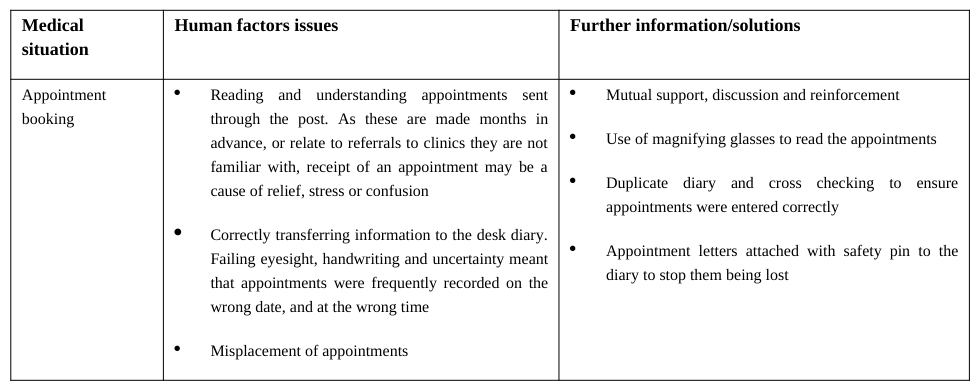
Using medical services and products in old age As people become older, managing health becomes a task in itself, which can control where and how people live. Successful ageing becomes a balance between coping with periods of illness, regaining health and learning to adapt to increasing frailty. Joshua and Ivy had developed successful coping strategies, compensating for lack of eyesight and mobility and doing household chores co-operatively. However, maintaining physiological and psychological well being and reassurance requires consistent liaison with multiple health care providers (e.g. opticians, chiropodists, dentists, local surgery and hospital departments). At this time Joshua and Ivy had at least one health related appointments every week, each of these required close management, and presented its own problems.
The table below shows typical issues.
Table 1: Issues with medications
Noncompliance was a major issue with Joshua. Ivy had previously been hospitalised with a life threatening illness and the importance of compliance had been emphasized. However, her medication changed on a daily basis, requiring her to read instructions with a magnifying glass and locate very small tablets. Failure of the local surgery to recognise a medical condition had resulted in near death, so neither fully trusted the health service. The drug regimes of Joshua in particular may have produced side effects, but Ivy was unable to speak coherently about this. Medications related to the control of Alzheimer’s were steadily resisted (either thrown away or omitted) either due to side effects (e.g. dizziness, nausea, drowsiness and hallucinations), misunderstandings about their long term benefits and required build up or the stigma attached to Alzheimer’s.
Although these issues occurred regularly. Joshua and Ivy were still able to living independently, but started to need more support. However, Joshua’s deteriorating health and cognitive abilities mean that the couple could no longer go out together (as Joshua would wander off) , he was increasingly incapable of holding a conversation (repeating he same question time and time again), staying awake, or being left on his own – as he would panic about Ivy’s whereabouts or would wreak havoc in the house. As he felt the house was being broken into locks were changed and the police called out many times. The constant worry over Joshua and her inability to perform satisfactorily as a care provider had a negative effect on Ivy’s well being and cheerfulness (Hagedoom et al’s 2001). A care agency was brought in to provide assistance and companionship but the couple could not make full use of this by letting go of household chores.
Hospitalisation Although frail, both Joshua and Ivy looked forward to holidays. Observations and conversations on the last holiday (August 2014) revealed that Ivy was no longer happy with the relationship and was increasingly unable and unwilling to cope with the demands placed on her. Joshua was unable to engage in meaningful conversations, and his nightwakefulness (and that of his dog) caused major disruptions to sleep patterns.
On the holiday, Joshua developed a urine infection. With no local medical services, poor internet connectivity, a non responsive local surgery with irregular opening hours, an emergency surgery was located in a village 10 miles away. Treatment was ineffective and resulted in a call out 12 hours later to an emergency paramedic, who gave enough assurances for a 6 hour drive home to be undertaken. 3 days later, and with no great improvement in his health, Joshua was taken to his local surgery and again sent home to have his bladder emptied by the district nurse. Convinced of inaccurate readings on their monitor and the complications caused by diabetes, the district nurses refused to treat Joshua, thereby necessitating admittance to a urology department. During this time the researcher and her partner took over from Ivy as the main decision makers.
CQS (2013) noted the need for hospitals to recognise the needs of patients with dementia, to record it, and to have training that “would help staff to identify the person with dementia and reduce length of stay by helping staff to respond effectively to dementia, for example by ensuring their nutritional needs are met.” The Alzheimer’s Society recognise the impact of dementia on patient’s outcomes; with longer stays, a worsening of dementia and physical health, a greater likelihood of being discharged in to a care home and a greater likelihood of antipsychotic medication being used.
Although treated quickly, compassionately and successfully, Joshua was kept in hospital for 10 days for observations, tests and to allow a care package to be arranged as part of reablement. Fortunately, no further medical complications arose, but the Alzheimer’s proved difficult to manage, with Joshua having no memory of why he was there, how he had become ill, what the catheter was, what a hospital was, where he lived or when he would be released. As soon as one question was answered )‘but what is wrong with me, ‘when can I go home,’ ‘can someone tell me what has happended to me’) it was repeated again. Not having any clear answers to his questions about diagnosis or length of hospitalisation did not help. Problems included:
Insufficient monitoring of food and fluid intake leading to the need for rehydration (via a drip, which he did not understand) and a weight loss of half a stone.
Lack of entertainment in the ward meant that Joshua spent all day in bed, staring at a wall, unable to walk, read or engage in conversation with other patients. This resulted in stress and anxiety.
Joshua’s lack of memory meant that he did not remember seeing consultants or what was explained to him by the nurses. As nursing staff were rotated, it was difficult to find out what was happening. Information was Social and Organizational Factors (2020) written on pieces of paper and sellotaped to the wall (e.g. how many more days he had to stay in the hospital, what was wrong with him, what the catheter was and how it worked).
Incorrect treatment, resulting in one incident when he was taken to theatre for an examination but given the wrong premeds and ‘left to die in a cold basement’.
The occupational therapist noticed he was soiling himself on a regular basis, and brought this to the attention of ward staff.
Visiting times were relaxed. Conversation revolved around showing holiday pictures, and continual reassurance of the same points. A sheet of Do’s and Don’t’s in relation to the catheter were provided, with pictures. If these were not adhered to, the chances of Joshua being able to transfer back home were reduced.
Reablement and adaptation for special needs The reablement team encourage independence after hospitalisation. They provided twice daily support and monitored long term needs for 6 weeks, after which other service providers had to be found. They provided social but not health care (e.g. they can remind the patients to take medicine but not give it to them). Patients with Alzheimer’s and catheters fall between social and health care, so it was up to the local attendants to decide how much support they provided. The team was large, variably trained, with no regular attendants and unreliable. With their help Ivy was persuaded that she might be able to continue living with Joshua.
The occupational therapist admitted that catheterization was normally the tipping point for people with Alzheimer’s, and would ultimately require residential care. To postpone this and manage increasingly difficult hygiene issues, the bathroom was converted into a disabled friendly wet room with a bidet toilet; a second bedroom was created so Ivy could have uninterrupted sleep, and the house was decluttered to provide ease of access, cleaning and space for the social care assistants. Problems experienced during this period included:
Poor installation of bathroom by the specialis supplier, including wrong shower head, and a radiator positioned too close to the toilet where it would burn legs if switched on
Extensive decluttering which was finally accepted by Ivy to help her gain a sense of control and to aid cleaning. However, Joshua lost his context (‘why would anyone live here,’do I live here’, ‘have you one this – well you’ve done a good job’). Books and personal artefacts were reintroduced.
A new television and CD player required careful positioning and firm attachment to walls as they would be taken apart. Ivy managed to understand their operation. Joshua did not
The new sleeping arrangements were rejected as an unwanted intrusion on personal life (’I don’t tell you to stop sleeping with your wife…)
Visiting everyday, it became clear that the couple were being targeted by nuisance callers (despite being on a register) who gradually amassing details about the couple.
Night time hunger and wandering became a safety risk. Kettles were left in bowls of water, metallic objects used in the microwave, cupboards emptied, food scattered over the floor, and clothes draped across fires. Ivy was constantly on edge throughout the night
Lack of joined up health and care packages meant that Joshua and Ivy were treated as individuals, not a couple. Different agencies asked the same information, failed to pass on information or include family members in information gathering, even though this was explicitly requested and written in instructions. For example setting up a procedure to get Joshua taken into emergency care if Ivy was omitted in to hospital in an emergency required at least two home visits and the completion of a 30 page booklet. Both lost their patience with the non- ending round of questions which different agencies were subjecting them to, and from which they were deriving little benefit.
Although Joshua accepted and understood the catheter and had been convinced that pulling it would do him irreparable harm, it caused many problems. It was left open, emptied at inappropriate times and locations, punctured and not positioned correctly on his leg. District nurses were repeatedly called out to deal with blockages and misuse. Ivy attempted to take control but did not understand/could not see all the component parts, but had to be constantly alert to Joshua emptying the bag in appropriate times or simply fiddling with it. Many homemade solutions were tried. The problem was confounded by the delivery of incompatible bags and the night time bag and bags which had different systems - the operation of which was never clearly explained to the couple. Night bags require careful management, preferably by someone who does not sleep with a dog and a partner, who lies still and who does not wander about all night. This meant that even with care workers twice a day to ensure that the bag was empty and set up properly, the catheter was misused resulting in wet bedding three or four times a week. Ivy had to remain vigilant throughout the night, check on its status, monitor Joshua’s movements throughout the night. Hygiene and cleanliness became major concerns.
Separation Obviously the situation with respect to Joshua was deteriorating. As well as memory problems he became verbally abusive when Ivy tried to take control or direct him. Going to day care centres twice a week did little alleviate the strain, and he could not remember going to them once he had come back. The case workers advised that the couple should consider their own needs as individuals.
Rather abruptly, Ivy decided that she could no longer carry on and requested that Joshua be immediately removed from the bungalow, which she would continue to inhabit for the short term and look after his dog. Although this had been predicted, it was still a shock and caused substantial upheaval. Being his only relative, Joshua moved in to my home, with my partner becoming full time carer. Joshua was confused, irritable and abusive, not knowing where he was, or what had happened, but knowing that he should be in his bungalow, with his dog. After a week, respite care was arranged in a nearby residential home to see if this would be a suitable solution. In order to help him settle, his dog was brought over. This was a very big alteration in his life, and the residential home was initially optimistic. However, after 4 days they requested that he leave immediately as he was too disruptive– going into rooms, moving papers etc and becoming agitated and aggressive when he did not understand his situation Keeping Joshua with us while we debated his future, it was clear that no amount of alteration would enable him to accept a move, and the quality of life for the rest of the family would deteriorate as he required constant day time attention and companionship and management during the night. Telecare and telehealth solutions were not considered as particularly helpful, as they would not stop Joshua rummaging through things, emptying food stuffs on the floor, or moving things, trying to dismantle things. Changing bed time routines did not help and sleeping pills were not recommended. Joshua remained adamant that he wanted to return to the bungalow and would be able to look after himself (‘I’ve been looking after myself for years’, ‘who do you think has been doing the cooking’). Any attempts at suggesting that this was not the case were met with incredulity. At this stage he changed from being abusive about Ivy for deserting him, to simply not mentioning her.
As he had been judged not yet frail enough/unsuitable for residential homes. Ivy had to leave the bungalow and he returned to live there with his dog and 24 hour care provided by the family for two weeks. The suggestion of care workers attending 4 times a day was rejected as unworkable, because even if he did let them into the house and accept them, they would not be able to guarantee his safety between visits. Following more refurbishment of the bungalow, a care agency was found that provided live in care, and the case worker was convinced that Joshua’s needs and wishes were being followed.
At the time of authorship, this arrangement has been going on for 5 weeks. We act as managers and co-ordinators, having found and briefed agencies and their staff. Carers live in for up to 2 weeks, they are paid directly with a premium going to the agency, given a float for the week to buy food, are met at the station and their travel costs covered. Joshua has been more tolerant of this relationship than expected. However, his confusion means that he does not know, recognise or remember that there are carers in his house, who try to direct his actions and look after him. This has resulted in the verbal and physical abuse of one female carer, who left after a week, and resulted in him being taken off their system. The second agency operates in a similar manner, requiring careful matching and initiating of carers. After another female carer claimed sexual harassment and feeling frightened, only male carers are now deemed suitable. As the 24 hour carers are finding it difficult to cope with a lack of sleep during the night, additional nigh time carers have also been arranged for two nights a week.
Joshua ‘likes’ being in his bungalow, in familiar surroundings, with his dog. It is not clear if he understands his relationship to the author and her partner. He knows that something is missing in his life, and that this is his memories. This makes him depressed. Although occasionally able to enter into a conversation, he asks the same questions repeatedly, perhaps out of politeness (such as ‘do you have much work on’, ‘is my car alright’, ‘are the kids alright’) without registering the answer. He likes listening to music, going to the day centres and his garden. He does not know that anyone is living with him if they go out the room, and still takes umbrage at the suggestion that Social and Organizational Factors (2020) he cannot look after himself. However he is lonely, disconnected and craves the companionship of a female, which he has had all his life. The extent to which the current arrangements are sustainable is not known. They require constant management from us on a daily basis even with a carer, the co—operation of Joseph and his continued good health.
DISCUSSION
The case study raises a number of issues which may be termed as wicked problems. With the trend to smaller families, break up of family units and mobility patterns it becomes very hard to develop and maintain relationships with elderly relatives Joshua is acutely aware of loss and does not understand what has happened to him – what he has lost or why. Providing photographs helps to bring back some memories, but in talking to him it seems that these memories only surface when he is looking at the pictures and even then he is unsure of what he is seeing or his relationship to it, without prompts. He is most affected by the loss of his ability to drive, his physical mobility and his memory (‘I can only think I have had some kind of mental breakdown’). His self identity is bound up with being a home and dog owner. This is evidenced in his repetition of his address, his army number, and his obsession over the whereabouts of his dog.
He has been able to deal, for the most part with the loss of autonomy and can be cheerful. He does not ask for help, but he has accepted strangers into his home who have to provide intimate care. Being at home brings anchorage and feelings of control (Nicholson et al, 2012) into his life and has enabled him to sustain connections with the past – through looking at ornaments and pictures As the situation evolves, new problems and challenges are set. Of these the most problematic are nightwakefulness (and dismantling/trashing of rooms), and recognizing how to deal with and reduce conflicts when Joshua feels that a stranger is trying to control him.
Given the desire to keep people in their own homes as long as possible, the caring profession, especially for older people is going to expand. Yet little is known about the qualities which such people should have, or the training they need. Indeed, the main experience for some of our carers has been that they have cared for a dying relative. Dewar and Nolan (2012) identified the need to develop compassionate care in hospital setting. In the private home care sector there is a similar need, i.e. to be aware of another’s feelings, appreciate how they are affected by their experiences and to interact with them in a meaningful way. Although carers should not be expected to be on –call 24 hours a day there is a need for them to engage with the person they are caring for and to learn very quickly how to show compassion and to interact with them in a meaningful way- perhaps through photographs and music/television. This will help to reduce the sense of loss, isolation and loneliness that is felt and increase feelings of companionship. Each carer put into the home with Joshua is alone with him for two weeks. They usually have a mobile phone, some drive. Although we brief them for half a day, this is not standard practice. Each carer leaves a log book which identifies habits and routines. None have mentioned their sense of isolation or the strangeness of being in a different home every two weeks. As companions, the changes may have benefitted Joshua – who used to spend all day dozing in front of Sky news or worrying - as he experiences people with different interests, skills and conversations. Although exhausted by their stay the carers are keen to return and applaud Joshua’s day time behaviour.
In conclusion, the ongoing case study is identifying specific areas which should be addressed in keeping the frail elderly living independently in the community; such as the better design and delivery of medicines; redesign of catheters; more joined up services in which the barriers between social and health care are removed. By studying the shift from independence and autonomy in the home, a new transition has been recognized, in which control is handed over, as well as the need for the type of skills needed by carers working as 24 hour live in companions.
Joshua used to say ‘as I am now, so shall you become’ when referring to his physical deterioration. The speed of medical advances means that the current generation will suffer from similar issues to the ones related here. The question is, do we have sufficient understanding of what it means to grow old and are we prepared to make the high levels of investment and sweeping reforms needed to improve health products and services. Although much could be learnt from the respectful treatment and care of the elderly in non Western societies, family break up means that many will have to be resourceful and independent in later life. This may necessitate training of young older people to understand, accept and plan for life changes – for extended periods of old age- to ensure successful aging and coping strategies, and to improve health literacy.
Lastly, greater consideration needs to be given to the role played by informal circles of care; family, friends and partners. Not all people want to, or can draw on these resources. With a substantial increase in the number of elderly, new local, sustainable and transferable community based and led initiatives need to developed, where older citizens and their carers can support each other, and find advocates.
REFERENCES
Abellan van Kan, G., Rolland, Y., Houles, M., Gillette-Guyonnet, S., Soto, M., Vellas, B.( 2010), The assessment of frailty in older adults. Clinics in Geriatric Medicine 26 (2), 275–286. Apitzsch, U. and Siouti, I. (2007), Biographical Analysis as an Interdisciplinary Research Perspective in the Field of Migration
Studies, Johann Wolfgang Goethe Universität Frankfurt am Main . http://www.york.ac.uk/res/researchintegration/Integrative_Research_Methods/Apitzsch%20Biographical%20Analysis %20April%202007.pdf Aronson, J. (2002), Elderly people’s accounts of home care rationing: Missing voices in long-term care policy debates.Ageing and Society, 22, 399-418 Baltes, P.B. and Baltes, M.M.(eds) (1990), Successful Ageing: Perspectives from the Behavioural Sciences, Cambridge,
England:CUP Bergman, H., Ferrucci, L., Guralnik, J., Hogan, D.B., Hummel, S., Karunananthan,S., Wolfson, C. (2007), Frailty: an emerging research and clinical paradigmo´ issues and controversies. The Journals of Gerontology Series A: Biological Sciences and Medical Sciences 62 (7), 731. Care Quality Commission (2013), Care Update, Issue 2, Retrieved 21st September, 2013 from http://www.cqc.org.uk/sites/default/files/media/documents/cqc_care_update_issue_2.pdf Chiseri-Strater, E. (1996), Turning in Upon Ourselves: Positionality, Subjectivity and Reflexivity.Ethics and Representation in
Qualitative Research Studies. Ed. Peter Mortensen and Gesa Kirsch.Urbana: National Council of Teachers of English, 1996. Cornwell, C & Sutherland, E. (1937), The Professional Thief, Chicago, University of Chicago Press Dewar, B. and Nolan, M. (2012), Caring about caring: Developing a model to implement compassionate relationship centred care in an older people care setting. International Journal of Nursing Studies, 50 (2013) 1247–1258 Denzin, N. (1989), Interpretive Biography London, Sage Dunhall, K. (2009), Ageing and mortality in the UK - National Statistician’s Annual Article on the Population in ONS (ed),
Population Trends ,No 134, Palgrave MacMillan, UK, p6-23. Equality and Human Rights Commission (2011), Close to home, Retrieved 21st September, 2013 from http:// www.equalityhumanrights.com Fried, L.P., Tangen, C.M., Walston, J., Newman, A.B., Hirsch, C., Gottdiener, J., Seeman, T., Tracy, R., Kop, W.J., Burke, G.
(2001), Frailty in older adults. The Journals of Gerontology Series A: Biological Sciences and Medical Sciences, 56 (3), M146. Goodson, I. and Sikes, P. (2001), Life History Research in Educational Settings: Learning From Lives, Buckingham. Open University Press Guba, E., and Lincoln, Y. (1981). Effective Evaluation. San Francisco: Jossey-Bass Hagedoorn,M., Sanderman, R., Ranchora, A.V., Brilman, E. I., Kempen,G. and Ormel, J. (2001), Chronic disease in elderly
couples: Are women more responsive to their spouses’ health condition than men? Journal of Psychosomatic Research, 51, 693-696. Nicholson, C., Meyer, J., Flatley, M. and Holman, C. (2011), The experience of living at home with frailty in old age: A psychosocial qualitative study, International Journal of Nursing Studies 50 (2013) 1172–1179 Nicholson, C., Meyer, J., Flatley, M., Holman, C. and Lowton, K. (2012), Living on the margin: Understanding the experience
of living and dying with frailty in old age, Social Science and Medicine 75 (2012) Roberts, B. (2002), Biographical Research, OUP.Buckingham Select Committee on Public Service and Demographic Change (2013), Ready for Ageing, Authority of the House of Lords London: The Stationery Office Ltd. Shaw, C. (1930), The Jack-Roller Chicago, University of Chicago Press Sikes, P. (2006), Autobiographies and life histories, http://www.edu.plymouth.ac.uk/resined/narrative/autobiographiesfinal.htm Stake, R.E. (2005). Quantitative case studies. In N.K. Denzin & Y.S. Lincoln (Eds.) The Sage Handbook of Qualitative Research
Conference, April, Cambridge, UK Yin, R.K. (1984), Case Study Research: Design and Methods, Newbury Park, CA: Sage Zorbaugh, H. (1929), The Gold Coast and The Slum: A Sociological Study of Chicago’s North Side Chicago, University of Chicago Press Thousand Oaks, CA: Sage.
LISTED IN THE AHFE DIGITAL BOOKSTORE CATALOGUE
Explore the complete digital volume
Advances in Social and Organizational Factors
Read this individual research paper free through the original publisher, or explore the full digital proceedings book.
ISBN 978-1-4951-2102-9
Explore this ISBN in the AHFE Bookstore ↗Listed in the July 2026 bookstore catalogue; search by ISBN to confirm current availability · Digital book purchase optional