Andree Woodcock, Jane Osmond, Gabriela Rodica Hrin, Olympia Papadopoulou, Oded Cats, Yusak Susilo, Tiago Pimentel, Owen O’Reilly (2021). Deconstructing the Whole Journey Traveler Experience. In: Advances in Human Aspects of Transportation: Part II. AHFE Open Access, vol. 16. https://doi.org/10.54941/ahfe100681
Understanding travelers’ experiences across the whole journey lifecycle is becoming increasingly important for defining and optimizing mobility for all travelers (active travelers and those using public and/or private modes of transport), for transport operators, transport authorities, municipalities and the designers of transport technology. Integrated transport solutions will see greater amalgamation of journey planners, route navigation systems and advanced parking and payment applications, through to vehicle prioritization. The FP7 project, METPEX aims to create a suite of measurement instruments which will capture in real time or retrospectively the whole journey experience, from planning to arrival at destination, across different transport modes. The paper will firstly outline the human factors of each stage of the traveler’s journey. Secondly, it will review the approaches currently used by transport operators to measuring the quality of the passenger experience. Thirdly, the aims and objectives of the METPEX project will be discussed together with work undertaken in the first year of the project, in relation to the development and validation of an extensive set of variables.
The Lisbon Strategy set a goal for the European Union to become the most competitive and dynamic knowledge- based economy in the world, capable of sustainable economic growth with more and better jobs and greater social cohesion. Public transport has a central role to play in ensuring equitable access to social, economic, educational and health services. Its effective use is also seen as key to reducing urban congestion and greenhouse emissions. However, public transport is regarded by many as an inferior form of transport, a perception which prevents it from realizing its full contribution to reducing road accidents, congestion, energy consumption and pollution. A greater understanding of mobility behavior and the expectations of users is required to enhance service provision, design and performance and to ensure the relevance of local, national and regional policies and strategies.
Although much research has been conducted on the integration of transport modes and travel information on the one hand, and travel behaviour and demand analysis on the other, these two streams of knowledge have not had adequate interaction hitherto. Furthermore, key stakeholders such as transport authorities, urban and regional local government and transport operators need to have access to standardised methods and results in ways that can inform policy and analysis, enabling the implementation of integrated transport systems and increased accessibility. Therefore there is a gap in the market to create a validated PanEuropean to measure and benchmark passenger experience which can be used by transport groups, operators and authorities.
OVERVIEW OF METPEX METPEX (ww.metpex.eu) is a three year, FP7 funded project. Its focus is on the measurement of the quality of the passenger journey (door-to-door), including private or individual forms of transport such as walking, cycling and car sharing. METPEX will develop, validate and evaluate a standardised tool to systematically measure passenger experience across whole journeys, to develop best practice and benchmark services. Therefore deconstructing the journey into its different element is necessary in order to develop a systematic approach to consideration of human factors. The information derived from the use of the METPEX measurement instruments will ultimately be used to inform policy makers in providing inclusive, passenger-oriented integrated transport systems that are accessible by all citizens. Specific objectives include:
1. Developing an integrated approach to the measurement of the whole journey passenger experience that takes into account human (physiological, perceptual, cognitive, sensory and affective) socio-economic, cultural, geographic and environmental factors. 2. Assessing the costs of ‘inaccessible transport’ for different sectors of society (such as those from low income groups, rural communities, the elderly, disabled and those with lower levels of literacy). 3. Assessing the extent to which the measurement of the passenger experience can be used to drive innovation and attention to transport quality from the customer’s perspective in the transport industry. 4. Evaluating the passengers experience from different regions of Europe and to support the integration of regional transport networks into an European transport network 5. Facilitating the harmonization of travel behaviour research and analysis across European Union Member States.
DECONSTRUCTING THE JOURNEY (PART 1) Woodcock (2012) stressed the need to take a systematic of the whole journey experience, in which each element should be optimized for each user, and that each part of the journey, including movement between transport modes and to and from transport gateways contributed in part to the overall experience. As such, the selection of transport mode is dependent on the sum of previous experiences, and each element of the journey may contribute negatively or positively to transport decision making. From this perspective the journey may be broken down into a number of elements (an example of these is shown in Table 1), each of which may have specific factors which need to be considered from the perspective of different user groups. This section focuses on some of these issues.
Table1: Example of a journey deconstruction Journey stage Description
Table available in the original PDF paper.
1. Assessment of need for the journey
2. Journey planning Including assessment of mode and time of travel, on line ticket purchase, finding
routes to the destination, collating information
3. Preparation for the journey Including gathering primary journey artifacts (e.g. tickets, bus passes, passports,) and secondary journey related artifacts (e.g. entertainment, mobility aids, carriers and food)
4. Movement from the origin to the transport gateway
Negotiating the route from the door to the first vehicle. Little attention is paid to this stage of the journey by transport operators, but it is of key importance to municipalities in planning transport provision
5. Interaction with transport service Including payment, ingress, travelling and egress from transport vehicle
6. Travelling on the vehicle Including vehicle design, service operation, quality of service, accessibility. Providing a high quality, friendly service is key to winning back support for public transport.
7. Negotiating transport interchange (with iterative loops from 2 to 6).
This may require change of transport mode, finding the location of transport stops, travel information for the onward journey, purchase of new tickets. Of especial importance are the needs of vulnerable and disabled travelers
8. Egress from the service to the destination
Although travel from the home to public transport may be considered, this stage is not so prioritised (Woodcock et al, 2014 and below)
Of the eight stages, the first two are the most crucial in terms of achieving EU transport targets as they relate to whether and how journeys should be undertaken. Integrating transport with smart city developments could significantly reduce the amount of journeys made, for example by supporting location independent working, e- commerce and penalties and rewards for certain types of behavior (such as higher parking charges in city centres, dedicated lanes for lift sharing). The impact of the destination has been studied in terms of tourism and vacation travel (e.g. Murphy et al, 2000), but it has only started to be addressed in terms of everyday travel. It may be argued that the attractors of a destination (Rajesh, 2013) in addition to the costs (e.g. physical, cognitive, temporal, financial and affective) need to be understood more fully. A starting point might be the attributes already developed in relation to tourist destinations. For example, Chi et al (2008) developed 8 categories – travel environment, natural attractions entertainment and events, historic attractions, infrastructure, accessibility relaxation, outdoor activities and value – some of which may be key elements in deciding whether to make a journey in to a city centre. The destination has to meet requirements, fulfill stated and unstated needs, especially if high costs are being incurred in the travel (e.g. in terms of journey preparation, see below) The quality of travel information can contribute substantially to the overall satisfaction with public transport (e.g. Balcombe et al., 2004; Stradling et al., 2000) whether it is static, dynamic or real-time, provide in advance, wayside or station or en route (FTA,2003; Hine and Scott, 2000). Factors influencing the usability of the information include the content, design, condition and timeliness of the information. Recognition of the whole journey experience highlights the need to provide multimodal information, to enable planning, and ease of transfer between modes in the provision of integrated multimodal information services (Lyons and Harman, 2002) which ‘‘minimise the effort for the user in acquiring information on mode choice options and is able to expose the user to information on such options’’ (Kenyon and Lyons, 2003). Groetenhuis (2005) mapped out the effectiveness of different forms of information, provided at different stages of the journey in terms of physical, cognitive and affective savings.
The deconstruction of the journey (shown in Table 1) includes a stage related to ‘preparation for the journey’. This has been included based on observations and personal experience of ‘the difficulty of getting out of the house’. Logically, if planning phases are included in discussions about the journey, then this stage should also receive some consideration as well. For many, once the decision has been made to make a journey, the route and mode of transport decided upon, it is quite easy to depart. For others, such as the elderly and those who have responsibility for others, this may not be so simple. Travel related artifacts needed to be found, transferred to appropriate clothing and bags etc. Primary artifacts may include keys, tickets, travel passes/permits/identity cards: secondary items could Human Aspects of Transportation II (2021) include mobility aids (such as walking sticks, buggies), appropriate clothing for the journey, maps; and tertiary items (non essential, but useful in making the journey more enjoyable), could include entertainment (devices), food etc. Obviously each element may have design/ergonomics issues associated with it. However, what may be important is the extra stress and time this places on potential travelers. It may be hypothesized that the less important the journey/the less strong the attractors of the journey, and the more complex the pretrip arrangements , the less likelihood there will be of undertaking a journey. For the elderly/ people with young children, this may lead to greater isolation.
The design of the interchange is crucial to actual and perceived seamless travel (Hickman et al, 2012). Its design effects the time spent waiting, the ease of transfer between vehicles and the attendant risks and inconvenience that are involved with this activity. Interchanges have been shown to foster uncertainty in the mind of the traveler (Chartered Institute of Transport, 1998; Colin Buchanan and Partners, 1998). Requirements relate to personal security, travel information, ticketing arrangements, predictability of service, low waiting times, and a reduction in organizational and institutional barriers (e.g. Faber, 1996; GMPTE, 1997).
Hine and Scott (2000) identified a number of factors associated with bad interchange design which included poor quality waiting environments, Payment for toilet facilities and inadequate toilet facilities, poor provision of timetable information (outdated, difficult to find),unreliable telephone information services, low levels of personal security, poorly lit facilities in the evening, confusing ticketing and pricing systems, carrying luggage long distance, no public telephones, poor signage within the interchange and for the bus or train services, lack of staff to ask for help, large distances between different interchanges, difficulty getting to the first vehicle and then finding the next service during the interchange activity, long boring waits for commuters. They found that interchanges represent a source of anxiety, uncertainty and powerlessness. This could be reduced if up to date information was given at key decision points, and with greater interoperability between service providers.
Walking forms a significant part of most journeys, yet it is only recently been given attention, through the links made between public health and active transport. However, walking routes are often impeded through poor maintenance such as cracked paving stones, puddles caused by blocked drains and broken lights. The London Councils recognized institutional barriers to promotion of walking (such as low priorities in terms of funding), lack of integrated funds for walking, safety concerns, misperceptions of walking speeds and distances, poor urban environments and habits. In terms of the whole journey experience, poorly maintained urban environments, or urban environments which prioritize motorized forms of transport lead to disadvantages for walkers including those using public transport. Mackett et al (n/d) listed examples of barriers to walking for those who are socially excluded as including changes of level, concerns about finding the way, difficulty in crossing roads, difficulties in moving along the pavements, difficulty in walking long distances and fear.
The objectives of METPEX are to measure the quality of the whole journey experience. The above review has been used to situate METPEX in terms of the wider factors involved in travelling. The measurement tools will enable us to capture (sometimes real time) information about most of the stages shown in Table 1, the interactions between passengers and the services, and to understand the relative importance of different factors (e.g. perceive quality of service). The toolset will not however gather information about Stages 1 and 3 as outlined in Table 1.The next sections of the paper will provide an overview of activities conducted in the first year of the project in support of the generation of the measurement instruments
UNDERSTANDING STAKEHOLDER REQUIREMENTS Although guidelines and standards aimed to accommodate the different needs of different travelers have been established, there is still a lack of knowledge on what is really valued by different groups of travelers who use different travel modes, and the requirements of those who do not use public transport. Moreover, previous studies often ignore the impact of the access and egress legs on the overall travelers’ journey satisfaction. Taking a holistic approach to the study of the passenger experience and journey satisfaction, not only from a users’ perspective but also that of stakeholders’, will provide an important bridge between action and intention to use more sustainable travel mode (Friman et al., 2011).
Prior to developing the METPEX tools (e.g. mobile app, on-line questionnaire, focus group and interview schedules), it was important to build on knowledge already gained in previous projects (such as those conducted under the CIVITAS programme) and to understand what information is currently recorded by transport planners, authorities and operators and where the gaps are. From these studies a comprehensive set of variables could be developed from which tools could be derived. To support this, a series of semi structured interviews were held with stakeholders across Europe to ascertain what journey information was currently being collected and the value placed on this. The following results provide an overview of this study, with especial reference to the situation in the UK.
The stakeholder interview survey was launched in April 2013 for 6 months across ten cities - Bucharest, Dublin, Grevena, Rome, Stockholm, Turin, Valencia, Coventry, Vilnius and Zurich - and one European body - the European Disability Forum (see http://www.edf-feph.org/). Stakeholders include local transport authorities, transport operators, government bodies, municipalities, passenger interest groups, those responsible for different aspects of the network and major regional employers.
A standardised interview schedule was drawn up to enable control of data gathering across the different countries. Questions related to the extent to which the stakeholder was informed about the perceived quality of service (such as vehicle and station comfort, network comprehension); the importance of such information; their knowledge about the passenger journey (e.g. origin, final destination, travel and waiting times); the importance they placed on that information; accessibility of the service, infrastructure and network (including travel information and ticketing provision, stations, vehicles and interchanges) for those with reduced mobility; the likely impact a project such as METPEX might have in increasing customer trust and patronage, operating costs, policy and employee satisfaction; and interest in benchmarking.
The interview also gathered stakeholders’ views on a pilot METPEX passenger survey questionnaire (developed from the initial literature review, Cats et al, 2014) on important travel experience factors, target user groups, common practices and policy priority areas. Stakeholders discussed which variables were important from their perspectives, identified variables that may be missed or unique from city to city and offered suggestions concerning questionnaire format and survey design.
In the UK, the interview was delivered in a semi structured manner in the stakeholder’s office. Respondents were encouraged to read the questionnaire beforehand and provide supporting material (e.g. data collection tools).
Results
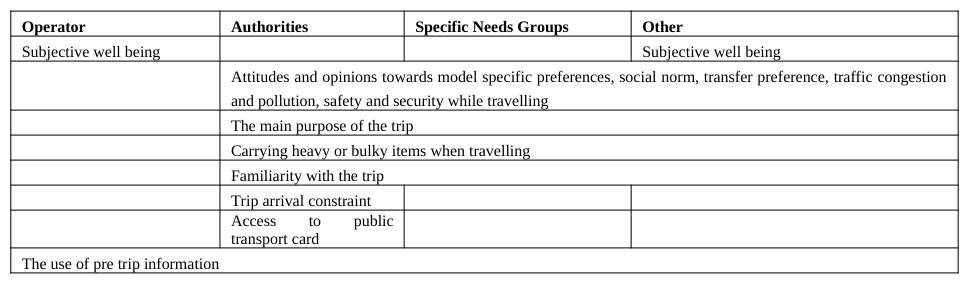
A total of 45 stakeholder interviews were conducted with planning authorities, public transport agencies and operators, non-governmental special interest groups and miscellaneous groups (e.g. national research institutes and passenger groups). An overview of the results is provided in Table 1 (Woodcock et al, 2014). Most the stakeholders appreciated and saw the benefit of METPEX. They believed that the identification of passengers’ travel needs would be essential for future action plans and transport service modernization. Further, they identified that one of the most useful outcomes of the project would be to quantify and rank the contribution of each quality factor to the overall experience and use this to guide investment in service improvement. One of the stakeholders highlighted the potential of this project to provide a better and more (economically) efficient service during the period of economic crisis.
Table 2: Variables most valued by different stakeholder groups (Woodcock et al, 2014) Operator Authorities Specific Needs Groups Other
Different factors were valued differently by different classes of stakeholders. Operators were mostly interested and concerned about the impact of detailed level-of-service related variables on passenger experience (e.g. the use of travel information, time utilization whilst on-board, more detailed impacts of disruptions, detailed trip pattern), and less interested in the overall satisfaction of whole journey, questioning the value of quantifying the impact of past poor experience. Furthermore, they also showed limited interest in variables that could neither be used in understanding their customers’ behavior, nor in detailed planning processes (e.g. the trip satisfaction can be improved in detailed level).
In contrast, planning authorities were more interested with wider general urban and public transport planning issues and the multi-modal travel patterns (e.g. different impacts of level-of-service for different travel modes and trip purposes). This is expected given their responsibility is to improve the transport service at the network and city (or even bigger) level. They were also interested in the impact of congestion and pollution in general and what particular conditions and locations public transport is needed from a planning perspective. The special interest groups were more interested in their constituents’ interests and for them, the questionnaire lacked detail. Some argued that the questionnaire was not detailed enough to explore the disabled travelers’ needs and considered that asking about personal information was insensitive.
The ‘other’ group of stakeholders was mainly government research institutes, many of whom were interested with more detailed trip patterns and behavioral variables that underlie the travelers’ decision making processes in order to inform policy decisions. They were also interested in multidisciplinary issues such as the role of subjective well- being, stress and the impact of travelers’ time constraints. Local stakeholders highlighted the benefits of having similar questions that are comparable with ones that they already use.
UK based results Public transport users in the UK have the opportunity to comment on the quality of public transport regularly through market research and evaluation conducted by transport authorities (such as CENTRO and Transport for Greater Manchester), Passenger Focus (the independent passenger watchdog which conducts national surveys on buses, trains and trams), surveys conducted by transport operators such as Virgin, Arriva and National Express amongst others and major regional employers (such as Birmingham International Airport).
Although much information is collected on the passenger experience, there is still a shortage of information about why people do not use public transport and the quality of the whole journey itself. It is argued that the wider traveller experience, including intermodal travel, the experience of travelling to the transport node, and the journey from the transport to the final destination, or the next stage of the journey may influence and restrict use of public transport. Currently information tends not to be collected by the transport operator if it is about issues which are beyond their control about, for example interchanges, stations or bus stops. They may include questions on it (for completeness) and pass information on. Indeed, most transport operators were only interested in the perceived quality of their service. The municipalities and regional transport authorities were more concerned with the overall quality of experience and the traveller’s journey (for example the provision of way finding information, tactile pavements and dropped kerbs. Many respondents were starting to consider social media or apps as a way of collecting travel information, but were not sure how to use the information or how representative it was. Additionally certain groups may be underrepresented in the surveys such as women with young children and those who did not use public transport Therefore there is a clear role for METPEX in investigating the quality of the whole journey experience as experienced by an individual traveller, paying particular attention to intermodality and those parts of the journey conducted by more active forms of transport. For the municipality and local transport authority, detailed local information is important in addressing need and planning new transport provision. Current surveys may not be able to capture the level of information needed to start planning for new models of mobility.
DEVELOPING THE TOOLSET Deconstructing the journey (part 2)
For METPEX, the whole journey from inception to arrival is the main unit of interest. In order to measure this, an inclusive set of measurement instruments is being developed which can be used to assess a particular stage of a journey, or the whole journey, including modal transfers, for different types of users. This may include journeys made wholly or partly by active, public or private forms of transport. Providing inclusive measurement instruments, which can be used by a wide range of respondents (in particular those with disability classified as Vulnerable Road Users or those from lower socio economic groups), is key to evaluating transport service provision. Therefore the measurement instruments include CASIC (Computer Assisted Survey Information Collection (in the form of on line surveys using SurveyMonkey), PAPI (Pen and Paper) systems (e.g. semi structured interviews) and focus groups for targeted user groups. Additionally a game app and dynamic questionnaire linked to a satellite navigation system (sbNavi™) are being developed to enable the collection of real time data (Woodcock et al. in press).
In order to develop this suite of measurement instruments, the first year of the project was used to understand and consolidate previous research and research instruments, through desk based research and interviews outlined above. The subsequent analysis showed that over 400 variables would need to be considered if the whole journey was to be analysed. From this, an extensive pilot questionnaire was developed and administered to over 200 people from Lithuania, UK, Greece, Ireland, Portugal, Italy, Sweden and Romania in both on-line and pen and paper formats. This showed the operational complexity of such a survey and the burden completing such a question would place on travelers. The subsequent analysis showed the importance of some factors in determining overall satisfaction (e.g. the longest leg of the journey, overall satisfaction and mood) and the relationship between the variables.
Following the pilot study, the original categorization of variables into political, organizational, functional, environmental, technological, and social dimensions was removed (from the users perspective, although each item can be traced back to these dimensions). The variables were recategorised to make them more respondent and journey oriented, prioritized, filtered and mapped on to the proposed measurement instruments so that only the most useful and highly prioritized variables for each user and journey type will be presented to a potential respondent. In this way METPEX will meet one of its objectives, i.e. to support and encourage adjustability and adaptability according to the context of use, e.g. time period, targets’ framework and resource limitations. Therefore, the full list of variables can be filtered so that only the most useful and preferred variables for each condition (e.g. user, mode of transport and journey stage) are included.
Initial filtering is being undertaken by colleagues across the project, and is focusing on the inclusion of variables that have been given a high priority by independent raters. At the end of the project, after the usefulness of the variables has been validated through our pilot study in 8 trial sites, guidelines will be provided to allow filtering by a researcher, who can use subsets of the ‘full survey’ to initiate targeted campaigns, or create a set of rules to generate appropriate research instruments.
CONCLUSIONS AND FUTURE WORK The METPEX trials will be undertaken in 8 cities (Coventry, Dublin, Grevena, Vilnius, Stockholm, Valencia, Bucharest and Rome) in autumn 2014. The deconstruction of the journey has enabled an extensive set of variables to be created from which a variety of measurement instruments can be generated, enabling real time and retrospective data gathering from different user groups, using different modes of transport. Prior to the trials each survey will be translated into the appropriate language, ethical and stakeholder approvals obtained, and Site Evaluation Assistants trained. The data from each site, and each measurement instrument will be collated on a central database enabling comparisons and benchmarking of services in different countries. This will also be used to establish which are the most reliable, valid and useful questions to include in the final toolset. The results will be presented back to the stakeholders in order to investigate how such information is used to inform policy and practice.
ACKNOWLEDGEMENTS
METPEX is funded under FP7-SST-2012-RTD-1, under the SST.2012.3.1-1. Research actions regarding the accessibility of transport systems work programme. The authors would like to acknowledge the contribution of all partners from Interactions (Ireland), SIGNOSIS (Belgium), ITENE (Spain), ZHAW (Switzerland), Euokleis s.r.l. (Italy), POLITO (Italy), ANGRE (Greece), KTH (Sweden), INTECO (Romania), FIA (Belgium), VTM (Portugal), SmartContinent (Lithuania), SBOING (Greece), TERO (Greece), RSM (Italy).
REFERENCES
Balcombe, R., Mackett, R., Paulley, N., Preston, J., Shires, J., Titheridge, H., Wardman. M., White, P. (2004), The demand for public transport; A practical guide. TRL Report, TRL 593, Crowthorne, UK Cats, O., Susilo Y., Hrin, R., Woodcock, A., Diana, M., Speicyte, E., O’Connell, E., Dimajo, C., Tolio, V., Bellver, P., and
Hoppe, M. (2014), An Integrated Approach to Measuring the Whole Journey Passenger Experience, Transportation Research Arena, Paris Chartered Institute of Transport. 1998. Passenger Interchanges - A Practical Way of Achieving Passenger Transport Integration.
Passenger Integration Working Party: CIT UK. Chi, C. G.Qing, & Qu, H. (2008), Examining the structural relationships of destination image, tourist satisfaction and destination loyalty: An integrated approach. Journal of Tourism Management, 29: 624--636 Colin Buchanan and Partners (1998), Transport Interchange - Best Practice Report. Department of Environment, Transport and
Regions: London. Faber, O. (1996), Ameliorating the Disbenefits of Rail Interchange. A Report for Rail Operational Research. Federal Transit Administration (FTA). 2003. Customer Preferences for Transit ATIS: Research Report. U.S. Department of Transportation, Battle Memorial Institute & Multisystems Inc., Washington Psychology, Bern, 4-7 September 2000. Friman M., Fujii S., Ettema D., Gärling T. & Olsson L.E. (2011). Psychometric analysis of the satisfaction with travel scale. In:
Presentation at the 9th Biannual conference of Environmental Psychology in Eindhoven, pp. 26-28, The Netherlands. GMPTE (Greater Manchester Passenger Transport Executive). 1997. Bus Station Audit, GMPTE. Grotenhuis, J.W.R., 2005. Integrated multimodal travel information in public transport. Final Thesis, Utrecht University, Utrecht
Hickman, R., Hamiduddin, I., Sellman, T. amd Hall, P. (2012), The seamless public transport journey: instrumental and affective, RGS, Edinburgh Hine, J. and Scott, J. (2000), Seamless, accessible travel: users’ views of the public transport journey and interchange. Transport Policy 7:217-226 London Councils, Living Streets and Walk London (n/d), Breaking Down Barriers to Walking in London
http://www.londoncouncils.gov.uk/policylobbying/transport/cyclingwalking/breakingdownbarrierstowalking.htm Lyons, G., Harman, R. (2002), The UK public transport industry and provision of multi-modal traveller information.
International Journal of Transport Management, 1, 1–13. Mackett, R.L., Achuthan, K. and Titheridge. H. (n/d), Overcoming the barriers to walking for those who are socially excluded, http://www.walk21.com/papers/Mackett,%20Roger-B-Overcoming%20the%20barriers%20to%20walking%20for%20peop.pdf Murphy, P., Pritchard, M. P., & Smith, B. (2000), The destination product and its impact on traveller perceptions”. Tourism Management, 21(1): 43-52 Rajesh, R. (2013), Impact of Tourist Perceptions, Destination Image and Tourist Satisfaction on Destination Loyalty: A
Conceptual Model , PASOS, 11, 3, 67-78 Stradling, S.G., Hine, J. and Wardman, M. (2000) ‘Physical, cognitive and affective effort in travel mode choices’. Symposium on Travel Mode Choice. International Conference on Traffic and Transport Tovey, M (ed) (2012), Design for Transport, A user centred approach to vehicle design and transport, Gower, UK Woodcock, A., Berkeley, N., Cats, O., Susilo, Y., Hrin, G.R., Reilly, O., Markucevičiūtė, I. and Pimentel, T. (2014), Measuring
quality across the whole journey, IEHF2014, Southampton, UK, April 2014 Woodcock, A., Petridis, P., Liotopoulos, F., Georgiadis, A., Brady, L. (2014), The challenges of developing an on-line tool to measure the quality of the passenger experience in a PanEuropean context, HCI 2014, Cyprus, Greece Woodcock, A. et al (2014) Measuring quality across the whole journey. IEHF conference, April 7-10, Southampton, UK
LISTED IN THE AHFE DIGITAL BOOKSTORE CATALOGUE
Explore the complete digital volume
Advances in Human Aspects of Transportation: Part II
Read this individual research paper free through the original publisher, or explore the full digital proceedings book.
ISBN 978-1-4951-2098-5
Explore this ISBN in the AHFE Bookstore ↗Listed in the July 2026 bookstore catalogue; search by ISBN to confirm current availability · Digital book purchase optional