Juan Luis Hernandez Arellanoa, J Nieves Serratos Perezb (2020). Demographic Factors Affecting Perceived Fatigue Levels among CNC Lathe Operators. In: Advances in The Ergonomics in Manufacturing: Managing the Enterprise of the Future. AHFE Open Access, vol. 12. https://doi.org/10.54941/ahfe100445
Fatigue in industrial workers is a multifactorial phenomenon. There are demographic factors that may have a significant influence on the perception of fatigue, but they remain almost unexplored to date.. The present study addresses this issue. A survey to assess fatigue was conducted among CNC lathe operators in three industrial concerns where automotive parts are manufactured. Homokinetic joints in site 1 (121 workers); camshafts in site 2 (121 workers); pistons in site 3 (21 workers). The subjects completed a survey instrument that included two questionnaires to assess fatigue: SOFI−S and OFER−S. There was also a section asking for demographic information. The MANOVA procedure was used to explore the influence of the demographic factors on fatigue. Factors affecting the fatigue dimensions (SOFI−S) were gender, body weight, stature, total length of sleep during a day, and age. Factors affecting the fatigue states (OFER-S) were weight of load being handled, gender, total length of sleep during a day, length of stay in the firm. Non-influential factors were educational status and whether the worker has a second paid job.
Fatigue is commonly used to indicate a physiological status, but some psychologists argue that this term should be used only to define a subjective experience that affects the performance of a task (Kroemer, Kroemer, and Kroemer- Elbert, 2003). According to Bridger (2003), there are at least three different meanings to the term ‘fatigue’. Sometimes it is used to mean sleepiness (fatigue as a result of sleep deprivation or disruption of circadian rhythms). It is also used as a synonym for ‘tiredness’ (e.g. after running a marathon or lifting heavy weights). Finally, it is used when referring to the kind of habituation to a mental task that occurs after prolonged execution that manifests itself as a desire to do something else. This kind of ‘mental fatigue’ is task-specific. So, even after driving for many hours, our brain is quite capable of processing the information required to understand a book or enjoy a symphony. Fatigue is usually inferred from its effects: most directly, decline in physical or mental task performance. Like stress, it is a term that is used in everyday life and its value as a scientific construct has long been questioned. Ream and Richardson (1996), offer the following definition, however: Fatigue is a subjective, unpleasant symptom which incorporates total body feelings ranging from tiredness to exhaustion, creating an unrelenting overall condition which interferes with individual’s ability to function in their normal capacity.
Fatigue in industrial workers is a multifactorial phenomenon. Workload, length of work shift, extended shift, manual handling of heavy loads are among the better known factors. However, there are demographic factors which may have a significant influence on the perception of fatigue, but to date most publications about fatigue have not referred to this facet of the phenomenon. Authors as Yoshitake (1978), Åhsberg, E., Gamberale, F., and Kjellberg, A. (1997), Åhsberg, E. and Gamberale, F. (1998), Åhsberg (2000), Fürst and Åhsberg (2001), Leung, A., Chan, C., & He, J. (2004), Gonzalez, Moreno, Garrosa, and López (2005), Sebastián, Idoate G., Llano, and Almanzor E. (2008), and Hernandez-Arellano, J.L., Ibarra-Mejia G., and Serratos, J. N. (2013) have focused on dividing the fatigue into dimensions or factors using statistical procedures, and they have not reported results about the influence of demografic factors on fatigue.
Some of the most widely used subjective methods for assessing work-related fatigue are the Swedish Occupational Fatigue Inventory (SOFI) (Åhsberg, Gamberale, and Kjellberg, 1997), and the Occupational Fatigue Exhaustion Recovery scale (OFER) (Winwood and Casalli, 2005). These two questionnaires have shown high levels of internal consistency and structural stability. In the present study SOFI-Spanish (Gonzalez, Moreno, Garrosa, and López, 2005) and OFER-Spanish (Hernández-Arellano, García-Alcaraz, Flores-Figueroa, and Vazquez-Alvarez, 2011) versions are applied. The study’s main aim is to widen our understanding on the causes of fatigue, inquiring about demographic factors that may significantly influence the perception of fatigue among CNC lathe operators.
METHODOLOGY
Study design The study design is non-experimental, descriptive, cross-sectional, and correlational. The survey was applied to workers classified as CNC lathe machine operators in three sites manufacturing automotive parts in Central Mexico. In all cases permission was obtained from the company´s management, and workers were advised of the survey beforehand.
Sample A sample of 263 workers was obtained from the three sites, using proportional simple random method. Once selected, workers were individually screened for the following inclusion criteria: at least six previous month experience as a CNC lathe operator, no history of musculoskeletal injuries in the past six months, and no history of cardiovascular disease. After being screened and upon accepting to participate, workers signed a consent form which also informed them on the purpose, information to be collected, procedures, risks and benefits, and measures to assure confidentiality.
Survey integration To conduct the study, a three-part survey instrument was applied. Two sections focused on the assessment of fatigue perception; the third one asked about demographic factors.
The first questionnaire was the SOFI-S (Gonzalez, Moreno, Garrosa, and López, 2005). This is an adaptation and validation of SOFI (Åhsberg, Gamberale, and Kjellberg, 1997) to Spanish language. This instrument was developed to assess fatigue in 5 dimensions: lack of energy, physical exertion, physical discomfort, lack of motivation and sleepiness. Each dimension includes 3 items. The extent of fatigue is assessed by adding the values assigned by the subject to the 3 items in each dimension.
The second section was the Spanish version of the OFER questionnaire, OFER-S (Hernández-Arellano, García- Alcaraz, Flores-Figueroa, and Vazquez-Alvarez, 2011). This is a translation and validation of the OFER questionnaire (Winwood and Casalli, 2005). It was adapted and validated for use in Mexican workers. This instrument assesses three states of fatigue: acute fatigue, chronic fatigue and recovery between shifts. Each state is assessed with 3 items.
The third section included 14 questions about demographic and work factors. Salient among them were gender, age, body weight, stature, marital status, number of economically dependent persons, total length of sleep during a day, length of stay in the firm, seniority in current job, weight of load being handled, educational status and whether the worker holds a second paid job.
Procedure The survey was applied at each site during off-duty periods. After selection and screening of subjects, trained research assistants administered the instrument. Selected participants were summoned to a meeting room where they were informed about the study and its aims, and further instructed on how to complete the instrument. The research assistant was at hand all the time to answer questions from the subjects. After completing the three sections, every participant received a small present.
Data analysis Data handling was performed using descriptive analyses. Percentages were estimated for nominal and categorical data; both central tendency and dispersion were estimated for scale data. Reliability and internal consistency were assessed using Cronbach's alpha index, whose values larger than 0.7 indicate that data is reliable (Nunally, 1995; Levy, Varela, and Gonzalez, 2003). The Kayser-Meyer-Olkin (KMO) index was used to check sample adequacy; a value larger than 0.7 indicates that the sample size is adequate, and so factor and structural analyses can be performed (Alvarez, 1995; Pett, Lackey, and Sullivan, 2003). Multivariate Analysis of Variance (MANOVA) was applied to identify the relationship between demographic factors and perceived fatigue. Significance level was set at p= 0.05. SPSS v17.0 software was used.
RESULTS
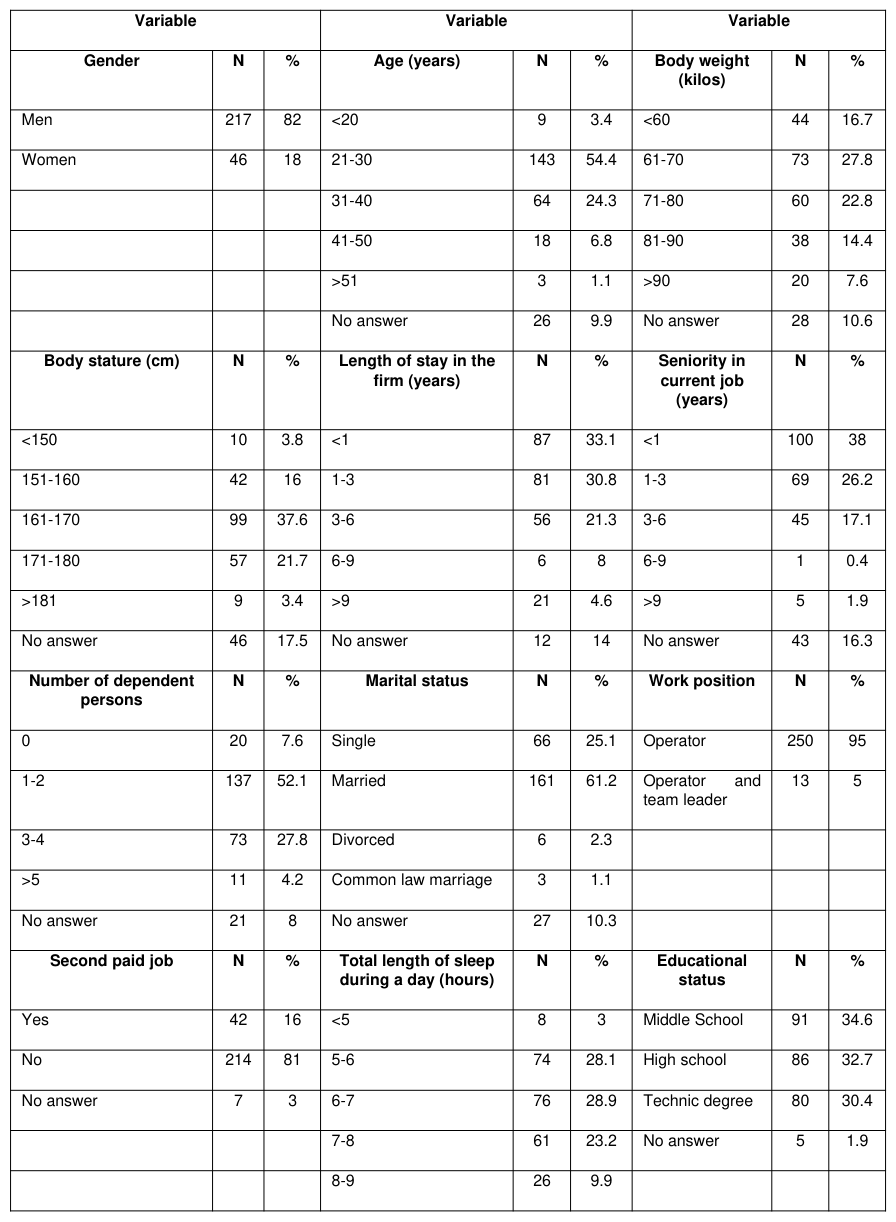
Two-hundred and sixty three subjects from the three sites were selected and completed the questionnaire; one- hundred and twenty-one were at the constant velocity joint manufacturing facility, one-hundred and twenty-one were involved in camshaft manufacturing, the remaining twenty-one worked at the pistons manufacturing site. The average time to complete the survey was 15 (±3) minutes. There were more males (217) than females (46) in the sample. Most workers held a technician’s qualification (63.1%); only 34.6% had completed high school. Five per cent of the sampled subjects performed also as team leader. The average length of work within the company was 3.5 years. A summary of the full collected information is shown in table 1.
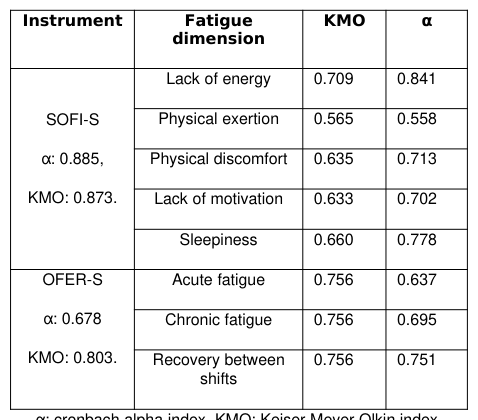
Internal consistency Internal consistency (Cronbach’s alpha index) and sample adequacy (KMO index) were assessed prior to data analysis proper. For SOFI-S data, Cronbach’s alpha index ranged from 0.558 to 0.885; KMO index ranged from 0.565 to 0.873. For OFER-S data, Cronbach’s alpha index ranged from 0.637 to 0.751; KMO index ranged from 0.756 to 0.803. All calculated values are shown in table 2.
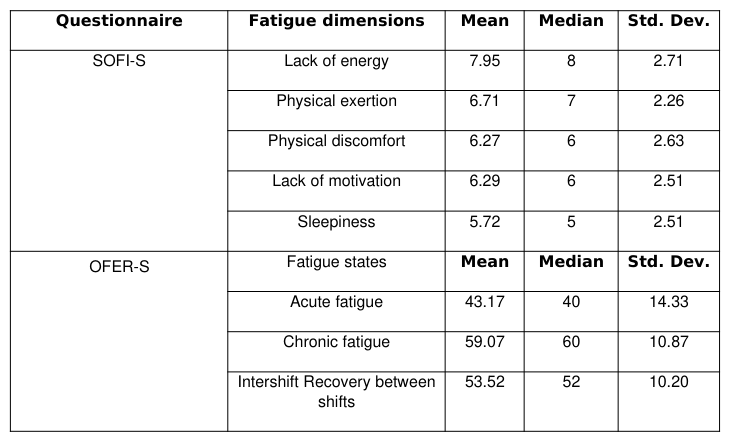
Fatigue scores Mean, median and standard deviation were calculated for dimensions (SOFI-S) and states of fatigue (OFER-S). For the former, minimum value is 3 and maximum is 15; for the latter, minimum value is 15 and maximum is 75. All descriptive measures are shown in table 3.
Table 3. Descriptive results for measured fatigue dimensions and fatigue state Questionnaire Fatigue dimensions Mean Median Std. Dev.
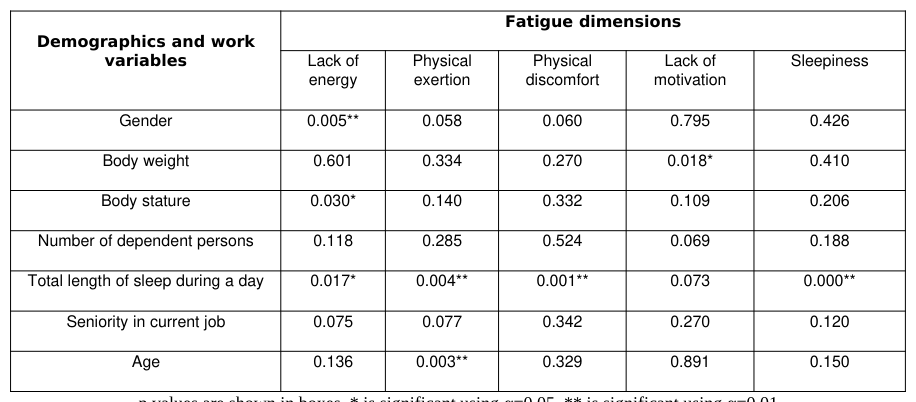
Relationship between demographic data and fatigue Multivariate Analysis of Variance (MANOVA) found that the variables gender, body weight, height, hours of sleep during a day and age showed significant effects with at least one SOFI-S fatigue dimension (p<0.05). The whole results appear in table 4.
Table 4. Demographic and work variables on dimensions of perceived fatigue Fatigue dimensionsEquation reproduced from the original PDF.
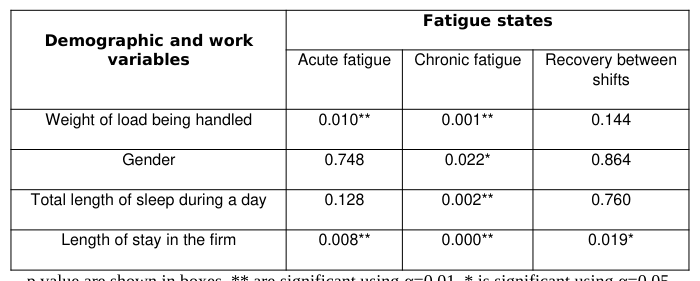
Multivariate Analysis of Variance (MANOVA) found that the variables weight of load being handled, gender, total length of sleep during a day, length of stay in the firm showed significant effects with at least one OFER-S fatigue states (p<0.05). Table 5 exhibits the whole results.
Table 5. Demographic and work variables on states of perceived fatigue Fatigue statesEquation reproduced from the original PDF.
DISCUSSION
The analysis on the probable relationship between demographic variables and SOFI-S results showed a significant effect of the variables gender and body stature on the dimension lack of energy, with women reporting higher levels. This finding is in line with the fact that female subjects were shorter (and lighter) than males, albeit in the sample they are in a proportion of one to four, respectively. It is difficult to ascertain if the findings would stand in case a larger number of women participated in the study.
It is true as well that the variable body weight reached significance against the dimension lack of motivation. However, at the moment it is almost impossible to advance a conjecture as to the meaning of this fact. It will obviously be a main focus for attention in future research.
Total length of sleep during a day was certainly the most influential demographic variable. It had a significant effect on four fatigue dimensions: lack of energy, physical exertion, physical discomfort and sleepiness. In truth, this is not surprising, and points to the relevance of the subjects having access to conditions that allow them an adequate rest. There is an obvious connection between these relationships and the timing of work shifts, which at the moment of the study were 12 hours long, in a one-week rotation scheme. Clearly, this too affects the workers’ performance and limits their possibilities to carry out properly other daily activities. They declared often having to rob time from their rest, which very much explains the extremely strong effect of the variable on the sleepiness dimension.
Age had a very significant effect on perceived physical exertion. This dimension being more accused as the worker’s age increased. This result is to be expected, although it is rather surprising that the increase in age did not seem to affect other physical dimensions as lack of energy or discomfort. Perhaps this might be explained in part by the very poor relationship between age and lack of motivation, but this is clearly a conjecture that needs to be further explored.
Regarding the relationship between demographic variables and the fatigue states assessed by the OFER-S questionnaire. The weight of load being handled had a significant effect on both acute fatigue and chronic fatigue, these being more accused as the weight increased. This factor is clearly related to a major physical demand, but it is very surprising that the observed effect was not evident on the physical dimensions explored by the SOFI-S instrument. Nonetheless, as has been already pointed out, the two questionnaires have shown high levels of internal consistency and structural stability.
The variable gender has a significant effect only on the chronic fatigue state. Women report feeling more fatigued than men. However, as has been already said, this apparent effect might be due to the relatively scarce presence of female subjects in the studied sample.
Total length of sleep during a day significantly affected only the chronic fatigue state. This is rather surprising, taking account of the very strong effect the same variable had on the fatigue dimensions assessed by the other instrument employed in the study. In considering this fact, we have hypothesised that it might be influenced by the wording employed in the description of the fatigue states. Clearly, this remains to be tested in future research.
The length of stay in the firm was a variable with a very significant effect on all three states of fatigue, particularly on chronic fatigue. The effect grew stronger with the increase of time spent as an employee in the firm, and this immediately could rise the question as to whether this is rather an effect of age. However, the latter did not reflect on the subjects’ perception of fatigue.
CONCLUSIONS
Not only work-related factors as the weight of load being handled, shift length, overall workload are relevant in the investigation of human fatigue; there are other factors that may cause fatigue to workers. Through the results obtained from the performance of Multivariate Analysis of Variance (MANOVA), this study has found that variables as gender, age, body weight, body stature, total length of sleep during a day and length of stay in the firm, relate to an increased perception of fatigue. Total length of sleep during a day was the most significant factor for human fatigue; it showed significant effects on four fatigue dimensions (lack of energy, physical exertion, physical discomfort and drowsiness) and on the chronic fatigue state.
REFERENCES
Åhsberg, E. (2000). Dimensions of Fatigue in Different Working Populations. Scandinavian Journal of Psychology , 231-241. Åhsberg, E., Fürst, C. (2001). Dimension of Fatigue during Radiotherapy-An Aplication of the Sewdich Occupational Fatigue Inventory (SOFI) on Cancer Patients. Acta Oncologica , 40 (1), 37-43.
Åhsberg, E., Gamberale, F. (1998). Perceived fatigue during physical work: an experimental evaluation of a fatigue inventory.
International Journal of Industrial Ergonomics (21), 117-131. Åhsberg, E., Gamberale, F., Kjellberg, A. (1997). Perceived quality of fatigue during different occupational task. Development of a questionnaire. International Journal of Industrial Ergonomics (20), 121-135. Álvarez, R. (1995). Estadística Multivariable y no paramétrica con SPSS. Aplicación a las ciencias de la salud. Madrid: Días de
Santos. Bridger, R. (2003). Introduction to Ergonomics (Second Edition ed.). Taylor & Francis. Fürst, C., Åhsberg, E. (2001). Dimensions of Fatigue During Radiotherapy. An Appication of the Multidimensional Fatigue Inventory. Supportive Care in Cancer , 9 (5), 355-360. Gonzalez, J. L., Moreno, J. B., Garrosa, H. A., López, L. A. (2005). Spanish version of the Swedish Occupational Fatigue
Inventory (SOFI): factorial replication and validity. Introducción Journal of Industrial Ergonomics , 35, 737-746. Hernández-Arellano, J. L., García-Alcaraz, J. L., Flores-Figueroa, J. D., Vazquez-Alvarez, N. E. (2011). Versión en español de la escala de recuperación por agotamiento causado por fatiga. Academiajournals.com , 218-222. Hernandez-Arellano, J.L., Ibarra-Mejia G., Serratos, J. N. (2013). Fatigue Dimensions among AMT Operators in Mexico.
Proceedings of the 2th Annual World Conference of the Society for Industrial and Systems Engineering. Las Vegas, NV. EUA. 155-160. Kroemer, K., Kromer , H., Kroemer-Elbert, K. (2003). Ergonomics: how to design for ease & efficiency. (P. Hall, Ed.) Leung, A., Chan, C., He, J. (2004). Structural Stability and Reliability of the Swedish Occupational Fatigue Inventory among Chinese VDT Workers. Applied Ergonomics , 35, 233-241. Levy, J., Varela, J., Gonzalez, J. (2003). Análisis multivariable para las ciencias sociales. Prentice Hall-Pearson. Nunally, J. (1995). Teoría psicométrica. México. D. F.: Mc. Graw Hill. Pett, M., Lackey, N., Sullivan, J. (2003). Making Sense of Factor Analysis. The Use of Factor Analysis for Instrument
Development in Healt Care Research. London: SAGE Publications. Ream E., Richardson A. Fatigue, a concept analysis. International Journal of Nursing Studies. (33), 519-529. Sebastián, C., Idoate G., V., Llano, L., Almanzor E., F. (2008). SOFI-SM: cuestionario para el análisis de la fatiga laboral, física y psíquica. Revista digital de seguridad y salud en el trabajo (2), 1-22. Winwood, P., Casalli, J. (2005). Developmentand validation of a scale to measure work-related fatigue and recuvery: the
occupational fatigue exhaustion recovery scale (OFER). Journal of Occupational and Environmental Medicine (47), 594- 606. Yoshitake, H. (1978). Three characteristics patterns of subjective fatigue symptoms. Ergonomics (21), 231-233.
LISTED IN THE AHFE DIGITAL BOOKSTORE CATALOGUE
Explore the complete digital volume
Advances in The Ergonomics in Manufacturing: Managing the Enterprise of the Future
Read this individual research paper free through the original publisher, or explore the full digital proceedings book.
ISBN 978-1-4951-2103-6
Explore this ISBN in the AHFE Bookstore ↗Listed in the July 2026 bookstore catalogue; search by ISBN to confirm current availability · Digital book purchase optional