Åsa Fast-Berglund, Erica Blom (2020). Evaluating ICT-Tools for Knowledge Sharing and Assembly Support. In: Advances in The Ergonomics in Manufacturing: Managing the Enterprise of the Future. AHFE Open Access, vol. 12. https://doi.org/10.54941/ahfe100430
This paper will through three industrial cases show the possibility to use ICT-tools in terms of QR-codes and movies for knowledge sharing and assembly support. Over 90 percent of industrial instructions are paper based with text and images showing instructions. New technologies make it possible to extend the instruction to a more easy to understand instructions, especially when I comes to complex tasks that are hard to explain in words or pictures. This paper will show how QR-codes could be used in order to solve this problem. Results shows that all the test persons thought that the movie instructions were better than the text and picture based ones, even though there were a lot of problems with Wi-Fi connections at the companies.
In order to make the knowledge sharing more efficient and flexible, ICT-tools have started to be seen as a solution in manufacturing companies. Knowledge sharing has been identified as a major focus area for knowledge management. The relevance of this derives from the fact that it provides a link between the level of the individual knowledge workers, where knowledge resides, and the level of the organization . There are many known technical solutions to be used to solve the issue of mass customization and an increased product variety. ICT tools hold the possibility to save time through quick and effective information flows that synchronizes the work and enables a proactive work setting .Furthermore, ICT provides a flexibility in time and room, so that the knowledge sharing could be done when the operator have time. Information is vital for operators. Multimedia technology can provide online information and advisory facilities for operators. Since the late 1990s access to information and communication technologies (ICT) has seen tremendous growth—driven primarily by the wireless technologies and liberalization of telecommunications markets. Presentation of information can be broken down into two parts; carrier and content of information . Carrier concerns the medium of information e.g. paper, screens, and PDAs, while the content concerns the mode of information e.g. text pictures, sound or movies. Mobile communications have evolved from simple voice and text services to diversified innovative applications and mobile broadband Internet. Millions of individual will use this possibility and the thinking of information system has evolved from a technical/systems focus towards a more user/costumer focus the last years .
The aim of this paper is to, through three industrial case studies; show how ICT, in terms of QR-codes and Pads, could be used in a new context in terms of instruction and knowledge sharing within production systems. The instructions, in terms of movies, are used for different tasks i.e. complex set-up, control station and daily inspection.
COGNITIVE AUTOMATION The scope of automation have widened through the use of information technology. Automation solutions in an assembly context do no longer only consider mechanical tasks; it also concerns cognitive support for control and information tasks. This could be described, according to Thurman et al. (1997) as: “Cognitive automation is software intended to automate cognitive activities, such as situation assessment, monitoring, and fault management, which are currently performed by human operators”. Furthermore, cognitive automation (LoAcognitive) could be described as the amount of technique and information provided to the operator in order to know what, how and when to do a specific task in the most efficient way. When a tool or machine is performing the task i.e. higher physical automation (LoAPhysical= 5–7), the cognitive automation is mainly used for control and supervision (LoACognitive= 4–7) .
Figure 1 The LoA matrix
The information system can be integrated with factory management programs to provide a management overview and quality control information. The integration of the information flows enables small batch sizes and rapid product changes . In order to assess cognitive solutions in a structured way the proposed matrix could be used in order to measure the current LoA but also analyse a future state of automation. Cognitive automation strategies are needed in order to achieve a sustainable and reconfigurable assembly system .
ICT USED FOR COGNITIVE AUTOMATION Within one level of cognitive automation, there could be several technical solutions. Hence, it is important to consider technology maturity in an evaluation process of choice of ICT-tools, this could be described as a readiness to use and develop new technology . Building up the know-how can be very time-consuming and expensive; therefore, the decision of eliminating an established technology or following up a new one is crucial . Despite this, very little attention has been paid to propose methods for evaluating technological maturity consistently between organisations . New external technologies often need further development. The recent advances in information technologies have helped organizations to apply technologies in innovative ways for supporting collaborative work practices. Such work practices represent a complex blend of human actors and technological systems, where individuals can accomplish tasks and interactions through technological systems that they could not otherwise achieve . By considering and especially integrating company external technologies in the existing production environment significant research and development efforts arise. Here, the company has to contemplate organizational as well as technical properties and requirements of the technology . Figure 2 shows two different types of ICT-tools to support the operator, within the same cognitive LoA= 3 (Teaching):
1. Using a “mobile information carrier” for assembly instructions: an experimental study has examined how an information source affects the quality and productivity when presenting assembly instructions. The study shows that quality is positively affected by mobility and shows indications of increased productivity (Thorvald et al., 2010). The main reason is the cost-benefit theory, ,i.e. information is always within reach and the cost to look one extra time at instructions is less than if the instructions are stationary. Both mobile and static instructions are at the same cognitive automation level; it is the carrier and possibilities to change or adapt the content to each operator that makes the mobile and electronic solution more reconfigurable and flexible. ICT tools hold the possibility to save time through quick and effective information flows that synchronizes the work and 2. Using “QR-codes“ to transfer knowledge and learning from expert to novice through film, text and audio. Case studies show that learning through film instead of only text or pictures are easier and that in increases the flexibility of the expert see Case A.
Figure 2 Example of ICT-tools used for cognitive automation
QR-Codes This paper uses QR-codes as part of the ICT-tool in order to share the knowledge through movies. QR Code is a two-dimensional symbol. It was invented in 1994 by Denso, one of major Toyota group companies, and approved as an ISO international standard (ISO/IEC18004) in June 2000. This two-dimensional symbol was initially intended for use in production control of automotive parts, but it has become widespread in other fields .
QR-codes was used in all the industrial case studies in order to create a flexible and time-saving path to the expert movie, so that operators do not have to seek for the information regarding the complex task, but to have the path directly at the station. A person may seek help in order to complete a difficult or unfamiliar task. Within this range of situations, it is useful to distinguish two types of goals: either the persons want to be helped with the completion of the task, or they want to be helped with the understanding of the task. Learning may only take place if the learner seeks help with the purpose of understanding the problem or the task at hand. In the case studies, the operators seek for the information in order to learn the task and to do it in the right and most effective way.
ICT AND KNOWLEDGE SHARING Knowledge sharing is defined as activities of transferring or disseminating knowledge from one person, group or organization to another .
Knowledge sharing presumes a relation between at least two parties, one that possesses knowledge and the other that acquires knowledge. The first party should communicate its knowledge, consciously and willinglyor not, in some form or other (either by acts, by speech, or in writing, etc.). The other party should be able to perceive these expressions of knowledge, and make sense of them . The effectiveness of knowledge driven work relies on individuals exchange their tacit and explicit knowledge to create new . Four channels for organizational communication has been proposed by to be used in processes of knowledge sharing (Van Selm & Nelissen, 2001).
1. Knowledge is shared in face-to-face contacts (e.g., Harris, 2002; Koeleman, 1997). This channel is considered rich as physical closeness leaves room to two-way communication or ambiguous knowledge.
2. Knowledge sharing through written material, being fast and accurate but less responsive to feedback and hence less rich (e.g., Harris, 2002, Koeleman 1997).
3. Audiovisual material (e.g., Koeleman, 1997).
4. Knowledge can be shared by means of digital media including ICT
Knowing the relationship between organizational culture and knowledge sharing, and how it affects the level of job satisfaction among ICT employees can help companies to retain good employees . In line with (Lee, 2001) the industrial case studies will show knowledge sharing between an expert and a group of novice operators i.e. from one person to a group. The ICT-tools used is based on channel 3 and 4 according to (Wenneker et al., 2002).
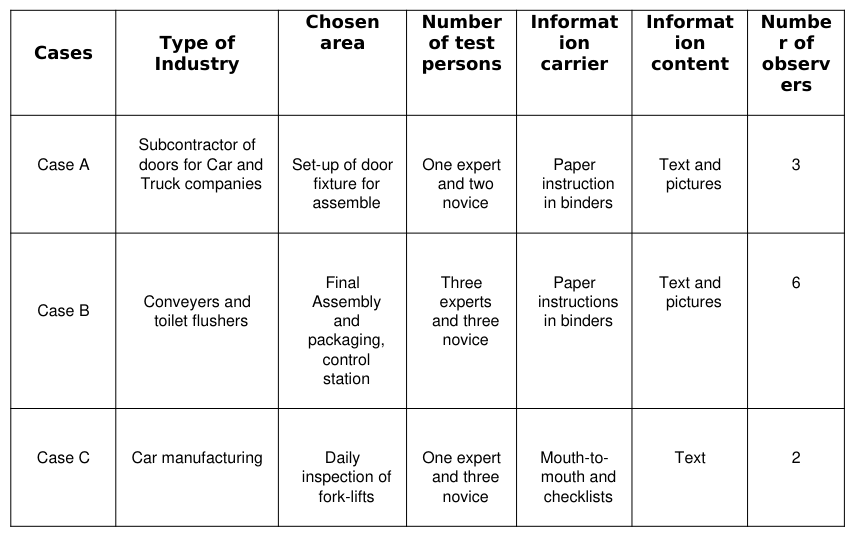
INDUSTRIAL CASE STUDIES Three Industrial case studies have been performed during 2013-2014. The methods used for collecting data were open interviews, video analysis, observations and questionnaires. Table 1 shows an overview of the current stage of the three case studies.
Table 1: Summary of the current situation Chosen Number Informat
The information content used has evolved during the cases, in case A and B, a movie with audio and text were used, but there were no chapters in the film so the operators had to pause and rewind. In Case C the film had chapters for each task so that the operator could look at the first task and then perform it, then look at task 2 etc. This was a clear improvement. The information carrier also changed during the cases; three different sizes were used during the cases. In case A the 10-inch screen were used, in case B the 4,3- inch screen and in case C they had a choice to choose from all three (all test operators choose the 10 inch-screen). Overall impression were that the 10 inch screen were the most popular to choose.
Figure 3 Different information carriers, adopted from The test at the case industries were done in two steps (or two meetings);
The first step was to record the movie with help of the expert. The tasks were recorded from different angels and many times in order to get the most optimal instruction. While the expert performed the tasks he told how the tasks should be performed, in terms of best practice (or standardized work) following the old instructions. Furthermore, what type of tools those was needed and if there were any particular hard or complicated tasks was also reviled during the film recording session.
The second step was to compare the old instruction with the QR-code based film instruction by assembling the same product. The test persons were both expert and novice operators performing the tasks. Afterwards they were asked questions about the instructions and pros and cons with both instructions.
Case A The first case company is a sub-contractor, which means that have demands on quality and delivery. The main reason for them to have instructions as QR-codes was that this was a new article they were starting to produce and the production engineer wanted to share the same knowledge about the set-up to the operators, further they wanted to increase the flexibility so that the expert doesn’t always has to be in place to teach the operators but the could learn by watching the video. The first step was to film the production engineer when he did the set-up of the product and then to film and analyse one novice and one expert when they did the set-up. Figure 4 illustrates the set-up in case A:
1. The old assembly instructions consisting text and picture illustrations
2. The QR-code connected to the assembly movie
3. The operator looks at the expert assembling the product.
Figure 4 Using QR-code and movies for a complex assembly task
The Pros:
Both the operators thought it was a great help to see the film, the expert (seen in figure 4) looked at the whole film first and then started to do the set-up. He paused and rewind the film several times before he was finished, but he manage to do the set-up without help from the expert.
Easy to use the technology
Flexibility for the expert, who does not have to be directly at place
The Cons:
The sound were in regular earplugs which resulted in removal when he had to go away from the Pad
Bad connection to the internet
Discussion on were to store the movies due to security reasons (at the test, the film were located at a private account at YouTube)
Case B The second case company is a sub-contractor and an end-producer of the two products tested. The main reason for them to have instructions as QR-codes was that one of the stations were a control station where it is very important to do the control in same way and not forget any tasks. For the other station there were a lot of craftsmen’s’ tasks, where you had the feel or push the articles in a certain way which is hard to explain using text and pictures, also the old instructions where seldom used and where place in binders far away from the operators. At the package station it was important to put the items exactly in the right order otherwise you could not close the box. No instructions were available, there were only a package list used as an ‘instruction’. The first step was to film the expert when she did the assembling, packaging and control of the products, then two novices and one expert did the assembling and one other expert did the control station. The novice persons thought that it was very hard to assemble the product, and had to call for the expert several times.
The Pros:
Film was much better than the old text-picture based assembly instruction
Easy to forget a step at the control station that was captured by the film.
The Cons:
The information carrier used in this case was a 4.3 inch smart-phone, due to problems with the Wi-Fi; the Pads could not be used. This screen was too small to see all the details at all the stations.
The film was not divided into chapters which made the novice operators stressed because they were not used to the technology and did not know how to pause.
The expert did not explain how the product should be placed at the start which confused the novice operators.
Case C The final case was a daily inspection of fork-lifts. The main reason for using QR-codes and film instructions were that the new operators get the instruction from an expert at their first day and then they only have a check-list to follow when they are doing the inspection. It is easy to forget something because all steps are not explicitly written in the check-list. Further, the ‘expert’ is not the same person which means that the new operators gets an interpretation of the check list which could differ from person to person, depending on level of experience. The test was done with three experts (two did the actual inspection while the third only looked at the movie and gave feedback). All the test persons used the 10 inch screen. The movie was divided according to the different tasks in the check-list so you could jump to a specific task if you felt that you know the first once.
Figure 5 the old way (left picture) and the new way (right picture) of revealing instructions of daily inspections of fork-lifts.
The Pros:
Standardized movie, so that all the new operators hear the same thing.
Easy to follow
Easy with the chapters so that you did not have to look at the whole movie
If it is possible to digitalise the check-list itself, it could save a lot of papers and work for the maintenance of the fork-lift.
The Cons:
Bad connection to the internet
Discussion on were to store the movies due to security reasons (at the test, the film were located at a private account at YouTube)
CONCLUSIONS
New technology holds a lot of possibilities to try new and easy to use support tools for operators. The case studies have shown the movies and QR-codes could be used as help in a lot of different contexts in production industry. When it comes to learning, most people seem to regard the film medium as the easiest medium for information search compared to text and text/image based instructions. There are many reasons for this and one is that it is generally easier for a novice to assemble parts when he/she can watch an expert assembling and describing the sequence simultaneously. It is as if there is an expert present with the company having to spend money and time on it. The text based instructions were sometimes regarded as limited and inadequate. Moreover, in writing or images, it is complicated to describe certain things such as movements or sounds. The film medium is more suitable for that. On top of that, people with a reading disorder do not have to struggle with comprehensive, sometimes intricate instructions in writing. With the help of a QR code, learning can be brought closer to the machine or station. Thus, the just in time learning in demand can be achieved. The views on whether an expert IRL is better than an expert on film are divergent. Those who advocated the filmed expert claim that the shared information will always be exactly the same, i.e. is standardized, while real time experts can and do express slightly different views on how to handle a machine or assemble a certain device. Another area of improvement which was brought forward deals with chapters in the film instructions. We tried it in our third case. With chapters, the assembly is easier for both novices and experts. Novices can focus on difficult parts and watch those parts repeatedly until they understand them, while experts can concentrate on specific areas instead of watching the entire film. What companies need to consider when it comes to technology are: Where to place the film; is the Internet safe or will you have to place the film on the company intra net or LMS? What mobile devices are most suitable for the employees and the company? The subjects of this experiment were of the opinion that smart phone screens were too small to make out, and that surfboards were to prefer. Both novice and expert users will use this as an instruction instead of paper, text or pictures. The quality and time will be measured and compared with the old paper instruction. Using QR-codes and Pads for electronic instructions i.e. movies, will not only increase the flexibility, quality and productivity, but also to make the industry more modern and appealing for the younger generation.
ACKNOWLEDGEMENT
This research is part of a VINNOVA/FFI funded project, GAIS and EFS founded project, Medvind. The work has also been carried out within the Production Area of Advance at Chalmers. This support is gratefully acknowledged.
REFERENCES
Ashleigh, M. J. & Nandhakumar, J. 2007. Trust and technologies: Implications for organizational work practices.
Decision Support Systems, 43, 607-617. Brousseau, E., Barton, R., Dimov, S. & Bigot, S. 2010. A Methodology for Evaluating the Technological Maturity of Micro and Nano Fabrication Processes. In: RATCHEV, S. (ed.) Precision Assembly Technologies and Systems. Springer Berlin Heidelberg. Fast-Berglund, Å., Bligård, L.-O., Åkerman, M. & Karlsson, M. 2014. Using the TRL-methodology to design
supporting ICT-tools for production operators. 47th CIRP Conference on Manufacturing Systems. Windsor, Ontario, Canada. Fasth, Å. & Stahre, J. Concept model towards optimising Levels of Automation (LoA) in assembly systems.
Proceedings of the 3rd CIRP Conference on Assembly Technologies and Systems, 2010 Trondheim, Norway. Fasth, Å. & Stahre, J. 2013. Cognitive Automation Strategy -For reconfigurable and sustainable assembly systems.
Assembly Automation, 33.
Fasth, Å., Stahre, J. & Dencker, K. Measuring and analysing Levels of Automation in an assembly system.
Proceedings of the 41st CIRP conference on manufacturing systems 2008 Tokyo, Japan. Fässberg, T., Nordin, G., Fasth, Å. & Stahre, J. iPod Touch - an ICT tool for assembly operators in factories of the future? Proceedings of the 43rd CIRP International Conference On Manufacturing Systems (ICMS), 2010 Vienna, Austria. Heilala, J. & Voho, P. 2001. Modular reconfigurable flexible final assembly systems. Assembly Automation, 21, 20-
30. Hendriks, P. 1999. Why share knowledge? The influence of ICT on the motivation for knowledge sharing.
Knowledge and Process Management, 6, 91-100. Hooff, B. V. D. & Ridder, J. A. D. 2004. Knowledge sharing in context: the influence of organizational commitment, communication climate and CMC use on knowledge sharing. Journal of Knowledge Management, 8, 117 - 130. Karlsson, M., Mattsson, S., Fasth-Berglund, Å. & Stahre, J. Could the use of ICT tools be the answer for increasing
competetiveness in swedish industry? 12th IFAC/IFIP/IFORS/IEA Symposium on Analysis, Design, and Evaluation of Human-Machine Systems, 2013 Las Vegas Nevada, USA. Lee, J.-N. 2001. The impact of knowledge sharing, organizational capability and partnership quality on IS outsourcing success. Inf. Manage., 38, 323-335. Reinhart, G., Schindler, S. & Krebs, P. 2011. Strategic Evaluation of Manufacturing Technologies. In: Hesselbach,
J. & Herrmann, C. (eds.) Glocalized Solutions for Sustainability in Manufacturing. Springer Berlin Heidelberg. Soon, T. J. 2008. QR code. Synthesis Journal, 59-78. Tong, C., Wah Tak, W. I. & Wong, A. 2013. The Impact of Knowledge Sharing on the Relationship between Organizational Culture and Job Satisfaction: the Perception of Information Communication and Technology (ICT) Practitioners in Hong Kong. International Journal of Human Resource Studies, 3, 9-n/a. Urbach, N., Müller, B., Dwivedi, Y. K., Wade, M. R. & Schneberger, S. L. 2012. The Updated DeLone and McLean
Model of Information Systems Success Information Systems Theory. Springer New York. Wenneker, M., Van Selm, M. & Nelissen, P. Role of ICT in processes of knowledge sharing in organizations.
CAIR 2002: Proceedings of the Conference of the Association of Internet Researchers, Panel 4C The Internet in Work and Organizations, 2002. Citeseer.
LISTED IN THE AHFE DIGITAL BOOKSTORE CATALOGUE
Explore the complete digital volume
Advances in The Ergonomics in Manufacturing: Managing the Enterprise of the Future
Read this individual research paper free through the original publisher, or explore the full digital proceedings book.
ISBN 978-1-4951-2103-6
Explore this ISBN in the AHFE Bookstore ↗Listed in the July 2026 bookstore catalogue; search by ISBN to confirm current availability · Digital book purchase optional