Leif Goldhahn, Christian Thümer (2020). Design and Technical Construction of Virtual-Reality-Supported Learning Elements for Manual Assembly. In: Advances in The Ergonomics in Manufacturing: Managing the Enterprise of the Future. AHFE Open Access, vol. 12. https://doi.org/10.54941/ahfe100468
Hochschule Mittweida – University of Applied Sciences, Faculty of Mechanical Engineering, InnArbeit – Centre of innovative process planning and ergonomics, Mittweida, 09648, Germany ↗
This paper presents a primarily methodical and technical orientated insight into the designing and building of learning scenarios in Virtual Reality (VR). An important focus of the paper forms the overview of the technical procedure in terms of the design of learning scenarios using the VR software solution Visual Decision Platform (VDP) available at the Mittweida University of Applied Sciences. By means of the modular configuration of this software, the clear allocation of functions for the individual areas of application and cases is possible. Case-specific usable elements of one such VR based learning scenario related to the available software solution are presented as well as its design procedure. Thus generates a largely standardised procedure which can be adapted to the relevant application case by means of the targeted call-up or exclusion of individual scene elements within the overall scene. Apart from that, several variants for the animation of objects in the VDP will be examined. In the course of this, selected software functions and procedures will be detailed and described in depth and also elucidated by means of suitable examples.
In the light of a constantly changing production environment and new products, new requirements are also being placed on employees involved with the production (Nyhuis et al., 2008), (Schenk and Wirth, 2004). The requirements in this respect range from knowledge of the newest statutory framework conditions to the implementation of basic technologies in the operational process to skills in terms of the implementation of product- specific procedures or skills in handling altered production resources. In work-intensive production areas such as manual assembly, the employees involved directly in the production constitute fundamental top performers within the company. From this can be deduced the need for effective and efficient (further) qualification of a wide number of employees without having to refer explicitly to the individual employee within the concept or the product being produced in each case (according to North, 2011).
The use of modern CAx techniques for the improvement and simplification of the understanding of technical correlations in the qualifying of specialist personnel has been largely appreciated in the recent past. Hence it stands to reason that these techniques also be deployed in the qualification process in preference to employees active in adding value in manual assembly (Jenewein and Schenk, 2010).
Besides the conventional two and three dimensional CAx applications, the Virtual Reality technique offers additional application possibilities and potentials to enable the more effective configuration of learning processes. In specific areas in which 3D CAD models are already generated within the product and process development, their continued use for training purposes is possible. This, however, leads to contextual limitations in considering the respective product on hand. The targeted realisation of systematic and simultaneously standardised concepts for the purpose of preparing and implementing these types of qualification processes should be as product-neutral as possible in order to realise multiple use with the simultaneous assignability of knowledge. For this reason, a modular learning unit concept has been developed at the Mittweida University of Applied Sciences, Faculty of Mechanical Engineering. This enables it for the user to generate learning content in accordance with a standardised principle, to arrange this structurally in a modular system and to reuse this in a work assignment-adapted form as required. A way of support appropriate to scope and demand therefore occurs by means of Virtual Reality learning elements.
VIRTUAL REALITY IN QUALIFICATION PROCESS The young technology of Virtual Reality constitutes an innovative medial aid for assisting qualification. In order to configure the learning process of each learner effectively and to address the individual, attention has, however, to be paid to a series of other marginal conditions. Examples are the learning methods used, the learning venues, the learning objectives strived for or the social forms used (Kuhlmann and Sauter, 2008).
Both in an academic environment (vocational college or similar) as well as in the operational environment it will not be possible to succeed in every case in providing the required real resources and environmental conditions necessary for high grade qualification. In this connection, virtual scenes are used to improve the situation whereby a time and place independence without the productivity-impairing allocation of real resources and a learning success-conducive containment to essential, flexibly configurable content takes place. Apart from this, the possible consequences of errors are marginal. The variants of the deployment of VR in the qualification process are potentially very versatile. At the same time, however, it is not currently productive and efficient to resort to VR in every case and every phase of the qualification process.
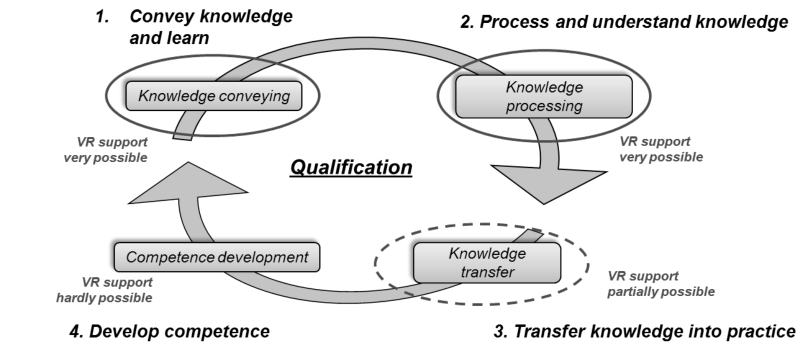
The process of qualification, according to Kuhlmann and Sauter (2008), can be subdivided into the four stages of: knowledge conveying, knowledge processing, knowledge transfer and competence development (see figure 1).
Figure 1. Process of qualification (according to Kuhlmann and Sauter, 2008)
In the knowledge conveying phase, it is that knowledge which the learner needs in order to cope with the problem to hand which is made available to them. Different methods can be used for communicating knowledge. The use of VR in this regard is a very good and versatile option. During knowledge processing, the knowledge gained in the previous stage is consolidated. This can take place, for instance, through exercises, simulation games, or case studies. The use of VR systems or similarly novel media is also very much to be favoured for this phase (according to Thümer, 2012). This, however, still does not establish qualification; for this, knowledge needs to be transferred into practice. Hence the knowledge is given a practical reference within the learner's personal realm of experience. Thus the individual qualification is developed. At the same time, the practical reference can only partly be established by means of a VR system. The development of competence can only take place in real situations in which the learner is self-dependently challenged in the workplace. Because the path to development of competence can only be configured individually and personally by each learner (according to Geithner et al., 2008), the possibilities of a qualification which is not based on individual advancement and thus exhibits a certain standardisation, is exhausted with the completion of the knowledge transfer stage.
COMPONENTS AND APPLICATION PHASES OF VIRTUAL- REALITY-SUPPORTED LEARNING SCENARIOS FOR MANUAL ASSEMBLY The conceivable life cycle phases of an assembly area in which VR support is possible are: restart, operation, alterations due to new products, assembly processes or production resources and disruption. In the case of restart, after successful VR supported qualification, already qualified employees are available who can be could be used immediately for the assembly work and no real resources would have to be tied up for qualification purposes. Even during the assembly operation the area can be utilised entirely for the assembly process; (further) qualification can take place with VR support which guarantees constant flexibility in the implementation and currentness of the learning content. Where a disruption exists or the implementation of an alteration in respect of the assembly product, processes to be undertaken or the tools /production resources to be used, a rapid reaction to the marginal conditions is possible. This makes an important contribution to the further increase in flexibility and speed of adaptation of the manual assembly process. Disruption avoidance strategies can be very quickly integrated into the qualification process.
The components of a VR supported learning environment are widely diversified. The following are some of the components which can be integrated into the VR scene:
illustration of CAD models of the assembly objects,
depicition of fundamental technologies,
animation and simulation of processes and process variants,
illustration of different work place variants as well as
visualisation of operating and production resources.
Theoretical content must also be conveyed for effective learning success. In this regard it must be borne in mind that not all part procedures can be implemented within the qualification process efficiently with VR support. Which is why typically alphanumeric information, photos, graphics, CAD data or videos are also lodged in the learning scenarios. The connection to multimedial and virtual learning interfaces would be particularly helpful in this. Apart from that, haptically tangible learning scenarios are needed for learning practical assembly assignments. At present, these can only be configured using physical system elements such as components, prototypes, tools and assembly fixtures.
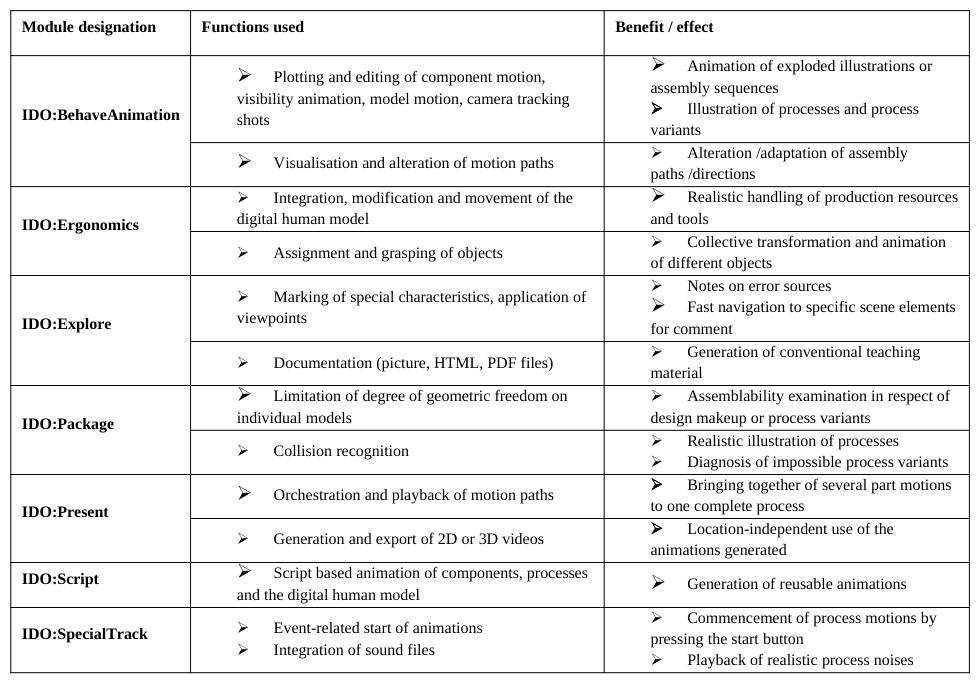
VISUAL DECISION PLATFORM AS POSSIBLE SOFTWARE SOLUTION Due to the existence of special and diverse hardware and software, a multiplicity of variants on interaction with the virtual world exists. The visual decision platform (VDP) from the company ESI Engineering System International GmbH is one possible VR software solution which is used at the Mittweida University of Applied Sciences in the faculty of Mechanical Engineering. By means of the VDP, three-dimensional data can be illustrated stereoscopically and it can be integrated with them in real-time. Table 1 shows the software modules used for the specific applications in the current version. The module IDO:Explore is necessary as the basis for any application on the desktop (2D GUI) or on the Powerwall (3D GUI). All further modules build on its basic functions. Within IDO:Explore, problem-free switching between the other modules is possible at any time.
Differentiation is made between functions, which are used by the tutor in the so-called desktop version of the VDP for the purpose of preparing the learning scene, and functions which the learner uses in support of the learning process on the stereoscopic system. The topics treated thereby range from the spatio-logical arrangement of the objects in the geometrical and structural view combined with the understanding of the technical functioning of the components, through the control of the design-determined assemblability of the individual parts, to the consideration of ergonomic problems in the configuration of a specific work place in practice. By means of the modular configuration of this software, the clear allocation of functions for the individual areas of application and cases is possible. Case-specific usable elements of one such VR based learning scenario related to the available software solution as well as its design procedure. Thus generates a largely standardised procedure which can be adapted to the relevant application case by means of the targeted call-up or exclusion of individual scene elements within the overall scene.
Table 1: Application of selected software features for learning elements (Goldhahn and Thümer, 2013b) Module designation Functions used Benefit / effect
STRUCTURE AND CHARACTER OF VIRTUAL-REALITY- SUPPORTED LEARNING ELEMENTS Learning elements are standardised qualification resources in terms of build-up and cycle. Their content is the result of meaningful modularisation of operation sequences. The main area of application for learning elements always exists where a competence, which is to be developed by means of a learning process, is so demanding or extensive or both that the learning process itself would be altogether considerably less successful without modularisation than with the implementation of learning elements. The advantages of such a modularisation lie, amongst other things, in a contraction of the development period and development complexity, a general usability of the individual modules, less documentation complexity and lower organisational complexity due to a reduced number of part systems.
Learning elements are distinguished by the following attributes:
standardised build-up,
object-overlapping usability,
deployment of different learning methods,
hierarchic and/or sequential linking,
recognition of general ergonomic principles as well as
consideration of individual prior knowledge.
The build-up of learning elements is likewise standardised. It falls into five core areas which in turn can each contain sub-areas (Goldhahn et al., 2012). In the first part, which contains general information, the title of the learning element, its content, the stipulated learning objective as well as the indexing in the overall system of all the learning elements and a brief description of the composition of the learning element are summarised. Apart from that, this section contains the knowledge and competencies which the learner has to bring with them in addition to the learning resources used. The second and most comprehensive section is the learning content. This contains a motivation for the learner to get involved with the learning content as well as a brief introduction to the range of topics. Moreover, the tools to be used and/or other technical resources are clarified. The necessary knowledge base for the skills to be attained is thereby accomplished. In the last point of this section, possible errors which can occur in the execution are pointed out in addition to special characteristics of the learning content and possible sources of error. This section will vary greatly from learning element to learning element in respect of scope and content. In the third section, the knowledge learned and skills attained up to that point are repeated in practical exercises and thereby consolidated. The way in which these exercises are performed will differ from case to case. Moreover, in section four the learning success is checked in the form an achievement control. This achievement control establishes by means of bullet points whether the learning content conveyed has been understood and that the knowledge and competencies learned can consequently be assumed in the future as known by the learner. Further learning elements can be later built on the back of this, for example. The last section contains information and references for the learner which is not a part of the actual learning content and hence need not be presented to the learner. In this section, the methodical first principles to be used, the necessary technical prerequisites as well as special learning directions on the individual sections, amongst other things, are gone into.
PROCESS OF DESIGNING VIRTUAL-REALITY-LEARNING- ELEMENTS FOR MANUAL ASSEMBLY In compiling learning elements, the use of a standardised procedure is recommended such as that illustrated in figure 2. Based on the very competence which is stipulated for a specific work sequence, this competence must be transformed into clearly defined requirements and also into the necessary learning content. A classification can be deduced from the needs conveyed for the learning content. Using this classification, the learning content is adequately described in the three dimensions "assembly element", "assembly process" and "assembly equipment". Suitable learning elements which already exist can be searched on the basis of the established classification. If the classification of the learning content matches one of the existing learning elements then this can be selected directly and subsequently used straight away. Where no suitable learning element is found then the necessary data, the learning content, is first gathered. To this end, explicit available knowledge is assembled from employees specialised with regard to content (e.g. workers already employed in the assembly area) and where possible their implicit knowledge and their experiences also recorded. This knowledge on a more comprehensive topic is thus collected and initially documented, without adherence to a specific outer form or fixed structure, which secures the preservation of the actual content. The learning content then has to be structured into learning elements in accordance with the standardised configuration. In the course of this, the necessary amendments are made to the content; the essential work content exists in the methodical editing. This is carried out by pedagogic specialists. For example: the learning method and technical resources must be selected here or the individually stipulated preconditions established. Apart from this, attention has to be paid to linking the individual learning elements with each other in terms of content (also between different areas of topic). The learning elements are compiled here using the bottom-up method where possible meaning that the learning content has to be integrated as universally as possible which promotes versatile application. Normally, after carrying out this step, the majority of learning elements will be linked together. After the contextual and methodic-didactic configuration of the learning elements, these are checked for relevance of content. In so doing, a test has to be performed as to whether each of the individual learning elements represents a discrete module which can be used autonomously and autarkically. This test should likewise be carried out by specialist employees who check it for the preservation of the original practical relevance thereby securing the usability for the target group. The result of this control will establish whether modifications in the form of alterations, amendments or adaptations are necessary. Should this be the case, the learning element must be corrected accordingly and subsequently retested. The newly generated learning elements are likewise to be classified. All classified learning elements are integrated into the overall system in the final step.
(Goldhahn and Meißner, 2012), (Thümer, 2012), (Goldhahn et al., 2012)
Embedded persons
Start
Educational competent person Content competent person
Legend: … Start or end (borderpoint)
Determining the required target skills
… Process
Request catalog
… Document … Information
… Decision
Classification of the required learning content
… Information memory
Classified required learning content
N
Y Corresponds the required learning content to the classification of an existing learning element?
Receiving information
Description, structuring the learning element
Selection of an appropriate learning element
Learning element
Test of the learning element
J Revision/adaption/ Changes necessary?
extension N
Classification
Classified learning element
Overall system
Position in the overall system
End
Figure 2. Process used for designing learning elements (according to Thümer, 2012)
Figure available in the original PDF paper.
FUNCTIONS AND PROCESSES OF DESIGN AND APPLICATE LEARNING ELEMENTS USING VDP Overview
The procedure for the compilation and use of Virtual-Reality-supported learning elements utilising VDP can be subdivided into three sections. The fundamental conception takes place outwith the VDP in separate software solutions or entirely without computer assistance. Thereafter, the necessary functions are prepared in the VDP before the actual implementation and use of the learning elements can take place in the last section.
Conception - outside VDP Preparation outwith the VDP is limited in the first section to the conceptual and constructive-conditional description and preparation. This section is illustrated in figure 3. After establishing the qualification needs by means of the targeted comparison of stipulated and available competence, the stipulated learning content must be clearly defined and demarcated. If the necessary information has been recorded by means of different processes and documented without adherence to a specific form or structure then didactic editing in addition to integration in terms of the methods used is necessary. From this integration and editing arises the actual learning scenario which, as a rule, contains VR supported and non-VR supported learning items. If the decision has been made for a VR implementation, the illustrative basis has to be produced in the form of the necessary CAD models. The individual models are to be prepared within a suitable CAD program in such a way that they can subsequently be used in the VDP. This includes, amongst other things, an appropriate number of object nodes or the adaptation of the polygon count per node. To be able to handle the subsequent VR model efficiently, all objects, the collective use of which is envisaged in the VDP, should be combined into parts. Conversely, parts or geometries which have already been combined and which are envisaged for individual use in the VDP are broken down into different object structures. Subsequently, the models must be converted into a VDP-compatible format such as VRML, Fraunhofer Standard or CSB. If the CAD program does not support the possible export formats then other external software must be used for the conversion.
1. Conception - outside VDP
Start Legend: … Start or end (borderpoint) Redording, description and preparation
of the learning contents
… Process … Necessary software modul
Methodological integration Didactic preparation
… Junction
Structuring the learning element Selection of VR supported learning items
Composit of non-VR supported learning items
Procurement of the CAD models Maya
CATIA
*.mb
Inventor Construktive processing
*.ma in the CAD program
AutoCAD
*.wgz
SolidWorks ProE *.iv Export in a VDP compatible
*.wrl
...
file format *.csb
...
A B
Figure 3. Software technical procedure of design and applicate learning elements using VDP (part 1)
Figure available in the original PDF paper.
Edition - inside VDP The following steps take place within the desktop version (2D GUI) of the VDP after the CAD models have been imported into it. Figure 4 gives an overview of this section. The scene is then arranged spatially and logically parallel in the geometrical and structural view. For each relevant node there are fundamental attributes to be fixed which influence its subsequent handling (e.g. "Collision handling" for collision analyses, "Dynamic" for manipulation and animation, "Cuttable" for sectional illustrations). The insertion of a digital human model is also possible. When doing so, particular attention should be paid to the separate logic of this model in the IDO:Ergonomics module. After the preparation, a defined and reproducible initial state can be created which can be used as the basis for all further observations.
A
2. Edition - inside VDP (2D GUI) IDO:Explore
Gender region
Import of the CAD models
Percentile Integration of the Age digitalen human
Collision Handling
Acceleration
Pickable
Somatyp
Spatial arrangement in the geometry view
Logical arrangement in the structure view Visible
Proportions
Dynamic
Population templates
States
Raytraced
Motion
Definition of the
Specification of relevant
Viewpoints initial state
attributes Override Volume
Ergonomic analyzes
Marker IDO:Ergonomics
Melt Offset
Gripping and viewing areas Observer positions
Cut Collision Cut Color
Object Connect
Creation of selected static
Cuttable
and dynamic functions Measurement function
State Elements
Material properties Object transformation IDO:Explore
Figure 4. Software technical procedure of design and applicate learning elements using VDP (part 2)
Figure available in the original PDF paper.
By using selected static and dynamic functions, a multiplicity of targeted learning functions can already be realised. This includes, amongst other things, the illustration of technical functionalities in addition to the handling of tools via a combination of limited degrees of freedom and grasped objects in conjunction with the digital human model. In so doing one avails oneself primarily of the functionalities of the IDO:Explore and IDO:Package modules whereby the (temporary) alteration of selected attributes is also partly necessary. An important contribution to the realistic configuration of virtual learning scenarios is made by the animation of objects. This can take place directly in the combined processing of the geometrical and structural view in the IDO:BehaveAnimation module or by means of script based Python programming in the IDO:Script module. In the first variant one again has the three options of recording, mapping or authoring. The individual part animations are then available as key-frame sequences. The temporal and/or spatial position of each of the key-frames can be visualised and also still subsequently altered or corrected. From a number of different part animations, a complete animation is then generated in IDO:Present by means of so-called orchestration. During this orchestration, the individual parts can be positioned adjacent to and on top of each other in terms of their temporary alignment and length so that a superimposed complete animation is generated. When selected static or dynamic functions are to run as a result of a certain action, one avails oneself of the functionalities in the IDO:SpecialTrack module. This allows, for example, machine movement to be started by means of "virtual push of a button" or characteristic background noises to be integrated. A multiplicity of multimedia-characterised documentation elements (e.g. text, pictures, two or three-dimensional video) or a combination thereof can be derived from the scene. The scene itself is saved with all its elements in the VDP's own format and thus remains available for subsequent use.
Application and implementation The actual use of VR supported learning scenarios likewise takes place with the aid of the VDP, but in stereoscopic space (3D GUI), i.e. immersively. To do justice to the methodical and didactic requirements from the preparation, the VR supported and non-VR supported learning items have to be brought together at this point (illustrated in figure 5).
C B
IDO:ImmersiveWorkspace
3. Application and implementation according to construction of the learning element
Implementation of VR supported learning items
Implementation of non-VR supported learning items
(3D GUI)
Representation of static functions
Use of dynamic functions Interaction of learners
End
Figure 5. Software technical procedure of design and applicate learning elements using VDP (part 3) EXAMPLE
Figure available in the original PDF paper.
The VR supported structural principle described together with the variants have been reviewed in several projects with students and representatives from companies and thus evaluated. This concerned the practicality in particular of coping with learning elements as well as the acceptance of the usability of the VR technique in supporting the learning process. Within the scope of one of these operations a learning element on the topic "Fitting radial shaft seals to DIN 3760" was created (Goldhahn and Thümer, 2013a).
With reference to the general, standardised configuration of a learning element, the following content, amongst other things, was gone into in the second section of this learning element.
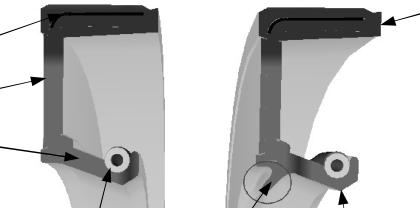
Geometric structure of the radial shaft seals (see figure 6)
Application and characteristics
Types (A, B and C; each with and without dust lip)
Materials used (NBR, EPDM, …)
Fitting direction and fitting variants
Storage and handling
Overall tribological system
Dimensions and labeling specifications (DIN 3760, 1996) Form A Form AS
Face
Stiffening ring Floor area
Membrane
Sealing lip Dust lip Tension spring
Figure 6. Types of radial shaft seals and their components in cross-section (selection) To guarantee the correct guidance of the shaft seal into the bore as well as a secure seating, knowledge of the applied forces (figure 7) is essential as this yields, among other things, the magnitude of the mating force to be applied or allowances on the shaft diameter for producing a press fit. This press fit results, in conjunction with the tension spring, in an internal radial force which, with the external radial force, fixes the shaft seal in its seat. This resistance is expressed through a frictional force which must be overcome during the assembly. It can be directly influenced by reducing the friction coefficient, e.g. by lubricating the shaft and shaft seal. An overview of the applied forces is given in figure 7.
Radial shaft seal Component to be sealed I (casing) Friction force
Normal force Axial force
Radial force (outside) Radial force (inside)
Component to be sealed II (shaft)
Figure 7. Overview of applied forces (in cross-section)
Figure available in the original PDF paper.
To be able to guarantee safe and long-lasting operation, operating media, operating temperature, rpm, peripheral speed and the application of pressure are gone into within the learning element. The peripheral speed must in this respect be positively maintained within a defined range in order to avoid overheating and premature wear. The principle of this dynamic seal which seals off components parts which are rotating against each other is explained for different application examples (drive system engineering, household appliances, construction machines, shipbuilding etc.). Depending on the qualification objective, the mechanics of static and dynamic leak-tightness as well as individual frictional situations can also be gone into. This specifically yields the correct selection of the suitable type and, where applicable, the use of special configurations or aids (e.g. support rings). At the same time, the characteristic as a wear part as well as the requirements on the surface quality of the shaft and the design of the bore is gone into. In the course of this, CAD models of the assembly object are made available to the learner in addition to typical installation cases. The required knowledge is conveyed. For assembling the radial shaft seals, fitting aids, fitting sleeves, fitting sockets, fitting cones or various press tools etc. are an option in specific applications (according to Wittel et al., 2011; DIN 3760, 1996).
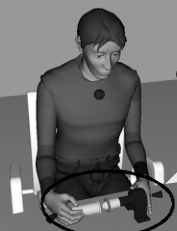
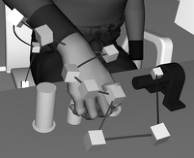
Visualisation of the actual assembly procedure is effected with the aid of the digital human model in the VDP. This performs the insertion of the radial shaft seal with the different assembly aids in differently prepared animations. Figure 9 shows the screen snapshot from the assembly procedure animation with the digital human model and with the aid of the fitting sleeve and fitting socket tools. In the course of this it is pointed out in particular, among other things, that only new shaft seals are to be used, that the fitting is to be performed perpendicular and centrally to the shaft, that the shaft seal must neither be distorted nor used for transmitting forces and to maintain a dwell time to prevent spring-back.
Radial shaft sealing ring Demonstrator Mounting socket Mounting sleeve
Figure 9. Screen snapshot of the animation of the assembly procedure
For this reason the preparations within and outwith the VDP are to be implemented as described. Figure 10 shows the established starting point (left), the correction of the key-frames and the motion path (centre) in addition to the assembled state in the orchestrated full animation (right).
Temporal visualization and
Logical starting point for creating a partial animation
correction of key-frames
Play the animation orchestrated
Geometric starting point for creating a partial animation
Spatial visualization and correction of the motion path
Figure10. Exemplary application of the digital human in a virtual learning environment To achieve a good learning effect, practical exercises using real parts are performed subsequent to this. Achievement control is implemented based on a mix of various test questions in conjunction with the practical procedures.
CONCLUSIONS
Due to a multiplicity of competitive, technical and demographic influencing factors, concepts for maintaining and extending an existing qualification will become of constantly increasing significance in companies. With the learning element concept presented, a possible solution strategy for improving this situation is envisaged. By means of this qualification aid, it has become possible to map product-independent knowledge and competencies and thereafter to use these flexibly and in various combinations. The potential of this modern technology lies here, in addition to the visualisation of existing 3D CAD models of the assembly products, in the targeted and realistic illustration of complete working systems which leads to an "imagination" for the user. Apart from this, there exists the possibility of animating or simulating assembly processes and different process variants without real resources having to be produced or occupied. The application is effected for manual assembly which is characterised by a high proportion of necessary practical knowledge, skills and proficiencies in the activities to be performed. A concept has been presented for the compilation and use of learning-elements and explained on the basis of extracted examples. The usability of the concept for different life cycle phases of an assembly work system has been demonstrated.
REFERENCES
DIN 3760 (1996) „Deutsches Institut für Normung e.V.: DIN 3760: Radial-Wellendichtringe“, Berlin: Beuth Geithner, S. Krüger, V. Pawlowsky P. (2008) „Wissensmanagement in der lernenden Organisation“, in: Strategische Personalentwicklung, Meifert M.T. (Ed.), Heidelberg: Springer Goldhahn, L. Meißner, N. (2012), „Multimediale Lernbausteine für die Teilefertigung“, in: Scientific Reports Wissenschaftliche
Zeitschrift der Hochschule Mittweida, Nr.3, pp. 99-104 Goldhahn, L. Meißner, N. Müller-Eppendorfer, K. Thümer, C. (2012), „Multimediale und Virtual-Reality-basierte Planungs- und Lernbausteine für die Teilefertigung und Montage“, in: Integrierte Planung in der Produktentstehung. Feature-basierter Ansatz zur durchgängigen Planung von der Konstruktion bis zur Fertigungssteuerung, ZKProSachs (Ed.). Berlin: Mensch und Buch. pp. 175-229 Goldhahn, L. Thümer C. (2013a), „Systematik Virtual-Reality-unterstützter Lernbausteine für die manuelle Montage“, in: 4.
Symposium Produktionstechnik innovativ und interdisziplinär, Heft 5, pp. 174-179 Goldhahn, L. Thümer C. (2013b), „Gestaltung und Anwendung Virtual-Reality-unterstützter Lernbausteine für die manuelle Montage“, in: 10. Fachtagung Digital Engineering zum Planen, Testen und Betreiben technischer Systeme, Schenk, Michael (Ed.). pp. 177-182
Kuhlmann, A.M. Sauter, W. (2008), „Innovative Lernsysteme: Kompetenzentwicklung mit Blended Learning und Social Software“, Berlin Heidelberg: Springer North, K. (2011) „Wissensorientierte Unternehmensführung - Wertschöpfung durch Wissen“, Wiesbaden: Springer Nyhuis, P. Reinhart G. Abele, E. (2008) „Wandlungsfähige Produktionssysteme: Heute die Industrie von morgen gestalten“,
Hannover: TEWISS Jenewein, K. Schenk, M. (2010) „Virtuelle Realität in der technischen Aus- und Weiterbildung – Gegenstandsbestimmung und Umsetzungsbeispiele“, IBBP-Arbeitsbericht Nr. 74 Schenk, M. Wirth, S. (2004), „Fabrikplanung und Fabrikbetrieb. Methoden für die wandlungsfähige und vernetzte Fabrik“,
Berlin Heidelberg: Springer Thümer C. (2012), „Konzeptionelle Entwicklung von Lernbausteinen für die manuelle Montage unter Nutzung von Virtual Reality“, Master Thesis, Hochschule Mittweida Wittel, H. Muhs, D. Jannasch, D. Voßiek, J. (2011) „Roloff/Matek Maschinenelemente: Normung, Berechnung, Gestaltung“,
Wiesbaden: Vieweg + Teubner
LISTED IN THE AHFE DIGITAL BOOKSTORE CATALOGUE
Explore the complete digital volume
Advances in The Ergonomics in Manufacturing: Managing the Enterprise of the Future
Read this individual research paper free through the original publisher, or explore the full digital proceedings book.
ISBN 978-1-4951-2103-6
Explore this ISBN in the AHFE Bookstore ↗Listed in the July 2026 bookstore catalogue; search by ISBN to confirm current availability · Digital book purchase optional