Paweł Królas (2020). Human Aspect and Risk in Quality Management Systems. In: Advances in The Ergonomics in Manufacturing: Managing the Enterprise of the Future. AHFE Open Access, vol. 12. https://doi.org/10.54941/ahfe100433
The fundamental aspect of enterprise activates concentrate on creating the value to the owner of the business. The organization is able to fulfill the requirements of the stakeholders by creating management system. One of the most popular management systems occurring in the organizations all over the world based on ISO requirements. Such model consists from different elements which also include human resources. The paper presents managerial aspect of human activity and risk according to the most popular Quality Management Systems. The first part of the paper concentrate on transfer knowledge from the management part to the operation filed of the organization. The second part of the article constitutes connection between chosen ISO management standards and the meaning of the human aspect in manufacturing. The last part of the paper deal with new proposal of the system which could be introduced in the turbulent environment of the enterprise. Article describes theoretical and practical aspects of the ISO systems implementation in small, medium and large organizations according to the human aspect and risk. It also presents the basic idea to the new system which concentrates on opportunities which occurs in changing environment of the enterprise.
Systemic change in the years 1989/1990 in Poland from a centrally planned economy to a market economy changed the understanding the meaning of the client to the enterprise. The beginning of 90-ties was characterized by fast, dynamic, rapid increase of the enterprise and series of bankruptcies of the organizations that were not able to match their offer to new market. Products and services offered by the enterprises were sold in short time. The situation in which supply of the clients could meet the demand of the market quickly changed. The price of the products or services ceased to be the only aspect in deciding on the purchase of the goods. Customers began to attach importance to the quality of the products and services provided by the enterprise. To improve the market situation polish enterprises started to introduce the ISO (International Organization for Standardization) standards.
In the early 90's there was a rapid development of Quality Management Systems, primarily the Quality Management System - ISO 9001, which contributed to the improvement of the quality of products and services. This standard had an impact on the growth of innovativeness of Polish enterprises. The result of the implementation of the ISO was increased confidence of stakeholders to the enterprise as well as foreign investors. Particularly, it was important for enterprises which produce their products for export. The enterprises which possessed the ISO certificate decreased the number of customer audits in the organizations (Królas, 2013, p. 53).
ISO standards became more popular in polish enterprise. Enterprises started to introduce new standards: Environmental Management Systems - ISO 14001, Occupational Health and Safety Management Systems (later polish norm PN-N-18001) - British specification OHSAS 18001, Information Security Management Systems - ISO 27001, as well as industrial standards - Food Safety Management Systems - ISO 22000 and others (Królas P., Królas L., 2010, p.149). The pro-quality systems have been introduction in all kind of the enterprise. At the beginning, the organization which implemented ISO standards were characterized by size – mainly it were large organizations, high innovate enterprise and theses of the enterprise which understand the needs of improvement of the operational form of enterprise activity. Similar action could be notice in medium size enterprise. Small organizations introduce ISO systems because of the needs of the improvements, fulfillment the conditions establish by large organizations, and tenders procedures.
DEVELOPING OF ISO STANDARDS The most popular ISO standard which has been implemented in polish organizations is Quality Management Systems - ISO 9001. The standard could be introduce to all kind of the organizations, regardless of type, size and product provided (ISO 9001, p. 12). Quality Management Systems are popular in many industries: production, energetic, mining, logistic, trade, service, etc. In the recent time ISO 9001 has been introduce in many kind of the administration sectors, especially government ministries, city halls and regional administration office. Such approach it is connected with the National Development Strategy 2020 (Ministerstwo Infrastruktury i Rozwoju). The main point of this Strategy is to improve the processes, objectives and competence approach in National Administration.
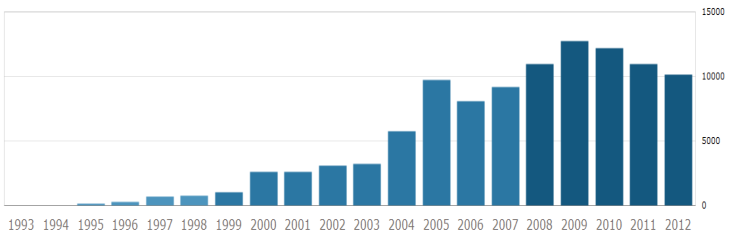
Figure 1. Evolution of ISO 9001 certificates in Poland. (from www.iso.org)
Figure 1 presents number of ISO 9001 certificates issued by certification bodies. The number of ISO 9001 certificates increased up to the year 2009. In 2005 the number of the organizations which got certificate ISO 9001 was 9718. It was more than in 2006 and 2007, but still the tendency was optimistic for the market. In 2009 the number of issued certificates ISO 9001 by the certification bodies achieved 12707 certificates. From this year, there has been a decrease tendency on the market according to this standard.
Another standard which is characterized by the high popularity in polish organizations is ISO 14001 – Environmental Management Systems. The number of issued certificates ISO 14001 by the certificates bodies has increase from 72 in 1999 up to 2014 in 2012 (www.iso.org). The organizations which implanted this standard creates image of the enterprise which is friendly to the environment, respects law regulations, improve the environmental and work conditions (Wawak, 2011).
In the recent time, number of industries certificate has increased. In Poland, especially in Wielkopolska Region, it is possible to noticed, the popularity of car industry requirements. ISO/TS 16949 - Quality Management Systems dedicated to automotive production and relevant service part organizations. This standard was developed by the International Automotive Task Force (IATF) which includes requirements from nine different car producers: Ford, GM, Chrysler, BMW, VW, Daimler, Renault, PSA Peugeot Citroen, Fiat from France, Germany, Italy, UK and USA (Sokołowicz, Srzednicki, 2006). This standard is crucial for car industry and cooperators which support automotive producer occurring in Poland: VW, Opel, MAN, Solaris Bus & Coach, Inter Groclin Auto and others. The numbers of the certificates increase from 77 in 2004 up to 505 in 2012 (www.iso.org).
Another example of increase the number of ISO certificates is industrial standard ISO 22000 (Food Safety Management System). The main purpose of this standard is to enable the identification, monitoring and controlling risks that may arise in the process of manufacture and storage of food products (Kędzior, Ptasińska, 2005). In 2007 the number of certificates ISO 22000 which have got polish organizations amount 137; in 2012 it was 659. Each of the listed standards: ISO/TS 16949, ISO 22000 based on the ISO 9001:2008. This standard gives the fundaments to the others pro-quality systems. The construction of this standard allows to transfers the strategy objectives of the enterprise to the lowest parts of the organizations. Engagements of people and respects of the procedures make a significant role in the Quality Management Systems (QMS).
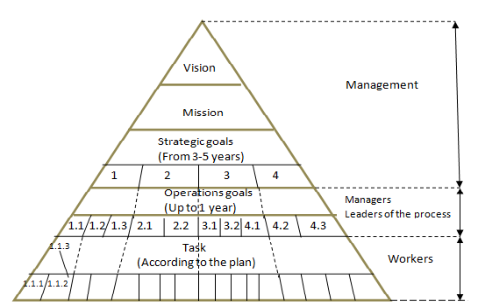
HUMAN ASPECT AND RISK Quality Management System could ensure objectives of the stakeholders. Understanding the idea of the systems, processes and the need of continually improvement by the employees is conducive to develop of the system. Each of the systems consist form vision and strategic objectives – Figure 2.
Figure 2. Managerial idea of the QMS (from Królas, 2013)
Each of the ISO systems has got specific requirements. ISO 9001 forms common part of different pro-quality systems. Basic idea of Quality Management System consists from three elements: Assumptions to the system
The management board establishes the QMS policy which is connected to the vision and mission of the enterprise. All employees can submit their proposals dealing with the general shape of the quality policy of the enterprise. As the document, quality policy includes strategic objectives which are transfer to the operational goals and tasks. Each of the strategic goals has got particular resources, indicator and the responsible unit. Every objectives or task must be specified according to assigned resources, responsible person, time limited etc. (Królas, 2013, p. 10).
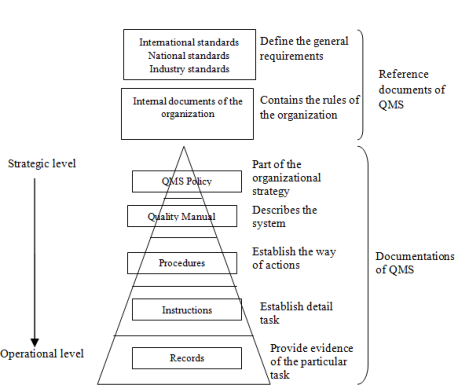
Operational Activities This part consists from the operational documents, sequence of the processes, system oriented procedures and instructions – Figure 3.
Figure 3. The hierarchy of QMS documentation. (Adapted from Hamrol, Mantura and Wawak)
The number of the procedures and instructions depends on the size of the enterprise and competence of the workers. The process approach focuses on three main groups of processes:
- Management processes - mainly regulatory and decision-making processes e.g. Human Resource, Management of the QMS etc. - Main processes - lead to the market value of the products and are a source of revenue and profit of the
organization. Their inputs and outputs could be assigned to an external client which puts certain requirements e.g. Plan of the production, Production, Sell etc., - Supporting processes – support the basic processes and provide data, information, or regulate the course of action. Do not lead to the creation of value-added to the customer e.g. Finance, Service, Internal Transport etc. (Hamrol, Mantura, 2005). - Each of the process has got the leader of the process; mainly it is middle class manager who is responsible for the realization of the process. Indicators of the process provide proper realization of the process. In case of interference of the process, the leader of the process identifies the reason of disruption. The owner of the process is supported by a competence employees assigned to a specific department. The number of employees which take part in the process depends on the size of the enterprise, type of the production, product complexity etc.
Monitoring and Control Quality Management Systems provide two basic tools to monitoring and controls: quality audits and management review. Each of the tasks should be done at least one time a year.
- Quality audits – it supports the organization in achieving its objectives by bringing a systematic and consistent action for assessing, improving the effectiveness of risk management, control of the systems and processes of the organizations (Czerwiński, Grocholski, 2003). The main objective of internal audit is to assess the conformity of measures implemented according to the QMS, evaluate their effectiveness and take corrective and preventive actions (Hamrol, Mantura, 2005). Auditors are mainly employees of the organizations, after specialized training course. Their knowledge is very useful to improve the activity of the organization. Audit could be internal (in the organization), external (e.g. to the need of the purchase), certification (made by certifications body). Properly conducted and developed audit is an effective tool for managing the organization (Hamrol, Mantura, 2005). - Management review – it is a periodic, scheduled and documented meeting of the leadership of the organization
with the leaders of the processes and managers responsible for implementation of the objectives of the quality policy to assess the effectiveness of the QMS by comparing the plan objectives to obtained results (Hamrol, Mantura, 2005). - Effectiveness of the Quality Management Systems depends on the commitment of top management and employees. The idea of the system approach to the management gives the measurable value to the organization.
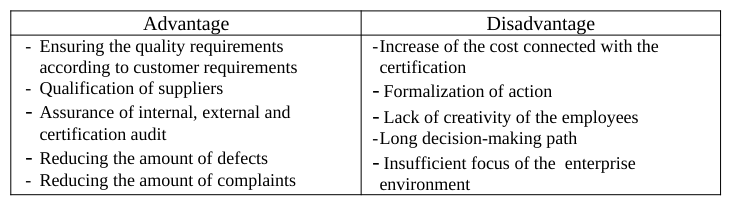
ADVANTAGE AND DISADVANTAGE OF ISO STANDARDS Development and implementation of pro-quality systems gives organizations the tangible benefits. It is also possible to notice some disadvantage connected with the ISO systems. Table 1 presents the main advantage and disadvantage connected with the introducing the ISO system into the organization.
Table 1: Advantage and disadvantage of ISO standards (Adapted from: Tabor, Zając, Rączka, 2000, Kotler, Caslione, 2009) Advantage Disadvantage - Ensuring the quality requirements
Pro-qualities system concentrates on the operational activities of the organizations. In a limited way it takes into the account the importance of the environment and business risk. The most popular standards ISO 9001:2008 have not included any systematic actions dealing with the turbulence, risk, uncertainty and opportunity. The answer to such problem could be made by the correlation of pro-qualities standards with the system concentrating on the opportunities.
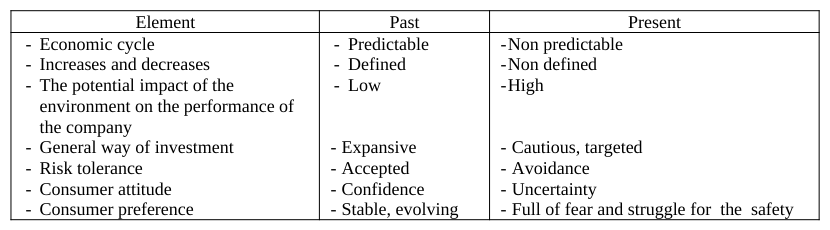
OPPORTUNITY QUICK RESPONSE MANAGEMENT SYSTEM The organization is able to shape the future by concentrating on the opportunity which exists in turbulent environment. The enterprise which could be able to joined the combination of thinking, planning, and reacting to the events that emerge in the environment could provide expected product for the customers (McKeown, 2012). Table 2 presents global market situation which has been changed in the recent time.
Table 2: Global market situation (Adapted from: Kotler, Caslione, 2009)
Time of simple organizational solutions has passed. The customers are not willing to take the risk. The turbulent situation on the market forces on the enterprise and customers to act in a planed way. One of the main factors is to manage the new organization's ability to perceive and use of unforeseen opportunities present in the environment while maintaining business functions to minimize risk and maximize the chances of success (Królas, Trzcieliński, 2010).
In such circumstances in is possible to establish the bases condition for the Opportunity Quick Response Management System. Figure 4 shows the basic idea on such System.
Figure 4: Basic idea of the Opportunity Quick Response Management System (Adapted from: Trzcieliński, 2011)
Figure available in the original PDF paper.
The presented Opportunity Quick Response Management System takes the operational aspects form the Quality Management Systems. Concentrations on core business of the enterprise can provide value added to the customer. Some elements of supporting process, based on lean management meta-concept (reduce the waste) could be transfer into the outsourcing process (Trzcieliński, 2007). Thanks to such approach organization has got better possibilities to use resource (especially financial resource) and is able to achieved advantage in turbulent environment. Process approach ensures the concentration on the value added to the customer.
Each of the opportunity presented on Figure 4, could create a new value the enterprise. The competitive environment is characterized by common access to the information, aggressive and unpredictable actions of the competitors. In such circumstances the enterprise with possessed well qualified employees who are working in small teams is able to compete on the market.
The macro-environment segments creates an opportunity which are predictable in long period of time e.g. changes in legislation in European Union. Some of the segments creates unpredictable opportunity e.g. conflicts which change the economic situation on particular area.
CONCLUSIONS
Pro-qualities ISO standards have been implemented in polish organizations at the beginnings of 90-ties. An approach to pro-quality systems has been changed along to the needs of the market (Królas, 2010, p. 151). The first standard ISO 9001 was introduced on the market in 1987. Novelization which was done in 1994 unified the terminology, documentation and also changed the terms: “purchaser” into the “customer”. The changes made in 2000 were deep and gave new open to the standard. The main aspect of the ISO 9001:2000 introduced the process approach in the organization. The last amendment in 2008 did not give the answer to the market needs (Wawak, 2011). In the recent time, the number of the certificates issued by certification bodies has decreased. It is connected with the cost reduction and additional values which should give the implementation of ISO standards. Based on such circumstances there is strong need of the new version of the most popular ISO standards – ISO 9001 which could concentrate on the needs of the top management of the enterprise.
Presented approach dealing with the Opportunity Quick Response Management System is focusing on opportunity, changes in environments and risk. Such system could be supported by Quality Management Systems in the operational field of the enterprise activity. The idea of this System will be verified during practical research in the enterprises.
REFERENCES
Czerwiński K., Grocholski H. (2003), Podstawy audytu wewnętrznego, LINK, Szczecin Hamrol A., Mantura W. (2005), Zarządzanie jakością. Teoria i Praktyka. Wydawnictwo Naukowe PWN, Warszawa International Organization for Standardization – www.iso.org ISO 9001:2008, Quality Management Systems – Requirements Kędzior W., Ptasińska J. (2005), Systemy jakości w przemyśle spożywczym, „Zeszyty Naukowe Akademii Ekonomicznej w Krakowie” nr 678 Kotler P., Caslione J.,A., (2009), Chaotics: The Business of Managing and Marketing in the Age of Turbulence, Edited by
AMACOM Królas P. (2013), Znaczenie klienta w zwinnym przedsiębiorstwie, Współpraca z klientem. Wydawnictwo: Polskie Forum ISO
9001. Królas P. (2013), Zarządzanie w burzliwym otoczeniu przedsiębiorstwa w oparciu o Zintegrowany System Zarządzania, Relacje, Magazyn Firm Rodzinnych Królas P. (2012), Zarządzanie ryzykiem a redukcja kosztów, Zarządzanie Ryzykiem 2. Ryzyko w działaniach biznesowych.
Praktyczne podejście. Wydawnictwo: Polskie Forum ISO 9001. Królas P., Królas L. (2010), Risk in Management Systems according to ISO standard, Archives of Foundry Engineering, Volume 10, Special Issue 3/2010, Katowice-Gliwice Królas P., Trzcieliński S., (2010), Risk in agile management enterprise, in Stefan Trzcieliński (Ed.), Management concepts,
strategies and structures, Publishing House of Poznan University of Technology, Poland McKeown M. (2012),, The Strategy Book Maverick & Strong Limited, Great Britain Ministerstwo Infrastruktury i Rozwoju, Strategia Rozwoju Kraju 2020, www.mir.gov.pl, Sokołowicz W., Srzednicki A. (2006), ISO. System zarządzania jakością oraz inne systemy oparte na normach. Wydawnictwo C.H. Beck Tabor A., Zając A., Rączka M. (2000), Zarządzanie jakością tom VI, Wydawnictwo Politechniki Krakowskiej Trzcieliński S., (2011), Przedsiębiorstwo zwinnne, Wydawnictwo Politechniki Poznańskiej Trzcieliński S., (Ed.) (2007), Agile Enterprise. Concepts and Some Results of Research, IEA Press, International Ergonomics
Association Wawak S. (2011), Zarządzanie Jakością, Wydawnictwo Helion, Gliwice
LISTED IN THE AHFE DIGITAL BOOKSTORE CATALOGUE
Explore the complete digital volume
Advances in The Ergonomics in Manufacturing: Managing the Enterprise of the Future
Read this individual research paper free through the original publisher, or explore the full digital proceedings book.
ISBN 978-1-4951-2103-6
Explore this ISBN in the AHFE Bookstore ↗Listed in the July 2026 bookstore catalogue; search by ISBN to confirm current availability · Digital book purchase optional