Svetla Fiserova (2018). Influence of Physical Properties of Concrete on Operator´s Exposure to Noise and Hand-transmitted Vibration. In: Advances in Physical Ergonomics and Human Factors: Part I. AHFE Open Access, vol. 1. https://doi.org/10.54941/1004
The contribution is focused on the assessment of influence of material properties on operator’s exposure to noise and hand-transmitted vibration. Screening measurements of work exposure to noise and hand-transmitted vibration were made in accordance with relevant standards for drilling in four types of concrete with different physical characteristics and used for different applications in the construction industry. The measurements were carried out twice in four different types of drilling using a hammer drill, Makita HR 2440. Results obtained by the screening measurements testify to the importance of material physical properties to the amount of operator’s exposure to noise and hand-transmitted vibration.
In the last decades, there has been a significant development in new technologies and machinery innovations. But yet many manual work activities requiring the use of hand-held mechanical, electric and pneumatic tools still exist. Each hand-held tool, containing a motor, is a source of noise and hand-transmitted vibration. Noise and hand- transmitted vibration are risk factors that can affect, from the point of view of human health, the quality of work conditions (Sujova, 2008). Persons that are exposed to long-term noise and hand-transmitted vibration at work are threatened by health permanent professional impairments.
The observation of occurrence of work-related diseases including occupational diseases and occupational disease risks is a significant indicator of health condition as well as work conditions. In the Czech Republic, all newly emerging and recognized work-related diseases are reported, in accordance with valid legal regulations, into the Czech National Registry of Occupational Diseases; data collection and processing are carried out by the National Institute of Public Health of the Czech Republic. According to CZ-ISCO classification, occupational diseases occur most frequently in a case of professions in the category Plant and machine operators and assemblers and in the category Craft and related trades workers. Most frequently, diseases caused by physical factors occur here; such as diseases caused by long-term exposure to noise and vibration usually in combination with one-side load and excessive load (Fenclova, 2012).
Unfavourable effects of noise on human health can be divided into effects on organs and subjective disturbing perceptions. The impairment of hearing organs and the onset of occupational disease, Perceptive cochlear hearing defect, caused by noise are due to extremely high levels of acoustic pressure LAmax (130-140 dB) and also long-term action of excessive noise. The essence of the disease is at first temporarily and later permanent functional and morphological changes in receptor and nerve cells of the organ of Corti of the inner ear. At the beginning, these impairments manifest themselves in a temporary increase in the hearing threshold. If noise acts longer, after a certain latent period, the worsening of hearing and subsequently limitation of speech understanding, tinnitus (perception of sounds without external stimulus “hissing, whistling”) and paracusia (perception of sounds are perceived as transformed “echoes”) will occur. Impaired hearing is sufficiently proved in the case of noise exposure at work depending on equivalent acoustic pressure level and duration of exposure. Noise also affects the cardiovascular system, can cause sleeping impairments and mental stress induced by noise nuisance (Jandak, 2007).
Human exposure to intensive vibration always induces an unfavourable response of human organism. Long-term exposure can cause its permanent impairment. At present, the highest health risk is represented by vibration transmitted to the upper limbs whereas working with various vibrating tools and whole-body vibration (Jandak, 2007). Frequent and long-term exposure to hand-transmitted vibration may lead to various symptoms of health impairments. We are able to identify several types of impairment: diseases of blood vessels and blood circulation, blood vessel impairments leading to so-called VWF (Vibration White Finger), bone and joint impairments, neurological impairment, muscle impairment, other whole-body impairments (e.g. central nervous system). In addition, co-occurrence of several impairments due to vibration is usual, because the presence of one type of impairment often leads to another. The onset of impairment depends on the characteristics of vibration, sensitivity of individuals and on other aspects of the environment. A term “Hand-arm vibration syndrome” (HAVS) is used for various combinations of impairments (Crocker, 2007). Sources of the vibration are above all hand-held tools.
The majority of occupational diseases are due to exposure to noise and hand-transmitted vibration where determined hygienic limits are exceeded and where adequate preventive measures, reducing the effects of risk factors on health, especially use of personal protective equipment, respecting of regime measures, etc., are not respected. The amount of exposure to these risk factors does not, however, depend only on the very type of used tools and the type of performed activity, but it also depends on working position, grasp properties of tools, exerted manual force, properties of working environment, microclimate and in outside workplaces also macroclimate conditions, physical and health dispositions of the operator and duration of operator’s adaptation to work activity being carried out (Novy, 2000). A significant aspect for the assessment of the amount of operator’s exposure is the properties and quality of the material being worked. The influence of physical properties of the material being worked on the amount of operator’s exposure to noise and hand-transmitted vibration is the subject of the presented research.
METHODS
Material under Study From a large variety of manually worked natural and synthetic materials, a construction material, namely concrete with various physical properties was selected for the purpose of research from the point of view of influence of material physical properties on amount of operator’s exposure to noise and hand-transmitted vibration. By the manufacturer of concrete mixtures, four samples of concrete materials of different chemical compositions were provided. From the point of view of evaluation of physical properties, declared minimum compressive strengths were specific to them. Nowadays, the selected concrete materials are in common and frequent use in determined conditions.
Anhyment, cast self-levelling screed based on calcium sulphate is used exclusively for cast floors (for load-spreading layer). As a binder, anhydrite AE or alpha plaster FE is used for Anhyment. Other components of Anhyment are sand, water and admixtures (Ceskomoravsky beton, 2013). Anhyment is an anhydrite cast screed with minimum compressive strength of 20 MPa, minimum flexural tensile strength of 4 MPa, formula No.: AE 20, consistency: F6, strength class according to the standard ČSN EN 13813: CA-C20-F4.
Cemflow, cast self-levelling screed based on a cement binder, supplied fresh by truck agitators directly to the site. To the structure of floors, it is pumped by mobile pumps, further is poured to a required thickness of the structure, and using a simple method of spreading is compacted and levelled. High compactness and perfect application over heating systems minimize resistance in the course of heat transmission, and thus accelerate the heating of the whole heating space of a building; for this reason, it is very suitable for floor heating (Ceskomoravsky beton, 2013). It is the case of a cast cement screed with Dmax = 4mm, minimum compressive strength of 20 MPa, minimum flexural tensile strength of 4 MPa, formula No.: CF20, consistency: F6, strength class according to the standard ČSN EN 13813: CT-C20-F4.
C 20/25 XO, standard concrete, unsuitable for external applications, used for floors. It is the case of concrete with Dmax = 22mm, minimum characteristic cylinder strength of 20 MPa, minimum characteristic cube strength of 25 MPa, for environments without the risk of corrosion and damage (Colleopardi, 2009), formula No.: 250431/250431, consistency: S3, compaction method: vibratory.
C 30/37 XF2, concrete suitable for industrial environments, floor slabs, lower parts of concrete constructions of road structures. This is the case of concrete with Dmax = 22mm, minimum characteristic cylinder strength of 30 MPa, minimum characteristic cube strength of 37 MPa, for environments slightly saturated with water and defrosting agents (Colleopardi,2009) formula No.: 376 943 + retarding agent, consistency: S4, compaction method: rodding.
Measuring instruments and accessories For noise measurement two instruments Acoustilyzer AL1 with a microphone Type 1/2" (Fig. 3) were used. The Acoustilyzer AL1 is a Class 2 integrating sound level meter; for calibration a calibrator of type Brüel & Kjær 4231 Class I was used, uncertainty ui is determined at 1dB. The instrument makes it possible to measure the values of SPL, Leq, LCpeak, Lmin, Lmax in accordance with IEC 61672, has a timer for replicate measurements and a basic range of 30 - 130 dB, 20 Hz to 20 kHz, with an internal memory for 580 results; the instrument is supplied with MiniLINK PC software. The microphone Type 1/2″ is omnidirectional, with sensitivity of (20 ±2) mV/Pa, according to IEC61672 Class 2.
For hand-transmitted vibration measurement, an analyzer of effects of vibration on humans Brüel & Kjær, type 4447 with accessories, namely a three-axis accelerometer, type 4520-002, calibrator, type 4294, holders for measurement on manual machines and cabling supplied directly by the manufacturer was used. It is a case of a handheld instrument satisfying the requirements of relevant ISO standards for the assessment and evaluation of vibration in the place from which it is further transmitted to the human body. It has functions required by the Directive EU 2002/44/EC on the minimum health and safety requirements regarding the exposure of workers to the risks arising from physical agents (vibration). It enables simultaneous measurements along three perpendicular axes and along one axis, RMS measurement and measurement of vibration peaks in the case of each axis separately, calculation of amplitude coefficient (Crest Factor), includes frequency-weighted curves for the effects of hand-arm vibration (HA: hand-arm) and whole-body vibration (WB: whole body) in the case of each axis separately (aWx, aWy and aWz), with memory capacity for 750 measurements.
As for conditions in the measured workplace, always before measurement commencement, readings were taken from an instrument TESTO 177 – H1 (temperature, relative air humidity) and an instrument GPB 2300 (barometric pressure).
Measurement procedure
To achieve the objective, namely the assessment of the influence of material properties on noise and hand-transmitted vibration exposure, drilling with a hammer drill Makita HR 2440 with drilling depth of up to 24 mm and mass of 2.3 kg was selected. Drilling into concrete is the type of working in the course of which over-limit noise and hand-transmitted vibration values are achieved. To increase the objectivity of evaluation of the influence of material properties, two techniques of drilling – vertical and horizontal were used and two bit sizes with a small difference in size – 6 mm and 8 mm diameter bits for concrete. The two techniques of drilling were selected so that the influence of different body postures at work in relation to the amount of noise and hand-transmitted vibration exposure could be minimized. Both the techniques of drilling into concrete are widely used in the construction industry.
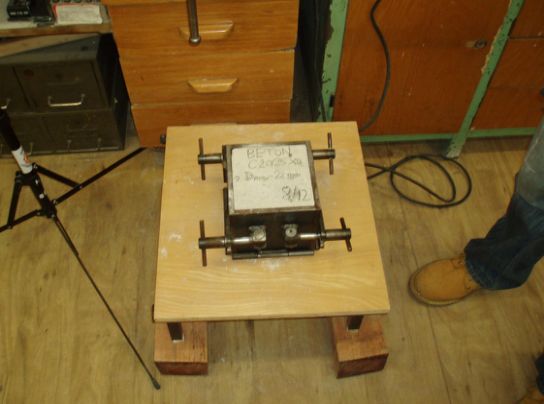
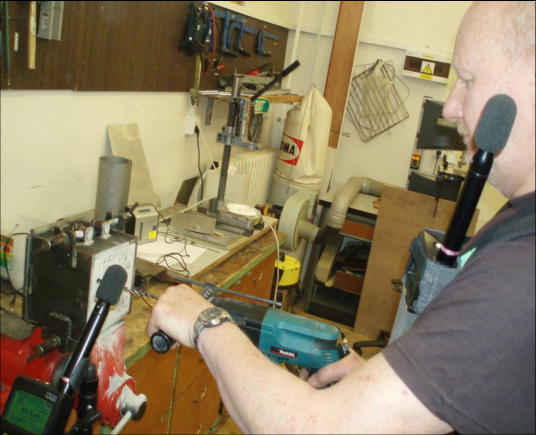
For fixing the material, a mould was lent by the manufacturer of concrete mixtures. It was placed on a wood plate with metal feet for vertical drilling (see Figure 1) and in a vice for horizontal drilling (see Figure 2). All measurements were carried out in the maintenance shop at the Faculty of Safety Engineering of VŠB – Technical University of Ostrava in Ostrava-Vyskovice. In all the measurements a worker performing similar activities in the framework of his job description participated.
Figure 1. Sample fixation for vertical drilling (Hrazdilek and Fiserova, 2012)Figure 2. Sample fixation for horizontal drilling (Hrazdilek and Fiserova, 2012) The methodology for the carried out measurements was in accordance with valid international standards in national modifications for the area of measurement and assessment of noise in the working environment and hand- transmitted vibration and in accordance with the Methodological guidance of the Ministry of Health of the Czech Republic for the measurement and assessment of noise and vibration in the working environment. For the purposes
of presentation of results, it is a case of especially ČSN ISO 1996-1, 2 – Acoustics - Description, measurement and assessment of environmental noise, ČSN ISO 9612 - Acoustics - Guidelines for the measurement and assessment of exposure to noise in a working environment, ČSN EN ISO 5349-1, 2 – Mechanical vibration - Measurement and evaluation of human exposure to hand-transmitted vibration, ČSN EN ISO 20643 – Mechanical vibration - Hand- held and hand-guided machinery - Principles for evaluation of vibration emission.
Noise measurement was carried out after calibration and setting using two instruments simultaneously; one microphone placed on the operator in the vicinity of his ear and the other on the adjustable stand at the height of the ears. In the case of drilling into each of four selected samples of concrete, 30 five-second interval measurements were taken for both drilling techniques (vertical – horizontal) with both bits (6 mm and 8 mm). Thus a sufficient number of values for the subsequent statistical processing of results were obtained. In the case of each tested sample of concrete, 40 measurements were taken (10 for each technique and bit) and the time of one measurement of 20 sec required for hygiene measurements was respected.
RESULTS
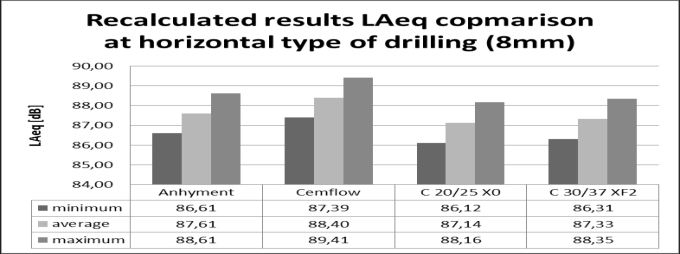
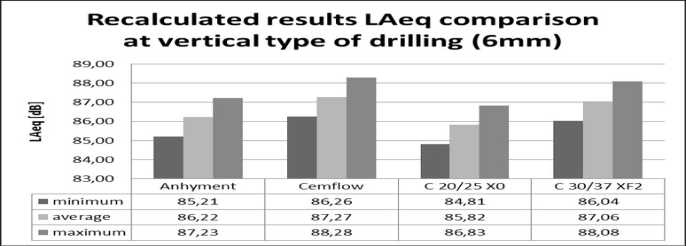
Noise measurement results Altogether, 240 noise measurements were processed for each tested type of concrete. In the interest of clarity, the acquired tabular values were by means of formulas and statistical processing transferred to reference eight sets. Results of measurements on the operator and on the stand were then recalculated for individual samples of concrete types. In Figures 3, 4, examples of recalculated data for one bit type and two techniques of drilling for all four examined measured concrete materials are provided.
Figure 3. Recalculated results LAeq comparison at horizontal type of drilling 8mm (Hrazdilek and Fiserova, 2012)Figure 4. Recalculated results LAeq comparison at vertical type of drilling 8mm (Hrazdilek and Fiserova, 2012)
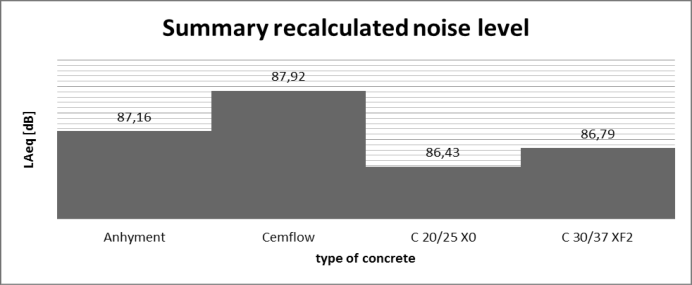
For the final presentation, as comparative values were selected values sensed by the microphone placed on the operator because thus always the same distance between it and the organ of hearing was kept. On the whole, values obtained by measurement on the stand were not after recalculation too different; they however exhibited the higher dispersion that those from the personal sensor. Recalculated results of equivalent noise level for the selected types of concrete are there in Figure 5.
Figure 5. Summary recalculated noise level (Hrazdilek and Fiserova, 2012)
From partial and recalculated results of noise measurement it is obvious that materials with higher compressive strength had higher values of noise emission. The non-homogeneous material (Cemflow) created the greatest noise in the course of working.
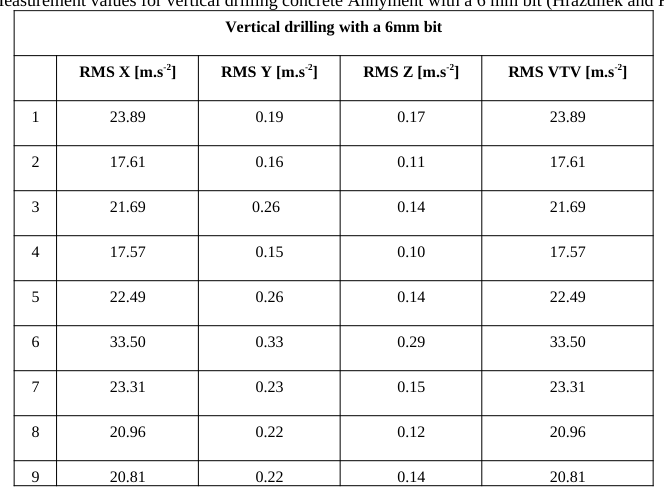
Results of hand-transmitted vibration measurement Altogether, ten measurements were taken for each of four types of material drilling. Measured values were given to tables. To each material, fours tables apply. In them are given the effective values of frequency-weighted hand- transmitted vibration on the axes x, y, z, (RMS X, RMS Y, RMS Z – effective value of frequency-weighted hand- transmitted vibration in specific directions) (quantity designation ahwx, ahwy, ahwx) and the summary value of vibration (RMS VTV – summary value of frequency-weighted acceleration of vibration ahv – it is the square root of the sum of squares of values ahw for vibration measured in three directions). In Table 1 an example of partial results for the type of concrete Anhyment at vertical drilling with a 6 mm bit is presented.
Table 1: Measurement values for vertical drilling concrete Anhyment with a 6 mm bit (Hrazdilek and Fiserova, 2012)
Vibration was measured in all axes. To drilling, the axis x is crucial; the influence of values on the axes y and z on the resulting value of vibration acceleration, RMS VTV, is very small. As far as the vertical technique of drilling is concerned, values are least different for all the materials. Horizontal drilling with an 8 mm bit shows the highest values in all materials.
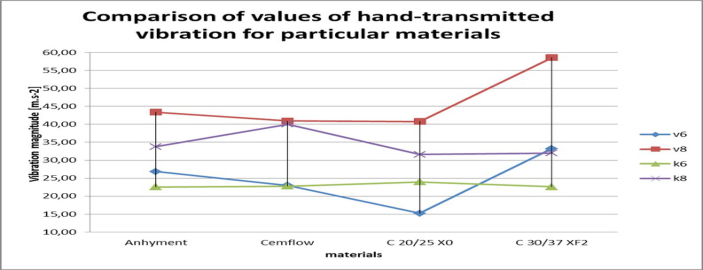
Figure 6. Comparison of values of hand –transmitted vibration for particular materials (Hrazdilek and Fiserova, 2012) In Figure 6 there is the recalculated comparison of values that confirms almost equal resulting values for the concrete types Anhyment and Cemflow; differences in recalculated summary values for specific types of drilling move in a range of 3.75–8.8 m.s-2. The highest values were found in the case of concrete C 30/37 XF0 and the lowest one in the material C 20/25 X0.
DISCUSSION
From the summary of all results of noise measurement and from the comparison with the properties of the given materials, some partial conclusions can be drawn. To materials with the guaranteed minimum compressive strength of 20 MPa (Anhyment and Cemflow), the material composition is, in the framework of noise exposure, crucial. The material Cemflow, which is non-homogeneous owing to added aggregates of size less than 4 mm, exhibits the greater noise level. Anhyment is homogeneous. In the case of materials C 20/25 X0 and C 30/37 XF2, values of noise were smaller owing to drilling without percussion (percussion drilling caused material cracking and crumbling). An increase in drilling depth was much smaller in these materials than in the materials Anhyment and Cemflow; this was caused by the greater size of aggregates (up to 22mm), which could be drilled through only with difficulty in places. In the case of materials C 20/25 X0 and C 30/37 XF2 it can be seen that with approximately the same composition but with different guaranteed compressive strengths, noise emission grows with increasing compressive strength. It is the position of drilling that has the influence on the noise level of drilling as well; horizontal drilling is noisier than vertical drilling. The size of bits is also decisive. In the case of horizontal drilling, the larger bit causes the greater level of noise. The lower level of noise in vertical drilling was measured for the larger bit; this does not apply to the material C 30/37 XF2, in the case of which the trend is the same as with horizontal drilling (Hrazdilek and Fiserova, 2012). All measurements demonstrate that hammer drilling even without percussion may lead to impaired hearing. The resulting recalculated values exceed 85 dB (Government Order No. 272 Coll., Czech Republic, 2011), which is a hygiene limit for noise load per shift that is valid in the Czech
Republic.
From the summary of all results of hand-transmitted vibration measurement and from the comparison with the properties of the given materials it can be assessed that in the case of materials with guaranteed minimum compressive strength of 20 MPa (Anhyment and Cemflow), resulting values of vibration are almost equal. It seems that the influence of material composition is only negligible. For the materials C 20/25 X0 and C 30/37 XF2, values of whole-body vibration were very different. Values of vibration measured on the material with lower compressive strength (C 20/25 X0) were lower than those on the other material with higher compressive strength. The position of drilling affects vibration as well. In horizontal drilling, higher values of vibration were measured in comparison with vertical drilling. The influence of the size of bits on vibration is considerable. The larger is the bit, the greater is vibration. Comprehensively, it can be said that the larger bit means the higher difference in measured values between horizontal and vertical drilling (Hrazdilek and Fiserova, 2012). The permissible limit for exposure to hand-transmitted vibration per eight-hour shift, which is valid in the Czech Republic, is 128 dB/2.8 m.s-2. The permissible limit for exposure to hand-transmitted vibration for 20 minutes or less is 142 dB/12.5 m.s-2 (Government Order No. 272 Coll., Czech Republic, 2011). If we calculate the legislatively determined safe time of drilling for each material, without exceeding the eight-hour shift limit of 2.8 m.s-2, these activities can be carried out, from the point of view of exposure to hand-transmitted vibration, in the time that is up to five times shorter than 20 minutes per eight-hour shift.
CONCLUSIONS
The aim of the study was to assess the influence of material physical properties on noise and hand-transmitted vibration exposure. As a determining property of concrete materials, the compressive strength during drilling was selected. Measurement results and their processing and evaluation have confirmed that with increasing compressive strength, noise and hand-transmitted emissions grow. As well, it has been confirmed that in the case of materials of the same compressive strength (Cemflow and Anhyment), the influence of material composition on noise emission is evident; the influence of material composition on hand-transmitted vibration is negligible. In the framework of a range given by research conditions, it can be stated after re-calculation of resulting values that with an increase in the minimum compressive cube strength by 12 MPa, values of noise and hand-transmitted vibration will increase on an average by 0.31 dB (noise) and 8.69 m.s-2 (hand-transmitted vibration). The determination of a real relation between the compressive strength and the increase in noise or vibration cannot be, based on this study, carried out, because the problem requires the much wider range of study. For setting effective prevention, knowledge of real exposure of operators to risk factors in real conditions of work is however necessary. Manufacturers of hand-held tools focus, in constructional design, on improvements from the point of view of reduction of direct exposure of operators to noise and hand-transmitted vibration, but employers do not always prefer safety over price when purchasing working tools.
REFERENCES
Colleopardi,M. (2009), “Modern concrete”, CKAIT Prague, Crocker, M.J. (2007), “Handbook of noise and vibration control”, Wiley Ceskomoravsky beton (Czech-Moravian concrete), trade association, (2013), The Website: http://www.transportbeton.cz/beton-a-produkty/anhydritove-potery.html Ceskomoravsky beton (Czech-Moravian concrete), trade association, (2013), The Website: http://www.transportbeton.cz/beton-a-produkty/cementove-potery-pro-podlahy.html Fenclova,Z. et al, (2012), “Occupational diseases in the Czech Republic 2012” The SZU (National Institute of Public Health) Website: http://www.szu.cz/publikace/data/nemoci-z-povolani-a-ohrozeni-nemoci-z-povolani-v-ceske-republice Government Order No. 272/2011 Coll., of 24 August 2011, on health protection against unfavourable effects of noise and
vibration , Czech Republic
Hrazdilek, J., Fiserova, S. (2012), “Influence of properties of worked material on noise and hand-transmitted vibration exposure”, VSB – Technical university of Ostrava Jandak,Z. (2007), “Human-transmitted vibration”, The SZU (National Institute of Public Health) Website: http://www.szu.cz/tema/pracovni-prostredi/vibrace-prenasene-na-cloveka Jandak,Z. (2007), “Noise in working environment”, The SZU (National Institute of Public Health) Website: http://www.szu.cz/tema/pracovni-prostredi/vibrace-prenasene-na-cloveka Novy,R.(2000), “Noise and vibration”, CVUT, Prague Sujova, E. (2008), “Principles of management in risk conditions” In Actual managers in theory and praxis, University of Zilina
LISTED IN THE AHFE DIGITAL BOOKSTORE CATALOGUE
Explore the complete digital volume
Advances in Physical Ergonomics and Human Factors: Part I
Read this individual research paper free through the original publisher, or explore the full digital proceedings book.
ISBN 978-1-4951-2104-3
Explore this ISBN in the AHFE Bookstore ↗Listed in the July 2026 bookstore catalogue; search by ISBN to confirm current availability · Digital book purchase optional