Kolodziej Sebastián Federico, Cruz Eugenio Rubén (2020). Comparative Study of Noise and Thermal Load Levels by General and Individual Sampling. In: Advances in Social and Organizational Factors. AHFE Open Access, vol. 9. https://doi.org/10.54941/ahfe100313
This paper is a comparative study of the levels of two environmental parameters in a job, heat and noise, analyzed from two different perspectives, the general and the particular. The study was conducted in a university dining for analysis considering two individuals that work in the field of cooking. The objective of the study is to evaluate the two environmental factors in this sector, noise and thermal load, and determine the variations between the levels of both aggressors measured in the general work environment, and levels that are perceived directly by the operator. To carry out the experience the instrumentation used for measurement of general environmental conditions were hygrometer, anemometer and sound level meter; and the instrumentation for measuring individual parameters were noise dosimeter, heart rate monitor and calorimeter consumption. Recorded data were analyzed and the valuesobtained from sampling equipment of the general environment and the personal sampling devices were compared. The comparison of the results obtained revealed that in a work environment as the analyzed, where operators have a continuous movement between different jobs, the use of individual measuring instruments are more accurate than measuring equipment of the general environment to set the exposure to dangerous levels of heat load and noise.
All job in which develop productive tasks, must have working conditions that safeguard the psychophysical health of workers and the task to perform without undue fatigue. The operator that is in a pleasant atmosphere, under hygienic conditions, without experiencing heat or cold and with the least possible noise, considerably reduces fatigue, concentrate on his work, is done better and avoid accidents. The poor working conditions are among the The University dining in the Faculty of Engineering, is a work environment in which there are different physical aggressors that can interfere with the activity being performed, as well as the health of the people working in it. Given the characteristics of the processes that take place inside, the main physical attackers present in this environment are the noise and the heat load.
Inadequate thermal environment causes reduction in physical and mental performance, and therefore the productivity, causes irritability, increased aggression, distractions, mistakes, discomfort from sweating, increased heart rate, which affects negatively on health, and even in extreme situations can cause death. An environment affected by heat load causes the elevation of body temperature, produces tension or stress to which the body responds with physiological mechanisms of thermoregulation, governed by the thermal control center located in the hypothalamus. Since the main physiological defense mechanism of the human body is sweating, conditions should lead to allow the removal of sweat from the skin surface to remove heat (Velázquez, 1995). To facilitate the removal of heat is important to wear clothing of lightweight material that does not hinder the evaporation of sweat.
Noise is another important factor that must be eliminated or reduced as far as possible to increase worker efficiency. It is common cause of fatigue, irritation and production falls, further if is intermittent or constant tends to emotionally excite workers, altering his mood and increasing the risk of accidents (Mondelo, and others, 1995). If the noise exceeds certain levels, not only causes discomfort, but can also affect hearing health of people, with the passing of the years causing occupational diseases such as deafness.
Manage exposure to these bullies in the workplace is not a complex activity, however required a high level of knowledge of the physical parameters that comprise, the particularities of the tools necessary to carry out the measurements and criteria for interpretation and evaluation the values obtained to determine with certainty the level of exposure to physical aggressors analyzed.
To measure these environmental factors different instruments are used, which allow a general monitoring of the work environment, or a personal analysis for each operator. General measurement equipment, allows knowing the existing levels in a determined aggressor in an environment, while an individual or personal equipment considers the particularities of each individual to determine what levels are actually perceiving the person. The use of one or other equipment is determined by different factors such as time, cost, business interruption, discomfort to the operator, etc. However is useful to know if the values measured by the two instruments are comparable and allow checking the existence of harmful levels for the operator.
The objective of the study is evaluate two environmental parameters in a work environment, noise and thermal load, and determine the variations between the levels of both aggressors measured with equipment of general sampling of the environment, and levels that are perceived directly by the operator by an equipment of individual or personal sampling.
The experiment is conducted in a university dining, considering for the analysis the kitchens area. This area is characterized by the existence of numerous sources of heat, such as ovens and stoves used for cooking food, as well as continuous noise sources such as fans and kitchen exhaust, random noise sources such as handling dishes, pots, cookware and the voices of people working in the sector.
METHODOLOGY
The evaluation of environmental parameters of noise and thermal load, was performed following the procedures and standards established in the Argentina Hygiene and Safety regulations. Different days were taken for analysis, but environmental conditions were similar.
The kitchen area under analysis has three distinct but interconnected areas that are: the stores sector, where provisions to the daily menu are saved, the food preparation sector, where the food is washed, cut, processed and preparing and the cooking sector where the food is cooked. The sectors considered for the analysis are the cooking and food preparation, which are characterized by a greater and constant presence of people working and therefore with a greater risk of exposure to workplace bullies. In these two sectors were installed measuring equipment of general environment. For personal sampling equipment, two workers were selected that develop their activities continuously in both sectors.
Thermal Load Evaluation The evaluation of Thermal Load of the general environment, is performed following the method of WBGT (Wet Bulb Globe Temperature). To measure this index is used an instrument that allow to obtain both the values of the different environmental parameters, as well as the index value of a direct way. Whereas the environment is a kitchen located in a closed setting, the expression used is for indoor environments.
Equation reproduced from the original PDF.
Where Tg = Globe Temperature Tbh = Wet Bulb Temperature
Tbs = Dry Bulb Temperature Once the index it knows, is necessary to establish the level of demand of the task and determining the ability of acclimation of the operators. As workers in this sector have spent several years in his post, are natives of the province, so they are used to the task and the job itself does not require too much effort, considering that both workers are acclimated. To know precisely the level of demand of the task was used the method measurement and analysis of the heart rate. This method allows the assessment of energy expenditure in situ, without interfering with the task that develops, facilitating the acceptance of the method by the individual subject to study, and allowing reproducibility. The procedure is based on the existence of a lineal relationship between heart rate and energy consumption that produce during a particular activity (Sole Gomez, 2008). To record this value to each operator has placed a heart rate monitor. Through this instrument the metabolic consumption was determined during the measurement time and was able to establish the level of demand of the task.
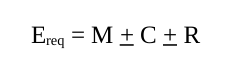
With respect to the particular analysis of the thermal load, the method of thermal balance or energy balance is kept. This method sets the amount of heat that must be dissipated by evaporation (Ereq) for the body to remain in thermal equilibrium. The probability of this equilibrium is determined by the ralation between Ereq and the maximum capacity of evaporation (Emax) calculated on the assumption that all the skin is damp with sweat.
Equation reproduced from the original PDF.
Where M is produced by the heart rate monitor, the heat radiation R and convection C are given by: R = 11x ((Tg + 14,4 x V0,5 x (Tg – Tbs))) Kcal/h
Equation reproduced from the original PDF.
Tg and Tbs are terms of temperature obtained with the thermal load meter and V is the velocity of the circulating air, measured with a vane anemometer.
The evaporation capacity of the environment, is a function of airspeed and the partial pressure of steam (Pa),
Equation reproduced from the original PDF.
To compensate the effect of light clothing is tentatively, it has been recommended temporarily reduce by a third the value of each one of the estimated coefficients. This correction factor has been calculated on the basis of empirical consideration (WHO, 1969).
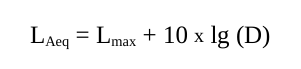
Noise Evaluation The noise evaluation is also done from two different perspectives, the general work environment and individually perceived by the operator. The noise of the overall work environment is assessed by measuring the levels of this aggressor by a type II sound level meter, which determines the LAeq (equivalent continuous sound level) value compared to the maximum allowed by national law. The noise perceived by the operator during the development of their activities is recorded by a noise dosimeter, laptop equipment carried by the operator while performing their activities. This instrument determines the noise dose (D) to which the operator is exposed. In order to compare values recorded by both instruments and contrast with the maximum permitted by law, the values of LAeq and Dose (D) are related by the following expression (Giménez de Paz, 2013):
Equation reproduced from the original PDF.
Where Lmax is obtained from the regulations.
RESULTS
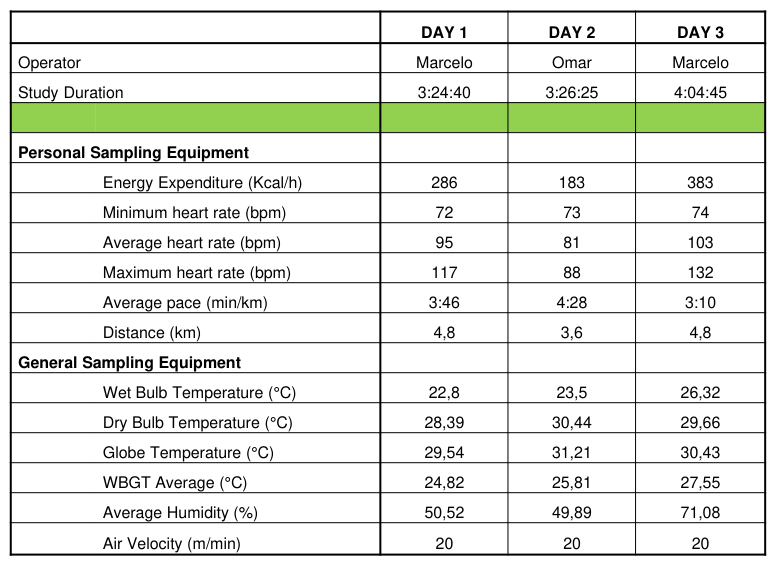
Thermal Load Evaluation The values obtained by the heart rate monitor and the heat load shown in Table 1.
Table 1: Measurements Results thermal load
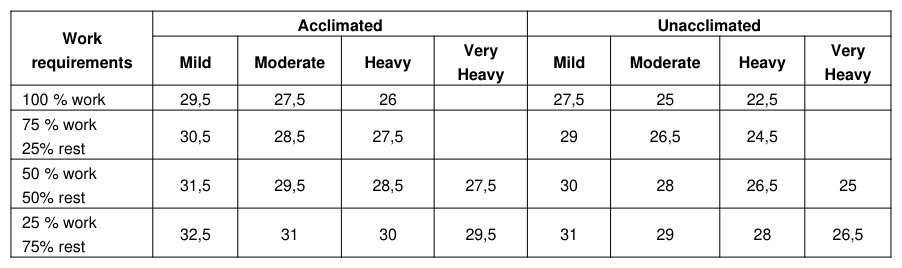
Whereas operators are acclimated and according to the energy consumption the requirement of the task is moderate, by Table 2 analyzed if is heat load and on this basis the corresponding period of work. As the WBGT index average weighted over time is less than tabulated value (Table 2), there is little risk of exposure to heat stress (Law 19587, 1979), in all cases analyzed.
In this case, as there is no heat load, periods of normal rest for the activity are contemplated. Pauses during the development of the task allow the recovery of the organism through the gradual elimination of fatigue for muscle load. Usually, the response is exponential and recovery effect is greater at the start than the end of the task. It is better to make many short pauses, than only one long (Melo, 2009).
Applying the method of energy balance is determined the amount of energy that the body needs yield (E req) and the atmosphere can be removed (Emax). Considering the heat storage capacity that has the body, can calculate the acceptable working time to avoid exposure to thermal stress due to the elevation of the internal body temperature.
Table 3: Allowable Working Time. Method of energy balance DAY 1 DAY 2 DAY 3
While on day 2 removal capacity of the environment allows body heat to evaporate, in the other days occurs a buildup of heat could lead to heat stress.
The difference observed in the results obtained with the two methods, a general analysis shows that is not enough for this type of work, in order to define the presence of thermal stress. While the WBGT method determines a low risk of exposure to heat stress, energy balance shows the possibility thereof if certain work periods are not respected.
Table 1 shows the characteristic of this task, because while the workspace is small, 50m2, operators have a constant displacement that exceeds the 5km in the workday.
Noise Evaluation In an environment of this kind, in which there are no permanent jobs, because operators are walking much of the time as evidenced by recording distances (Table 1), the location of the sound level meter is key to values obtained adequately represent the levels to which operators are exposed. In this respect two locations for the sound level meter were selected, one at the sector of preparation of food and other cooking sector, considered to be representative for recording noise levels, and both do not interfere with normal operation of the activities.
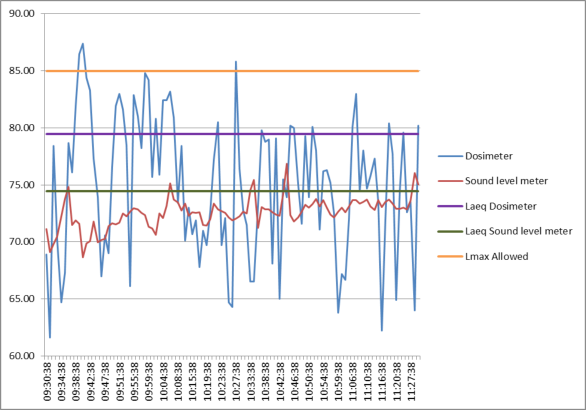
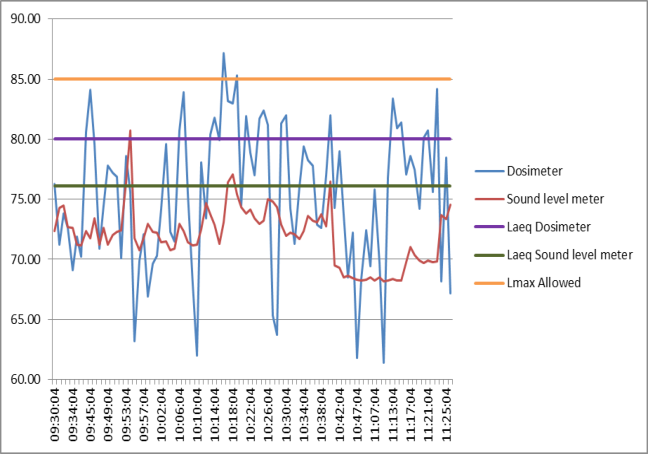
The values measured with the sound level meter, as well as with the dosimeter indicates, for each sector, in Figures 1 and 2.
Figure 1. Record sound level meter and dosimeter first measurement
Figure 1 shows the noise levels recorded at each instant by both equipment during the first day of measurements, as well as the specific levels of LAeq. In this case the meter was installed in the sector of cooking, and the dosimeter was worn by one of the operators active in the two sectors of the kitchen. As noted, the LAeq measured by the dosimeter is
79.5 dBA, while the LAeq sound level meter is 74.4 dBA.
Figure 2. Record sound level meter and dosimeter second measurement
Figure 2, corresponding to the second measurement, show the levels recorded by the meter installed in the area of food preparation, while the dosimeter was placed at another operator which operates in both sectors. The LAeq measured by the dosimeter is 80.04 dBA, while the LAeq sound level meter is 76.08 dBA.
According to the results, recorded values by the dosimeter in different days and with different operators, are very similar. Similarly, the levels recorded by the meter located in the two sectors, differ in less than 2 dBA. However, if we compare the LAeq of the dosimeter and the sound level meter, the latter is significantly lower than the first. This shows that for a work environment of this kind, in which operators have a constant movement between different sectors, the values of the general measurements in each sector, are not representative of what the operator really sees.
Even though reported levels are not harmful to the work period, reaches limits that may be considered annoying. If the measured values are greater, so that the exposure is conditional for a period of time, the level recorded by the dosimeter indicate a shorter time than it would be to consider the values given by the sound level meter for each sector exposure.
CONCLUSIONS
Measurements of thermal load and noise in the workplace allow to know the levels to which workers are exposed in their jobs. For this, pitch measuring instruments so that it do not interfere with the normal course of activity, but which values obtained result representative of the levels to which workers are exposed.
In the analysis of the thermal load, by implementing the method as universally known as WBGT, a low probability of thermal stress was determined. By using the energy balance method, significantly higher value was obtained, probably closer to reality since it depends on the characteristics of each individual, such as heart rate and the associated metabolic consumption. This method provides a higher probability of heat stress, if the normal periods of work and rest for this activity are not respected.
Measuring noise in a working environment with a sound level meter, to assess existing levels and confirm that the limits set by the rules is not exceeded, although it is one of the methods commonly used, does not ensure that the measured values are those actually perceives the operator, at least in environments of this type where a continuous movement thereof. In this case in order to obtain values that are representative of what is perceived by the operator; it is convenient to use a tool such as the dosimeter. Comparing the equivalent values measured by the two instruments, we can see that for the dosimeter is 5dBA above those obtained by the sound level meter. In this case it is below the allowed limit values, but in a different situation, with higher levels of noise, probably hearing health of the workers can compromise when considering the values measured with a sound level meter.
REFERENCES
García Criollo, R. (2005). Estudio del Trabajo, Ingeniería de métodos y medición del trabajo. Mexico: McGraw- Hill. Giménez de Paz, J. (2013). Ingeniería Acústica. Para estudiantes y profesores en Higiene y Seguridad. Propiedades
del ruido y su control. Buenos Aires. Argentina: GPE. Ley 19587, D. R. (1979). Ley de Higiene y Seguridad del Trabajo. Buenos Aires. Melo, J. L. (2009). Ergonomía Práctica. Guía para la evaluación ergonómica de un puesto de trabajo. Buenos Aires: Mapfre. Mondelo, P. R., Torada, E. G., Uriz, S. C., & Vilella, E. (1995). Ergonomía 2. Confort y estrés térmico. Barcelona:
Ediciones UPC. OMS . (1969). Problemas de salud relacionados con el trabajo en condiciones de sobrecarga térmica. Ginebra: OMS. Solé Gomez, D. (2008). NTP 295. Valoración de la carga física mediante la monitorización de la frecuencia
cardíaca. Instituto Nacional de Seguridad e Higiene en el Trabajo. Velázquez, F. (1995). Manual de Ergonomía. Madrid España: Mapfre.
LISTED IN THE AHFE DIGITAL BOOKSTORE CATALOGUE
Explore the complete digital volume
Advances in Social and Organizational Factors
Read this individual research paper free through the original publisher, or explore the full digital proceedings book.
ISBN 978-1-4951-2102-9
Explore this ISBN in the AHFE Bookstore ↗Listed in the July 2026 bookstore catalogue; search by ISBN to confirm current availability · Digital book purchase optional