Bruno M. Razza, Luis Carlos Paschoarelli, Cristina C. Lucio, José Alfredo C. Ulson, Danilo C. Silva (2022). Perception of Effort in Manual Actions (Torque and Pulling Strength) on Different Interfaces. In: Advances in Ergonomics In Design, Usability & Special Populations: Part I. AHFE Open Access, vol. 18. https://doi.org/10.54941/ahfe100776
Tasks and products still require inappropriate demand of manual force are considered risk factors for the development of occupational diseases (Kattel et al., 1996; Aghazadeh and Mital, 1987). In ergonomic assessments, psychophysical data may provide relevant information that complement or assist understanding the results of physical assessments. In previous studies, we measured the pulling strength with 3 different handles (Razza et al., 2012) and torque strength was obtained with 5 different prismatic-shape handles (Paschoarelli et al., 2012). This study aimed to assess the reported individual perception of the strength exerted in the same conditions of those previous studies using VAS perception scale. The effects of individual characteristics (laterality and gender) and tasks elements were investigated in the reported perceived effort. This study employed three handles height (40 mm, 20 mm and 1 mm thick) grasped with 3 types of pinch grips (pinch 1, pinch 2 and pulp-pinch) and 3 prismatic-shaped handles for the assessment of torque (cylindrical, square and triangular). Results indicate that subjects of both genders could exert less effort with the handle of 40 mm height in comparison to the other heights, and pulp-pinch was considered the easiest to perform the effort. Torque’s results indicated that subjects required more effort with the cylindrical handle than to the others shapes. Of all observed conditions, the type of pinch grip had the greater impact on this measure of perceived effort.
Despite the increasing automation in the industrial environment, many tasks still demand great magnitude of manual efforts, such as: maintenance tasks, manual material handling, patients’ transportation in hospitals etc (Imrhan, 199; Kim and Kim, 2000). Tasks and products that require inappropriate application of manual strength are considered risk factors for the development of occupational diseases (Kattel et al., 1996), and are responsible for much of the total injuries in industry (Aghazadeh and Mital, 1987). Specifically, the use of pinch grips in several industrial tasks, and also torque strength, have been associated with high levels of occupational diseases (ARMSTRONG; CHAFFIN, 1979; CHAO et al., 1976; EKSIOGLU et al., 1996), hence they are considered risk factors in ergonomic evaluation (KEYSERLING et al., 1993).
Biomechanical, physiological and psychophysical approaches have been used to establish recommended capacity thresholds for specified task demands (Fischer and Dickerson, 2012). The ISO 6385 (1981) — which deals with ergonomic guidelines for the design of products, workplace and tasks — recommends that, along with objective Ergonomics In Design, Usability & Special Populations I (2022) https://openaccess.cms-conferences.org/#/publications/book/978-1-4951-2106-7 assessments (countable), subjective assessment (psychophysical metric) should be taken as a complementary measure. Therefore, the use of methods to evaluate subjectively tasks and determine acceptable workloads has become a common procedure in ergonomic approaches, combining the physical variables to the subjective perception of users.
Psychophysical methods are commonly used to establish guidelines and limits for task acceptability or to indicate task demands. Despite their widespread use and practical application, the subjectivity of psychophysical methods can limit their perceived benefit to ergonomists and engineers (Fischer and Dickerson, 2012). According to Dempsey (1998), it was believed that these approaches yielded different or conflicting information regarding a given task. However, recent research has begun to uncover associations between biomechanical and psychophysical approaches. Growing evidence demonstrates that acceptable psychophysical loads and forces are related to the underlying joint loading exposures, particularly at the most biomechanically limiting joint (Fischer and Dickerson, 2012).
In ergonomic assessments, psychophysical data, such as the individual perception of interface variables acting on it and its activity or product usage may provide relevant information that complement or assist in understanding the results of physical assessments. Thus, psychophysics offers an opportunity to examine worker perception of tasks involving multiple occupational stressors by allowing the worker to “integrate” this information. In the psychophysical approach, the human serves as instrument of observation. Like any instrument, the human observer can be biased and lead to inaccurate measures due to subjectivity of the metric (Fernandez and Marley, 2012).
Nevertheless, the ergonomic uses of psychophysical data continue to grow and the major applications are on the determination of subjective acceptability and/or tolerance and for the design of systems or products (Fernandez and Marley, 2012). For example, psychophysical data has been used to develop the NIOSH lifting guide as well as the Liberty Mutual models for manual material handling tasks. In both of these cases, the data were generated using whole body exertion (Fernandez and Marley, 2012). The Method of Adjustment in particular has been widely used in establishing acceptable weights of lift (Ciriello et al., 1993; Snook, 1985a and 1985b).
Accordingly to Tullis and Albert (2008), the most efficient way to record subjects' perception in ergonomic assessments is with some type of rating scale such as the Visual Analogue Scale (VAS) (Bacci, 2004, Collins et al., 1997; Björkstén et al., 1999), Borg's scales (Borg, 1998), Likert Scales (Likert, 1932), among others, to the detriment of open questions, which are more difficult to analyze.
The VAS scale is widely used in subjective evaluation of many variables. It consists of a row (horizontal or vertical), with a certain length (often 10 cm) and anchors that represents the maximum and minimum criteria of the variable to be measured (Bacci, 2004). Collins et al. (1997) recommends the use of this type of scale at the expense of categorical scales, claiming to be more precise. Huskisson (1983 apud Björkstén et al., 1999) also recommends the use of this method since that VAS scores are highly correlated, are simple to measure and interpret, sensitive, easily reproducible and universal.
One crucial aspect to be considered when using this method is the correctly choice of terms that will be used as anchors. In the field of ergonomic design, at least two criteria of perception must be respected, one of which may involve a negative concept — e.g., discomfort or greater effort — and another with a positive concept — e.g., comfort and less effort.
Ayoub and Dempsey (1999) and Fernandez and Marley (2012) provided an excellent summary of the advantages and disadvantages of the use of psychophysical methods in occupational activities. The advantages of psychophysics metrics include: 1) reproducible results; 2) realistic simulation of activities and conditions; 3) results that take into consideration the whole job and integrate biomechanical and physiological factors; and 4) results that appear transferrable to similar tasks as guidelines. Similarly, these psychophysical studies also have disadvantages which include: 1) fundamentally, these results are subjective and can be influenced by many personal factors; 2) there is risk that the results may overestimate or underestimate long-term working limits, particularly for high frequency or very intense task requirements; and 3) several studies were based upon nonindustrial (student) populations.
In this study we aimed to evaluate the individual perception of effort in simulated tasks for torque and pulling strength. The influence of the personal characteristics of gender and laterality were considered. The tasks’ elements consisted of 4 different shapes of the handle in torque strength, three types of pinch grips and three handle heights for pulling strength. Two samples were recruited for two subsequent trials. The first consisted of the investigation of Ergonomics In Design, Usability & Special Populations I (2022) https://openaccess.cms-conferences.org/#/publications/book/978-1-4951-2106-7 the influence of gender on perceived strength and the second trial compared perceived reported strength for right and left handed individuals.
MATERIAL AND METHODS The procedures of this study were approved by the Committee of Ethics in Research (CEP-FMB-UNESP n. 373/2005) and the recommendations of the National Health Council (Resolution 196-1996) and the Brazilian Association of Ergonomics (Associação Brasileira de Ergonomia, 1002 ERG-BR) for research involving humans were met.
This study consisted of two different samples. In the first approach, the influence of gender on perceived exertion in pulling force was investigated. This measure was assessed with three different pinch grips and three different handles. In a second approach, the influence of laterality on the perception of effort was investigated. In this second approach, we also investigated the perception of exertion when performing the torque in different handles.
Subjects Sample 1
Sixty right-handed unpaid volunteers participated in the experiment, being 30 women in the mean age of 21.60 years (SD 3.05), ranging from 18 to 30 years, and 30 men, in the mean age of 21.83 years (SD 2.46), ranging from 18 to 28 years. None of the subjects reported any history of musculoskeletal disease in the upper limbs in the last year. The subjects’ written consent was obtained and all procedures were widely explained to them. The Edinburgh Inventory (Oldfield, 1971) was applied to certify that the whole sample was right-handed.
Sample 2 Sixty male adults unpaid volunteered in this second research. Thirty of them were right-handed and thirty left- handed. The excluding criteria was the same as the previous sample and the Edinburgh Inventory (Oldfield, 1971) was also applied to certify the laterality of the individuals. The mean age of the left handed subjects was 21.7 years (SD 3.05) in a range 18-30 years. The right handed subjects were the same recruited in sample 1.
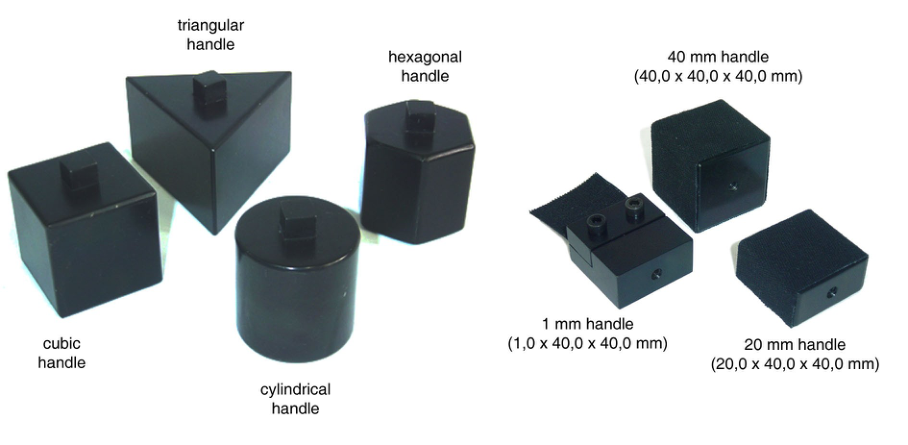
Apparatus Four handles with different formats were used to measure the torque strength (Figure 1, in the left). They were prismatic shaped with 50 mm length and based with the geometrical forms of a circle (cylindrical), a triangle (triangular), a square (cubic) and a hexagon (hexagonal).
For the measurement of pulling strength, three handles of three different heights were employed, one corresponding to a height of 40 mm high (40.0 x 40.0 x 40.0 mm), another one 20 mm high (20.0 x 40.0 x 40.0 mm) and the last one having an extension in fabric of 1 mm thick (40.0 x 40.0 x 1.0 mm). In the 20 mm and 40 mm handles, fabric was applied all over the surface in contact with the hands, for a standardization of texture in the hand-object interface; besides, corners were made round to avoid pressure concentration on the hands of the subjects (Figure 1, in the right).
Printed questionnaires were used for the registry of reported data, as follows: personal information of the subjects; written consent to participate voluntarily in the study; assessment of laterality score; and the registry of perceived exertion for each trial.
Ergonomics In Design, Usability & Special Populations I (2022) https://openaccess.cms-conferences.org/#/publications/book/978-1-4951-2106-7
Figure 1. Handles used for the assessment of perceived torque and pulling strength.
Procedures The procedures of this study followed recommendation of related literature (Daams, 1993; Hook and Stanley, 1986; Mathiowetz et al., 1984; Caldwell et al., 1974; Chaffin and Andersson, 1990; Mital and Kumar, 1998). Subjects in this experiment were asked to exert their maximum pulling strength (maximum isometric voluntary contraction) with each hand, alternately, and hold the strength for a 5 seconds period. The sequence of measurements was randomized and an interval of at least one minute was provided among trials to avoid fatigue.
For the evaluation of maximum voluntary isometric contraction for torque and pulling strength with pinch grips, each subject was asked to remain in the standing posture facing the equipment, the elbow of the upper limb flexed 90°, the forearm in neutral position – horizontally aligned – and the wrist positioned freely, according to the preference of the subject. The equipment was positioned at the height of the subject’s elbow. In the measurement of torque strength, the subjects were oriented to grasp the handle freely. For the pulling strength, however, three types of pinch grips were evaluated. The pinch grips used were:
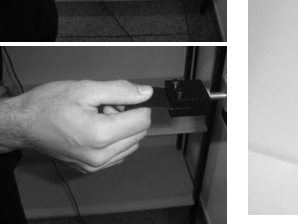
- Pinch-2 (thumb opposed to index finger); - Three jaw chuck pinch (index and middle finger opposed to thumb); and - Lateral pinch (thumb opposed to the lateral side of index finger, also called key-pinch).
The subjects were asked to keep the fingers which were not active in the grip flexed to the palm of the hand. In the pulling strength measurement for pinch-2 and chuck pinch, the wrist remained in extension and slight ulnar deviation. Figure 2 exemplifies the types of grips employed in pulling strength and the handles used for torque strength.
The recorded strength of these measurements and detailed procedure for this assessment was reported in previous studies (Paschoarelli et al., 2012 and Razza et al., 2012). After the exertion of strength for each variable, subjects were asked to report the perceived effort in a VAS Scale of 100 mm, in which 0 corresponds to no effort and 100 corresponds to the maximum effort. The intention was to report the effort applied with each condition and not to try to estimate the resulting force. Thus, it is expected that the least favorable condition would be more difficult to perform and higher effort scores must have been registered.
Ergonomics In Design, Usability & Special Populations I (2022) https://openaccess.cms-conferences.org/#/publications/book/978-1-4951-2106-7
Pinch 2
Chuck pinch
Lateral
Figure 2. On the left: pinch grips evaluated in the study. On the right: the four handles in position.
We used descriptive statistics analysis across all the data. The Mann Whitney U Test (P ≤ 0,05) for non-parametric group comparison was used to verify statistically differences between genders and lateralities. Wilcoxon’s test for non-parametric sample comparison was applied to analyze the influence of different handle shapes for torque strength, different heights and different pinch grips for pulling strength.
RESULTS AND DISCUSSION
Results of the subjective evaluation are presented in Table 1 and Table 2. The mean values presented dimensions measured on the visual analogue scale, in which 0 means no effort and 100 means maximum effort.
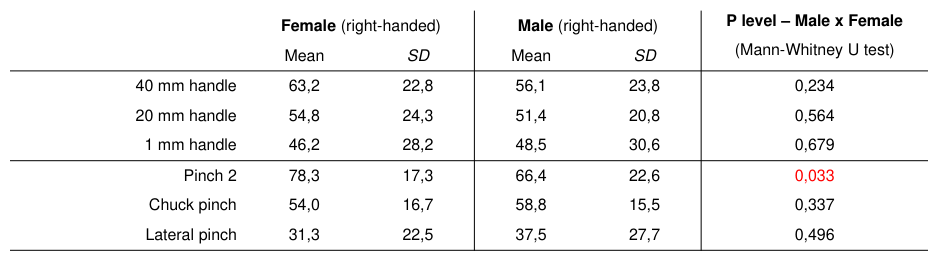
Table 1 presents the results (mean and standard deviation) of reported effort for pulling strength with pinch grips for gender comparison. The handle in which the least effort was necessary to perform the maximum exertion was the 40 mm handle, and the 1mm handle presented the worst condition. For the pinch grips, we observed that the lateral pinch had better results, and the worst reported effort was obtained for the pinch 2 grip. The last column indicates the results of Mann-Whitney U test. The gender effect was responsible for statistical differences only the pinch 2 grip (P ≤ 0,05).
Table 1. Results of perceive effort for pulling strength with pinch grips - Gender Comparison Female (right-handed) Male (right-handed) P level – Male x Female
Ergonomics In Design, Usability & Special Populations I (2022) https://openaccess.cms-conferences.org/#/publications/book/978-1-4951-2106-7
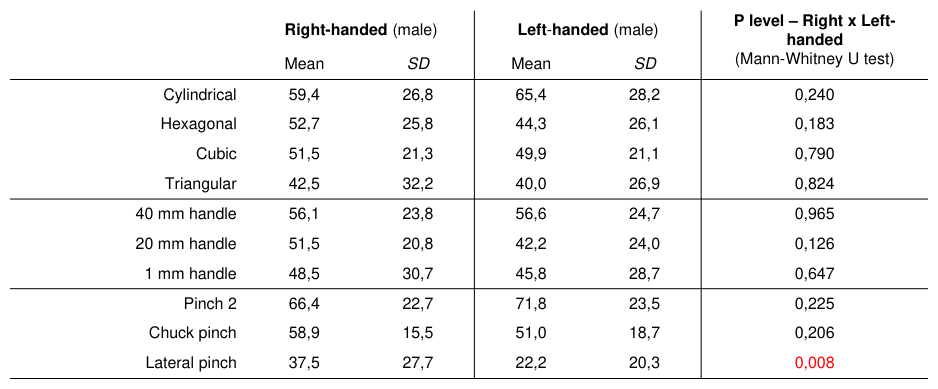
Table 2 presents the results (mean and standard deviation) of perceived effort for torque strength and pulling strength with pinch grips for laterality comparison. In reported torque effort, the best results can be seen with the triangular prismatic shape and the worst results were recorded for the cylindrical handle. For pulling strength with pinch grips, the effects of the handle height and type of pinch grip were the same as the results reported in sample 1. The last column indicates the results of Mann-Whitney U test. Laterality was responsible for differences in reported strength only for the lateral pinch (P ≤ 0,05).
Table 2. Results of perceived effort - Laterality Comparison Right-handed (male) Left-handed (male) P level – Right x Lefthanded
The effect of handle shape for perceived torque strength was assessed with Wilcoxon’s test. The results of this analysis are presented in Table 3. The cylindrical handle was perceived to be significantly different from the others in terms of reported effort only for left handed subject (P ≤ 0,05). For right-handed subjects, the shape of the handle was not different in reported effort.
Table 3. Handle comparison for perceived torque strength [Wilcoxon test].
The effect of handle height for perceived pulling strength with pinch grip was assessed with Wilcoxon’s test. The results of this analysis are presented in Table 4. Statistical differences were found only for the comparison of the 20 mm in opposition to the 40 mm for male left-handed subjects and for the 40 mm and 1 mm handles for right-handed female subjects.
In table 5 is presented the results for the analysis of the effect of grip type for the perceived effort. The results indicated that the grip used influenced significantly the perceived effort in most conditions (P ≤ 0,05). The one exception found was between pinch 2 and chuck pinch for right-handed male subjects.
Ergonomics In Design, Usability & Special Populations I (2022) https://openaccess.cms-conferences.org/#/publications/book/978-1-4951-2106-7
Table 5. Pulling strength perceived according to the type of grip [Wilcoxon test].
Subjects perceived that a greater effort is exerted with pinch 2 in comparison to the chuck or lateral pinch. This indicates that the volunteers considered the pinch 2 grip to be the most demanding or fatiguing of all. It has been demonstrated in literature that pinch grips may cause tensions in the tendons of the deep digital flexor muscle (Chao et al., 1976; Eksioglu et al., 1996), and since there is less muscles active in the exertion of strength in pinch 2 than in the chuck or lateral pinch, it may explain the more pronounced perceive effort.
Additionally, the size of the contact surface may also have influenced this perception. The lateral pinch grip offers larger contact surface with the handle, providing a more stable and better friction grasp. Comparatively, pinch 2 grip has lowest contact surface, which leads to a less stable hold. Consequently, lateral pinch demands more space in the handle to be used than pinch 2 or chuck pinch.
In previous publications (Razza et al., 2012 and Paschoarelli et al., 2012), the results of the measured strength were reported for this very sample. The comparison of the results for the measured strength and the reported perceived subjective effort may be useful to verify the accuracy of using psychophysical metrics to evaluate effort or strength.
In Razza et al. (2012) the handle height effect was weaker in determining the strength than the type of grip. The strongest grip was the lateral, followed by the chuck and then the pinch 2. Handle height differed significantly only in some cases and revealed to be subdued by handle height influence. The same results were observed for handle height and type of pinch grip.
For the torque strength, Paschoarelli et al. (2012) demonstrated that the handle shape influence the strength measured. In this study, the triangular handle showed the higher torque strength, followed by the cubic and the hexagonal. The cylindrical handle was responsible for the lowest records of strength. The same results were obtained with the use of psychophysical data.
The small or none difference found between gender and laterality in this study was expected. Since the subjects were asked to exert their maximum strength, independently of the magnitude of the strength measured, the effort reported was considered maximum for each individual. This can be a valid psychophysical metric to assess fatigue or muscular stress in work environments or in daily activities, but it is inadequate to predict the magnitude of strength.
In summary, the results suggest that the type of pinch grip used in pulling strength situations have the greater effects observed. In this case, the best design solution is to provide enough contact area on the surface of the object or handle in order to permit the use of this grip, since it has a greater demand of space to be performed in comparison to other pinch grips. The results of the handle shape in torque strength can be easy understood by the momentum provided by some handles. The triangular handle provides the best momentum and consequently will transmit more torque. Thus, more torque applied can be interpreted as less effort exerted, as it can be seen in the results of this study.
CONCLUSION
The similarities found between the psychophysical results of this study and the metric results for the same sample (Razza et al., 2012 and Paschoarelli et al., 2012) supports the use of psychophysical measures to evaluate perceived fatigue and effort in work or daily situations. Particularly, the psychophysics measured was useful to identify task related elements, such as handle size, handle shape of type of grip. However, for interrelated subjects’ Ergonomics In Design, Usability & Special Populations I (2022) https://openaccess.cms-conferences.org/#/publications/book/978-1-4951-2106-7 characteristics, such as laterality or gender, it has proved to be a weak measure.
Psychophysical metric is cheaper and more accessible to evaluate than traditional metric that require equipment in laboratories and frequently cannot be adapted easily to the workplace. The subjective perceived effort has shown to be useful to investigate workload and to design tasks and products in situations in which the magnitude of the strength exerted is less important than the context in which the force is applied. The index of perceived effort can be interpreted as metabolic of ergonomic costs if physical task performance that can be translated into requirements of the staff in industry of workstation.
Psychophysics remains a powerful tool for establishing guidelines to dimension tasks and preventing injuries by using the information from workers. A better understanding about the information inherent in a psychophysical response and how it is related and affected by subjective individual experiences will help to improve the effectiveness and efficacy of the usage of this metric in designing products and tasks.
Acknowledgements
This research was supported by FAPESP (Proc. FAPESP 05/58600-7).
REFERENCES
Aghazadeh, F., & Mital, A. (1987). Injuries due to hand tools: results of a questionnaire. Applied Ergonomics, 18, 273-278.
http://dx.doi.org/10.1016/0003-6870(87)90134-7 Armstrong, C. A., & Chaffin, D. B. (1979). Carpal tunnel syndrome and selected personal attributes. Journal of Occupational Medicine, 21(7), 481-486. Associação Brasileira de Ergonomia. (2009). ERG BR 1002 Norm: Deontology Code of Certified Ergonomists. Retrieved from
http://www.abergo.org.br/arquivos/normas_ergbr/norma_erg_br_1002_deontologia.pdf. Ayoub, M.M., & Dempsey, P.G. (1999). The psychophysical approach to manual materials handling task design. Ergonomics, 42(1), 17-31. http://dx.doi.org/10.1080/001401399185775 Bacci, A. V. F. Comparação da escala CR10 de Borg com a escala analógica visual (VAS) na avaliação da dor em pacientes com
disfunções temporomandibulares [Master’s thesis]. Retrieved from BV-CDI Fapesp. (Proc. No. 01/11173-6) Björkstén, M. G., Boquist, B, Talbäck, M, & Edling, C. (1999). The validity of reported musculoskeletal problems. A study of questionnaire answers in relation to diagnosed disorders and perception of pain. Applied Ergonomics, 30(4), 325-330. http://dx.doi.org/10.1016/S0003-6870(98)00033-7 Borg, G. (1998). Borg's Perceived Exertion and Pain Scales. Ciriello, V.M., Snook, S.H., Hughes, G.J. (1993). Further studies of psychophysical determined maximum acceptable weights
and forces. Human Factors, 35(1), 175-186. Chao, E. Y., Opgrande, J. D., & Axmear, F. E. (1976). Three dimensional force analysis of finger joints in selected isometric hand functions. Journal of Biomechanics, 9, 387-396. http://dx.doi.org/10.1016/0021-9290(76)90116-0 Collins, S. L., Moore, R. A., & Mcquay, H. J. (1997). The visual analogue pain intensity scale: what is moderate pain in
millimetres? Pain, 72(01-02), 95-97. Crawford, J. O., Wanibe, E., & Laxman, N. (2002). The interaction between lid diameter, height and shape on wrist torque exertion in younger and older adults. Ergonomics, 45(13), 922-923. http://dx.doi.org/10.1080/00140130210162243 Daams, B. J. (1993). Static force exertion in postures with different degrees of freedom. Ergonomics, 36(4), 397-406.
http://dx.doi.org/10.1080/00140139308967897 Dempsey, P.G. (1998). A critical review of biomechanical, epidemiological, physiological and psychophysical criteria for designing manual materials handling tasks. Ergonomics, 41, 73-88. http://dx.doi.org/10.1080/001401398187332 Eksioglu, M., Fernandez, J. E., & Twomey, J. M. (1996). Predicting peak pinch strength: Artificial neural network vs. regression.
International Journal of Industrial Ergonomics, 18, 431-441. http://dx.doi.org/10.1016/0169-8141(95)00106-9 Fernandez, J.E., & Marley, R.J. (in press). The development and application of psychophysical methods in upper-extremity work tasks and task elements. International Journal of Industrial Ergonomics. http://dx.doi.org/10.1016/j.ergon.2012.09.004. Fischer, S.L., & Dickerson, C.R. (in press). Applying psychophysics to prevent overexposure: On the relationships between
acceptable manual force, joint loading, and perception. International Journal of Industrial Ergonomics. http://dx.doi.org/10.1016/j.ergon.2012.09.006. Hook, W. E., & Stanley, J. K. (1986). Assessment of thumb to index pulp to pulp pinch grip strengths. Journal of Hand Surgery (Br), 11(1), 91-92. http://dx.doi.org/10.1016/0266-7681(86)90024-0 Huskisson, E. (1983). Visual Analogue Scales. In: R. Melzack (Ed.), Pain Measurement and Assessment (33-37).
Ergonomics In Design, Usability & Special Populations I (2022) https://openaccess.cms-conferences.org/#/publications/book/978-1-4951-2106-7
Iida, I. (2005). Ergonomia: projeto e produção (2nd ed., text rev.). Imrhan, S. N. (1991). The influence of wrist position on different types of pinch strength. Applied Ergonomics, 22(6), 379-384.
http://dx.doi.org/10.1016/0003-6870(91)90079-w International Organization for Standardization. (1981). ISO 6385, Ergonomic principles in the design of work systems – Part 4.2. Kattel, B. P., Fredericks, T. K., Fernandez, J. E., & Lee, D. C. (1996). The effect of upper-extremity posture on maximum grip strength. International Journal of Industrial Ergonomics, 18, 423-429. http://dx.doi.org/10.1016/0169-8141(95)00105-0 Keyserling, W. M., Stetson, D. S., Silverstein, B. A., & Brouwer, M. L. (1993). A checklist for evaluating ergonomic risk factors
associated with upper extremity cumulative trauma disorders. Ergonomics, 36(7), 807-831. http://dx.doi.org/10.1080/00140139308967945 Kim, C.H., & Kim, T.K. Maximum torque exertion capabilities of Korean at varying body postures with common hand tools.
(2000, July). Proceedings of the International Ergonomics Association, 44, 157-159. http://dx.doi.org/10.1177/154193120004401710 Kim, K.H., Martin, B.J., & Chaffin, D.B. (2004). Modeling of shoulder and torso perception of effort in manual transfer tasks.
Ergonomics, 47, 927-944. http://dx.doi.org/10.1080/00140130410001673397 Likert, R. (1932). A technique for the measurement of attitudes. Archives of Psychology, 140, 55. Mathiowetz, V., Weber, K., Volland, G., & Kashman, N. (1984). Reliability and validity of grip and pinch strength evaluations.
The Journal of Hand Surgery, 9(2), 222-226. http://dx.doi.org/10.1016/s0363-5023(84)80146-x Mital, A., & Kumar, S. (1998a). Human muscle strength definitions, measurement, and usage: Part I – Guidelines for the practitioner. International Journal of Industrial Ergonomics, 22, 101-121. Mital, A.; Kumar, S. (1998b). Human muscle strength definitions, measurement, and usage: Part II – The scientific basis
(knowledge base) for the guide. International Journal of Industrial Ergonomics, 22, 123-144. Oldfield, R. C. (1971). The assessment and analysis of handedness: The Edinburgh inventory. Neuropsychologia, 9(1), 97-113.
http://dx.doi.org/10.1016/0028-3932(71)90067-4 Paschoarelli, L. C., Razza, B. M., Lucio, C. C., Ulson, J. A. C. & Silva, D. C. (2012). Laterality and Usability: Biomechanical Aspects in Prehension Strength. In: M. M. Soares & F. Rebelo (Eds.), Advances in Usability Evaluation – Part I, (181- 190). Peebles, L., & Norris, B. (2003). Filling 'gaps' in strength data for design. Applied Ergonomics, 34(1), 73-88.
http://dx.doi.org/10.1016/s0003-6870(02)00073-x Razza, B. M., Paschoarelli, L. C., Silva, D. C., Ulson, J. A. C., & Lucio, C. C. (2012). Pulling Strength with Pinch Grips: A Variable for Product Design. In: M. M. Soares & F. Rebelo (Eds.), Advances in Usability Evaluation – Part I, (428-436). Snook, S.H. (1985a). Psychophysical considerations in permissible loads. Ergonomics, 28(1), 327-330. http://dx.doi.org/10.1080/00140138508963140 Snook, S.H. (1985b). Psychophysical acceptability as a constraint in manual working capacity. Ergonomics, 28(1), 331-335.
http://dx.doi.org/10.1080/00140138508963141 Tullis, T., & Albert, B. (2008). Measuring the user experience: collecting, analyzing, and presenting usability metrics.
Ergonomics In Design, Usability & Special Populations I (2022) https://openaccess.cms-conferences.org/#/publications/book/978-1-4951-2106-7
LISTED IN THE AHFE DIGITAL BOOKSTORE CATALOGUE
Explore the complete digital volume
Advances in Ergonomics In Design, Usability & Special Populations: Part I
Read this individual research paper free through the original publisher, or explore the full digital proceedings book.
ISBN 978-1-4951-2106-7
Explore this ISBN in the AHFE Bookstore ↗Listed in the July 2026 bookstore catalogue; search by ISBN to confirm current availability · Digital book purchase optional