Helda Oliveira Barros, Marcelo M. Soares, Epitácio Leite Rolim Filho (2022). Use of Virtual Reality in Neurorehabilitation: How the Effects of Immersion and Presence May Contribute to Motor and Cognitive Recovery. In: Advances in Ergonomics In Design, Usability & Special Populations: Part I. AHFE Open Access, vol. 18. https://doi.org/10.54941/ahfe100810
This paper discusses the effects of virtual reality immersion in the functional recovery of neurological patients. To do so, we conducted a review of the literature after identifying relevant articles published between 2000 and 2013. The results of this review show that high levels of immersion can cause a greater sensation of presence, which can make some applications more effective. The most important level is the realistic experience that immersive VR prompts the user to have. By requiring to have a high level of sensory, visual, auditory and haptic fidelity, the immersive virtual environment enables the experience in the virtual world to correspond, as far as possible, to experiencing the real world being simulated.
In recent years, Virtual Reality (VR) has begun to be used as a tool for assessing and treating people with disabilities and has had a great impact on neurorehabilitation. The rationale for using VR in rehabilitation is based on the opportunity to engage on active experiential learning that prompts and motivates the participant, due to the ability of appropriate VR tools both to measure behavior in challenging environments objectively and to maintain rigorous experimental control over the multimodal stimuli. Moreover, this offers the ability to individualize treatment needs since recycling evaluation standards and treatment protocols can be calibrated (Weiss et al, 2010).
According to Rebelo et al (2010), the concepts of immersion and presence are key to understanding what physical and psychological experiences individuals have in virtual environments.
According to these authors, immersion is characterized by the user perceiving him/herself to be inserted into a real environment, while being directly linked to the settings of the virtual surroundings and the sensations of seeing, hearing, touching and feeling that this causes. Therefore, presence is linked to the psychological aspects involved Ergonomics In Design, Usability & Special Populations I (2022) and is verified in the (visual and auditory) sensations provoked in the subject´s relationship with the virtual interface.
High levels of immersion can cause a greater sensation presence, which can make some applications more effective. The most important level is the realistic experience that immersive VR prompts the user to have. By requiring a high level of sensory, visual, auditory and haptic fidelity, the immersive virtual environment enables the experience in the virtual world to correspond, as far as possible, to experiencing the real world being simulated (Bowman and McMahan, 2007).
Immersion and presence in virtual reality In the 90s, much of the excitement generated by VR was centered on immersion - complex technologies that replaced sensory information from the real world with synthetic stimuli, such as 3D images, spatialized sound, strength and tactile feedback. The goal of immersive virtual environments was to bring realism to the user’s experience in a computer-generated world. This meant, virtually and in real time, producing a sensation of presence in the user’s mind (Bowman and McMahan, 2007).
Immersion refers to the sensory fidelity that a virtual system offers, namely by using a VR platform (Weiss et al, 2010). The psychological product of technological immersion is presence - the psychological sensation of being in the virtual environment instead of the physical environment and interacting with the media (Bohil, Alicea, Biocca, 2011).
The level of immersion of a VR system depends only on its software and the technology used. Immersion is objective and measurable. Presence varies with the response from the user and is context dependent. Different users may have different experiences of presence with the same virtual system, and a single user can experience different levels of presence with the same system at different times, depending on his/her state of mind and recent history (Bowman and McMahan, 2007).
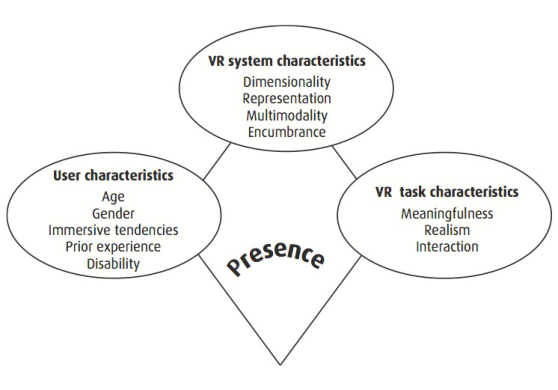
According to Weiss et al (2010), the sensation of presence in a virtual environment depends on a set of factors (see Figure 1) which include: the user’s virtual representation, the platform used (two- or three-dimensional), the number and quality of the modes of feedback, the user’s characteristics - such as age, gender and functional abilities, the characteristics of the virtual environment and the task requested - including its meaning and the intuitiveness of the interaction.
Figure 1. Factors which influence the sensation of presence in the virtual environment (Weiss et al, 2010).
Immersion and presence in virtual rehabilitation Ergonomics In Design, Usability & Special Populations I (2022)
A fundamental principle in rehabilitation is to conduct therapeutic tasks without causing the patient fatigue and frustration. Knowledge about the relationship between the user’s characteristics, the sensation of presence and performance within the virtual environment can help therapists achieve an ideal match between customizing the environments, achieving gains in motor and cognitive skills and reinforcing patients’ involvement in the task. Thus, a better understanding of the relationship between disability and performance in virtual environments should lead to greater efficiency in using VR-based rehabilitation (Kizony, Katz and Weiss, 2004).
In this context, virtual therapy allows the treatment protocol to be adjusted for each individual in congruence with that patient’s functional ability and quantitative control of the tasks requested, such as speed, power and endurance. It is not possible for human beings to be in control of these. This increases reliability when conducting repetitive tasks (Pignolo, 2007).
METHODOLOGY
Given the above, this study set out to conduct a review of the literature with a view to clarifying what claims are made for the effects of VR in the functional recovery of neurological patients.
The emphasis during the search for papers was on journals in the field of Rehabilitation Ergonomics - namely, Applied Ergonomics, Ergonomics, Human Factors and Ergonomics and the International Journal of Industrial Ergonomics, and the databases of IEEE, SciELO, PubMed and Medline.
In addition to journals, the research also included a review of selected papers from the proceedings of the 2009-2012 IEEE International Conferences on Virtual Reality.
After analysis, only 14 published papers were used to prepare this article. The selection of items was based on their appropriateness to the research context and the impact factor of the journals and their periodicity.
RESULTS
VR allows work to be carried out on motor and cognitive disabilities simultaneously, while providing recreational opportunities for people with severe disabilities (Weiss et al, 2010). According to these authors, VR has been used as a means for assessing and rehabilitating cognitive processes such as visual perception and spatial neglect, attention span, memory, information processing and sequencing.
Pignolo (2009) also states that clinical and biomechanical evidence suggests the efficacy of VR-mediated therapy in the functional recovery of people with a disability. However, the relationship between the sensation of presence, immersion and performance within virtual environments is still not fully understood (Weiss et al, 2010).
More studies are needed with large samples of patient in order to define the relationship between disability and residual function, and to establish common evaluation criteria and neuro-rehabilitation protocols in VR.
To conduct virtual training, there are three possible ways to use immersive tools: fully immersive (using a head- mounted display), semi-immersive (large projection screens), or non-immersive (desktop-based VR). The physical level of immersion will influence the sensation of presence in the virtual environment (Rebelo et al, 2012).
According to Bowman and McMahan (2007), the greater the level of immersion is, the greater the sensation of presence will be, which can make therapeutic applications more effective.
Sharan et al (2012) claimed satisfactory results for rehabilitating children with cerebral palsy on using inter-active games in non-immersive environments. However, fully immersive therapy, due to the strong sensation of presence, is more effective at achieving good rehabilitation results. To obtain a strong sensation of presence, users are subjected to different stimuli, such as visual and audio feedback. The characteristics of hardware and software and the complexity of the task requested sets out to provide users with a significant experience in the context of the authors’ therapeutic goals.
Thus, to be successful, many VR applications depend on the high fidelity of sensory stimuli, with the goal of Ergonomics In Design, Usability & Special Populations I (2022) producing a realistic experience that puts the user in a simulated environment to good effect. According to Riva, Molinari and Voncelli (2002), the greater the quality of the immersive virtual environment is, the greater the user satisfaction and the more realistic his/her experience will be. In other words, these applications require a high level of immersion because they produce a better sensation of presence (Bowman and McMahan, 2007).
Motor and cognitive recovery in virtual therapy Virtual environments are designed to stimulate the senses by multimodal means, thus making them ideal for research on multisensory integration - multimodal stimuli (visual, auditory, tactile and haptic) are used in a unified perceptual experience (Bohil, Alicea, Biocca , 2011).
The control of multimodal stimuli is of great importance in neuro-rehabilitation as it enables interactive environments to be personalized, their being matched consequently to the skills of the users and this also provides proprioceptive feedback which is essential for motor recovery.
Thus, virtual reality (VR) offers opportunities to manipulate therapeutically relevant variables and to work on the performance of motor and cognitive skills during immersion.
The central nervous system is not able to distinguish between sensory-motor experiences and relational experiences that occurred in the real world and in virtual environments. The realistic feeling of presence, provoked at high levels of immersion, allows a greater number of neuronal units to be recruited, which, besides the motor stimulus, constitutes an important part of cognitive training.
Positive results have been reported after using VR to rehabilitate people with various diseases (Alamri et al, 2008; Connelly et al, 2010. Jang et al, 2005). These authors report a reduction in disabilities and an improvement in the performance of real-world activities after training with a VR system. Other benefits from VR include the rapid transition between unlimited tasks, stimulation from cognitive networks and increased activation of secondary motor areas.
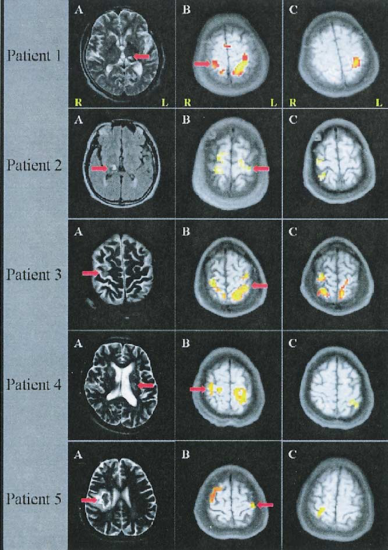
A study by Jang et al (2005) observed that cortical activation was reorganized from the contralesional side (before VR-mediated therapy) to the ipsilesional side (after virtual therapy), as shown in Figure 2.
Figure 2. Results from functional magnetic resonance before and after virtual rehabilitation (Jang et al, 2005).
Ergonomics In Design, Usability & Special Populations I (2022)
Although the neural mechanisms associated with immersion in virtual environments are not clearly understood, it is suggested that the intensive training of the affected limb could generate effective synaptic potentiation, thus increasing the induced practice of neuroplasticity (Jang et al, 2005).
When neuroplastic effects are achieved, there is a transfer of the skills acquired in the virtual world to the real context. The internal representations resulting from exploring the simulated space are then transferred to the real world. The training of a motor task in a virtual environment should improve performance in the task in the real world.
DISCUSSION
Although promising, therapy mediated by virtual reality is still undergoing some difficulties.
According to Bohil, Alicea, Biocca (2011), the items of equipment used in VR are still heavy, difficult to operate and expensive to build and run. In addition, creating virtual environments requires specialized skills in three- dimensional modeling, texturing, character animation and programming.
According to the authors, another major concern is the emergence of nausea after interacting with virtual environments. A widely accepted explanation for this is the mismatch between sensory inputs: how visual information provides users with the sensation of movement, vestibular feedback may indicate a degree of movement that is not offset by the patient´s visual field.
Rehabilitation is an opportunity to help people reduce the impact of their motor limitations. However, Physiotherapy - an important part of the treatment program of persons with disabilities, is a long-term conduct and stimulating patients’ motivation is always a large concern (Cheng et al, 2009).
According to Sharan et al (2012), the levels of participation, satisfaction and cooperation and motivational factors are significantly higher in VR when compared to conventional therapy.
Finally, it is important to observe the transfer of skills acquired in the virtual world to the real context. According to Jack et al (2001), experiments on the motor formation task and the transfer of skills to the actual environment indicate that the effects of virtual training are not fully understood, nor entirely conclusive. This conflict may be a reflection of the differences in learning abilities of perception and motor skills, or may reflect the current scarcity of studies on using VR to train motor skills.
CONCLUSIONS
In future studies, we intend to contribute to demonstrate the effects of virtual reality-based therapy when compared with traditional rehabilitation protocols. Thus, our intention is, by means of simulations using haptic devices, to generate high-quality evidence so that the specific effects of VR-mediated therapy to rehabilitate people with disabilities can be studied.
The high flexibility in programming and being able to program virtual environments mean the therapist can set a variety of controlled stimuli, monitor patients' responses, and offer assessment options and forms of clinical treatment that traditional methods lack.
By using immersive virtual reality therapists and patients interact in a simulated environment, with a strong sensation of presence that sees to it that all activities may be carried out safely.
Ergonomics In Design, Usability & Special Populations I (2022)
REFERENCES
Alamri, Eid, Iglesias, Shirmohammadi, El Saddik. Haptic Virtual Rehabilitation Exercises for Poststroke Diagnosis. IEEE TRANSACTIONS ON INSTRUMENTATION AND MEASUREMENT, VOL. 57, NO. 9, SEPTEMBER 2008. Bohil, Alicea, Biocca. Virtual Reality in Neuroscience and Therapy. Neuroscience. Vol 12. December, 2011. P 752-762. Bowman, D and McMahan, R. Virtual Reality: How much immersion is enough? Computer, vol. 40, no. 7, pp. 36-43, July 2007. Chen, C. Jeng, M. Fung, C. Doong, J. and Chuang, T.. Psychological Benefits of Virtual Reality for Patients in Rehabilitation
Therapy. Journal of Sport Rehabilitation, 2009, 18, 258-268. Connelly, Jia, Toro, Stoykov, Kenyon, Kamper. A Pneumatic Glove and Immersive Virtual Reality Environment for Hand Rehabilitative Training after Stroke. IEEE TRANSACTIONS ON NEURAL SYSTEMS AND REHABILITATION ENGINEERING, VOL. 18, NO. 5, OCTOBER 2010. Jack, Boian, Merians, Tremaine, Burdea, Adamovich, Recce, Poizner. Virtual Reality-Enhanced Stroke Rehabilitation. IEEE
TRANSACTIONS ON NEURAL SYSTEMS AND REHABILITATION ENGINEERING, VOL. 9, NO. 3, SEPTEMBER 2001.
Jang, You, Hallett, Cho, Park, Cho, Lee, Kim. Cortical Reorganization and Associated Functional Motor Recovery after Virtual Reality in Patients with Chronic Stroke: An Experimenter-Blind Preliminary Study. Arch Phys Med Rehabil Vol 86, November 2005. p. 2218-2223. Kizony, R., Katz, N. and Weiss, P.L. Virtual reality based intervention in rehabilitation: relationship between motor and
cognitive abilities and performance within virtual environments for patients with stroke. Proc. 5 th Intl Conf. Disability, Virtual Reality & Assoc. Tech., Oxford, UK, 2004. Pignolo, Loris. ROBOTICS IN NEURO-REHABILITATION. J Rehabil Med 2009; 41: 955–960. Rebelo, F., Duarte, E., Noriega, P. and Soares, M.M. "Virtual reality in consumer product design: methods and applications". In: Karwowski, Soares and Stanton. Human factors and ergonomics in consumer product design. Chapter 24. p. 381-404. Boca Raton, CRC Press, 2010. Rebelo, F. Noriega, P. Duarte, E. Soares, M. Using Virtual Reality to Assess User Experience. Human Factors: The Journal of
the Human Factors and Ergonomics Society, November 2012. Riva, Molinari and Vincelli. Interaction and Presence in the Clinical Relationship: Virtual Reality (VR) as Communicative Medium Between Patient and Therapist. IEEE TRANSACTIONS ON INFORMATION TECHNOLOGY IN BIOMEDICINE, VOL. 6, NO. 3, SEPTEMBER 2002. Sharan, Ajeesh, Rameshkumar, Mathankumar, Jospin Paulina, Manjula. Virtual reality based therapy for post operative
rehabilitation of children with cerebral palsy. Work 41 (2012) 3612-3615. Weiss, P.L., Kizony, K., Feintuch, U. and Katz, N. Virtual Reality in Neurorehabilitation. In: SELZER, CLARKE, COHEN, DUNCAN, GAGE. Neural repair and rehabilitation, Volume 2: Medical neurorehabilitation. Cambridge University Press, 2010.
Ergonomics In Design, Usability & Special Populations I (2022)
LISTED IN THE AHFE DIGITAL BOOKSTORE CATALOGUE
Explore the complete digital volume
Advances in Ergonomics In Design, Usability & Special Populations: Part I
Read this individual research paper free through the original publisher, or explore the full digital proceedings book.
ISBN 978-1-4951-2106-7
Explore this ISBN in the AHFE Bookstore ↗Listed in the July 2026 bookstore catalogue; search by ISBN to confirm current availability · Digital book purchase optional