Amilton Arruda, Edna Sant’Anna Moura, Rosmarina Hoppe (2022). Universal Design Concepts Applied to a Semi-automated Loft for the Third Age with Accessibility. In: Advances in Ergonomics In Design, Usability & Special Populations: Part I. AHFE Open Access, vol. 18. https://doi.org/10.54941/ahfe100835
With the growth of the elderly population in Brazil, there is increasing concern about appropriate dwellings for the elderly and to make these environments fit for this age group. For this important task of design, greater use must be made of information and computing tools so as to draw up more innovative designs. Adapting environments from the point of view of the dimensions, of computerization, of the physical space and of furniture in order make homes comfortable, safe and suitable for the elderly, as become of great importance today, because recent studies reveal that every year in our cities, the number of elderly people has been increasing. The object of this paper is to present a proposal for a dwelling with multiple functions, all of them concentrated on computer systems that meet the needs and assist this age group in coping with their limitations. Under the rules of Living with Gerontology arising from old age, adapting a new space for an accessible Loft is, according to the latest trends, a new concept of housing that aims to offer the elderly, an ever-growing and more active segment of society, a setting that is more appropriate and a safer life which has quality and dignity.
This is a Design & Architecture project, with ergonomic studies adapted to the elderly, with features that may make it possible to give more autonomy to the residents of these special homes, with attention being paid to the details, the use of specific materials that promote accessibility, comfort, automation and the use of some sustainable materials of paramount importance. To create it, it was essential to meet the different requests made by the universal design and design for accessibility.
The main objective of this project [using the concepts of Living with Gerontology applied to a Sustainable Loft] was to broaden the accessibility of the elderly to this structure, thus providing greater integration with the environment. It was an initiative for intelligent and automated adaptations for the elderly to be made to internal environments with a view to seeking a better quality of life for these users. The research and analysis of the data served so we might better understand that a small gated community of small apartments may include the elderly, while at the same time it pleases people of other age groups. There are details of modern life that will make all the difference in these dwellings.
We are active in the various stages, which range from research, design, concepts of sustainable architecture, use of Ergonomics In Design, Usability & Special Populations I (2022) https://openaccess.cms-conferences.org/#/publications/book/978-1-4951-2106-7 intelligent materials to the final design, and inclusion of technical solutions in the use of current and innovative technologies. The purpose of the Project serves to stimulate together with the real estate and also the construction sector, the concept of creating and implementing this type of construction, so that the elderly have a good experience of longevity; they will be taking advantage of and using all the resources presented and one s which form part of an innovative project.
Longevity is one of the great achievements of the 20th and 21st centuries which, together with the fall in the birth rate is leading to the world population aging. The average life expectancy in Brazil, according to IBGE (the National Agency for Official Statistics), is 75, reaching 81 or more, in more developed regions, which confirms that Brazil’s population is also aging at the moment.
The projection is that in 2025, Brazil will have the sixth largest elderly population in the world, with approximately 32 million people in this group, and that this will reach 52.2 million by 2040. The main causes of longevity are related to major scientific and technological innovations (mediated by design), better living conditions for the population as a whole, adequate urbanization of towns and cities, improvements in nutrition, personal hygiene, improved sanitation in general and, particularly, environmental conditions at work and at home.
The significant increase in the elderly population has been a matter that has been receiving great attention in all sectors which have resources that facilitate meeting the basic needs of this age group. This situation implies the development of specific public policies of action for the elderly so that this fosters their physical, social and economic well -being. This prospect of longevity makes the family become the object of attention, since it is in this space that family relationships are built, as well as prompting concern about for the space in which the elderly will live, in the struggle for better living conditions and personal autonomy, thus reducing dependence on relatives. (source: IBGE) In this respect, design & architecture as areas of developing new products that improve quality of life, using concepts of accessibility and automation, has nowadays become the area that attracts most attention because searching using more appropriate technical and quality tools, makes the final project more innovative. According to the Brazilian Institute of Geography and Statistics - IBGE, the proportion of elderly people in Brazil has been growing faster than that of children. In 1980, there were about 16 seniors for every 100 children; in 2000, this ratio almost doubled to 30 elderly people per 100 children and in 2010 this increased even more, ro 45 seniors for every 100 children.
Moreover, the drop in the fertility rate is primarily responsible for the reduction in the number of children, but longevity has been progressively contributing to the increase in the elderly population. In Brazil, women live, on average, eight years longer than men. The differences in life expectancy between the sexes show that: in 1991, women accounted for 54% of the number of seniors; in 2000, this rose to 55.1%. Therefore, in 2000, for every 100 elderly women there were 81.6 elderly men. 8.9 million (62.4 %) of the elderly are heads of households and the majority, 14.5 million, live in large cities.
Another conclusion: living in a large town or city can benefit the elderly due to the proximity of their children, (aif their children live in the same town), specialized health services and other facilitators of everyday life. Thus, the degree of urbanization of the elderly population also follows the trend of the total population, this being around 81%. The proportion of the elderly residing in rural areas fell from 23.3% in 1991 to 18.6% in 2000 (data from IBGE), ie in a decade, and in this same period the Brazilian elderly population increased from 8.8% to 11.1% of the total population of the country.
According to Lucila L. Goldstein of the Department of Geriatrics, Hospital das Clinicas of the Faculty of Medicine, University of São Paulo in her research in the area of Gerontology: If the trends of the demographic parameters implicit in the projection of the population of Brazil are maintained, the country will move rapidly along a path towards a demographic profile which will get older and older, a phenomenon that, undoubtedly, will result in adjustments to social policies, particularly those geared to meet the growing demands in the areas of housing, health, social security and welfare.
The so-called "Third Age" means the age group over 60 years old, both male and female, couples and the widowed, Ergonomics In Design, Usability & Special Populations I (2022) https://openaccess.cms-conferences.org/#/publications/book/978-1-4951-2106-7 the retired and those consolidating their professional career. According to Goldstein: The elderly who belong to the Third Age, also deemed the "Golden Age " are parents, grandparents, couples or widowed, show affection, and are united to the family; most live with relatives, or in sheltered housing or nursing homes; they look after their health, feed themselves, engage in some kind of physical exercise, are religious, have fun, enjoy recreational activities, watch TV, listen to music, dance, celebrate birthdays, make friends very easily.
Figure 1. Source: Centre of Reference and Documentation on
Figure available in the original PDF paper.
POTENCIAL DE CONSUMO DOS IDOSOS CONSUMPTION POTENTIAL OF THE ELDERLY Increasingly numerous, the elderly appear as a new market niche for companies offering products and services. According to Sidnei Porto, Director of Planning and Market Relations (Gerencial Brasil/SP): "With financial independence, a willingness to spend and awareness about how and what to consume, this population is starting to attract the attention of entrepreneurs to the importance of personalized service and loyalty." The elderly of today have active lives and are consumers of almost everything. They need products and a service that matches their needs and limitations.
The market will be forced to adapt its products and services to the conditions and characteristics of the elderly. Smaller packages are one of the requirements because many seniors live alone or only with their spouse and do not consume large amounts of food and products.
In exercising their purchasing power, elderly women, for example, perforce prompt the appearance of fashion, cosmetics and products associated with an aesthetic standard and beauty appropriate for those who are mature. The cosmetic industry is one that has reacted quickly to the aging of women concerned with the maintenance of certain aesthetic standards. The desire to consume has been extended by several segments, including that of Information Technology. The purchase of computers and their derivatives and the use of the internet have caused a great change in some segments that used to insist on placing barriers to the intellectual and cultural development of the elderly, and we note that the internet has become a large factor in social integrating the elderly.
A rather unusual public when thinking about consumers has been catching the attention of marketing professionals. As the elderly have a consumption potential of around R$ 8.7 billion and a tendency to grow in number, some companies have been studying how to handle this public and have been on the look-out for new business Ergonomics In Design, Usability & Special Populations I (2022) https://openaccess.cms-conferences.org/#/publications/book/978-1-4951-2106-7 opportunities. We are talking about the elderly, who still come across as an odd public to some companies. According to Thiago Torquato, "The elderly need special attention and look for a service that is rarely found." Banks and travel agencies have already discovered this lucrative niche. The builders are aware of these customers by offering homes that are of easy access with safe.
The numbers reinforce the potential consumption of the elderly. Brazil has millions of the over 60s, who account for 10.5% of the population, according to IBGE. Projections by the World Health Organization forecast that as a result of increased life expectancy, unprecedented opportunities and expectations of consumption for future decades are being created. As they are aware of such great potential, some brands are already seeing opportunities and investing in marketing actions for this public. Also according to the Organization of American States (OAS), the main areas of investment in the coming decades will be for the elderly - housing, health, social security and welfare.
Although available to customers of all ages, various services and activities were conceived so as to serve the elderly. According to Gilberto Cavicchioli, companies ought to invest in customized products for this audience. The elderly do not look on it kindly when they are dealt with conservatively nor when products are launched and positioned as products for the elderly, because the consumption of these goods would be labeled as being for the "old ", which is what they do not want, as he explains as follows: "According to the Elderly, age is nothing, respect is everything."
For Cavicchioli, the elderly consumer is also an important person in making decisions on purchasing products for the family, especially in the retail trade, since by having more free time, they go more often to the supermarket. In addition, the elderly have a strong habit of exchanging opinions with others, thereby influencing their purchases, "it being up to the supplier to find out who the buyer is," says Cavicchioli. Seniors wish to live well, to study, to travel, to have new experiences and not to be left out of experiencing what younger generations do. "Lesser physical ability does not mean lesser mental capacity. They want to interact with electronic products, for example, but are more impatient with regard to what´s new." Therefore, Cavicchioli suggests that companies invest in friendlier interfaces and produce manuals that are more pleasant to read.
The elderly population is undergoing a period of transformation to the point that it is necessary to "reinvent the concept of third age." For Gilberto Cavicchioli, "The elderly consumer is also more informed and wants to take part in society." Furthermore, "The designer by using Marketing tools can help in this reinvention by introducing new products and services that meet and reflect the desires and needs of this public."
GERONTOLOGY Gerontology is the study of the aging process of humans and the phenomena arising from old age. It is important because it studies aging from the perspective of a multi- and interdisciplinary approach and seeks appropriate intervention alternatives with regard to the Elderly, its outlook being to improve the quality of life and to maintain the functional capacity of over 60s.
geriatrics
psychology
social service
physiotherapy
nursing
gerontology
occupational
speech
therapy architecture interior design Ergonomics In Design, Usability & Special Populations I (2022) https://openaccess.cms-conferences.org/#/publications/book/978-1-4951-2106-7
Figure 2. Outline of the discipline of Gerontology. Source: Instituto Brasileiro de Gerontologia – IBGERON.
Figure available in the original PDF paper.
Currently, the focus of studies in gerontology has been successful aging, and has started to investigate the positive aspects of aging and its potential for development, learning ability, the functionalities that are preserved throughout life, psychological well-being and the satisfaction indices in old age so that we can define this as the high level of physical and mental health, emotional well -being and the ability to adapt to the third age.
Gerontology presents environmental and cultural aspects of aging. It is a medical and social science, given that it includes complex problems of Medicine and Sociology. According to the Brazilian Institute of Gerontology (IBGERON in Portuguese), of the Organization of Civil Society of Public Interest (OSCIP in Port.), the main aspects and concepts associated with the term successful aging are: (a) Biological aspects in aging; (b) Socio-cultural, demographic and bioethical issues in aging; and (c) Clinical and emotional aspects in aging: low risk of disease and disabilities related to diseases; mental and physical functioning; active engagement with life.
We cite some areas of interest to Gerontology: Design and architecture: in the study of both architecture and design, it is of fundamental importance that an assessment of environmental comfort and accessibility in the built spaces are considered. Therefore, the definition of these terms, the use of ergonomic methods and processes, data and estimates by sampling must be known. This field is significant in our view and key because somehow it involves others. It is as if through design and architecture, all other aspects of gerontology had a piece of them.
Accessibility: this aims to serve all the people in the various types of buildings, regardless of their physical conditions, be these normal, limited or outside the "standard" set by a desirable human scale. Houses must be planned so that people can move around safely, use the equipment and participate effectively in the environment in which they reside. On the issue of sizing and accessibility, the designer must design, using the recommendations of NBR 9050/2004, as well as the proposals of Universal Design, while always paying close attention to the particularities of each situation, dimensions, adequate facilities, risks of accidents, etc.
Comfort: environmental comfort in built environments with accessibility contributes to the well-being, physical health, mental balance and to improving the quality of life of the elderly. In this context, the comfort of the elderly is addressed from the hygrothermal point of view, relative to the satisfaction of the person with the humidity and temperature; intensity of light, the result of the amount and intensity of local luminosity; acoustic, with respect to sound quality, on minimizing noise, echoes; and anthropodynamic, which refers to the movements required by the various human activities (Barbosa, A. L., 2020.)
Automation and the use of new technologies in equipment and systems used in residential control can provide autonomy and security, by bringing back the confidence and self-esteem of the elderly or disabled person." The integration of mobile interfaces through cell phones, smartphones, tablets etc and other electromechanical devices whether controlled locally or remotely," can bring numerous benefits in terms of security for the peace of mind of families and the elderly themselves. (Barbosa, A. G., 2020) Using voice command or touch-screens with high contrast and large characters provides access to lighting and air- condition controls and allows the remote opening of doors, windows, and so forth. "Among its many applications, task scheduling stands out because of its simplicity and efficiency, and reminds people about the time to take their medications, meals etc.," says Barbosa.
"The system constantly monitors all functions of the residence thus enabling relatives to be alerted in case of emergency such as a fall, or avoiding dangerous situations, for example, by interrupting the flow of gas if it is forgotten that the stove is on, advances in residential control systems and wireless technology offer a higher level of comfort and safety and such systems are easily used by the elderly "(Barbosa, A. G, 2002)
Ergonomics In Design, Usability & Special Populations I (2022) https://openaccess.cms-conferences.org/#/publications/book/978-1-4951-2106-7
PRINCIPLES OF UNIVERSAL DESIGN Wikipedia defines Universal Design as follows: "Universal Design or Total Design or Inclusive Design, which means " design that includes " (the opposite of to exclude)”and "design for all", is a focus on the design of products, services and environments in order that they are usable by as many people as possible regardless of age, ability or situation. It is directly related to the concept of inclusive society and its importance has been recognized by government, business and industry.
In Universal Design, the designer studies a series of issues that are not usually addressed in a common project, because in this work it needs to consider all possible uses, by very different users. This includes social, historical, anthropological, economic, political and technological questions, and especially those about ergonomics and usability.
Universal design is a relatively new term that emerged from "accessible design." – one that is free of barriers so as to give accessibility to people with a disability."
It refers to places, products and systems accessible to anyone. It is the design of new products and environments to be used by all people, for as long as possible, without the need for adaptation or special design. For designers who use these principles and its tools well, it is possible at the design stage to improve on the specifications thereby benefiting thousands of elderly people with or without physical disabilities thus providing the benefit of a series of new and modern products, as well as a new system of housing, universally designed.
According to Housing for the Lifespan of All People, "Universal design conceptualizes what is applicable or common to all purposes, conditions and situations."
The following are some of the principles of Universal Design, explained more specified form: a) Principle of Correct Use: The artifact is usable and marketable to people with diverse abilities/disabilities and have the following characteristics: (i) it sets the same form of use for all users; (ii) it avoids the segregation or stigmatization of any user; (iii) it provides privacy, safety and security for all users equally; (iv) it makes the device attractive to all users. Thus, note that universal design caters to a wide range of people, preferences and abilities.
b) Principle of Flexibility in Use: The artifact accommodates a wide range of individual preferences and abilities, with the following characteristics: (i) it lays down the choice of the form of use; (ii) it accepts the use or access on the right and on the left; (iii) it facilitates the user in being precise and accurate; (iv) it provides for adjusting to users’ habits.
c) Principle of Simple and Intuitive Use: The use of the artifact is easily understood by the user, no matter their experience, knowledge, language skills or level of concentration. Also: (i) it eliminates unnecessary complexities; (ii) it is consistent with the user’s expectation and intuition; (iii) it accommodates a wide range of skills and language skills; (iv) it groups information consistent with its importance; (v) it provides for effective memory and feedback during and after task completion.
d) Principle of Perceptible Information: The artifact provides the information that the user needs, regardless of the ambient conditions or the user's sensory abilities: (i) it uses different modalities (pictorial, verbal and tactile) for presenting essential information; (ii) it maximizes the legibility of essential information; (iii) it describes the elements in a way that differentiates them, thus facilitating instructions or recommendations, (iv) it provides compatibility with a variety of techniques and equipment used by people with sensory limitations.
e) Principle of Tolerance of Error: Ergonomics In Design, Usability & Special Populations I (2022) https://openaccess.cms-conferences.org/#/publications/book/978-1-4951-2106-7
The artifact minimizes hazards and the adverse consequences of non-intentional or accidental actions: (i) it arranges elements that minimize hazards and errors by using the most used and most accessible ones, thereby eliminating, isolating or concealing the dangerous elements, (ii) it provides alert to hazards and errors; (iii) it provides for the failure of safety parts; (iv) it discourages unconscious actions in tasks that require vigilance.
f) Principle of Little Physical Exertion: The artifact can be used efficiently and comfortably with a minimum of fatigue: (i) it allows the user to maintain a neutral body position; (ii) it does not require great effort to operate; (iii) repetitive minimization, (iv) it minimizes the physical effort of support.
g) Principle of Size and Space for Approach and Use: It provides for appropriate size and space for approach, searching, handling and use, no matter the user’s height, posture or mobility: (i) it provides a clear line of sight to the important elements, for any user, whether sitting or standing; (ii) it makes access to all components comfortable for any user, whether sitting or standing, (iii) it accepts hands or prostheses of varying sizes; (iv) it provides adequate space for the use of ancillary equipment or that of helpers. Thus, the artifact offers spaces for interaction and appropriate sizes, reach, manipulation and use, circulation of 0.90 m wide and 2.10 m high, o.80 m wide doorways, minimum diameter of 1.50 for maneuvering a chair.
The information aforementioned regarding the principles of Universal Design were originally gathered by the Center for Universal Design (North Carolina State University, USA) in which it was first mentioned in the 70s by the North American Ronald Mace, an academic architect and translated by the architect Silvana Cambiaghi, FAU/USP (Cambiaghi, 2007). She also weaves other considerations on features which the Designer should incorporate into projects: economics, engineering, culture, gender and environmental considerations in the process and the art of designing, the form of use, daring more, going beyond the traditional, serving the extraordinary.
According to ABNT (the Brazilian Association for Technical Standards), via (NBR-9050) the following concept for Universal Design aimed at the architectural accessibility is postulated: "Making buildings and street furniture and equipment adequate for the elderly and people with disabilities." Moreover, it says: "What we must take into account are: the space of the environment, the support needs, the height of the furniture and the preventive measures against falls so as to generate accessibility for the elderly."
PROPOSAL For the elderly, maintenance and use of the residence by themselves is of utmost importance because this configures their comfort zone in a known area, thus highlighting their consolidation of normality. This project proposal gives evidence, in a systematic way, of the conception of housing that is adequate for the elderly, thereby enabling them to have a comfortable life that they manage, while maintaining their individuality and independence and with a view to promoting a better quality of life for the residents, with the maximum of autonomy from their families.
The proposal contemplates the environment, with innovative adaptations. The project presented here was developed for individuals aged from 60 years, who value design environment, using the friendly technologies available (computers, telematics, automation components and accessories) all integrated into the interior of the plant, and using all resources and materials available and accessible to the Brazilian market .
This is a Project for apartments, of the functional loft style, using small spaces on average of 50-70 m 2 matched to the limitations and needs of the elderly, using materials, furniture, decor and equipment that promote accessibility and comfort to the residents.
Figure 3 and 4 shows the initial part of the proposal. An Analysis of the Semantic Panel. Semantic panels according to (Salles 2008 , p.127), represent for the critique of the development process of projects, the materialization of the dynamics of creative thought which seeks visual references of their repertoire in the cultural context, thus comprising the pieces of the jig-saw that structure the meaning and message intended for the final product.
Therefore, the research seeks significant repetitions and redundancies that may enable " [ ... ] generalizations to be Ergonomics In Design, Usability & Special Populations I (2022) https://openaccess.cms-conferences.org/#/publications/book/978-1-4951-2106-7 established about creative doing, the pathway of a form of theorizing." (Salles 2008, p.128).
Figures 3. Semantic Panel – source: authors
Figures 4. Semantic Panel – source: authors
In the process of creating industrial products, a set of components of the individual or collective imaginary is activated that represents the beliefs of the creator, a mental representation of his/her unconscious repertoire. (Farias, M. 2012, p.7) In the process of creating and constructing ideas, the imaginary is easily confused with the imagination, defined by Wunenburger (2007, p. 8) as "( ... ) the ability to engineer and use images ," while the imaginary represents: "( ... ) a set ( metaphor, symbol, reporting ), forming coherent and dynamic sets, referring to a function of productions,
Ergonomics In Design, Usability & Special Populations I (2022) https://openaccess.cms-conferences.org/#/publications/book/978-1-4951-2106-7 mental or materializations in works based on visual (a painting, drawing, photograph) images and linguistic sets, which are symbolic in the sense of an adjustment of proper and figured meanings (2007, p. 11).
A semantic panel is therefore made up of an imagistic narrative framework that includes both mental representations, a result of this faculty of creating starting from the combination of one’s own ideas from the imagination, as well as touching and affecting the creator, and transport fantasy, memory, dream, myth, romance, fiction and many other components of the imaginary. (Farias, M. 2012, p.7)
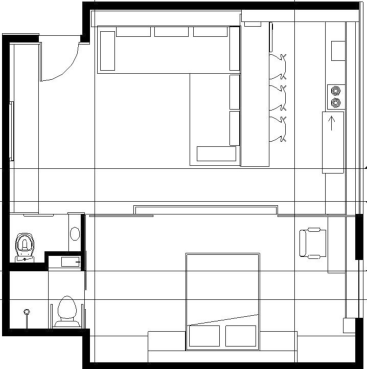
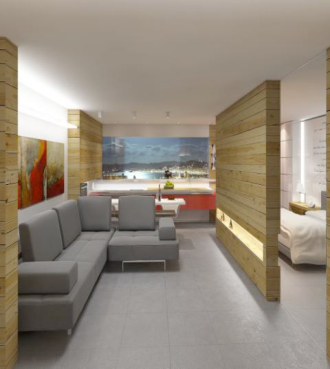
Figure 5. Floor plans of the Concept of the Environmentalized Loft – design: authorsFigure 6. Images of the Interior of the Environmentalized Loft – design: authors
Ergonomics In Design, Usability & Special Populations I (2022) https://openaccess.cms-conferences.org/#/publications/book/978-1-4951-2106-7
CONCLUSIONS
This is a Design and Architecture project adapted to the elderly, with features that enable the residents of these special houses to be more autonomous, and one that pays attention to the details, use of specific materials that promote accessibility, comfort, automation and the use of some sustainable materials of paramount importance. To create it, it was essential to meet the different requests provided by the basic principles of universal design.
The main objective the Interior Design Project on Living with Gerontology - Sustainable Loft was to broaden the accessibility of the elderly to the structure presented by providing more integration with the environment. It was an initiative for adaptations of smart indoor environments for the elderly. Quality of life is ageless; so we developed a series of differentials to increase the well-being in our undertaking.
We created the interior project living with Gerontology - loft with accessibility, while seeking to meet the aspirations of this audience; it is possible to identify these through the analysis of semantic panels, through constructive and more appropriate designs by taking into account a wide range of the requirements that make housing functional for every phase of life.
The research and development in the design phase served so that we understand that a building can include the elderly, but at the same time one that pleases people of other age groups. These are details that will make all the difference at the time of its sale and marketing.
We are active in various phases of this proposal: this ranges over the survey of images and semantic panels, design aspects, the research on new and existing construction materials, the overall scope of the final project, integrating technical solutions, using telematic and current technologies and the continuous search for more innovative design.
The purpose of the Project is to prompt the concept of creating and implementing this type of construction, using concepts and fundamentals of universal design so that older people may have good experiences of longevity; they will be taking advantage of and enjoying the resources presented and be part of this Project of an Innovative Interior.
REFERENCES
ASSOCIAÇÃO BRASILEIRA DE NORMAS TÉCNICAS, (2004), Norma NBR 9050, “Acessibilidade a Edificações, Mobiliário, Espaços e Equipamentos Urbanos”. Rio de Janeiro. Baranauskas, M. C. C., (2007) “Design Universal e Design Acessível: Fatores Humanos em Sistemas Computacionais”.
Universidade Estadual de Campinas, Instituto de Computação. Barbosa, A. L. G. (2002), “Conforto e qualidade ambiental no habitat do idoso”. Tese de doutorado da Universidade Federal do Rio de Janeiro. Barros, C. F. M. (2000), “Casa segura, uma arquitetura para a maturidade”. Rio de Janeiro: SENAI/Artes
Gráficas. Cambiaghi, S. (2007), “Desenho Universal, métodos e técnicas para arquitetos e urbanistas”. São Paulo: SENAC. Farias, M.O. (2012) “A Gênese da Linguagem do Produto Industrial: transformações da imagem na passagem entre linguagens
no processo de criação”. Ensaio publicado na revista nº 2. 2014 designPortfolio, Goiânia, AVILA. Roaf, S.; Fuentes, M.; Thomas, S. (2009), “Echohouse: A casa ambientalmente sustentável.” Trad. de Alexandre Salvaterra. 3. Ed. Porto Alegre: Bookman. Salles, C.. A. (2008) “Crítica genética: fundamentos dos estudos genéticos sobre o processo de criação artística” 3ª ed. Revista
EDUC, São Paulo. Schittich, C. (2007), “Housing for People of All Ages: flexible-unrestricted-senior-friendly”. Berlin: Ed.
Detail. Tilley, A. R.; Dreifuss, H. (2005), “As Medidas do Homem e da Mulher: Fatores Humanos em Design”.
Trad. de Alexandre Salvaterra. Porto Alegre: Bookma Wilson, J. R.; Corllet, E. N. (1995), “Evaluation of human work: a practical ergonomics methodology”. 2 ed. London: Taylor & Francis, 1995. Wunenburger, J. (2007) “O imaginário.” São Paulo: Edições Loyola.
Ergonomics In Design, Usability & Special Populations I (2022) https://openaccess.cms-conferences.org/#/publications/book/978-1-4951-2106-7
LISTED IN THE AHFE DIGITAL BOOKSTORE CATALOGUE
Explore the complete digital volume
Advances in Ergonomics In Design, Usability & Special Populations: Part I
Read this individual research paper free through the original publisher, or explore the full digital proceedings book.
ISBN 978-1-4951-2106-7
Explore this ISBN in the AHFE Bookstore ↗Listed in the July 2026 bookstore catalogue; search by ISBN to confirm current availability · Digital book purchase optional