Rodolfo AG Vilela, Marco Antônio Pereira Querol, Laura Seppänen, Francisco de Paula Antunes Lima, Renata Wey Berti Mendes, Manoela Gomes Reis Lopes, Ildeberto M. Almeida, José Marçal Jackson Filho (2022). Work Ergonomic Analysis and Change Laboratory: Similarities and Complementarities Between Interventionist Methods. In: Advances in Ergonomics In Design, Usability & Special Populations: Part II. AHFE Open Access, vol. 19. https://doi.org/10.54941/ahfe1001234
1 University of São Paulo São Paulo, SP 01246-904, BR ↗
2 Federal University of Paraná Curitiba, PR 80090-000, BR ↗
3 Finnish Institute of Occupational Health Helsinki, FI-00250, FI ↗
4 Federal University of Minas Gerais Belo Horizonte, MG 31270-901, BR ↗
5 Federal University of Rio de Janeiro Rio de Janeiro, RJ 21941-909, BR ↗
6 Botucatu Medical School, UNESP Botucatu, SP 18618-000 BR g Jorge Duprat Figueiredo Foundation of Safety and Occupational Medicine Rio de Janeiro, RJ 20011-902, BR ↗
7 Jorge Duprat Figueiredo Foundation of Safety and Occupational Medicine, Rio de Janeiro, RJ 20011-902, BR ↗
The objective of this study is to compare the interventionist methodologies of Ergonomic Work Analysis (EWA) influenced by a French approach, and the Change Laboratory method based on the Activity Theory approach. This study aims at identifying complementarities and convergences between these methods to improve work related accident and diseases prevention. Reference publications of these two methodologies were selected to make a theoretical comparison between the approaches. The criteria selected for the comparison were: units of analysis and key concepts, main methodological principles, the role of demand, main steps of the method, the relationship between the diagnosis and creation and construction of new solutions processes, the role of researcher / interventionist, the role of practitioners and ethical issues. Based on this comparison, resources will be drawn from both approaches to map out the ingredients for efficient intervention for the prevention of accidents and health problems related to work. We argue that ergonomic analysis has as its main strength deep and detailed understanding of the actions and operations of workers engaged in real work, while, on the other hand, the Change Laboratory seeks understanding within a historical and systemic perspective and emphasizes intervention in the whole activity system.
Studies on surveillance and accident prevention made by public and private agents in Brazil have shown the need to improve the analytical capacity of these professionals because their academic education is strongly influenced by traditional occupational medicine, safety and the industrial hygiene approach. These fields tend to focus on the attention given to risk and disease factors, especially the visible technical aspects established in standards and by legislation, and neglect the organizational determinants of these events, resulting in interventions of little or only partial efficacy. Another challenge is that these actions are usually ad hoc, external interventions in the work process, and therefore can only capture the nuances, the variability and the invisibility of the organizational aspects, if one adopts a methodology for the in-depth analysis of events or situations of risk, which calls for knowledge of other more appropriate methodologies and interaction with the agents of production, going beyond merely checking compliance with standards and procedures (Assunção and Lima, 2003; Vilela et al, 2012). However, access to the organizational dimension requires the mastery of methodologies that can assess the measure in which the work determines and influences the generation of the risk of accidents and other harm. The experience of the research group was able to associate the in-depth analysis of specific hazardous situations by combining the use of the Model for Accident Analysis and Prevention-MAPA (Almeida and Vilela, 2010) with Ergonomic Work Analysis - EWA (Guérin et al, 2004). It allowed the perception of the organizational determinants of accidents in companies and sectors with high accident rates. The findings of these studies are compatible with current concepts that show the decisive participation of organizational aspects in the genesis of accidents (Llory,1999; Reason,1999; Daniellou et al, 2010). Despite obtaining a detailed diagnosis in intervention studies, the recommendations arising from the analysis carried out meet resistance on the part of the organizations , even when pressed by public agencies in inter- sector surveillance actions.
A central hypothesis is that the diagnosis and recommendations alone, however important they are, are insufficient to trigger the desired transformations, even when inserted in the context of legal regulations and the pressure of inter-institutional actions. Another hypothesis is that the necessary changes presuppose a new design of the work place, and more importantly, new ways of organizing the activity concerned. These changes require a follow-up, supervisory and monitoring process, which can be executed with appropriate methodologies to bring the actors together to discuss the real problems and find viable solutions. These procedural (and pedagogic) visions related to the problem are recognized by Activity Ergonomics, but the findings produced by this methodology sometimes are restricted to the person of the researcher, who becomes the bearer of an overall vision of the activity, without being able, in the majority of cases, to change the different and contradictory logical postures and representations which lie behind the activities of the various departments of the particular enterprise.
Intervention (derived from the Latin inter, between, and venio, to come, that is, ‘to come between’) is a “purposeful action by a human agent to support the redirection of ongoing change.” So the interventionist intervenes in an actor’s actions so that the activity in which he is involved takes a new direction. The term intervention is usually reserved for the application of specially planned forms and methods. A method is a pre-planned procedure or set of steps to follow that is generally applicable to certain tasks. An intervention method can be a result of experimentation and empirical experience, but it can also be based on a theory that provides the reasons and rationale for the nature and sequence of the steps to be taken. In this case, the intervention method is part of a broader methodology that answers questions such as how to delineate and understand the purpose of the intervention, how and why the method produces the outcomes it is claimed to produce, and on what grounds and in which ways the results of an intervention can be extrapolated to other situations and other activities (Virkkunen and Newnham, 2013).
The primary objective of this study is to compare the methodology of the EWA influenced by a French approach with that of the Change Laboratory based on an activity theory approach. This study has yet to identify complementarities and convergences to improve interventionist tools.
Method: reference publications of these two methods were selected to obtain a theoretical comparison between the approaches. To do this, the following aspects were selected: units of analysis and fundamental categories, main methodological principles, main steps of the method, the role of demand, construction and creation of new solution processes, the relationship between the diagnosis and the impetus to change, the role of the researcher / interventionist, the role of actors involved and ethical issues. Based on the comparison, resources will be drawn from both approaches to map out the ingredients necessary for the creation of efficient intervention tools for the prevention of accidents and health problems related to work.
The need for this article emerged from the experience of the authors working on previous development projects
(Cordeiro, 2003; Vilela, 2006). We have perceived that even when a diagnosis of some questions is reached, others arise, for example: how successful was the diagnosis? Who should perform it? What is the role of the diagnosis in change and development? How does one involve the organization’s actors in lasting changes? The challenge of the sustainability of the production system is currently a huge social question when companies seek higher and quicker profits on a global market, but what is the role and potential of interventionist methodologies in obtaining lasting changes? In this way the surveillance and prevention of work related accidents and injuries require a double endeavour. The first concern is to construct a work situation diagnosis to give visibility to the organizational determinants of these events. The second is the intervention and change itself, seeking to avoid the occurrence of adverse events and anomalies in the activity.
These questions motivated the team to look at the Change Laboratory Method developed at Helsinki University (Virkkunen and Newnham, 2013) in view of the need for a process of learning and the involvement of the actors in the search for solutions and a change of the organizational determinants that give rise to workers’s health disorders and problems. This article represents an effort to approximate the two interventionist methodologies that have common bases and points of connection so as to produce more consistent intervention efforts, enriching the field of knowledge on this topic, and more importantly, leading to the creation of work processes that are both more healthy and human.
RESULTS
Ergonomic Work Analysis (EWA) The EWA was developed in francophone countries and is to be distinguished from other ergonomic approaches. Whereas the primary object of biomechanical ergonomics, also called British ergonomics, is the equipment used to do the work the object of francophone ergonomics is more enigmatic and is the work itself (Wisner, 2004. pag.44). "The foundation of activity ergonomics is linked to the fact that a product may have incorporated the best knowledge from the Human Factors Science, and does not permit the satisfactory service work to workers population use them"(Wisner, 2004. pag.44). According to Wisner, for one to conceive a good technical device one would need to analyze the work. The difference between that and the studies undertaken and controlled in the laboratory arises when researchers give their attention to workers' behaviour in a real work situation. The precursors of this latter approach were the work studies of Pacaud(1946, 1949) and later Ombredane and Faverge (1955). The analysis of observable behavior was initially tolerated by the behaviourists, but EWA completed the rupture with behaviorism when it came to value the spoken word, loaded with meaning, as a means of describing behavior. .Then arose the techniques for observation and collection and appreciation of the verbalizations of workers in concrete situations, techniques such as self-confrontation, the attribution of value to narratives, an approach essential to EWA with its "psychological and anthropological movement of situated cognition". According to Wisner (1987), ergonomics is the art (technique) by which scientific knowledge and the worker’s practical knowledge of his own work situation are utilized. “Its principle is itself revolutionary, because it makes one think that intellectuals and scientists have something to learn from the speech and behavior of workers".
Regarding the activity’s invisibility, the access to it requires a new domain of work, a new vision, a new readiness to listen and so a new modality of interaction with the operators concerned. This is an ethnographic approach, different from the external investigator’s view (Oliveira, 2000). Thus Teiger (1993), states that the ergonomics brought about a paradigmatic revolution within the sciences dedicated to study the man-machine relationship, because she starts from the formula “adapt the work to the man” (Wisner and Marcelin, 1971), which is contrary to the taylorist view predominant nowadays that it is necessary to choose the right man for the right place, and regard the machine and the workplace, to which the worker must adapt, as immutable.
Ergonomics can be understood as a “pedagogical act” (Dugué et al, 2010) by promoting the encounter of the different professional worlds (Béguin, 2009) by which workers would become familiar with the professional fields of the engineers and technicians and these latter would get to know the professional world of the workers and their activities (real work). The intervention provides, therefore, the opportunity to create a "common world" by means of a mutual learning process in which the representations of their own work and that of others are highlighted..
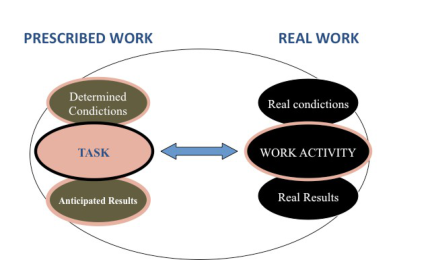
The ergonomic specialty is, on one side, knowledge of the human being, and on the other, of his activity, that is to say, it is knowledge of the human being in action. Ergonomics thus constructs its specialty on the basis of this knowledge which did not previously exist or was insufficient, or lay outside any practical context, as for example in laboratory experiments. Ergonomics claims to offer a holistic vision of man, in which he is conceived in terms of his physiological, cognitive and affective dimensions in society. Beyond studying the subject in the sphere of his activity, Ergonomics will produce knowledge useful to action, whether this relates to the design or transformation of work situations or the technical objects involved (Falzon, 2007). Differing from Taiyor’s approach, French ergonomics differentiates prescribed work (called the task) and real work (called the activity), introducing new possibilities and horizons for the understanding of the operator who is now seen not as a mere executor of orders, but in his full dimension as a bearer of knowledge, intelligence and subjectivity (Wisner, 1997; Guérin et al., 2004). The task consists of a set of goals imposed on operators and of externally defined requirements for the achievement of those goals and is also a principle that imposes a work setting mode in relation to time. It is external to the worker concerned, it does not take the particularities of the operators into consideration, let alone what they think about the choices made and imposed on them. The activity, however, is understood as that which the worker does to fulfill the instructions he has received; it is the central element around which the structure and components of the work situation are organized, it is also a response to the constraints to which the worker is subject but which he is able to transform. In this way the operator deals with and manages multiple possible compromises between the conflicting requirements which may be present in his work activity. The work involves heterogeneous dimensions such as the worker’s physical body, his cognition and affections, the individual and the social, production and health. Thus the work is the unit of activity, the conditions under which it is carried out and its effective results. Work analysis is the analysis of this set of dimensions and the relationships established within this system.
Figure 1. Summarizes the differentiation between work, task and activity in the ergonomic activity domain. (Guérin et al., 2004)
The interest in understanding the distance between the prescribed and the real work does not seek either to reduce or delete it (seeing that the prescription can be quite useful to work), but rather to give visibility to the real work and to rediscuss work representations with a view to general good health and the process’s safety and efficacy, in order to bring about beneficial lasting change. This difference is highly important for the understanding of the concept of activity. This is always related to the commitment of the worker in the light of what was requested of him (i.e., prescribed) and the real situation, within the limits of human and technical variability, as well as any other interactions that may be present.
But activity is more than the result of a compromise between the requirements of the task and the requirements of the internal state of the worker. It is also a reflection and construction of the history of the subject who is active and arbitrates between "what is asked for" and what "is in fact possible". Activity goes beyond the concrete performance of the task or its redesign, in which the worker not only carries out what is expected of him and manages the variability but, further, constructs his own competence, health and identity (Noulin, 1995). The operator undertakes his activity in real time according to this framework: the work activity is a strategy to adapt to the real work situation, object of prescription. This approach shows that the operator does not remain neutral in the face of the constraints arising in his relationship to the work. That is, he develops his own strategies, a personal modus operandi and the regulations necessary to adapt to and meet the requirements of production, taking into account his own internal state, the lowest energy and cognitive cost and his safety and that of the system (Assunção and Lima, 2003). By strategies is meant the plans developed by the operator to achieve his goals. They are the paths that the operator should follow in the course of the action, in the light of the ideal conditions: materials, interaction with colleagues, time requirements, etc.
By modus operandi is meant the specific means that each operator adopts for the execution of the task, the signs he uses, the speed at which he works, the way he handles and does things etc. Changes in conditions and aspects associated with the chosen strategies require adjustments in the modus operandi which may affect the safety of the system (Guérin et al., 2004). The distance between the prescribed work and the real work is the concrete manifestation of the contradiction always present in the work action, that between 'what is requested’ and what the “thing requires”. The EWA is the analysis of the strategies (regulation, anticipation, etc.) used by the operator to manage this distance — that is, the human/system analysis task. Terssac and Maggi (2004) highlight three fundamental propositions of ergonomics which represent significant contributions and reversals of perspective in relation to other disciplines which study work: the variability of contexts and individuals, which represents an inversion of perspective of the taylorist model of the "average worker well trained, working in a stabilized function"; the differentiation between task and activity already commented on earlier, the concept of regulation and competence. For the authors, the operator’s regulation of the activity represents an inversion of the view of the efficiency of the system because this does not give rise to either the accuracy of the procedures or the working methods adopted, even when the “right way to do” it is strictly followed. According to the authors, "the results can only be obtained thanks to the ability to adjust the activity developed by operators acting on one side to manage changes in external and internal conditions of the activity, and on the other to take into account the effects of the activity" (pag.92). According to Falzon (2007), regulation is a control mechanism that compares the actual results of a process with the production expected and adjusts the process in the light of the discrepancy. All regulation assumes the existence of a dynamic system. The regulation comprises three moments: the detection of a short- coming in relation to a desired state, a diagnosis of this difference, which implies an acceptable judgment, and if necessary an action to make any adjustment that may be required. The concept of regulation is used in the following situations: a) in the shaping of a regulation system, in which the operator plays the role of regulator and comparer of the technical systems involved (process supervision, supervision of regulations); (b) in the regulation of human activity when the operator regulates his own activity in order to avoid any negative repercussions of the activity for himself and achieve the objectives of the task, including learning etc. In this last regard, the operator is considered his own comparer /regulator , which takes into account his "inputs " (his initial state and the objectives of the task) in the quest to "optimize his output" – his final state and his performance. The function of regulating will affect the activity; for example, if an activity leads to excessive fatigue, or involves a difficult posture, the operator adjusts his activity by adapting the speed of his action or the modus operandi to reduce the constraints; if the activity is stimulating and achieves good results it produces positive effects such as the development of the skills involved, interest in the work, job satisfaction and a feeling of usefulness that can together transform the activity in the sense of improving the modus operandi (Falzon, 2007).
The concept of competence, closely linked to the ability of the individual to regulate his activity, involves everything that is included in the action and makes the difference, including the operator’s knowledge of his own body, his know-how, his models, his heuristics, i.e. everything that allows him to give a meaning to his action in the working situation and so achieve the desired result, without new learning (Terssac and Maggi, 2004). The possibility of the regulation of a more flexible system or its negation has to do with the notion of workload, which can be interpreted on the basis of the understanding of the leeway which offers an operator at any given time the possibility of developing procedures with a view to achieving the required objectives, without adverse effects for his own state. So a moderate workload corresponds to a situation in which it is possible to devise a personal modus operandi that satisfies these criteria and changes the work mode. The increased workload implies a decrease in the number of possible modus operandi and in extreme cases, only a single modus operandi is possible and sometimes not even that, so, whatever the operator does, the goal is never reached (Guérin et al., 2004:67).
The EWA Method "The essential characteristic of the EWA is that it is a method which examines complexity, without highlighting any particular model chosen a priori". This approach is the opposite to that of the applied sciences which use elaborate models in the field thanks to experimental laboratory methods (top down or descending approach). The EWA, as a bottom-up approach, is like similar methods used in human sciences such as ethnography and work psychology. However, EWA differs from these related disciplines as it seeks to respond to specific issues and needs in order to propose working solutions. According to Wisner (2004: p. 42), we may compare the EWA to a clinical diagnosis, although whereas in medicine it seeks to cure an individual, in EWA’s search the work situation is diagnosed and the diagnosis seeks to meet the needs of the vast majority of people who will make use of it.
In "Understanding and transforming work", Guérin et al. (2004) proposes a fairly detailed description of the WEA method This starts with a request for help (a demand) and suggests its reformulation, follows through a comprehensive analysis of the company, a preliminary investigation of the setting of the activity, formulates a preliminary diagnosis and builds an action plan on the basis of systematic analysis of the activity, their validation, a final diagnosis and a recommendation, the researcher always interacting with workers and managers, recording their verbal comments. This method is always singular as it adapts to a specific demand for transformation that is also unique and cannot be reduced merely to the analysis of a given activity, even if that is unavoidable. According to Hubault (2007), the analysis of the work in terms of the activity allows one to understand why and how a company acts and consequently allows one to identify how it is possible to act.
But the final diagnosis and recommendations appear to be the culmination of the method. Although several articles deal with ergonomic interventions have been published, the details as to how this intervention should be undertaken have been little exploited in project situations. The logic that seems to prevail is that a good diagnosis would be sufficient to achieve change (Lamonde, 2007), which leaves a gap, because even if the diagnosis serves as the basis for transformation, it is insufficient to ensure its achievement. It is just a definition of the problem, a preliminary step that allows one to determine what needs to be done.
The field of ergonomics most relevant to intervention with a view to transformation is the ergonomics of project design. Thus the ergonomist is one more specialist who participates in the leading team of a project and his role is to give visibility to aspects of work, either as part of a diagnosis of the problem to be changed when it comes to changing an existing reality, or to study reference situations, when the objective is the construction of a new reality. It is as a member of the project team that the ergonomist can play his role as mediator of the encounters, dialogues and exchanges which take place between engineers, designers and workers, here understood as new tool users or occupants of the new layout.
Ergonomic intervention should be seen as a delicate moment of social construction because it puts the company and workers in a situation of confrontation regarding potentially destabilizing elements: the project itself , because a project always results in changes in the rules in force; the presence of an external and interventionist expert who possesses appropriate independent professional knowledge and values; and the conduct of a participatory project that will alter the usual decision-making process (Dugué et al., 2010). We can understand that this role is more easily accepted by the company when they feel a real need of transformation. But what about the ergonomic function when the intervention is the result of an offer and not of a felt need (demand)? When a public agent intervenes by order or recommendation of the State, through the surveillance actions of, for example, a Workers Health Centre (CERESTs), labor inspection auditing, or even a union?
Change Laboratory and Activity Theory Change Laboratory (CL) is a set of concepts and methodological principles that was developed by researchers at the Centre of Research on Activity Development Learning (CRADLE) at Helsinki University, Finland (Engeström et al, 1996) to be used as tool for researchers and professionals to use together to produce superficial or profound transformations at work. The method is an application of the Developmental Work Research Methodology inspired by the Cultural Historical Activity Theory (CHAT) and its core concept was developed by Lev Vygotsky (1896- 1934). Developmental Work Research was mainly developed in the educational field for to study and development of work and organizations and has since been used in other fields of research. As pointed out by Virkkunen and Newnham (2013), the Change Laboratory method cannot be fully understood without due attention to the specific dialectical view of change and development of human activities that lies behind it. This was designed to promote expansive learning, which is to expand the object-motive of an activity system. Expansive learning is a process of concept formations and transformative re-meditation that follows the logic of ascending from the abstract to the concrete. The method is based on the concept of everyday thinking and interaction from a dialectical view. This shows that common sense ignores the chain of interconnections of objects and conditions while treating them as isolated and fixed and here and now and not focusing on their roots. Everyday thinking is sufficient for many daily activities, but it does not function to analyze change and develop inventions in complex work activities (Virkkunen and Newnham, 2013).
Vygotsky’s experiment brings forth the situational re-mediation of an individual’s action. Re-mediation of a longstanding collaborative activity is a more complex and time-consuming process that involves chains of processes of double stimulation. It also calls for an organized collaboration between the parties involved in the activity.
The concept of Double Stimulation in the Change Laboratory, proposed by Vygotsky, is to use re-mediation to advance and strengthen the development in subjects. The subjects are given new tools, devices, and concepts to assist them in solving more complex problems. First the subjects are presented with a set of problems and situations (mirror data) that they would encounter in their day to day activities to provide a conditional stimulus of a problem that needs to be solved. They can also be provided a second stimulus of concepts that are used for analyzing these mirror data. Through the development of the analyses of the first stimulus, a general model of organization of human activity will be provided as a second stimulus which can use as a psychological tool for understanding the connection between observations and constructing a systemic understanding of the activity while also finding the contradictions within the problematic systems of the subjects daily work routine. In the end, a new model of activity is developed that is used as a tool for overcoming the problematic situation (Engeström, 2011). The development and formulation (through the second stimulus) of the first stimulus are essential for motivating the subjects to engage the change efforts.
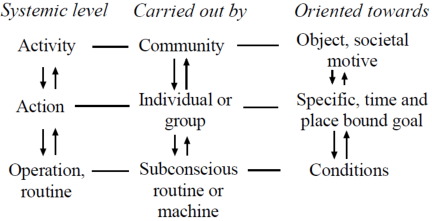
The central characteristic of an action is its conscious orientation to a goal that holds it a specific time and place, which was stated by Leont’ev (1978). Actions are done through operations without self awareness which are learned through repetitive and rehearsed behavior. Tools for operations are materials embodiment within the recurring activities of humans and are ways of performing operations instead of actions. The perform various tasks and help making it possible to reach different goals without setting the goal itself.
Leont’ev’s theory of the systemic levels of human activity is described in Figure 2.
Figure 2. The hierarchical organization of human activity. (Leont’ev’s, 1978, pp. 66-67)
Operation, activity, and action have an internal and dialectical relationship. Joint activities are shown in an individual’s action but also formed through these actions. This is similar to determining what actions are needed to perform an operation, while also operation affect what available actions can be done.
Collective activity system is shown as a systemic, molar and key unit of analysis. The system is oriented to an object which means it there can be no activity without an object. The object is transforms into an outcome by multiple societal purposes of the activity, things like producing goods for customers and offering paid work are included in this. The activity is performed by means of actions, and while performing the last analyst may seem irrational when an individual action is isolated from the activity. Engeström (1999) stated that an action as a unit of analysis presents the following limitations: it fails to make explicit the social and collaborative character of human life, individual actions are easily reduced to rational realization of conscious goals, “irrational” and unplanned actions are left unexplained; the action by itself does not explain the origin of the goals nor why people act as they do.
The general model of organization of human activity (Figure 3), Change Laboratory’s main theoretical concept, is a tool for theoretical thinking for the development and developmental possibilities of the practitioners’ activity as was as modeling its structure and contradictions within itself. It is a tool for creating hypotheses and thought experiments about the causes of disruptions in the system that the practitioners incur during their activity and ways to overcome them.
In s tr u m e n ts : to o l s a n d s i g n s
P r o d u c ti o n O b j e c t S u b j e c t O u t c o m e s e n s e , m e a n i n g C o n s u m p ti o n
E x c h a n g e D i s t r i b u t i o n R u l e s C o m m u n i t y D i v i s i o n o f l a b o r
Figure 3. Activity System Model. (Engeström, 1987, p. 78)
Figure available in the original PDF paper.
There is an assumption, within the system, that the relationship between the subject and object of activity mediated by cultural artifacts, along with social mediators: rules, division of labor and community. The components presented in this model can be defined as follows: a) the subject refers both to an individual as a group of people in which their positions and viewpoints are chosen as the analytical perspective; b) the object is understood as the meaning, the reason and purpose of a system of collective activity, and is open to numerous and partial interpretations; c) tools are all instruments of action subject mediators (actual tools, theories, models, concepts, methods, symbols); d) the community encompasses all individuals or groups who are directly transforming that object; e) the division of labour is the division of tasks between the subjects; f) rules refer to the regulations, rules and conventions related to activity context. Activity must be seen from the perspective of the parties involved which is an internal view. The full object of the joint activity can not be seen by an individual nor can an individual dictate fully the object of the joint activity. The interpretation and construction of the object will always differ from individual to individual because of the historical change and development caused by perspectives, backgrounds, and interests. The object of the activity is constructed and continuously reconstructed discursively. This process can be understood as a Change Laboratory intervention (Engeström, 2007). There are two perspectives that practitioners can use towards their work form the model of an activity system: from the chosen subject, and from the collective activity system. Knowing the connection between the perspectives will enhance the learning for change A shared social construction of the practitioners’ work is facilitated when there is a joint analysis of work practices with the activity system model.
The concept of contradiction is a philosophical concept associated to the distinction between the immediately observable surface of an activity and in the internal relationships in its system structure and is essential for understanding the dynamics of the development of an activity system. The concept should not be confused with its different appearances as paradoxes, tensions, inconsistencies, conflicts, dilemmas, or double binds that the parties involved are currently experiencing or the observable surface of the activity. Inner contradictions were created in the past and need to traced back to the development. Contradictions are shown on many level in the activity system: within each element, between elements, between an old and new activity system, or between different activity systems.
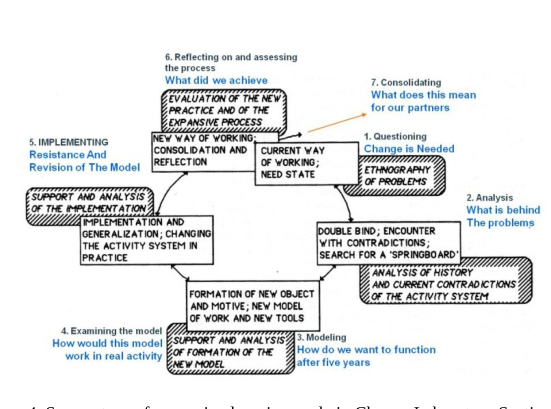
The Expansive learning Process The Change Laboratory is a specific method used for promoting expansive learning, which is a transformation of the object of activity so that the contradictions within the activity system are solved or dealt with in a new way (Engeström 1987). Simultaneously, all elements within the activity system change or obtain a new meaning in the activity.
Figure 4. Seven steps of expansive learning cycle in Change Laboratory Sections.
Doubts, hesitation and disturbances in individual’s actions are the starting point of the learning process. The direction is from individual to the collective (Activity System) and back to the individual. However, the individual’s point of departure is itself understandable only as a cultural-historical product (Engeström 1987, 322).
Figure 5 shows the logic of the analysis of an activity in the Change Laboratory. Normally it starts with an analysis of individuals’ and groups’ typical, repeated actions and the double binds, disturbances and problems the parties experience in performing them. The analysis then moves up to the level of the activity system and down to the specific action, operations and instruments through which the actions are performed. Historical changes that took place in the object and other elements of the activity system along with the changes of the relationships of interaction with in the activity system are mediated is the analysis of activity focal point. An essential element to the new model’s design, testing and elaboration are concrete experiments. A Change Laboratory intervention should incorporate specific, incremental improvements with a new organic perspective on the long-term development of the activity. Differentiating the immediate visible surface from the underlying systemic structure of the activity, along with the interaction of their levels are central in the Change Laboratory intervention.
It is necessary to have a collective understanding to solve problems along with collective efforts to find and create solutions. Improvement and traditional problem solving interventions starts by identifying a problem and then proceeds to experiment, correct and elaborate on a solution idea (arrow 1>4 in Figure 5).
Figure 5. The difference in the problem solving processes of change intervention and Change Laboratory intervention.
Figure available in the original PDF paper.
(Virkkunen and Newnham, 2013)
There is then a movement back to the level of individual actions and immediately visible problems to the analysis of the systemic causes of the problems and to a broad reconceptualization and restructuring the idea of the activity during the Change Laboratory. Then there is a return to the level of individual actions constructing and applying corresponding new instruments, relationships of collaboration, rules, and principle of division of labor (arrows 1>2>3>4). Empirical data of the current problem in the activity is produced by the researcher-interventionist together with the practitioners, and provide conceptual tools for showing the problem’s origin and systemic causes while also creating a model of the future form of the activity which then is tested, implemented and elaborated.
This process is fundamentally different from the linear change intervention in the central role that parties’ process of signification and their plays in it, according to Virkkunen and Newnham (2013). The next stimuli first works as psychological tools for collaborative analysis and development and then to a new concept that works as a psychological tool in transforming the activity system to surmount its inner contradictions that make disturbances, ruptures, conflicts and double bind situations and conflicts in the day to day activity. Change Laboratory method does not aim at creating just an intellectual solution or a change of practice, but constructs the collaborative transformative agency and motivation of the practitioners through the understanding of the idea of the activity and a new perspective of its future development. For this to happen, the Change Laboratory intervention must be based on the practitioners’ intensive collaboration on questioning of the developmental changes of and possibilities in the activity. The sequent intervention sessions are done on a schedule that guarantees the discussion continues and ideas are gathered from session to session which is reinforced by visualizing and documenting the collective thought that is done in the discussions during the Change Laboratory sessions. A crucial step in the process and its evaluation are the use of concrete experiments and their new concepts help guide the practitioners’ sustained, collective learning and construction of a new form of the activity, expanding the activity and their expertise beyond the boundaries of the previous form of the activity. This showed that individual and collective learning begin in the collaborative inquiry of the origin and systemic causes of problems and their possible solutions and created a new perspective on the development of the activity. It was seen while the practitioners were transforming the activity with the newly created idea of the activity that their individual and collective learning to take place more rapidly when experimenting with new tools and forms of action of the new idea and by creating solutions to problems encountered when changing the work practices.
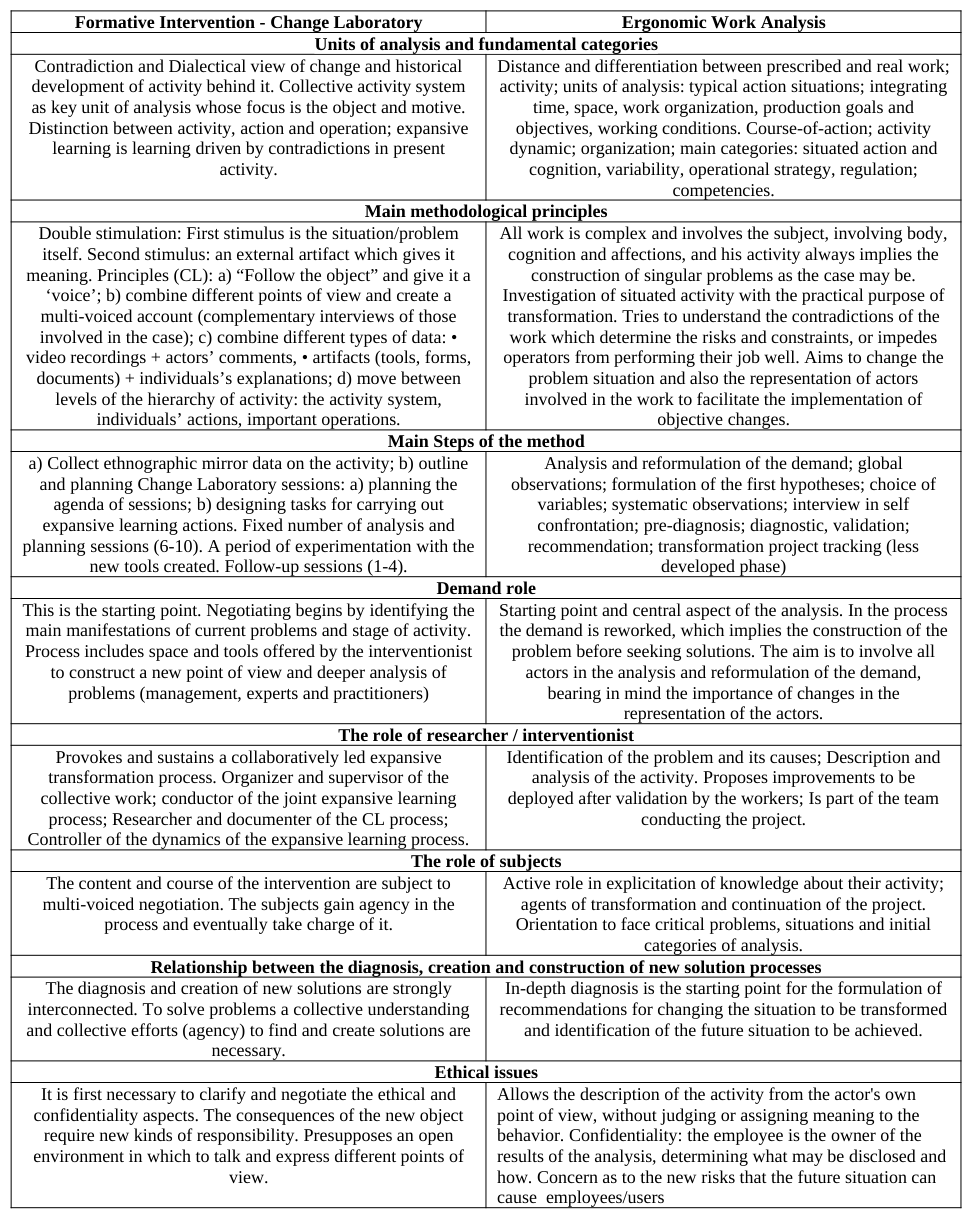
Comparisons
Table 1: Basis of comparison between Change Laboratory and Activity’s Ergonomics
DISCUSSION
Norros (2004) argued for the potential of the CHAT to create an Activity System and developmental frame for the analysis of actions. She reasoned that this frame could be completed with another systemic frame, the functional modeling of socio technical systems. According to the author, this frame for discovering the intrinsic constraints of work, which in a formative sense shape human behavior, is being developed. “Such an extension of the original Activity System frame appears to provide the necessary pre-requirements for an analysis of activity as a context of personal situated actions”. In our analysis we think that the ergonomic approach can contribute to these links.
The activity concept for ergonomics seems to be the action concept referred to in CHAT. If this is confirmed we may call ergonomics of activity a situated action theory than can help to corroborate the Norros’s approximations. Prescribed work and real work in CHAT are not perceived as in ergonomics (it is not a central category of analysis in activity theory) but there are some points of contact especially regarding the vision of innovative actions. For CHAT, an innovative action (similarities with the ‘regulation’ concept of ergonomics) is a positive deviation from the script such as an individual’s attempt to improve the process by acting in a new way. The meaning of various observed deviations from the script becomes clearer if the practitioners analyze the causal links between them and construct a picture of the disturbance process that they together constitute (Engeström, 2008, pp. 52-63). A rupture can lead to a disturbance, one disturbance can lead to another that can further lead to an innovation as the actors try to put the process back on track or an innovation can lead to a rupture and disturbance if the other actors do not succeed in reacting to it adequatly. In EWA’s traditional view, the practitioners play a secondary role in developing and creating solutions. Besides the efforts to conduct the process using the ethnographic approach it seems to be more often adopted during initial steps, but it is not applied throughout the complete process. The step of conclusion of the recommendations seems to be similar to the role of the specialist, a traditional interventionist who tries, isolated from the actors, explain to the managers, the root of problems and possible solutions. This fragmented process of diagnose and recommendations making helps to understand the difficulties perceived by the interventionist when he delivers the “recommendations” and he finds difficulty in obtaining the agreement of managers (Vilela et al., 2010; 2012).
In this sense there seems to be a double interventionist conduct, that in the stage of listening and collecting data when he adopts an ethnographic posture and denies his specialist role and that in the next phase of the elaboration of his diagnosis and his presentation of his prescriptions, when a posture closer to that of the expert who provides a set of recommendations, without sometimes putting their relevance or feasibility to the test, seems to predominate, since the creation and development of the new real situation are delegated to those who requested the intervention. He attempts to foresee possible problems by means of prior validation processes or simulation of possible future activity (Daniellou, 2005). But there are few studies that follow the entire start-up phase (Castro et al., 2012). The concept of regulation as a homeostatic system proves to be limited here, because the regulation of the activity of social work is always necessary to build social devices that may be reappropriated by employees during the performance of their activities.
The challenge of a diagnosis and sustainable interventions are aspects of the same phenomenon and are closely interconnected. A poor, partial or biased analysis of the work situation will lead to superficial recommendations and weak changes that will not answer sufficiently to the causal determinants lying behind these events. The idea of “recommendations” needs to be questioned. It is based on the “specialist logic” of the man who knows what has to be done and transmits this knowledge to others who do not know it and have to learn. What we need to do is rethink the subject of knowledge production, because in complex situations nobody masters the whole understanding of the process involved, that knowledge is diffuse, which emphasizes the need for collective construction.
While it may be affirmed that the hypothesis that ergonomic analyses have as their main strength the ability to understand real work (i.e. actions and operations of workers) in a deep and detailed way, it seems less able to understand and to intervene in the whole activity system, or understand the contradictions and historical development of that system. In the Activity Theory and Change Laboratory, change is the rule, and therefore, contradictions are changing but never disappear completely. So sustainability may be a phase in which some contradictions are resolved, but soon primary contradictions become manifest again in other forms. The Change Laboratory seems to contribute to the simultaneous construction of diagnosis and solution through engaging different parts of the organization and by enhancing learning for sustainability.
ACKNOWLEDGEMENTS
We acknowledge the support from Research Foundation of São Paulo State (FAPESP – Protocol nº 2012/04721-1) and Public Minister of Labor (15ª Region, São Paulo).
REFERENCES
Almeida I.M., Vilela, R.A.G. (2010), Modelo de Análise e Prevenção de Acidentes de Trabalho - MAPA. CEREST Piracicaba, Piracicaba SP. 52p. Assunção, A. A., Lima, F.A.P.(2003), “A contribuição da ergonomia para a identificação, redução e eliminação da nocividade do
trabalho”. In: Mendes R, organizador. Patologia do Trabalho. Rio de Janeiro: Atheneu. pp. 1768-1789. Beguin, P. (2009). When users and designers meet each other in the design process. Risky Work Environments: Reappraising Human Work Within Fallible Systems, 153. Castro, I.S.; Lima, F. P. A., Duarte, F. M. C. (2012). The start up as a phase of architectural design process. Work (Reading,
MA), v. 41, p.140–144. Cordeiro, R. (2003), Diagnóstico e Controle de Acidentes de Trabalho em Piracicaba. Projeto de Pesquisa em Políticas Públicas.
FAPESP, Proc. 00/13719-3, 2003. Daniellou, F.(2005). The french-speaking ergonomists’ approach to work activity: cross-influences of field intervention and conceptual models. Theorethical Issues in Ergonomics Science. 6(5), 409-427, september 2005. Daniellou, F., Simard, M. Boissières, I. (2010). Facteurs humains et organisationnels de la sécurité industrielle : un état de l’art .
Nº 2010-02 des Cahiers de la Sécurité Industrielle, Institut pour une Culture de Sécurité Industrielle, Toulouse, France (ISSN 2100-3874). Website: http://www.icsi-eu.org/francais/dev_cs/cahiers/ Dugué, B., Petit, J., Daniellou, F. (2010). L’intervention ergonomique comme acte pédagogique. Perspectives interdisciplinaires sur le travail et la santé, (12-3). Engeström, Y. (1987), “Learning by expanding: an activity-theoretical approach to developmental research”. Orienta-Konsultit
Oy. Engeström, Y., & Sannino, A. (2011). Volition and agency in organizations: An activity-theoretical perspective. Paper presented at the Conference of Association International de management Stratégique AIMS) in Nantes, France, June 9, 2011. Engeström, Y., Virkkunen, J., Helle, M., Pihlaja, J., Poikela, R. (1996), ”The Change Laboratory as a tool for transforming
work”. Lifelong Learning in Europe, 1(2), 10-17. Engeström Y. (1999), “Activity theory and individual and social transformation”. In: Engeström Y, Miettinen R. & Punamäki RL. (Orgs.) Perspectives on activity theory. Cambridge: University Press. Engeström, Y. (2011), “From design experiments to formative interventions”. Theory & Psychology, v. 21, n. 5, p. 598-628. Falzon, P. (2007), Natureza, Objetivos e conhecimentos da ergonomia in: (Falzon) Ergonomia. São Paulo (SP): Editora Blucher;
PP (3-19) Guérin, F., Laville, A., Daniellou, F., Duraffourg, J. Kerguelen, A. (2004). “Compreender o trabalho para transformá-lo. A prática da Ergonomia”. 2ª Edição. São Paulo: Edgard Blücher (Ed.) Hubault, F. (2007). Nature d’intervention, nature de savoir. Éducation permanente, 170, 77-85. Lamonde, F. (2007), As prescrições dos ergonomistas. In Ergonomia (Falzon) E. Blucher. São Paulo. pp 330-342 Leont'ev, A. N. (1978). “Activity, consciousness, and personality”. Englewood Cliffs: Prentice Hall. Llory M. Acidentes Industriais o Custo do Silêncio. Rio de Janeiro: Editora MultiMais. 1999, 320p. Norros, L. (2004), “Acting under uncertainity. The core task analysis in ecological study of work”. VTT Publications. Espoo, FI.
2004. 246p. Noulin, M.(1995), Analyser l’activité et/ou comprendre le travail. Actes du Séminaire DESUP/DESS (7-10). Paris: Université Paris 1. Oliveira, R.C. (2000), “O trabalho do antropólogo: olhar, ouvir, escrever”. In: O trabalho do antropólogo. Oliveira, R.C. 2ª
Edição. SP: UNESP. pp. 17-36. Ombredane, A. and Faverge, J.-M. (1955). L’analyse du travail. Paris: PUF. Pacaud, S. (1946), Recherche sur la sélection psychotechnique des agents des gares dits “facteurs” enregistrants”. Le Travail Humain, IX,1 43-73. Reason J.( 1999), Human error. New York: Cambridge University Press. 323p. Teiger, C. (1993), Représentation du travail, travail de la représentation. In : Weill-Fassina, A. ; Rabardel, P. ; Dubois, D. ed.
Représentation pour l’action. Toulouse : Octarés Édition. Terssac, G. Maggi, B. (2004), “O trabalho e a abordagem ergonômica”. In Daniellou F. A ergonomia em busca de seus princípios. p. 79-104. E.Blucher. São Paulo. Vilela, R.A.G. (2006), Ações interinstitucionais para o diagnóstico e prevenção de acidentes do trabalho: aprimoramento de uma
proposta para a Região de Piracicaba. Projeto de Pesquisa em Políticas Públicas. FAPESP, Proc. 06/51684-3, 2006. Vilela, R.A.G., Silva, R.C., Jackson Filho, J.M.(2010), Poder de Agir e sofrimento: o caso dos agentes comunitários de saúde de uma unidade de saúde da família de Piracicaba - SP. Rev. bras. Saúde ocup., São Paulo, 35 (122): 289-302. Vilela, R.A.G., Almeida, I.M., Mendes, R.W.B. (2012), Da vigilância para prevenção de acidentes de trabalho: contribuição da
ergonomia da atividade. Ciênc. saúde coletiva vol.17 nº.10, Rio de Janeiro. Virkkunen J, Newnham DS. (2013), “The Change Laboratory. A tool for collaborative development of work and education”.
Sense Publishers, Helsinki, FI. 2013.
Wisner, A.; Marcelin, J.( 1971), A quel homme le travail doit-il être adapté. Rapport n. 22. CNAM, Paris, 13 p. Wisner, A. (1987), “Por dentro do trabalho ergonomia: métodos e técnicas”. São Paulo (SP): Oboré/FTD. Wisner, A. (1997), A inteligência no trabalho. São Paulo: FUNDACENTRO. Wisner, A. (2004), “Questões epistemológicas em Ergonomia e Análise do Trabalho”. In: A ergonomia em busca de seus princípios. Daniellou, F. pp. 29-55. E. Blucher. São Paulo.
LISTED IN THE AHFE DIGITAL BOOKSTORE CATALOGUE
Explore the complete digital volume
Advances in Ergonomics In Design, Usability & Special Populations: Part II
Read this individual research paper free through the original publisher, or explore the full digital proceedings book.
ISBN 978-1-4951-2107-4
Explore this ISBN in the AHFE Bookstore ↗Listed in the July 2026 bookstore catalogue; search by ISBN to confirm current availability · Digital book purchase optional