Aide Maldonado-Macías, Arturo Realyvásquez Vargas (2022). An Expert System Approach for Ergonomic Evaluation of Advanced Manufacturing Technology. In: Advances in Ergonomics In Design, Usability & Special Populations: Part II. AHFE Open Access, vol. 19. https://doi.org/10.54941/ahfe1001271
Current models to evaluate and select Advanced Manufacturing Technology (AMT) present deficiencies since human factors and ergonomics (HFE) aspects have been neglected and obviated. Therefore models have emerged that propose the effective integration of these aspects. This chapter presents a literature review emphasizing in authors and methodologies that have addressed this topic. Also, the development of a fuzzy expert system (FES) based on Fuzzy if-then rules with a novel axiomatic design approach for ergonomic compatibility evaluation on the selection of AMT is presented. A numerical example for the selection of CNC plastic molding machines is also included. Literature review was made by using key words on scientific databases such as Science Direct and Ebscohost including papers from the last five years.As results we present a list of authors, methodologies and models that have contributed to ergonomic evaluation of AMT. A fuzzy expert system (FES) was developed and programmed in Matlab ®. It was validated using previous case studies’ results and sensibility analysis. The FES provides a practical way for single or group evaluation for ergonomic compatibility of AMT and may contribute to more complete decision making processes including HFE aspects.
AMT is one of the most important elements to achieve competitiveness in manufacturing industry. The selection of AMT involves multiple aspects that are difficult to identify in its entirety, among them are ergonomic and safety aspects (Maldonado et al. 2009). The aim of this article is to present a literature review of models that have include these aspects and have proposed expert system approaches to decision making. The use and investment of AMT is increasing in those industries that wish to remain competitive in a global market. The consideration of ergonomic human factors and ergonomics (HFE) aspects is essential for proper implementation and adaptation between humans and technology. The development of models that include these aspects effectively and incorporate expert knowledge will contribute to a more complete, effective and efficient decision making processes.
1 Dr. Aide Aracely Maldonado-Macías is professor-investigator affiliated to the Industrial Engineering Department at the Autonomous University of Juarez Mexico. amaldona@uacj.mx Ergonomics In Design, Usability & Special Populations II https://openaccess.cms-conferences.org/#/publications/book/978-1-4951-2107-4
ERGONOMIC COMPATIBILITY OF ADVANCED MANUFACTURING TECHNOLOGY Advanced Manufacturing Technology (AMT)
Advanced Manufacturing Technology (AMT) comprises computer-based technologies incorporated into manufacturing operations having a significant impact on the product, process and informational aspects of the system (Ordoobadi and Mulvaney, 2001; Percival and Cozzarin, 2010; Small and Chaen, 1995). It provides strong competitive advantage for organizations that adopt it (Matta and Semeraro, 2005, Percival and Cozzarin, 2010). Realyvasquez (2012) and Maldonado (2009) presented a literature review of AMT concept from a variety of authors. For Bayo-Moriones and Diaz (2004), Saraph and Sebastian (1992), this technology has created a significant change in the competitive strategies of manufacturing companies looking for a combination of flexibility, efficiency and quality, minimizing significant cost and optimizing quality. According to Dean and Snell (1991) its most important feature is the potential to integrate several stages of the manufacturing process. Consequently, it enables the manufacturing of both, large amounts and small batches of standardized products, with high quality (Gyan- Baffour, 1994).
AMT also includes computer numerically controlled equipment, automated production lines, flexible manufacturing systems (FMS), computer aided design (CAD), computer aided manufacturing (CAM), just in time systems (JITS), resource planning business, robotics, group technology, automated manual material handling and automated identification techniques (Chuu, 2009; Matta and Semeraro, 2005, Percival and Cozzarin, 2010). According to Maldonado (2009) the evaluation and selection of AMT is a complex problem that manufacturing organizations around the world must face. Recently, models have been developed to facilitate decision-making on AMT and allow to reach more comprehensive and complete solutions, quick and effective for manufacturing environments.
Ergonomic Compatibility (Simvatology) This term (Symvatology) was coined by Karwowski (2001) by combining two Greek words: symvatotis (compatibility) and logos (or logic-reasoning). It was proposed as a sub discipline of ergonomics, as the science of human-artifact compatibility (system). The objectives of Simvatology are discovering the laws of human artifact compatibility proposing theories for human-artifact compatibility and develop a quantitative matrix to support such measures. Other objectives are to observe, identify and describe empirical research and produce theoretical explanations of natural phenomena of human-artifact compatibility. Simvatology is the systematic study (including theory, analysis, design, implementation and application) of the interaction processes that define, transform, and control the consistency of the relationships between artifacts (systems) and people. An artifact system is defined as a set of all artifacts (namely, objects made by human labor), as well as the natural elements of the environment and their interactions in time and space offered by nature. A human system is defined as a human with all the relevant features (physical, perceptual, cognitive, and emotional, etc.) to interact with the artifact system. The human-system compatibility should be considered at all levels, including physical, perceptual, cognitive, emotional, social, organizational, managerial, environmental and political. This requires a way to measure the inputs and outputs that characterize the whole system of human interactions (Karwowski, 1991, 2000). The objective of quantifying human- artifact compatibility can only be achieved if we understand its nature.
In the above framework, compatibility is a natural phenomenon that is affected by the structure of the human-artifact system, its inherent complexity and entropy or level of incompatibility between elements of the system. For Karwowski (1991, 2000) compatibility must be considered in relation to complexity. The transition from a high to a low level of complexity, does not necessarily lead to a better (or higher) level of compatibility. Often the improvement of human systems in most human-artifact relationships with respect to the entire system compatibility can only be achieved at the expense of increased complexity. The ideal is to achieve a high level of human-artifact compatibility at a low level of complexity. Ergonomic Incompatibility (EI acronym), is defined as a degradation of human-artifact system, which is reflected in the measurable inefficiency of the system and human losses. The complexity-incompatibility principle can be stated as follows: As the complexity of the human-artifact system increases, the incompatibility between the elements of the system also increases, and is expressed through their ergonomic interactions at all levels, what entropy leads to more ergonomic (level of ergonomic incompatibility Ergonomics In Design, Usability & Special Populations II https://openaccess.cms-conferences.org/#/publications/book/978-1-4951-2107-4 between the system and its elements) and decreases your chances for effective ergonomic intervention. On this principle, Karwowski, Marek and Noworol (1988), Karwowski (2005), Karwowski and Jamaldin (1995) and Norman (1989), claim that the paradox of technology is that adding functionality to an artifact is accompanied by an increase in complexity, which is reflected in the difficulties encountered when humans interact with consumer products and technology in general. This added complexity often increases the difficulty and frustration when interacting with these artifacts. The reason for this is that technology with more features and functions, it also has less feedback. The complexity in technology can’t be avoided when features are added and only minimized by good design of it. For Karwowsky (2001), symvatology should help to advance the progress of the ergonomics discipline by providing a methodology for the design for compatibility as well as the design of compatibility between artificial systems (technology) and humans.
Expert System A fuzzy expert system is a human knowledge based system and constructed by membership functions where fuzzy rules are used to reasoning about the data and maps out precise inputs (Azadeh et al., 2008). The expert system comprises four components: rules, fuzzifier, inference engine, and defuzzifier (Mendel, 1995). The fuzzy rules are used to infer the input-output relations through the inference engine (Alvarez and Peña, 2004).
The fuzzifier transforms precise inputs into degrees of membership from linguistic values, namely in vague terms (Alvarez and Peña, 2004; Sivanandam, Sumathi and Deepa (2010). As example be x with a membership value of µ(A)x being the fuzzy set corresponding to linguistic value low. According to Mendel (1995), the fuzzifier activates the rules using linguistic variables, which are fuzzy sets associated with them, meanwhile the inference engine performs the inference operations of the rules, and maps the obtained results using the fuzzy sets, then fuzzy set fuzzifier defines the shape in which rules are combined. The fuzzy sets are transformed by a defuzzifier in accurate results, in other words, from vague values to precise values (Alvarez and Peña, 2004; Mendel, 1995; Sivanadam et al., 2010).
There are 3 different kinds of systems that combine the rules by different principles. These are: 1) pure expert systems, 2) expert systems Takagi - Sugeno type, and 3) expert systems defuzzifier and fuzzifier. In all these systems the rule set is based on IF-THEN rues, there is an algorithm (inference engine) in which the result is obtained and may be output as a fuzzy set in the first or function as seconds. According to Sivanandam et al. (2010), Mamdani and Sugeno methods are the most effective ones for fuzzy inference. These authors note that these methods mainly differ on the consequent of the fuzzy rule, while Mamdani’s method uses fuzzy sets as consequential, the systems obtained by Sugeno´s method uses functions of the variables.
For example
(Mamdani method) (1) (Sugeno method) (2)
Many valuable applications of these systems have become part of expert systems; in this case, an application for the evaluation, justification and selection AMT.
METHODOLOGY
Scientific databases were reviewed among them are Science Direct, EBSCOHOST and JSTOR. The search was made by keywords in a variety of journals. They were organized according to their content, methodology, evaluation methods and ergonomic aspects of AMT. Also, those concerning expert system approaches for the selection, justification or evaluation of Advanced Manufacturing Technology were included.
Maldonado (2009) and Maldonado et al. (2013) developed the Ergonomic Compatibility Evaluation Model (ECEM) to assess AMT from an ergonomic perspective. This model was adopted as basis to develop the Fuzzy Expert System. In this model ergonomic compatibility evaluation for AMT involves ergonomic compatibility attributes (ECMA) that were divided into five main attributes: human skills and training compatibility (A11), physical work Ergonomics In Design, Usability & Special Populations II https://openaccess.cms-conferences.org/#/publications/book/978-1-4951-2107-4 space compatibility (A12), usability (A13), equipment emissions (A14) and organizational requirements (A15). The main attribute A11 includes two sub-attributes: skill level compatibility (A111) and training compatibility (A121). The main attribute A12 includes five sub-attributes: access to machine and clearances (A121), horizontal and vertical reaches (A122), adjustability of design (A123), postural comfort of design (A124), physical work and endurance of design (A125). The main attribute A13 includes seven sub-attributes: controls´ design compatibility (A131), controls´ physical distribution (A132), visual work space design (A133), information load (A134), error tolerance (A135), man machine functional allocation (A136), design for maintainability (A137). The main attribute (A14) includes four sub-attributes: temperature (A141), vibration (A142), noise (A143), residual materials (A144). The main attribute (A15) includes two sub-attributes: rate of work machine compatibility (A151) and job content machine compatibility (A152). Majority of sub-attributes were considered as intangible benefit attributes excluding sub-attributes (A125, A141, A142, A143, and A144).
This author also obtained the weights for each attribute and sub-attribute by applying the Analytic Hierarchy Process (AHP) proposed by Saaty (1977). Linguistic terms for the assessment were Poor (P), Regular (R), Good (G), Very Good (VG), and Excellent (E) for intangible attributes and sub-attributes; Very Low (VL), Low (L), Medium (M), High (H) and Very High (VH) for tangible attributes and sub-attributes.
For the development of the FES software like Matlab ® 2010 was used.
EXPERT SYSTEM METHODOLOGY The method to develop the FES was divided into two stages. The first stage includes the formulation of fuzzy rules (IF-THEN rules), and the second stage refers to the development of the FES with Matlab ® and its validation.
Stage 1: Fuzzy rules formulation Different fuzzy sets can be adopted to deliver the fuzzy rules (Celik et al., 2007) for the tangible and intangible attributes. The scale for the Ergonomic Incompatibility Content (EIC) was developed based on the fact that membership functions can be assigned to linguistic terms by mean of the intuition delivered of the experts’ judgment. This scale comprises the range 0-4 because the EIC delivered by Maldonado (2009) is nearly to this scale. Fig. 3 shows these fuzzy sets and Table 1 shows the fuzzy sets with their linguistic terms and their correspondent membership functions. Attributes were organized in a hierarchical way classifying into a same group those attributes with common specifications (Azadeh et al., 2008). The attributes were regrouped according to specifications pointed out by Corlett and Clark (1995). This was made in order to decrease the number of fuzzy rules. Once fuzzy sets and linguistic terms were defined, fuzzy rules were derived by applying the following steps.
Step 1: Defuzzification. A precise value was associated with each fuzzy set by mean of the centroid method applying the next equation (3)
Step 2: Applying the Human Incompatibility Axiom. This axiom states that a design with less human incompatibility content has a greater success probability; it mean, the alternative with lower EIC is the best ergonomic alternative. This axiom was applied by mean of the next equation (Celik et al., 2007): (4)
Where EICi is the ergonomic incompatibility content for the attribute i on a defined alternative, and ci is the centroid value—compatibility content— for the linguistic term given to the attribute i on the defined alternative. This step applies only for the sub-attributes.
Ergonomics In Design, Usability & Special Populations II https://openaccess.cms-conferences.org/#/publications/book/978-1-4951-2107-4
Figures 1(a), 1(b), 1(c). Fuzzy sets used to formulate fuzzy rules: a) fuzzy sets for tangible attributes (Celik et al. 2007), b) fuzzy sets for intangible attributes (Celik et al., 2007), and c) fuzzy sets for EIC.
Step 3: Applying the importance weights of attributes. The weights of the attributes on Table 2 are the original weights, however, when attributes regrouping occurred many weights changed. The new weights were derived by dividing the original weight of each attribute by the sum of the weights on a new group. To keep a weighing base the new weights were normalized. The weight for the new group is the sum of the original weights of the attributes regrouped into it. Table 3 shows the new weights. Note in this table that because of the regrouping new sub- attributes were obtained. These sub-attributes were spatial design of equipment (A12123), which is the grouping of the sub-attributes A121, A122 and A123; man-machine interaction (A1312), which is the grouping of A131 and A132; information processing (A1334), result of A133 and A134; and man-machine tasks and error management (A1356) results of A135 and A136. Once the new weights were defined for each group, the EIC of each attribute was multiplied by its corresponding weight.
Table 1. Linguistic terms of the fuzzy sets and their membership functions.
Table 2 Initial weights of the attributes delivered by Maldonado (2009).
Table 3 Final weights of the attributes used by Realyvásquez (2012).
A137 A14 A141 A142 A143 A144 A15 A151 A152 0.09 0.121 0.15 0.24 0.33 0.26 0.120 0.42 0.58 Ergonomics In Design, Usability & Special Populations II https://openaccess.cms-conferences.org/#/publications/book/978-1-4951-2107-4
Step 4: Adding and obtaining the weighted EIC. The weighted EIC were added in order to get a total EIC for each group. This step applies to all the groups taking into account all the possible combinations of qualifications to the sub-attributes. Step 5: Finding the consequent for the attribute for the subsequent hierarchical level. The consequent (linguistic term) for the attribute for the subsequent hierarchy level was derived by applying the Mamdani fuzzy inference system. For this, the EIC valued, computed on step 4, was introduced on the fuzzy sets scale shown on Fig. 3c. After this, the intersection points with the different fuzzy sets are found and the consequent is the fuzzy set with the point with the highest membership. Step 6: Fuzzy rules formulation. Now that the linguistic term for the sub-attributes and the consequent for the attributes are known the rule can be made on this manner: IF x is A and y is B, THEN z is C. All the combinations are taken into account. In order to decrease the number of fuzzy rules, some of these are summarized on one rule. For example, the following rules: IF A111 is Poor and A112 is Poor, THEN A11 is Very High IF A111 is Poor and A112 is Regular, THEN A11 is Very High IF A111 is Poor and A112 is Good, THEN A11 is Very High IF A111 is Poor and A112 is Very Good, THEN A11 is Very High IF A111 is Poor and A112 is Excellent, THEN A11 is Very High
They can be stated as only one rule: IF A111 is Poor, THEN A11 is Very High.: The adverbs at least and at most were used to summarize another group of rules when the qualifications for an attribute range from an extreme value to some linguistic term or vice versa respectively, on a continuous way, and the consequent is the same in all the rules. For example, the following rules for the attribute A11: IF A111 is Poor and A112 is Poor, THEN A11 is Very High IF A111 is Poor and A112 is Regular, THEN A11 is Very High IF A111 is Poor and A112 is Good, THEN A11 is Very High IF A111 is Poor and A112 is Very Good, THEN A11 is High IF A111 is Poor and A112 is Excellent, THEN A11 is High
They can be summarized in only two rules: IF A111 is Poor and A112 is at most Good, THEN A11 is Very High IF A111 is Poor and A112 is at least Very Good, THEN A11 is High
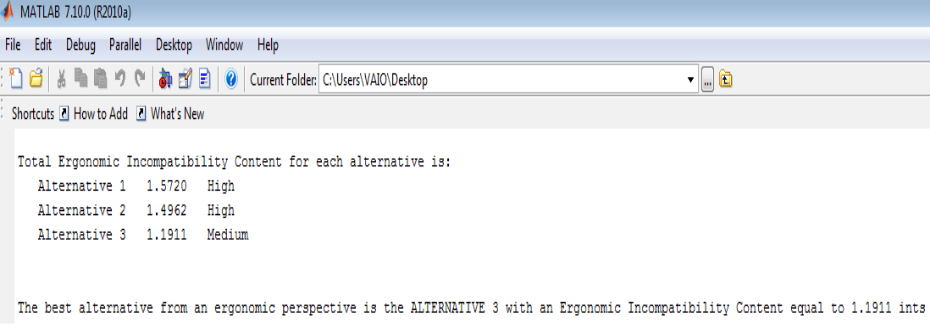
Selection of the best ergonomic alternative Once the evaluators have assigned qualifications to each of the sub-attributes for a specific number of alternatives, the expert system must provide a final EIC qualification for each one of the alternatives, both in numerical and linguistic value. As shown in Fig. 4, the best alternative is the alternative with the minor numerical EIC value.
Figure 2. Selection of the best alternative of AMT from an ergonomic perspective.
Ergonomics In Design, Usability & Special Populations II https://openaccess.cms-conferences.org/#/publications/book/978-1-4951-2107-4
Stage 2: Development and validation of the expert system At this stage, the expert system development process with Matlab ® 2010 and the functions that it contains are described. The methods applied to the validation of the system are also described.
Development of the expert system with Matlab ® 2010 For the application of the expert system on the evaluation and selection of AMT from an ergonomic approach, a program was developed in Matlab ® 2010. This program contains the methodology exposed above. It was necessary to create several for loops. Some of these loops allow the evaluator to assess all the alternatives to then continue with the following evaluator. Other loops allow to a same evaluator to continue with the assessment to the next alternative. Logic operations were also developed by using the operator if. These logic operations help to assign a precise value to each fuzzy qualification for each alternative regard to each one of the ergonomic sub-attributes and to assign a linguistic qualification (Very Low, Low, Medium, High, and Very High) to the EIC depending on the range where this falls. Other operations were the mathematical operations indicated on the steps 1 to 4, and the geometric mean by the case when the alternatives are assessed by a group of evaluators.
Validation of the expert system An expert system can be validated against historical results regardless the number of cases against which the system is validated (O´Keefe, Balci and Smith, 1986). So, the expert system was validated against the results formulated by Maldonado (2009) on three study cases. It was also validated by mean of a sensibility analysis (O’Keefe et al., 1986). Sensibility analysis is carried out by changing the values of the system input variables on an interest rang observing the effect on the system performance (O’Keefe et al., 1986).For example, suppose the following fuzzy rules were formulated:
IF A111 is Poor and A112 is Poor, THEN A11 is Very High IF A111 is Poor and A112 is Regular, THEN A11 is Very High IF A111 is Poor and A112 is Good, THEN A11 is Very High IF A111 is Poor and A112 is Very Good, THEN A11 is Very High IF A111 is Poor and A112 is Excellent, THEN A11 is Very High As it is known, the qualification for A112 does not have any effect on the qualification for A11, always that A111 is Poor. Then, giving any value to A112 must not affect intermediate and final results. To perform the sensibility analysis on the expert system some rules that are summarized in only one were randomly selected. On these rules, the values of the sub-attributes, that according to the rule do not have any effect within a range of qualification, were changed. For example, suppose that the following rule was selected:
IF A111 is Poor and A112 is at most Good, THEN A11 is Very High When the sensibility analysis was performed, A111 was constant with a qualification equal to Poor, while A112 changed its qualifications to Poor, Regular and Good. With these changes the intermediate and final results must keep constant.
RESULTS
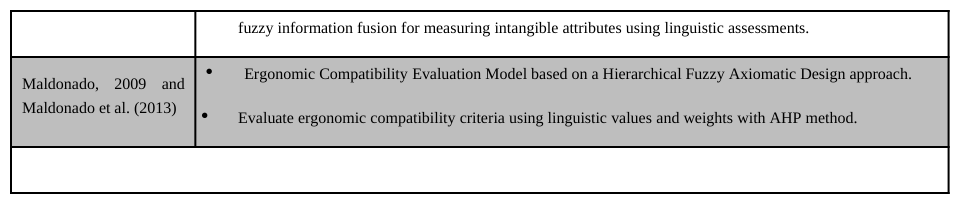
Table 4 presents a list of authors, date and description of methodologies used for the evaluation of AMT from an expert system approach.
Ergonomics In Design, Usability & Special Populations II https://openaccess.cms-conferences.org/#/publications/book/978-1-4951-2107-4
Ergonomics In Design, Usability & Special Populations II https://openaccess.cms-conferences.org/#/publications/book/978-1-4951-2107-4
NUMERICAL EXAMPLE An example corresponding to selection of AMT in CNC plastic molding machines is presented in this section.
Example. Ergonomic assessment of CNC plastic molding machines. Table 5 shows the qualifications given by the experts to the CNC plastic molding machines alternatives. At this table the alternatives are indicated by the letters X, Y, and Z; the experts by E1-E3, and the qualifications are abbreviated on the following way: P = Poor, R = Regular, G = Good, VG = Very Good, and E = Excellent, VL = Very Low, L = Low, M = Medium, H = High, VH = Very High. At this example, three experts evaluate three molding machines alternatives. Qualifications given by the experts are introduced in the Matlab ® 2010 program. When there are several evaluators, as in this example, the expert system applies a geometric mean to the centroid of the qualifications of a specific sub-attribute for each alternative. At the end, the expert system provides the final EIC for each alternative. Table 6 shows the results of the expert system in the case study of milling machines.
At this case the best alternative is X according to the expert system, since X has a minor EIC. This example was taken from Maldonado (2009) and it was also used to perform another validation of the expert system. Maldonado (2009) and the expert system coincided in most of the ranking of the alternatives. On this validation it was concluded that the expert system has an acceptable performance.
Table 5. Qualifications given by the experts to the molding machines alternatives
E1 E2 E3 X Y Z X Y Z X Y Z A111 G P VG VG G G VG R R A112 VG VG VG VG G G G R R
A121 VG VG VG VG G G VG G G A122 VG G G G R R VG G R A123 G R G VG P R VG G R
A124 VG VG VG VG G G VG G R A125 H H M L L L L L M A131 VG R G E R R VG R R
A132 VG R G VG R R VG G R A133 VG VG R VG R R VG R R A134 E VG G VG R R VG G R
A135 VG R P VG R G VG R R A136 VG G R VG R G VG R R A137 G R R VG R R G R G
A141 M M H M M M VL L L A142 L L L L H H VL VL VL A143 L M M L VH VH VL VL L
A144 L L L H H H L L L A151 G G G G G G VG VG VG
A152 G R G VG G G VG G G
Ergonomics In Design, Usability & Special Populations II https://openaccess.cms-conferences.org/#/publications/book/978-1-4951-2107-4
Table 6. EIC for the CIM alternatives
Table available in the original PDF paper.
Alternative EIC with the Expert System X 0.5012
Y 1.5056 Z 1.2334
CONCLUSIONS
From the literature review it can be concluded that a variety of methodologies have been used to achieve decisions about the selection of AMT have considered a variety of attributes, but there are few models that have included ergonomic and safety attributes. Predominant methodologies involves multi-attribute and multi-criteria approaches also financial economic models and expert knowledge integration for judgmental and weights. The ergonomic and safety attributes represented in the model ECEM may coincide with those found in the literature and should be considered in the design and evaluation of the AMT. Methodologies with a focus on expert system have contributed to the development of systems supporting decision making inferences about AMT by using fuzzy nature rules. Numerical example helped to validate the FES against case studies and also they proved the FES saves time and effort to evaluators when performing computations.
REFERENCES
Abdel-Kader, M. G., Dugdale, D. (2001). Evaluating Investments in Advanced Manufacturing Technology: a Fuzzy Set Theory Approach. British Accounting Review. Vol. 33. pp. 455-489. Álvarez, H., Peña, M. (2004). Modelamiento de Sistemas de Inferencia Borrosa Tipo Takagi-Sugeno. Avances en
Sistemas e Informática. Vol. 1. pp. 1-11. Azadeh A., Fam I. M., Khoshnoud M., Nikafrouz M. (2008). Design and implementation of a fuzzy expert system for performance assessment of an integrated health, safety, environment (HSE) and ergonomics system: The case of a gas refinery. Information Sciences. Vol. 178. pp. 4280-4300. Celik M., Kahraman C., Cebi S., Er I. D. (2007). Fuzzy axiomatic design-based performance evaluation model for
docking facilities in shipbuilding industry: The case of Turkish shipyards. Expert Systems with Applications. pp. 1-17. Chuu, S. J. (2009). Selecting the advanced manufacturing technology using fuzzy multiple attributes group decision making with multiple fuzzy information. Computers & Industrial Engineering. Vol. 57. pp. 1033-1042. Corlett, E. N., Clark, T. S. (1995). The Ergonomics of Workspaces and Machines. A Design Manual. Library
Network. Vol. 2. Pp.1-122. Dean, J., Snell, S. (1991). Integrated manufacturing and job design: Moderating effects of organizational inertia.
Academy of Management Journal, Vol. 34, No. 4. pp. 776-804. Gyan-Baffour, G. (1994). Advanced manufacturing technology, employee participation and economic performance: An empirical analysis. Journal of Managerial Issues. Vol.6, No. 4. pp. 491-505. Karsak, E. E., Tolga, E. (2001). Fuzzy multi-criteria decision-making procedure for evaluating advanced
manufacturing systems investments. International Journal of Production Economics. Vol. 69. pp. 49-64. Kengpol, A., O'Brien, C. (2001). The development of a decision support tool for the selection of advanced technology to achieve rapid product development. International Journal of Production Economics. Vol. 69. pp. 177-191. Karwowski W. (1991). Complexity, Fuzziness, and Ergonomic Incompatibility Issues: The Control of Dynamic
Work Environments. Ergonomics. Vol. 34, No. 6. pp. 671-686. Karwowski, W. (2005). Ergonomics and Human Factors: The Paradigms for Science, Engineering, Design, Technology, and Management of Human-Compatible Systems. Ergonomics. Vol. 48, No. 5. pp. 436–463. Karwowski W. (2001). International Encyclopedia of Ergonomics and Human Factors. Taylor & Francis, London. Karwowski, W. (2000). Simvatology: The science of an Artifact-Human Compatibility, Theoretical Issues in
Ergonomics Science. Vol. 1, No. 1. pp. 76-91. Karwowski W., Jamaldin, B. (1995). The Science of Ergonomics: System Interactions, Entropy, and Ergonomic Compatibility Measures. Advances in Industrial Ergonomics and Safety. Vol. 7. A. C. Bittner, Jr., and P. C. Champney, Eds., Taylor & Francis, London, pp. 121-126.
Ergonomics In Design, Usability & Special Populations II https://openaccess.cms-conferences.org/#/publications/book/978-1-4951-2107-4
Karwowski, W., Marek, T., and Noworol, C. (1988, August).Theoretical Basis of the Science of Ergonomics. In Proceedings of the 10th Congress of the International Ergonomics Association, A. S. Adams, R. R. Hall, B. J. McPhee, and M. S. Oxenburgh, Eds., Taylor & Francis, Sydney, Australia. pp. 756–758. Maldonado-Macías, A. A. (2009). Modelo de Evaluación Ergonómica para la Planeación y Selección de Tecnología
de Manufactura Avanzada. Instituto Tecnológico de Ciudad Juárez, Disertación Doctoral. Maldonado, A. A., Alvarado A., García J. L., Balderrama C. O. (2013). Fuzzy axiomatic design methodology for the selection of Advanced Manufacturing Technology. International Journal of Advanced Manufacturing Technology. Vol 66. pp 171-186.doi:10.1007/s00170-012-4316-8 Maldonado, A. A., Sánchez, J., Noriega, S., Díaz, J. J., García, J. L., Vidal, L. (2009). A Hierarchical Fuzzy
Axiomatic Design Survey for Ergonomic Compatibility Evaluation of Advanced Manufacturing Technology— AMT— Proceedings of the XXIst Annual International Occupational Ergonomics and Safety Conference. pp. 270-277. Matta, A., Semeraro, Q. (2005). Design of Advanced Manufacturing Systems. Models for Capacity Planning in Advanced Manufacturing Systems. Springer. pp. 1-10. Mendel, J. M. (1995). Fuzzy Logic Systems for Engineering: A Tutorial. Proceedings of the IEEE. Vol. 83. pp. 345-
377. Mohanty, R. P., Deshmukh, S. G. (1998). Advanced manufacturing technology selection: A strategic model for learning and evaluation. International Journal of Production Economics. Vol. 55. pp. 295-307. O´Kane, J. F., Spenceley, J. R, Taylor, R. (2000). Simulation as an essential tool for advanced manufacturing
technology problems. Journal of Materials Processing Technology. Vol. 107. pp. 412-424. O´Keefe, R. M., Balci, O., Smith, E. P. (1986). Validation of expert system performance. IEEE Expert. pp.81–90. Norman, D. (1989). The Design of Everyday Things, Double-day, New York. Ordoobadi, S. M., Mulvaney, N. J. (2001). Development of a Justification Tool for advanced manufacturing technologies: system-wide benefits value analysis. Journal of Engineering and Technology Management. Vol. 18. pp. 157-184. Percival, J. C., Cozzarin, B. P. (2010). Complementarities in the implementation of advanced manufacturing
technologies. Journal of High Technology Management Research. Vol. 21. pp. 122-135. Saaty, T. L. (1977). Scaling method for priorities in hierarchical structures. Journal of Mathematical Psychology.
Vol. 15. pp. 234-281. Sivanandam, S. N., Sumathi, S., Deepa, S. N. (2010). Introduction to Fuzzy Logic using MATLAB. Springer. pp. 1-
368. Small, M. H., Chaen, I. J. (1995). Investment Justification of advanced manufacturing technology: an empirical analysis. Journal of Engineering and Technology Management. Vol. 12. pp. 27-55. Saraph, J.V, Sebastian, R. J. (1992). Human resource strategies for effective introduction of advanced manufacturing
practices (AMT). Production and Inventory Management Journal, 33 (1), 64-70. Realyvasquez Vargas, A. (2012). Development of an expert system based on fuzzy if-then rules for the evaluation of ergonomic compatibility evaluation of Advanced Manufacturing Technology (AMT) (In Spanish) Autonomous University of Juarez, Mexico, Master in Science Thesis Talluri, S., Yoon, K. P. (2000). A cone-ratio DEA approach for AMT justification. International Journal of
Production Economics. Vol. 6. pp. 119-129.
Ergonomics In Design, Usability & Special Populations II https://openaccess.cms-conferences.org/#/publications/book/978-1-4951-2107-4
LISTED IN THE AHFE DIGITAL BOOKSTORE CATALOGUE
Explore the complete digital volume
Advances in Ergonomics In Design, Usability & Special Populations: Part II
Read this individual research paper free through the original publisher, or explore the full digital proceedings book.
ISBN 978-1-4951-2107-4
Explore this ISBN in the AHFE Bookstore ↗Listed in the July 2026 bookstore catalogue; search by ISBN to confirm current availability · Digital book purchase optional