Teresa Serpa, Fernando Moreira da Silva (2022). User Centered Design Principles for Entrepreneurs: Quality and Sustainability Since Start-Ups Beginning. In: Advances in Ergonomics In Design, Usability & Special Populations: Part III. AHFE Open Access, vol. 20. https://doi.org/10.54941/ahfe1001322
This paper aims to enhance the importance of User Centered Design specifically for entrepreneurs, improving their companies and products and/or services. The focus of the research project concerns the importance of Design in service start-ups. The current situation, with the economical crisis and the consequent unemployment, created the opportunity for many individuals to develop their own companies, generating jobs for themselves and others. Usually, those entrepreneurs choose the same work industry where they have previous experience and know-how. Anyhow we have to consider that the average of startup companies end before being three years old. Before the creation, during daydreaming and the “kitchen table meetings” phase, people underestimate the time and effort needed to create, raise and maintain this kind of companies. This is a very important moment for the company’s maintenance and future. Focusing on the paradigm change, companies and entrepreneurs need to adapt themselves to the new reality through know-how. We underline the importance of User Centered Design (methodology and tools), Ergonomics and Human Factors to develop the projects in those small companies, which are fundamental to operationalize, enhance quality and increase global sustainability leading as main research result to a model where those are core aspects.
“As the twig is bent, so grows the tree” (English proverb) The reached model presented in this paper shows the need of the Entrepreneurs to, since the early beginning of their companies, focus on the User during the creation processes of the company and their products/services.
This model was based on the analysis of the literature on service StartUps and Entrepreneurship, Human Factors and Ergonomy (HFE) and Design and the relations between them.
The novelty of this research concerns this different approach of all these subjects, considering them as part of a holistic system with a common and sustainable point of view.
This paper wants to underline the importance of this kind of approach, in the current global situation, where the entrepreneurs can use the existent knowledge on Design and HFE on their own benefit.
USER CENTERED DESIGN: THE METHOD The term ‘User Centered Design’ was published for the first time in 1986 by Norman and Draper.
User Centered Design is a methodology, has certain techniques and “ (…) The major advantage of the user-centered design approach is that a deeper understanding of the psychological, organizational, social, and ergonomic factors that affect the use of computer technology emerges from the involvement of the users at every stage of the design and evaluation of the product. The involvement of users assures that the product will be suitable for its intended purpose in the environment in which it will be used. This approach leads to the development of products that are more effective, efficient, and safe. (…)” (Abras, 2004).
The research made on startups and Entrepreneurship, Design and HFE, and the process of analysis/synthesis of that same information, originated the presented results and synthesis tables, diagrams and principles.
RESULTS AND DISCUSSION
“(…) The complexity of today’s global economic environment has made it more important than ever to recognize and encourage the qualitative as well as the quantitative aspects of growth, integrating such concepts as inclusiveness and environmental sustainability to provide a fuller picture of what is needed and what works.(…)” (World Economic Forum, 2011).
Change and improvement are key words when referring to the evolution need to overcome the global crisis. "Adapt or die" and "Do more with less" are phrases in the order of the day, used by many authors (Best, 2011; Fried, 2010) concerning companies, individuals but also organizations and nations, and they reflect the urgent need for change through greater efficiency and effectiveness.
The focus on the startups relates in the need of many active persons who became unemployed lately and mass production portuguese industry cannot compete with some countries with much cheaper prices. To this article, the startup definition entails some innovation degree, eitheir in the business model, the company or the product/service offer (Ries, 2012).
With a high unemployment rate in the country, many people are trying to create their own companies. Some of them have high educational or university degree, and have professional experience in one or more industries. In those cases, this phase is a new and difficult one, challenging the individual to succeed in times of change and uncertainty.
In the actual portuguese culture, risk taking and challenge aren’t the most natural things to do, so becoming entrepreneur is a very heavy decision to take. It’s even harder when the potential entrepreneur has the knowledge that the future of the company will have a very high impact in his/her professional, personal and familiar life (Vericat, 2013). This situation can be very stressful and the owners can feel very lonely, overwhelmed, anxious and scared of the risks they are taking, leaving to a myopia cycle (Ferreira, 2010).
It’s common to say that the major problems of startups are not external (like the macroeconomy situation), but they are the personality mirror. The problems are coming from the entrepreneur himself.
By nature, the true entrepreneur type likes to take risks and have a focus on the solution instead of in the problem. They have characteristics of character/personality like positive thinking, self confidence, determination, courage, persistence and resilience. These last ones are major issues for the survival of the company. The pitfalls are many during the first three to four years of a startups company.
One of the main things is that the business area must be interesting and that it needs to offer something unique or different for the future buyers that they already need or will need in the future. For startups it is better to have a special small actuation niche and users group than a common ground with many unloyal clients.
For startups owners most of the times the launch of the company and their services needs to be fast, with solutions that are less-than-optimal, which can be very hard for the perfectionists type of people.
For the creation of a new small company, a common advice is to keep it lean with the minimum use of external capital as possible. The main investment shall be in time and emotional and personal efforts (Ries, 2012) For entrepreneurs, it is important to have a general overview of important things on HFE and Design that can have an impact on the products/services they are trying to sell and in the business itself.
The tendency to think with a system approach, keeping in mind the interrelations and the elements by themselves, putting the focus on the user, seem to be general tendencies from different knowledge areas, either scientific or applied, a holistic view as a Global tendency.
Design Design has been seen as a service applying intangible resources, like creativity. Concerning the final results, Design developed a evolutionary line that goes from the simple styling of tangible products forms, evolving to intangible services, experiences and systems (Brown, 2008). According to this evolution, several definitions for different specialization areas have been created, like: Service Design (Kimbell, 2008. Schindlholzer, 2008), Systems Design (Brown, 2009), but also new definitions were created like Silent Design (Gorb, 1987).
The main generic objective of Design is to create a better world and society. Regarding this, several issues and definitions are being developed like: sustainable design; green design; eco design; co-production design; consumer oriented design; interface design; inclusive design, etc. If, in one hand, they reflect a holistic view of all the general system where design stands and interferes (a comprehensive view of activities and consequences), on the other hand, they focus on very detailed and specific issues like the consumer particular needs and wishes, for example.
Design principles were developed by several authors, and Norman (1988) suggested that the following seven principles of design are essential for facilitating the designer’s task: “1. Use both knowledge in the world and knowledge in the head. By building conceptual models, write manuals that are easily understood and that are written before the design is implemented.
2. Simplify the structure of tasks. Make sure not to overload the short-term memory, or the long-term memory of the user. On average, the user is able to remember five things at a time. Make sure the task in consistent and provide mental aids for easy retrieval of information from long-term memory. Make sure the user has control over the task.
3. Make things visible: bridge the gulfs of Execution and Evaluation. The user should be able to figure out the use of an object by seeing the right buttons or devices for executing an operation.
4. Get the mappings right. One way to make things understandable is to use graphics.
5. Exploit the power of constraints, both natural and artificial, in order to give the user the feel that there is one thing to do.
6. Design for error. Plan for any possible error that can be made, this way the user will be allowed the option of recovery from any possible error made.
7. When all else fails, standardize. Create an international standard if something cannot be designed without arbitrary mappings.“ (Norman, 1988, pp.189-201).
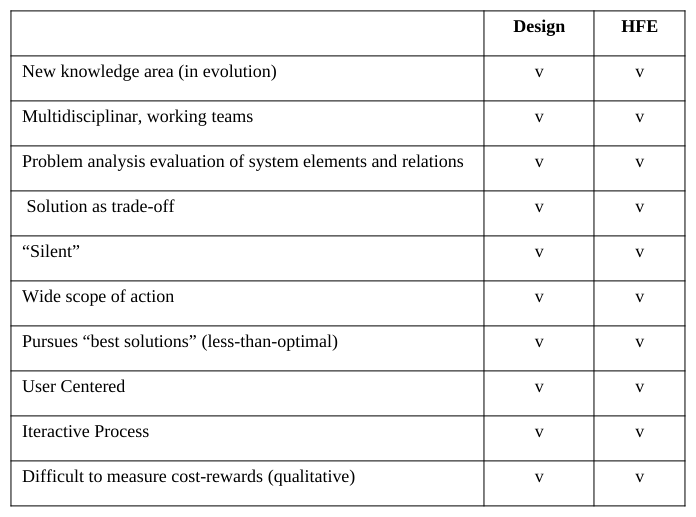
Design and HFE Design and HFE knowledge areas and professions have many similarities. Both are new knowledge areas, that balance multidisciplinar knowledges (between scientific and applied sciences), analyse problems has systems (considering their elements and interrelations), see the solution as trade-offs, many times their work is “silent” (because it’s not visible), has a wide scope of action (from products to services, for example), pursues the best solutions has a whole, having the user in a central role of the creation process, using several steps of the iteractive process and it’s very difficult to measure the cost-rewards relation some of them are intangible (the most favourable way is to use comparative values in different moments of their knowledge integration in the process, but as a system evaluation, like total amounts).
Table 1. Design and HFE general similarities (Author) Design HFE
Design and Business Design and Business have been in opposite fields by nature. But Design raised its own influence in the organization where it stands/operates and it has been embodying different managerial, strategic and economics knowledge on behalf of itself, namely through Design Management and Design Strategy (Mozota, 2002). This evolution proved to be beneficial to the organization where it stands, to their products/services, clients, consumers and results.
Design in Business is vital for the corporate strategy and raises business performance (Best, 2011) and touches all the Porter value chain (Porter, 1998; Mozota, 2003).
The Designer abilities for Strategic Design are being studied, for example by the Helsinki Design Lab: “(…) Strategic design is about applying some of the principles of traditional design to ‘big picture’ systemic challenges like health care, education, and climate change. It redefines how problems are approached, identifies opportunities for action, and helps deliver more complete and resilient solutions.
This is only possible when design is integrated into the DNA of organizations, creating new opportunities for designers with a strategic aptitude to migrate from studios and ateliers to integrated positions, embedded within organizations and governments. (…)” Helsinki Design Lab also gives a definition of the three core competencies that the strategic designer needs to have:
“(…) Integration (…) The naturally integrative approach of design helps illuminate the complex web of relationships— between people, organizations, and things—to provide a holistic point of view.
By working across different areas of expertise, strategic design outlines the ‘architecture of the problem,’ highlighting key opportunities for improvement in all aspects and outcomes of a problem. (…)” “(…) Visualization (…) Fluent in visual representation, the strategic designer uses this skill as an important and iterative means of communicating complex, even contradictory, relationships—which would be difficult or impossible to explain in text and numbers alone. (…)”
“(…) Stewardship (…) In recent years, the emphasis on ‘design thinking’ has powerfully demonstrated the value of applying creativity in a business context.
But successful design is not only about creative thinking. It also involves implementation and ensuring that key ideas maintain their integrity during that process. Designers must be involved over the duration of change processes, providing constant expertise and feedback to identify, test, and deliver durable solutions. (…)” So, in the organization where it now stands, the designer starts to be a key element in its organization strategy, which has been studied also by Model Igloo (Almendra, 2008b) among others.
StartUps, HFE and Design The Diagram 1 focus on the importance of Design and HFE in service startups. Part of the problematic presented in the paper is this system and the interrelation of these three elements.
Diagram 1. Start Up - HFE – Design interrelations (Author).
Design and HFE are disciplines that have a system approach. The elements are part of the whole and the interrelations between them are very important. As a system, each element or interrelation can balance or unbalance the system (Diagram 2).
Diagram 2. System approach: elements and interrelations (Author)
Design and HFE are iterative processes, and both must have the user as central element that must interfere in all the creation process.
The users are the only ones that can give human inputs about the product/service of the companies. The user Center approach methodology will improve the general quality, sustainability and inclusivity of the company, its products/services, and all the other parts of the system.
Diagram 3. Design and HFE are iterative processes, and in both the user is central (Author)
CONCLUSIONS
In order to enhance the importance of User Centered Design specifically for entrepreneurs, improving their companies and products and/or services, we are developing this research in the presented areas and in close ones.
Untill this moment and considering this research stage, we can predict that placing the user at the center of the Design and HFE process and considering the individual abilities, motivations, feelings and expectations of the users, will improve the quality of the company and the products/services and increase the general happiness of the users.
Furthermore, and using different tools like surveys to startups entrepreneurs and experts panel tests of guidelines, we will step forward to create the referred model and prove the importance of User Centered Design and Service Design for service startups.
REFERENCES
Abras, C., Maloney-krichmar D., Preece, J. (2004). “User-Centered Design”. Bainbridge, W. Encyclopedia of Human-Computer Interaction. Thousand Oaks: Sage Publications. Almendra, R., Monteiro Barata, J., Nevado, P., Romão, L.(2008). “The “Igloo Model”: a proposal for an analysis of
the contribution of Design to the competitiveness of companies”, ICAM – 15th Annual International Conference on Advances in Management, Boston. Best, K. (2011). “What can Design Bring to Strategy? Designing Thinking as a Tool for Innovation and Change”.
InHolland University of Applied Sciences. Brown, T. (2008) “Design Thinking”. Harvard Business School Publishing Corporation. Harvard School. Brown, T. (2009) “Change by Design: How Design Thinking Transforms Organizations and Inspires Innovation”.
Harper Business Edition. First Edition. Ferreira, M. P., Santos, J. C., Serra F. R. (2010). “Ser Empreendedor: Pensar, Criar e Moldar a Nova Empresa”.
Edições Sílabo. Fried, J., Hansson, D.H. (2010), “Rework”, Crown Business. Gorb, P., Dumas, A. (1987). “Silent design”. Design Studies, Vol. 8(3), pp.150-156. Helsinki Design Lab. “What is strategic design?”. (Online). Available: http://helsinkidesignlab.org/pages/what-isstrategic-design Kimbell L., Seidel V. P. (2008). “Designing for Services – Multidisciplinary Perspectives: Proceedings from the
Exploratory Project on Designing for Services in Science and Technology-based Enterprises”. Saïd Business School. University of Oxford. Mozota, B. B. (2002). “Design and competitive edge: A model for design management excellence in European SMEs”. Design Management Journal Academic Review. Vol. 2, No. 1, p. 88-103. Norman, D. (1988). “The design of everyday things”. New York: Doubleday. Norman, D. A. & Draper, S. W. (Editors) (1986) “User-Centered System Design: New Perspectives on Human-
Computer Interaction”. Lawrence Earlbaum Associates, Hillsdale, NJ. Oborne, D. J. (1998). “Ergonomics at work Human Factorrs in Design and Development”. Wiley. Third Edition. Ries, E. (2012). “Lean Startup”. Prime Books. Vericat, G. F. (2013). “O livro Vermelho das Mulheres Empreendedoras”. BookOut. World Economic Forum – WEC. (Online). Available: www.weforum.org .
LISTED IN THE AHFE DIGITAL BOOKSTORE CATALOGUE
Explore the complete digital volume
Advances in Ergonomics In Design, Usability & Special Populations: Part III
Read this individual research paper free through the original publisher, or explore the full digital proceedings book.
ISBN 978-1-4951-2108-1
Explore this ISBN in the AHFE Bookstore ↗Listed in the July 2026 bookstore catalogue; search by ISBN to confirm current availability · Digital book purchase optional