Rui Grazina, Fernando Moreira Da Silva, Fernando Poeiras (2023). The Body of Sensation within the context of Atmospheric Painting. In: Affective and Pleasurable Design. AHFE Open Access, vol. 71, pp. 46–57. https://doi.org/10.54941/ahfe1003243
In this study we analyse approaches through which the construction of atmospheres in painting is accomplished, and in which ways there might be a crucial relationship between the conception of these images, and the body of sensation. Further to a theoretical framework, we study diverse case studies and propose to establish pertinent distinctions. The cases are examined from the point of view of their pictorial values, and are juxtaposed in sets in order to endeavour to question each other in a more pertinent manner. We try to reach conclusions regarding the construction of atmospheres in themselves, and also in which forms these might allow cognitive and interpretative advances, and how these constructions might be related to different mechanisms of sensation and perception, and in particular how these will be enabled by the body of sensation.
In this paper we address the construction of some types of atmospheres in the scope of painting. With our selection of case studies we propose seve- ral distinctions that we argue as pertinent and we try to confront them and to propose interpretations of the diverse types of outcomes. The main focus and central point that we propose connects these diverse structures of com- prehension from the standpoint of a somatic design interpretation – one that connects mind and body -, and in that sense, we try to highlight the importa- nce and relevance of the body as an enabler of sensation itself. We argue that by considering this body of sensation we might be able to reach an understan- ding of diverse approaches that produce disparate and contrasting pictorial values that we find in atmospheric painting. At the end of the paper we try to reach conclusions concerning the construction of atmospheres in themselves and what they might allow in cognitive and interpretative terms in general. Also, we propose, that these sort of constructions might be incorporated into design practices and allow the creation of new capacities for its development. In the long run these forms of progression might thus also promote actual social advances.
The Body of Sensation Within the Context of Atmospheric Painting 47
THE CONSTRUCTION OF DEPTH AND DENSITY IN ATMOSPHERES There are diverse and contrasting ways in which the construction of atmo- spheres is enabled in atmospheric painting. In the scope of this study we will be concentrated on two main considerations. On the one hand, the processes of construction of atmospheres themselves, and on the other, on the forms through which the body might, in some way, become a part of the pain- ting itself and become the main focus of atmospheric painting. We start the research by addressing the notions of depth and density of the image and the significance it has on framing the body itself in a particular way. Color is also relevant, we argue, considering the diversity and profusion of the images we identify within this range of approaches. Finally, we examine the notion of enclosure and constraint of the body itself, that we argue might help us in understanding possible connections between the notions of figuration and “the Figure” developed by French philosopher Gilles Deleuze.1
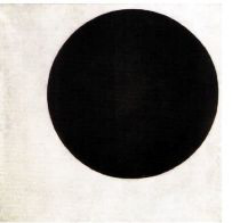
DEPTH, DENSITY AND THE BODY OF SENSATION There are diverse ways for the construction of depth in painting in general and in atmospheric painting in particular. A classic and extreme example of an absolute construction of depth might be the total separation opera- ted in Kazimir Malevich’s paintings of the early twentieth century. In “Black Circle”- figure 1 -, as in other works, the Russian painter performs a radical construction in terms of density and depth. A binary distinction is involved — the total white as the closest object in the image, and the black circle as the void.
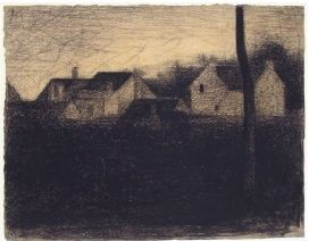
There are no transitions in this paradigmatic and radical painting example and precedent. In our first case study – Figure 2 – Georges Seurat presents an atmospheric construction in which we identify the density of the pictorial stroke as the main constructor of the image itself.
Through the repeated use of such pictorial element, the 19th century French painter manages to materialize a landscape of houses that arise through the density of the black strokes upon a light background. Neither black nor white necessarily represent proximity or distance – both are used as methods of pointing out different materialities. We argue that by means
Figure 1: Kazimir Severinovich Malevich, black circle, (https://www.artsy.net/artwork/ kasimir-severinovich-malevich-black-circle, 1928).Figure 2: Georges Seurat, landscape with houses (https://www.metmuseum.org/art/co llection/search/337676, 1881–82).
of the space closed or left open by the density of the black strokes disti- nctive values of materiality emerge. We further argue that the construction of depth might be thought of from the extreme example of Malevitch and the paradigmatic “Black Circle” – Figure 1 -, to gradually assume more subtle constructions. This enables new meanings and new possibilities for the image in such ways that it permits the creation of diverse pictorial constructions and further, particular atmospheres, we think.
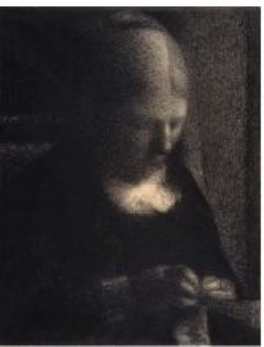
We might consider an example of these possibilities again through the work of Seurat, in this specific case by means of the painting in Figure 3. The Fre- nch painter constructs an image that unlike the previous example “Landscape with Houses”, does not extend itself across the canvas but instead focu- ses on one key element – a human subject. The image is grounded on a semi-darkness achieved by the density of Seurat’s strokes, and the focus is centered on the face and hands of the figure.
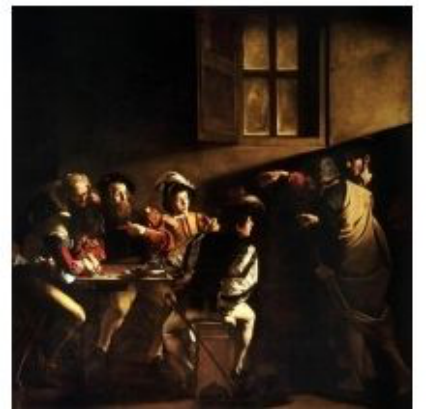
Whereas the previous images might convey a certain melancholy, on this one we think that we can identify calm and tranquility. Unlike the prece- ding George Seurat example, there are no loose wide and crossed strokes, but rather a very small type of stroke that enables an almost monochro- matic pointillist technique, and one that emphasizes the static and more contemplative character of the painting.2 Although we might argue for points in common with Seurat’s “Embroidery; The Artist’s Mother”, Caravaggio’s “The Calling of Saint Matthew” – Figure 4 -, transports us to another type of atmosphere with considerable differences, although we might contend, with some common ele- ments. From the domestic and familiar sphere of an apparently peaceful and calm space, we are taken to an environment in which the pictorial elements convey the tension between its protagonists. This atmosphere is built within the particular “chiaroscuro” characteristic of Caravaggio’s Baroque painting. The painter’s technique consists of a powerful intensity and discrepancy betw- een the shadowy and the illuminated. The dark background tone establishes a base for different levels that results in intense and powerful effects due to the sheer overall contrast.
It might be argued that it is as if Malevitch’s binary abstraction took on a life of its own and by moving some of the characters out of the deep black void
The Body of Sensation Within the Context of Atmospheric Painting 49
Figure 3: Georges Seurat, embroidery; the artist’s mother, 1882–83, https://www.metm useum.org/art/collection/search/334652.Figure 4: Michelangelo Merisi da Caravaggio, the calling of Saint Matthew, 1599-1600, https://commons.wikimedia.org/wiki/File:Caravaggio,_Michelangelo_Merisi_da_- _The_Calling_of_Saint_Matthew_-_1599-1600_(hi_res).jpg.
of his paintings, Caravaggio managed to transport them to the edge of the canvas, close to the light and adjacent to the observer. Besides the tridimensio- nal consequences, light acquires here – or is given, rather – another character. Further to giving life to characters on the canvas, light becomes something in itself, a sign of something of a particular sort. The radiance that permeates the whole painting brings the characters to life, presenting their demeanor and tensions in the hierarchy of the event as it is narrated, and manifesting the atmospheric character of the scene. We argue that this light that illumina- tes St. Matthew conveys the atmosphere of transcendence that the painting embodies.
COLOUR, SENSATION AND AN ENCLOSED BODY In the same way that depth can be worked upon through transitions between light and dark, we argue that the transitions and divergences between colours also enables the construction of atmospheric images.
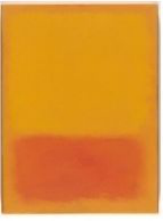
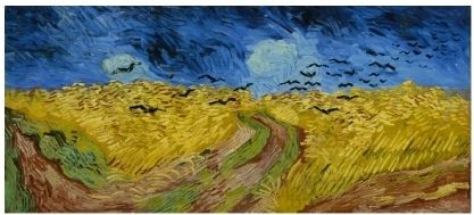
In the images of Mark Rothko and of Vincent Van Gogh - Figure 5 and 6 - we have two examples of atmospheric constructions with common and com- parable elements with the previous case studies, and yet, within a very diverse structure, setting and outcome. Rothko’s image is constructed as an abstra- ction, whereas Van Gogh’s is a representation of a landscape. As we have seen in previous instances, we can point to Rothko’s image as an abstraction that conveys an atmosphere of serenity, and one in which the colours induce an idea of a positive, almost elated setting.
On the other hand, in Van Gogh’s painting we find disturbing movements within the heavy and foreboding sky that in turn are reflected on the agi- tation of the wheat-fields and in the flight of the birds. Just as in Rothko’s image, we find that Van Gogh’s example constitutes also a representation that makes us aware of depth, texture and distance. We further argue that we might also feel the movement on the wheat field and the stampede of the crows in addition to the sinister overtones that the presence of the birds might also convey. Rothko’s image frames a soothing atmosphere through its static blocks of colour, that as a consequence of their orthogonality and organiza- tion are able to transmit a sense of warmth and calm. The orange colour field is situated at a certain distance from us, whereas the red rectangle is felt – or
Figure 5: Mark Rothko, untitled, 1968, https://www.moma.org/collection/works/37042.Figure 6: Vincent Van Gogh, Wheatfield with crows, 1890, https://www.vangoghmus eum.nl/en/collection/s0016V1962.
The Body of Sensation Within the Context of Atmospheric Painting 51
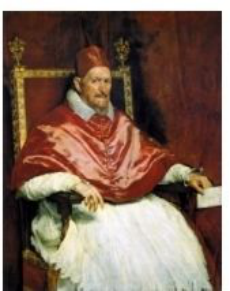
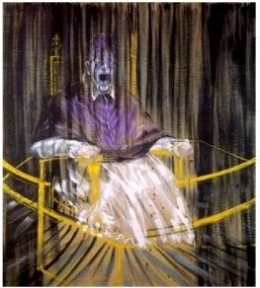
Figure 7: Diego Velazquez Pope Innocent X, 1650, https://arthive.com/diegovelazquez /works/12142~Portrait_of_Pope_Innocent_X.Figure 8: Francis Bacon, study after Velázquez’s portrait of pope innocent X, http://www.art-theoria.com/painting-of-the-month/study-after-velazquezs-portrait- of-pope-innocent-x/.
perceived – closer to us, detached from the background, but equally reassu- ring. In Van Gogh’s case, on the other hand, there is a substantial sense of depth in the image. The wheat field is situated closer to us by means of the general construction of the image and by the character of the colour, whereas the sky is distanced from us by the effect of the emotionally charged blue in counterpoint with the yellow.
We argue that both paintings address different forms of atmospheric con- struction grounded fundamentally on the repercussions that they produce on the sensitive body of the viewer.
An extreme process through which this body of sensation reaches a higher level of stimulation will be, we argue, that of turning into itself. To the con- straint of an atmosphere that reaches an obsessive character, in the sense that it deals with the body of the painter himself.
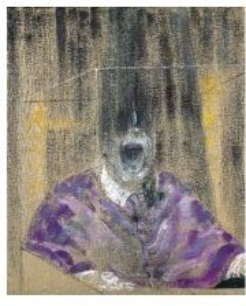
With his Pope Innocent X studies in the 1950s – Figure 8 – Francis Bacon initiated a series of portraits that feature claustrophobic environments. These induce an unsettling and oppressive atmosphere – one that we argue in
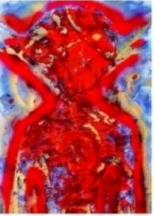
Figure 9: William S. Burroughs, the melting red disease, 1988, https://www.artsy.net/ artwork/william-s-burroughs-the-melting-red-disease.
the scope of this paper and of our reasoning, reaches a state of obsession. Through the use of expressive markings, Bacon transforms a representation of Pope Innocent X – Figure 7 – into a depiction of the tortured expression of an apparently imprisoned subject. In these three paintings of Francis Bacon, William S. Burroughs and Vincent van Gogh that we juxtapose, we try to find traces of atmospheres linked to what we argue might be these states of obsession. In order to find the core of obsession itself we need to find the root of the word. According to Mark Wiatt, the term refers to images or ideas that come into one’s consciousness against its will, and that might deprive the subject of the ability to think and to act. The term is derived from the Latin “obsidere”, which means “to lay siege to” and figuratively to control. Psychiatrists describe the obsessive experience as that of someone taken by an intrusive thought that captures consciousness and that despite the lucid mental state of the subject, makes him incapable of stopping such thought.3 We think that further to this mental state, and in the sense that this state turns the subject hostage, the existence of a body will also be crucial. Writing about Bacon’s painting, Gilles Deleuze addressed in a particularly meaning- ful and vital way the necessity of a body and how it enables the processes of sensation:
“As a spectator, I experience the sensation only by entering the painting, by reaching the unity of the sensing and the sensed. This was Cezanne’s lesson against the Impressionists: sensation is not in the “free” or dis- embodied play of light and color (impressions); on the contrary, it is in the body, even the body of an apple. Color is in the body, sensation is in the body, and not in the air. Sensation is what is painted. What is painted on the canvas is the body, not insofar as it is represented as an object, but insofar as it is experienced as sustaining this sensation” (Deleuze, 1981)4.
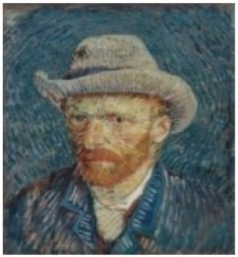
Despite the contrasts between the chosen examples, they might neverthe- less be related by some common points – and by a common thread -, that might help us clarify the elements of their proposed proximity. What we consider mainly relevant is the fact that these are representations of a body that has in some way become captive – Figure 9, 10, 11. In the three pain- tings we face a repetition of strong and determined graphic marks. In Bacon we encounter the marks of a brush that produces heavy vertical strokes.
The Body of Sensation Within the Context of Atmospheric Painting 53
Figure 10: Self portrait with Grey Felt Hat, Vincent Van Gogh, 1887, https://www.vincen tvangogh.org/self-portrait-with-grey-felt-hat.jsp.Figure 11: Francis Bacon, head VI, 1949, 93.2 × 76.5 cm, https://www.artscouncilcollect ion.org.uk/artwork/head-vi.
In Burroughs we have the violent lines that are drawn around a hesitant figu- rative element. In Van Gogh’s case, the scattering of countless strokes around the depicted face.
In his philosophy of the body, Hermann Schmitz5 removes the hesitant status of atmospheres, considered as part of a subject-object dichotomy. If we accept their relative or complete independence from objects, atmosphe- res must then belong to the subject. Referencing Schmitz, Böhme mentions what happens when we regard the serenity or the melancholy of a landscape. According to Böhme these feelings become projections of moods, and in this sense they might be interpreted as internal psychic states (Böhme, 2018)6.
And so, we argue, that for the presence of internal psychic states we will obviously need the existence of a somatic framework. As we already menti- oned, obsession may be correlated to a subject deprived of freedom. And we consider that a lack of freedom will be an ultimate challenge to the body. On all the three last case studies we identify an obsessive atmosphere in which, we argue, we might find the idea of a subject trapped within the image itself – or within himself –, literally in his own particular and claustrophobic psychic state.
Be it by a vertical weight that falls on a face that writhes in a scream, by the framing or captivity depicted by a continuous line that delimits a vague figure, or by the fixed and imprisoned face of the author within a concentric and overpowering cloud of countless strokes that define the limits of his face – and we might add, the constrains, the limits to his own freedom. The painter becomes circumscribed inside the frame, and we might argue, becomes its captive.
DISCUSSION
From Seurat to Caravaggio, we try to construct a progression that comes from a sense of total abstraction to diverse manifestations of the body in painting. In the cases of Seurat and Caravaggio the atmospheric character is accomplished through the high degrees of contrast between light and dark. In Seurat’s case the semi-darkness creates images of calm and of a melancholic character. Caravaggio’s “chiaroscuro” attempts to highlight a relationship between a human presence and the manifestation of transcendence. In both, the play of light and shadow is used so that the pictorial values enable a hyperbolic construction.
In Van Gogh, we argue that another sort of distortion is provoked by the dichotomy caused by the intense and contrasting use of colour. The landscape elements are treated so that the movement and agitation – of sky, fields and birds – are achieved through a representation that emphasises such elements by convoluted brushstrokes and by a play of deeply contrasting colours – the yellow field in movement and the threatening blue sky.
In a painting like Rothko’s the image is static and there is an emphasis on the field of red colour that stands out from the frame and approaches the viewer.
Finally, in Francis Bacon, William S. Burroughs and in Van Gogh’s self-portrait, the pictorial elements refer to the human body and in this sense the ambiguity becomes greater as the “object” itself is human, and the ambivalence of the images acquires a tone, we argue, associated with obsession.
The french philosopher Gilles Deleuze discussed how the painter Francis Bacon thought of sensation and representation in what we might designate as a double mode. On the one hand, the notion of a form related to what he attempts to represent – which Deleuze refers to as “figuration”. On the other hand, a representation linked to sensation, which the philosopher describes as “the Figure”. These approaches to two very different levels of representation allow us to engage with an understanding of painting that embraces very distinctive and divergent approaches, and at the same time, that enables us to analyze painting’s intense operative richness.
“There are two ways of going beyond figuration (that is, beyond both the illustrative and the figurative): either toward abstract form or tow- ard the Figure. Cezanne gave a simple name to this way of the Figure: sensation. The Figure is the sensible form related to a sensation; it acts immediately upon the nervous system, which is of the flesh, whereas
The Body of Sensation Within the Context of Atmospheric Painting 55
abstract form is addressed to the head, and acts through the intermedi- ary of the brain, which is closer to the bone. Certainly Cezanne did not invent this way of sensation in painting, but he gave it an unprecedented status.” (Deleuze, 1981)7.
What seems most relevant to us in the specific case of atmospheric pain- ting is the way in which it articulates various and ambivalent frames of reference, and that through this process offers us works in which the tre- atment of pictorial values creates a space for ambiguity. This ambiguity carries in itself a wealth of valuable possible meanings. And this will be a common denominator that we find in the general scope of this type of painting.
In each particular case we studied, we argue that the ambiguity is worked out, in a particular way associated with a particular author, and his parti- cular way of approaching painting itself. Hermann Schmitz8 assumes in his philosophy that the notion of atmosphere combines an emotional character with a certain spatial character. In our case studies of atmospheric painting, and in the scope of the ambiguity we mention, we argue that this enables the creation of very differentiated and particular atmospheres associated to diverse spatial characters.
This ambiguity between the immediate character of a sensation connected to a depiction, and the reflexive character of its possible perception, leads in our understanding to unusual situations. This occurs in the sense that familiar representations of some of the pictorial elements used for the con- struction of the images are developed in themselves and contextualized with other pictorial elements, so that the reading of the global image creates a cer- tain interpretational dissonance. This divergence transports the observer – or in our particular argumentation, the putative designer -, to particular con- texts in which the notion of what might be considered figuration and what we might refer to as “the Figure” becomes ambiguous.
But what seems most important to us to highlight in this discussion is the great interpretative richness that these atmospheres might allow. In this manner, atmospheric painting might grant a capacity to transform picto- rial values from the level of figuration into connotations related to the notion of “the Figure”. This might then create the possibility to surpass values associated to a direct creation of conventional images, and in doing so, enable the opening of new fields of significance and new conceiva- ble values for imagination and creation, thus create new possibilities of meaning within a context in which the body represents a fundamental ele- ment. This will necessarily be a somatic notion of the body – a body that connects mind and sensation – and one that will enable the possibi- lity of new meanings and new capacities of interpretation. In this regard, when these characteristics are incorporated into design thinking they might have impacts on the work itself on several levels, making it possibly much richer. In the long run this might obviously bring further repercussions on a social level, as the designer is further capable and empowered for his work overall.
CONCLUSION
“Of course dualistic systems of mind and body have always had their dissenters. Many of the Eastern philosophies were built on a monistic set of beliefs, and even early Western thought had its contrary tradi- tions of Pythagoras and Hippocrates, which theorized a more unified view of our relationship with the world. In more recent times, Martin Heidegger took a pivotal step away from dualistic models by defining our essential condition not as a passive thinking subject symbolically confronting “things” out there but in a more primal sense as Dasein or simply “being-in-the-world”. (Mallgrave, 2013)9.
The thinking of Harry Francis Mallgrave10 is important to us at this point, and in the context of this study, in the sense that it provides a general perspective for our tentative conclusions. This importance, we argue, will be to enable a possible counterbalance to the contemporary stronghold of Cartesian thought and the preponderance it has on a society based on visual values and references. In this regard, Juhani Pallasma mentions the contem- porary relevance of confronting the hegemony of images in order to enable the resistance to a possible demise of imagination (Pallasma, 2011)11.
The work of investigators such as Johnson12, Damásio13 and McGuilchrist14 among others, is extremely relevant to us in the sense that it points towards a renewed relevance of the connection of levels of sensation and the body – this from the altogether disparate field of neuroscience – with the mechanisms of thought in general. Thus the immaterial might become an almost “quasi-thing”15, we might argue, in the viewpoint of Griffero.
On the other hand, there is a contemporary approach we find in advances such as the ones present in soma design16, that are expressed in processes that reincorporate the body into design thinking, by reassessing and questio- ning the hegemony of language and logic. We might them think of slow and thoughtful processes in which human values become again fundamental and further these might constitute a reevaluation of the importance of the body as the ultimate repository of combined reflexive thought and intuition. In the particular scope of this study we thus tried to emphasize the importance that we find in the body – thought of as the enabler of the meeting of mind and sensation – as a possibility in thinking design itself. By looking at the examples from atmospheric painting our main goal was twofold.
First and on a particular level – the particular focus in the present study -, we think that we might enlighten the thinking around design – and its pos- sible future -, with new forms of looking into the past. In our particular case, looking into atmospheric painting might make us able to emphasize the importance of representation – namely drawing, we might suggest -, as an ever present form to think about design. The vastness and breadth that we find in atmospheric painting allows us to grasp the multitude of approaches to representation but also and very importantly, the way different approaches might enable totally disparate and peculiar interpretations. We propose that these ideas might be extrapolated to the actual field of design, in the sense that they might further allow its development and its comprehensiveness. On the other hand, and secondly, we attempt to create the possibility to reiterate
The Body of Sensation Within the Context of Atmospheric Painting 57
the importance of the body in itself as a counterpoint to the prevalence of the digital and therefore of that which is not corporeal in essence. This is a bias overwhelmingly present in Western thought and in contemporaneity, that entails a number of clear dangers, we think.
We argue that the lack of empathy present on a fundamentally digital world will go against the diversity and scope of potentialities that the concept of embodiment might allow. This is a notion of embodiment as a whole where intuition and reflexive thought might exist side-by-side and complete each other.
So, on the overall, by going back to the necessity of considering a body in order to understand atmospheric painting we tried to demonstrate the impor- tance of that same body in general terms and, on a global perspective, as a way of constituting a possible way forward to ascertain our very presence in the world.
Further to a dualistic perspective, we argue that a humanistic, holistic and somatic consideration of the body – our own body – as the connector between sensation and perception, might be crucial for a sustainable way of thinking design and building a balanced future. This stability might, in the long run, allow a more socially harmonic and interconnected approach to our very presence and interaction with our society and our world.
ACKNOWLEDGMENT
The author would like to acknowledge the importance of both supervisors and co-authors in the work developed within this paper in particular, and, above all, in the development of the PhD thesis.
REFERENCES
Böhme, G. (2017). Atmospheric Architectures: The Aesthetics of Felt Spaces.
T. Engels-Schwarzpaul, Ed. Bloomsbury Academic, p. 37. Damasio, A. (2003). Looking for Spinoza: Joy, Sorrow, and the Feeling Brain (First edition). Harvest. Deleuze, G. (1981, 2003). Francis Bacon: The Logic of Sensation. A&C Black. p. 35,
p. 34. Gage, J. (2007). Colour in Art. Thames & Hudson. Trans. SUNY Press. Griffero, T. (2017). Quasi-Things: The Paradigm of Atmospheres. SUNY Press. Hook, K. (2018). Designing with the Body: Somaesthetic Interaction Design (Illustrated edition). The MIT Press. Johnson, M. (2008). The Meaning of the Body: Aesthetics of Human Understanding.
University of Chicago Press. Mallgrave, H. F. (2013). Architecture and Embodiment: The Implications of the New Sciences and Humanities for Design. Routledge, p. 9. McGilchrist, I. (2012). The Master and His Emissary: The Divided Brain and the
Making of the Western World (Reprint edition). Yale University Press. Pallasmaa, J. (2011). The Embodied Image: Imagination and Imagery in Architecture (1st edition). Wiley, p. 17. Publishing, M. (2005). International Dictionary of Psychoanalysis, 3 Volume Set.
Macmillan Reference USA. Schmitz, H. (2019). New Phenomenology: A Brief Introduction. T. Griffero, Ed.
Mimesis International.
LISTED IN THE AHFE DIGITAL BOOKSTORE CATALOGUE
Explore the complete digital volume
Affective and Pleasurable Design
Read this individual research paper free through the original publisher, or explore the full digital proceedings book.
ISBN 978-1-958651-47-6
Explore this ISBN in the AHFE Bookstore ↗Listed in the July 2026 bookstore catalogue; search by ISBN to confirm current availability · Digital book purchase optional