From the Neural Perspective (2020). Work Engagement and Burnout - Consequences of Mismatch Between Individual and Work Environment. In: Advances in Science, Technology, Higher Education and Society in the Conceptual Age: STHESCA. AHFE Open Access, vol. 10. https://doi.org/10.54941/ahfe100401
The aim of the paper is to explore neural correlates of burnout and its neurophysiological nature. At present, burnout syndrome is described mainly in psychological paradigm referring to self-report measures and neuropsychological, performance-based tests. There are only a few studies that characterize biomarkers of burnout and provide some evidence for its neural specification. These findings allow to formulate assumptions supporting the neural nature of burnout and indicate the importance of implementing objective neuroscience methods in this research area. Most of burnout studies that used objective measurements (e.g. fMRI, EEG) are related to cognitive capabilities and impairments. There is still insufficient research exploring emotional component of burnout. The aim of this paper is to investigate neuronal characteristics of both, cognitive and emotional responses in burnout syndrome. In the proposed research model, several components of brain activity are considered to be accurate indicators of these two essential consequences of mismatch between individual and work circumstances. The burnout syndrome still lacks well defined diagnostic criteria. Describing the objective indicators of the phenomena may influence further research in this area which in turn may be of great importance not only in description and explanation of the burnout syndrome, but also in diagnosis and prevention.
Previously, burnout research had been conducted in the context of care-giving and service professions in which relationships between providers (doctors, nurses, psychotherapists, and teachers) and recipients (patients and students) played a fundamental part in the occupational role (Maslach et al., 1993). Gradually with time, the concept of burnout has been extended to a wider context than human services and education and has been described in terms of a crisis in relation to an employee and their job, and not necessarily as a crisis in relationships with the recipient of their work (Maslach et al., 1996). Consequently, burnout syndrome can occur in any profession and has been characterized by the state of exhaustion in which individuals become cynical in relation to their work and suffer from decreased professional efficacy (Maslach et al., 2001).
Extensive research has identified a variety of factors determining burnout, which have been traditionally divided into three separate groups: occupational, organizational and individual antecedents. The vast majority of research has been devoted to the role of organizational factors such as overload, time pressure, role conflict and ambiguity, lack of social support at work and autonomy (Schaufeli and Enzmann, 1998) neglecting the importance of individual characteristics in the etiology of the syndrome (Burisch, 2002). Recently research on burnout has begun to develop new theoretical frameworks that integrate both individual and situational factors, rather than considering them separately. Maslach and Leiter (1997) have begun to address this challenge by providing a model that focuses on the degree of match or mismatch between the person and six domains of his or her work environment. Based on a literature review, the authors summarized a wide range of research on workplace factors related to burnout and provided the Areas of Work-life Model of burnout (Leiter and Maslach, 2003). This model proposes six areas of work life that cover the crucial relationships with burnout: workload, control, reward, community, fairness, and values. According to this model, burnout stems from chronic mismatches between people and their work setting in terms of some or all of these six areas. An employee’s psychological relationships to their jobs have been conceptualized as a continuum between the negative experience of burnout and positive experience of engagement (Leiter and Maslach, 2003; Maslach and Leiter, 2005). The greater mismatch between the person and the job, the greater the probability of burnout; conversely, the greater the match, the greater the likelihood of engagement with work (Maslach and Leiter, 2008). However, it still remains an intriguing question why some employees report high levels of burnout whereas others working in the same environment do not.
Recently it has been assumed that personality can play a role in the way someone reacts to the environment (Van der Linden et al., 2007). Some people seem to have a disposition to react more strongly than others in a similar situation (Gable et al., 2000). Overall, many studies support the notion that certain aspects of personality can affect average stress levels and stress-related disorders such as burnout (Langelaan et al., 2006). Among individual characteristics the most frequently discussed are the Five Factor Model characteristics, positive and negative affectivity, optimism, proactively personality and hardiness. The meta-analysis study examining the most often considered dispositional correlates of burnout dimensions, provided by Alarcon et al. (2009), showed that neuroticism, trait anxiety and negative affectivity were positively correlated with burnout and are the strongest burnout predictors, while extraversion, conscientiousness, agreeableness, hardiness, optimism and proactively personality were negatively correlated with burnout. Therefore, some personality traits have been demonstrated to increase vulnerability for stress-related psychopathology and should be controlled while analyzing burnout syndrome.
Sequential process of burnout was described in many research (e.g. Leiter et al., 2010; Toppinen-Tanner et al., 2002) which consequently confirm the sequence of burnout components: exhaustion–cynicism-lack of professional efficacy. It is emphasized that burnout is a process - it may start from the state of fatigue, the feeling of exhaustion and may lead to severe psychosocial and health consequences. One of the first burnout symptoms and burnout core components is fatigue, lack of energy, that refers mainly to the state of exhaustion. Burnout has some symptoms that overlap chronic fatigue syndrome (CFS). What differentiates both syndromes is their etiology - burnout has psychological work-related causes, while CFS has medical/somatic background. In burnout the cause is known (i.e. work), in CFS remains unknown – medical mechanism of CFS are still unexplained (Leone, 2008). Both syndromes reveal though similar further effects, like subjective feeling of tiredness, worn out and being inefficient.
Early research on burnout had implications for both physical and psychological health (Ahola, 2007; Schaufeli and Enzmann, 1998). Several studies have shown connections between burnout and physical health such as musculoskeletal disorders and cardiovascular disease (Ahola, 2007). Most frequently, burnout is associated with depression (Schaufeli and Greenglass, 2001) – some authors emphasize a reciprocal relationship between burnout and depressive symptoms (Ahola and Hakanen, 2007), while others underline the causal effect of burnout. For example, last findings of Hakanen and Schaufeli (2012) in their seven-year prospective study revealed that burnout predicted depressive symptoms but not vice versa. To exclude a possible causal effect of depression in burnout samples, variables of depression, affect, and mood are often controlled (e.g. van Luijtelaar et al., 2010).
BURNOUT AND COGNITIVE IMPAIRMENTS Research indicate that individuals with burnout often complain about impaired cognitive performance (Van der Linden et al., 2005), however, the relationship between burnout and cognitive functioning has hardly been empirically validated using objective measures. There are only a few studies examining the subjective cognitive complaints of individuals with burnout linked to actual cognitive deficits, as measured with cognitive neuropsychological tests (for review see Oosterholt et al., 2012). However, none of these studies has used neuroimaging methods. The summary of these studies suggests that the pattern of these deficits seems to indicate that burnout is particularly accompanied by impaired executive functioning, while automatic cognitive processes may remain intact.
Considering the reference to fatigue syndrome, in many CFS research significant information processing deficits were observed (Billiot et al., 1997; Tiersky and Johnson, 1997), however in some they were not (e.g. Lange et al., 2005). Inconsistent findings may be related to research methodology or, taking into account processual character of CFS and burnout - different phase of analyzed syndromes. Another possibilities of explaining these conflicted data are presented in neuroimaging studied. For example, Lange et al. (2005) comparing CFS patients and healthy controls observed that there was no difference in accuracy of processing challenging auditory information, but individuals with CFS utilized more extensive regions of the verbal working memory network. In their Blood Oxygen Level Dependent fMRI study they illustrated that CFS group exerted greater effort to process auditory information as effectively as control group.
These findings suggest that even if individuals gain the same performance level they may have different subjective experience of task difficulties and subjective “costs” of their achievements. Similarly, van Luijtelaar et al. (2010) comparing burnout and control group did not expose any difference on the performance level but observed significant distinction between their EEG patterns.
Sandstrom et al. (2005) revealed specific cognitive impairments in a group of patients with chronic burnout syndrome (CBS). They observed significantly reduced performance in nonverbal memory test (immediate and delayed conditions) as well as in visual and auditory attention tasks. No differences between CBS group and control group was discovered in performance on the verbal tests and verbal memory.
Although there are some empirical proofs for impairments in cognitive functioning of employees suffering from burnout, relatively little is known about mechanisms underlying them, and there is a visible lack of neurocognitive research in this area.
BURNOUT AND EMOTIONAL CONSEQUENCES The second stage of burnout is referred to the dimension of cynicism. It is associated with callous, negative, and cynical attitude towards patients/students/clients and co-workers, and may lead to a further deterioration in social relationships (Hakanen and Schaufeli, 2012). It is characterized by a cynical view, impassivity, difficulty in feeling compassion or sympathy. Burnout subjects tend to treat others at work (patients/students/clients and coworkers) in an impersonal way.
Cynicism dimension reflects the detachment and distance from the work itself and may be labeled as “uninvolved”. It is occasionally described as depersonalization (e.g. Schaufeli and Greenglass, 2001) what evokes some semantic problems. Depersonalization may be defined in clinical sense and is usually linked to dissociative disorder. In this context depersonalization is usually related to derealization, altered state of consciousness, and is related to psychopathological perspective. These symptoms may occur in schizophrenia, depression, phobia, or obsessive- compulsive disorder (ICD-10; F48.1).
It is particularly important to differentiate this characteristic of burnout from clinical connotation. In psychological literature depersonalization is described also in non-pathological context, where the frequency of experiencing depersonalization in general population and some adaptive aspects are emphasized (Mudyn, 2012).The adaptive function of this process is linked to the attempt of losing contact with situations that evokes negative (usually strong) emotions. Aversive aspects of the specific situation cause negative emotional response. Depersonalization is often an effect of stressful circumstances (acute or chronic).
In burnout syndrome, the negative emotional response is related to chronic work-related stressful situation in which individual loses one’s resources to effectively deal with it and is unable to handle the pressure.
When trying to operationalize this dimension of burnout it is not possible to find any data concerning cynicism alone. Therefore, several data on depersonalization are analyzed. For example, Phillips et al. (2001) studying neural responses to emotionally salient stimuli in subjects with depersonalization disorder, and in psychiatric and healthy control subjects, concluded that depersonalization is related to:
- reduced neural responses in emotion-sensitive regions, - increased responses in regions associated with emotion regulation.
The vast majority of findings on depersonalization are based on clinical research in which depersonalization symptoms are usually associated with other psychiatric or neurological disorders. Therefore, it requires the great caution to transfer these findings to burnout studies. There is however one research that explores depersonalization problem in healthy subjects and explains the mechanism of information processing in depersonalization. Abel et al. (2003) examined neural responses in emotional blunting (one of the symptoms of depersonalization) that was produced by ketamine (glutamate receptor antagonist) infusion. It was predicted that ketamine would generate reduced activity in limbic and visual brain regions (involved in emotional processing), and increased activity in dorsal regions of the prefrontal cortex and cingulate gyrus (associated with cognitive processing and emotional regulation). BOLD signal change in fMRI was measured in two study conditions: ketamine or saline placebo infusions while 30s blocks of stimuli (faces displaying fear versus neutral expressions) were exposed. Researchers observed a normal pattern of neural response in limbic and visual cortex when subjects viewed fearful faces during the placebo infusion, while in the ketamine condition significant BOLD signal change was demonstrated only in left visual cortex. However, viewing neutral stimuli subjects in ketamine condition revealed neural responses in visual cortex, cerebellum and left posterior cingulate gyrus. The authors concluded that emotional blunting may be associated with:
- reduced limbic responses to emotional stimuli, - relative increase in the visual cortical response to neutral stimuli.
Taking into account the above findings and their compatibility, it is highly probable that in a burnout group, subjects who have high scores on cynicism dimension will reveal:
- decreased neural activity associated with emotional processing (reduced limbic responses to emotional stimuli), - increased activity of the prefrontal cortex (dorsal regions) and cingulate gyrus (associated with cognitive
processing and emotional regulation), - increased response to neutral stimuli (visual cortex, cerebellum and left posterior cingulate gyrus).
PHYSIOLOGY OF BURNOUT Since burnout was defined as a prolonged response to chronic stress at work (Maslach et al., 2001), and the hypothalamus-pituitary-adrenal axis (HPA axis) is the central stress-physiological system for the long term adaptation of an organism to stress (Sapolsky et al., 2000) many studies hypothesized that the HPA axis were involved in burnout syndrome, producing however inconsistent results (for review see Sonnenschein et al., 2007). The influence of acute and chronic stress on nervous system was broadly described by Popoli et al. (2011) in their animal study. They illustrate that chronic stress impairs potentiation in the thalamus-prefrontal cortex (PFC) pathways and potentiation in hippocampus-PFC connection. These effects are associated with the disruption of PFC- dependent tasks influencing working memory performance and behavioural flexibility.
Chronic stress causes changes in synaptic plasticity that could be caused by an altered structure of glutamatergic synapses (such as atrophy, dendritic retraction or spine loss). According to Popoli et al. (2011) chronic stress entails shrinkage of neurons, simplification of dendrites and reduction of spine synapse density in the medial prefrontal cortex, while the opposite process is observed in neurons in the basolateral amygdala and orbitofrontal cortex (OFC) that have tendency to grow. Additionally, Popoli et al. (2011) described some reversible effects in neurons changes, what may indicate the temporary consequences of chronic stress. Although these findings are based on animal study and they cannot be generalized to the human population, they are an important contribution in understating the mechanisms of stress-related changes in central nervous system (CNS).
A recent systematic review of 31 studies on biomarkers in burnout, provided by Danhof-Pont et al. (2011), list 38 biomarkers involved not only in the hypothalamus-pituitary-adrenal axis, but also in autonomic nervous system, immune system, metabolic process, and hormones. The results are often conflicting due to incomparability of studies but strongly emphasize the physiological nature of burnout syndrome.
There is some evidence for significant neurobiological consequences of work-related stress. Examining brain activation patterns in work-related long-term sick leave (LTSL) subjects, Sandstrom et al. (2012) revealed that comparing to patients with depression and healthy controls, LTSL patients had significant frontal hypoactivation, what is consistent with outcomes obtained by Popoli et al. (2011). Such a pattern is probable in a stress reaction and may be typical in the first stage of burnout.
BURNOUT AND EEG RESEARCH The latest research that has provided an important contribution in exploring objective criteria for burnout was conducted by van Luijtelaar et al. (2010). Using the EEG system of 26 channels and involving ERP correlates of burnout they have revealed significant differences between burnout and control group (N=26). Burnout participants showed reduced P300 amplitude (5.69 versus 8.78 microvolts in control group; F=6.43, df=1,22, p<0.05), lower alpha peak frequency (9.72 Hz versus 10.27 Hz in control group; F=4.40, df=1,24, p<0.05) and reduced beta power (3.31 versus 3.81 microvolts in control group; F=5.86, df=1,24, p<0.05). Additionally, burnout group tended to have less alpha during the eye opening condition. These results have provided new evidence for differentiating burnout from depression and chronic fatigue – two clinical disorders that often are overlapped with burnout symptoms. Their results show that burnout may clearly be distinguished from those disorders as in burnout group frontal asymmetry was not revealed (frontal asymmetry and reduced P300 amplitude are associated with depression).
Furthermore, in van Luijtelaar et al.’s (2010) study there was no difference between burnout and control groups for memory span, reaction times, and attention. If it was possible to achieve significant differences between comparing groups on the neural level, while no difference were reported in neuropsychological functioning, it may suggest that it is possible to observe and capture neural response in burnout group before typical behavioral signs are identified. There is evidence that burnout subjects manifest worse results mainly in reaction times, memory and attentional tests (Van der Linden et al., 2005; Sandstrom et al, 2005), but if it would be possible to find significant markers for burnout before it results in a considerably lower efficacy in behavioral tasks, it would be an essential contribution in this research area.
It is worth mentioning that van Luijtelaar et al.’s study had numerous limitations. Firstly, it was possible that tasks designed by authors were not sufficient to reveal significant differences in behavioral measures between the analyzed groups. Secondly, the sample was relatively small (13 subjects in burnout group and 13 in control group). Therefore, replication with more subjects is needed. Moreover, van Luijtelaar et al.’s study was conducted using 26- channel EEG equipment, thus further research conducted with more sophisticated EEG system (like dense array EEG) may bring more detailed neuronal characteristics of analyzed problem. Considering limitations of van Luijtelaar et al.’s study it is fair to assume that there is no reliable data providing unequivocal information about electrophysiological correlates of burnout.
Individuals presenting symptoms of burnout can be characterized by both configuration of personality features, like high neuroticism, high level of state anxiety and impaired cognitive and emotional functioning, especially decreased executive control, focusing attention, better performance in automatic versus novel tasks (Oosterholt et al., 2012), reduced emotionality or depersonalization. All of the above individual features were extensively studied using EEG and, for example, individuals with high neuroticism can be characterized by increased amplitude of feedback-related negativity (FN), compared to individuals low in neuroticism (Hirsh and Inzlicht, 2008). Moreover, highly anxious individuals are known to have larger error-related negativity (ERN) amplitude, as well as increased amplitude of late positive potential (LPP), associated with emotional processing. Thus, to prove separate burnout effect on cognitive and emotional processing, it is necessary to control the crucial personality features.
INDIVIDUAL DIFFERENCES AND EVENT-RELATED POTENTIALS Currently, great amount of scientific research focuses on searching for neural correlates of individual differences using neuroimaging techniques, like magnetoencephalography (MEG), functional magnetic resonance imaging (fMRI) or electroencephalography (EEG). Especially event-related potentials (ERPs) as one of the ways of analyzing EEG data seem to be a valuable technique. ERPs can be used to distinguish and identify psychological and neural sub-processes involved in complex cognitive, motor, or perceptual tasks. Moreover, they provide extremely high time resolution (one millisecond interval). To analyze the assumptions proposed in this paper following ERP components are investigated: error-related negativity (ERN), feedback-related negativity (FN), P300, late positive potential (LPP), N170 and alpha, beta, and theta bands.
Error-related negativity and feedback-related negativity Both, error-related negativity (ERN) and feedback-related negativity (FN) are error-sensitive ERP components, associated with performance evaluation. The ERN is a response-locked, negative-going, sharp deflection with fronto-central scalp distribution, occurring approximately 50 ms after an incorrect response (Gehring et al., 1993). Source localization analyses, as well as fMRI data suggest the anterior cingulate cortex (ACC) as the generator of the ERN (Carter et al., 1998; Ridderinkhof et al., 2004).
The ERN can be elicited by various cognitive tasks across different modalities or stimuli types (Gehring et al., 2011). A growing body of literature shows that the amplitude of the ERN is sensitive to both individuals differences and external manipulation across subjects (Weinberg et al., 2011). For example, the amplitude of the ERN is enhanced in individuals with general anxiety disorder (Weinberg et al., 2010) and obsessive-compulsive disorder (Endrass et al., 2008), as well as in non-clinical groups of participants with high levels of negative (Hajcak et al., 2004), high behavioral inhibition or high punishment sensitivity (Boksem et al., 2006), and high trait anxiety (Hajcak et al., 2003; Pourtois et al., 2010).
The FN is feedback-locked component, elicited 250–300ms following the presentation of performance feedback. Its morphological characteristics are similar the ERN. The FN is enhanced after negative compared to positive feedback, indicating that it is sensitive to the valence of an outcome (Gehring and Willoughby, 2002). Subjects scoring high on measures of negative affectivity and punishment sensitivity are characterized by a larger FN (De Pascalis et al., 2010). Moreover, individuals scoring high on neuroticism scale have FN of greater amplitude in response to uncertainty about the correctness of their performance (Hirsh and Inzlicht, 2008).
P300 The P300 (currently known as P3b) is a large, broad, positive component in the ERP that typically peaks 300 ms after onset of a rare, task-relevant stimulus, regardless of its physical nature. The P300 has a centro-parietal scalp distribution with its maximum over midline scalp sites. P300 reflects brain activity related to cognitive operations - attention allocation and activation of immediate memory(van Luijtelaar et al., 2010). Moreover, in a course of research there has been described second type of P300 component, evoked by rare event that is not task-relevant. To distinguish those two types of P300, the one evoked by rare, but relevant stimuli is currently called P3b, and the component evoked by rare but not task relevant stimuli is called P3a. P3a can be distinguished from P3b on the basis of an earlier peak latency of 250–300 ms and a scalp distribution with a midline fronto-central maximum.
The relation between P3a and P3b has not been fully explicated (Polich, 2007). The P300 is commonly elicited in the oddball paradigm, but only after the stimulus has been evaluated and categorized. Stimuli that are more difficult to categorize elicit longer latency P300 components. Whereas P300 latency is sensitive to variables involved in stimulus evaluation, it is relatively unaffected by variables that affect response selection and execution (Duncan et al., 2009). Moreover, amplitude and latency of P300 may be affected by factors like circadian and seasonal cycles, exercise, fatigue, sleep deprivation, commonly used drugs (alcohol, nicotine), age, IQ, handedness, and gender (Polich and Kok, 1995), as well as personality variables - e.g. low arousal individuals have smaller P300 amplitudes compared to high-arousal (Duncan et al., 2009).
Reduced P300 is related to cognitive impairment and is observed in several psychopathological disorders (e.g. schizophrenia, depression, antisocial personality disorders). Exploring neuronal generators of P300 – cortical (mesial and superior temporal areas, and inferior parietal area) and subcortical areas (the hippocampus and the amygdala) have been identified (Nishitani et al., 1999). As it is emphasized (e.g. Sonnenschein et al., 2007), chronic stress, that is one of burnout components, is associated with hippocampal dysfunction and chronic increase of the HPA axis’ activation - reduced P300 amplitude might be an effect of hippocampal dysfunction. Decreased amplitude of P300 may be responsible for attention and memory deficits which is reported in burnout groups (van Luijtelaar et al., 2010).
Late positive potential The late positive potential (LPP) is an ERP component associated with emotion processing. LPP becomes visible approximately 300 ms after stimulus onset and can be observed through full duration of stimulus presentation or even after stimulus offset, (Hajcak and Olvet, 2008). It is commonly identified at a midline centroparietal recording site. LPP is known to have higher amplitude when presented stimuli have positive or negative valence, compared to neutral control (Schupp et al., 2004). The magnitude of LPP is associated with subjective arousal ratings and motivational salience of stimulus categories (greater amplitude for biological imperatives, like threat, erotic images etc.). Moreover, unlike early perceptual components, LPP is sensitive to both picture emotionality and complexity. Studies on clinical groups revealed that presentation of negative pictures to highly anxious participants elicited LPP of larger amplitude, while subjects with clinical depression showed decreased LPP amplitude, what suggest blunted emotional differentiation (Hajcak et al., 2012).
N170 The N170is a negative-going ERP component, peaking approximately 160-170 ms following stimulus presentation. The N170 of the highest amplitude can be observed at occipito-temporal electrode sites with right-hemisphere lateralization, while the component itself is generated in the fusiform and inferior-temporal gyri. N170 has particularly large amplitude when individual is presented with face stimuli (so-called N170 face-effect) and may be considered as the earliest and the strongest mark of difference between faces and non-faces. Additionally, N170 is also emotionally sensitive – it has more negative amplitude when presented faces express negative emotions, compared to neutral faces (Eimer, 2011).
Alpha, beta and theta bands Spontaneous EEG activity does reflect conditions, functional properties and global states of brain functioning (Nunez, 2000). There are numerous neuronal oscillations represented in ongoing brain activity and they are basis of many different behavioral patterns and sensory mechanism what connects them to information processing and cognitive activity (Fingelkurts et al., 2006). In general brain waves have traditionally been subdivided into frequency bands: alpha band (8-12 Hz), beta band (12-30 Hz) delta band (0.1-4 Hz) gamma band (25-100 Hz, mainly 40 Hz) and theta band (4-7 Hz). For the purpose of this research model only three of them will be described below - alpha, beta and theta band. The oscillatory dynamics of individual bands reflect different cognitive states - alpha band is known to reflect state of “cognitive preparedness” (Angelakis et al., 2004); beta band is associated with state of intentional concentration as well as motor activity; theta band is associated with information integration and working memory - it is believed to reflect hippocampus’ readiness to process incoming information.
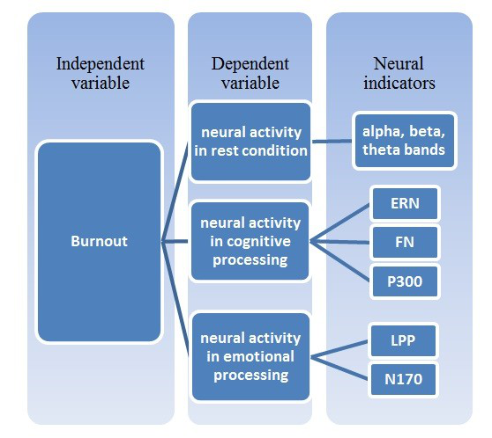
THE PROPOSED RESEARCH MODEL According to described literature several assumptions are formulated for a new research model (see Figure 1). Some of postulations are based on an existing research and will allow to verify its findings, some provide the original contribution in this research area and will allow to explore cognitive and emotional consequences of burnout. The authors’ general assumption is that the existing findings allow to expect that there is a unique pattern of neural activity which is typical for burnout syndrome.
Van Luijtelaar et al.’s research (2010) revealed that:
- burnout subjects are characterised by reduced alpha peak frequency and alpha power compared to no-burnout controls - burnout subjects are characterised by reduced beta power compared to no-burnout controls - in burnout group theta to beta ratio is increased compared to no-burnout controls - burnout subjects are characterised by reduced P300 amplitude compared to no-burnout controls.
Taking into account the above results it may be concluded that a high level of burnout symptoms is associated with increased cognitive impairments.
Due to the limitations of van Luijtelaar et al.’s study (listed in the section: Burnout and EEG Research), results presented by them should be re-tested. Thus, proposed in this paper study design allows to eliminate all the appointed by van Luijtelaar et al.’s weaknesses and gives an opportunity to obtain reliable and replicable results allowing to draw far-reaching conclusions considering the nature of burnout syndrome.
Additionally, according to Hirsch and Inzlitch research (Hirsh and Inzlicht, 2008), individuals scoring high on neuroticism scale reveal increased FN amplitude in a situation of uncertainty, when the external evaluation of performance does not provide explicit information about reaction’s correctness. Considering specifics of burnout syndrome it may be assumed that individuals with burnout syndrome will have FN of higher amplitude in response to uncertain feedback, compared to no-burnout controls, due to their increased sensitivity to the lack of feedback, which is known to be correlated with all three dimensions of burnout syndrome (Maslach, et al., 2001). Therefore, burnout subjects may be characterised by FN of increased amplitude, especially when they are presented with uncertain performance evaluation.
It has been shown that individuals perceiving errors as highly threatening (e.g. highly anxious individuals) are characterised by increased ERN amplitude. Considering characteristics of burnout syndrome, besides the causal relationship between anxiety or negative emotionality and burnout, it is fair to assume that burned-out individuals will respond to committed errors with greater amplitude of the ERN. The impaired response to stressful events in burned-out individuals (see: the relationship between HPA axis functioning and burnout) may result in an increased response to errors as natural stressors. Thus, burnout subjects may be characterised by increased ERN amplitude.
Beside investigating and verifying cognitive consequences of burnout, one of the purposes of the proposed research model is to explore also its emotional component. On the grounds of research review described in the section: Burnout and Emotional Consequences, it may be concluded that a high level of burnout symptoms is associated with increased impairment in emotional processing.
Considering the emotional blunting associated with burnout syndrome as well as characteristics of depersonalization as one of the burnout dimensions it may be concluded, that burned-out individuals will be characterised by decreased amplitude of N170 in response to faces, especially faces expressing emotions.
Research on LPP have shown, that individuals with blunted emotional response can be characterised by decreased LPP amplitude (Hajcak et al., 2012). Considering emotional consequences of burnout, it can be assumed that emotional blunting associated with depersonalization can cause decrease in LPP amplitude, especially in the light of research on ketamine-induced emotional blunting (Abel et al., 2003).
Therefore, burnout subjects may be characterised by decreased LPP amplitude in response to emotional stimuli and decreased N170 amplitude in response to presented faces, especially to faces expressing emotions.
Figure 1. The proposed research model.
The presented research model (Figure 1) is a theoretical frame for an experiment that will be conducted by the authors of this paper to determine whether individuals presenting burnout symptoms can be characterized by specific patterns of ERP response in both, cognitive and emotional performance as well as by abnormalities in continuous EEG recording.
CONCLUSIONS
Considering classification’s issue – burnout is not included in DSM-IV and international classification of diseases and related health problems - ICD-10 includes it in the section: ‘Problems related to life-management difficulty’ (Z73) and describes it as ‘State of vital exhaustion’ but does not provide any diagnostic criteria. These examples show that the burnout syndrome still lacks specific criteria. Most of the literature on burnout considers psychological indicators – it is determined by behavioral characteristics and refers mainly to subjective experience and measures. Describing the objective indicators of the phenomena may influence further research in this area what may be of great importance not only in description and explanation of the burnout syndrome, but also in diagnosis and prevention.
What is important, the burnout consequences may be temporary and may not lead to serious health and/or psychosocial outcomes. In the literature, some positive effects of intervening programs are described. Ekstedt et al. (2009) proved that rehabilitation program (lasting 6-12 months) based on cognitive-behavioral therapeutic methods might influence significantly the recovery from burnout. Analyzing sleep physiology they revealed that such a rehabilitation considerably improved sleep pattern (number of arousals, sleep fragmentation, sleep latency, sleep efficiency and time of rising). Reduction of the arousal from sleep was associated with a recovery from fatigue and it was the best predictor of return to work. Brandes et al. (2009) demonstrated that specially designed receptive music therapy programs significantly reduced burnout symptoms after 5 weeks and underlined their long lasting effects. Skodova and Lajciakova (2013) showed that psychosocial training had a positive influence on burnout levels among health care students. In the recent research it was discovered that biological treatment with using bright light gave positive effects in a group of burnout subjects (Meesters and Waslander, 2010).
Maslach et al. (2001) emphasize the chronic nature of burnout and its resistance to spontaneous recovery. Thus, it is especially important to highlight the problem and explore the possibilities of minimizing the effects of burnout – via organizational, individual and social resources. All trials in solving the problem of burnout are highly needed to minimize its individual, social and organizational consequences.
This paper would be an important contribution in defining markers of burnout – if an employee’s problem is diagnosed properly and early enough, it may help to restrain from developing severe symptoms and consequences such as depression, and would enable to apply solutions that were revealed as adequate in burnout treatment. Then, the process of minimizing costs of burnout could start earlier. The outcome of the proposed research model and future work in this area may influence greater awareness and interest in burnout syndrome. It may support exploring both burnout sources and consequences, as well as practical programs on burnout rehabilitation and prevention.
ACKNOWLEDGMENT
The preparation of this paper was supported by a grant from the National Science Centre (research project no. 2013/10/E/HS6/00163, head - Krystyna Golonka).
REFERENCES
Abel, K. M., Allin, M. P. G., Kucharska-Pietura, K., David, A., Andrew, C., Williams, S., …, & Phillips, M. L. (2003). Ketamine alters neural processing of facial emotion recognition in healthy men: an fMRI study. Neuroreport, 14, 387–91. Ahola, K. (2007). Occupational burnout and health. People and Work Research Reports 81. Ahola, K., & Hakanen, J. (2007). Job strain, burnout, and depressive symptoms: a prospective study among dentists. Journal of
Affective Disorders, 104, 103–10. Alarcon, G., Eschleman, K., & Bowling, N. (2009). Relationships between personality variables and burnout: A meta-analysis.
Work & Stress, 23(3), 244-263 Angelakis, E., Lubar, J. F., Stathopoulou, S., & Kounios, J. (2004). Peak alpha frequency: an electroencephalographic measure of cognitive preparedness. Clinical Neurophysiology, 115, 887–97. Başar, E., & Güntekin, B. (2008). A review of brain oscillations in cognitive disorders and the role of neurotransmitters. Brain
Research, 1235, 172–93. Billiot, K., Budzynski, T., & Andrasik, F. (1997). EEG patterns and chronic fatigue syndrome. Journal of Neurotherapy, 1–11. Boksem, M., Tops, M., Wester, A. E., Meijman, T. F., & Lorist, M. M. (2006). Error-related ERP components and individual differences in punishment and reward sensitivity. Brain Research, 1101(1), 92–101. Brandes, V., Terris, D. D., Fischer, C., Schuessler, M. N., Ottowitz, G., Titscher, G., …, & Thayer, J. F. (2009). Music programs
designed to remedy burnout symptoms show significant effects after five weeks. Annals of the New York Academy of Sciences, 1169, 422–5. Burisch, M. (2002). A longitudinal study of burnout: the relative importance of dispositions and experiences. Work & Stress, 16, 1–17. Carter, C. S., Braver, T. S., Barch, D. M., Botvinick, M. M., Noll, D., & Cohen, J. D. (1998). Anterior cingulate cortex, error
detection, and the online monitoring of performance. Science, 280, 747–9. Danhof-Pont, M. B., van Veen, T., & Zitman, F. G. (2011). Biomarkers in burnout: a systematic review. Journal of Psychosomatic Research, 70, 505–24. De Pascalis, V., Varriale, V., & D’Antuono, L. (2010). Event-related components of the punishment and reward sensitivity.
Clinical Neurophysiology, 121, 60–76. Duncan, C. C., Barry, R. J., Connolly, J. F., Fischer, C., Michie, P. T., Näätänen, R., …, & Van Petten, C. (2009). Event-related potentials in clinical research: guidelines for eliciting, recording, and quantifying mismatch negativity, P300, and N400. Clinical Neurophysiology, 120, 1883–908. Eimer, M. (2011). The Face-Sensitive N170 Component of the Event-Related Brain Potential. In: The Oxford Handbook of Face
Perception (pp. 329–344). Ekstedt, M., Söderström, M., & Akerstedt, T. (2009). Sleep physiology in recovery from burnout. Biological Psychology, 82, 267–73. Endrass, T., Klawohn, J., Schuster, F., & Kathmann, N. (2008). Overactive performance monitoring in obsessive-compulsive
disorder: ERP evidence from correct and erroneous reactions. Neuropsychologia, 46, 1877–1887. Fingelkurts, A., Fingelkurts, A., Ermolaev, V., & Kaplan, A. Y. (2006). Stability, reliability and consistency of the compositions of brain oscillations. International Journal of Psychophysiology, 59, 116–26. Gable, S. L., Reis, H. T., & Elliot, A. J. (2000). Behavioral activation and inhibition in everyday life. Journal of Personality and
Social Psychology, 78, 1135–1149. Gehring, W. J., Goss, B., Coles, M. G. H., Meyer, D. E., & Donchin, E. (1993). A neural system for error detection and compensation. Psychological Science, 4, 385–391. Gehring, W. J., Liu, Y., Orr, J. M., & Carp, J. (2011). The Error-Related Negativity (ERN/Ne). In: S. J. Luck & E. S. Kappenman
(Eds.), The Oxford Handbook of Event-Related Potential Components (pp. 231–291).
Hajcak, G., & Olvet, D. M. (2008). The persistence of attention to emotion: brain potentials during and after picture presentation.
Emotion, 8, 250–5. Hajcak, G., McDonald, N., & Simons, R. F. (2003). Anxiety and error-related brain activity. Biological Psychology, 64(1-2), 77-90 Hajcak, G., McDonald, N., & Simons, R. F. (2004). Error-related psychophysiology and negative affect. Brain and Cognition,
56(2), 189–97. Hajcak, G., Weinberg, A., MacNamara, A., & Foti, D. (2012). ERPs and the study of emotion. In Oxford handbook of ERP components (pp. 441–474). Hakanen, J., & Schaufeli, W. B. (2012). Do burnout and work engagement predict depressive symptoms and life satisfaction? A
three-wave seven-year prospective study. Journal of Affective Disorders, 141, 415–24. Hirsh, J. B., & Inzlicht, M. (2008). The devil you know: neuroticism predicts neural response to uncertainty. Psychological Science, 19, 962–7. Klimesch, W. (1999). EEG alpha and theta oscillations reflect cognitive and memory performance: a review and analysis. Brain
Research. Brain Research Reviews, 29, 169–95. Lange, G., Steffener, J., Cook, D. B., Bly, B. M., Christodoulou, C., Liu, W. C., …, & Natelson, B. H. (2005). Objective evidence of cognitive complaints in Chronic Fatigue Syndrome: a BOLD fMRI study of verbal working memory. NeuroImage, 26, 513–24. Langelaan, S., Bakker, A. B., van Doornen, L. J. P., & Schaufeli, W. B. (2006). Burnout and work engagement: Do individual
differences make a difference? Personality and Individual Differences, 40, 521–532. Leiter, M. P., & Maslach, C. (2003). Areas of worklife: A structured approach to organizational predictors of job burnout.
Research in Occupational Stress and Well-Being, 3, 91–134. Leiter, M. P., Gascón, S., &Martínez-Jarreta, B. (2010). Making Sense of Work Life: A Structural Model of Burnout. Journal of Applied Social Psychology, 40, 57–75. Leone S.S. (2008). Unravelling fatigue in the working population: Course, consequences, and its association with burnout. Wilco,
Amersfoord. Maslach, C., & Leiter, M. P. (1997). The Truth About Burnout: How Organizations Cause Personal Stress and What to Do About It. San Francisco: Jossey-Bass. Maslach, C., & Leiter, M. P. (2005). Stress and burnout: The critical research. In C. Cooper (Ed.), Handbook of stress medicine
and health (pp. 155–172). London: CRC Press. Maslach, C., & Leiter, M. P. (2008). Early predictors of job burnout and engagement. The Journal of Applied Psychology, 93, 498–512. Maslach, C., & Schaufeli, W. B. (1993). Historical and conceptual development of burnout. In W. B. Schaufeli, C. Maslach, & T.
Marek (Eds.), Professional burnout: Recent developments in theory and research (pp. 1–16). Washington DC: Taylor & Francis. Maslach, C., Jackson, S. E., & Leiter, M. P. (1996). The Maslach Burnout Inventory-General Survey Manual (3rd ed.). Palo Alto: Consulting Psychologist Press. Maslach, C., Schaufeli, W. B., & Leiter, M. P. (2001). Job burnout. Annual Review of Psychology, 397–422. Meesters, Y., & Waslander, M. (2010). Burnout and light treatment. Stress and Health, 26, 13–20. Mudyn, K. (2012). Feeling of unreality and its contexts. The phenomenological aspects of dissociative processes. Annales
Universitatis Paedagogicae Cracoviensis, 123, 85–100. Nishitani, N., Ikeda, A., Nagamine, T., Honda, M., Mikuni, N., Taki, W., …, & Shibasaki, H. (1999). The role of the hippocampus in auditory processing studied by event-related electric potentials and magnetic fields in epilepsy patients before and after temporal lobectomy. Brain, 122 (4), 687–707. Nunez, P. L. (2000). Toward a quantitative description of large-scale neocortical dynamic function and EEG. The Behavioral and
Brain Sciences, 23(3), 371–98; 399–437. Ogrim, G., Kropotov, J., & Hestad, K. (2012). The quantitative EEG theta/beta ratio in attention deficit/hyperactivity disorder and normal controls: sensitivity, specificity, and behavioral correlates. Psychiatry Research, 198, 482–8. Oosterholt, B. G., Van der Linden, D., Maes, J. H. R., Verbraak, M. J. P. M., &Kompier, M. a J. (2012). Burned out cognition--
cognitive functioning of burnout patients before and after a period with psychological treatment. Scandinavian Journal of Work, Environment & Health, 38, 358–69. Phillips, M. L., Medford, N., Senior, C., Bullmore, E. T., Suckling, J., Brammer, M. J., …, & David, A. S. (2001).
Depersonalization disorder: thinking without feeling. Psychiatry Research, 108, 145–60. Polich, J. (2007). Updating P300: an integrative theory of P3a and P3b. Clinical Neurophysiology, 118, 2128–2148. Polich, J., & Kok, A. (1995). Cognitive and biological determinants of P300: an integrative review. Biological Psychology, 41, 103–46. Popoli, M., & Yan, Z. (2011). The stressed synapse: the impact of stress and glucocorticoids on glutamate transmission. Nature
Reviews, 13, 22–37. Pourtois, G., Vocat, R., N’diaye, K., Spinelli, L., Seeck, M., & Vuilleumier, P. (2010). Errors recruit both cognitive and emotional monitoring systems: simultaneous intracranial recordings in the dorsal anterior cingulate gyrus and amygdala combined with fMRI. Neuropsychologia, 48(4), 1144–59. Ridderinkhof, K. R., van den Wildenberg, W. P. M., Segalowitz, S. J., & Carter, C. S. (2004). Neurocognitive mechanisms of
cognitive control: the role of prefrontal cortex in action selection, response inhibition, performance monitoring, and reward- based learning. Brain and Cognition, 56, 129–40. Sandstrom, A., Rhodin, I. N., Lundberg, M., Olsson, T., & Nyberg, L. (2005). Impaired cognitive performance in patients with chronic burnout syndrome. Biological Psychology, 69, 271–9.
Sandstrom, A., Säll, R., Peterson, J., Salami, A., Larsson, A., Olsson, T., & Nyberg, L. (2012). Brain activation patterns in major depressive disorder and work stress-related long-term sick leave among Swedish females. Stress, 15, 503–513. Sapolsky, R., Romero, L., & Munck, A. (2000). How do glucocorticoids influence stress responses? Integrating permissive,
suppressive, stimulatory, and preparative actions. Endocrine Reviews, 21, 55–89. Schaufeli W.B., & Greenglass E.R. (2001). Introduction to special issue on burnout and health, Psychology & Health, 16, 5, 501-
510. Schaufeli, W. B., & Enzmann, D. (1998). The burnout companion to study and practice: A critical analysis. CRC Press. Schupp, H. T., Ohman, A., Junghöfer, M., Weike, A. I., Stockburger, J., & Hamm, A. O. (2004). The facilitated processing of threatening faces: an ERP analysis. Emotion, 4, 189–200. Skodova, Z., & Lajciakova, P. (2013). The effect of personality traits and psychosocial training on burnout syndrome among
healthcare students. Nurse Education Today. Sonnenschein, M., Mommersteeg, P. M. C., Houtveen, J. H., Sorbi, M. J., Schaufeli, W. B., & van Doornen, L. J. P. (2007).
Exhaustion and endocrine functioning in clinical burnout: an in-depth study using the experience sampling method. Biological Psychology, 75, 176–84. Tiersky, L., & Johnson, S. (1997). Neuropsychology of chronic fatigue syndrome: a critical review. Journal of Clinical and Experimental Neuropsychology, 19, 560–586. Toppinen-Tanner, S., Kalimo, R., & Mutanen, P. (2002). The process of burnout in white-collar and blue-collar jobs: eight-year
prospective study of exhaustion. Journal of Organizational Behavior, 23, 555–570. Van der Linden, D., Beckers, D., & Taris, T. (2007). Reinforcement sensitivity theory at work: punishment sensitivity as a dispositional source of job-related stress. European Journal of Personality, 21, 889–909. Van der Linden, D., Keijsers, G. P., Eling, P., & Schaijk, R. V. (2005). Work stress and attentional difficulties: An initial study
on burnout and cognitive failures. Work & Stress, 19, 23-36. Van Luijtelaar, G., Verbraak, M., van den Bunt, M., Keijsers, G. P. J., & Arns, M. (2010). EEG findings in burnout patients. The Journal of Neuropsychiatry and Clinical Neuroscience, 22, 208–217. Weinberg, A., Olvet, D. M., & Hajcak, G. (2010). Increased error-related brain activity in generalized anxiety disorder.
Biological Psychology, 85, 472–80 Weinberg, A., Riesel, A., & Hajcak, G. (2011). Integrating multiple perspectives on error-related brain activity: The ERN as a neural indicator of trait defensive reactivity. Motivation and Emotion, 36(1), 84–100.
LISTED IN THE AHFE DIGITAL BOOKSTORE CATALOGUE
Explore the complete digital volume
Advances in Science, Technology, Higher Education and Society in the Conceptual Age: STHESCA
Read this individual research paper free through the original publisher, or explore the full digital proceedings book.
ISBN 978-1-4951-2110-4
Explore this ISBN in the AHFE Bookstore ↗Listed in the July 2026 bookstore catalogue; search by ISBN to confirm current availability · Digital book purchase optional