Tatjana Beuker, Tina Mioch, Mark A. Neerincx (2021). Team Design Patterns for participatory development of First Response Human-Agent Teaming. In: Human Systems Engineering and Design (IHSED2021): Future Trends and Applications. AHFE Open Access, vol. 21. https://doi.org/10.54941/ahfe1001151
First responders (FRs) work in complex and dangerous environments in which information is often uncertain and incomplete. Advancements in sensor and artificial intelligence technology pose great potential for supporting FRs to stay resilient throughout dynamic mission developments. To avoid creating higher workload or requiring more expertise, a recommended strategy is to use a human-centered design approach that regards the human and machine as team members (Neerincx et al., 2016). For the ASSISTANCE project, we develop a module that will offer FRs support during incidents involving hazardous substances, displaying information about current and predicted gas cloud distributions using constantly updated input from meteorological services, chemical sensors, and FRs. In this research we investigated how teamwork between FRs and the module should be designed to facilitate adequate decision-making. For this purpose, Team Design Patterns (TDPs) were recently proposed as they describe roles and responsibilities within a team in an and reusable manner (Van Diggelen & Johnson, 2019). An additional benefit is the possibility to actively involve different stakeholders in the design process, incorporating relevant expert knowledge in the learning and reasoning of the AI-agent (van Stijn et al, 2021). We created three TDPs, each assigning different roles and responsibilities to the AI-agent and FRs, and assessed these with FRs in an online survey. In the first pattern, FRs collaborate with an ‘Informing Agent’ that is responsible for keeping FRs updated about the current and predicted situation. The second pattern describes the cooperation with an ‘Advising Agent’, which additionally gives mission-relevant recommendations. In the third TDP, FRs collaborate with the ‘Deciding Agent’, which also can make decisions regarding actions and carry them out. The collaboration with the first two agents was evaluated by presenting two scenarios to the FRs in which they had to handle an incident in simulated collaboration with either the ‘Informing Agent’ or the ‘Advising Agent’. The ‘Deciding Agent’ was presented at the end and FRs were asked to indicate their acceptance and preference. The results showed that preference and acceptance varied across FRs and different decisions. For example, when deciding where to allocate measurement teams, hazmat officers, who are experts in this task, tended to prefer an AI-agent with less responsibility whereas on scene commanders with less expertise for this task tended to prefer the AI-agent to take more responsibility. Additionally, comments given by the FRs indicated that trust and sufficient explanation of the underlying decision model were important factors that influenced willingness to collaborate with the AI-agent. In conclusion, this paper shows how TDPs can be applied to systematically involve end-users in the Human-AI system design process. The results point towards recommending a design solution in which the AI-agent can adapt its collaboration style to different FRs and decisions it is assisting with. Next steps include defining and investigating how to design such an adaptive cooperative system, taking into account ethical aspects such as trust of the FRs in the information and recommendations of the system and transparency of the decision model. ReferencesNeerincx, M. A., van Diggelen, J., & van Breda, L. (2016). Interaction design patterns for adaptive human-agent-robot teamwork in high-risk domains. In International conference on engineering psychology and cognitive ergonomics (pp. 211-220). Springer, Cham.Van Diggelen, J., & Johnson, M. (2019). Team design patterns. HAI 2019 - Proceedings of the 7th International Conference on Human-Agent Interaction, 118–126.Van Stijn, J.J., Neerincx, M.A., ten Teije, A.T., Vethman, S. Team Design Patterns for Moral Decisions in Hybrid Intelligent Systems: A Case Study of Bias Mitigation, AAAI-MAKE 2021 Spring Symposium.
Human Systems Engineering and Design (IHSED 2021) https://openaccess.cms-conferences.org/#/publications/book/978-1-7923-8987-0
INTRODUCTION
First responders (FRs) operate in complex and dangerous environments that change dynamically involving often uncertain and incomplete information. They need to update their mental model about changes in the environment and adapt their strategies and actions accordingly to keep the public and themselves safe. Advancements in sensor and artificial intelligence (AI) technology pose great potential for supporting FRs to stay resilient throughout dynamic mission developments. Within the European project ASSISTANCE1, we are developing a module that will offer FRs, in particular firefighters, support during incidents involving hazardous substances. This chemical hazard module displays information about current and predicted gas cloud distributions using constantly updated input from meteorological services, chemical sensors, and FRs (Mioch et al., 2021).
To create a tool that is accepted by the FRs and is beneficial during the mitigation of disasters, we pose the following research question for this study: How should the collaboration between first responders and the system be designed to ensure situation awareness and provide support in understanding and adapting to dynamic situations throughout incident mitigation?
FRs usually assess information from a lens of actionability, meaning that information is prioritized depending on whether it can be used to act upon it (Zade et al., 2018). The right information should be delivered at the right time to the right person. However, different FRs prioritize different kinds of information and ratings for actionability of information vary across roles, contextual factors, and format (Zade et al., 2018). To ensure that the module supports the actionability and avoids increasing workload of the FR, we use a human-centered design approach (Neerincx, Van Diggelen and Van Breda, 2016) by designing the module as an AI team member with monitoring, communication and teaming capabilities.
Human-agent teaming (HAT), just like human-only teams, work towards achieving a common goal. Team members have to coordinate their actions as they rely and depend on each other, and there has to be a consensus about how tasks, roles, and responsibilities are allocated within the team. Identifying these teaming aspects and their coordination when creating HAT is therefore vital (Johnson and Vera, 2019). The co-active design framework was developed to systematically explore the design space of joint human-agent activities and identify interdependence relationships that require coordination and collaboration (Johnson et al., 2014). Team Design Patterns (TDPs) were recently proposed as a method to enhance the HAT design further, explicating the core teaming processes with their interdependencies in a comprehensive and, for the different stakeholders, understandable way (Van 1 assistance-project.eu
Human Systems Engineering and Design (IHSED 2021) https://openaccess.cms-conferences.org/#/publications/book/978-1-7923-8987-0
Diggelen et al., 2018). They describe roles and responsibilities within a team in an abstract and reusable manner (Van Diggelen and Johnson, 2019). An additional benefit of TDPs is the possibility to actively involve different stakeholders in the design process, incorporating relevant expert knowledge in the learning and reasoning of the Agent (Van Stijn et al., 2021).
The TDPs should include the roles, tasks and communications for establishing the actionable (shared) situation awareness (SA) that is needed to jointly perform the activities (Endsley, 2016; Seppänen et al., 2013; Van Stijn et al., 2021). To explicate and structure the SA-support, Interaction Design Patterns (IDPs) can be integrated into the TDPs (Neerincx, Van Diggelen and Van Breda, 2016). These IDPs show how the interaction will take place for the collaboration and coordination so that the different stakeholders can understand and assess the HAT design appropriately.
To answer our (explorative) research question we designed the chemical hazard module as an adaptive intelligent system, acting as an artificial team member, to further support FRs in their decision-making process according to their roles, goals, and changes in the environment. We designed three TDPs, each allocating different responsibilities and capabilities to the artificial team member (Agent). These TDPs were translated into IDPs and implemented into two scenarios. The scenarios and tasks were developed in close cooperation with FRs, and evaluated with FRs.
COLLABORATION DESIGN In a first step, a variety of TDPs were created from which three were chosen that described best an incremental increase in responsibility and decision-support offered by the agent during the mitigation of a mission.
Each TDP assigns different roles and responsibilities to the agent and FR. In the first TDP, FRs collaborate with an Informing Agent that is responsible for keeping FRs updated about the current and predicted situation. The second TDP describes the cooperation with an Advising Agent, which additionally gives mission-relevant recommendations. In the third TDP, FRs collaborate with a Deciding Agent, which is allowed to make independent decisions regarding actions and carry them out. These three TDPs were specified in detail; in Table 1 one possible TDP, for the Advising Agent, is given as an example, both in graphical representation (to facilitate discussion with end users [Van Diggelen and Johnson, 2019]) and textual representation. This example TDP describes the different responsibilities and the coordination between human and AI team members. The specification also gives the possibility to make the advantages and disadvantages of the solution explicit, making it easier to identify and discuss consequences of the solution that need to be taken into account when designing adaptive systems.
Human Systems Engineering and Design (IHSED 2021) https://openaccess.cms-conferences.org/#/publications/book/978-1-7923-8987-0
Table 1: TDP Advising Agent
Table available in the original PDF paper.
Name Advising Agent Description Both actors are monitoring the environment. The human additionally performs a mission related task, and the agent monitors the human when new information about changes in the environment emerge. The agent recognizes the change (e.g., through sensor input) and initiate a recalculation of the model and its implications. Based on this it generates an advice towards which actions to take, explains it to the human (additionally to displaying the new situation) and monitors the response of the human. The human decides whether to accept or decline. Structure
Example Measurements of gas concentrations lead to a recalculation of the gas cloud distribution. The agent displays the adjusted gas cloud and recommends further measurement locations to increase the certainty about the gas distribution. The FR accepts or declines given advice. Requirements R1 The human needs to have sufficient understanding of what is happening in the environment. R2 The agent has to understand the implications of the change and provide a suggestion for actions. R3 The agent has to be able to explain what changes happened and why an advice is given. R4 The agent has to be sufficiently trusted in its ability to give advice. Advantages A1 The human is actively supported in the decision-making process. A2 The agent does not need to understand the implications of the proposed action, only the implications of the change that prompted the advice. Disadvantages D1 Constant suggestions might annoy the human actor.
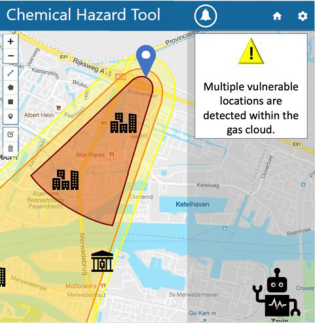
D2 Not well calibrated advice might confuse and distract the human. D3 The agent can only produce predesigned advice. In addition to these TDPs, Interaction Design Patterns (IDPs) were specified and integrated into two scenarios that were presented to the FRs in an online survey. IDPs specify particular design choices regarding specific interaction, for example how the agent should present new information and a change in the environment, and how the FR can instruct the agent. Fig. 1 shows how for the same situation the decision support of the agent differed according to the TDP that was used and therefore the role and responsibilities that the agent took on. In the example below the FR was informed about vulnerable locations that were likely to be affected by the gas cloud. A decision
Human Systems Engineering and Design (IHSED 2021) https://openaccess.cms-conferences.org/#/publications/book/978-1-7923-8987-0 had to be made about whether it was necessary to alert the public and depending on the applied TDP different support was provided. For the creation of the scenarios interviews with FRs were hold to verify created incident developments and presented decisions and tasks.
Figure 1. Example of different translations of TDPs into IDPs for task ‘Alerting the public’.
EVALUATION AND RESULTS Procedure, Participants and Measures
For the evaluation an online questionnaire was compiled. The questionnaire included two blocks. In the first block two scenarios were presented, a train accident with chlorine spill and an industrial accident with sulfur dioxide escaping. The FRs were asked to solve the incidents in simulated collaboration with the Informing Agent and Advising Agent. During the mitigation of the scenario FRs had to make decisions about which route to take to get to the location safely, whether to alert the public about possible dangerous gas development, where to do measurements, and whether to warn team members in the field that were located within the calculated danger zone. In the second block FRs were confronted with three of the decisions already made during the first block, but this time the FRs were shown how the collaboration would have looked like with a Deciding Agent. For each decision, FRs were asked to indicate whether they would accept the Deciding Agent as a collaboration partner or if they preferred to instead change to either the Informing or Advising Agent.
The survey was filled in by 19 firefighters (2 female, 17 male) that have leading functions during incidents and make decisions concerning the action plan. The age ranged from 34 to 65 years (M=50.1, SD=10.0) and years of experience ranged from
Human Systems Engineering and Design (IHSED 2021) https://openaccess.cms-conferences.org/#/publications/book/978-1-7923-8987-0
3 to 40 years (M=21.3, SD=11.4). After assessing the indicated positions held within the fire brigade, two groups were identified. The first group includes hazmat officers (11 participants), and the second group includes on-scene commanders who lead missions and policy makers who decide about procedures during missions (8 participants). All participants accepted the informed consent.
Multiple measures were implemented throughout the survey. The preferred collaboration style was assessed twice, after completion of the first block by asking the FRs about their preference for the Informing Agent’, ‘Advising Agent’, ‘both alright’ or ‘neither of the agents’ for each presented task; it was also assessed during the second block, by asking FRs to indicate for each of the three decisions whether they would be willing to give the agent permission to decide on its own, or whether they would prefer to switch to the Informing or Advising Agent. Additionally, it was recorded if FRs followed the advice of the Advising Agent or decided to implement other actions. FRs were also asked to rate the helpfulness of the support the agents provided on a five-point Likert Scale. Situation awareness was assessed by adapting the SAGAT method and freezing the screen at random points during the scenario and asking mission relevant questions (Endsley, 1988). Subjective situation awareness was assessed by presenting an adapted version of the MARS questionnaire (Matthews and Beal. Throughout the survey FRs were asked multiple times to comment or explain their choices.
Results
Comparing indicated preferences after the first block showed that FRs preferred to collaborate with one of the agents compared to not being assisted by either of the agents, which was only the case in 5% of the occasions. After the first block, no uniform preference towards one of the agents was found. Both the Informing and the Advising agent were rated as overall helpful on a five point Likert Scale (M=4.26, SD=.73 for Informing Agent, M=4.1, SD=.89 for Advising Agent).
The SA assessments showed no difference between the collaboration styles and were generally high, as participants replied 87% of the time correctly to the SAGAT questions. Also, subjective SA was generally rated high on a five point Likert scale for the collaboration with both agents (M=4.04, SD=.86 for Informing Agent, M=3.97, SD=.86 for Advising Agent).
The advice of the Advising Agent was followed 76% of the occasions, although there were differences regarding the different tasks. All participants accepted the suggested route to the location, whereas the recommended measurement positions were followed the least often, with 64% acceptance. Looking at the difference between the two groups it was found that hazmat officers tended to follow the advice less often (67%) compared to the group of on scene commanders and policy makers (87.5%). The difference was most prominent for the decision whether to accept the advice to alert the public, where 46% of the hazmat officers did not follow the advice compared to 13% of the other group members that rejected the advice.
Human Systems Engineering and Design (IHSED 2021) https://openaccess.cms-conferences.org/#/publications/book/978-1-7923-8987-0
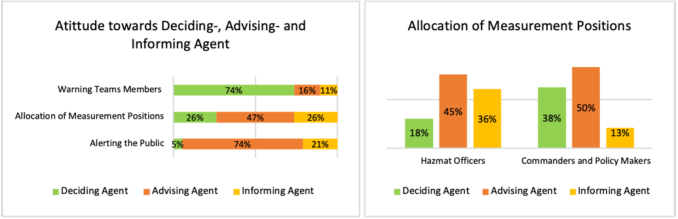
During the second block, the FRs indicated for each of the three decisions whether they would be willing to give the agent permission to decide on its own, or whether they would prefer to switch to the Informing or Advising Agent. The results are shown in Fig. 5 (left). For task Alerting the public, the results show a significant difference between the frequency with which the three agents were chosen (χ²(2) = 14.632, p = .001). The majority of FRs opted to collaborate with the Advising Agent (74%) instead of granting the Deciding Agent the permission to act independently or collaborating with the Informing Agent when deciding whether to alert the public. Concerning the task Warning team members in the field, again a significant difference between the three possible agents was found, χ²(2) = 14.000, p = .001; most FRs (74%) agreed to give the Deciding Agent permission to decide and act on its own for this task.
Concerning the task Reassigning measurement locations, no significant difference was found regarding the preference for the three agents. Nonetheless differences in tendencies between the two groups were observed. In both groups, the Advising Agent was preferred most frequently. Moreover, hazmat officers tended to accept the Deciding Agent less often and opted for the Informing Agent more often compared to the group of commanders and policy makers. The distribution of choices for agents when allocating measurement teams is shown in Fig. 5 (right).
Looking at choices of each FR, it was found that some preferred the same agent for all three tasks and others varied their choices from decision to decision.
Several recurring themes could be identified when analyzing feedback and comments given by the FRs, namely trust and reliability, and the need of the agent to adapt its strategy and learn from decisions and actions taken by the FR. Also, FRs requested more information concerning the underlying model that made predictions and determined advice and possible actions to gain more trust in the system. One FR commented that trusting the agent would most likely develop over time and depend on the experience the FR makes with the system.
of the requirements for human systems integration are derived from requirements for performance, efficiency, environmental, operational, maintenance, and training (see Table 1). Some will be buried in mechanical and electrical requirements. One of the obstacles to realizing the substantial potential of HSI is the lack of clear articulation of human engineering requirements in the Statement of Work (SOW) or other authorizing documentation received from the customer, and the lack of a HSI software or architecture framework to track requirements changes.
Human Systems Engineering and Design (IHSED 2021) https://openaccess.cms-conferences.org/#/publications/book/978-1-7923-8987-0
Figure 1. Left: Attitude towards collaborating with the Deciding Agent and indicated preference to change to either Informing Agent or Advising Agent; Right: Distribution of choices for agents for the decision of ‘Allocating Measurement Positions’
CONCLUSION
This paper investigated how the collaboration between FRs and the chemical hazard module should be designed to offer support during the mitigation of chemical hazardous incidents. For this purpose, three TDPs were designed and their suitability was evaluated by FRs in an online survey. The results show that there is no ‘one fits all solution’. Preferences varied depending on the type of decision at hand and the FR making the decision. Results from the first block showed that the support offered by the agents was generally rated as helpful and that FRs preferred to be supported by one of the agents rather than working without one of the assisting agents.
The second block showed that FRs were more likely to accept collaborating with the Deciding Agent and hand over control for a decision that had less impact on the safety of citizens (‘warning team members’) compared to a decision that would directly affect citizens (‘alerting the public’), in which case they preferred to collaborate with the Advising Agent.
Further, compared to commanders and policy makers, hazmat officers who are usually responsible for allocating measurement teams, tended to give the agent less autonomy for this task. Commanders sought more assistance for this task and tended to choose the Informing Agent less often. Accordingly, hazmat officers tended to follow the advice of the agent less often than commanders and policy makers which could be due to their respective expertise and roles during the mitigation of incidents involving hazardous substances.
Based on the results neither of the presented TDPs can be discarded as an unacceptable collaboration style. Each TDP has its legitimacy depending on the situation, expertise, and personal preference.
Human Systems Engineering and Design (IHSED 2021) https://openaccess.cms-conferences.org/#/publications/book/978-1-7923-8987-0
Feedback given by the FRs indicated that ethical aspects such as trust of the FRs in the information and recommendations of the system and transparency of the decision model have to be taken into account regarding further development of the chemical hazard module.
Limitations of this research were that the study was not performed in the field with a more mature prototype which decreased the pressure and workload the FRs would normally experience during a mission.
Nevertheless, the study shows how TDPs can be applied to systematically involve end-users in the Human-AI system design process in an early stage of development. It further shows that there is a clear need for agent support, but that preferences on the type of support depend on the person and context. Based on these results, we will complement the TDPs with a Work Agreement TDP, that will show how to establish this adaptation of support to the person and context. This TDP will make use of the benefits Work Agreements provide by specifying preferences, obligations, and prohibitions (Mioch, Peeters and Neerincx, 2018). The Work Agreement TDP will govern the use of the TDPs presented in this paper and will be evaluated subsequently.
ACKNOWLEDGMENTS
This work was funded by the EU ASSISTANCE project (grant no. 832576) The authors would like to give special thanks to the fire fighters affiliated with the Gezamenlijke Brandweer Rotterdam in the Netherlands for participating in this research.
REFERENCES
Endsley, M. R. (1988). ‘Design and Evaluation for Situation Awareness Enhancement’, Proceedings of the Human Factors Society, 32nd Annua, 97– 101 Endsley, M. R. (2016). ‘Designing for situation awareness: An approach to user-
centered design’. CRC press. Johnson, M., Bradshaw, J. M., Feltovich, P. J., Jonker, C. M., Van Riemsdijk, M.
B., & Sierhuis, M. (2014). ‘Coactive design: Designing support for interdependence in joint activity’, Journal of Human-Robot Interaction, 3(1), 43-69. Johnson, M., & Vera, A. H. (2019). ‘No Ai is an island: The case for teaming intelligence’, AI Magazine, 40(1), 16–28. Matthews, M. D., & Beal, S. A. (2002). ‘Assessing situation awareness in field
training exercises’, ARI DTIC Report 1795 Mioch, T., Peeters, M. M. M., and Neerincx, M. A. (2018). ‘Improving Adaptive Human-Robot Cooperation through Work Agreements’. In: 2018 27th IEEE
Human Systems Engineering and Design (IHSED 2021) https://openaccess.cms-conferences.org/#/publications/book/978-1-7923-8987-0
International Symposium on Robot and Human Interactive Communication (RO-MAN), pp. 1105–1110. Mioch, T., Sterkenburg, R., Beuker, T., Neerincx, M.A. (2021). ‘Actionable Situation Awareness: Supporting Team Decisions in Hazardous Situations’, Proceedings of the 18th ISCRAM Conference – Blacksburg, VA, USA Neerincx, M. A., van Diggelen, J., & van Breda, L. (2016). ‘Interaction design
patterns for adaptive human-agent-robot teamwork in high-risk domains’, Lecture Notes in Computer Science (Including Subseries Lecture Notes in Artificial Intelligence and Lecture Notes in Bioinformatics), 9736, 211–220 Seppänen, H., Mäkelä, J., Luokkala, P., & Virrantaus, K. (2013). ‘Developing shared situational awareness for emergency management’. Safety science, 55, 1-9. Van Diggelen, J. and Johnson, M. (2019). ‘Team Design Patterns’, In: Proceedings
of the 7th International Conference on Human-Agent Interaction, 06-10 October 2019, Kyoto, Japan, 118-126. ACM Van Diggelen, J., Neerincx, M., Peeters, M., & Schraagen, J. M. (2018).
‘Developing effective and resilient human-agent teamwork using team design patterns’. IEEE intelligent systems, 34(2), 15-24. Van Stijn, J., Neerincx, M. A., Annette, T., Vethman, S. (2021). ‘Team Design Patterns for Moral Decisions in Hybrid Intelligent Systems: A Case Study of Bias Mitigation’, AAAI-MAKE 2021 Spring Symposium Zade, H., Shah, K., Rangarajan, V., Kshirsagar, P., Imran, M., and Starbird, K.
(2018). ‘From situational awareness to actionability: Towards improving the utility of social media data for crisis response. In: Proceedings of the ACM on human-computer interaction 2.CSCW, pp. 1–18
Human Systems Engineering and Design (IHSED 2021) https://openaccess.cms-conferences.org/#/publications/book/978-1-7923-8987-0
LISTED IN THE AHFE DIGITAL BOOKSTORE CATALOGUE
Explore the complete digital volume
Human Systems Engineering and Design (IHSED2021): Future Trends and Applications
Read this individual research paper free through the original publisher, or explore the full digital proceedings book.
ISBN 978-1-7923-8987-0
Explore this ISBN in the AHFE Bookstore ↗Listed in the July 2026 bookstore catalogue; search by ISBN to confirm current availability · Digital book purchase optional