Yang Yu, Ba Hung Nguyen, Duy Tai Dinh, Fangyu Yu, Tsutomu Fujinami, Van Nam Huynh (2022). A Topic Modeling Approach for Exploring Attraction of Dark Souls Series Reviews on Steam. In: Intelligent Human Systems Integration (IHSI 2022): Integrating People and Intelligent Systems. AHFE Open Access, vol. 22. https://doi.org/10.54941/ahfe1001077
Millions of players are active on gaming service platforms such as Twitch and Steam every month, but few researchers pay attention to their comments and experience. Among many types of games, hardcore games attract game enthusiasts with highly great difficulty. Hardcore games require players to invest much time to learn, so they have the highest engagement in the game genre. The Dark Souls series has always been a landmark masterpiece in hardcore games. It attracts many hardcore players with its challenging, subversive narrative, rich gameplay, and builds. The analysis of the success of the Dark Souls series is meaningful and inspiring for game developers. Many studies have analyzed the impact of Dark Souls games on player behaviors from a psychological and cultural perspective in current Game Research. However, few studies have investigated the attraction of the Dark Souls series from the players' perspective. Therefore, this research uses a topic model on massive review data of the Dark Soul series on Steam to reveal players' concerns. It aims to explore the charm of the Dark Souls series. The Dark Souls trilogy of three games produced by From Software and are available on Steam. Steam is the most significant worldwide digital distribution platform that offers comprehensive service, including installing and automatically updating games and community features such as friends lists and groups, cloud storage, and in-game voice and chat functionality. Since both Dark Souls (DS1) and Dark Souls 3 (DS3) was highly rated in this franchise, this study focuses on the masterpiece of the trilogy: Dark Souls. In the experiment, we collected a new review dataset of the Dark Souls series from Steam, including approximately 100,000 DS3 and 23,000 DS1 reviews up to October 2021. Then we used the Latent Dirichlet Allocation (LDA) model to categorize reviews from both datasets. Consequently, we uncovered 15 and 14 topics from DS1 and DS3, respectively. Among them, we used 13 topics that appear in both games to find out topics with high frequencies and positive ratings. The results indicate that most game players are concerned with five common topics: "experience", "combat", "character", "item", and "difficulty”, which are related to in-game items and boss fight design. Specifically, these topics appear in both games with a frequency and positive rating of over 10%. We also found stratification on "device" significantly lower than other topics, reflecting the developer's less optimizing game control when DS series were ported. Generally, the analysis results from this research provide high interpretability that can further support other studies in this field.
Intelligent Human Systems Integration (IHSI 2022): Integrating People and Intelligent Systems https://openaccess.cms-conferences.org/#/publications/book/978-1-7923-8988-7
INTRODUCTION
In the current era when fast-food games are popular, it is very precious to be willing to spend much time seriously playing a hardcore game. Although the gaming industry has made tremendous development, primarily because of the lockdown caused by the epidemic, forcing people to spend more time staying at home to get in contact with more games. However, as a symbol of the gaming industry, hardcore games still attract game enthusiasts with highly great difficulty. The hardcore game requires players to invest much time and effort to learn, complete, or demonstrate skill. Therefore, it is the highest engagement in the game genre. Hardcore games usually feature in-depth stories or battles that cannot be easily paused. Hardcore games and the people who play them usually participate in the game community to discuss strategies, tips, and stories when they are not playing.
The Dark Souls (DS) series has always been a landmark masterpiece in hardcore games. It attracts many hardcore players with its challenging, provocative narrative, rich gameplay, and builds. This series contains Dark Souls (original version in 2011 and remastered version in 2018), Dark Souls II (2014), and Dark Souls III (2016). Since both Dark Souls and Dark Souls III were highly rated in this franchise, this study focuses on the masterpieces of the trilogy: Dark Souls III (DS3) and Dark Souls: Remastered (DS1). The analysis of the success of the Dark Souls series is meaningful and inspiring for game developers. However, even though previous research (Van Nuenen 2016, Vella 2015) has analyzed the impact of Dark Souls games on player behaviors from a psychological and cultural perspective in current research, few studies have investigated the attraction of the Dark Souls series from the players’ perspective. Thus, this study will analyze the Dark Souls series from users’ perception according to player reviews.
Thanks to the development of internet technology, we can obtain enormous re-views shared by players through online game platforms nowadays. Online game platforms have become a very new and prospective field of investigation in the gaming industry. Many researchers used statistical models to understand the dynamics of player behavior to facilitate improvements in game design (Baumann et al. 2018, Lin et al. 2019). Game reviews are the most direct expression of players’ concerns about the game. Steam, one of the world’s largest online game platforms, offers an adequate opportunity to analyze players’ behavior. Steam platform community records player reviews and whether players recommend the game. Users can mark any review as helpful, and reviews with many such votes are recognized as a higher interest to potential customers. Many players rely on the experiences other users expressed in reviews before purchasing games.
As the studies of game reviews from a data scientist perspective, our goal is to re-veal players’ concerns by using a topic model on massive review data of the Dark Souls series on Steam. Furthermore, it aims to explore the charm of the Dark Souls series. Finally, the findings of this work may help game developers to improve the quality
Intelligent Human Systems Integration (IHSI 2022): Integrating People and Intelligent Systems https://openaccess.cms-conferences.org/#/publications/book/978-1-7923-8988-7 of their games. The following section will introduce related work in this field and outline our data and methods. After that, the results are presented in-depth and discussed. Finally, we conclude by highlighting limitations and future work.
RELATED WORK
Online review is a rich and under-explored resource for gathering feedback about the product experience in the industry. Online review is also an essential source of product information for consumers. With the development of the Internet environment and the emergence of new media, there is also growing demand for analyzing online reviews and identifying users’ opinions. The study on online reviews (Schindler & Bickart 2012) showed that moderate length and positive evaluative statements could contribute to their helpfulness. (De Pelsmacker et al. 2018) tested the influence of star ratings and rating usefulness of online reviews on review readers’ impressions of the reviews. (Eberhard et al. 2018) investigated that the length of the reviews and the time spent playing the game influenced the usefulness of the comments. For hardcore games reviews, many researchers have focused on the storytelling and the interaction between players. (Gandolfi 2018) presented the relationship between gaming service platforms and users through the data of DS3.
Related to this work, since topic modeling techniques was proved very useful and practical to semantic mining in datasets, we use topic modeling to extract the topics from online reviews. Topic modeling is a type of statistical modeling to discover the abstract “topics” that appear in a collection of documents. Latent Dirichlet Allocation (LDA) (Blei et al. 2003) is one of the most popular topic modeling methods which cluster topics based on the words’ co-occurrence. In the last couple of years, topic modeling techniques using LDA have been increasingly used for various purposes. The use of LDA from simple application to unsupervised analysis includes many additional project extensions. Former researchers have introduced LDA to extract information embedded in review datasets. (Yiran & Srivastava 2019) used LDA to cluster topic words in Amazon reviews of a new mobile. (Yu et al. 2021) discovered 19 topics in the games domain available on Steam by using the LDA model. (Laily et al. 2020) found out the topics discussed more frequently in each tourist destination review using LDA. (Wang et al. 2018) proposed an LDA-based computational framework for spam detection in online review data.
DATA & METHOD Dataset
We use the API provided by Steam to obtain a new dataset of DS3 and DS1 up to October 2021. The data features include a unique recommendation ID, author ID, review recommend status tag for this review, the date the review was created/updated,
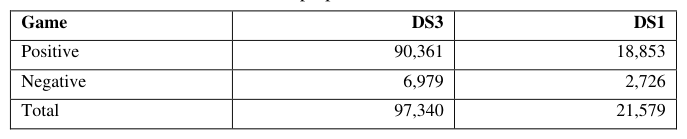
Intelligent Human Systems Integration (IHSI 2022): Integrating People and Intelligent Systems https://openaccess.cms-conferences.org/#/publications/book/978-1-7923-8988-7 language tag, review text, the number of people who rated the review as helpful, and the number of people who rated the review as funny and so forth. Before we apply LDA topic modeling, basic text processing will be implemented for text data such as stopwords removal, tokenization, and stemming. The purpose of text processing is to eliminate non-English words, emoticons, or characters with insignificant meaning for information extraction. Stopwords removal is a process of removing words that are likely unimportant for information extraction such as “game”, “gg”, “steam”, “valve”, and “gaben”. The second step is tokenization. It separates sentences into words so that the topic model can process them. The last processing is stemming. It restores inflected words to their base form. Table 1 presents the properties of our datasets after prepossessing.
Table 1: The properties of the datasets
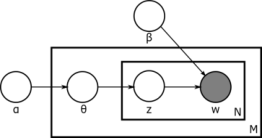
Latent Dirichlet Allocation (LDA) for Topic Modeling This study applies Latent Dirichlet Allocation (LDA) (Blei et al. 2003) to identify players' preferences of games based on the review text. LDA is a generative probabilistic model. It assumes that a document contains multiple topics and that each word in the document is generated by one of these topics. Since LDA can automatically repeat the topic and word distribution analysis to find the keywords to infer each topic, we implement LDA for topic modeling in our datasets. Figure 1 illustrates the graphical LDA procedure.
Figure 1. Graphical model representation of LDA. (Adapted from Blei et al. 2003)
EXPERIMENTAL RESULTS Topic Modeling and Grouping with LDA
Intelligent Human Systems Integration (IHSI 2022): Integrating People and Intelligent Systems https://openaccess.cms-conferences.org/#/publications/book/978-1-7923-8988-7
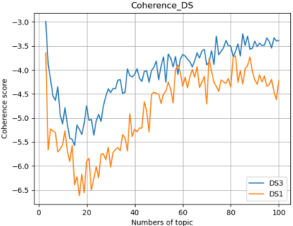
For finding the optimal number of topics, we analyze the coherence (u_mass) score (Mimno et al. 2011) of DS3 and DS1, which is a measure used to evaluate a topic model (Newman et al. 2010). Figure 2 shows the number of topics from 3 to 100 with their coherence scores. We could choose the optimal number of topics as 14 for DS3 and 15 for DS1 respectively, as the coherence scores are flattened out after that. In addition, Figure 3 presents two topics examples from both DS3 and DS1 inferred through LDA using WordCloud. The size of each word corresponds to its probability under one topic group. The higher the probability, the larger the size of this word shown in WordCloud.
Figure 2. Coherence score of two DS games. Figure 3. Topics discovered by LDA.
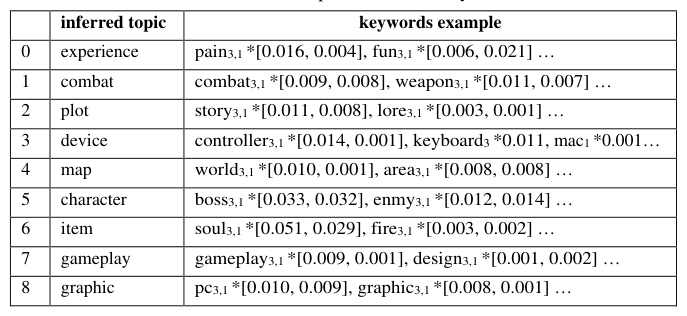
We validate the inferred topics of the LDA model by combining the weighted keywords and original review text to noisy. Table 2 lists the topics we summarized from DS3 and DS1 reviews. Each keyword with its subscript (3 or 1) indicates which DS game this keyword inferred from. For instance, “roll3” refers to DS3, “remaster1” refers to DS1, and “boss3,1” refers to both DS3 and DS1. Thus, topics 0 to 12 are common topics existing in both DS games, while topics 13 to 15 are unique topics inferred from DS3 or DS1, respectively.
Table 2: Inferred topics and related keywords inferred topic keywords example
Intelligent Human Systems Integration (IHSI 2022): Integrating People and Intelligent Systems https://openaccess.cms-conferences.org/#/publications/book/978-1-7923-8988-7
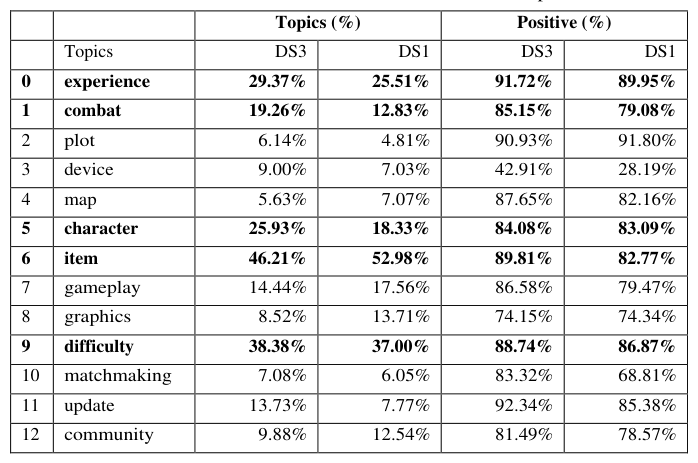
#of reviews contain the topic In this stage, we analyzed the topic frequencies ( #of total reviews ), and topic
# of recommended reviews contain the topic positive rates ( # of total reviews ) (Lin et al. 2019) based on 13 common topics from DS3 and DS1 to explore the attraction of the DS series. We summary them and present the result in Table 3.
Table 3: Prevalence and Sentiment Distribution of Topics Topics (%) Positive (%)
Intelligent Human Systems Integration (IHSI 2022): Integrating People and Intelligent Systems https://openaccess.cms-conferences.org/#/publications/book/978-1-7923-8988-7 boss fight topics are over 80%, reflecting DS players are satisfied with these aspects. On the contrary, the topic “plot” does not frequently appear in both games. We infer the unique storytelling mode of the DS series led to this consequence.
Additionally, we also noticed that the topic positive rate of “device” was significantly lower than other topics. Specifically, most of the complaints focus on “controller”. For cross-platform games running on PC and Console, players hope game developers can better optimize the game controls to reduce the negative effects of porting.
CONCLUSIONS
This study aimed to explore the attraction of the Dark Souls series by analyzing reviews uploaded by players on Steam with text mining approaches. In this experiment, we collected a total of 123,000 DS reviews, including 100,000 DS3 and 23,000 DS1 reviews for analysis. Our contributions in this paper are first by utilizing the topic modeling approaches on DS reviews, and we uncover 14 topics from DS3 and 15 topics from DS1, which reflect essential DS game elements. Second, we investigated the topic prevalence and positive rate of 13 common topics in DS3 and DS1. Apart from “experience”, we identify five common topics that were most widely discussed by Dark Souls players, namely “combat”, “character”, “item”, “gameplay” and “difficulty”. Specifically, these topics appear in both games with a frequency and positive rating of over 10%. In addition to the advantages, we also discovered that the topic “device” is the shortcomings of the DS series.
There are apparent limitations to our current work. First, other souls-like games such as Bloodborne or Sekiro: Shadows Die Twice were not analyzed. Also, we only focused on the remastered version and lack of analysis on the original version, which may affect our results may not fully reflect the thoughts of all DS1 players. Second, although English is a mainstream language, analysis of reviews in other languages is also vital. Additionally, our collected reviews are full of abbreviations and memes, which brings difficulties to our study. Our conclusions may suffer from these bias due to limited background knowledge.
REFERENCES
Baumann, F., Emmert, D., Baumgartl, H. and Buettner, R. (2018), “Hardcore gamer profiling: Results from an unsupervised learning approach to playing behavior on the steam platform”, Procedia Computer Science 126, 1289--1297. Blei, D. M., Ng, A. Y. and Jordan, M. I. (2003), “Latent dirichlet allocation”, the
Journal of machine Learning research 3, 993--1022. De Pelsmacker, P., Dens, N. and Kolomiiets, A. (2018), “The impact of text valence, star rating and rated usefulness in online reviews”, International Journal of Advertising 37(3), 340--359.
Intelligent Human Systems Integration (IHSI 2022): Integrating People and Intelligent Systems https://openaccess.cms-conferences.org/#/publications/book/978-1-7923-8988-7
Eberhard, L., Kasper, P., Koncar, P. and Gütl, C., 2018, October. “Investigating helpfulness of video game reviews on the steam platform.” In 2018 Fifth International Conference on Social Networks Analysis, Management and Security (SNAMS), IEEE, 43--50. Gandolfi, E. (2018), “Enjoying death among gamers, viewers, and users: A network
visualization of dark souls 3’s trends on twitch. tv and steam platforms”, Information Visualization 17(3), 218--238. Laily, I. L., Budi, I., Santoso, A. B. and Putra, P. K. (2020), “Mining indonesia tourism’s reviews to evaluate the services through multilabel classification and lda”, In 2020 International Conference on Electrical Engineering and Informatics (ICELTICs), IEEE, 1--7. Lin, D., Bezemer, C.-P., Zou, Y. and Hassan, A. E. (2019), “An empirical study of
game reviews on the steam platform”, Empirical Software Engineering 24(1), 170--207. Mimno, D., Wallach, H., Talley, E., Leenders, M. and McCallum, A. (2011), “Optimizing semantic coherence in topic models”, In Proceedings of the 2011 conference on empirical methods in natural language processing, 262--272. Newman, D., Lau, J. H., Grieser, K. and Baldwin, T. (2010), “Automatic evaluation
of topic coherence”, In Human language technologies: The 2010 annual conference of the North American chapter of the association for computational linguistics, 100--108. Schindler, R. M., and Bickart, B. (2012), “Perceived helpfulness of online consumer reviews: The role of message content and style”, Journal of Consumer Behaviour 11(3), 234--243. Van Nuenen, T. (2016), “Playing the panopticon: Procedural surveillance in dark
souls”, Games and Culture 11(5), 510--527. Vella, D. (2015), “No mastery without mystery: Dark Souls and the ludic sublime”, Game Studies, 15(1). Wang, Z., Gu, S. and Xu, X. (2018), “Gslda: Lda-based group spamming detection
in product reviews”, Applied Intelligence 48(9), 3094--3107. Yiran, Y. and Srivastava, S. (2019), “Aspect-based sentiment analysis on mobile phone reviews with lda”, In Proceedings of the 2019 4th International Conference on Machine Learning Technologies, 101--105. Yu, Y., Nguyen, B.-H., Yu, F. and Huynh, V.-N. (2021), “Discovering topics of
interest on steam community using an lda approach”, In International Conference on Applied Human Factors and Ergonomics, Springer, 510--517.
Intelligent Human Systems Integration (IHSI 2022): Integrating People and Intelligent Systems https://openaccess.cms-conferences.org/#/publications/book/978-1-7923-8988-7
LISTED IN THE AHFE DIGITAL BOOKSTORE CATALOGUE
Explore the complete digital volume
Intelligent Human Systems Integration (IHSI 2022): Integrating People and Intelligent Systems
Read this individual research paper free through the original publisher, or explore the full digital proceedings book.
ISBN 978-1-7923-8988-7
Explore this ISBN in the AHFE Bookstore ↗Listed in the July 2026 bookstore catalogue; search by ISBN to confirm current availability · Digital book purchase optional