H. Patricia Mckenna (2022). Ambient Theory for Smart Cities: Is it a Good Theory?. In: Intelligent Human Systems Integration (IHSI 2022): Integrating People and Intelligent Systems. AHFE Open Access, vol. 22. https://doi.org/10.54941/ahfe100959
This paper provides an evaluation of ambient theory for smart cities, based on a review of the research literature focusing on key criteria for “good theory.” The literature review is interdisciplinary in nature and a brief overview of ambient theory is provided across several domains including rhetoric, architecture, and smart cities. Ambient theory, as applied to date in the context of smart cities and environments, is evaluated in relation to criteria identified, describes, and employed by other researchers. A mix of “good theory” elements, drawn from a variety of researchers, forms the basis for consideration and evaluation of ambient theory for smart cities. Findings provide a promising outcome and a rich and vibrant space for research and practice is identified in this paper, available now for inquiry, debate, evaluation, further testing and validation, contestation, development, refinement, and expansion.
INTRODUCTION AND BACKGROUND Intelligent human systems integration is addressed in this paper through an exploration of
Intelligent Human Systems Integration (IHSI 2022): Integrating People and Intelligent Systems https://openaccess.cms-conferences.org/#/publications/book/978-1-7923-8988-7 the “goodness” of ambient theory for smart cities. Among the many and varied descriptions of smart cities is that provided by Townsend (2013) as “places where information technology is combined with infrastructure, architecture, everyday objects, and even our bodies to address social, economic and environmental problems.” For the Urban Hub (2019), “the smart city concept is simply good urban planning” in that it “incorporates both advances in digital technology and new thinking in the age-old concepts” from “relationships, community, environmental sustainability” to “good governance, and transparency” noting “smart cities are interactive.” The need to better understand the smart cities phenomena has led some researchers to call for the development of stronger theoretical foundations (Batty, 2013; Roy, 2009). Indeed, Stephanidis et al. (2019) identify the need for “the conceptualization of theories” in order to “adapt to the increased interactivity of new technologies.” In response, this paper is motivated to explore whether ambient theory for smart cities, which focuses on dynamic, interactive, and awareness-enabling technologies and more aware people, meets the attributes of a good theory. As such, this work draws on guidance for the writing of good theory from Shalley (2012) and some of the virtues of good theory discussed by Naor, Bernardes, and Coman (2013), drawing on the work of Wacker (1998) who identifies the importance of elements such as uniqueness, generalizability, parsimony and simplicity, and abstraction. According to Shalley (2012), through theory building and development it is possible to “make connections between constructs that were not evident previously” while also “proposing new relationships that could improve our understanding of human behavior.” This paper argues that ambient theory “provides us with the opportunity to be creative, by potentially seeing new relationships” while “blending work in different areas to enhance our knowledge, exploring new ways of thinking” (Shalley, 2012) about people and technology interactions and integrations in smart cities.
While many theories have been reviewed for smart cities from the theory of change to complexity theory to window theory (McKenna, 2021d), ambient theory was formulated, operationalized, and advanced as a theory for smart cities by McKenna (2021a). Ambient theory for smart cities, referred to in this paper as ATSC, is described by McKenna (2021a) in terms of a 3-part proposition consisting of the need for “awareness in relation to technologies and to people”; “awareness-based spaces that foster an evolving interplay of one or more elements – adaptive, dynamic, emergent, interactive, pervasive”; and “meaningfully involving people in action, whether in planning, design, development, implementation, evaluation, or creative use(s) of the ambient dimension of technologies.” Ambient theory was then assessed as a theory (McKenna, 2021b), guided by the work of Whetten (1989) in terms of the formal properties constituting a theory, in terms of definitions, domain, relationships, and predictive capabilities. In assessments, ambient theory for smart cities was found to meet the requirements of a theory (McKenna, 2021b). Ambient theory is so far known to be applied in the context of rhetoric by Rickert (2013) and according to Crawford and Ballif (2014) when reviewing the work of Rickert (2013), in the form of “extended mind theory” and “an ambient theory of materiality.” Ambient theory has also emerged in the context of architecture in the form of an integrative theory of architectural and urban ambience (2002). And finally, ambient theory has been advanced and
Intelligent Human Systems Integration (IHSI 2022): Integrating People and Intelligent Systems https://openaccess.cms-conferences.org/#/publications/book/978-1-7923-8988-7 applied in the context of smart cities (McKenna, 2021a; 2021b).
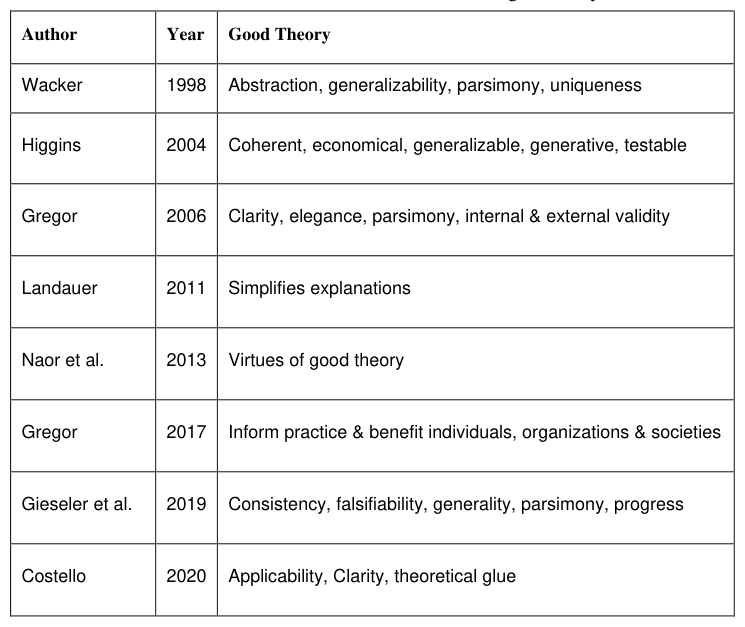
PERSPECTIVES ON GOOD THEORY A review of the research literature focusing on the notion of “good” theory is provided in this section along with an overview provided in Table 1.
Table 1: Overview of the research literature for good theory Author Year Good Theory
Intelligent Human Systems Integration (IHSI 2022): Integrating People and Intelligent Systems https://openaccess.cms-conferences.org/#/publications/book/978-1-7923-8988-7 agreement with evidence, absence of disconfirmation, soundness of argument, internal and external validity, and consistency with other theory.” Good theory, in the words of Landauer (2011), from an engineering perspective, “simplifies explanations and makes them more coherent, robust, objective, and even allows better predictions of behavior.” Naor et al. (2013) provide a lesson in theory assessment and “good theory” determination in relation to the theory of constraints. Consideration is given to virtues of good theory discussed by Naor et al. (2013), drawing on the work of Wacker (1998). From an information systems perspective, Gregor (2017) makes the claim for “good theory” that it “can inform practice and provide benefits to individuals, organizations and societies.” Gieseler, Loschelder, and Friese (2019) identify “a selection of quality criteria that make for good theory” as a “theoretical perspective” in evaluating theories for consistency, precision, parsimony, generality, falsifiability, and progress. Gieseler et al. (2019) identify an “empirical perspective” for theory evaluation to determine “how empirically proven is a theory.” Costello (2020) employs five constructs to evaluate a theory – clarity, theoretical glue, cumulative tradition, parsimony, and applicability. It is worth noting that Shalley (2012) addresses why the writing of good theory “is always an important issue to consider” for “conceptual research and meta-analyses” where, the purpose of the latter is to “provide a comprehensive understanding of the state of a particular literature and develop theory.” Additionally, “good theory” (Shalley, 2012) “causes us to think about phenomenon in ways that we normally would not.”
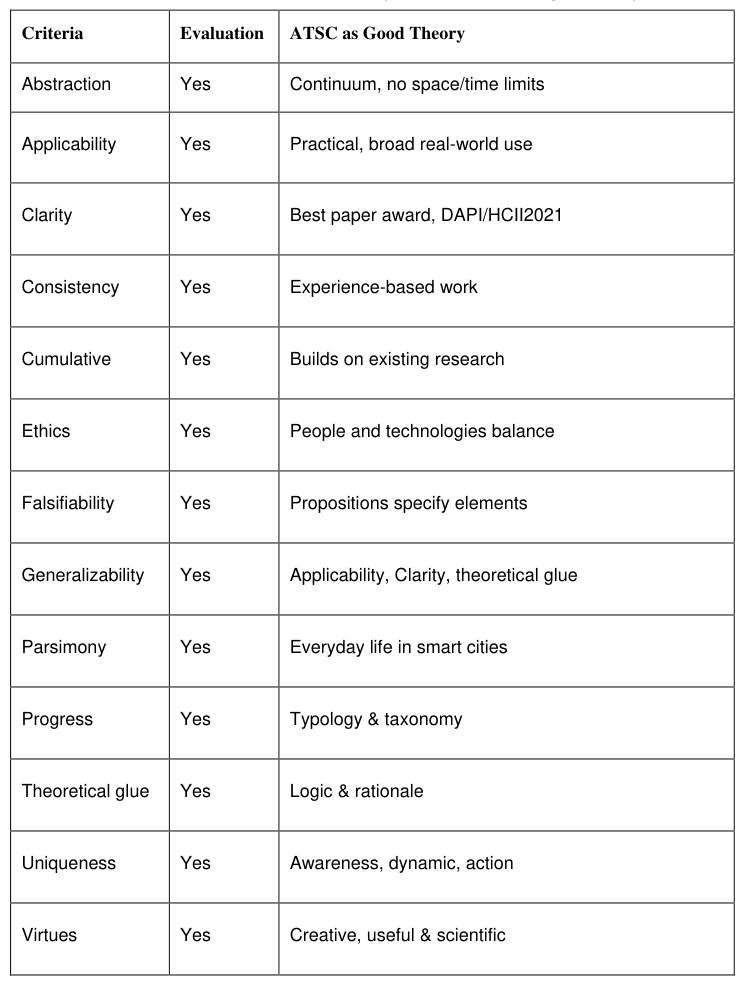
GOOD THEORY CRITERIA AND ATSC This paper provides an evaluation of the “goodness” of ambient theory for smart cities (ATSC) as advanced by McKenna (2021a), based on a review of the research literature, focusing on key criteria identified in the Theoretical Perspective section. The literature review is interdisciplinary in nature in keeping with the interdisciplinary nature of smart cities. What follows is an evaluation of ambient theory as applied to date in the context of smart cities in relation to criteria identified, described, and employed by researchers. A mix of good theory elements, drawn from a variety of researchers, forms the basis for this evaluation. An overview of evaluation results is provided in Table 2 of this section.
Abstraction – Ambient theory meets the abstraction requirement (Wacker, 1998) of being “independent of time and space” (Naor et al., 2013) in that the ambient is said to function as “a continuum of awareness” and “an awareness of continuum” (McCullough, 2013). Applicability – Ambient theory meets the applicability requirement (Wacker, 1998; Costello, 2020) in that it is intended for use with “practical real world problems” in smart cities. Clarity – Whether ambient theory is “clearly communicated and understandable” (Costello, 2020) emerges through a Best Paper Award (McKenna, 2021a) from the Distributed, Ambient and Pervasive Interactions affiliated Conference at the HCI International Conference, 2021. Consistency – Ambient theory would seem to exhibit “consistency with empirical observation” (Gieseler et al., 2019) as demonstrated by experience-based and assessment-
Intelligent Human Systems Integration (IHSI 2022): Integrating People and Intelligent Systems https://openaccess.cms-conferences.org/#/publications/book/978-1-7923-8988-7
Table 2: Evaluation of ambient theory for smart cities as a good theory Criteria Evaluation ATSC as Good Theory
Intelligent Human Systems Integration (IHSI 2022): Integrating People and Intelligent Systems https://openaccess.cms-conferences.org/#/publications/book/978-1-7923-8988-7 based work in smart cities (McKenna, 2021a). However, Naor et al. (2013) refer to internal consistency where “the theory identified all relationships” while ambient theory is more open, dynamic, and adaptive where many relationships may yet emerge. Testing internal consistency using Cronbach’s Alpha on item responses for six survey questions about smart cities, good reliability emerges with a score of 0.82. Cumulative Tradition – McKenna (2021a) provides a review of the research literature for the ambient and develops ambient theory for smart cities. This would seem to constitute what Shalley (2012) describes as meta- analyses which “can contribute to our cumulative knowledge” while “cumulatively building on existing research” (Dubin, 1978; Costello, 2020). Ethics – Costello (2020) identifies the area of ethics as important for theory and ATSC is attentive to this criterion in terms of balancing people and technology interactions and integrations in urban environments (McKenna, 2021a; 2021c; 2021d). Falsifiability – Gieseler et al. (2019) point to the importance of a theory being falsifiable and ambient theory adheres to this criterion in that the underlying propositions identify various elements (e.g., awareness) that need to be present. Generality – Gieseler et al. (2019) describe generality as “a theory’s quality to apply to various fields, situations, or domains of behavior.” Ambient theory adheres to generality in that it applies to the smart cities field and many sub-fields, any number of real-world situations, and domains of behavior characterizing everyday life. Parsimony and Simplicity – Ambient theory is parsimonious (McKenna, 2021a) to the extent that “it is based on the presence or absence” of three simply stated propositions. Progress – To the extent that ambient theory development for smart cities has inspired the development of a typology for seeing through smart cities (McKenna, 2021c) and a taxonomy for invisibilities and visibilities in smart cities (McKenna, 2021d), signs of progress (Gieseler et al., 2019) are evident. Theoretical Glue – Ambient theory consists of the “strong underlying logic and rationale” (Costello, 2020) of awareness-enabling technologies interacting with more aware people (McKenna, 2021a), as the “theoretical glue”. Uniqueness – The uniqueness (Naor et al., 2013) of ambient theory is associated with 3 simple propositions involving awareness, dynamic, and meaningfully involving people in action. Virtues (Creative, Useful and Scientific) – Ambient theory exhibits virtues (Naor et al., 2013) in that it is sufficiently open to foster creativity and usefulness in urban spaces and regions (McKenna, 2021a; 2021c). Ambient theory is scientific in that studies employing ambient theory to date involve the use of exploratory case study research combined with an explanatory correlational design enabling qualitative and quantitative data analysis (McKenna, 2021a).
DISCUSSION OF FINDINGS Findings in this paper affirm that ambient theory for smart cities is a “good” theory in that, properties such as applicability and clarity emerge in relation to awareness and sensing and people and technologies. Parsimony emerges in relation to the accommodating of awareness and sensing in smart cities and environments. Uniqueness and other virtues emerge in terms of assessments of why awareness matters and how interactivity occurs (McKenna, 2021a; 2021b; 2021c; 2021d). Generality and generalizability emerge in relation to correlations between awareness and interactivity, technology-driven services, and creative opportunities
Intelligent Human Systems Integration (IHSI 2022): Integrating People and Intelligent Systems https://openaccess.cms-conferences.org/#/publications/book/978-1-7923-8988-7
(McKenna, 2021a). In an interactive or virtuous cycle, the various aspects of “good theory” that are evident in articulations and use of ambient theory reinforce and enrich each other while inviting debate, further use, and testing. To the extent that “good theory” is said by Gieseler et al. (2019) to “inspire new research, lead to discoveries that make contributions beyond the previously known, and promote theoretical progress”, ambient theory has begun to inspire developments for smart cities in terms of typology (McKenna, 2021c) and taxonomy development (McKenna, 2021d) but it cannot yet be said to have “spurred hundreds of studies, novel theorizing, and methodological, scientific debates” (Gieseler et al., 2019) although it is shown to be influential in the work of other researchers as the recipient of the Best Paper Award (McKenna, 2021a) at a recent conference.
CONCLUSION
This paper employs the notion of “good theory” as a form of scholarly inquiry in the exploration of ambient theory for smart cities (ATSC) in determining whether the theory is a good one. Based on guidance about what constitutes “good theory” from the research literature across multiple domains, an evaluation of ATSC reveals that findings to date show promising signs. For example, in proposing and testing ambient theory, variables for understanding smart cities have been identified and a range of relationships have been correlated pertaining to people and technologies in smart environments (McKenna, 2021a; 2021b; 2021c; 2021d) in support of predictive capabilities. Indeed, Wacker (1998) claims that “good theory must first be a theory” and this is affirmed by McKenna (2021b) while additional ways in which ATSC meets good theory requirements are developed in this paper. Going forward, this evaluation of ATSC provides opportunities for engagement with the various criteria discussed in this paper and this will occur through use, debate, and discussion by researchers and practitioners in smart cities and possibly other domains. Opportunities also exist for the modification of ATSC as a tool to better understand smart cities or, to complement other theories used with smart cities and urban environments and regions.
REFERENCES
Augoyard, J.-F. (2002). Deficiencies in the research about architectural and urban ambient environment and proposition of new tools: The sound example. Architectural and Urban Ambient Environment: First International Workshop, Nantes, France. Batty, M. (2013). Big Data, Smart Cities and City Planning. Dialogues in Human Geography
A Journal of Rhetoric in Society 4(1), Last accessed 2021/05/19.
Intelligent Human Systems Integration (IHSI 2022): Integrating People and Intelligent Systems https://openaccess.cms-conferences.org/#/publications/book/978-1-7923-8988-7
Dubin, R. (1978). Theory Development. New York: Free Press. Gregor, S. (2017). On Theory. In: The Routledge Companion to Management Information Systems. 1st Edition, pp. 57-72. London: Routledge. Gregor, S. (2006). The Nature of Theory in Information Systems. MIS Q 30(3): 611-642 Gieseler, K., Loschelder, D.D., Friese, M. (2019). What Makes for a Good Theory? How
to Evaluate a Theory Using the Strength Model of Self-Control as an Example. In: Sassenberg K., Vliek M. (eds) Social Psychology in Action. Springer, Cham. https://doi.org/10.1007/978-3-030-13788-5_1. Higgins, E.T. (2004). Making a Theory Useful: Lessons Handed Eown. Personality and Social Psychology 8(2): 138-145 Landauer, C. (2011). There is Nothing so Practical as a Good Theory. 2011 IEEE Fourth
International Conference on Space Mission Challenges for Information Technology, pp. 184-191, doi: 10.1109/SMC-IT.2011.32. McCullough, M. (2013). Ambient Commons: Attention in the Age of Embodied Information. The MIT Press, Cambridge, MA. Doi:10.7551/mitpress/8947.001.0001. McKenna, H.P. (2021a). The Importance of Theory for Understanding Smart Cities: Making
a Case for Ambient Theory. In: Streitz, S. Konomi (eds) Distributed, Ambient and Pervasive Interactions, HCII 2021. LNCS, Springer, Cham. McKenna, H.P. (2021b). Is Ambient Theory for Smart Cities Even a Theory? An Affirmative Assessment. Proceedings of the Future Technologies Conference. McKenna, H.P. (2021c). Seeing Smart Cities through a Multi-Dimensional Lens:
Perspectives, Relationships, and Patterns for Success. Springer. Doi: 10.1007/978-3- 030-70821-4. McKenna, H.P. (2021d). Visibilities and Invisibilities in Smart Cities: Emerging Research and Opportunities. Hershey, PA: IGI Global. DOI: 10.4018/978-1-7998-3850-0. Naor, M., Bernardes, E.S., Coman, A. (2013). Theory of Constraints: Is it a Theory and a
Good One? International Journal of Production Research 51(2): 542-554 Doi: 10.1080/00207543.2011.654137. Rickert, T. (2013). Ambient Rhetoric: The Attunements of Rhetorical Being. University of Pittsburgh Press, Pittsburgh, PA. Roy, A. (2009). The 21st Century Metropolis: New Geographies of Theory. Regional Studies
43(6): 819-830. doi:10.1080/00343400701809665. Stephanidis, C., et al. (2019). Seven HCI Grand Challenges. International Journal of Human– Computer Interaction 35(14): 1229-1269. DOI: 10.1080/10447318.2019.1619259. Shalley, C. E. (2012). Writing Good Theory: Issues to Consider. Organizational Psychology
Review, Special Forum on Good Theory 2(3): 258-264 Townsend, A. M. (2013). Smart Cities: Big Data, Civic Hackers and the Quest for a New Utopia. W. W. Norton & Company, New York. Wacker, J. G. (1998). A definition of theory: Research guidelines for different theory-
building research methods in operations management. J. of Oper. Mgmt 16: 361-385 Wacker, J. G. (1998). A Conceptual Understanding of Requirements for Theory-building Research: Guidelines for Scientific Theory Building. J of Supply Chain Mgmt 44(3): 5-11 Whetten, D. (1989). What Constitutes a Theoretical Contribution? Academy of Management
Review 14 (4): 468–489 Urban Hub. (2019). Cities. Essen, Germany: Thyssenkrupp. Retrieved 19 May 2021 from https://www.urban-hub.com/cities/
Intelligent Human Systems Integration (IHSI 2022): Integrating People and Intelligent Systems https://openaccess.cms-conferences.org/#/publications/book/978-1-7923-8988-7
LISTED IN THE AHFE DIGITAL BOOKSTORE CATALOGUE
Explore the complete digital volume
Intelligent Human Systems Integration (IHSI 2022): Integrating People and Intelligent Systems
Read this individual research paper free through the original publisher, or explore the full digital proceedings book.
ISBN 978-1-7923-8988-7
Explore this ISBN in the AHFE Bookstore ↗Listed in the July 2026 bookstore catalogue; search by ISBN to confirm current availability · Digital book purchase optional