Fabian Sarmiento, Andrés Moran, Pablo Ron (2022). Evaluation of Liquefied Petroleum Gas as a Fuel Input in a Mechanical Injection Diesel Internal Combustion Engine. In: Intelligent Human Systems Integration (IHSI 2022): Integrating People and Intelligent Systems. AHFE Open Access, vol. 22. https://doi.org/10.54941/ahfe100981
In this research, the performance of an internal combustion engine with an adapta-tion for liquefied petroleum gas (LPG) injection was analyzed. The automotive indus-try works on the development and improvement of internal combustion engines, both in their design, metrics, technology incorporation, among others. Part of the research is focused on testing different fuels to reduce emissions and preserve or improve op-erating parameters. Recent studies have shown that the incorporation of LPG in the combustion mixture of diesel engines reduces pollutant emissions and increases pow-er output. In Latin America, there is a significant population of mechanical injection engines that use fuel with 500 ppm of sulphur, so it is relevant to study alternatives to improve combustion. This study evaluated the vehicle performance with a 1998 diesel internal combustion engine, which was adapted to an LPG injection system as input fuel. Torque, power, opacity, particulate matter, and fuel consumption tests were carried out using the IM240 cycle, using different diesel and LPG mixtures. The results show that there is an increase in torque values 22.06 lb.ft and power of 13.47 HP at 300 rpm with a mixture of 53.43% diesel and 46.57% LPG. Opacity had an increase to 82% at the critical point, while there is a decrease in fuel consumption. In addition, as the LPG / Diesel ratio increases, the engine exhibits strong internal explo-sions as a result of delayed ignition, which could cause engine damage. Finally, the results are contrasted with those of other research studies and it is concluded that the incorporation of LPG injection systems in mechanical injection diesel engines, alt-hough it increases the power and torque of the engine, there may be cases where a reduction in the emission of polluting gases or particulate matter is not obtained and normal operation is not guaranteed, especially in mixtures with high LPG proportion. Environmental pollution is a problem of global concern, so the way to reduce pollu-tion and pollutant emissions is constantly being investigated while maintaining or improving parameters such as torque and power. To achieve this goal, mechanical modifications, the vehicle in general, or fuel quality is regulated. Another alternative that has been studied is the mixture of fuels using diesel cycle engines with LPG. In, for example, tests were carried out on fuel-air premixture (PCCI) diesel engines by adding LPG to the combustion mixture, resulting in a reduction in particulate matter emissions and an improvement in auto-ignition resistance. On the other hand, in tests were conducted on injection ignition diesel engines, where power increase, NOx reduc-tion, and CO increase were determined for diesel and LGP fuel mixtures. In LPG and diesel mixtures were tested on an electronically controlled BOSCH VP3 engine up to 75% LPG, which achieves a reduction in fuel consumption of approximately 3.5% by increasing the gas injection angle achieving ignition at a point very close to the opti-mum. Finally, in tests were carried out by adding LPG to the mixture in dual-fuel Diesel CNG engines where the author reports a reduction in power.
Intelligent Human Systems Integration (IHSI 2022): Integrating People and Intelligent Systems https://openaccess.cms-conferences.org/#/publications/book/978-1-7923-8988-7
INTRODUCTION
Environmental pollution from internal combustion engines is a problem of global concern(Dhingra et al., 2019), (Forouzanfar et al., 2016), so the way to reduce pollution and pollutant emissions is constantly being investigated while maintaining or improving parameters such as torque and power. To achieve this goal an alternative that has been studied is the mixture of fuels using diesel cycle engines with LPG. Some works were develop and any one had a different results (Wang et al., 2016), (Chakraborty, Roy and Banerjee, 2016), (Rimkus, Melaika and Matijošius, 2017), (Romero, Acosta and Lopez, 2016), (Alberto et al., 2018).
For the project execution, a diesel fuel with sulphur content up to 500 ppm (INEN Standard 1489) (INEN, 2016) was used, which produced a higher percentage of opacity. LPG and diesel mixtures were tested in a 1998 TOYOTA HILUX diesel internal combustion engine with mechanical injection without electronic control, where torque, power, fuel consumption, opacity, and particulate matter were tested.
METHODOLOGY
A quantitative experimental approach was used to evaluate the vehicle's performance by performing torque, power, and particulate material tests. The tests were carried out at the Technology Transfer Center for Training and Research in Vehicle Emission Control in Ecuador (CCICEV). The tests were carried out under the NTE INEN 22 07 standards following an IM 240 driving cycle protocol that lasts 240 seconds and covers 3.2 km of distance.
LPG System Adaptation to the diesel engine.
The system used for LPG injection in the diesel engine was a KIT BIGAS/GLP EASY GAS LPG, with DGM 59645 GPL approval number, which incorporates a pressure reducer, a solenoid valve, ECU, wiring, stepper motor, switch, pipes, belts, and mixer.
Software.
The system has BIGAS Dual Fuel CPP software installed on a computer, where the engine data is entered and where the signals from the sensors installed in the vehicle also reach. This software makes it possible to monitor the vehicle behavior with the different diesel and LPG mixtures.
In-vehicle tests The performed tests were Torque, Power, Opacity and Particulate Matter. Comparative tests were carried out between diesel and diesel + LPG mixtures in proportions of 19.77%, 33.29%, and 46.57% of LPG in the blend to analyze the vehicle behavior. The fuel energy formula, which is part of a system’s energy balance was used to calculate mass percentages of diesel and LPG.
mD 1 * P.C.I.D * η = mD 2 * P.C. I.D * η + mGLP1* P.C.I.GLP * η
Intelligent Human Systems Integration (IHSI 2022): Integrating People and Intelligent Systems https://openaccess.cms-conferences.org/#/publications/book/978-1-7923-8988-7
Torque and Power. A chassis dynamometer LPS 3000 was used for torque and power tests and to simulate the IM240 driving cycle.
Fuel consumption. To measure fuel consumption, an external graduated fuel storage system was adapted during a driving cycle from which volumetric difference readings were taken before and after the tests.
Opacity. The opacity was measured with the MAHA MDO2 equipment. The probe was placed inside the exhaust pipe during the cycles determined above. This parameter was measured with unmixed diesel and the three mixtures mentioned above.
Particulate matter. The MAHA MPM-4 equipment designed to continuously measure particulate matter was used to measure particulates. Similar to the opacity, the probe was placed inside the exhaust pipe while performing the IM 240 driving cycle tests with the four diesel/LPG ratios.
The test is performed by raising the engine speed from idle to 2500 rpm at full load, with the throttle fully open. When the desired speed is reached, the accelerator pedal is released immediately.
RESULTS AND DISCUSSION
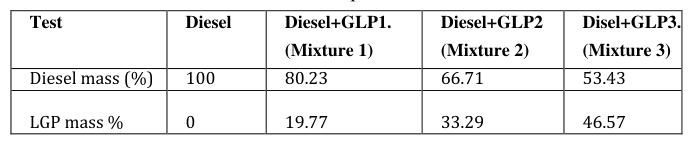
Mixture composition The experiment was carried out with 4 different blends between diesel and LPG, all in the same IM 240 driving cycle. The main fuel is diesel, while LPG is added as a fuel supply. The tests performed were limited to a 46.57% contribution due to increased engine vibration. This value diverges from the work done in (Omar, Selim and Emam, 2017), (Aydin, Irgin and Çelik, 2018) where LPG represents 70% of the mixture. Table 1 shows the mixture composition values.
Table 1. Composition of the mixture Test Diesel Diesel+GLP1.
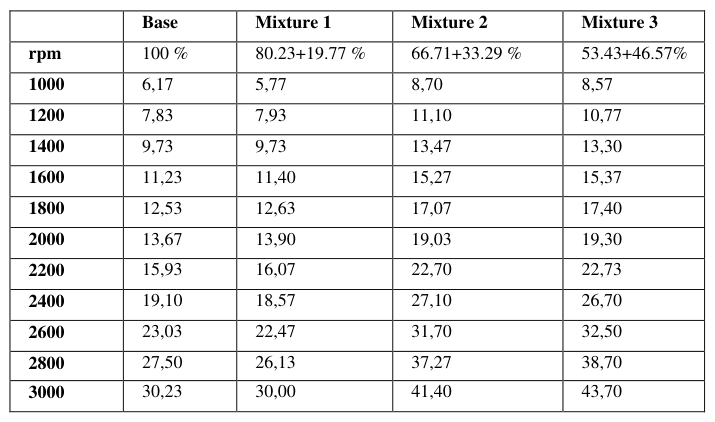
Power The Power results of the tests performed with the different Diesel + LPG mix compositions are shown in Table 2.
Intelligent Human Systems Integration (IHSI 2022): Integrating People and Intelligent Systems https://openaccess.cms-conferences.org/#/publications/book/978-1-7923-8988-7
Table 2. Power results in HP Base Mixture 1 Mixture 2 Mixture 3 rpm 100 % 80.23+19.77 % 66.71+33.29 % 53.43+46.57%
According to the results obtained, the power output increases due to the addition of LPG fuel, which delivers additional energy to the diesel mixture that normally works with excess air. These results are congruent with the results obtained in (Kim et al., 2017), (F. Payri, J.M., 2011), (Tiwari and Sinha, 2014), (Boretti, 2017).
Intelligent Human Systems Integration (IHSI 2022): Integrating People and Intelligent Systems https://openaccess.cms-conferences.org/#/publications/book/978-1-7923-8988-7
Torque Lambda and Opacity in a static test
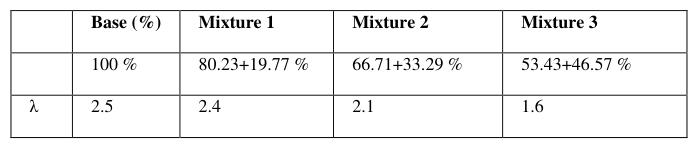
The opacity values depend on the lambda values obtained during engine operation. The lambda values that were obtained by means of the lambda CAN interface software and are shown in Table 4.
Table 4. Lambda results in % Base (%) Mixture 1 Mixture 2 Mixture 3
The obtained lambda results show that the values decrease as the amount of LPG increases, i.e., the diesel engine tends to work with an increasingly richer mixture, with the amount of fuel getting closer to the 14.7: 1 ratio corresponding to petrol engines (F. Payri, J.M., 2011). This behavior is consistent because diesel engines normally work in a lean mixture, i.e., in lambda ranges greater than 1. In this case, the engine is calibrated at λ = 2.5 with diesel only and is reduced as LPG is added. Table 5 shows the opacity values obtained in the tests.
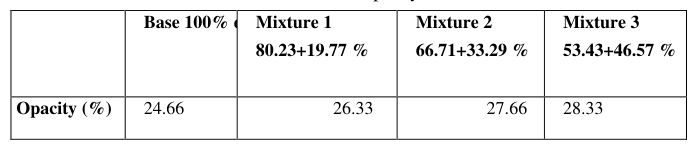
Table 5. Opacity results in % Mixture 2 Mixture 3
Table 5 shows that the opacity values increase as the amount of LPG in the mixture increases, reaching an opacity of 28.33% when 46.57% LPG is added. This is because diesel fuel normally runs lean, i.e., with excess air to ensure complete combustion of the fuel. When it is premixed with LPG, the available air mass is reduced, producing incomplete combustion of the diesel in the flame front, the area where particulate matter is generated, which results in increased opacity. Similar opacity results are reported in (Boretti, 2017), (Ashok, Denis Ashok and Ramesh Kumar, 2015).
In general, exhaust gas analysis allows diagnosing the engine condition based on lambda, which in diesel engines is normally a value greater than 1 and ideally up to 1.65 for maximum efficiency (lower consumption). Lambda values between 2.5 and 1.5, were obtained in the tests, therefore an increase in
Intelligent Human Systems Integration (IHSI 2022): Integrating People and Intelligent Systems https://openaccess.cms-conferences.org/#/publications/book/978-1-7923-8988-7 opacity, a similar case experienced by (Gómez et al., 2020). The particulate matter values obtained are shown in Table 6.
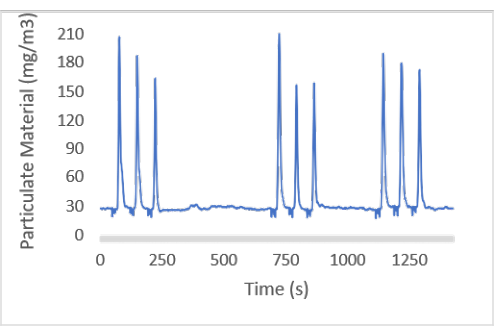
Figure 1 shows the results of the particulate matter test of one of the mixes; each peak represents a load applied to the engine until its speed rises to 2500 rpm. Each group of three peaks represents the three measurements taken with each fuel mixture tested.
Figure 1. Diesel only particulate matter test
According to the results obtained, the opacity values increase as the amount of LPG in the mixture increases. On the other hand, and contrary to this work, (Ashok, Denis Ashok and Ramesh Kumar, 2015) reports a reduction of particulate matter in LPG-rich mixtures and a power loss with respect to the engine operation that only works with diesel. (Gómez et al., 2020).
CONCLUSIONS
This research shows that the use of LPG as input fuel in a diesel engine does not ensure the pollutant reduction emitted to the environment, but the result depends on conditions such as ignition time, type of electronic injection control, and fuel input characteristics used, as reported in other investigations ((Rimkus, Melaika and Matijošius, 2017),(Aydin, Irgin and Çelik, 2018) and (Ashok, Denis Ashok and Ramesh Kumar, 2015)) where emission reductions and total consumption are achieved when the ignition
Intelligent Human Systems Integration (IHSI 2022): Integrating People and Intelligent Systems https://openaccess.cms-conferences.org/#/publications/book/978-1-7923-8988-7 is controlled by the injection system, but also a decrease in engine power. Even in [1] it is indicated that an emission reduction and power increase can be achieved by effectively controlling these parameters compared to a commercial diesel engine. In this regard, the best results in terms of emissions and energy efficiency could be determined to identify the minimum equipment required by an engine to work with fuel input and in this way quantify the impact of mass deployment of these elements.
Another important difference with other studies is the mixture type and how to start the combustion of the mixture. In the current study, diesel is used as the main fuel and LPG is used as the input fuel, where as the percentage of LPG increases, so do engine vibrations. Unlike (Omar, Selim and Emam, 2017), where the base fuel is LPG and diesel is added to start the gas combustion, which makes it possible to control the optimum combustion point and reduce vibrations. This is because the mixture of LPG and air charges the combustion chamber, so that when the diesel is injected, a premature pressure peak occurs, generating the tapping of the internal elements, similar to the results observed in Cusiana by(Romero, Acosta and Lopez, 2016), where it is mentioned that the origin of LPG and its characteristics alter the combustion properties, to the point where it is necessary to install a system that interrupts the injection of LPG if the vibrations exceed a predetermined limit.
As the amount of LPG in the mixture increases, the mixture changes from lean (typical diesel) to a rich mixture, which is why the fuel fails to combust properly, increasing opacity and the possibility of emitting hydrocarbons as particulate matter. These results are consistent with those mentioned by (Rimkus, Melaika and Matijošius, 2017), where it indicates that the addition of LPG in the mixture increases the concentration of partially combusted products, such as carbon monoxide and hydrocarbons in the exhaust gases. Additionally, the results agree with (Romero, Acosta and Lopez, 2016), who mentions that CO emissions rise, attributing this effect to the lack of control in the injection of diesel in the mixture.
Finally, the results obtained in this research are aligned to the studies as (Romero, Acosta and Lopez, 2016) in terms of power and torque increase. Researchers in agree that LPG can be used as an additional fuel in proportions up to 40%, but it is recommended to carry out studies on durability, operation, and maintenance costs that should be considered in the long term.
ACKNOWLEDGMENTS
We thank the Faculty of Engineering and Information and Communication Technologies of the Indoamerican Technological University.
REFERENCES
Alberto, C. et al. (2018) ‘desempeño de un moto-generador alimentado con GLP de elevado contenido de butano’, 23(03), pp. 334–343.
Intelligent Human Systems Integration (IHSI 2022): Integrating People and Intelligent Systems https://openaccess.cms-conferences.org/#/publications/book/978-1-7923-8988-7
Ashok, B., Denis Ashok, S. and Ramesh Kumar, C. (2015) ‘LPG diesel dual fuel engine - A critical review’, Alexandria Engineering Journal, 54(2), pp. 105– 126. doi: 10.1016/j.aej.2015.03.002. Aydin, M., Irgin, A. and Çelik, M. B. (2018) ‘The impact of diesel/LPG dual fuel on performance and
emissions in a single cylinder diesel generator’, Applied Sciences (Switzerland), 8(5), pp. 1–14. doi: 10.3390/app8050825. Boretti, A. (2017) ‘Numerical study of the substitutional diesel fuel energy in a dual fuel diesel-LPG engine with two direct injectors per cylinder’, Fuel Processing Technology, 161(x), pp. 41–51. doi: 10.1016/j.fuproc.2017.03.001. Chakraborty, A., Roy, S. and Banerjee, R. (2016) ‘An experimental based ANN approach in mapping
performance-emission characteristics of a diesel engine operating in dual-fuel mode with LPG’, Journal of Natural Gas Science and Engineering, 28, pp. 15–30. doi: 10.1016/j.jngse.2015.11.024. Dhingra, S. et al. (2019) ‘Internet of things mobile-air pollution monitoring system (IoT-Mobair)’, IEEE Internet of Things Journal, 6(3), pp. 5577–5584. doi: 10.1109/JIOT.2019.2903821. F. Payri, J.M., D. (2011) Motores de dombustión interna alternativos. Forouzanfar, M. H. et al. (2016) ‘Global, regional, and national comparative risk assessment of 79
behavioural, environmental and occupational, and metabolic risks or clusters of risks, 1990–2015: a systematic analysis for the Global Burden of Disease Study 2015’, The Lancet, 388(10053), pp. 1659–1724. doi: 10.1016/S0140- 6736(16)31679-8. Gómez, A. et al. (2020) ‘Comparative study of the opacity tendency of alternative diesel fuels blended with
gasoline’, Fuel, 264(December 2019), p. 116860. doi: 10.1016/j.fuel.2019.116860. INEN (2016) ‘Norma Técnica Ecuatoria NTE INEN1489: Productos derivados de petróleo. Diésel.
Requisitos’, Octava rev. Available at: http://www.normalizacion.gob.ec/wp- content/uploads/downloads/2016/05/nte_inen_1489-8.pdf. Kim, K. et al. (2017) ‘Lower particulate matter emissions with a stoichiometric LPG direct injection engine’, Fuel, 187, pp. 197–210. doi: 10.1016/j.fuel.2016.09.058. Omar, F. K., Selim, M. Y. E. and Emam, S. A. (2017) ‘Time and frequency analyses of dual-fuel engine block
vibration’, Fuel, 203, pp. 884–893. doi: 10.1016/j.fuel.2017.05.034. Rimkus, A., Melaika, M. and Matijošius, J. (2017) ‘Efficient and Ecological Indicators of CI Engine Fuelled with Different Diesel and LPG Mixtures’, Procedia Engineering, 187, pp. 504–512. doi: 10.1016/j.proeng.2017.04.407. Romero, C. A., Acosta, R. and Lopez, J. (2016) ‘The Status of Experimental Investigations on the use of LPG
for generator sets in Colombia’, SAE Technical Papers. doi: 10.4271/2016-01-0880. Tiwari, D. R. and Sinha, G. P. (2014) ‘Performance and Emission Study of LPG Diesel Dual Fuel Engine’, (3), pp. 198–203. Wang, Y. et al. (2016) ‘Study on combustion and emission of a dimethyl ether- diesel dual-fuel premixed
charge compression ignition combustion engine with LPG (liquefied petroleum gas) as ignition inhibitor’, Energy, 96(x), pp. 278– 285. doi: 10.1016/j.energy.2015.12.056.
Intelligent Human Systems Integration (IHSI 2022): Integrating People and Intelligent Systems https://openaccess.cms-conferences.org/#/publications/book/978-1-7923-8988-7
LISTED IN THE AHFE DIGITAL BOOKSTORE CATALOGUE
Explore the complete digital volume
Intelligent Human Systems Integration (IHSI 2022): Integrating People and Intelligent Systems
Read this individual research paper free through the original publisher, or explore the full digital proceedings book.
ISBN 978-1-7923-8988-7
Explore this ISBN in the AHFE Bookstore ↗Listed in the July 2026 bookstore catalogue; search by ISBN to confirm current availability · Digital book purchase optional