Dandan Kowarsch, Zining Yang (2022). A System Dynamics Approach on Modeling Homeless Prevention Strategy: A Case Study of LA County. In: Intelligent Human Systems Integration (IHSI 2022): Integrating People and Intelligent Systems. AHFE Open Access, vol. 22. https://doi.org/10.54941/ahfe100986
This article presents a system dynamic modeling approach to simulate the effect of a homeless prevention strategy on the homeless population in Los Angeles. Despite the implementation of rehousing strategy suggested by policy makers, the Los Angeles homeless population has increased over time. Traditional statistics analysis is widely used in researching this topic, but using aggregated data fails to provide sufficient explanations on the correlation between the permanent supportive housing and homeless population. Our system dynamics model overcomes this challenge in a unique way using stocks and flows. We model stocks as key factors that have significant impact on homelessness, including prevented homeless population, the population of the homeless who are in the temporary housing programs, and the population of those who are settled in the permanent supportive housing program. Flows provide details on how stocks are related to each other, allowing memories of the history and interconnection in the homeless system. Each stock may affect the other due to time delays and feedback loops through inflows and outflows. To assess the impact of homeless prevention programs, we perform simulation and scenario analysis by adjusting model inputs including ratios for prevented homelessness and the rapid re-housing. The system dynamics model helps unveil the unintended consequence introduced by the Housing-First policy and allows us to evaluate various policies to come up with data-driven recommendations. The simulation results suggest that prevention strategy could lead to a positive impact on reducing the homeless population. Indeed, the use of Housing-First policy along with a preventative program for homelessness could be considered as a more effective strategy for the mitigation of LA homelessness.
The aim of this article is to assess the contemporary homeless prevention program that has been implemented with respect to the Los Angeles Homeless Initiative policy. Los Angeles homeless population has grown significantly since 2007. As of 2021, the homeless population has reached 62,000, compared to 32,000 in 2007 (Los Angeles Homeless Authority Service, 2021). Eviction becomes the major issue that causes people to become homeless. To prevail over the issue, based on Federal policy for homelessness, Los Angeles implement a homeless prevention strategy. The County looks forward to seeing if the prevention has a positive effect on reducing the homeless inflows.
The prevalent studies on homelessness are conducted using statistics. Some problems with statistics include that first using regression models most likely gives us a correlation rather than causality. Second, a regression modeling approach may not be able to overcome either the feedback loops or information delays between the explanatory variable and the dependent variable. In addition, the outcomes based on descriptive and inference analyses require a large sample size. It becomes a challenge when data is unavailable or not valid. Lastly, statistics are data dependent. Various small samples may result in different outcomes using the same modeling technique.
System dynamics modeling, however, triumphs in both endogeneity and data issues. System dynamics is a computer-based approach for policy analysis and design. System dynamics application is helpful in evaluating dynamic problem of homelessness in a complex social, economic, and ecological system because it allows us to look up the key factors in separate modules and study the interconnectivities between modules in the system. System dynamics is also useful to identify unexpected consequences that may be produced by a new homeless
Intelligent Human Systems Integration (IHSI 2022): Integrating People and Intelligent Systems https://openaccess.cms-conferences.org/#/publications/book/978-1-7923-8988-7 policy.
LITERATURE REVIEW
Policies related to homelessness have concentrated on the relationship between housing and the homeless. Recently, the focus of Los Angeles policy makers has been moved toward homelessness prevention initiatives (Apicello, 2021; Berg, 2013; Busch-Geertsema and Fitzpatrick, 2008; Culhane and Schwartz-Barcott, 2011; Mackie, 2015). In Europe and Australia, prevention is a key strategy to mitigate homelessness (Gaetz and Dej, 2017). According to Mackie and Szeintuch, in Europe, there is widespread use of prevention services including but not limited to emergency rent, security deposits, moving assistance, mortgage and utility assistance, rent/landlord mediation, education, and job training (Mackie, 2015; Szeintuch, 2017). In the U.S., eviction prevention is implemented to prevent families living in a very expensive rental market from losing their housing (National Center for Biotechnology Information). The use of emergency homeless prevention aims to assist families in avoiding homelessness and the subsequent trauma and disorganization that accompany it (National Center for Biotechnology Information). The studies on homeless prevention policy in New York City suggest that the intervention prevents 5 to 11 percent of participating households from entering shelters (HUD, 2009; Goodman et al. 2016; Locke et al. 2011; Messeri, et al. 2016). A similar finding is unveiled by Evans, Sullivan, and Walskog in a study of the homeless in Chicago. They report that people requesting assistance when funding is available are 76 percent less likely to enter into a homeless shelter (Evans et al. 2016). Byrne et al. (2016) find that most veterans who received assistance are able to avoid homelessness even after the assistance ceased.
Why is system dynamics a proper approach to study homelessness? Because it is not heavily data dependent. System dynamics allows us to test the homeless prevention policy and the relevant assumptions so as to help LA policy makers to determine its effect on any success with or without accessible data. Moreover, the grounds of homelessness are most likely non- linear and intertwined. According to Forrester, human beings are capable of using the methods of simulation to determine the behavior of complex systems (Forrester, 1958). Indeed, it has been found that people are as adaptable to the more abstract strategic planning as they are to tactical decision making once their outlook has been lifted to the broader and longer-range picture (Forrester, 1958). System dynamics simulation is a tool which allows to set the conditions and simulate the outcomes under the conditions in the system. On the basis of the descriptions and assumptions about the policy, the system dynamics simulation software, such as Vensim, PowerSim, or Stella, produces graphs of information concerning the changes in the homeless population.
Intelligent Human Systems Integration (IHSI 2022): Integrating People and Intelligent Systems https://openaccess.cms-conferences.org/#/publications/book/978-1-7923-8988-7
METHODOLOGY
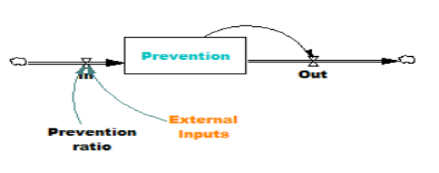
Our system dynamics model is implemented in Vensim PLE Plus 1.For the purpose of simplicity, three major modules created in the homelessness system are as follows: the prevention module for the prevented homeless population, a short-term housing module, and a permanent supportive housing module. Fig. 1 below is a snapshot of the prevention module.
Figure 1. The prevented population stock is linked by an inflow and an outflow.
The prevention ratio as an exogenous variable represents the average percentage of those who are at-risk of becoming homeless can be prevented through available subsidies. The external inputs represent the population of those who have a high risk of becoming homeless. It is an estimated external variable in the system. The cumulative prevented population (Prevention) is calculated through equation (1).
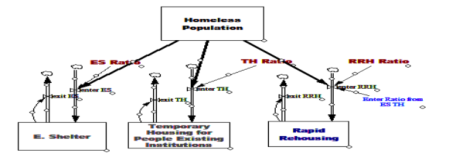
𝑛 0 + 𝑃𝑟𝑒𝑣.(𝑡=0) . 2 (1) The second module of the temporary housing stage portrays the relationships among shelter, homeless housing programs, and the homeless population. A snapshot of this level is attached in Figure 2 below.
Intelligent Human Systems Integration (IHSI 2022): Integrating People and Intelligent Systems https://openaccess.cms-conferences.org/#/publications/book/978-1-7923-8988-7
Figure 2. Three short-term housing programs. Homeless people can temporarily stay in an emergency shelter (E. Shelter), alternatively, if they are chronically homeless, they may qualify for transitional housing (Temporary Housing for People Existing Institutions). The homeless people may also qualify for the rapid re-housing program. However, when the program ends in a few months, usually 3 months up to 9 months in Los Angeles, those who cannot be self-sufficient in the limited time have to return to the streets and become unsheltered homeless again.
In Figure 2, ES Ratio reflects the proportion of homeless who are sheltered. In the same vein, TH ratio is the proportion of homeless settled in a transitional housing program. The RRH ratio is the proportion of homeless staying in the rapid re-housing program. The precedence of street dwellers to be stabilized is that the homeless first leave the streets for either a shelter, or a transitional housing, or rapid rehousing, and stay in the program for a certain period of time, depending on the program. If they become financially independent, after they exit housing program, they live on their own. Alternatively, they may be transferred to the permanent supportive housing program. Those who can be neither self-supportive nor stabilized in permanent supportive housing become returning homeless.
The last module is permanent supportive housing. As we have mentioned previously, it connects to the three short-term housing programs and directly affects the reduction in the homeless population. A snapshot of the entire model is attached in Fig.3 below.
Figure 3. The homeless system dynamics model architecture.
Figure available in the original PDF paper.
Intelligent Human Systems Integration (IHSI 2022): Integrating People and Intelligent Systems https://openaccess.cms-conferences.org/#/publications/book/978-1-7923-8988-7
The homeless system dynamics model consists of the prevention strategy, three temporary housing programs, and one permanent supportive program (Rental Subsidized Program and Case Management). The red arrow line is a reinforcing feedback loop representing those who are not able to be settled in permanent supportive housing leave from the temporary housing program back to the streets.
In the homeless system, the primary feedback loops are as follows: (1) People who are not prevented fall into the homeless subsystem, then stay in one of the temporary housing programs, but return to the streets when waiting for permanent supportive housing. (2) The homeless use a rapid rehousing program, then return homeless after the program is terminated. (3) The vulnerable people unfortunately become homeless, stay in shelter or the transitional housing program, and then move into the rapid rehousing program, eventually return to streets, and become homeless again.
PARAMETER ESTIMATION AND VALIDATION The initial values for the stock variables are pulled from empirical data. To gain the parameters for all the ratios, we allow the model to simulate outputs with multiple sets of possible ratios and calibrate the ratios mainly based on forming a likelihood function for observing the actual time series data conditional on model parameters. We then conduct a Markov Chain Monte Carlo (MCMC) simulation to estimate the joint posterior distribution of the model parameters subject to observed data. Finally, we select the set of ratios that produce the most accurate outcomes as the simulated parameters.
The model is constructed with the support of the homeless manager of the City of Malibu, Los Angeles County. In addition, the parameters are recalibrated based on historical data extracted from U.S. Department of Housing and Urban Development between 2007 and 2019. The homeless data for 2020 is collected from Los Angeles Homeless Authority Service.
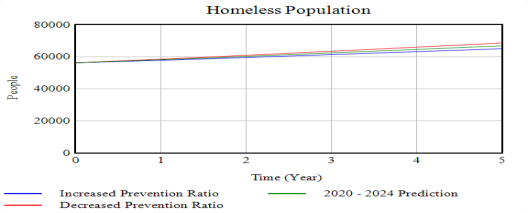
SCENARIO ANALYSIS I- PREVENTION The goal of this scenario is to understand the impact of the number of prevented people on the total homeless population in the next five years. First, we decrease the prevention ratio from 0.55 to 0.45, and leave other control variables unchanged. Second, we increase the prevention ratio from 0.55 to 0.65 and hold all other variables unchanged. Figure 4 is the graph of the output comparison among the three conditions.
Intelligent Human Systems Integration (IHSI 2022): Integrating People and Intelligent Systems https://openaccess.cms-conferences.org/#/publications/book/978-1-7923-8988-7
Figure 4. Simulated results of adjusted prevention ratios.
The green line in the middle is the benchmark simulated outcome based on the initial setup. The graph displays an increase in the prevention ratio leads to a decrease in the homeless population (blue line) otherwise, a decrease in the prevention ratio leads to an increase in homelessness (red line).
SCENARIO ANALYSIS II - PREVENTION AND REDUCTION OF RETURNING HOMELESSNESS To test the model’s reliability, we leave the prevention ratio within the range from 0.75 to 0.85 and constrain the rapid rehousing return ratio between 0.5 and 0.6, leaving all other conditions unchanged. The model iterates 200 times. The result is displayed in Figure 5 below.
40
30
20
10
0 43800-44900 44900-46000 46000-47100
47100-48200 48200-49300 49300-50400
50400-51500 51500-52600 52600-53700
53700-54800 54800-55900 55900-57000
Figure 5. The simulated results based on higher prevention ratio and lower homeless returning rate.
Figure available in the original PDF paper.
The simulated result suggests that if the prevention ratio is improved and the returning ratio is decreased, the homeless population most likely will drop into a range between 48,200 and 53,700 between 2020 and 2024.
Intelligent Human Systems Integration (IHSI 2022): Integrating People and Intelligent Systems https://openaccess.cms-conferences.org/#/publications/book/978-1-7923-8988-7
CONCLUSIONS
An efficient prevention program could be helpful in preventing housing-insecure families and individuals from being homeless. According to LAHSA, from 2018 to 2019, LAHSA prevented 1,472 adults, 1,298 of them remain housed at the end of the year. The System Dynamics simulation model demonstrates a similar result: the more people are prevented from being homeless, the less the homeless population will be. However, the implementation of the prevention strategy alone may not be able to produce a significant impact on the reduction of the homeless population in Los Angeles. We argue that the prevention strategy could be more effective if the policy makers were able to identify the most vulnerable group and their long-term needs. When the homeless are sheltered or settled in a short-term housing program, it is more important to develop a complete set of strategies that help facilitate the homeless to be eventually independent. Hence, we speculate that a more effective approach to ease LA homelessness would be an integrated implementation of a prevention strategy associated with an effective housing strategy that promptly prevents the homeless from returning on the streets after existing the housing programs.
REFERENCES
Apicello, J. (2021). A paradigm shift in housing and homeless services: applying the population and high-risk framework to preventing homelessness. Open Health Services and Policy J. 3, 41-52 Berg, S. (2013). The HEARTH Act. Journal of Policy Development and Research, 15, 317-
323 Busch-Geertsema, V. and Fitzpatrick, S. (2008). Effective homelessness prevention?
Explaining reductions in homelessness in Germany and England. European Journal of Homelessness, 2, 69-95 Culhane, D. P. and Schwartz-Barcott, D. (2011). Residential instability among low-income families: A concept analysis. Archives of Psychiatric Nursing, 30(2), 257-261 Mackie, P. K. (2015). Homelessness prevention and the welsh legal duty: Lessons for
international policies. Housing Studies, 30(1), 40-59 Gaetz, S. and Dej, E.(2017): A new direction: A framework for homelessness policy review: A report to inform the review of homelessness legislation in Wales. Retrieved from http://orca.cf.ac.uk/47872 Szeintuch, S. (2017). Homelessnes prevention policy: A case study. Social Policy &
Administration, 51(7), 1135-1155 National Center for Biotechnology Information, http://www.ncbi.nlm.nih.gov U.S. Department of Housing and Urban Development (2009). Homeless Prevention and Rapid Re-Housing: Los Angeles Community Perspectives https://www.hudexchange.info/resource/1128/homeless-prevention-and-rapid-re- housing-los-angeles-community/ Goodman, S. Messeri, P. and O’Flaherty, B. (2016). Homelessness prevention in New York
City: On average, it works. Journal of Housing economics, 31, 14-34
Intelligent Human Systems Integration (IHSI 2022): Integrating People and Intelligent Systems https://openaccess.cms-conferences.org/#/publications/book/978-1-7923-8988-7
Locke, G. Gan, K. Flore, N. Unlu, F. and Rolston, H. (2011). Evaluation of the homebase community prevention program: Year one summary report. Cambridge, MA: Abt Associates Inc. Evans, W. N. Sullivan, J.X. and Wallskog, M. (2016). The impact of homelessness
prevention programs on homelessness. Science, 353(6300), 694-699 Byrne, T. Treglia, D. Culhane, D.P. Kuhn, J. and Kane, V. (2016). Predictors of homelessness among families and single adults after exit from homelessness prevention and Rapid Re-housing Programs: Evidence form the department of veterans affairs supportive services for veteran families program. Housing Policy debate, 26(1), 252- 275 Forrester, J. (1958). Industrial Dynamics: a major breakthrough for decision makers. Harvard
Business Review
Intelligent Human Systems Integration (IHSI 2022): Integrating People and Intelligent Systems https://openaccess.cms-conferences.org/#/publications/book/978-1-7923-8988-7
LISTED IN THE AHFE DIGITAL BOOKSTORE CATALOGUE
Explore the complete digital volume
Intelligent Human Systems Integration (IHSI 2022): Integrating People and Intelligent Systems
Read this individual research paper free through the original publisher, or explore the full digital proceedings book.
ISBN 978-1-7923-8988-7
Explore this ISBN in the AHFE Bookstore ↗Listed in the July 2026 bookstore catalogue; search by ISBN to confirm current availability · Digital book purchase optional