Annalisa Barla, Marina Cuneo, Simone Roberto Nunzi, Giorgia Paniati, Andrea Vian (2022). AI-based component management system for structured content creation, annotation, and publication. In: Intelligent Human Systems Integration (IHSI 2022): Integrating People and Intelligent Systems. AHFE Open Access, vol. 22. https://doi.org/10.54941/ahfe1001009
The ever-mutable regulations and laws, over-information, and the exponential change of digital technologies require large complex entities, companies, and public administrations to continually adapt their production and information processes. Indeed, they increasingly need to update and to inform employees and users in an immediate, efficient, and timely manner (Bostrom 2006; Harari 2018; Yaneer Bar-Yam 2004). To this end, following the principles of human centered design (Norman and Draper 1986), authors should decline information according to the user profile and create different versions of the same content.However, content management systems (CMS) that support the vast majority of large complex websites (Barker 2016), flatten text (often in multiple languages), regulations, images, videos and quantitative variables (dates, numerical parameters, geographic location) in a linear document. The content is managed in a digital format that loses all structure, prevents reuse, and takes no advantage of the originally modular nature of the information. This causes an uncontrollable growth of touch points to be maintained and updated, and a fragmentation of information sources inevitably doomed to abandonment and inconsistency.Challenges grow exponentially with the organization scale and with information complexity: using CMS and traditional web tools only, the most likely result is a corpus so intricate, specialized and self-contradictory as to be not only ineffective, but even harmful (Vian 2020). This catastrophic and widespread state is caused by the degree of information complexity, which has vastly exceeded the capability of traditional CMSs.In this paper we describe the regulatory, technological and economic requirements and the system of software, organizational and cultural solutions that emerged at the University of Genoa (UniGe) as a result of the successful development of a content service platform (CSP), powered by intelligent tools and aimed at addressing the aforementioned issues.We have designed and deployed a CSP that leverages the granularity of information to transform it into structured and reusable data following a single-sourcing and component content management paradigm (Andersen and Batova 2015). The CSP manages and annotates multimedia content, translates text, and catalogues images and videos based on their semantic content using state-of-the-art machine learning methods. The integration of human processes and intelligent tools facilitates the decoupling of information and technology choices, and triggers a content structuring process that better serves current user’s needs and prepares UniGe knowledge base for future advances in the semantic web (Berners-Lee, Hendler, and Lassila 2001).The system we present is part of the UniGe CSP and is being used to publish notices, news and events on about 200 websites about education and research, including the main website. In particular the CSP: manages and publishes structured and granular content for multiple channels, user profiles and devices is integrated with services from the Google Cloud AI ecosystem for image recognition and automatic text translation features a user-friendly graphical interface that simplifies the editorial process is provided with digital rights tools, to assign different roles within the editorial staff and to enable editors on specific profiles or touchpoints serves all output data in machine readable formats for reuse in other applications.In spite of strong internal resistance, the institution was highly committed to the success of the project, which span almost seven years and called for the involvement of about 20 full-time equivalents of an interdisciplinary, dedicated and highly skilled team. The adoption of the system in UniGe involved the entire course of business processes, entailed profound technological and cultural transformations and received strong appreciation and support. On one hand, its advent has highlighted the pressing needs for digital transformation in a typical large Italian public organization, and the excellent and tangible results obtained with a strategy relying on the integration of human processes and intelligent systems. On the other hand, the fragile political conditions necessary for such integration signal that the collective acceptance and cultural transformation required by digital technology is at least as important as the technological framework.Our findings strongly support hybrid systems, where intelligent methods sustain, enhance and complement the capabilities of humans, giving them control over the process and its final outcome and a clear picture of the benefits achieved. In this intermediate phase of building a hybrid human-AI, human acceptance is indeed a necessary condition for the success of digital transformation processes (Chen et al. 2020).
Intelligent Human Systems Integration (IHSI 2022): Integrating People and Intelligent Systems https://openaccess.cms-conferences.org/#/publications/book/978-1-7923-8988-7
INTRODUCTION
The ever-mutable regulations and laws, over-information, and the exponential change of digital technologies require large complex entities, companies, and public administrations to continually adapt their production processes and information services. Consequently, they need to update their digital outlets to inform employees and users in an immediate, efficient, continuous, and timely manner (Yaneer Bar-Yam, 2004; Bostrom, 2006; Harari, 2018). As they have to constantly edit all their information content, the standard updating and maintenance procedures, especially for the web, are not adequate to keep up with the ever- growing rate of change. Organizations, rather than facing a standard web design problem, have to solve a more challenging redesign process that should also be compliant with the principles of human centred design (Norman and Draper, 1986; Cooley, 2000). Indeed, information should be tailored according to users’ profiles and the same content should be published in different versions on unique web touchpoints (Kotler et al., 2013).
However, the vast majority of websites for large-scale organizations are supported by content management systems CMS tools (Barker, 2016), that usually flatten in a linear document naturally structured content such as text (often in multiple languages), regulations, images, videos and quantitative variables (e.g., dates, numerical parameters, geographic location). The content is therefore stored in a digital format that loses all structure, prevents reuse, and takes no advantage of the originally modular nature of the information. This causes an uncontrollable growth of touchpoints to be maintained and updated, and a fragmentation of information sources inevitably doomed to abandonment and inconsistency (Vian, 2020).
In this paper we describe the regulatory, technological, and economic requirements and the system of software, organizational and cultural solutions that emerged at the University of Genoa (UniGe) as a result of the successful development of a Content Service Platform (CSP), powered by intelligent tools and aimed at addressing the aforementioned issues. The integration of human processes and intelligent tools facilitates the decoupling of information and technology choices and triggers a content structuring process that better serves current user’s needs and prepares UniGe knowledge base for future advances in the semantic web (Berners-Lee, Hendler and Lassila, 2001). We believe that this case study is paradigmatic for all complex public administrations.
DIGITAL INNOVATION IN A COMPLEX PUBLIC ORGANIZATION In this section we illustrate the cultural and technological context of UniGe and the requirements that we identified as essential to carry out a deep digital innovation process within UniGe and provide it with an innovative content management platform.
Intelligent Human Systems Integration (IHSI 2022): Integrating People and Intelligent Systems https://openaccess.cms-conferences.org/#/publications/book/978-1-7923-8988-7
Context The main goal of our (several years long) work was to redesign information services for our university, following a design-driven strategy. This project transformed UniGe's presence on the web, producing a system of websites accurately describing the complex academic procedures in a user-centred manner. At the same time, our activity led to a radical transformation of the services underlying the described processes. This design-driven transformation has inevitably yielded a strong resistance to change which is typical of the complex socio-technical systems described in (Norman and Stappers, 2015; Norman, 2016). To illustrate the context where we operated, we will outline the main causes of this phenomenon, noting that an exhaustive list of all possible reasons is beyond the scope of this paper.
On the one hand, increasingly pressing ministerial duties and limited economic resources find middle management badly ill-prepared to adapt their strategies and related technological solutions in an agile manner. Not being trained to identify and address changing needs, this group becomes completely hostile to change and finds itself persisting in old standard practices ("We've always done it this way"). On the other hand, employees are usually required to oversee web pages as a collateral workload. Without any real training or specific skills, people improvise as designers, web designers, web developers, web editors, copywriters, data collectors. Moreover, the misalignment between the technological/organizational change and the cultural progress, is oftentimes the major cause for failures of change processes.
Therefore, in absence of a real understanding of the problem, of a common leadership strategy, of the necessary specific skills and of a profound cultural shift, the outcome of the process is systematically a spontaneous, chaotic, and catastrophic project: the adopted technologies do not dialogue with each other, and data are collected, processed, and exposed for different purposes, often mutually exclusive, thus making them neither interoperable nor reusable. This maze of non-interconnected, non-data-driven digital services inevitably ruins the internal and external image of the institution. Users (students) and follow-up audits consistently provide negative feedback on content reliability and overall usability, with heavy financial fallout in terms of funding.
Requirements From the perspective of design oriented towards fulfilling users' needs, it is necessary to find solutions that break this vicious circle and start the process of improvement of the institutional UX maturity (Jacob Nielsen, 2006; Jakob Nielsen, 2006).
The first necessary fix is the full governance endorsement, which must strongly support the design and data driven transformation process. This activity must be broken down into modules that, however sub-optimal, drive the overall transformation plan, diminishes resistance, and incrementally deliver results by generating the conditions to continue for the
Intelligent Human Systems Integration (IHSI 2022): Integrating People and Intelligent Systems https://openaccess.cms-conferences.org/#/publications/book/978-1-7923-8988-7 entire plan. In the absence of such motivated support, the transformation is doomed to failure. The second condition is an evolution of the radical collaboration approach (Burnett and Evans, 2016). Each module must be managed by a permanent multidisciplinary team. In our case, the team consisted of designers, developers, process analysts, copywriters, and data scientists. The third requirement is to acknowledge that an IT system designed to be used by many individuals with different skills and educational backgrounds cannot guarantee the production of data and content of consistent quality without heavy use of automation tools. In this sense, integration with Artificial Intelligence (AI) tools that help authors understand and structure text into blocks, manage thousands of media files by annotating them according to their semantic content, and prepare text content in all desired languages is imperative. Lastly, universities need to invest in the up-skill and re-skill of their employees (Fuggetta, 2018; The Reskilling Revolution - World Economic Forum, no date), to build a new generation of employees with lifelong learning skills, prepared to navigate and adapt to the unknown technological, environmental, and societal transformations the future may bring.
AN INTELLIGENT CONTENT SERVICE PLATFORM FOR UNIGE We have designed and deployed a CSP that leverages the granularity of information to transform it into structured and reusable data, following a single-sourcing and component content management paradigm (Ament, 2002; Andersen and Batova, 2015). The platform is based on the principles of visual information (Bederson and Shneiderman, 2003) and user- centred design (Norman and Draper, 1986). The CSP organizes the content following Shneiderman's mantra "Overview first, zoom and filter, then details-on-demand" (Shneiderman, 2003) and declines it with respect to the profile of the reader: all information irrelevant to a certain user is thus automatically hidden. Using CSP, the author generates a knowledge graph whose vertices are blocks of text annotated according to their semantic meaning and whose arcs are the logical links that trace the process from beginning to end. The generated texts, profiled for each individual user, are coherent and stored in an organized data structure optimized for search engines. In particular the CSP:
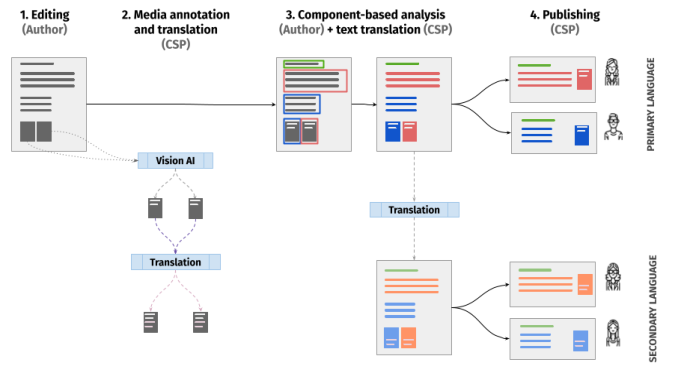
manages and publishes structured and granular content for multiple channels, user profiles and devices (Figure 1)
is integrated with services from the Google Cloud ecosystem for image recognition and automatic text translation
features a user-friendly graphical interface that simplifies the editorial process
is provided with digital rights tools, to assign different roles within the editorial staff and to enable editors on specific profiles or touchpoints
serves all output data in machine readable formats for reuse in other applications.
Intelligent Human Systems Integration (IHSI 2022): Integrating People and Intelligent Systems https://openaccess.cms-conferences.org/#/publications/book/978-1-7923-8988-7
Figure 1. Content creation and publication schema illustrating the interplay between authors and CSP. The platform supports and eases the Author Experience (AX) thanks to the integration with AI methods for media annotation and language translation.
The complexity of UniGe procedures required the use of AI tools, or else it would have been impossible to successfully address both current demands and future developments. As depicted in Figure 1, authors edit the textual content following a component-based analysis that splits the content in blocks used by CSP to generate all versions needed for individual users’ profiles. Before publication, the textual and media content is processed by a dedicated system that exploits state-of-the art deep learning methods. As the reliability of current AIs is still subpar to human intelligence in many aspects, and as the indiscriminate use of learning algorithms may propagate various forms of "algorithmic discrimination" and bias in the system (Buolamwini and Gebru, 2018), we developed UniGe's CSP according to a "hybrid human-AI (H-AI)" approach, pursuing synergy and symbiosis between human and artificial intelligence (Chen et al., 2020).
AI-driven annotation system UniGe CSP is currently used in production to publish notices, news, events and content on about 200 websites about education and research, including the main website. The AI-driven annotation system we present in this section is the part of UniGe CSP that manages and annotates multimedia components, translates text, and catalogues images and videos based on their semantic content using state-of-the-art machine learning methods. Image and media annotation
Multimedia contents that integrate text are fed into the platform by authors who are appropriately authorized. For this reason, we expect that a completely human-driven annotation may lead to heterogeneous results in terms of quantity and quality of the
Intelligent Human Systems Integration (IHSI 2022): Integrating People and Intelligent Systems https://openaccess.cms-conferences.org/#/publications/book/978-1-7923-8988-7 information associated with the media, with a very bad impact on the ability to search and reuse the data in the media library. We therefore chose to integrate into the system an annotation service based on deep learning methods (Goodfellow, Bengio and Courville, 2016), able to support the activity of CSP users in the creation and management of content.
Figure 2. The system uses Google Vision AI services to characterize the image content and produces a set of tags in English as well as their translation in Italian thanks to the integration with Google Translation (ph. Belinda Fewing - unsplash.com).
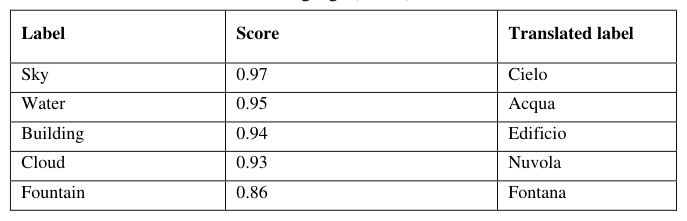
More specifically, we use pre-trained Google Vision AI models through Google Cloud APIs (ImageAnnotatorClient – Documentation) to perform label annotation. Following an image annotation request specific to the label detection feature, the model outputs a vector of label annotation objects, where (1) mid is an opaque entity ID. If present, contains a machine- generated identifier (MID) corresponding to the entity's Google Knowledge Graph entry, (2) description is the entity textual description. Labels are returned in English only and (3) score - the confidence score, which ranges from 0 (no confidence) to 1 (very high confidence) and provides the assignment probability to the class. By default, only labels with a confidence score of more than 0.5 are returned. For each media file, we retrieve and store the description vector only, retaining up to 30 labels. Although the full model architecture is not public, label IDs can be found in the Google Open Images Dataset V6 - a dataset of ~9M images annotated with 59.9M image-level labels spanning 19,957 classes (Open Images V6 – Description). Translation to the secondary language The integration with Google Translation (TranslationServiceClient - Documentation) allows the translation from the primary language to one (or, possibly, many) secondary language(s). When the system makes a translation request to Cloud Translation - Basic, text is translated using the Google Neural Machine Translation (NMT) model (Wu et al., 2016). In particular, the label description vector obtained from the image annotation phase described above is extracted from the Google Vision API response and used in the translate text request, along with the parameters identifying the primary (source) language and the secondary (target) language. The output vector contains the translations listed in the same order as the corresponding input vector. The translation of the textual content follows the same pipeline. In Table 1, we report a subset of labels and scores associated by Vision AI to the image in Figure 2 and the corresponding translated labels obtained through Google Translation.
Intelligent Human Systems Integration (IHSI 2022): Integrating People and Intelligent Systems https://openaccess.cms-conferences.org/#/publications/book/978-1-7923-8988-7
Table 1: Top-5 labels and prediction scores assigned to the image in Figure 2, and corresponding translated labels processed by Google Translation in the secondary language (Italian).
DISCUSSIONS AND CONCLUSION In this paper we discussed the adoption of an AI-driven Content Service Platform in a large public administration. In spite of strong internal resistance, the institution was highly committed to the success of the project, which span almost seven years and called for the involvement of about 20 full-time equivalents of an interdisciplinary, dedicated and highly skilled team. The adoption of the system in UniGe involved the entire course of business processes, entailed profound technological and cultural transformations, and received strong appreciation and support.
On one hand, its advent has highlighted the pressing needs for digital transformation in a typical large Italian public organization, and the excellent and tangible results obtained with a strategy relying on the integration of human processes and intelligent systems. On the other hand, the fragile political conditions necessary for such integration signal that the collective acceptance and cultural transformation required by digital technology is at least as important as the technological framework.
The interaction between human experts and the AI-driven CSP was essential to tackle the extremely challenging task of redesigning a chaotic system of hundreds of interconnected websites. Indeed, when complexity rises, the integration with AI is essential to meet high quality content standards and to avoid the generation of missing or inconsistent data. Nevertheless, AI is still lacking general inference skills and this limitation must be balanced out with human activity when designing services especially for the general public. For instance, the picture in Figure 2 is correctly characterized by the labels in Table 1, but the system could not extrapolate that the image depicts Piazza De Ferrari, the main square in Genova. To this end, human intervention is essential to complete the process of image annotation.
Our findings strongly support hybrid systems, where intelligent methods sustain, enhance, and complement the capabilities of humans, giving them control over the process and its final outcome and a clear picture of the benefits achieved. In this intermediate phase of
Intelligent Human Systems Integration (IHSI 2022): Integrating People and Intelligent Systems https://openaccess.cms-conferences.org/#/publications/book/978-1-7923-8988-7 building a hybrid human-AI, human acceptance is however a necessary condition for the success of digital transformation processes. For - as seen in UniGe - the increasing complexity calls for the adoption of smart tools, which imply a paradigm shift that is impossible to support with mere up-skilling measures alone.
REFERENCES
Ament, K. (2002) Single Sourcing: Building Modular Documentation. William Andrew. Andersen, R. and Batova, T. (2015) “The Current State of Component Content Management: An Integrative Literature Review”, IEEE Transactions on Professional Communication, 58 (3), pp. 247–270. Barker, D. (2016) Web Content Management: Systems, Features, and Best Practices.
O’Reilly Media, Inc. Bederson, B. and Shneiderman, B. (2003) The Craft of Information Visualization: Readings and Reflections. Berners-Lee, T., Hendler, J. and Lassila, O. (2001) “The semantic Web”, Scientific
American, 284 (5), pp. 34–43. Bostrom, N. (2006) “3. Welcome to a world of exponential change”, DEMOS COLLECTION, 21 (40), p. 11. Buolamwini, J. and Gebru, T. (2018) “Gender Shades: Intersectional Accuracy Disparities
in Commercial Gender Classification”, in Conference on Fairness, Accountability and Transparency. Conference on Fairness, Accountability and Transparency, PMLR, pp. 77–91. Burnett, B. and Evans, D. (2016) Designing Your Life. Chen, L. et al. (2020) “Hybrid Human-Artificial Intelligence”, Computer, 53 (8), pp. 14–17.
doi:10.1109/MC.2020.2997573. Cooley, M. (2000) “Human-centered design”, in Information Design. MIT Press, pp. 59--81. Fuggetta, A. (2018) Cittadini ai tempi di Internet: Per una cittadinanza consapevole nell’era digitale. FrancoAngeli. Goodfellow, I., Bengio, Y. and Courville, A. (2016) Deep Learning. Cambridge, MA, USA:
MIT Press (Adaptive Computation and Machine Learning series). Harari, Y.N. (2018) 21 Lessons for the 21st Century. Random House. ImageAnnotatorClient - Documentation (2021). Available at: https://googleapis.dev/nodejs/vision/latest/v1.ImageAnnotatorClient.html#annotateIm age. Kotler, P. et al. (2013) Marketing. Available at: https://researchdirect.westernsydney.edu.au/islandora/object/uws%3A17982/. Nielsen, Jakob (2006) Corporate UX Maturity: Stages 1-4, Nielsen Norman Group.
Available at: https://www.nngroup.com/articles/ux-maturity-stages-1-4/. Nielsen, Jacob (2006) Corporate UX Maturity: Stages 5-8, Nielsen Norman Group.
Available at: https://www.nngroup.com/articles/ux-maturity-stages-5-8/. Norman, D.A. (2016) Living with complexity. MIT press. Norman, D.A. and Draper, S.W. (1986) User Centered System Design; New Perspectives on Human-Computer Interaction | Guide books. Available at: https://dl.acm.org/doi/book/10.5555/576915.
Intelligent Human Systems Integration (IHSI 2022): Integrating People and Intelligent Systems https://openaccess.cms-conferences.org/#/publications/book/978-1-7923-8988-7
Norman, D.A. and Stappers, P.J. (2015) “DesignX: Complex Sociotechnical Systems”, She Ji: The Journal of Design, Economics, and Innovation, 1 (2), pp. 83–106. doi:10.1016/j.sheji.2016.01.002. Open Images V6 - Description (2021). Available at: https://storage.googleapis.com/openimages/web/factsfigures.html. Shneiderman, B. (2003) “The Eyes Have It: A Task by Data Type Taxonomy for Information
Visualizations”, in Bederson, B.B. and Shneiderman, BEN (eds) The Craft of Information Visualization. San Francisco: Morgan Kaufmann (Interactive Technologies), pp. 364–371. The Reskilling Revolution - World Economic Forum (2021). Available at: https://www.reskillingrevolution2030.org/. TranslationServiceClient - Documentation (2021). Available at: https://googleapis.dev/nodejs/translate/latest/v3beta1.TranslationServiceClient.html#t ranslateText. Vian, A. (2020) A big web redesign. Genoa University Press. Available at:
https://gup.unige.it/node/377. Wu, Y. et al. (2016) “Google’s Neural Machine Translation System: Bridging the Gap between Human and Machine Translation”, CoRR. Yaneer Bar-Yam (2004) Making things work. Necsi-Knowledge Press.
Intelligent Human Systems Integration (IHSI 2022): Integrating People and Intelligent Systems https://openaccess.cms-conferences.org/#/publications/book/978-1-7923-8988-7
LISTED IN THE AHFE DIGITAL BOOKSTORE CATALOGUE
Explore the complete digital volume
Intelligent Human Systems Integration (IHSI 2022): Integrating People and Intelligent Systems
Read this individual research paper free through the original publisher, or explore the full digital proceedings book.
ISBN 978-1-7923-8988-7
Explore this ISBN in the AHFE Bookstore ↗Listed in the July 2026 bookstore catalogue; search by ISBN to confirm current availability · Digital book purchase optional