Lin Zhu, Wentong Huang, Fu Zhiyong (2022). Future Footprint: Explore the Unexpected Future from the Existing Signals Through the Prototype Inspiration. In: Intelligent Human Systems Integration (IHSI 2022): Integrating People and Intelligent Systems. AHFE Open Access, vol. 22. https://doi.org/10.54941/ahfe1001026
Under the exponential growth of the computing power of artificial intelligence, the revolution of thinking that designers pursue turn to qualitative rather than quantitative. Instead of trying to capture as many signals as possible, it's judging and internalizing the signals. Design and art practitioners are widely considered to be the most divergent thinkers, and the early stages of design thinking include a variety of heuristic tools to guide users through brainstorming and propose as many solutions as possible in a short period. We analyzed the research of creativity generation on designers, restored and summarized their commonalities upward, and established the basic format of design signals. Based on this, we explored how to inspire designers to pull out from the rigid thinking system, to discover more unknown connotations, more perspectives, and possibilities for understanding. This paper attempts to promote a path of inspiration to explore the desirable future. By exploring and analyzing the path of designers to generate design inspiration, we propose the Prototype Inspiration tool of the future footprint and start from three dimensions of future signals, values, and personal experience. Inspire the design team to generate a quality conception of the future based on the separation, integration, and reorganization of real signals in a short time. And introduce the prototype inspiration tool with future thinking through the application and verification in the real teaching environment, which expands the dimension and depth of design ideas in the early stage of design. We inclined to think future ideas not as being created out of thin air but as being stimulated, as breaking down stereotypes by reconstructing vague, scattered information. This requires developing sensitivity to information and an accurate sense of trends. The prototype heuristic is a preliminary solution proposed by us at the present stage. In the following sections, we will apply the prototype heuristic to a more specific design context to test the effective range of the tool and discuss how the interactive effects and heuristic effects change when multiple people use AR tools remotely. We have several directions for our future work. One direction is to recognize the impact of our proposed prototype heuristic tools on the design concept in new or existing tools, and to examine the impact of creative output on the overall design process. Second, we will further quantify the designer's propensity and familiarity with the various signals, and how they use affects design activities. Third, try to bring both the input of creative inspiration and the output of creative ideas into the prototype inspiration system, that is, to realize the whole thinking process in AR. Fourth, build a community and an open platform for future resources to support online and offline collaboration among team members from multiple backgrounds.
Intelligent Human Systems Integration (IHSI 2022): Integrating People and Intelligent Systems https://openaccess.cms-conferences.org/#/publications/book/978-1-7923-8988-7
INTRODUCTION
Design and art practitioners are widely considered to be the most divergent thinkers, and the early stages of design thinking include a variety of heuristic tools to guide users through brainstorming and propose as many solutions as possible in a short period. We analyzed the research of creativity generation on designers, restored and summarized their commonalities upward, and established the basic format of design signals. Based on this, we explored how to inspire designers to pull out from the rigid thinking system, to discover more unknown connotations, more perspectives, and possibilities for understanding.
Researchers have studied creative design practices from many different angles. Gabora likens the human mind to a map in which the locations of memories are represented by neurons. Some think of the creative process as a combination of our minds and the matrix of thought in our environment (O’Neill et al. 1999). A main line of research is seeking to derive cognitive models of the creative process (Herring et al. 2009). Models of design creative processes have been evolving since at least 1926 when the first model was introduced by Wallas. Warr and O'Neill summarized the commonality of the above creative models and integrated them into a single, unified model. Their universal creative process model emphasized the similarity of the previous models. And try to reach a consensus. That is, before coming up with an idea to solve the problem, everyone looks at the information related to the problem to understand what is needed to produce an acceptable solution (Otto and Wood, 1999). Refers to this as the construction of domain knowledge (Amabile, 1983). Prototype usually appears in the later stage of the process as a way to verify design ideas. Proposed the Early Prototype Experience (EPE) to place the prototype in the Early stage of the design process to inspire designers to increase their physical understanding of the problem (Otto and Wood, 1999). In the following ten years, the design system has been growing, the stakeholders and the dimensions of the project have been greatly expanded, and the design process has gradually undergone the transformation from single-chain to multi- chain.
172 techniques were identified e for generating ideas (Smith, 1998). Based on this work, creative generation techniques used in design practice and found that designers highly utilize active and passive search among the 19 most commonly used search methods (Herring et al.2009). Passive search refers to designers looking for inspiration by browsing materials (Alexander and Henry, 2006). Moreover, searching for images on the Web has been identified as one of 19 ideation techniques most frequently utilized in design practice. It is an important and necessary stage for designers to analyze the design features of existing products in the design creation stage because it can enable designers to have a deeper understanding of design elements (Bonnardel, 1999). The designer solves a new problem by linking it to previous information, using examples as the source of inspiration and innovation in the design process (Bonnardel, 2000). In addition, designers often use similar products as design examples to compare and analyze different features. Through this evaluation, the
Intelligent Human Systems Integration (IHSI 2022): Integrating People and Intelligent Systems https://openaccess.cms-conferences.org/#/publications/book/978-1-7923-8988-7 designer transfers the functionality needed for the original product to the new design. When one is fixed on a particular idea, a combination of random and semi-random example searches can be useful for generating new ideas (Purcell and Gero, 1992). Recent research has applied these principles to the creation of APIs for Web-based services (Hartmann et al.2008). They use the concept of "crack, mash, and glue," and Mashing means selecting pieces from existing technology and repurposing their functionality. It serves as a place to communicate with other stakeholders (customers, team members, and users). Prototypes become the "essential medium for information, interaction, integration, Prototypes then present us with a different kind of embodiment, although not only they embody design ideas or specifications, render them concrete, and inform the designer's thinking (Schrage, 1996). This further inspired us to process the original information to provide information that would drive future designs.
PROTYPE INSPIRATION Prototypes are not only the internal structures of the shapes of objects and tools but also the relationships between tools and people. We call these Prototype Inspiration, the prototype is suggestive mainly because of the similarity between the properties and characteristics of the thing itself and the thing to be created. To provide multi-dimensional known information to inspire the unknown future design ideas.
In the design field, the definition of "prototype" is those solid models and models available for testing, which are the concrete expression of thinking constructed based on the design ideas of designers. Prototype inspiration is inspired from real-life examples to find ways or methods to solve problems. The things that have an inspiring effect on solving problems are called prototypes. The attributes and characteristics of every object we touch in life can form a "prototype" in the mind. In the process of problem-solving, the problem solver is inspired by some principles in the "prototype" and makes it combine the relevant knowledge of the current problem to form a solution, to creatively solve the problem. Several teams have been working on ways to introduce information sets early in the design process to explore the effects of design inspiration. But the naming of this form is not uniform. Some of them use Infrastructure, Prototype, Examples, Archetype, and so on. Herring uses the term example to refer to any material, product, prototype, or digital artifact (sketch, photograph, web page) that contributes directly or indirectly to a design.
When we sort out the design inspiration tools, we find that, the tools depend largely on personal cognition at the early stage of use due to personal differences. And similar solutions are generated by chain thinking without external intervention. Tools for personal differences in the early stage of usage depends on the individual cognition greatly, users with different background can produce a distinct direction. Users of the same background during the initial link will largely link thought of similar keywords, carried out at the beginning of a period is
Intelligent Human Systems Integration (IHSI 2022): Integrating People and Intelligent Systems https://openaccess.cms-conferences.org/#/publications/book/978-1-7923-8988-7 repetitive word association. At the beginning of each brainstorm, only a small number of single attribute information elements (such as clothing, food, housing, and transportation) are set out, and the retrieved memories are also limited by the term, and the thinking mode is more inclined to keyword search. And without outside intervention in the case of the chain to produce a very similar scheme, also known as the scheme crash.
The use of prototypes for design verification has existed for decades, and several experts have proposed to design inspiration through prototype products and verified its effectiveness through experiments. One of the most frequently mentioned problems is the resulting phenomenon of design fixation, where viewing related design objects after they are identified may limit the variety of solutions, innovation, and the number of ideas generated. The designer just made some adjustments to the local details. On the other hand, having real objects as a reference allows designers to consider more realistic realizability in their thinking (Walker et al. 2010). We believe that the reason why design is more fixed comes from the external manifestation of the prototype and the selection logic, that is, which prototype is chosen as the raw material for inspiration and the selection principle. Reason prejudges our choices before we make them, and any thought that seems illogical at first sight will be negated by itself before it can be expressed. This is where we try to find a balance between an intangible idea and a stylish product. Method of Prototype Inspiration We have been trying to explore the appropriate path of archetypal inspiration. Before this, we developed a card set based on paper (see Figure 1). Composed of 99 current news items. Use a combination of pictures and text introduction. Each card includes a news headline, picture, and text introduction. 16 users were randomly assigned, and each user received about 5 cards for independent reading. Participants worked in pairs and wrote down predictions based on the future news in the previous step. We collected and sorted out the contents filled in by participants. In general, the categories of topics are relatively rich and a large number of creative ideas have been generated in a short time. The participants accurately extracted the key information in the news, but it was influenced to some extent by the words used in the news. Based on many previous experimental experiences, we build a thinking path of three-axis control from the perspective of AR and combine all raw materials to explore the higher dimension of thinking.
Intelligent Human Systems Integration (IHSI 2022): Integrating People and Intelligent Systems https://openaccess.cms-conferences.org/#/publications/book/978-1-7923-8988-7
Figure 1. Future Footprint -99 News
Figure available in the original PDF paper.
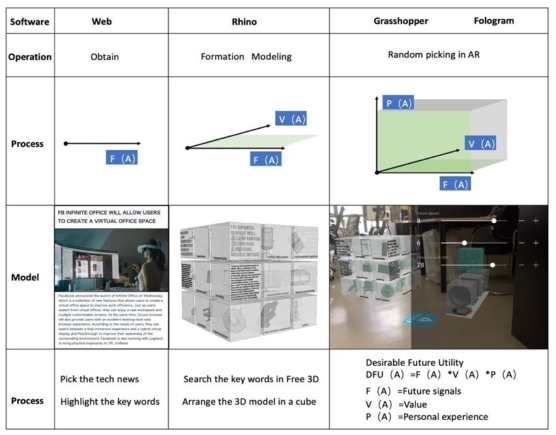
In this paper, we try to use an interactive prototype inspiration software component to realize the design scheme in the future. Starting from the construction of the future signal resource package, a design infrastructure inclusive of various options is established. Based on this, quantitative data is extracted for in-depth exploration, and systematic challenges and opportunities are addressed in this way. The exploration from the known signal to the unknown future is realized through three main steps, which are 1. Signal collection. 2. Signal processing. 3. Concept generation (see Figure 2).
Figure 2. Process of Prototype inspiration
SIGNALS PROCESSING Continuing with the 99News collection approach, we collect multiple stories from multiple information sites. The main body of news here is the product release information with a sense of science and technology and future foresight. We are currently building a repository of future signals, which will be open to the public for free. We printed the future signals into cards of uniform size and invited students majoring in design to read the contents of the cards and underline the strong signals on each card that they thought were enlightening keywords. After summarizing and sorting out the keywords of each card, we converted each signal into a table with 6 key words in a fixed format. Search for each keyword corresponding to each
Intelligent Human Systems Integration (IHSI 2022): Integrating People and Intelligent Systems https://openaccess.cms-conferences.org/#/publications/book/978-1-7923-8988-7 signal extracted from Step1 signal collection on the Free 3D website, such as "Desk", "Cotton", etc. Guarantee the correlation degree between the keywords and the model, and ensure the openness of the model. We reorganized the transformed future signals in Rhino software. After classifying each model and keywords, we put them into a Rhino cube. Each side of the cube corresponds to a complete signal and keywords, and each cube can store 4 signals. After that, we endowed the prototype inspiration with the ability of random extraction through Grasshopper.
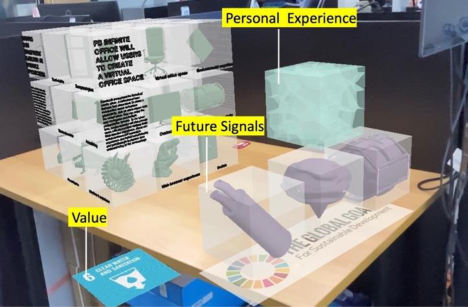
We use Fologram to create a future environment that includes the prototype product, corresponding world values, and user satisfaction, enabling real-time interaction between the user and the prototype inspiration. In addition, we set the synchronization between the mobile terminal and the computer terminal, so that we can obtain the operation records of all the devices that join the network in the AR scene through the computer terminal. We set three control axes in the Fologram: 1. Future signals, 2. Value, 3. Personal experience. Users can control the information of the three dimensions by moving the control axis. The following is an example to further introduce it. For example, the following corresponding information appears randomly after sliding the three axes (see Figure 3).
Figure 3. A real scene selected randomly in the Fologram
DISCUSSION
The prototype inspiration is a preliminary solution proposed by us at the present stage. In the following sections, we will apply it to a more specific design context to test the effective range of the tool and discuss how the interactive effects and heuristic effects change when multiple people use AR tools remotely. We have several directions for our future work. One direction is to recognize the impact of our proposed prototype heuristic tools on the design concept in new or existing tools, and to examine the impact of creative output on the overall
Intelligent Human Systems Integration (IHSI 2022): Integrating People and Intelligent Systems https://openaccess.cms-conferences.org/#/publications/book/978-1-7923-8988-7 design process. Second, we will further quantify the designer's propensity and familiarity with the various signals, and how their use affects design activities. Third, try to bring both the input of creative inspiration and the output of creative ideas into the prototype inspiration system, that is, to realize the whole thinking process in AR. Fourth, build a community and an open platform for future resources to support online and offline collaboration among team members from multiple backgrounds.
CONCLUSIONS
We compared multiple design inspiration process models’ overtime to find the elements that emerged in different periods and continued to this day, to determine the dimensions that should be considered when inspiring designers to design relevant systems in the future. Otto & Wood proposed that the prototype should be placed at the beginning of the design process as the carrier of inspiration. Subsequently, many scholars supported this idea and made evolution, but the mainstream design process still only regarded it as a way to verify design ideas. Introducing prototypes early on can lead to design fixation, which is one of the main reasons that prevent prototypes from being used as heuristic tools. We use Fologram to operate the future signal as a design resource in the creative design process. Explore from the fusion of images to stimulate the creation of information reconstruction. Through the path between prototype and design concept and weaken its direct correlation, help designers to put forward forward-looking product service system design scheme.
ACKNOWLEDGMENTS
This paper is supported by Tsinghua University Teaching Reform Project (2020 autumn DX05_01 Creativity, innovation and entrepreneurship education), Prototype innovation resource library and prototype demonstration system for integrated teaching.
REFERENCES
Alexander, F. and Henry, L. (2006). A Goal-Oriented Web Browser.Proc. CHI, 2006, pp.751-760. Amabile, T., (1983). The Social Psychology of Creativity. 1st ed. New York: Springer-
Verlag. Bonnardel, N. (1999). Creativity in Design Activities: The Role of Analogies in a Constrained Cognitive Environment. Proc. Creativity & Cognition, pp.158-165. Bonnardel, N., (2000). Towards understanding and supporting creativity in design: analogies
in a constrained cognitive environment. Knowledge-Based Systems, 13, pp.505-513.
Intelligent Human Systems Integration (IHSI 2022): Integrating People and Intelligent Systems https://openaccess.cms-conferences.org/#/publications/book/978-1-7923-8988-7
Herring, S., Chang, C., Krantzler, J. and Bailey, B., (2009). Getting Inspired! Understanding How and Why Examples are Used in Creative Design Practice. CHI 2009, Design Methods, pp.87-96. Herring, S. R., Chang, C.-C., Krantzler, J., & Bailey, B. P. (2009). Getting inspired!
Understanding how and why examples are used in creative design practice. In Proceedings of the ACM conference on human factors in computing systems (CHI’09) .pp. 87–96. Hartmann, B., Doorley, S. and Klemmer, S., (2008). Hacking, Mashing, Gluing: Understanding Opportunistic Design. IEEE Pervasive Computing, 7(3), pp.46-54. Kirsh, D. and Maglio, P., (1994). On Distinguishing Epistemic from Pragmatic Action.
Cognitive Science, 18(4), pp.513-549. Miller, S., Jones, B. and Bailey, B., (2009). Idea Generation Techniques among Creative Professionals. HICSS. O’Neill, E., Johnson, P. and Johnson, H., (1999). Representations and User-Developer
Interaction in Cooperative Analysis and Design. Human–Computer Interaction, 14(1- 2), pp.43-91. Osborn, A., (1963). Applied imagination; principles and procedures of creative problemsolving. 2nd ed. New York: Scribeners and Sons. Otto, K. and Wood, K., (1999). Product design. Upper Saddle River, NJ: Prentice Hall. Purcell, A. and Gero, J., (1992). Effects of examples on the results of a design
activity. Knowledge-Based Systems, 5(1), pp.82-91. Schrage, M,(1996). Cultures of Prototyping, in Bringing Design to Software, T. Winograd, Editor. ACM Press: New York, pp.191-213. Shneiderman, B., (2000). Creating creativity. ACM Transactions on Computer-Human
Interaction, 7(1), pp.114-138. SMITH, G., (1998). Idea-Generation Techniques: A Formulary of Active Ingredients. The Journal of Creative Behavior, 32(2), pp.107-134. S.R. Klemmer, B. Hartmann, and L.Takayama, (2006). How Bodies Matter: FiveThemes for
Interaction Design, Proc.6th Conf. Designing Interactive Systems,ACM Press, pp. 140–149. WALKER, V., JENSEN, D., CRIDER, K., WEAVER, J., WOOD, K. & MAIXNER, M.
(2010). Effects of an early prototyping experience on the innovation process: Can design fixation be avoided? ASEE Annual Conference and Exposition, Conference Proceedings. Warr, A. and O'Neill, E., (2005). Understanding Design as a Social Creative Process. Creativity & Cognition, 2005, pp.118- 127.
Intelligent Human Systems Integration (IHSI 2022): Integrating People and Intelligent Systems https://openaccess.cms-conferences.org/#/publications/book/978-1-7923-8988-7
LISTED IN THE AHFE DIGITAL BOOKSTORE CATALOGUE
Explore the complete digital volume
Intelligent Human Systems Integration (IHSI 2022): Integrating People and Intelligent Systems
Read this individual research paper free through the original publisher, or explore the full digital proceedings book.
ISBN 978-1-7923-8988-7
Explore this ISBN in the AHFE Bookstore ↗Listed in the July 2026 bookstore catalogue; search by ISBN to confirm current availability · Digital book purchase optional