Afnan Zafar, Marja Ahola (2022). Internationalisation of Finnish Firms and Use of Digital Solutions. In: Human Interaction & Emerging Technologies (IHIET-AI 2022): Artificial Intelligence & Future Applications. AHFE Open Access, vol. 23. https://doi.org/10.54941/ahfe100911
Firms in Finland are experiencing an immense shortage of skilled workers, and one of the many ways to cope with this shortage is the internationalisation of firms. The starting point of internationalisation of the firm is the smooth induction process of foreign background employees in the firm and utilising digital solutions. This paper explores different ways firms use to enhance the employees’ induction process and promote internationalisation. The data has been collected from 36 firms from Finland in the interview form between 2020-2021. The collected data were analysed qualitatively and provided widespread information. This paper focuses on the induction and internationalisation side of data. The study explains digital solutions, orientation-training programs, promoting an inclusive work culture and background evaluations to enhance the induction process. The practical implication of this study is to provide guidelines and bases to develop further digital solutions for the induction process in Finnish firms.
Finland is famous for innovation and technological growth in many industrial sectors (Schienstock, 2016). Due to the demand, the need for highly skilled workers increased
Human Interaction & Emerging Technologies (IHIET-AI 2022) Artificial Intelligence & Future Applications https://openaccess.cms-conferences.org/#/publications/book/978-1-7923-8989-4 many folds in the last decade (Zafar & Kantola, 2019) in various industrial segments. Multinational companies (MNCs) that have headquarters or regional offices internationally can manage required skilled workers from abroad (Aalto, 2020). At the national level, small and medium-sized enterprises (SMEs) cannot adapt to this trend to solve the local shortage of skilled workers in their organizations (Sustainability Barometer, 2021). There are many barriers to adopting similar strategies in SMEs, such as lack of internationalization (Fletcher, 2001), training and integration resources (Zafar & Ahola, 2021), time and financial limitations (Sustainability Barometer, 2021), language-related issues (Heikkilä, 2005), and inability to accept future challenges (Nichols & Virsinger, 2021). Recent official data showed that an estimated 30000 workers are needed by 2030 to replace the ageing population of Finland (Central Chamber of Commerce, 2021).
Many projects at the national and EU levels try to facilitate talent searches, recruitment, induction, job training, and integration at work in Finnish companies (Talent Boost Cookbook Finland 2.0, 2020). MALVA project (Preparing immigrants for working life) is one such project (LAB, 2020). The project has many goals, but this paper focuses on two of those; induction of foreign employees and usage of digital tools to help the workplace counsellors. The paper explores the current insights about the induction of foreign background employees and firms and their internationalisation standings in the Päijät-Häme (Lahti) and Uusimaa (Capital) regions of Finland. Against this background, the purpose of this paper is to answer the following research questions (RQs): RQ 1: What are the processes that Finnish firms follow for the induction of foreign background employees?
RQ 2: What is the current situation of the firms and their internationalisation concerning the induction of foreign background employees?
More specifically, this study has two main objectives:
To explore the induction process of foreign background employees
To explore the firms and their internalisation The RQs and objectives are to investigate 36 Finnish firms in Päijät-Häme (Lahti) and Uusimaa (Capital) regions of Finland. The paper has four chapters. First, it describes the background research followed by research methods. Next, the analysis is summarised. The article ends with a discussion, conclusion, implications, and scope for future research.
RESEARCH BACKGROUND In the past, the word ‘internationalisation’ circulated a lot in business and technology-
Human Interaction & Emerging Technologies (IHIET-AI 2022) Artificial Intelligence & Future Applications https://openaccess.cms-conferences.org/#/publications/book/978-1-7923-8989-4 related literature (Johanson & Vahlne, 1990). Governments also use this word repeatedly in their official policy documents (Internationalisation of Enterprises, 2020). There is a demographic (age, sex, education, country of birth) side of internationalisation and how people interact with the external world in travel, trade, cultural adaptation, and various types of international transactions (Fletcher, 2001). An-other parameter for internationalisation at the organisational level is the development of new products for external markets (Pries & Schweer, 2004), utilising the technological advantage in a new market (Fletcher, 2001) (Zafar, 2021), investing in international activities (Johanson & Vahlne, 1990), spending resources on R&D (Gammeltoft, 2006) and mapping the international competitors’ activities (Mathews & Zander, 2007).
Digitalisation has been hand in hand with internationalisation (Lee et al., 2019). The starting point of the digitalisation discussion is mainly about transforming the existing solutions into digital solutions and reducing the time and use of human resources in the meantime (Parviainen et al., 2017). Research also noted that digitalisation is valuable for approaching and capturing international markets (Lee et al., 2019). The global digital banking products and e-residency programs are examples of the digitalisation products contributing heavily to international businesses (HAN, 2011) (Tammpuu & Masso, 2018). Digitalisation has remarkably reduced the costs of international trade and improved the connectivity with international business partners and customers (Neubert, 2018).
Over the last decade, internationalisation and digitalisation-focused projects have gotten much attention and funding in Finland (Valtakari et al., 2021). Hiring foreign background workers is a way to promote internationalisation in firms (Koski et al., 2020). Digitalisation and internationalisation have struggled while hiring foreign background workers from abroad or within Finland (International Talent Attraction, Tampere 2019). There are many barriers that Finnish firms face when adapting foreign background workforce (Nichols & Virsinger, 2021). One of the crucial barriers is the difficult induction and integration process (International Talent Attraction, Tampere 2019) of foreign background employees within the Finnish firm (Nichols & Virsinger, 2021). Some projects have helped to improve the employability of foreign background workers (Talent Boost Cookbook Finland 2.0, 2020), but the usage of digital tools in a similar induction workforce is not very visible. However, the Finnish Government has repeatedly highlighted the importance of integration, internationalisation, and digitalisation in various contexts (Valtakari et al., 2021). But it is now time to review how the internationalisation and digitalisation process concept trickles down to ground level Finnish firms, particularly when inducting foreign background employees.
METHODS
The survey and interviews were conducted using a single questionnaire consisting of
14 questions. Most of the questions were open-ended and some were multiple-choice questions. The questionnaires mainly covered topics such as the respondent's role in the company, company induction models and availability of digital materials. It also asked about financial resources, type of digital tools used in the company, induction of new employees (local and remote), pandemic impact, the customized orientation of employees with an immigrant background and willingness to cooperate with the Malva project team.
A Google questionnaire and cover letter were sent to the companies via email. The content and approach of the message were also carefully discussed with the representatives of the steering group in order to arouse interest in the companies. The companies were later contacted by direct phone calls. A total of 126 companies were contacted by e-mail or telephone and 56 companies replied. Data of 36 firms were used in this article based on full completion of telephonic interviews.
In the companies interviewed, those in charge of orientation had many job titles, for example: team coach, service supervisor, service supervisor, tutor supervisor, store manager, marketing manager, career supervisor, project supervisor, foreman, human resources manager, supervisor, managing director or development director, deputy managing director, recruitment unit expert, competence development director, transport, factory or production manager, unit manager, training manager or team leader. The choice of respondents was made carefully to obtain the best information from the companies.
The companies belonged to various industries, such as care and nursing, wood industry, clothing, IT, food production, building materials, logistics, personnel and training services, manufacturing and packaging, waste management, water heating and cooling companies, and areas of trade. About 53% of the companies were large (more than 250 employees), about 10% were medium-sized (50-249 employees) and about 37% were small (less than 50 employees). The companies were all located in Päijät-Häme and Uusimaa.
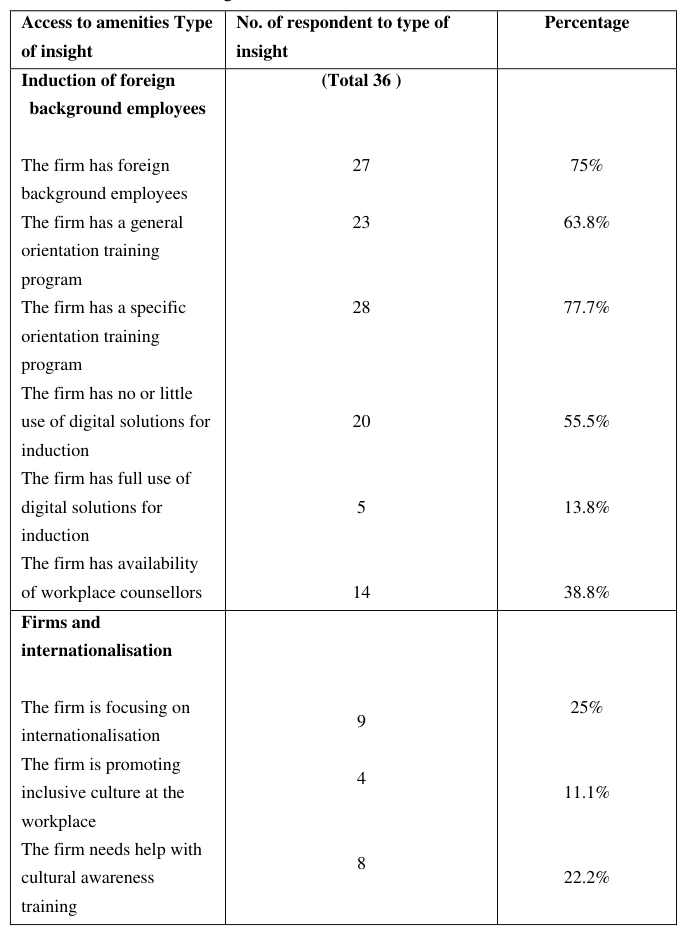
ANALYSIS The interview data were qualitatively analysed and grouped based on the relevance of information. Insights were grouped into five categories, and each group was further divided into subcategories. The scope of this article covers the first two groups of insights which are: induction of foreign background employees and firms and internationalisation. The first group was subdivided into six subcategories, and the second group was subdivided into three categories. 75% of the firms from the dataset have foreign background employees, and 77.7% of firms have specific orientation training programs available in their firms to induct new employees. Table 1 elaborates each insight, related number of respondents and percentage of the respondent.
DISCUSSION AND CONCLUSION This paper explores linkages between the induction of foreign background employees and firms and internalization in Päijät-Häme (Lahti) and Uusimaa (Capital) region firms. The data analysis showed various processes that Finnish firms follow for induction of foreign background employees as the answer to RQ1. The qualitative data explains five subcategories of induction of foreign background employees such as the existence of foreign background employees in the firms (75%), availability of general and specific orientation training programs (63.8% and 77.7%), little or no use of digital solutions for induction (55.5%), full use of digital solutions for induction (13.8%) and availability of workplace counsellors (38.8%). Table 1 shows that 75% of interviewed firms have foreign background employees working for them in various roles. In contrast, companies have generalised and developed specific training based on the type of job that the employees must do. But only 38% of companies have workplace counsellors to help the induction process. While around 55% of firms have little or no use of digital tools for the induction process. Only about 13% of firms were fully utilising digital tools for the induction of foreign background employees. Lack of digital solutions usage put extra pressure on human training and inductions, which was visible in the everyday work life of the interviewed firms.
The data also provides us with information regarding the internationalisation of firms as the answer to RQ2. Internationalisation is divided into three subcategories based on the collected data. The data showed the focus of firms on internationalisation (25%), promotion of inclusive culture at the workplace (11.1%) and firms are looking actively for cultural awareness training for their employees (22.2%). Although Finland’s Government's official policies (Talent Boost Cookbook Finland 2.0, 2020) focus on the internationalisation of firms at various levels, the collected data showed that very few organisations translating that focus of internationalisation in reality. This finding led to the contrast between Government policies and understanding and implementation of internationalisation on the ground.
This research helps us to understand the present situation of the induction process of foreign background employees and the internationalisation of firms. Analysed data provided the on-ground picture about the understanding and implementation of Government policies. It is an important implication of this research to provide clarity in the internationalisation message and provide digital resources to local businesses to induct foreign background employees. A limitation of this research is the sample size used to collect the dataset, which consisted of only two regions of Finland (Päijät- Häme and Uusimaa). Expansion of data collection in Finland could be helpful to provide a better understanding of the national behaviours of firms and the development of digital induction solutions in firms.
Aalto 2020. (n.d.). Retrieved December 10, 2021, from https://www.aalto.fi/en/department-of-management-studies/information-on- foreign-owned-corporations-in-finland-today Central Chamber of Commerce. (2021).
https://kauppakamari.fi/tiedote/keskuskauppakamari-osaamisperusteisen- maahanmuuton-tavoitteeksi-valittomasti-30 000-vuosittaista-tulijaa/ Fletcher, R. (2001). A holistic approach to internationalisation. International Business Review, 10(1), 25–49. https://doi.org/10.1016/S0969- 5931(00)00039-1 Gammeltoft, P. (2006). Internationalisation of R&D: Trends, drivers and managerial
challenges. International Journal of Technology and Globalisation, 2(1–2), 177–179. https://doi.org/10.1504/IJTG.2006.009133 HAN, M. (2011). ACHIEVING SUPERIOR INTERNATIONALIZATION THROUGH STRATEGIC AMBIDEXTERITY. Http://Dx.Doi.Org/10.1142/S0218495807000046, 15(01), 43–77. https://doi.org/10.1142/S0218495807000046 Heikkilä, E. (2005). Mobile vulnerabilities: perspectives on the vulnerabilities of
immigrants in the Finnish labour market. Population, Space and Place, 11(6), 485–497. https://doi.org/10.1002/PSP.396 International Talent Attraction, Tampere 2019. (n.d.). Internationalisation of enterprises, 2020. (n.d.). Retrieved December 10, 2021, from https://tem.fi/en/internationalisation-of-enterprises Johanson, J., & Vahlne, J. E. (1990). The Mechanism of Internationalisation.
International Marketing Review, 7(4). https://doi.org/10.1108/02651339010137414/FULL/XML Koski, H., Pajarinen, M., Ylhäinen, I., & Nevavuo, J. (2020). GLOBAL GROWTH FOR COMPANIES Impact Study. LAB. (2020). MALVA - Preparing immigrants for Working life. Lee, Y.-Y., Falahat, M., Sia, B.-K., & Rahman, A. (2019). Impact of Digitalization
on the Speed of Internationalization. International Business Research, 12(4). https://doi.org/10.5539/ibr.v12n4p1 Mathews, J. A., & Zander, I. (2007). The international entrepreneurial dynamics of accelerated internationalisation. Journal of International Business Studies 2007 38:3, 38(3), 387–403. https://doi.org/10.1057/PALGRAVE.JIBS.8400271 Neubert, M. (2018). The Impact of Digitalization on the Speed of
Internationalization of Lean Global Startups. https://papers.ssrn.com/abstract=3394507 Nichols, S., & Virsinger, P. (2021). “Always standing on the fragile side of ice”: Immigrants’ integration into the labor market in Finland-Report. Parviainen, P., Tihinen, M., Kääriäinen, J., & Teppola, S. (2017). Tackling the
Digitalisation Challenge: How to Benefit from Digitalisation in Practice.
International Journal of Information Systems and Project Management, 5(1), 63–77. https://doi.org/10.12821/IJISPM050104 Pries, L., & Schweer, O. (2004). The product development process as a measuring tool for company internationalisation? The case studies of DaimlerChrysler and Volkswagen. International Journal of Automotive Technology and Management, 4(1), 1–21. https://doi.org/10.1504/IJATM.2004.004393 Schienstock, G. (2016). From Path Dependency to Path Creation: Finland on its
Way to the Knowledge-Based Economy. Http://Dx.Doi.Org/10.1177/0011392107070136, 55(1), 92–109. https://doi.org/10.1177/0011392107070136 Sustainability Barometer, 2021. (n.d.). Retrieved December 10, 2021, from https://ek.fi/en/current/bulletins/finlands-sme-sustainability-barometer- employees-are-the-most-important-aspect-of-sustainability-for-sme- employers/ Talent Boost Cookbook Finland 2.0. (2020).
https://tem.fi/documents/1410877/0/Talent+Boost+Cookbook+Finland_2.0_F INAL.pdf/137bb163-1029-66ce-ce7d- 1e81cf764775/Talent+Boost+Cookbook+Finland_2.0_FINAL.pdf?t=1615875 183962 Tammpuu, P., & Masso, A. (2018). ‘Welcome to the virtual state’: Estonian eresidency and the digitalised state as a commodity: Https://Doi.Org/10.1177/1367549417751148, 21(5), 543–560. https://doi.org/10.1177/1367549417751148 Valtakari, M., Nyman, J., Eskelinen, J., Oosi, O., Wennberg, M., Viitanen, J., &
Melkior, M. (2021). BUSINESS FINLAND PROGRAMS ADVANCING DIGITALIZATION Evaluation of a continuum of 13 programs and 15 years Program evaluation report. Zafar, A. (2021). Survival of Fittest: Open Innovation and Product Development Linkages. Lecture Notes in Networks and Systems, 319, 1131–1137. https://doi.org/10.1007/978-3-030-85540-6_145 Zafar, A., & Ahola, M. (2021). Human-Artificial Systems Collaboration in Service
Innovation and Social Inclusion. 527–532. https://doi.org/10.1007/978-3-030- 68017-6_78 Zafar, A., & Kantola, J. (2019). Brain drain in Finland; a real threat or a myth and its impact on Finland’s R&D capabilities. Zeszyty Naukowe Politechniki Poznańskiej. Organizacja i Zarządzanie, 79(nr 79), 243–256. https://doi.org/10.21008/J.0239-9415.2019.079.16
Read this individual research paper free through the original publisher, or explore the full digital proceedings book.
ISBN 978-1-7923-8989-4
Explore this ISBN in the AHFE Bookstore ↗Listed in the July 2026 bookstore catalogue; search by ISBN to confirm current availability · Digital book purchase optional