Analysis, research and comparison on the technological impact had a social level in the past, current and future generations. Project development for a digital maintenance laboratory dedicated to assisted autonomous repair by the citizen.Society is continually facing radical changes and mutations. In the last year, mainly due to the disorder created by the arrival of the global pandemic, the population has come closer to digital tools and moved away from direct, real and more alive human contact. The new condition has led to reconsidering the relationship with digital technology, and has brought out the weaknesses and criticalities that society still has today with regard to technologies and the digitization of services. Technological innovation and the ever-increasing speed with which change occurs have led to a radical transformation of the known world until now.Advanced robotics, artificial intelligence, big data, blockchain are just some of the factors that, combined and integrated with each other, are affecting the sphere of work, society as a whole, and everyone's daily life. Not everyone is ready to face this revolution, which is why the topic addressed concerns the difficulties encountered in relation to the use of new technologies by citizens. Technology and technostress are phenomena that affect not only mature generations but also young people and these factors affect their well-being. According to the numerous studies analyzed on the subject (starting from the thought of Rosen and Weil in the 1980s, up to Thorpe and Brosnan in their studies on phobic disorders) one of the most appropriate actions to improve the approach is those that can be defined hybrid psycho-digital spaces is a targeted action towards a technological education accessible to all that directly implements the education of technologies in a greater way, without barriers and obstacles, above all cognitive and psychic towards those who still feel and believe outside this technological sphere.The proposal is to create a hybrid space alternating between physical and virtual, shared and common, usable by every citizen where they can feel safe, understood and motivated in the use of digital tools and technologies. One of the points of the project will be in the deepening of "digital maintenance" and everything that entails, starting from the programmed obsolescence of electronic devices up to the assisted repair or self-repair directly by the citizen to abandon the economy of use and throws. The project development space will offer specific virtual and non-virtual services. It will be a support to the citizen in the context of neighborhood life by creating a connection between the inhabitants and the power of sharing knowledge in the technological field. The objectives will aim to make citizens aware of autonomous and possible maintenance for their digital devices, and therefore to reduce electronic waste to encourage a planned reuse of what they already own.
Time Magazine in 1982 proclaimed the "computer" as "man of the year". Apparently, whoever influenced the lives of Americans that year more than anyone else is a machine and not a man. It is official that a new era is beginning for mankind. A
Human Interaction & Emerging Technologies (IHIET-AI 2022) Artificial Intelligence & Future Applications https://openaccess.cms-conferences.org/#/publications/book/978-1-7923-8989-4 revolution is underway between the two millennia, demonstrating what will then happen in the future and which will have a strong impact not only on the computer world but on all spaces and areas in relation to postmodern man. At the heart of this change is the digitization of all services, tools and access keys to a future life made up of information useful for extending and increasing human mental and mnemonic abilities.Especially starting from the 90s, society and every citizen comprising this network found themselves overwhelmed by media and technologies that have become digital and thus the World Wide Web was born; a space called "Internet". This space will give access to a disproportionate number of technologies attached to the opening of a portal for the management and publication of multimedia content of all kinds and will also lead to the birth of new services that will involve programs, data, applications, etc.
But was the world ready to welcome all this?
Now, not everything that man needs during his daily life turns out to be tangible. The elements previously seen as vital are now suspended in a network that is not visible to the eyes of those who cannot see. Man must prepare himself for a new vision of using the services offered; being able to understand that even what is immaterial can exist and can be useful for carrying out tasks, actions and comforts. The debate takes place in the understanding of the manuality of our actions. Very often we try to understand if we can keep under our control, updated, and tested even what we do not create directly with our hands. We do not place our total trust in technology but we take the right to always keep some reserves. We still need material confirmation that keeps us clinging like a thread to the reality of things. The debate opens between the digital service offered and the credibility we place in it, as it cannot be used directly with our hands. The goal is to challenge our trust and make the digital ideology accessible without any reservations, with a totally free mind and in total safety. The human psyche, the new millennium and the generational change can sometimes build walls towards this new world made up not of lands to be conquered but made of new interconnected networks to amplify and conquer a new knowledge for the benefit of oneself and also of one's community.
DIGITAL MAINTENANCE Maintenance is an ancient activity, and it is natural to connect it to the concept of time and wear. Maintenance is linked to the very evolution of civilization and the logic of building and producing for the benefit of human life and well-being. For each product or good, its maintainability is an "investment" to guarantee its durability. Over the decades, the term of maintenance has brought with it different meanings and concepts based on the areas of application. In the 1970s it was recognized as the "science of conservation" and a new term "terotechnology" was also coined, which literally means conservation technology intended above all in the industrial field. The British Standard Institution defines terotechnology as: “a combination of management, finance, engineering and other disciplines, applied to physical assets to pursue an
Human Interaction & Emerging Technologies (IHIET-AI 2022) Artificial Intelligence & Future Applications https://openaccess.cms-conferences.org/#/publications/book/978-1-7923-8989-4 economic life cycle cost related to them. This objective is achieved with the design and application of availability and maintainability to plants, machines, equipment, buildings and structures in general, considering their design, installation, maintenance, improvement, replacement with all the consequent returns information on design, performance and costs. Over the decades, the maintenance of physical things has therefore changed its role based on the needs of companies and users in the context of production and disposal. To date, the concept of maintenance no longer stops only at physical things but also needs to include virtual and hybrid ones. Maintenance no longer deals only with furniture, accessories and physical tools but also with digital and technological devices, which can have a strong impact not only on the need for the disposal of objects but also on their own dispersion and toxicity with an environmental impact to the detriment of every living being. Maintenance can be used as a tool to extend the life cycle of a product and, therefore, postponing its disuse with respect to the time set at the time of production. In fact, in the area of environmental sustainability, maintenance plays an essential role in fulfilling certain stipulated principles also in order to better manage the available resources. In 2011, the OECD introduced a real principle that could summarize the simplest but fundamental operations for the care of useful things, it is the principle of the 3 Rs: Reduce, Reuse, Recycle. This principle, belonging to the circular economy, is also valid in the context of new technologies where in addition to the 3Rs, the concept of preventive maintenance is added, with the role of preserving what is still efficient. (Latouche, 2012)
Preventive maintenance is a policy that aims to perform a "revision", "replacement" or "repair" maintenance intervention, before the component fails. Based on the field of application in which a durable good is used, it is important to assess its reliability in real operating conditions, to anticipate the occurrence of failures through a prognostic ability, in order to mitigate system risks. Maintenance and its many facets of application could be one of the solutions applicable to digital objects of daily use to postpone their disuse not only in large companies but also between individuals such as individual citizens. The performing equilibrium action should be able to be easily included by any subject, therefore capable of carrying out maintenance on their assets without any cognitive and application limits. (Crawford, 2009)
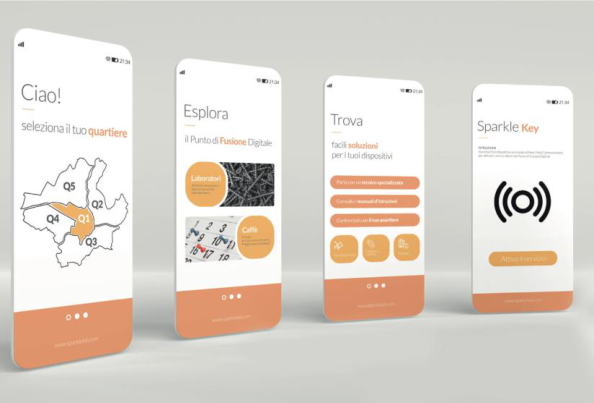
HYBRID LABORATORIES FOR DIGITAL MAINTENANCE The project was born from the idea that each of us can have access to technological knowledge. The goal is to develop a network of hybrid laboratories for the maintenance of its digital devices. The subjects included within the connection network are fundamental for the birth of the Fusion Point, a place divided between physical and virtual reality that in a hybrid form leads to the sharing of technological knowledge in aid of the daily needs of citizens inside of new smart cities and suburbs.
The fusion is intended as a fusion between mind and practice, between tradition and technology, between the child and the adult, between the home environment and the speed of the world market. A specific logic was drawn up for the laboratories
Human Interaction & Emerging Technologies (IHIET-AI 2022) Artificial Intelligence & Future Applications https://openaccess.cms-conferences.org/#/publications/book/978-1-7923-8989-4 according to the urban structure of the city of Florence, the neighborhoods were taken into consideration for a possible redevelopment and inclusion of the digital maintenance laboratories provided for by the Digital Fusion Point. The territorial arrangement of the maintenance laboratories foresees the branching from the city center and therefore district 1 then proceeding towards the outermost districts.
SPACES FOR SHARED KNOWLEDGE By examining the future space considered, it was hypothesized to divide the laboratory into four areas related to the intended objective. The objective of the Fusion Point is to bring support and help to citizens active within urban life where they will be able to meet to discuss and take advantage of the services for the repair, maintenance and replacement of their digital devices including including household appliances but including in the dimension of the AI - Artificial intelligence. By digital devices we mean all those that are part of the home and everyday environment. Examples including: smartphones, tablets, computers, microwaves, washing machines, speakers, etc. The complex, created inside a historic building in the center of the city of Florence with an adjoining cloister, includes:
- A welcome area with an information point and Bookcrossing;
- Self service area for the release and collection of repaired items;
- Two laboratories including one for direct repair and assisted repair, one for total self-repair;
- A Digital Detox area located in the external area of the cloister;
- A coffee area with a special digital showcase for courses, seminars and updates on new technologies being released.
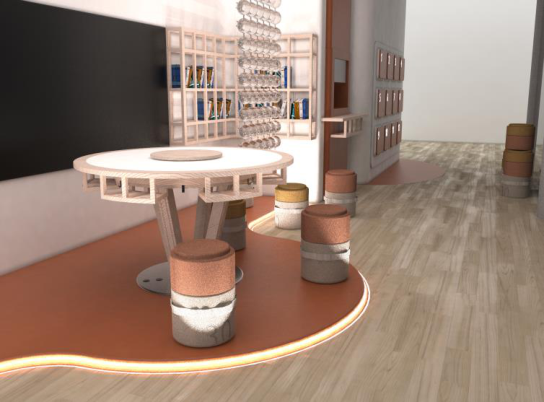
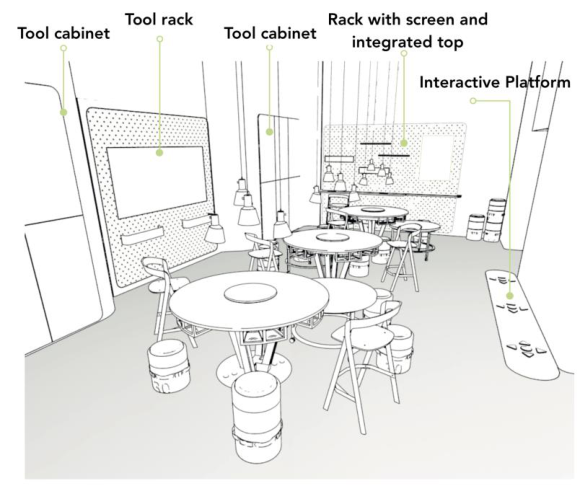
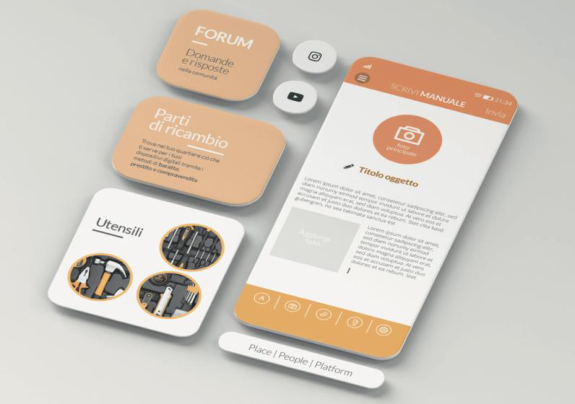
Each area has modular and stackable seats, tables and work benches equipped for assembly and disassembly of equipment, racks with usable tools and with the choice of rental at home, interactive screens to follow instruction manuals and video demonstrations, finally direct support from of on-site technicians specialized in various fields including electronic, computer and mechanical engineering. In addition to the technicians always present, external collaborators will also be active on call, such as: electricians, plumbers and other different figures interested in the maintenance of devices for problem solving. The entire project will develop on simple and repeated shapes with chromatic variations; recycled materials from industrial processing waste; approach of augmented reality available to the user and therefore a synthesis of balance between digitalization and natural elements.
Figure 1. 3D Model and rendering dedicated to explain welcome area, do-it-yourself services, technical and administrative offices.Figure 2. Explanatory scheme of the self-repair laboratory.
The need to design experiences and spaces that are able to hold together the physical and virtual dimensions, is confirmed not only by the project, especially by the experiences that have developed in recent years following the pandemic.
What we can say is that these two dimensions are enriched and mutually enhanced by highlighting new research perspectives. Here the concept of maintenance finds a new intangible dimension and allows new perspectives for design investigation that only at first glance can appear contradictory with the principle of innovation and digital innovation in particular.
REFERENCES
Bentivogli M., (2014), Contrordine compagni, Manuale di resistenza alla tecnologia per la riscossa del lavoro e dell’Italia, p. 300, Rizzoli, Milano Crawford M., (2009), Shop Class as Soulcraft: An inquiry into the value of work,
Penguin group, p. 249, Londra Latouche S., (2012), Usa e getta, le follie dell’obsolescenza programmata, p. 152, Bollati Boringhieri, Torino Lee S. Robert, (1970),Social Attitudes and the computer revolution, Public Opinion
Quarterly, Volume 34-Issue 1, pp. 53-59, Oxford Academic, Spring Montani P., (2014) , Tecnologie della sensibilità. Estetica e immaginazione interattiva, p. 104, Cortina Raffaello, Milano
Read this individual research paper free through the original publisher, or explore the full digital proceedings book.
ISBN 978-1-7923-8989-4
Explore this ISBN in the AHFE Bookstore ↗Listed in the July 2026 bookstore catalogue; search by ISBN to confirm current availability · Digital book purchase optional