Zhiwei Mo (2022). On the Product Service System Design of Diabetes Management for Patients. In: Human Interaction & Emerging Technologies (IHIET-AI 2022): Artificial Intelligence & Future Applications. AHFE Open Access, vol. 23. https://doi.org/10.54941/ahfe100923
The increasing number of chronic patients is still a problem for the Italian medical system. In the age of digitalization, digital technology offers many opportunities for helping these patients solve problems, through advanced technologies such as the Internet of Things, big data, and cloud computing, smart devices can be used to collect and analyze the health information of diabetic patients, and transmit it to medical institutions in a form of visual models for obtaining reasonable treatment recommendations timely. This smart product can analyze the patient's health data in real time, meet the needs of the patient, and facilitate the connection between the patient and various medical institutions. This paper studies the product service system centered on diabetic patients, designs a smart device with blood sugar testing, and provides an Italian localized solution.
In Italy, diabetes is a common non-infectious chronic disease. Approximately 3 million people have been diagnosed with diabetes. There are about 1.5 million people who are unaware that they have the disease. Type 2 diabetes and unidentified diabetes account for about 95% of the total number of patients, while type 1 diabetes patients account for 5% (Conoscere il diabete). This could have serious consequences, because diabetes may lead to coronary heart disease, a stroke, microvascular complications, neuropathy, lower limb amputation and other diseases, which has a negative impact on the lives and financial situation of diabetic patients (Jessica, Harding, Meda, Pavkov, Dianna, Magliano, Jonathan, Shaw & Edward, Gregg, 2019).
Diabetes can be treated and controlled, but it cannot be cured. In 2018, the proportion of people with diabetes who were hospitalized in Italy was 7.54% (Epidemiologia delle ospedalizzazioni per diabete in Italia). This means that more and more diabetic patients choose to take medicine to control their blood glucose. Self-testing blood glucose can be an important tool for diabetes management. This result can help doctors assess the degree of glucose metabolism disorders of diabetic patients, provide reasonable hypoglycemia care plans, evaluate treatment effects and improve treatment plans (Automonitoraggio glicemico).
At present, the self-testing method for diabetic patients in Italy is usually to take blood samples for testing, and then diabetic patients fill in the diary with the test results (Chinese Journal of Medical Frontiers, 2011). This method may cause fear in the patient and cannot upload data instantly. Without data sharing, medical institutions cannot immediately access to test results, which can easily lead to disease progression. Patients may also miss the best time for treatment. Digital technology can promote the sharing of information and data among people, devices and institutions. Smart devices provide people with the opportunity to manage health data. Cloud computing and cloud services make up for the limitations of the computing and storage capabilities of mobile devices. The development of these technologies has facilitated the integration of online and offline services, bringing new opportunities to the healthcare service industry. Diabetes patients can get more efficient and faster health management programs. Therefore, it is necessary to develop a health management service for people with diabetes.
THEORETICAL RESEARCH Product Service System (PSS) is a reflection on the unsustainable development caused by extensive industrial production. The early concept of PSS was put forward by the International Environment Program, with the purpose of realizing sustainable development of the environment based on ensuring economic benefits. With time, most scholars regarded PSS as a competitive proposition. Manzini and others believe that the product service system is an innovation strategy: it shifts the economic focus to the design (or sales) of a system consisting of products and services, and is a new
Human Interaction & Emerging Technologies (IHIET-AI 2022) Artificial Intelligence & Future Applications https://openaccess.cms-conferences.org/#/publications/book/978-1-7923-8989-4 type of stakeholders (mainly manufacturers and The relationship between customers) can generate new value growth points (Manzini, Vezzoli, 2003).
The application of product service system (PSS) has transformed the traditional physical design that only focuses on "products" into a system design that focuses on "sales" and "services" of products (Jiang, Zhu, 2008). The health management research of diabetics in Italy based on the theory of product service system will shift from "specific product design" to "system design", from "designing products" to "solving problems". Improve existing problems, integrate health management into family life, and explore the overall social medical resource optimization plan centered on diabetic patients based on considering the use experience of patients.
INVESTIGATION AND ANALYSIS User Reaserch
According to Brunico's follow-up survey from 1990 to 2000, diabetic patients are mainly concentrated in 50 years of age or older (Dati di incidenza nazionali). According to data released by ISTAT in 2016, people over 60 years of old are more susceptible to diabetes, and 19.8% of people over 75 have diabetes (Diabete:dati di prevalenza a livello nazionale). As the population ages, more older people will suffer from diabetes in the future. Therefore, the study focuses on old users over 60 years of old.
At present, many diabetics have used blood glucose monitoring equipment, but its positive effects are not significant. According to the analysis of the correlation between the health beliefs of patients with type 2 diabetes and their blood glucose self-monitoring behavior, patients usually use blood glucose meters only when they feel unwell (Yu, Ding, Shen, Wang, Liu,2013). There are three reasons: 1. The operation of the blood glucose meter is complicated and time-consuming; 2. Pain during blood collection; 3. The decline in eyesight and learning ability of the elderly causes use disorders (Ji,2015).
At the same time, the existing blood glucose meter cannot bring direct benefits to patients, and its self-testing blood glucose data don’t have a greater effect The reason is that there is no integrated humanized health management system. Therefore, based on the principle of convenience, a blood glucose meter with real-time data transmission and a health management system centered on diabetic patients are particularly important. Market Analysis At this stage, the blood glucose meters on the market are mainly divided into two categories: 1. Ordinary blood glucose meters; 2 Non-invasive blood glucose meters.
The ordinary blood glucose meter uses a "finger stick" method to smear the patient's blood on the test paper, and put the test paper in the blood glucose meter. This blood glucose self-testing method has been going on for many years. At present,
Human Interaction & Emerging Technologies (IHIET-AI 2022) Artificial Intelligence & Future Applications https://openaccess.cms-conferences.org/#/publications/book/978-1-7923-8989-4 test strips are not standardized. Therefore, the test strips used by each brand of blood glucose meter are different, and the price of the test strips is high, which often brings economic burdens to patients. When a patient uses an ordinary blood glucose meter, the blood needs to be taken from the finger, and the sese of fear caused by this step is the biggest obstacle for many patients. In addition, patients may develop wound infections after repeatedly testing their blood glucose.
In recent years, many companies have begun to introduce non-invasive blood glucose meters based on near-infrared and mid-to-far infrared spectroscopy technologies. This kind of blood glucose meter can detect the blood glucose of the patient without taking blood. The patient only needs to put his finger on the sensing element for a moment to obtain the blood glucose value in the body. This new blood glucose monitoring method can help patient overcome the sense of fear. However, due to technical and experimental limitations, the accuracy rate of non-invasive blood glucose meters is lower than that of ordinary one, but the accuracy rate still reaches more than 90% (Wu, Kong, 2018).
Since the main problem is the fear of pain during the patient's use of the blood glucose meter, the design chooses a non-invasive blood glucose meter solution.
DESIGN PRACTICE Sistem Construction
The core of the diabetes health management service system is to monitor and maintain the blood glucose health of diabetic patients. Blood glucose data will be presented in numerical form.in the system.
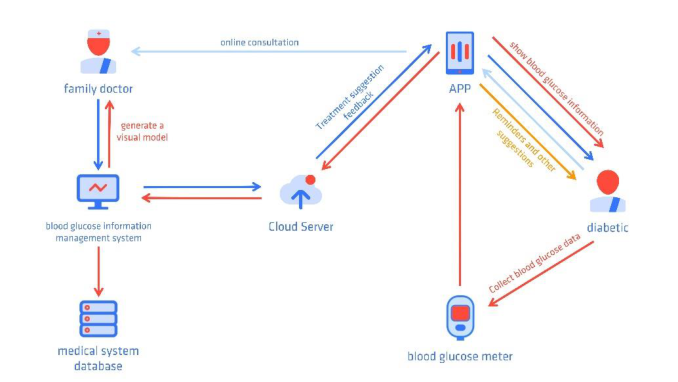
The system consists of four parts: transmission of blood glucose data (red), medical advice and feedback from family doctors (blue), online consultation (light blue), and blood glucose test reminders and other suggestions (orange) provided by APP. These four functions form a complete closed-loop system. (Figure 1. Shows the diagram)
Figure 1. Diagram of Diabetes Health Management System After the patient uses the blood glucose meter, the blood glucose meter will obtain the patient's blood glucose data and the data will be immediately uploaded via Bluetooth to the APP. The patient can observe their blood glucose data through the APP. When the mobile phone connects the Internet, the blood glucose data will be automatically transmitted to the cloud server and the information management system. The information management system displays the patient's long-term blood glucose data in visualization model to the family doctor, allowing the family doctor to have a deeper understanding of the patient's blood glucose changes. Blood glucose data will also be uploaded to the system database for preservation and improvement of existing clinical data. At the same time, the mobile APP supports online consultation, reminding patients to test blood glucose and achieve other suggestions.
Based on this health management system for diabetic patients, family doctors can remotely understand the patient's blood glucose level and the changing trend of blood glucose, analyze the patient's blood glucose abnormalities, and quickly and accurately provide patients with medical advice. Patients don’t need to submit paper documents to family doctors. This system greatly improves medical efficiency and utilization of resources.
Product Design The color of the non-invasive blood glucose meter is white, and its length, width, and height are 71mm, 41mm, and 40mm respectively. It is small and easy to carry. After the patient needs to use, s/he needs to press the end to separate the upper and lower parts, and place finger on the spectrum sensor in the device. The clamping design is adopted to realize the patient's finger close to the spectrum sensor. Equipped with an LCD display, the smart meter greatly simplifies the steps, and is convenient to use for blood glucose detection. The UI design is also simple and easy to read. The
Human Interaction & Emerging Technologies (IHIET-AI 2022) Artificial Intelligence & Future Applications https://openaccess.cms-conferences.org/#/publications/book/978-1-7923-8989-4 information on the display includes the battery power level, Bluetooth connection, and blood glucose index. (Figure 2 shows an example)
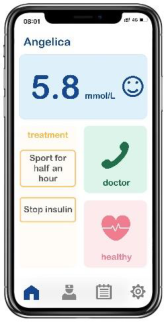
The APP interface is designed with low saturation and high saturation color contrast, which is clear and easy to read. The interface is simple, and all-important information is displayed on the homepage, and this way avoids too many elements to cause cognitive burden and confusion for older users. (Figure 3 shows an example)
Figure 2. Glucose meter model rendering Figure 3. APP user interface design
CONCLUDING REMARKS Based on the theory of product service system, and through case studies of diabetes health management system, an Italian localizati plan is proposed to provide efficient homecare services. The research found that: medical treatment is only used as an aid to health in order to achieve self-management of health and rational use of medical resources for people with diabetes. Only when the patient is willing to accept and use the product service system, the diabetes self-management system can play a huge role in the digital medical service industry.
ACKNOWLEDGEMENTS
With the help of Dr. Carla Senesi, I have a deeper understanding of the local chronic disease situation in Italy. I am very grateful to Dr. Liang Shuang for his help, and also to the professors at the University of Florence for their theoretical support.
Automonitoraggio glicemico, https://www.siditalia.it/divulgazione/autocontrolloglicemico Conoscere il diabete, https://www.siditalia.it/divulgazione/conoscere-il-diabete Dati di incidenza nazionali,
https://www.epicentro.iss.it/igea/diabete/incidenza_italia Diabetes Branch of Chinese Medical Association (2011), “Guidelines for Clinical Application of Blood Glucose Monitoring in China (2010 Edition)” Chinese Journal of Medical Frontiers, 62-72. Diabete: dati di prevalenza a livello nazionale,
https://www.epicentro.iss.it/igea/diabete/prevalenza#istat Epidemiologia delle ospedalizzazioni per diabete in Italia, https://www.epicentro.iss.it/diabete/epidemiologia-ospedalizzazioni-per- diabete-in-italia Jessica L., Harding, Meda E,. Pavkov, Dianna J., Magliano, Jonathan E., Shaw &
Edward W., Gregg (2019),ends in diabetes complications: a review of current evidence. Diabetologia volume 62, 3-16. Jiang P., Zhu Q. (2008), “oduct Service System and Its Research Progress.”
Manufacturing Automation,12-14. Ji M. (2015), “Design and research of household blood glucose meter products” Beijing Institute of Technology. Manzini E., VEZZOLI C. (2003), “A Strategic Design Approach to Develop
Sustainable Product Service Systems: Examples Taken from the "Environmentally Friendly Innovation" Italian Prize.” Journal of Cleaner Production,51-57. Wu Z., Kong N. (2015), “Summary of the development of blood glucose meter detection technology.” Popular Science & Technology,84-87. Yu Y., Ding H., Shen L., Wang X., Liu S. (2013), “Investigation of blood glucose
self-monitoring in 90 patients with type 2 diabetes.” Shanghai Pharmaceutical, 51-53.
Read this individual research paper free through the original publisher, or explore the full digital proceedings book.
ISBN 978-1-7923-8989-4
Explore this ISBN in the AHFE Bookstore ↗Listed in the July 2026 bookstore catalogue; search by ISBN to confirm current availability · Digital book purchase optional