Fabian Dietrich, Stefanie Liebl, Torsten Merkel, Gabriele Buruck (2024). Concept development and implementation of a trend-based work analysis using digital tools and studies to identify load peaks. In: Human Factors and Systems Interaction. AHFE Open Access, vol. 154, pp. 229–235. https://doi.org/10.54941/ahfe1005370
As part of the “Perspectives on labour research Lusatia” (PAL) project, five chairs at Zwickau University of Applied Sciences are working with industrial partners to develop low-threshold methods and tools for simplified screening of work characteristics. Traditionally, the assessment of work systems requires extensive specialist knowledge in the areas of occupational safety, ergonomics and operational design. Creating a hazard and stress register as a basis for work system design is therefore time-consuming and most of the times cost-intensive, which leads to a wait-and-see attitude, especially among small and medium-sized companies. However, innovations in the field of work analysis are now enabling the use and integration of smart, digital assistance systems, such as smartwatches or fitness trackers, combined with portable, intelligent environmental measurement technology. This combination allows an autonomous, in-house assessment of the stresses occurring without the need for external specialists and expensive equipment. The protection of personal rights is guaranteed by anonymized and pseudonymized data transmission. The departmental or process-specific evaluation of the collected data using machine learning creates an indicative stress assessment that enables work to be organized in line with all requirements. The resulting rough classification of key areas for action serves to define priorities for action and supports targeted decision-making processes for further measures, in which experts are involved on a selective basis. As a result, companies can carry out a focus-oriented and therefore economically sensible optimization of work design. Of particular importance, however, are the expected positive effects on employees, such as increasing motivation as well as higher job satisfaction.
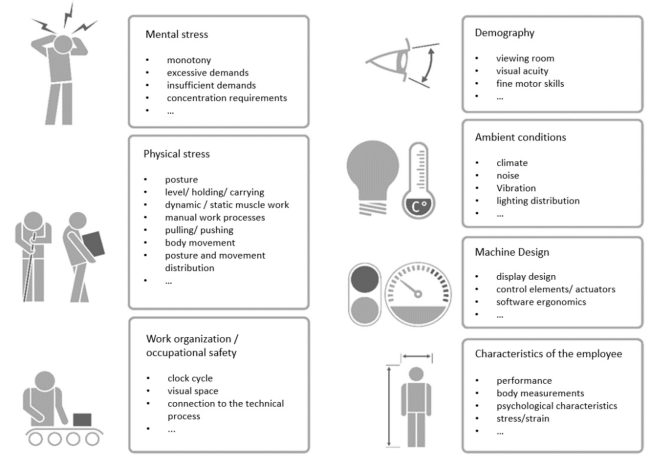
influencing factors (Schlick, 2017; Fig. 1). As a result, creating an overview of the stresses that occur and all possible risks is time-consuming and may be costly. As companies often do not have the necessary in-house expertise to draw up assessment registers, they tend to adopt a wait-and-see approach and mainly rely on compliance with the legally prescribed support services pro- vided by occupational safety and occupational medicine specialists. However, this approach does not lead to an active improvement in working conditions and does not do justice to the fundamental need to assess stressful situations in everyday working life.
The aim of the research and transfer project “Perspectives on labor research lusatia” (PAL) is therefore to develop attractive job offers, particu- larly in Lusatia, which has been severely affected by structural change. Using a digitally supported approach that requires no prior knowledge of work design, companies are to be enabled to deal with the design level of their work systems themselves by means of a simplified work analysis and thus develop the necessary sensitivity for New Work. Furthermore, the use of digital technologies presents many people with major challenges and causes psychological stress due to a lack of or poor training. A 2014 study by the EDCL Foundation also points out that growing up with technological progress alone is not an indicator of a person’s digital competence. There is a possibility of incomplete mastery of the ability to use technology safely and efficiently (EDL Fundation, 2014). The assumption that young people auto- matically have digital skills needs to be reconsidered, as there is a new digital divide between the everyday use of technology and the demands of the digital workplace (Nárosy et al., 2021).
Figure 1: Selection of the influencing factors to be determined within a work system to maintain the health and performance of employees (own illustration).
Concept Development and Implementation of a Trend-Based Work Analysis 231
While other working groups involved are researching methods and tools for improving working conditions, the sub-project on work analysis in small and medium-sized enterprises described here focuses on the use of wearables and their integration with intelligent, portable environmental measurement technology as well as diary studies that allow employees to document their interactions with digital technologies in real time. This allows precise doc- umentation of activities, challenges and successes in dealing with various tools and platforms as well as the resulting digitalization stress (Hoppe, 2009). The simplified work analysis is achieved through data processing using machine learning in anonymized and pseudonymized form. By com- bining and interpreting data from several sensors, the possibilities of a simple stress assessment are investigated and used to create a corresponding cadas- tre without external help in the company. The aim of this approach is not a medically precise measurement, but the provision of a rough classification of key areas for action in preparation for operational decisions. This classifi- cation forms the basis for further measures and targeted work design within the company.
TECHNICAL APPROACH Wearables have long offered the possibility of measuring basic vital data, the importance of which for the assessment of work-related stress has been demonstrated in various studies (Sammito et al., 2014; Weber et al., 2016).
Physical stress and its effects on the cardiovascular system can be deter- mined by measuring the heart rate. This method has long been used for training measures and health monitoring in popular and competitive sports. One challenge was to use the common measurement with photodiodes, as used in many fitness bands, instead of the ECG-accurate chest straps (Kauper; Merkel, 2018). This method is easier to use and more acceptable to the wearer. The improved measurement comfort should encourage users to take long-term measurements over weeks and months, which leads to a significantly better assessment of workload over time. The corresponding measurement technology was verified in several series of tests using com- parative measurements with ECG recordings. Depending on the system, the results of the optical measurement technology were within the safety level of S = 95 % defined for the test series with a relative error of less than 5 % com- pared to the ECG value. A system-related delay in the measured values of up to 30 seconds compared to the actual heart rate is typical. Although this lim- its the suitability of the systems for acute situational assessments, the optical measurement technique for determining the heart rate provides good results for trend assessment over working days and longer periods of time. Due to the convenience and sufficient measurement accuracy, the project group therefore prefers optical wearables worn on the arm to determine trends in vital data.
In addition to detecting physical stress, the systems should also detect increased work-related mental stress. In the evaluation of the optical sensors preferred for determining physical stress, no clear assessment of individ- ual stress-inducing events could be demonstrated. However, considering the S2k guideline “Use of heart rate and heart rate variability in occupational
medicine and ergonomics” (Sammito et al., 2014), it is possible to use long- term effects due to longer deviations from the resting heart rate or a reduction in heart rate variability. As the measurements are only used as a guide to action, trends in vital signs can also be recorded with optical sensors as sig- nificant characteristics over longer periods of time. Furthermore, a digital diary study is carried out by the employees to support the recording of vital data. This will be realized using a smartphone provided, which triggers offline queries at irregular intervals and asks the employee about positive and neg- ative affects (PANAS), perceived workload (NASA-TLX) and use of digital tools. In this way, objectively measured stress can be directly linked to various digital work tools and subjective stress level.
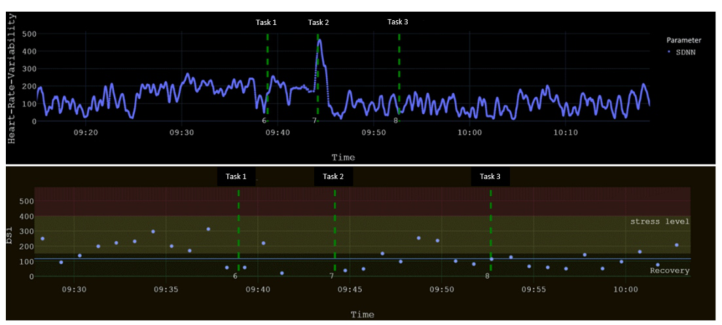
Various manufacturers of wearables offer options for determining stress in the form of a measurement of heart rate variability or by determining a stress indicator using their own evaluations, such as “body load” or “stress”. The measurement results are usually processed in a closed system provided by the manufacturer, which requires access via the internet to the provider’s cloud server (Merkel, 2021). To ensure the anonymity of the participants and for quality control and gradual improvement of work-related evaluations and interpretations, the heart rate variability in the project is calculated and eval- uated in an application for mobile devices specially developed at the West Saxon University of Applied Sciences and displayed via a traffic light chart in the dashboard (Fig. 2). The release of this data is therefore under the full control of the user. The system also has a note and diary function for record- ing special events. A mobile measuring system is used to determine the work environment factors, which permanently records data on 17 environmental factors. In combination with the wearables worn on the employees’ bodies and a detailed job description, correlations can be derived for assessing the work.
Figure 2: Display of vital data measurements (SDNN) and calculated variables (bsi) showing different levels of strain depending on different activities used as a basis for displaying the traffic light chart.
Concept Development and Implementation of a Trend-Based Work Analysis 233
EXPERIMENTAL DEVELOPMENT OF THE ANALYSIS CONCEPT After clarifying the technical framework conditions, it is necessary to develop and test a procedural model for operational areas of application. The project team at the University of Applied Sciences Zwickau has developed two lab- oratory experiments based on typical task and activity patterns in office and project work as well as in workshop areas with order picking and assembly activities (Merkel, Buruck et al., 2023).
In the experiment on office work (experimental group n = 23, control group n = 25), the test subjects worked on six task fields on a notebook. The study investigated whether various dimensions of mental stress change depending on digital work interruptions. The key finding was that work interruptions have a negative impact on the experience of time pressure. In addition, the system generated work interruptions through non-rejectable interjections that simulate interruptions in everyday office life, such as phone calls or interjections from colleagues. The quality of the vital data recorded using wearables was checked in parallel using certified measurement technology.
In the workshop test, two test subjects work together in the areas of order picking and assembly. The same measurement concept is used here, but addi- tional stresses have to be overcome that deviate from the normal load and are intended to generate both mental and physical stress. These include
Bending, bending and lifting loads from floor to head height and back,
Fast walking (6 km/h),
Compliance with time specifications with the clock running backwards,
Errors in the assembly situation (unrecognizable assembly points in the drawing and mismatched parts for an assembly that cause problems with assembly and adherence to the time specification).
While the measurement data obtained in the office test is mainly intended to prove the validity of the measurement using wearables, the workshop test is primarily used to identify characteristics for the allocation of special physical and mental stresses. In order to determine a trend in recovery ability, long- term studies have already been carried out in another research project at the West Saxon University of Applied Sciences, each lasting six months. These studies included a diary and twice-daily recording of stress levels using the NASA-TLX. From these studies, it was possible to detect longer work-related stress phases with low recovery capacity (Fröhlich, Merkel, 2022).
In addition, a digital diary study is to be conducted in the partner compa- nies for the situational assessment of work-related stress and the associated affects in the workplace. The data will be recorded at three measurement times per day and is controlled via the MovisensXS application. The survey is supplemented by a questionnaire on the use of certain digital work tools. The aim of the study is to determine changes in affect and stress levels in the workplace over the course of at least five days. Furthermore, based on Hoppe’s technology stress model (Hoppe, 2009), the relationship between affect, stress and the ability to function, use and competence to use digital work tools is to be determined.
A smartphone-supported digital diary study can offer considerable bene- fits in determining affect, stress and technology use in the workplace. The use of smartphones allows employees to record and document their moods, emotions and stress levels as well as their use of technology in real time. This allows immediate documentation of emotions in everyday working life. By using smartphones, gaps in memory, which often occur due to late question- ing, can be avoided. Due to the duration of the study of at least five days, it is possible to identify long-term trends and patterns with regard to the analysed constructs. This makes it possible to identify the causes of stressful situations and derive appropriate measures. In this context, it is possible to determine both an intrapersonal trend and an interpersonal trend by means of a multilevel analysis. The continuous recording of data over a period of five days allows the identification of changes in behaviour and fluctuations in the emotional state of employees. This enables an early response to poten- tially stressful situations. The data obtained from the digital diary study can serve as a basis for targeted interventions to optimise the handling of stress in the workplace. This can include the development of stress management strategies, measures to promote well-being or organisational changes. The use of smartphones enables efficient data transmission. The data is collected offline and then uploaded to the MovisensXS app provider’s servers via the secure university network. The data is then processed securely and trans- ferred to data analysis software for further evaluation which complies with data protection regulations.
CONCLUSION AND OUTLOOK The described system for digital stress measurement is currently being tested at the project partner Trumpf Sachsen GmbH in various departments and thus during various work tasks. After a traditional work analysis and risk assessment to record the existing work systems, the autonomous digital recording of work requirements is carried out with a time delay. These ini- tial tests are designed to last 3–4 weeks in order to draw conclusions about the development of performance over the course of the day and the ability to recover based on the heart rate variability data during the period under consideration. During the recording of the measured values, the test subjects are provided with cell phones with a specially developed application that enables the wearables as well as the diary study to be used locally without the system provider’s internet environment. During the tests, the participants are informed about the trends in the data collected using a traffic light sys- tem. The feedback from the company so far, both from test subjects and from the works council and management, has been consistently positive and acceptance is high.
A key advantage of digital measurement data collection and evaluation is the scalability of the concept. The anonymized and pseudonymized data can be laid out in the form of “stress and hazard maps”across various areas of the company in order to derive the need for action and priorities in the ranking of necessary measures. Depending on the accuracy of the resulting adjustments, suitable suggestions can be generated later in the application in the area of
Concept Development and Implementation of a Trend-Based Work Analysis 235
behavioural and situational prevention. The parallel digital diary study in the company can help to identify the causes of stress, obtain a comprehensive picture of employees’ digital skills, identify individual development needs and translate measures to promote these skills into targeted training courses for company employees. In this way, the perceived workload can be reduced and the workflow optimized in the future.
Further developments to improve the informative value of the analysed work processes are to be achieved through a modular measurement concept. While the university in Zwickau is working on its own measuring base for load determination, cooperation with other teams within the PAL project and with developers of suitable measurement technology and various products is being examined. The foundations have been laid for the operational use of a digital measurement system to identify key areas of activity within the work processes. In future, the continuous further development and refinement of the evaluation mechanisms will take place in close interdisciplinary exchange with industrial partners and scientists.
REFERENCES
ECDL Foundation. The Fallacy of the ‘Digital Native’: Why Young People Need to Develop their Digital Skills, 2014. Available online at: https://icdleurope.org/poli- cyand-publications/the-fallacy-of-the-digital-native/ (Accessed June 25, 2023). Fröhlich, M.; Merkel, T.: Studienkonzept und Ergebnisse zur Interpretation von
Vital-Parametern im Zusammenhang mit deren Wirkung auf die Arbeit”; Magde- burg 03/2022, GFA Press Sankt Augustin. Hoppe, A. Technikstress – Theoretische Grundlagen, Praxisuntersuchungen und Handlungsregularien, S. 56, Shaker Verlag, Aachen 2009, ISBN 978-3-8322- 8502-9. Kauper, J.; Merkel, T.: Stärken und Schwächen neuer objektiver Messverfahren
und -technik für die Arbeitssystembewertung und Gefährdungsbeurteilung; Pabst Science Publishers, Lengereich 2018; ISSN 1615–7729. Merkel, T.: Auswahl und Einsatz von Smart Devices in der Arbeitsanalytik; 04/2021 IWKM; Science Report 2021. Merkel, T.; Buruck, G.; Hellbach, S.; Pelzecker, S.; Fischer, S.; Junghans, T.: “Vom
arbeitswissenschaftlichen Konzept über das Experiment in die betriebliche Praxis von Gefährdungsanalyse und Arbeitsgestaltung”; Hannover 03/2023, GFA-Press Sankt Augustin ISBN 978-3-936804-32-4. Nárosy T, Röthler D, Svecnik E. Digital Competence Framework for Austria. Dig- Comp 2.2 AT. Federal Ministry Republic of Austria. Vienna: Digital and Economic Affairs, 2021. Sammito, S.; Thielmann, B.; Seibt, R.; Klussmann, A.; Weippert, M.; Böckel-
mann, I.: 002/042 - S2k-Leitlinie: Nutzung der Herzschlagfrequenz und der Herzfrequenzvariabilität in der Arbeitsmedizin und Arbeitswissenschaft. Stand: 06/2014. Schlick, Ch.; Bruder, R.; Luczak, H.: Arbeitswissenschaft. 4. Aufl., Berlin: Springer Vieweg, 2017. Weber B.; Ellegast R.; Schellewald V., Weber A.; Röhrig M.; Friemert, D.;
Hartmann, U.: “Messung der physischen Aktivität mit Wearables” 6. DGUV Fachgespräch Ergonomie - Zusammenfassung der Vorträge vom 2./3. November 2016.
LISTED IN THE AHFE DIGITAL BOOKSTORE CATALOGUE
Explore the complete digital volume
Human Factors and Systems Interaction
Read this individual research paper free through the original publisher, or explore the full digital proceedings book.
ISBN 978-1-964867-30-4
Explore this ISBN in the AHFE Bookstore ↗Listed in the July 2026 bookstore catalogue; search by ISBN to confirm current availability · Digital book purchase optional