Rute Gomes, José Manuel Silveira Dias, Marco Neves, Paulo Dinis (2022). Sustainable Product Service System (SPSS) for Designing a Portuguese Furniture Service: Comprehensive Approach. In: Human Dynamics and Design for the Development of Contemporary Societies. AHFE Open Access, vol. 25, pp. 211–220. https://doi.org/10.54941/ahfe1001391
CIAUD, Research Centre for Architecture, Urbanism and Design, Lisbon School of Architecture, Universidade de Lisboa, Rua Sá Nogueira, Polo Universitário do Alto da Ajuda, 1349-063 Lisboa, Portugal ↗
Product Service System (PSS) is a Sustainable Design strategy for developing product service-based solutions, that contribute towards the reduction of product waste, towards the generation of new forms of partnership among stakeholders, leading to innovative product service solutions and to new ways of responsible consumption.A research on PSS for domestic adaptable furniture is being carried out. Having in mind the Portuguese context, it is important to comprehend existing PSSs and identify models and opportunities for designing a Sustainable Product Service System (SPSS) for adaptable furniture within the Portuguese context. For this, the following research questions arise: What are the most common business models in Portuguese SPSSs? What are their fragilities and strengths? What factors may better contribute to a higher consumer satisfaction? To answer these questions, there were developed five case studies on ongoing significant Portuguese SPSSs, analysing three approaches for each of the cases in the sample: i) needs satisfaction, ii) stakeholders involved, iii) sustainable strategies. The case studies results enabled a wider comprehension of the existing Portuguese panorama on sharing economy Product Service Systems models, providing information for the development of a PSS domestic adaptable furniture.
Often, dwellings’ space seem inadequate to accommodate households’ needs. This is mostly due to variations on households’ geometry, and/or to new ways of living, triggering a spatial reconfiguration or even the need to find a bigger dwelling that is suitable for the households’ new functional needs. Dwellings’ flexibility has been a subject worked throughout time and history, in various architecture and design proposals.
A research on furniture that may adapt to households’ functional and spa- tial needs, has been carried out, proving that furniture design can contribute to the dwellings adequacy on changing needs throughout time, and consequ- ently improving households living quality (Gomes, 2017). Following this, and
in the context of a great demand for a change on consumer patterns, towards a more conscious and sustainable use of an adaptable and durable furniture solution, it is important to find strategies that will contribute to a furniture system that engages users emotionally, for a longer usage period, and that is produced and maintained locally, promoting the economy of small businesses (Gomes, 2020). Having reached these premises, one is stepping into the dyna- mics of a Product Service System (PSS), more specifically Sustainable Product Service System (SPSS). A SPSS is a product service system that seeks for soci- ally equitable, eco-efficient and cohesive solutions (Mont, 2002; Tischner and Tukker, 2006; Vezzoli et al., 2014).
For a PSS to promote a sustainable development it needs to be aligned with the sustainable 3Ps (People, Profit and Planet), having in mind its effects towards social responsibility and equity, the reduction of natural resources consumption (Brezet et al., 2001; Tischner and Tukker, 2006; Manzini and Vezzoli, 2008).
Since consumption is necessary for everyday living, and especially if we are focusing on furniture-based research, it is important to adopt strategies that will contribute towards more durable solutions. This way, the product life cycle will have a longer usage period. This is one of the strategies referred by Manzini and Vezzoli (2008), for developing a more sustainable solution, and for which it is necessary to plan ways of making durability possible, in material terms, by providing updating and maintenance services, and in emotional terms, by promoting an engagement relationship for users towards their products. These strategies, aligned with a durable product will be a SPSS.
A SPSS need to have three approaches in harmony: i) a satisfaction system approach, warrantying the need of the user is satisfied; ii) stake- holder configuration approach, having a well balanced managing relation of all the stakeholders’ involved, from designers, to producers, distributers, maintenance, to users; iii) a system sustainability approach, by adopting more sustainable and cohesive practices, having in mind the sustainable 3Ps (Vezzoli et al., 2014).
This paper aims to comprehend the dynamics of a SPPS, and case studies in the Portuguese market, that can contribute to designing a system for an adaptable furniture system for the same context. For this, the following rese- arch questions arise: What are the most common business models in sharing economy Portuguese models? What are their fragilities and strengths? What factors may better contribute to a higher consumer satisfaction? The follo- wing section explains the research methods and materials and section three presents the results. Section four describes the achieved conclusions.
METHODS AND MATERIALS The goal of this paper is mainly to comprehend managing models of SPSSs in general, and in the Portuguese context. This will provide us clues for the design of a furniture-based SPSS.This paper pursues five case studies on SPSSs active in Portugal. It is organized in i) Sample selection, ii) Analysis factors, iii) Results and discussion.
Sustainable Product Service System (SPSS) for Designing a Portuguese Furniture Service 213
Table 1. Sample selection, service offer area and sustainable strategy Ref Name Service offer area Sustainable strategy
Table available in the original PDF paper.
LV Lisboa Viva Mobility Public transport and vehicle sharing FF Fruta Feia Food waste Local producers, circular economy BL Book in Loop Education Secondhand education tools, circular economy CB Cork Brick Furniture Adaptable, durable solutions, Recycling and Downcycling, Users’ business engagement FA FAMO Office Furniture Adaptable, durable solutions, Recycling and Downcycling.
Figure 1: Gira sharing bicycle system incorporated in Navegante Lisbon public tran- sport. Source: www.gira-bicicletasdelisboa.pt (accessed 10.02.2022).
Sample Selection Having as focus the comprehension of varied existent Portuguese SPSSs, the used criteria for the sample selection were being varied in service offer; having products associated to the service and operating in Portugal.
Table 1 presents five cases of SPSS operating in Portugal.
Lisboa Viva Lisboa Viva is the public mobility service offered by Lisbon Metropolitan Area integrating various transport suppliers (Figure 1), managed by different public organizations, or with a governmental participation: Carris (buses), Metropolitano de Lisboa (tube), Comboios de Portugal (CP – trains), Ferta- gus (Southern trains), Soflusa/ Transtejo (boats). From 2019, these different services have been integrated into one mobility service. This service, named Navegante pass, has various models, depending on user types (discounts for students, retired and families), period of usage (single use, weekly or mon- thly), areas of usage (only one city or all the 18 metropolitan area cities). Having as reference a monthly pass for the average user, it allows the user to travel within the 18 cities in Lisbon metropolitan area, using all the refer- red transport providers for the value of 40€. This represented a great money saving for average families that commuted every working day within Lisbon metropole, becoming a great incentive for families to stop using their cars in their daily routine.
To the Navegante pass can be added a sharing Bicycle service. This is an extra service, paid separately either early, monthly, or daily. Through- out the city there are different bicycle dock stations, either for traditional bicycles, or for electrical bicycles. The service is also supported by an APP, where the user can get information on the available bicycles and free docks. This service is supported by Lisboa Viva Service, is very affordable and Lisbon commuters use it as part of their routine mobility services. This service is a good example of public services mobility. Previously there were a great number of service providers, and for some users, having to use daily, more than two providers, represented a higher financial cost, besi- des having to choose each one to apply for, could be restrictive. Navegante Service made travelling in the Lisbon Metropolitan Area easier, cleaner, and cheaper.
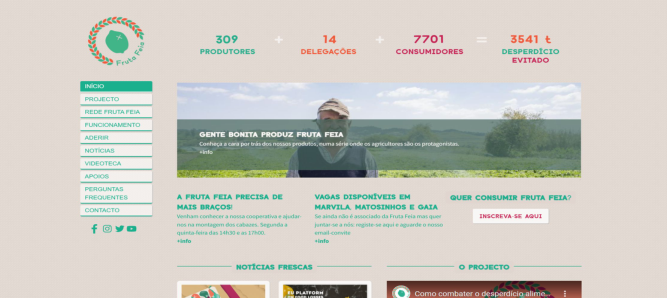
Fruta Feia Regular supermarkets acquire their fruits and vegetables, based on quality standards that include, among others, shape, size, and colour. These restricti- ons make perfectly good food products go to waste, just because they don’t look as good as the quality regulation demands. Fruta Feia, meaning Ugly Fruit, is a cooperative that collects from farmers the fruits and vegetables that don’t apply for big supermarkets appearance quality standards, and supplies them to final consumers (Figure 2).
The consumer must apply to the service, to start having regular fruit and vegetable baskets. The service varies in size. Consumers can refer to their favourite and not appreciated products to help the basket contents, which will always depend on the season, product proximity and availabi- lity. Besides avoiding food waste, FF contributes to small farming economies, shortening intermediate stakeholders, making products have a fairer value to both producers and consumers. FF also promotes workshops on sustai- nable consumption near youngsters to awake them to the importance of consuming local products and valuing every sized vegetable and fruit. This way FF’s service reaches kids populations and embraces an educational mission.
Sustainable Product Service System (SPSS) for Designing a Portuguese Furniture Service 215
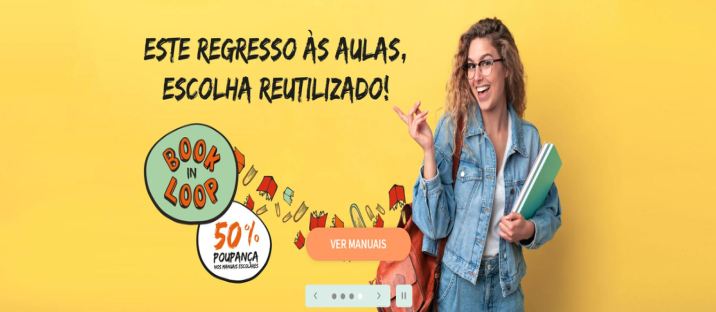
Figure 3: Advertising of Book in Loop. Source: www.bookinloop.com (accessed 10.02.2022).
Book in Loop Book in Loop is a service of buying and selling second-hand schoolbooks, from the 5th to 12th grade (Figure 3). This service is based on a circular economy model, allowing families to save money when they need to buy schoolbooks for a new academic year, and saving the environment from the production of more books. BL buys second-hand schoolbooks adding the amount of the transaction to the customer account, becoming a credit when the customer needs to buy schoolbooks. The service is expanding their offer of second-hand items to other educational tools such as scientific calculators.
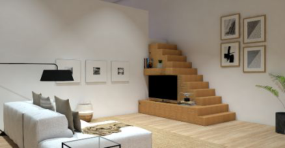
Cork Brick Cork Brick is a company that supplies cork modular solutions that allow users to build walls and furniture according to their functional needs. The system has seven different modules that can be assembled without using glues or fixing accessories, easing the user to reconfigure their space in a playful way, as a Lego system (Figure 4). For engaging the user into the company’s mission, CB invites users to propose new system configurations, receiving the selling royalties from their proposed model. This strategy promotes creativity, and generates higher empathy levels towards the service.
CB promotes a circular economy. The modules are only composed of cork agglomerate, which is a very sustainable material, known by its characteri- stics of sound and thermal isolation, besides its comfortable touch. When the user does not need the CB system anymore, the company will receive back the pieces, recycling them back into agglomerate for new modules.
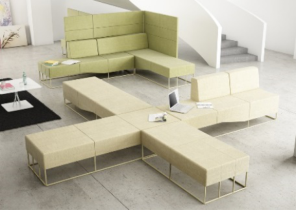
FAMO FAMO is a Portuguese office furniture company that develops high quality modular solutions. Their service helps clients to configure (and reconfigure) their space, according to their businesses demands throughout time. Besi- des being reconfigurable in shape, some of FA’s collections can see their colour changed on client demand during their usage period (Figure 5).
Figure 4: Cork Brick module (above), Cork Brick configuration Staircase Macau on the left, on the right Favicon configuration. Source: www.corkbrick.com (accessed 10.02.2022).Figure 5: Some of FAMO’s solutions on office modular systems. On the left Brick system and on the right TX system. Source: www.famo.pt (accessed 10.02.2022).
FAMO research team has been focused on offering long lasting solutions, using reconfigurable and adaptable systems, aiming to avoid the system disposure. The use of a strong client service is one of the strategies used by FA, offering maintenance and upgrading services.
RESULTS
The selected sample was varied in services, although there were two cases in furniture services, which for the going on research in furniture design is justifiable.
The analysis factors will be aligned by the suggested by (Vezzoli et al., 2014), as approaches for developing a PSS on Design for Sustainability: i) needs satisfaction, ii) stakeholders’ configuration, and iii) sustainability strategies.
Needs Satisfaction Needs satisfaction is fundamental when relating to a service supply, where the client needs to have his functional needs fulfilled. In all the sample, needs are generally satisfied. Lisboa Viva (LV) is a public service that has been gai- ning great acceptance from metropolitan users. Few years ago, the service improved on all fronts, by providing an APP that would clean a very bureau- cratic system, by connecting all travelling providers in one service, by making the service much cheaper than before, and by adding other services such as bicycle sharing. The Covid19 pandemic made this change in scene go slower, as many commuters were not comfortable about sharing spaces, on the other
Sustainable Product Service System (SPSS) for Designing a Portuguese Furniture Service 217
hand, the bicycle service was a success, because it is an individual transport, and was adopted fast by Lisbon commuters.
As in LV, Fruta Feia (FF) and Book in Loop (BL) offer services that are cheaper than regular ones. This is a plus on service satisfaction. In FF’s case, there is the issue of unpredictability that can be less positive for the need satisfaction: The weekly basket comes with a strict variety of fruits and vege- tables that are not chosen and come by surprise. But since the concept is about using local and seasonal food that doesn’t fit big supermarkets’ size and shape metres regulations, one must expect a surprise. However, it is generally acce- pted by their consumers. On the other hand, BL delivers exactly what they are expected for. Consumers are generally satisfied. The online platform is very clear, and works as a regular bookshop, and the delivery time is similar. BL’s spread of the service to other expensive materials used in high school, is a good step forward, as some families struggle to afford these kinds of tools.
The other two cases are furniture services. Both Cork Brick (CB) and FAMO (FA) offer modular and reconfigurable products, focused on a sustai- nable premise of durability, supported by customer services. CB adopts a strategy of engaging users with their creativity, offering royalties for selling of their designed models. This is a clever way of engaging customers and promoting a loyalty relation.
Stakeholders Configuration Lisboa Viva (LV) is from the sample, the one with more involved stakehol- ders, which are all the transport services operating in Lisbon metropolitan area (AML). LV combines all services from suppliers in a general one that focuses on sustainable mobility in AML. Although the stakeholders operate in the same way as before, the LV service towards the client is much easier and systemic. Clients use the service directly with the transportation com- panies, but all interface and payments are directly with LV. In the case of Fruta Feia (FF), stakeholders are the local farmers, food distribution places, FF communication services and consumers. FF establishes connections in two fronts: with the local farmers to identify available food for supply, and with the consumers, to identify the needed food and to arrange baskets accordin- gly. As in FF, Books in Loop (BL), work on two fronts, buying, collecting and managing second-hand school books, on the other side, with the poten- tial clients providing an online selling service. From these two cases, only FF manages stakeholders having in mind local economies, while BL sells their books nationwide.
The studied furniture companies are both producers and the service sup- pliers. Here, services extend to product live time, using strategies that will contribute a longer usage period. From these cases, CB also provides a dow- ncycling service, by collecting old modules and recycling them back into new ones.
Sustainability Strategies In LV’s case the used strategy was to uncomplicate the public transport netw- ork service in AML, by providing one service interface to the commuter, user-friendly and cheaper than usual. LV users have a Navegante card that
also gives the option of using Gira bicycle service. This change in scenario was an upgrade in Lisbon commuters’ mobility service, feeling more appe- aling to leave their cars at home on their daily routine. FF’s is sustainable initiative all the way: firstly it starts with avoiding food waste, that is in perfe- ctly good consumption conditions, secondly, it helps small producers whose products don’t comply with the quality standards set by big supermarket chains, by selling them in more fare values, afterwards, it creates respon- sible consumption awareness in consumers, creating a cooperative where consumers comply with the responsibility of buying their food basket, with other levels of quality standards based on sustainability, rather than size and shape.
BL’s second-hand schoolbooks offer a clearly sustainable service that con- tributes to the reduction of the production of new books. Besides being a money saver for households with kids, it awakens near them the relevance of resource saving, making families be part of this saving mission.
Both CB and FA supply durable furniture solutions, supported by durabi- lity strategies, such as modularity, reconfigurability, functional adaptability, upgrading and recyclability. Also, to support client engagement towards the company, CB invites consumers to design a system configuration, where the creativity can be rewarded with royalty winning upon configuration selling.
CONCLUSION
Having in mind the initially set questions (What are the most common models in Portuguese SPSSs? What are their fragilities and strengths? What factors may better contribute to a higher consumer satisfaction?) and upon the achieved results, the following answers arise: From the studied sample, one could identify different product service models, but these are obviously not representative of the Portuguese SPSS eco- nomy. The mobility public service Lisboa Viva aggregates different transport companies from Lisbon metropolitan area and provides one only service, making simpler and cheaper the use of public transports. This service’s strength is making public transport mobility simpler and cheaper. LV’s con- sumer interfaces are intuitive and clear in-service communication. On the other hand, Fruta Feia is a cooperative that connects small farmers and their ≪ugly≫fruit and vegetables commonly destined to waste, and consumers. FF is the service manager and the provider, establishing the connection with the consumers, identifying their basket’s profile, according to size, product preferences and/or dislikes. This service also depends on volunteer work and can become demanding on the management and balance of available produ- cts and baskets to go. To simplify the service supply, customers compromise to collect their food baskets weekly. There is a fragility in this model, the basket’s content is always a surprise. However, consumers are very aware that by achieving one of these baskets weekly, they are getting more than food, they are contributing to the local farmers’ economy and adopting a more conscious consumption.
Sustainable Product Service System (SPSS) for Designing a Portuguese Furniture Service 219
The next three cases can be seen as online product providers. Books in Loop act in the second-hand market, having found an opportunity in sch- oolbooks and learning tools. Although the government offers schoolbooks to students in public school, others in the private system must fully pay for them. Serving only consumers in the private school system may be a fragility for BL. However, it is still a significant market to focus on. Sustainability wise, maybe BL could, as FF, distribute locally. It seems to be a good strategy from BL for customer satisfaction, that used book providers may get credits on their account for buying other materials.
FAMO and Cork Brick are producers and suppliers. They supply long lasting furniture systems, adopting different design strategies.
In general, it was important to realise that SPSSs generate higher empathy levels towards their consumers if they engage them in their sustainable mis- sion, either of sharing services, food and products waste, or durable solutions. For this, it is relevant to adopt good communication strategies, for engaging and generating loyalty levels from consumers. Also, as seen in the Cork Brick case, and proposed by Manzini and Vezzoli (2008), engaging clients into the business, valuing their capacities and experience using participatory practices, seems to be very positive on building up a trust and long-lasting relationship, especially when referring to durable products.
When relating to furniture services, one can take into consideration posi- tive strategies used by SPSS cases, such as having local suppliers, which can positively contribute to the small businesses’ economy. The cooperative model used by Fruta Feia figured to be positive, as they are the managers and the interface between suppliers and users, communicating the value of adopting a sustainable solution. This may contribute to consolidating a user’s network, where they could share their experiences on modular furniture con- figuration , and exchange or even sell furniture parts within the network, contributing also towards a sharing model service.
ACKNOWLEDGMENT
The authors would like to acknowledge the support of CIAUD, Research Centre for Architecture, Urbanism and Design, Lisbon School of Archite- cture. This work is financed by national funds through FCT - Fundação para a Ciência e a Tecnologia, I.P., under the Strategic Project with the reference UIDB/04008/2020.
REFERENCES
Brezet, H., Bijma, A.S., Ehrenfeld, J., and Silvester, S. (2001) The design of eco-efficient services. Methods, tools and review of the case study based “Desi- gning eco-efficient Services” project. Report for Dutch Ministries of Environment (VROM). The Hague: VROM. Manzini, E., Vezzoli, C. (2008). Design for Environmental Sustainability. Springer
Science and Business Media, London. Gomes, R. (2020). “Designing for Unpredictable Households: Furniture Design Requests for a Flexible Use of Dwellings”, in: Markopoulos et al. (Eds): AHFE 2020, AISC 1218, pp. 175–184. Springer Nature Switzerland.
Gomes, R. (2017). Design de Mobiliário para um Uso Flexível da Habitação: Enquadramento, Requisitos Funcionais e Protótipo. FAUL Lisbon School of Architecture. PhD Thesis. Mont, O. (2002) “Clarifying the Concept of Product-Service System”. Journal of
Cleaner Production, n.° 10 (3) pp. 237–245. Tukker, A. & Tischner U. (2006) New Business For Old Europe. Reino Unido, Greenleaf Publishing. Vezzoli, C., Kohtala, C. and Srinivasan, A. (Eds) (2014). Product-Service System
Design for Sustainability. Greenleaf Publishing Limited. Sheffield: UK.
LISTED IN THE AHFE DIGITAL BOOKSTORE CATALOGUE
Explore the complete digital volume
Human Dynamics and Design for the Development of Contemporary Societies
Read this individual research paper free through the original publisher, or explore the full digital proceedings book.
ISBN 978-1-958651-01-8
Explore this ISBN in the AHFE Bookstore ↗Listed in the July 2026 bookstore catalogue; search by ISBN to confirm current availability · Digital book purchase optional