Matthias Hillner (2022). Towards a Democratisation of Innovation. In: Creativity, Innovation and Entrepreneurship. AHFE Open Access, vol. 31, pp. 159–168. https://doi.org/10.54941/ahfe1001518
Singapore is an innovation-intensive nation. In 2020 Prime Minister Lee Hsien Loong pledged to inject ‘up to S$150million’ in the country’s startup ecosystem (Channel News Asia). This paper discusses the distribution of public funds amongst startups in Singapore. It raises questions about the effectiveness of early-stage pre-seed funding and discusses medium and long-term impact of distributed funds on business performance. The paper defines startups as growth-oriented independent SMEs in pursuit Series A investments. It distinguishes between bootstrap initiatives and funding-intensive initiatives. The paper argues that there is currently a problematic emphasis on funding-intensive startups, and a potentially compromising neglect of bootstrap ventures who do typically not have equal access to smart funds, mentoring schemes and support frameworks. Equally importantly, bootstrap initiatives often escape the radar of government authorities, thus compromising the authorities’ capabilities of monitoring innovation performance across the entire spectrum.This paper uses a mixed-method approach. It draws on a series of exchanges with experts — entrepreneurs, incubator managers, investors, VC firms, as well as representatives of government funding bodies — and secondary research findings. The primary research data has been collected over a period of nine years. The preliminary hypothesis is that the support mechanisms in the context of contemporary startup ecosystems tend to be ill-directed and may compromise overall innovation performance. Various studies carried out in different parts of the world raise questions about the effectiveness of government funding for innovations that are pursued by startups and suggest that the distribution of public funds does often not benefit innovation performance generally: Following an investigation of public fund distribution in China, Hong et al. (2015) claim that ‘government grants negatively impact the overall innovation efficiency in the high-tech sector.’ Other studies (Liu and Rammer, 2016) point towards the possibility that government grants are often used as substitute for private innovation investment by established businesses who, in the absence of public funding, would be able to afford R&D financing internally, whilst early-stage startups that are in greater need of funding, often miss out on support due to requirements related to match funding or trading history. This means that early-stage startups are often disadvantaged, in particular bootstrap initiatives, whilst established SMEs and large businesses do not enhance their innovation performance through subsidies. It is also thought that there is a prioritisation of incremental innovations and a lack in funding for potentially disruptive innovations because the latter are at higher risk of economic failure. As a result, firms tend to prioritise incremental innovation, in conjunction with which it is easier to predict viability.This paper, which primarily focuses on the distribution processes used by Enterprise Singapore (ESG) and other public institutions in Singapore, raises questions about the effectiveness of public spending in relation to innovation. Bootstrap ventures that might benefit from smart-fund injections, are not captured by the Singapore authorities, and there is currently no reliable progress tracking to objectively monitor startup performance. Instead, various funding organisations including universities, VC firms, as well as the ESG, rely on each other’s recommendations in their decision-making. There is a likelihood that the selection process is subject to bias which may have compromising macro-economic implications in the long term.To summarise the above, the proposed paper raises questions about the tracking of government funded startups, and it explores the consequences of startup funding from an economic and a sociopolitical point of view. The paper discusses possibilities of reversing this trend by empowering independent startups through accessible support frameworks that operate autonomously and independent from profit-oriented incubators, VC firms and angel investment networks.Sample Sources:Hong, J. et al. (2015): Government Grants, Private R&D Funding and Innovation Efficiency in Transition Economy, Abingdon-on-Thames, UK: RoutledgeLiu, R., Rammer, C. (2016): The Contribution of Different Public Innovation Funding Programs to SMEs’ Export Performance, ZEW Discussion PapersSoetanto, D. P., van Geenhuizen, M. (2015): Getting the right balance: University networks’ influence on spin-offs’ attraction of funding for innovation, in: Technovation, Volumes 36–37, February–March 2015, Pages 26-38, Amsterdam, Netherlands: Elsevier Teece, D. (2009): Business Models, Business Strategy and Innovation, Amsterdam, Netherlands: Elsevier
Startup Genome carry out annual surveys to monitor startup business per- formances across the world through comparing different regions and startup ecologies. Their 2019 report credits Singapore as a Leader in South-East Asia (Startup Genome, 2019, p. 12). Although it had dropped two places in the global eco-systems ranking, it was still listed no 14 in the world and thus a contender to be one of the ‘30 “next” hubs’ which are expected to follow in the footsteps of Silicon Valley’s historic precedent. Startup Genome’s ran- king criteria comprise performance, funding, market reach, connectedness, talent, experience, knowledge, growth index, infrastructure, and policy. The report does not clarify in full detail how each of the criteria is measured, but the range of performance measures taken into consideration as well as
the large number of startups assessed around the world lends the report cre- dibility. The report cites Sam Altman from Y Combinator, a valley-based VC firm, who speculates that ‘Instead of one new center or two new centers (of entrepreneurship, besides Silicon Valley), there will be 30, and there will be clusters in different places that don’t quite get to the density of the Bay Area but get beyond critical mass.’ (author’s brackets). Singapore takes ran- kings very seriously and Enterprise Singapore (ESG), the agency in charge of managing and distributing government funds within the city state, is listed amongst the Startup Genome Network Members (Startup Genome, 2021, p. 161). Startup Genome’s 2021 report ranks Singapore next to Stockholm at 17, a further three places below its 2017 position.
This paper is not aimed at speculating on Singapore’s potential to become one of the next dominant innovation hubs, it is focusing on Singapore as an innovation ecosystem to elicit some general insights in how such ecosy- stems behave, and how the distribution of funds may affect balances within individual innovation ecosystems. In 2020 Prime Minister Lee Hsien Loong pledged to inject ‘up to S$150million’ in the country’s startup ecosystem (Tang, 2020). The question how these funds are distributed leads us back to ESG. Formerly known as SPRING Singapore, this department was ince- pted in 1996 under the Ministry of Trade and Industry, with the purpose of enhancing the competitiveness of local enterprises. The questions that arise are:
Which enterprises are affected and which are not?
How can this impact be enhanced?
How will the distribution of funds impact the ecosystem at large?
THE PREMISE There is widespread confusion surrounding the category of small and medium-sized businesses (SMEs) and startups. Startups are usually SMEs, but by far not all SMEs are startups. For startups not to fall into the SME cate- gory, substantive funding is required. This can only be the case if successful serial entrepreneurs invest revenues in follow-up ventures, like Steve Jobs lau- nching NEXT or Elon Musk starting Tesla, for example. However, such are the exception rather than the norm, and this paper does not examine spinoffs, i.e. initiatives launched larger enterprises, although it has to be acknowledged that a lot of Singapore’s innovation performance has historically been reliant on innovations developed by established corporations rather than startups. In the same year in which Singapore dropped in the Startup Genome rankings, Jamrisko et al. (2021) reveal that the country has climbed from 3rd to 2nd in the world in the Bloomberg 2021 Innovation Index. But the latter ranking does not focus on startups, so the question remains whether or not Singa- pore is performing to the best of its capacity when nurturing startups. Might this be a indication that Singapore is performing well in relation to inno- vation in general, but less well in terms of startup ecosystem performance? This question is difficult to answer since there is widespread confusion about what constitutes a startup. Singapore’s Economic Development Board (EDB) claims that there are 55,000 startups in Singapore, where as Chong (2021)
Towards a Democratisation of Innovation 161
states in The Business Times that ‘the city-state now boasts over 3,000’. The confusion is presumably grounded in the difficulty to separate startups from SMEs.
As highlighted above, whilst most startups tend to be SMEs before they enter the scaling stage, by far not all SMEs are startups. Many businesses are not designed to grow. This paper defines startups as growth-oriented independent SMEs in pursuit Series A investments. It distinguishes between bootstrap initiatives, businesses that develop with limited or no external fun- ding, and funding-intensive initiatives, businesses that secure pre-seed and / or seed funding in exchange for equity en route to Series A investment rounds. Of course, bootstrap ventures may switch to funding-intensive deve- lopment strategies, and, conversely, a funding-intensive startup may be forced to bootstrap, at least temporarily, where revenue growth is limited. However, the dichotomy between funding-intensive startups and bootstrap initiati- ves is widespread, and the questions raised earlier will focus on both these categories of businesses.
THE METHODOLOGY This paper uses a mixed-method approach. It draws on secondary research findings and triangulates these with a range of direct exchanges with experts — entrepreneurs, incubator managers, investors, VC firms, as well as repre- sentatives of government funding bodies. The primary research data has been collected over a period of nine years and falls partially into a doctoral study (2013–2019) and partially into a postdoctoral inquiry (2019-2021). The last six years of this inquiry were conducted in Singapore. The author of this paper has had direct conversations with leading representatives from a range of significant innovation catalysts in Singapore, including ESG, GovTech Singapore, NUS Enterprise (National University Singapore), A*Star, Antler, Entrepreneur First, as well as various Venture Capital Fund Managers and the EDB. He has also met the then CEO of the Action Community for Entrepre- neurship (ACE) and served ACE as a startup mentor (November-December 2021). The insights and reflections shared in this paper are grounded in these exchanges.
THE HYPOTHESIS The principal objective behind entrepreneurship is to yield high returns through taking measured risks in conjunction with business development and innovation management. The difference between investment-intensive star- tups and bootstrap startups is that the former share the risks with investors, whereas the latter carry the risks independently, perhaps mitigate it through a slowing down of the business development whilst growing more organically. However, startup business support is not limited to financial resources. They also come in the form of advice and guidance. Where startups are not grown out of industry-practice-based insights, entrepreneurs need to develop know- ledge and competencies over and above the design and configuration of their value proposition. Commonly this knowledge is developed during business
162 Hillner
incubation periods and through exchanges with investors, startup business mentors and coaches. Whilst often co-founded through government funds, startup incubators are typically capitalising on equity shares taken from star- tups which they accept in. In Singapore, this has led to a convergence of incubators and VC firms which often blurs the boundaries between stakeh- olders. Singapore do provide startups across the spectrum with mentoring, however, mentoring activities are always aimed at equity investment, even where investment is not needed to develop. Of course, introducing the need to verify a startup’s viability and success prospects paves the way towards a selection process that may help to filter out ill-conceived business propo- sitions. However, it also filters out startup teams that may have developed perfectly sound propositions but are unwilling to shred equity at a very early stage. An ACE incubatee whom the author has mentored articulated fina- nce needs in relation to a platform development. What appeared to have gone unnoticed was the possibility to onboard a co-founder who has the technical expertise to carry out platform coding. This would require shred- ding some equity, but it would have eliminated the costs for development, and also helped with platform maintenance matters. More often than not, entrepreneurs reverse engineer the funding need by using the budget ceiling stipulated by the funding pitch organiser as a starting point for their calculati- ons. What also follows from this funding focus is that the selection processes deployed by incubators are systemically skewed due to the incubators’ own commercial interests. We may hypothesise that the support mechanisms in the context of contemporary startup ecosystems in Singapore could be ill- directed and compromise the overall innovation performance of the country’s startup ecosystem.
Various studies carried out in relation to different innovation ecologies globally raise questions about the effectiveness of government funding for innovations that are pursued by startups and suggest that the distribution of public funds may often compromise rather than enhance innovation perfor- mance generally: Following an investigation of public fund distribution in China, Hong et al. (2015, p. 1073) claim that ‘government grants negatively impact the overall innovation efficiency in the high-tech sector.’ They argue ‘where private return from R&D is already high, it may negatively impact private R&D expenditure’. But Hong et al. focus on large and medium enter- prises, and one cannot necessarily deduce conclusions in relation to startups, most of which are small or micro businesses. Liu and Rammer (2016, p. 1) argue that ‘without public support, SMEs tend to underinvest in innovation’. Again, we have to be careful because many SMEs do not fall into the star- tup category. A point in which Liu and Rammer concur with other authors is that ’Whilst it is clear that different public support schemes are launched to nurture innovative SMEs, the effectiveness of these public investments is still far from clear’. Also noteworthy is their point that ‘appropriating the full returns from investment in innovation is often beyond a SME’s con- trol.’ According to the scholars ‘new-to-market product innovations’ do not necessarily benefit from public funding when appropriating returns natio- nally, but it does benefit their export performance. In their conclusion they emphasise that their ‘study conveys an important message to policy makers,
Towards a Democratisation of Innovation 163
highlighting the importance of public support on cutting-edge innovations when considering the internationalization strategy of firms, and SMEs in particular’ (Liu and Rammer, 2016, p. 16). Whilst it is likely that there is generally a paucity of studies in the context of innovation funding, there seem to be particularly few which focus on innovations pushed through startups, and even fewer that differentiate between funding-intensive and bootstrap initiatives.
The fact that the distribution of public funds is usually guided by questi- ons surrounding viability and proximity to market, leads to a scenario where startups that are close to market are given preference, whereas those that may be in greater need, e.g. high-risk-high-return initiatives or those in pursuit of disruptive innovations, are losing out. As a result, firms are likely to priori- tise incremental innovation, in conjunction with which it is easier to predict viability. Tying public funding to equity investment as is common practice in Singapore is also problematic because this eliminates bootstrap initiatives from the equation entirely. For certain startups it may not be advisable to shred equity at an early point in time, but entrepreneurs in Singapore have little choice. Either they fall in line and strive for investment, or they will be on their own and without support of any kind.
THE SINGAPORE SCENARIO The principal objective behind entrepreneurship is to yield high returns through taking measured risks in conjunction with business development and innovation management. Before further discussing the difference in the situa- tion surrounding bootstrap and funding-intensive initiatives, the focus needs to be shifted back towards the innovation ecology in Singapore, and to the three questions raised in the introduction.
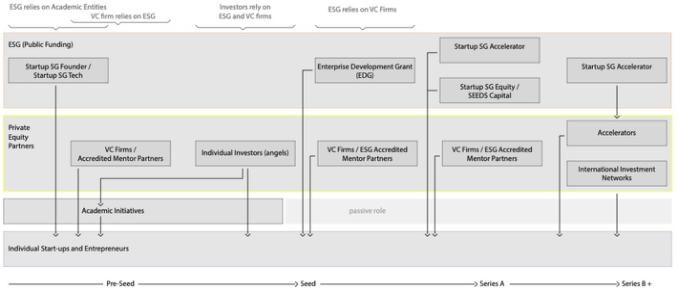
ESG is the agency in charge of government funding in Singapore. Having conversed with various ESG representatives including the Director of ESG’s Startup Development Division, but also with representatives of NUS Enter- prise, participants at NUS’ GRIP Programme, as well as representatives of the VC firms mentioned earlier, the following has become clear:
the aforementioned S$150million comprise early-stage pre-seed smart funds such as the ‘Startup SG Founder’ which has been increased from S$30K to 50K.
These are often distributed via academic incubators such as NUS’ GRIP programme.
Where students turn entrepreneurs, academic organisations in Singapore tend to retain IP and license it exclusively to the inventor. Therefore they take an interest in the startup company.
ESG rely on the recommendations of the academic partner involved in the startup company.
VC firms are partially guided through ESG’s decision on the distribution of Startup SG Founder grants.
Angel Investors are guided by the representatives of VC firms when the latter get their incubates to pitch for equity investment.
164 Hillner
Figure 1: A typical investment route for startups in Singapore.
And lastly, ESG take decisions in regards to their distribution of PoC and PoM grants with a view on the previous avenue of events.
Here the circle closes. The entrepreneurs lose equity every step of the way (with the exception of the Startup SG Founder grant), and the decision- makers rely on each other’s verdicts (Figure 1). VC firms are highly unlikely to walk back their recommendations, should they come to realise that they were mistaken. On the contrary, they may even try to secure additional public funds to compensate for erroneous assumptions that have led to initial inve- stments. This is where the system flaws get augmented. If confronted with the scenario, innovation stakeholders often point towards the nine or ten unicorns which Singapore has produced thus far. Whilst this is great, it is not reflective of the systems overall performance.
This hyper-focus on funding has another side effect, one that can be felt in other innovation ecosystems such as the UK as well as in Singapore: Focus on funding often distracts from focus on market. One entrepreneur spoken to, had gone through most of the funding cycles mentioned above, Startup SG Founder grant, GRIP at NUS, Entrepreneur First, etc. The conversion reve- aled that the startup had been under development for over four years, and there had not been any sales or prospect of sales. When spoken to, the foun- der, whose name and company is not disclosed here to avoid jeopardising his endeavour, was in pursuit of another immanent pre-seed funding round which was to pave the way towards yet another pre-seed funding round both of which were aimed at enhanced prototyping. The business already had six FT and three PT employees and was in the process of relocating to larger office spaces. The IP at play was partially sourced from NUS where the star- tup founder had developed it in conjunction with a PhD study, and partially licensed from a US firm where competing / complementary IP had been iden- tified. Despite the lack of imminent sales, the cash burn of this initiative was considerably high at the time. After years of venture building, the fun- ding focus appeared to have kept this startup from developing market access strategies.
Towards a Democratisation of Innovation 165
THE ARGUMENT This paper, which primarily focuses on the distribution processes used by Enterprise Singapore (ESG) and other public institutions in Singapore, raises questions about the effectiveness of public spending in relation to innovati- ons that are fostered through startups. Bootstrap ventures that might benefit from smart-fund injections, are not captured by the Singapore authorities, and there are currently no reliable progress tracking processes that would allow to objectively monitor startup performances. Instead, various funding organisations including universities, VC firms, as well as the ESG, rely on each other’s recommendations in their decision-making. There is a likelihood that the selection process is subject to bias which may have compromising micro- and macro-economic implications.
CONCLUSION
The range of organisations and activities involved make it clear that Singa- pore offers a dynamic and very active innovation startup ecology. What is not so clear is how effective its initiatives are. Its nine unicorns provide little evidence for its capabilities to nurture startup performance across the whole spectrum, and the fact that it has been dropping in international rankings raises questions about its modus operandi. But Singapore may not be alone. Hong et al. (2015, p. 1069) argue that ‘despite interest in efficiency evolu- tion, evaluation programmes are lacking’. Where reports and studies can be found in Singapore, one cannot always be certain how objective they are. When carrying out surveys and studies, confirmation bias and selection bias can often lead to skewed conclusions.
In January 2022, Singapore’s Action Community for Entrepreneurship (ACE) published a position paper ‘that i) articulates viewpoints and feedback from ecosystem stakeholders and ii) provides actionable recommendations and strategies to Government on what can be done to address current gaps…’ (Action Community for Entrepreneurship Singapore, 2022a). So cle- arly the issue has been recognised, but who exactly contributed to the paper? Following their ‘thanks to all startup founders/VCs/business leaders who have contributed to the Paper in one way or another’, ACE (2022b) apologi- sed on social media for not having been able to ‘manage to capture everyone’. So how rigorous and objective was the process of selecting respondents? What exactly was the methodology behind? The credibility of this study is further compromised by the fact that the paper starts with four full pages of motivational speech, success stories and trophy icons (2022a, pp. 5–9). What the paper does highlight is that the lack of funding is the interviewees number one concern (2022a, p. 10) and this does confirm at least to some extent the aforementioned prioritisation of funding over other matters. But is funding really the problem, or may it have more to do with the way in which funds are distributed?
An inter-subjective inquiry cannot resolve this question. Due to the lack of objective data on startup ecological performance in relation to the distri- bution of public funds in Singapore, the hypothesis presented here cannot be proven true or false beyond doubt. However, it is clear that there is currently
166 Hillner
a problematic emphasis on funding-intensive startups in Singapore, and a potentially compromising neglect of bootstrap ventures who do typically not have equal access to smart funds, mentoring schemes and support networks. Equally importantly, bootstrap initiatives escape the radar of Singapore’s authorities until they start trading, thus compromising the authorities’ capa- bilities of monitoring innovation performance across the entire spectrum of its startup ecosphere.
London-based VC fund manager Del Palacio (2013) argues. ‘You are not an entrepreneur because you raise money, but because you make money’. Ultimately, the commercial success of a startup needs to be measured on the revenues generated, not on the funds raised. Not only does Singapore neglect independent startups which could benefit Singapore’s economy, the nation could also risk the collapse of its innovation ecosystem in the event that reve- nue generation of funded ventures fail to develop according to expectations in the long run. If revenues do not manifest in time, and equity funding sources run dry, which is not at all impossible in such a small nation, then Singapore’s innovation ecosystem could suffer a terrible setback.
The above clearly raises questions about the efficiency of innovation fun- ding distributed by Singapore’s government. It seems clear that the relation- ship of government support measures and innovation ecosystem performance in Singapore and other innovation ecosystems is worthy of further studies. But these would need to be independent and cannot be carried out from within to ensure objectivity.
At the Singapore Bicentennial Conference on Oct 1, 2019, Professor Tommy Koh stated ‘Singapore does not need sycophants. It needs loving cri- tics.’ A loving critic would argue that the Singapore Government (and perhaps many other startup ecosystems) needs a systematic longitudinal monitoring and periodic analysis of startup ecosystem performance that informs the deci- sion making surrounding the distribution of government funds. To avoid bias and prejudiced reporting, insights must be grounded in robust and obje- ctive data rather than in intersubjective opinions, anecdotal evidence, or the statistical analysis of a small section of relevant data.
This paper was authored to draw attention to shortfalls in the analysis of startup ecosystems, and to raise questions about the widespread focus on funding-intensive startups which typically leads to the neglect of bootstrap strategies. One of these questions is whether or not independent startups could be empowered through accessible support frameworks that operate autonomously and independent from profit-oriented incubators, VC firms and angel investment networks, and if such a framework could be deplo- yed to collect and analyse anonymously key data in order to measure startup ecosystem performance in a reliable fashion, and generate insights that could help to enhance startup ecosystem performance across the entire spectrum of startup businesses.
ACKNOWLEDGEMENT
I would like to express my special thanks to Dominic Ang from ACE,Anthony Chong from A*Star, Andrew Crombie from Crombie Design, Seow Hui from
Towards a Democratisation of Innovation 167
Enterprise Singapore, Faiz Mulla from IBM iX Singapore, Ho Yuen Pin from NUS Enterprise, Christian Rieger from SAP Singapore, Adam Sutcliffe, from Falmouth Launchpad, Carl Ward from AWS Singapore„ Eugene Wee from A*ccelerate Venture Creation, Paul Zaman, Investors Relations at Maxis Kuala Lumpur.
REFERENCES
Action Community for Entrepreneurship Singapore (2022a) ACE position paper, Creating a Future-Ready Startup Ecosystem. Singapore Government; Source: https://www.pwc.com/sg/en/financial-services/assets/ace-position-paper.pdf Action Community for Entrepreneurship Singapore (2022b) Announce- ment of imminent position paper, Singapore Government; Website: https://www.linkedin.com/posts/aceorgsg_singapore-startup-ecosystem-ugcP ost-6885153285901299712-76xW/ Conversation with Dominic Ang, former CEO at Action Community of Entrepre-
neurs (ACE) Singapore, 20 April 2021. Conversation with Puneeta Bhatia, Program Manager at Antler Singapore, 30 March
2021. Conversation with Carl Bishop, Fund Team Manager at Entrepreneur First UK, 31
March 2021. Conversation with Anthony Chong, Innovation Coach at A*Star Singapore, 5 March
2021. Chong, Claudia (2021) What’s missing in Singapore’s startup scene? Business Times; Website: https://www.businesstimes.com.sg/garage/whats-missing-in-singapores- startup-scene Conversation with Itxaso Del Palacio, Partner at Notion, Teaching Fellow in
Entrepreneurship, UK, 23 May 2013. Economic Development Board Singapore (2022) Innovation. Singapore Government; Website: https://www.edb.gov.sg/en/our-industries/innovation.html Conversation with Daniel Foster, Creator Fund UK, 24 November 2021. Conversation with Ho Yuen Ping, NUS Enterprise, National University of Singapore,
3 June 2020. Hong, J. et al. (2015) Government Grants, Private R&D Funding and Innovation Efficiency in Transition Economy. Abingdon-on-Thames, UK: Routledge. Conversation with Seow Hui, Director at Startup Development Enterprise Singapore,
23 March 2021. Jamrisko et al. (2021) South Korea Leads World in Innovation as US Exits Top Ten.
Bloomberg; Website: https://www.bloomberg.com/news/articles/2021-02-03/sout h-korea-leads-world-in-innovation-u-s-drops-out-of-top-10 Conversation with Olga Kokshagina, Slingshot, 8 September 2020. Liu, R., Rammer, C. (2016) The Contribution of Different Public Innovation Funding Programs to SMEs’ Export Performance. ZEW Discussion Papers Conversation with Michael Raybman Hustle Fund VC, 6 March 2021. Conversation with Christian Rieger, Head of Software Solution Parter at SAP
Singapore, 30 November 2020. Conversation with Simon Siah, Entrepreneurship Coach Singapore, 15 October
2021. Soetanto, D. P., van Geenhuizen, M. (2015) Getting the right balance: University networks’ influence on spin-offs’ attraction of funding for innovation, in: Technovation, Volumes 36–37, February–March 2015, Pages 26-38. Amsterdam, Netherlands: Elsevier.
168 Hillner
Startup Genome (2019) Global Startup Ecosystem Report 2019. San Francisco, USA: Startup Genome LLC. Startup Genome (2021) Global Startup Ecosystem Report 2021. San Francisco, USA:
Startup Genome LLC. Conversation with Michelle Tan, Development Partner, Innovation Eco-system Development, Enterprise Singapore, 9 January 2020. Tang, See Kit (2020) Higher grants, more mentorship support for first- time start-up founders under enhanced programme. Channel News Asia; Website: https://www.channelnewsasia.com/singapore/startup-sg-founder-progr amme-higher-grant-50000-626561 Conversation with Carl Ward, Director of Solution Architecture APJ at AWS,
Singapore. Conversation with Eugene Wee, Managing Director at A*ccelerate Venture Creation, 6 February 2020. Conversation with Paul Zaman, Investors Relations at Maxis Kuala Lumpur, 5 May
2021.
LISTED IN THE AHFE DIGITAL BOOKSTORE CATALOGUE
Explore the complete digital volume
Creativity, Innovation and Entrepreneurship
Read this individual research paper free through the original publisher, or explore the full digital proceedings book.
ISBN 978-1-958651-07-0
Explore this ISBN in the AHFE Bookstore ↗Listed in the July 2026 bookstore catalogue; search by ISBN to confirm current availability · Digital book purchase optional