Muhammad Ammar, Muhammad Moeed Ahmed, Muhammad Abdullah Younas, Khezar Qayyum, Fahad Iqbal Khawaja, Umer Asgher, Sara Ali, Yasar Ayaz (2022). A Chain-Driven Live Roller Mechanism for Loading and Unloading Packages on Autonomous Mobile Robots in Warehouses. In: Industrial Cognitive Ergonomics and Engineering Psychology. AHFE Open Access, vol. 35, pp. 46–52. https://doi.org/10.54941/ahfe1001600
Robotics and Intelligent Systems Engineering (RISE) Lab, Department of Robotics and Artificial Intelligence, School of Mechanical and Manufacturing Engineering (SMME), National University of Sciences and Technology (NUST), Sector H-12, Islamabad, 44000, Pakistan ↗
Robots that can navigate through their environment are termed mobile robots. Mobile robots are being utilized in various fields, such as agriculture, transport, package delivery, disaster recovery, military, surveillance, and warehouse management. In warehouses, Autonomous Mobile Robots (AMR) for intralogistics are becoming increasingly common in warehouses. AMRs for intralogistics allow a safer work environment, less need for manual labor, and minimal downtime which translates to optimized productivity. AMRs do not need any specialized infrastructure for guidance as they can be set up with the existing warehouse layout. Presently, AMRs in warehouses need assistance while loading and unloading packages in their storage compartments. Manual loading and unloading is a simple but time-consuming solution. Robotic manipulators are also commonly used for this purpose either mounted on the AMR or present at the conveyor station. Another possible solution is to make use of a tilting platform, or a plate installed on top of the AMR using a hydraulic system that drops off the load by banking the top to one side. This paper proposes an alternate solution for loading and unloading packages on AMRs in warehouses. A chain-driven live roller (CDLR) system is proposed which is installed on top of the AMR. The rollers are driven by a chain that is connected to the rollers via sprockets. The chain is driven by a motor powered by the robot’s battery, so no external power source is needed. The loading can be done by a conveyor belt dropping package to be transported on top of the robot. The robot prevents slippage of the package during transportation by using actuated braces that pop up as soon as the package starts moving over the live rollers. At the drop-off location, the braces drop down and the CDLR is driven automatically by the robot for the drop-off of the package. Chutes or containers can be used as the drop-off location. In addition to simplifying the loading and unloading process, the proposed mechanism optimizes the overall process as it can transport heavy loads without any torque reduction. The proposed system needs minimal human assistance and is more reliable and time-efficient as compared to existing systems.
A Chain-Driven Live Roller Mechanism for Loading and Unloading Packages 47
INTRODUCTION
The current increasing demand for premium quality products and services requires high productivity levels of engineering systems. Industrial automa- tion is one way to cater to this rising need. Industrial automation eliminates the need for manual work in the industry and offers several benefits. One of the areas where automation has been very effective in the field of logistics chains (“A Complete Guide to Warehouse Automation”, n.d.).
Research and development of warehouse management have been grow- ing quickly due to its importance in the industrial chain. Optimization and automation of information within a warehouse are known as warehouse intralogistics. Warehouse intralogistics offer reduced operating costs, better efficiency in handling load, and a safer workplace (“Intralogistics”, 2021). This is where Autonomous Mobile Robots (AMR) fit in as an integral player in warehouse intralogistics.
Conventionally, Autonomous Guided Vehicles (AGV) were used for the transportation of packages in warehouses. Their movement requires a pre- defined path physically laid out on the warehouse floor. However, in case of any obstruction in the path, AGVs stop in their tracks and the obsta- cle needs to be removed manually. Recent advances in technology have addressed this problem by introducing AMRs in place of AGVs which do not need a fixed path for navigation (Fragapane et al., 2021). They can move to any access point within a specified area. Unlike AGVs, AMRs can react dynamically to changes in the environment and can perform navigation around any obstruction in their path and therefore seldom require human intervention.
Despite the successful implementation of AMRs, many warehouse opera- tions are not easily automated (Ackerman, 2022). Loading and unloading of warehouse packages remain a cardinal matter requiring technological inno- vation. Its optimization holds utmost importance in increasing intralogistics’ efficiency due to its laborious and repetitive nature which if done manually, halts the overall productivity of warehouse operations.
Proposing an alternate solution to loading and unloading packages on and off the AMR is the objective of this paper. The presented system uses a chain- driven live roller (CDLR) mechanism installed on top of the AMR. The rollers are driven by a chain with the help of sprockets. This feature does not require an additional power source due to the chain being powered by the robot’s bat- tery itself. The loading can be done by a conveyor belt dropping packages to be transported on top of the AMR. This initiates the popping up of actua- ted braces on top of the robot along the rollers to safely receive the package, avoid slippage, and hold it in place till the robot makes it to the drop-off location where they dropdown. Consequently, the rollers are driven, and the package is transferred from the robot to the drop station.
The rest of the paper contains a review of the available solutions for unlo- ading and loading in section 2. The design of the proposed model is then presented and explained in section 3. Section 4 entails the simulation results and the parameters under which the study was conducted. The paper is then concluded in section 5 and further recommendations are made.
RELATED WORKS Robotic Manipulators are commonly used for loading and unloading the package from the mobile robot. This can be done by using a manipulator that is attached to the top of the robot. The manipulator is equipped with sensors that detect and carry the object to be delivered. The manipulator drops the object at a specified spot when it reaches its destination. These models are useful for the transportation of small objects (Datta et al., 2007). However, some models are being developed that can lift very heavy loads (Ackerman, 2022). These models are flexible, in that they can pick objects from any location and specific pickup spots are not needed. However, the models are expensive and therefore are not suitable for small to mid-level warehouses.
Another way robotic manipulators are used for loading and unloading purposes is that they are installed at the location where the AMR package is placed on top of the AMR. A manipulator is also present at the drop-off location, which unloads the package from atop the AMR.
Autonomous forklifts are being developed that can autonomously lift the package to be delivered and drop it off at the desired destination. The forklift uses a combination of sensors to make sense of its surroundings (“Autono- mous Forklift, Driverless”, 2021) and uses the data gathered by its sensors to help pick up and drop off the package from its initial position to its destina- tion. Autonomous forklifts are only suitable for the transportation of heavy loads and have a very high initial cost.
This paper proposes a module for loading and unloading packages to and from an autonomous mobile robot. The design aims to create an efficient loading and unloading mechanism that requires minimal operator oversight.
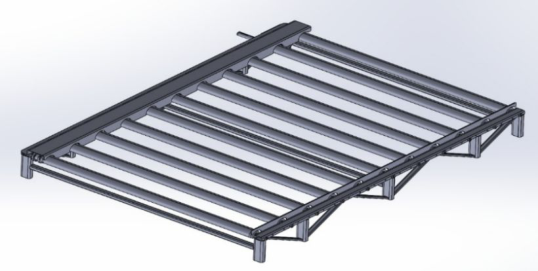
MODEL The proposed design is an autonomous mobile robot with a top module atta- ched to it. The top module consists of chain-driven live rollers (CDLR) shown in figure 1. CDLRs are usually used for conveyor belts. Metal rollers are held in place by a strong base. The rollers are connected by a chain. The chain is connected to the rollers using sprockets, so the rotation of one roller causes rotation of all the connected rollers.
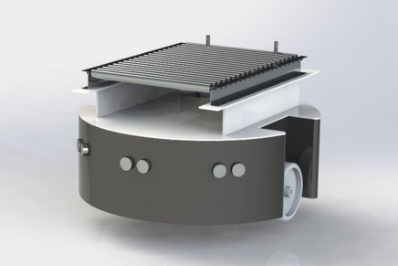
The CDLR module is installed on a platform on top of the AMR. A motor drives the rollers of the CDLR module. The motor is powered by the battery of the AMR. Actuated braces are placed at one end of the CDLR to prevent the package from rolling off the CDLR during transportation. The proposed system needs to be equipped with sensors that sense the presence of packages on the AMR. The system then commands the braces to pop up, preventing further movement of the package. Figure 2 shows the proposed AMR model with the CDLR module.
The way the proposed system works is that AMR recognizes the pick-up location and positions itself in front of it. A conveyor belt is used to deliver packages to the top of the AMR. The conveyor belt and the AMR must be at the same height. The motor that actuates the CDLR makes the rollers move
A Chain-Driven Live Roller Mechanism for Loading and Unloading Packages 49
Figure 1: CDLR module.Figure 2: CDLR module on top of AMR.
until the package is at the center. This is done using a camera that analy- zes the position of the packages using computer vision. Once the package is in position, braces pop up in between the rollers to prevent slippage of the package during motion. As the rollers are connected by a chain, the braces along with stopping the slippage of the package, also stop the rolling of the rollers. Since the AMR moves forward, braces are required only at the back as the package tends to slip in the backward direction. The AMR then naviga- tes through the environment, towards the drop-off location. At the drop-off location, the braces close inside, and the motor attached to the CDLRs is driven. This causes the package to move along the rollers and onto the deli- very platform. The delivery platform must be the same height as the CDLR module or lower than it.
STRENGTH ANALYSIS Strength analysis plays an important part in the design of the CDLR. It provides us with quantitative figures regarding the stress and deformation experienced by the model when a load is applied to it (Vijayaragavan et al., 2018). For the proposed CDLR model, strength analysis simulation was car- ried out in SOLIDWORKS to study how the CDLR behaves under loading conditions. The study was conducted according to the Von Mises failure
theory, which states that material will fail if the Von Mises stress of that material under load is equal to or greater than the yield limit of that material (Dey, 2021). This section defines the method used to study the response of CDLR under loadings.
Material Properties The material was selected according to the application of the CDLR top module, i.e., it undergoes repetitive loading and unloading during its life cycle. The properties to be exhibited require elasticity, resistance to fatigue failure, and high strength to mass ratio. Aluminum alloy 7075-T6 (SN) was the material selected for the CDLR module for this study.
Simulation To simulate loading conditions, the following steps were applied to the strength analysis study:
A simplified CDLR module is used for this study with constraints added to simulate loading conditions.
The CDLR top module is fixed at the top of the AMR and has a bon- ded constraint with it. To simulate this criterion during the analysis, the base of the simplified CDLR model has been assigned the fixed geometry constraint.
For loading conditions, a distributed load of 100 kg was applied to the rollers.
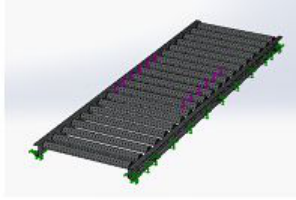
The mesh used for this analysis is a very fine mesh having triangular ele- ments, as shown in figure 3. The fine mesh was selected due to its complex geometry and minute design details.
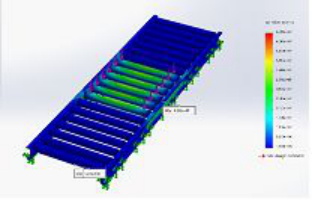
After the application of constraints and meshing, the study was then solved for Von Mises Stress analysis. Figure 4 shows the simulated results.
The Von Mises Stress analysis results are then compared with the yield strength of the material, by the Von Mises failure theory.
Maximum Von Mises Stress: 68.16MPa
Ultimate yield strength of Aluminum alloy 7075-T6 (SN): 505 MPa According to the Von Mises failure theory since the maximum Von Mises Stress < ultimate yield strength of the material, the design will not fail under loading conditions (using 100kg packages). The limiting factor of safety therefore will be dependent on the robot to which the CDLR module is attached.
CONCLUSION
Warehouse intralogistics is vital to meet the demands of the competitive mar- ket. Despite developments in the automation of warehouses in the last few decades, warehouse logistics are still not fully automated to the point where no human intervention is required. This is due to errors associated with the tasks involved, so a supervisor is needed to always oversee the process. This paper proposed a design that provides a solution for loading and unloading
A Chain-Driven Live Roller Mechanism for Loading and Unloading Packages 51
Figure 3: Mesh diagram.Figure 4: Von Mises stress analysis.
packages on top of AMR in warehouses. The design is more reliable and time- efficient than existing solutions. It requires minimal human intervention as there is less room for error during operation. It also provides smoother and more time-efficient operation as it only takes a few seconds for the transfer of packages to and from the mobile robot. The presented design is safe for usage as tested in simulation. However, prototyping and testing are required before it can be deemed a feasible design.
ACKNOWLEDGMENT
The authors would like to acknowledge School of Mechanical and Manufa- cturing Engineering (SMME), National University of Sciences and Techno- logy (NUST), Pakistan and European Union (EU)’s Horizon 2020, Research and Innovation Staff Exchange Evaluations (RISE) under grant agreement No 823904 - ENHANCE project (MSCA-RISE 823904) for technical sup- port and funding.
REFERENCES
A Complete Guide to Warehouse Automation. from https://igps.net/resources/a-com plete-guide-to-warehouse-automation-slp/ Ackerman, E. (2022). A Robot For the Worst Job in the Warehouse. https://read.nxtbook.com/ieee/spectrum/spectrum_na_january_2022/a_robo t_for_the_worst_job_in_.html Autonomous Forklift, Driverless. (2021). Retrieved 18 May 2022, from https://yuji
nrobot.com/autonomous-forklift-driverless/
Datta, S., Ray, R., & Banerji, D. (2007). Development of autonomous mobile robot with manipulator for the manufacturing environment. The Interna- tional Journal Of Advanced Manufacturing Technology, 38(5-6), 536–542. doi: 10.1007/s00170-007-1024-x Dey, A. (2021). Introduction to Von Mises Stress. from https://whatispiping.com/v
on-mises-stress/ Fragapane, G., de Koster, R., Sgarbossa, F. and Strandhagen, J., 2021. Planning and control of autonomous mobile robots for intralogistics: Literature review and rese- arch agenda. European Journal of Operational Research, 294(2), pp. 405–426. doi: 10.1016/j.ejor.2021.01.019 Intralogistics: What Is It And Why Is It Important For Warehousing?. (2021).
from https://na.bhs1.com/intralogistics-what-is-it-and-why-is-it-important-for- warehousing/ Vijayaragavan, E., Bhat, S., Patel, A., & Rana, D. (2018). Design and analysis of a mobile robot for storage and retrieval system. IOP Conference Series: Materials Science And Engineering, 402, 012205. doi: 10.1088/1757-899x/402/1/012205
LISTED IN THE AHFE DIGITAL BOOKSTORE CATALOGUE
Explore the complete digital volume
Industrial Cognitive Ergonomics and Engineering Psychology
Read this individual research paper free through the original publisher, or explore the full digital proceedings book.
ISBN 978-1-958651-11-7
Explore this ISBN in the AHFE Bookstore ↗Listed in the July 2026 bookstore catalogue; search by ISBN to confirm current availability · Digital book purchase optional