Claudia Giliberti, Fabio Lo Castro, Maria Patrizia Orlando, Raffaele Mariconte, Maurizio Diano (2022). Use of hearing aids at work: results of a questionnaire for the analysis of comfort and perceived benefit. In: Human Factors in Accessibility and Assistive Technology. AHFE Open Access, vol. 37, pp. 37–44. https://doi.org/10.54941/ahfe1001640
Almost 460 million world people live with moderate to severe hearing loss (HL), with noise the most common cause, particularly in the workplace. Noise-induced HL is still one of the most prevalent recognized occupational diseases, but in Italy, it is no longer at the first ranks, thanks to technical and organizational solutions adopted to reduce noise in the work environment after 2008. In particular, Italian surveillance system data show that Construction is the work sector in which HL is most present (28% of cases), followed by Manufacture (17%). HL can compromise social life, causing isolation, frustration, depression, and even cognitive decline, while in the workplaces could affect workers’ safety, representing an important injury risk factor. The use of hearing aids (HA) represents an effective preventive action. In Italy, there are at least 7 million hearing-impaired people, but only 29.5% wear an HA (2018 data). Their use appears to be more widespread in the older age groups, while the least use is found from 45 to 64 years (20.8%) which refers to professionally active people. Many aspects prevent the use of an HA, among these, technical and psychological reasons. The objective of this study is to evaluate the degree of comfort/discomfort and the perceived benefit of using an HA, particularly in working environments.MethodsAn ad hoc questionnaire consisting of 10 questions, five on the working sphere and five on perception, was developed. The former investigated the acoustic comfort of the work environment, use of HA, hearing protectors, accessories, and the information received on the correct use of HA at work; the second investigated the satisfaction of the prosthetic solution, the improvement in the perception of speech or the sounds direction and danger signals to avoid accidents at work. The answer options for each question were yes / sometimes / no. Further information on gender, age, type of job, years of work, type of HA and years of use, type of hearing damage, was collected. The professions were grouped into seven categories: construction workers, freelancers, health professions, teachers, office workers, traders, others, which were further classified on noise exposure and hearing risk into High risk (construction workers), Medium risk (teachers, traders), Low risk (freelancers, health professions, office workers). The results were statistically analyzed.ResultsThe questionnaire was administered to 141 workers (55 females and 86 males) with an average age of 57 years (minimum 21, maximum 82). The sample shows prevalently bilateral sensorineural HL, works for about 30 years, wears an HA from 6 years, mainly “in the ear” type (77%), mostly employed as freelancers (21%), office workers (19%), construction workers (18%).For high-risk employees, the use of an HA with personal protective equipment has been discussed, taking into account the issue regarding the protection of these prosthetic workers in noisy work environments. The results show that special attention should be paid to the optimization of the prosthesis for this category of workers, most acoustically exposed, taking into account their comfort, perceived safety, and satisfaction.
In 2018, World Health Organization (WHO) estimated that almost 6,1% of the world’s population live with disabling hearing loss (HL) of moderate or higher severity in the better hearing ear. As populations age, the num- ber of people with HL will increase, from 460 million in 2018, up to 630 million by 2030, and over 900 million in 2050 (World report on hearing, 2021). Among the causes of hearing impairment, genetic defects, birth com- plications, chronic ear infections, use of ototoxic drugs, childhood and pregnancy-related illnesses, injury, age, and noise exposure, can be included (Regulations to Implement the Equal Employment Provisions of the Ameri- cans with Disabilities, 2022). Noise-induced hearing loss (NIHL) represents one of the most prevalent occupational conditions internationally and ranks third in the global classification of occupational diseases (Mirza et al. 2018; Andrejiova et al. 2021). Exposure to high noise levels on-the-job is respon- sible for 16% of cases of disabling HL among adults worldwide, causing
financial and disease burdens on individuals and society (Kou-Huang et al. 2020). According to the 6th European Working Conditions Survey, 28% of wor- kers in 2015 were exposed to excessive noise for at least a quarter of their time at work (Teixeira et al. 2021). The occupations at the highest risk for HL are mainly Mining, Manufacturing, Construction of buildings (Le et al. 2017). In particular, Construction workers experienced high levels of HL, increasing by work duration (Dement et al. 2018; Masterson et al. 2016; Tak et al. 2009). A NIOSH statistic shows that about 51% of all workers in Construction have been exposed to hazardous noise, 52% of noise-exposed construction workers report not wearing hearing protection, and 16% of noise-exposed tested Construction workers have hearing impairment in both ears (Kerns et al. 2018; Green et al. 2021; Masterson et al. 2013). Italian surveillance system for the period 2010-2014 confirms these data, showing that Construction is the work sector in which NIHL are particularly present (28% of cases), followed by Manufacturing (17%) (Pizzuti et al. 2018).
HL can influence the quality of life of those affected, in the social and occupational sphere. In social life, HL could cause isolation, frustration, depression, and even cognitive decline (Kou-Huang et al. 2020). In the work- place, HL increases the risk of occupational injuries, since it may reduce the employee’s alertness, due to the difficulty in perceiving audible signals, inclu- ding speech. Accidents can occur because alarms or danger signals cannot be recognized, or no attention has been paid to them, or their origin has not been clearly identified, compromising the safety of workers (Leroux et al. 2018).
The use of hearing aids (HA) could represent an effective rehabilitation treatment for restoring audibility function and the outcome is usually good, taking into account that these devices do not provide normal functional hea- ring (Bisgaarda et al. 2021). This is particularly important in the workplace, where background noise, reverberations, moving and multiple sources of noise could interfere with the proper functioning of the amplification devices (Leroux et al. 2018). Unfortunately, many barriers (cost, poor access to heal- thcare, and lack of information) prevent extensive use of HA. Global Burden of Disease has used large data set on HA sales to estimate the number of peo- ple with HL that effectively use HA throughout the world (Bisgaarda et al. 2021). For European countries, questionnaires were sent to a representative sample affected by HL, investigating: prevalence and adoption rates of HA, HL characteristics and population demography, satisfaction of HA owners and impact on life quality, reasons for non-adoption HA. Data related to 2018 showed that Italy has the highest percentages of the 65+ population and the second highest prevalence of self-reported HL, after Poland (Laureyns et al. 2020). In Italy, there are at least 7 million hearing impaired people, but, despite the incidence of the disease, only 29% use HA. The adoption rate of HA is low, especially among mild HL patients, which represent the majority of hearing impaired people, while it is higher among moderate or severe HL patients (greater than 40 dB on average), around 70% of the total. The use of HA appears more widespread in the older age groups, while the lowest usage is found for the age group from 45 to 64 years, which refers to professio- nally active people. Subjective, psychological, and technical reasons prevent
Use of Hearing Aids at Work: Results of a Questionnaire for the Analysis of Comfort 39
Table 1. The questionnaire administered to workers with Hearing Aids.
Table available in the original PDF paper.
Item Working Sphere Perception Sphere 1 Do you feel your work environment acoustically comfortable?
Do you feel safer in your workplace, using HA?
Do you feel any improvement in word perception using HA? 2 Do you wear HA while working? Using HA, are you able to better perceive acoustic warning or verbal alerts, useful to avoid risks at work? 3 Do you wear hearing personal protecting equipment while working?
Do you feel satisfied of your HA, especially in the workplace?
4 Have you received specific information about the correct use of HA during work?
Do you clearly identify sounds direction, using HA?
5 Do you use accessories with HA that can facilitate communication in the workplace?
an extensive use of HA. Conversely, among HA users, data indicate levels of satisfaction above 80% and explicit references to an improvement in their life quality, from the ability to communicate to the improvement of relationships.
This work wants to contribute to this issue, evaluating the degree of com- fort/discomfort and the perceived benefit of using an HA, particularly in working environments, by using a specific questionnaire administered to a sample of Italian workers with hearing impairment.
METHODS
An ad hoc questionnaire was developed and administered to 141 workers. The questionnaire consisted of 10 items, five on the working sphere and five on perception (see Table 1). The former investigated: the acoustic comfort of the work environment, use of HA, hearing protectors, accessories, and infor- mation received about the correct use of HA at work; the second investigated: the satisfaction of prosthetic solution, the improvement in the perception of speech, sounds direction and danger signals. The answer options for each question were YES / SOMETIMES / NO. Further information on gender, age, job, years of work, type of HA and years of use, type of hearing damage, was collected. The professions were grouped into seven categories: construction workers, freelancers, health professionals, teachers, office workers, traders, others, which were further classified on hearing risk into High-risk (constru- ction workers), Medium-risk (teachers, traders), Low-risk (freelancers, health professions, office workers).
RESULTS AND DISCUSSION
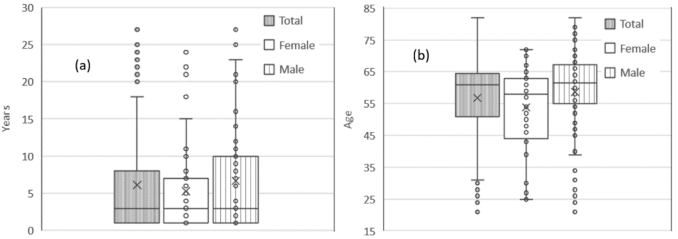
The median age of the entire sample was 57 yrs (s.d. 13 yrs, 25th percentile: 52 yrs, 75th percentile: 64 yrs). Females represented 39% of the sample, with a median age of 54 yrs (s.d. 13 yrs, 25th percentile: 45 yrs, 75th percentile: 63 yrs). Males represented 61% of the sample, with a median age of 59 yrs
Figure 1: For the sample, years of use of hearing aids (a); age distribution (b).
(s.d. 13 yrs, 25th percentile: 55 yrs, 75th percentile: 67 yrs, see figure 1b). The sample included different jobs, mainly freelancers (21%, distributed among entrepreneurs, architects, lawyers, managers, accountants, etc.), office workers (19%), construction workers (18%), traders (17%), healthcare pro- fessionals (9%, mostly physician and nurses), and teachers (7%). Among females, the most common profession was office workers (24%), followed by traders (22%), among males construction workers (29%), followed by freelancers (26%), and traders (22%).
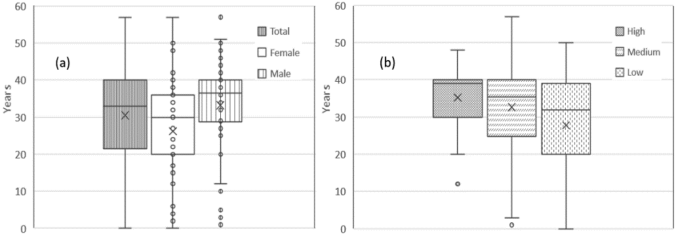
In the sample, the work carrier was 30 years long on average (s.d. 13 yrs, 25th percentile: 22 yrs, 75th percentile: 40 yrs). Males worked longer than females (33 yrs vs. 26 yrs, see Figure 2a). Construction workers represented the activity with the longest permanence at job (36 yrs), followed by teachers (35 yrs) and traders (33 yrs). Bilateral sensorineural was the most frequently hearing impairment (70% of the total sample, 71% of females, and 69% of males). In-The-Ear (ITE) HA was worn by 77% of the sample, mostly male (80% males vs 73% females), followed by Behind-The-Ear (BTE) HA (23% of the sample). ITE HA was most frequently used by freelancers (26%), followed by office workers (18%) and construction workers (16%). BTE HA was most frequently used by traders (34%), followed by office workers and construction workers (both 22%). Males used HA for more years than females (7 yrs vs. 5 yrs), while the median period of HA use was 6 yrs in the entire sample (s.d. 8 yrs, 25th percentile: 1 yr, 75th percentile: 8 yrs), (see Figure 1).
In the sample, the percentage of workers classified into High-risk was 18%, Medium 27%, and Low 55%. The construction workers represen- ted the major category among High-risk workers (96%), mainly males, with an average age of 59 yrs and a significantly higher working time than the other categories, median value 39 yrs for High-risk vs 32 yrs for Low-risk (see Figure 2). These workers, mainly suffering bilateral sensorineural HL, in 73% of the cases wore ITE HA for at least 6 yrs. For the Medium-risk category, the median age of the sample was 58 yrs, with a time on the job of about 36 yrs. In 74% of the cases, the workers were affected by bilateral sensorineural HL and wore ITE HA for at least 6 years. Traders represented the major category among Medium-risk workers (63%), evenly distributed between males and females, followed by teachers (26%, 30% males, and 70% females), and lastly other professions (11%).
Use of Hearing Aids at Work: Results of a Questionnaire for the Analysis of Comfort 41
Figure 2: Working years for all recruited workers, by gender (a) and risk classifica- tion (b).
The Low-risk category included freelancers (39%), predominantly men (73%), office workers (35%), predominantly men (52%), and health pro- fessionals (17%), predominantly women (61%). Low-risk workers had an average age of 55 yrs with 32 yrs on the job. They wore ITE HA in 84% of cases for about 6 yrs, and they suffered from bilateral sensorineural HL in 65% of cases. The answers related to the working sphere showed that most High-risk workers considered their work environment as acoustically uncomfortable (54%), while workers classified as Low-risk, substantially comfortable, with few exceptions (7% of the sub-sample) among teachers, health professi- ons and freelancers. Workers classified as Medium-risk expressed doubts about the acoustic comfort of their work environment, answering “some- times” in 42% of cases. In general, most of the sample used HA during work (87%), without gender differences. Medium and Low-risk workers wore HA more frequently than those classified as High-risk (High-risk 69%, Medium-risk 95%, Low-risk 88%). Among Low-risk workers, health pro- fessionals asserted that HA use was incompatible with other equipment normally used in medical practice, e.g. stethoscope (answer “sometimes” in 38% of the cases). The use of amplified electronic stethoscopes could represent an effective ergonomic solution, providing a wireless connection to the HA that ensures hygiene for the workers. These devices improve the auscultation of heart and pulmonary sounds, compensating for the hea- ring deficit with specific acoustic filters. Accessories, as above mentioned, were used by 61% of the health profession category. On the contrary, in the overall sample, HA accessories were used by 38% of High-risk wor- kers (mostly drivers), 34% of Medium-risk workers (mostly traders), and 30% of Low-risk workers (mostly freelancers), mainly devices to improve communication.
Among High-risk workers, mainly in the construction sector, there can be difficulties in finding hearing protection compatible with HA and required by the workplace regulations. For this reason, the majority of these workers (76%) preferred to wear ITE HA that allows the simultaneous use of pro- tective hearing equipment, such as headphones, while BTE HA is generally incompatible (modern technology has shrunk the size of BTE, allowing them to work with headphones). Among the workers wearing ITE HA, only 54%
used hearing personal protective equipment (HPPE) at work, although they received specific information about their correct use. The use of HA in con- junction with HPPE in a noisy work environment is still an arguable issue. Four scenarios could be considered: i) HA in the “off”position in lieu of using HPPE: this situation does not provide adequate protection against noise (HA could effectively block out sound, but only if it fits snugly). ii) HA turned “off” with HPPE worn: this combination could block out too much sound and the worker may not hear warning signals or other essential sounds. iii) HA turned “on” with no HPPE: if the noise at work was loud enough to permanently damage hearing, amplifying it with a HA, could cause additi- onal hearing loss. iv) HA worn, turned “on” with HPPE: optimal hearing depends on the attenuation class of the headphones (Leroux et al. 2018). Evaluation by a qualified occupational hearing professional and monitoring employees at the worksite may determine the suitability of HA or hearing protectors for specific environments. A multidisciplinary approach involving the employer, the occupational health physician, and the hearing care pro- fessional is required to ensure the best protection of the worker’s residual hearing function.
Despite the regular use of HA, the minimum level of satisfaction was found among High-risk workers (69% vs 82% for the Low-risk ones), probably due to a moderate perception of danger signals and a low safety perception in the workplaces (respectively 77% and 58% of cases). On the contrary, by using HA, an improvement in the perception of words and in the iden- tification of the sound direction has been obtained (respectively 92% and 81% of cases). An “ad hoc” setting of HA, especially for workers exposed to acoustically severe environments, has to be performed to reduce the risk of accidents or near misses. To guarantee workers’ safety, the usual HA set- tings in standard conditions must be integrated with specific procedures for noisy work environments, where multiple signals, reverberations, and strong background noises could interfere with the normal response of the HA. Simi- lar results were also observed for Medium-risk workers, where a moderate level of satisfaction was found (79%), even if they had the highest level of perceived safety (93%) and the best perception of verbal warnings and sound direction (respectively 97% and 89%).
CONCLUSION
For the High-risk category (mainly construction workers, most acoustically exposed), particular attention must be paid to the use of HA with perso- nal protective equipment, taking into account the protection of the workers in severe noisy work environments. The results show that the optimization of HA setting must include perceived safety and satisfaction, in compliance with an ergonomic design for a comfortable fit. The effectiveness of HA in supporting listening, communication and localizing sound sources in the typi- cal acoustic conditions in the workplace could then represent a fundamental issue to guarantee the health and safety of HL impaired people employed in the various job sectors.
Use of Hearing Aids at Work: Results of a Questionnaire for the Analysis of Comfort 43
REFERENCES
Andrejiova, M., Pinosova, M., Badida, M. (2021) Occupational Disease as the Bane of Workers’ Lives: A Study of Its Incidence in Slovakia. Part 2. International journal of environmental research and public health, 18(24), 12990. Bisgaarda, N., Zimmerb, S., Laureynsc, M., Grotha J. (2021) A model for estima-
ting hearing aid coverage world-wide using historical data on hearing aid sales. International journal of audiology, 1–9. Dement, J., Welch, L.S., Ringen, K., Cranford, K., Quinn, P. (2018) Hearing loss among older construction workers: Updated analyses. American Journal of Industrial Medicine, 61(4), pp. 326–335. Green, D.R., Masterson, E.A., Themann, C.L. (2021) Prevalence of hearing pro-
tection device non-use among noise-exposed U.S. workers in 2007 and 2014. American Journal of Industrial Medicine, 64(12), pp. 1002–1017. Kerns, E., Masterson, E.A., Themann, C.L., Calvert, G.M. (2018) Cardiovascular conditions, hearing difficulty and occupational noise exposure within U.S. industries and occupations. American Journal of Industrial Medicine, 61(6), pp. 477–491. Kou-Huang, C., Shih-Bin, S., Kow-Tong C. (2020) An overview of occupatio-
nal noise-induced hearing loss among workers: epidemiology, pathogenesis, and preventive measures. Environmental health and preventive medicine, 25(1), 65. Laureyns, M., Bisgaard, N., Bobeldijk, M., Zimmer, S. (2020) Getting the numbers right on Hearing Loss Hearing Care and Hearing Aid Use in Europe, A Europe Wide Strategy: EHIMA, report. Avaible at: https://www.ehima.com/wp-content/u ploads/2020/08/Getting-the-numbers-right-AEA_EFHOH_EHIMA-June-2020- final.pdf Le, T.N., Straatman, L.V., Lea, J., Westerberg, B. (2017) Current insights in
noise-induced hearing loss: a literature review of the underlying mechanism, path- ophysiology, asymmetry, and management options, Journal of otolaryngology - head & neck surgery, 46(1), 41. Leroux, T., Laroche, C., Giguère, C., Voix, J. (2018) Hearing Aid Use in Noisy Workplaces. Paris: IRSST. Masterson, E.A., Tak, S., Themann, C.L., Wall, D.K., Groenewold, M.R., Ded-
dens, J.A., Calvert, G.M. (2013) Prevalence of hearing loss in the United States by industry. American Journal of Industrial Medicine, 56(6), pp. 670–681. Masterson, E.A., Bushnell, P.T., Themann, C.L., Morata, T.C. (2016) Hearing impairment among noise-exposed workers — United States, 2003–2012, Morbidity and Mortality Weekly Report, 65(15), pp. 389–394. Mirza, R., Kirchner, D.B., Dobie, R.A., Crawford, J. (2018) Occupational noise-
induced hearing loss, Journal of Occupational and Environmental Medicine, 60(9), pp. 498–501. Pizzuti, A., et al. (2018) Sistema di sorveglianza delle malattie professionali, Ipoacusia da rumore, un problema di salute ancora attuale sul Lavoro [Hypoacusia caused by noise, a still current health problem at work]. Rome: INAIL Regulations to Implement the Equal Employment Provisions of the Americans
with Disabilities (2022) U.S. Code of Federal Regulations Title 29 Subtitle B Chapter XIV Part 1630. Avaible at: https://www.ecfr.gov/current/title-29/subtitle- B/chapter-XIV/part-1630 Tak, S., Davis, R.R., Calvert, G. M. (2009) Exposure to hazardous workplace noise and use of hearing protection devices among US workers–NHANES, 1999–2004, American Journal of Industrial Medicine, 52(5), pp. 358–371,
Teixeira, L.R., Pega F., de Abreu, W., de Almeida, M.S., de Andrade, C.A.F., Azevedo, T.M., Dzhambov, A.M., Hu, W., Macedo, M.R.V., Martínez-Silveira, M.S., Sun, X., Zhang, M., Zhang, S., Correa da Silva, D.T. (2021) The prevalence of occupational exposure to noise: A systematic review and meta-analysis from the WHO/ILO Joint Estimates of the Work-related Burden of Disease and Injury, Environment international, 154, 106380 World report on hearing (2021) World Health Organization. Avaible at: https://ww
Human Factors in Accessibility and Assistive Technology
Read this individual research paper free through the original publisher, or explore the full digital proceedings book.
ISBN 978-1-958651-13-1
Explore this ISBN in the AHFE Bookstore ↗Listed in the July 2026 bookstore catalogue; search by ISBN to confirm current availability · Digital book purchase optional